Posts Tagged ‘BBC’
Saturday, November 1st, 2014
Egon Willighagen recently gave a presentation at the RSC entitled “The Web – what is the issue” where he laments how little uptake of web technologies as a “channel for communication of scientific knowledge and data” there is in chemistry after twenty years or more. It caused me to ponder what we were doing with the web twenty years ago. Our HTTP server started in August 1993, and to my knowledge very little content there has been deleted (it’s mostly now just hidden). So here are some ancient pages which whilst certainly not examples of how it should be done nowadays, give an interesting historical perspective. In truth, there is not much stuff that is older out there!
- This page was written in May 1994 as a journal article, although it did have to be then converted into a Word document to actually be submitted.[1] Because it introduced hyperlinks to a chemical audience, we wanted to illustrate these in the article itself! Hence permission was obtained from the RSC for an HTML version to be “self-archived” on our own servers where the hyperlinks were supposed to work (an early example of Open Access publishing!). I say supposed because quite a few of them have now “decayed”. We were aware of course that this might happen, but back in 1994, no-one knew how quickly this would happen. What is interesting is that the HTML itself (written by hand then) has survived pretty well! I will leave you to decide how much the message itself has decayed.
- This HTML actually predates the above; it was written around November 1993 and represented the very first lecture notes I converted into this form (on the topic of NMR spectroscopy). A noteworthy aspect is the scarce use of colour images. At the start of 1994, the bandwidth available on our campus was pretty limited (the switches were 10 Mbps only) and a request went out to reduce the bit-depth of any colour images to 4-bits to help conserve that bandwidth! I rather doubt anyone took much notice however, and the policy was forgotten just a few months later.
- In 1996, I had two visitors to the group, Guillaume Cottenceau, a french undergraduate student, and Darek Bogdal, a Polish researcher who wanted to learn some HTML. Together they produced this, which was an interactive tutorial to accompany the NMR lecture notes previously mentioned. These pages introduce the Java applet (yes, it was very new in 1996), which Guillaume had written and which Darek then made use of. And hey, what do you know, the applet still works (although you might have to coerce your browser into accepting an unsigned applet).
- Here is a programming course that I had been running with Bryan Levitt for a few years, now recast into HTML web pages some time in 1994-5. This particular project I still hold dear, since it expanded upon the NMR lectures by getting the students to synthesize a FID (free induction decay) using the program they wrote, and then perform a Fourier Transform on it. I even encouraged students to present their results in HTML (I cannot now remember how many did). This link is to the computing facilities we offered students in 1994 for this project, ah those were the times! In 1996, the programming course was replaced by one on chemical information technologies, and here students were most certainly expected to write HTML. Some of the best examples are still available. And to illustrate how things happen in cycles, that course itself is now gone to be replaced by, yes, a programming course (but using Python, and not the original Fortran).
- In tracking down the materials for the programming course described above, I re-discovered something far older. It is linked here and is (some of) the Fortran source code I wrote as a PhD student in
1974 1972. So I will indulge in a short digression. My Ph.D. involved measuring rate constants, and the accepted method for analysing the raw kinetic data was using graph paper. For first order rate behaviour, this required one to measure a value at time=∞, which is supposed to be measured after ten half-lives. I was too impatient to wait that long, and worked out that a non-linear least squares analysis did not require the time=∞ value; indeed this value could be predicted accurately from the earlier measurements. So in 1974, I wrote this code to do this; no graph paper for me! Also for good measure is a least squares analysis of the Eyring equation. And you get proper standard deviations for your errors. In retrospect I should have commercialised this work, but in 1974, almost no-one paid money for software! What a change since then. I must try recompiling this code to see if it still works! And for good measure, here is a Huckel MO program I wrote in 1984 or earlier (I did compile this recently and found it works) and here is a little program for visualising atomic orbitals.
- In January 1994, I was asked to create a web page for the WATOC organisation. This certainly predated the web sites for e.g. the RSC, the ACS, indeed famous sites such as the BBC and Tesco (a large supermarket chain) which only started up in mid 1994. The WATOC site itself moved a few years ago.
- This is one of those wonderfully naive things I started in 1994, and which did not last long (in my hands). Nowadays, the concept lives on as MOOCs. Note again the almost complete expiry of the hyperlinks.
- This is a project we also started in 1994, Virtual reality[2],[3]. The idea was that if HTML was text-markup, VRML was going to be 3D markup. VRML itself never quite caught on, but it is having a new life as a 3D printing language!
- And by 1995, I felt confident enough in my ability to (edit) HTML, that we started a virtual conference in organic chemistry (we did four of them in the end). I remember the first one involved contributors sending me a Word version of their poster, and I did all the work in converting it into HTML. Such virtual conferences still run, but in truth most participants still prefer to travel long distances to go drink a beer with their chums, rather than hack HTML.
I am going to stop now, since this is far too much wallowing in the past. But at least all this stuff is not (yet) lost to posterity.
References
- H.S. Rzepa, B.J. Whitaker, and M.J. Winter, "Chemical applications of the World-Wide-Web system", Journal of the Chemical Society, Chemical Communications, pp. 1907, 1994. https://doi.org/10.1039/c39940001907
- O. Casher, and H.S. Rzepa, "Chemical collaboratories using World-Wide Web servers and EyeChem-based viewers", Journal of Molecular Graphics, vol. 13, pp. 268-270, 1995. https://doi.org/10.1016/0263-7855(95)00053-4
- O. Casher, C. Leach, C.S. Page, and H.S. Rzepa, "Advanced VRML based chemistry applications: a 3D molecular hyperglossary", Journal of Molecular Structure: THEOCHEM, vol. 368, pp. 49-55, 1996. https://doi.org/10.1016/s0166-1280(96)90535-7
Tags:3D printing language, ACS, BBC, Bryan Levitt, chemical audience, chemical information technologies, Darek Bogdal, Fortran, Guillaume Cottenceau, HTML, http, Java, large supermarket chain, personal Web presence, Python, researcher, spectroscopy, Tesco, Virtual reality, WATOC, web technologies
Posted in Chemical IT, Historical | No Comments »
Wednesday, March 12th, 2014
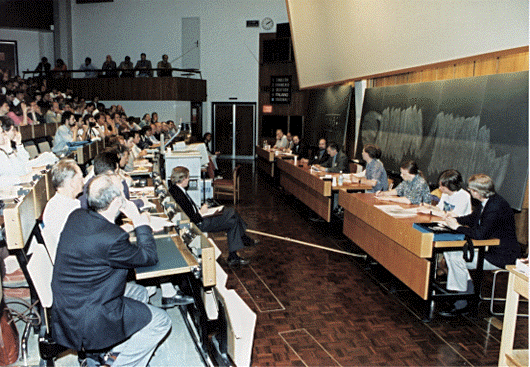
A short post this, to remind that today is officially the 25th birthday of the World-Wide-Web, in March 1989. It took five years for a conference around the theme to be organised and below is a photo from that event.

(C) CERN Photo
From my perspective and perhaps from the 200 or so others present at that closing session, I went back home and told my young children that the world had changed that week. So it has.
And one personal anecdote. In January 1994, a colleague in my department mentioned that they knew the producer of a BBC science program called Tomorrow’s World. He suggested I send him an email describing what the WWW was, and its potential. I did, and he responded a little time later with a link to the very first Web site produced within the BBC (British Broadcasting Corporation). To my regret ever since, I did not capture that site as it was then. Of course, it eventually grew to the one we now know (and read about TimBL’s call for a Web Magna Carta on that very site today).
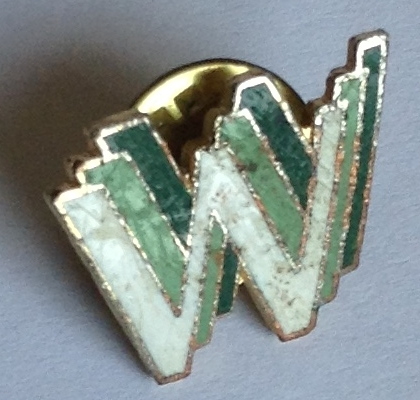
Here is another momento, although very sadly not in good condition (it was dropped in the garden, and spent some time buried!). A genuine first WWW conference badge.

Tags:BBC, British Broadcasting Corporation, producer, Tomorrow's World, Web Magna Carta
Posted in General | 2 Comments »
Sunday, June 2nd, 2013
A few years ago, we published an article which drew a formal analogy between chemistry and iTunes (sic)[1]. iTunes was the first really large commercial digital music library, and a feature under-the-skin was the use of meta-data to aid discoverability of any of the 10 million (26M in 2013) or so individual items in the store.‡ The analogy to digital chemistry and discoverability of the 70 or so million known molecules is, we argued, a good one.
Well, the digital photography revolution is very similar; I just checked my personal digital photo library to find it contains almost 14,000 photos dating back ten years now. It is not easy to find a particular photograph! Well, the reason I am posting here is to bring to your attention the first 6 minutes or so of an item in the BBC collection.† It is a very nice accessible explanation of the importance of meta-data for photography, and some of the innovative things that are being done for both acquiring and for manipulating this data. As I listened to this, I felt that for photograph, think molecule! And think of all the innovative things that could be done there as well.

Actually, you might reasonably ask how/whether molecular metadata is deployed here in this blog. It certainly is on Steve Bachrach’s site (see for example this recent post where you will find InChI keys for every molecule displayed; thus InChIKey=GOOHAUXETOMSMM-GSVOUGTGSA-N). I don’t do that on this blog (perhaps I should), but instead I provide URL links to a digital repository where they are displayed: thus follow http://dx.doi.org/10.6084/m9.figshare.706756 and you will find InChIKey=USGIFUSOUDIDJL-UHFFFAOYSA-N where it can be used as a search term to find any other instances of the same molecule at the site.
‡ Historical note: In 1997, we produced a CD-ROM containing the proceedings of the Electronic Conference on Trends in Heterocyclic Chemistry (ECHET96), H. S. Rzepa, J. Snyder and C. Leach, (Eds), ISBN 0-85404-894-4. Because it was entirely digital, we were able to include an “app” which created a visual navigation point derived from analysing the meta-data present (the entire contents had been expressed in HTML and so it was relatively easy to gather this meta-data). The software we used was called Hotsauce and was based on MCF (meta content framework) as developed by Apple engineer Ramanathan V. Guha for an internal experiment (we sometimes forget that in those days Apple was the Google of its day!). Guha left Apple, joined Netscape and MCF became RDF. The rest, as they say, is history. But you can see an early deployment on the CD-ROM I refer to above (these are NOT yet collectors items. Hint!).
† This being the BBC iPlayer collection, it is quite possible that it is not accessible outside the UK, or indeed even within the UK it may only be available for 8 days after broadcast. Which would be a shame.
References
- O. Casher, and H.S. Rzepa, "SemanticEye: A Semantic Web Application to Rationalize and Enhance Chemical Electronic Publishing", Journal of Chemical Information and Modeling, vol. 46, pp. 2396-2411, 2006. https://doi.org/10.1021/ci060139e
Tags:Apple, BBC, digital photography, engineer, Google, Historical, HTML, metadata, opendata, RDF, search term, Steve Bachrach, United Kingdom
Posted in Chemical IT | No Comments »
Monday, March 11th, 2013
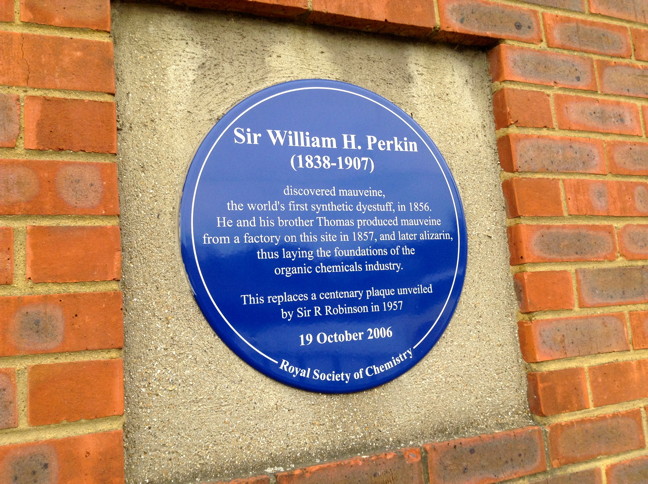
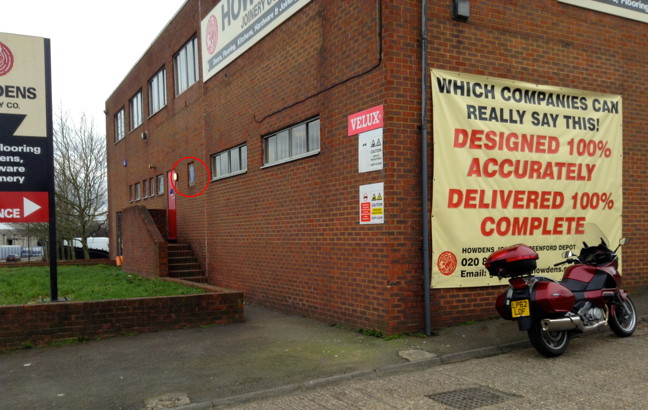
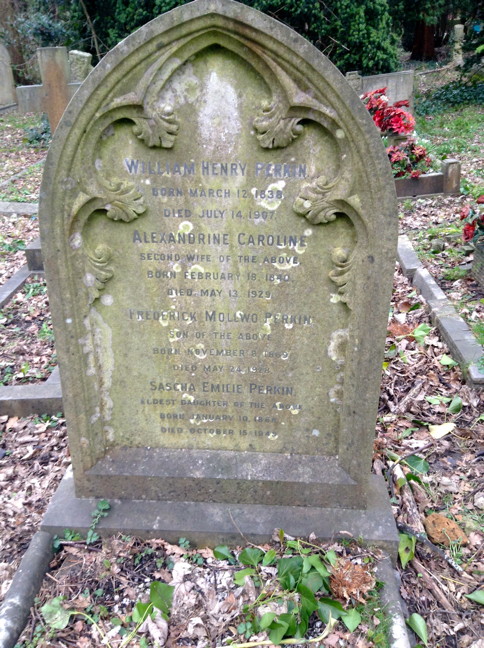
William Henry Perkin is a local chemical hero of mine. The factory where he founded the British (nay, the World) fine organic chemicals industry is in Greenford, just up the road from where we live. The factory used to be close to the Black Horse pub (see below) on the banks of the grand union canal. It is now commemorated merely by a blue plaque placed on the wall of the modern joinery building occupying the location (circled in red on the photo).
View Larger Map


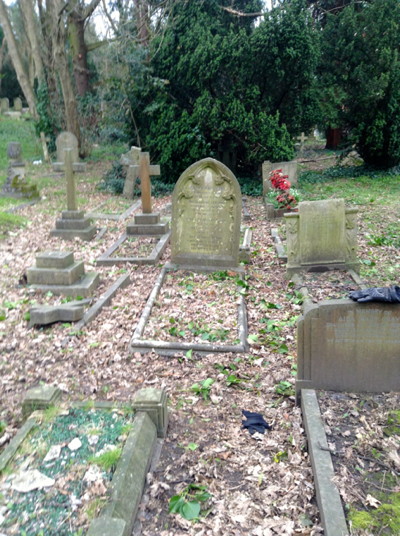
But when BBC TV contacted me to ask where his grave was, a little detective work was needed to track it down to the cemetery in Christchurch, Roxeth (near Harrow-on-the-Hill).
View Larger Map


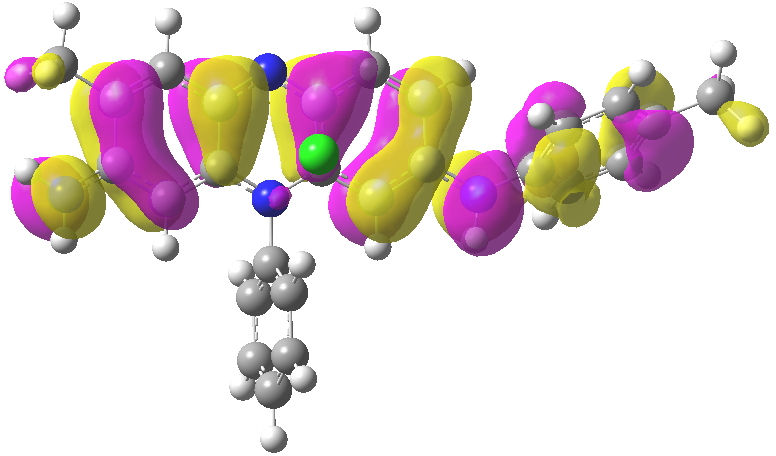
And if you ever need to track me down, my office window is the one with the translucent image of a mauveine molecular orbital.
View Larger Map

Click for 3D
Tags:BBC, Black Horse pub, detective, dye industry, greenford, Historical, local chemical hero, organic chemicals industry, William Henry Perkin
Posted in Interesting chemistry | 6 Comments »
Friday, January 6th, 2012
I thought I would launch the 2012 edition of this blog by writing about shared space. If you have not come across it before, it is (to quote Wikipedia), “an urban design concept aimed at integrated use of public spaces.” The BBC here in the UK ran a feature on it recently, and prominent in examples of shared space in the UK was Exhibition Road. I note this here on the blog since it is about 100m from my office.
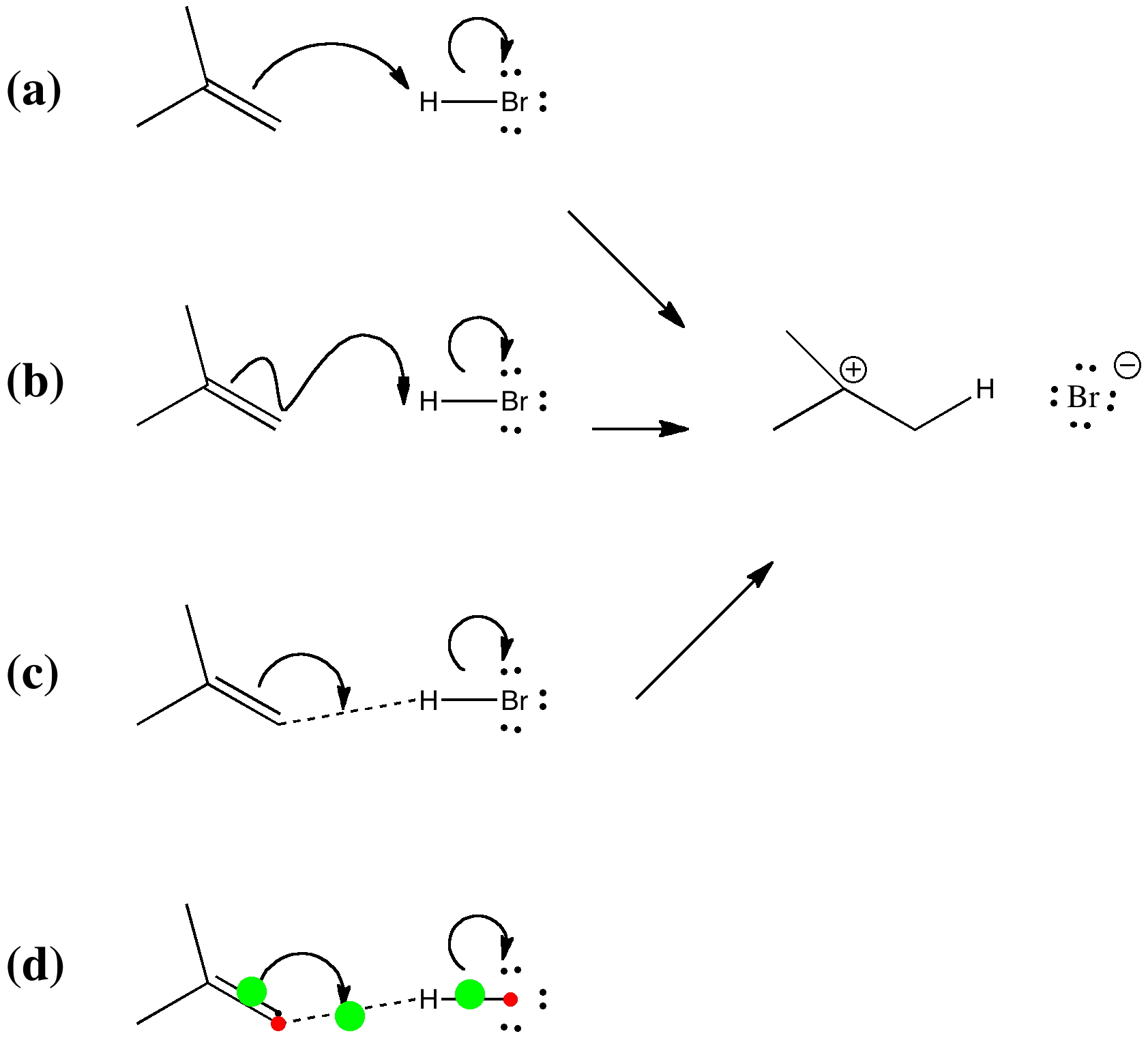
Shared space is the Mornington Crescent of urban design, where you have to work out the rules of the game by in effective participating in it. Thus the new “rules” of travelling down Exhibition Road (by either foot, car, bike, bus or indeed motorbike as I do each day) are not declared, and each participant works them out on the fly. This is supposed to lead to fewer misunderstandings, although the practice does seem rather different (at least at the moment). But where is the chemistry? Well, these thoughts were triggered by two colleagues independently asking me about how chemists use metaphors, and how chemists use representations. I have in fact touched upon both of these previously, and it struck me that this last example, of arrow pushing in organic chemistry, was in fact a nice example of a shared space in chemistry. The rules of arrow pushing are not formally set out (in an IUPAC rule book or similar) but are worked out on the hoof so to speak. Except that the space is shared only by organic chemists. I have observed over the years that e.g. physical or inorganic chemists will mostly not dare venture into that shared space; they often give a rather good impression of not understanding the rules. I also know from experience that mathematicians and physicists regard arrow pushing as anything other than a shared (scientific) space.
Yet the modern scope and ethos of science is that we should all venture into shared spaces (whether they are in or out of our comfort zones). Perhaps, in science, the problem is that so much of what we do has what I refer to as “implicit semantics” (its part of our DNA of e.g. being a chemist). Take for example the diagram below (which I used previously) which sets out four possible sets of rules for this particular shared space. Even so, without further explanation, you might be struggling to infer what message is carried by this diagram. That is because so much of it contains implicit semantics, and unless you recognise the missing features, how can you go about finding out what is invisible?

Curly arrow pushing
My concluding thought would be that shared space is what the semantic web is surely striving for. And if Exhibition Road is anything to go by, it is clearly quite a challenge. But if I (and particularly the pedestrians I encounter there each day) end up surviving 2012, perhaps the Semantic Web may one day come about as well!
Tags:BBC, chemist, semantic web, shared space, Tutorial material, United Kingdom
Posted in Chemical IT, Curly arrows, General | No Comments »