Posts Tagged ‘chair’

Tetrahedral carbon and cyclohexane.

Wednesday, August 22nd, 2018

Following the general recognition of carbon as being tetrahedrally tetravalent in 1869 (Paterno) and 1874 (Van’t Hoff and Le Bell), an early seminal exploitation of this to the conformation of cyclohexane was by Hermann Sachse in 1890.[1] This was verified when the Braggs in 1913[2], followed by an oft-cited article by Mohr in 1918,[3] established the crystal structure of diamond as comprising repeating rings in the chair conformation. So by 1926, you might imagine that the shape (or conformation as we would now call it) of cyclohexane would be well-known. No quite so for everyone!

When The Journal of the Imperial College Chemical Society (Volume 6) was brought to my attention, I found an article by R. F Hunter;

He proceeds to argue as follows:

  1. The natural angle subtended at a tetrahedral carbon is 109.47°.
  2. “The internal angle between the carbon to carbon valencies of a six-membered ring cyclohexane will, if the ring is uniplanar, be … 120°.
  3. “When the cyclohexane ring is prepared … we must therefore have the pushing apart of two of the valencies”.
  4. The object of the experiments commenced in this College in 1914 was “to find what effect the pushing apart of the valencies …must have on the angle between the remaining pair of valencies“.
  5. You do wonder then why the assumption highlighted in red above was never really questioned during the twelve-year period of investigating angles around tetrahedral carbon.

The article itself is quite long, reporting the synthesis of many compounds in search of the postulated effect. Of course around twenty years later, Derek Barton used the by then generally accepted conformation of cyclohexane to explain reactivity in what become known as the theory of conformational analysis.

These two articles dating from 1926, and probably thought lost to science, show how some ideas can take decades to have any influence, whilst others can take root very much more quickly.


The chair cyclohexane structure is easily discerned from Figure 7 in the Braggs’ paper![2]

References

  1. H. Sachse, "Ueber die geometrischen Isomerien der Hexamethylenderivate", Berichte der deutschen chemischen Gesellschaft, vol. 23, pp. 1363-1370, 1890. https://doi.org/10.1002/cber.189002301216
  2. "The structure of the diamond", Proceedings of the Royal Society of London. Series A, Containing Papers of a Mathematical and Physical Character, vol. 89, pp. 277-291, 1913. https://doi.org/10.1098/rspa.1913.0084
  3. E. Mohr, "Die Baeyersche Spannungstheorie und die Struktur des Diamanten", Journal für Praktische Chemie, vol. 98, pp. 315-353, 1918. https://doi.org/10.1002/prac.19180980123

Halogen bonds 4: The strongest (?) halogen bond.

Sunday, December 7th, 2014

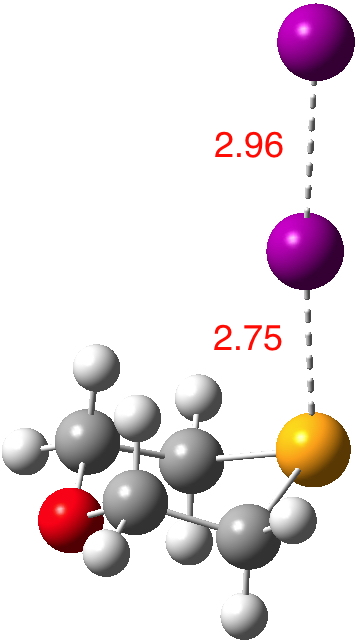
Continuing my hunt, here is a candidate for a strong(est?) halogen bond, this time between Se and I.[1].
OXSELI
The features of interest include:

  1. The six-membered ring is in the chair conformation.
  2. The (relatively enormous) I…I substituent is axial!
  3. It is attached to the Se rather than the O.
  4. The Se…I distance is 2.75Å, some 1.13Å shorter than the combined atom ver der Waals radii (1.90 + 1.98 = 3.88)
  5. The Wiberg bond index is 0.42 for the Se-I bond and 0.63 for the I-I bond (at the crystal geometry). It is tending towards a symmetrical disposition of the central iodine (a feat also achieved by the iodine in the NI3 complex).
  6. The NBO E(2) perturbation involving donation from the Se lone pair into the I-I antibond is 77 kcal/mol, almost twice the value of the one involving DABCO…I-I and way above the values found for the related hydrogen bond.
  7. The B3LYP+D3/Def2-TZVPP+PP(I) optimised structure expands the Se-I bond distance to 3.04 and contracts the I-I distance to 2.81Å indicating (as with DABCO…I-I) that there may be compression of this bond induced by the lattice.
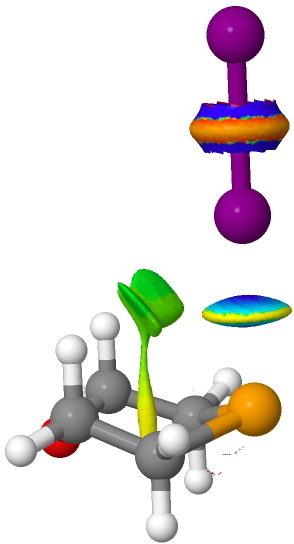
  8. The NCI surface shows a classical “strong” interaction between Se and I (blue), but significant additional features arising from the axial hydrogens that might account for the axial orientation of the Se…I-I group.
    Click for  3D

    Click for 3D

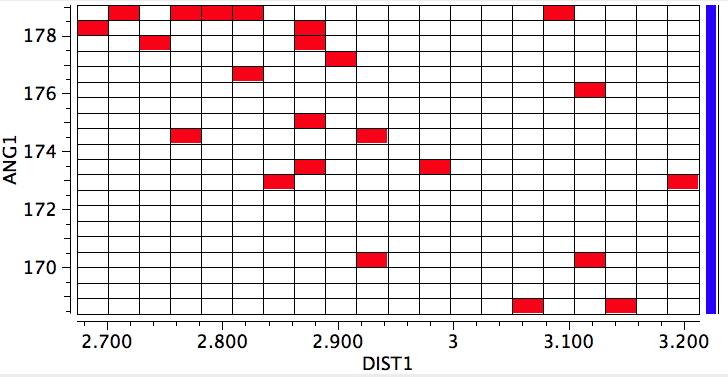
  9. For good measure, here is the complete crystal structure search, defining any non-bonded contact between any element of group six and group seven that is <0.5Å shorter than the van del Waals contact. Our candidate is on the left hand edge of the plot.
    Se-I

References

  1. H. Maddox, and J.D. McCullough, "The Crystal and Molecular Structure of the Iodine Complex of 1-Oxa-4-selenacyclohexane, C<sub>4</sub>H<sub>8</sub>OSe.I<sub>2</sub>", Inorganic Chemistry, vol. 5, pp. 522-526, 1966. https://doi.org/10.1021/ic50038a006

Ribulose-1,5-bisphosphate + carbon dioxide → carbon fixation!

Sunday, April 20th, 2014

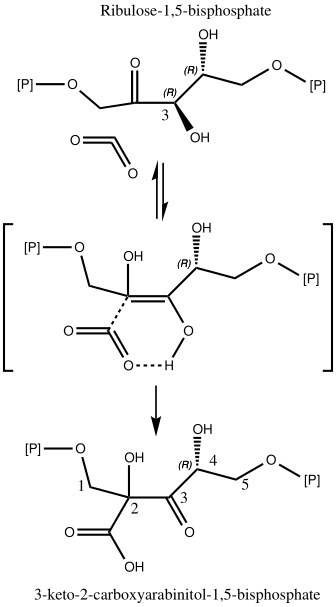
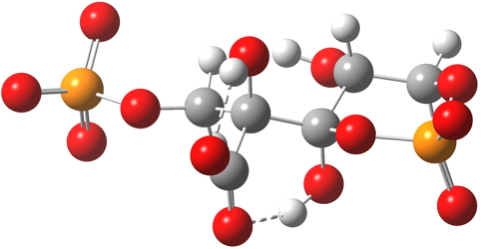
Ribulose-1,5-bisphosphate reacts with carbon dioxide to produce 3-keto-2-carboxyarabinitol 1,5-bisphosphate as the first step in the biochemical process of carbon fixation. It needs an enzyme to do this (Ribulose-1,5-bisphosphate carboxylase/oxygenase, or RuBisCO) and lots of ATP (adenosine triphosphate, produced by photosynthesis). Here I ask what the nature of the uncatalysed transition state is, and hence the task that might be facing the catalyst in reducing the activation barrier to that of a facile thermal reaction. I present my process in the order it was done.

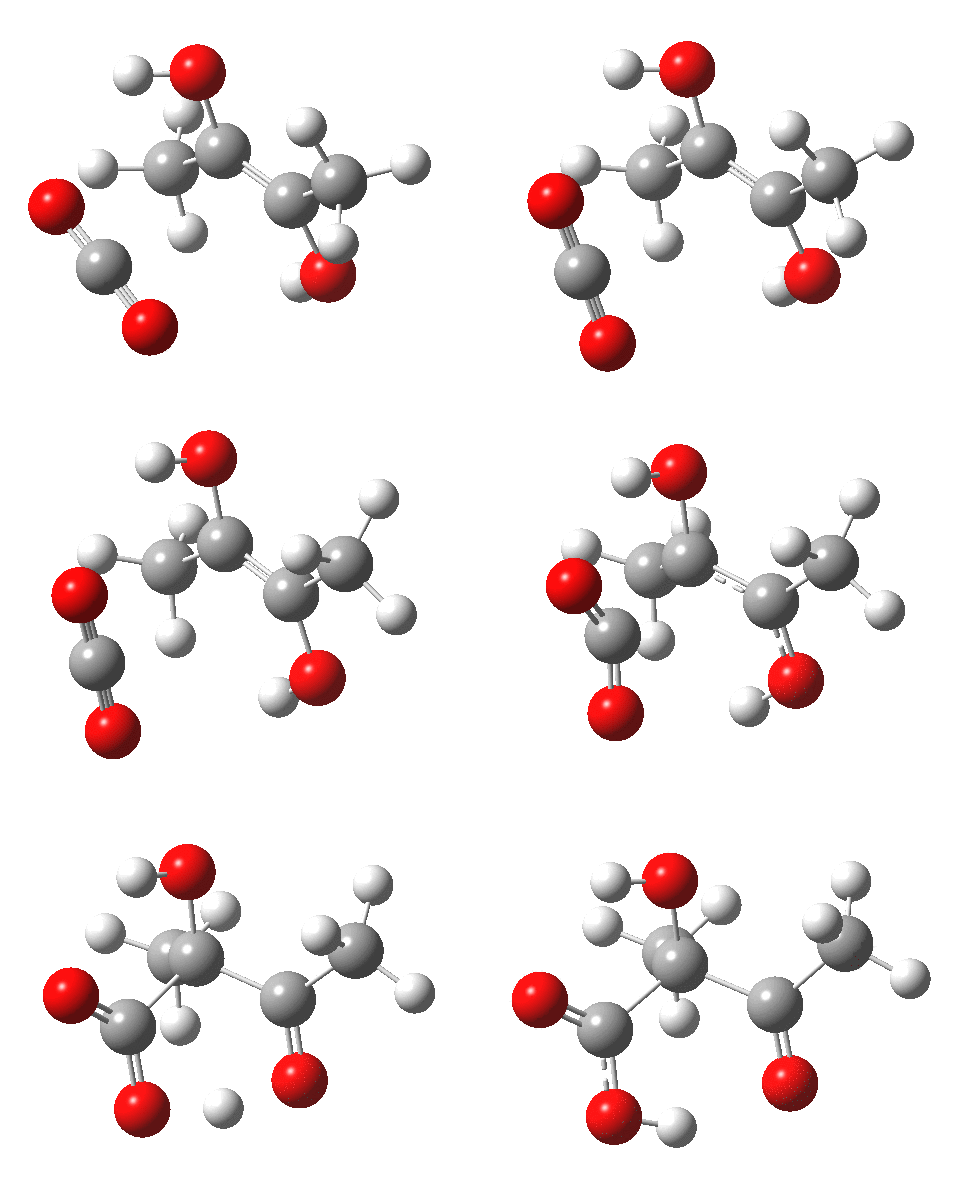
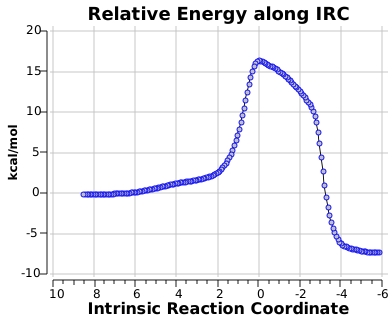
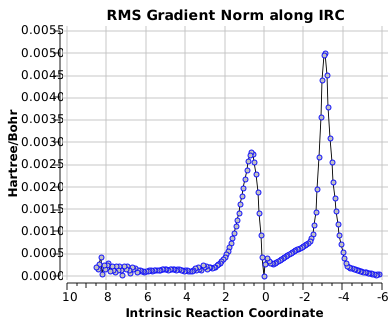
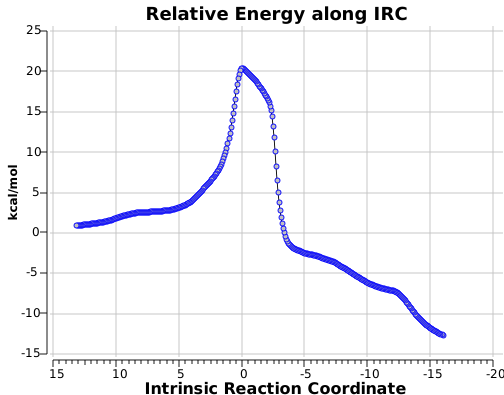
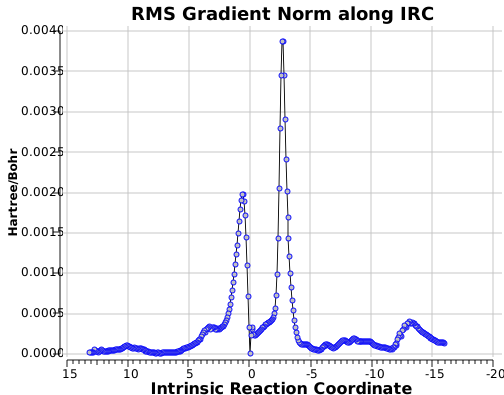
carboxFirstly, I will hypothesize that since C3 needs to lose a hydrogen, the easiest way of doing so is to form the enol of Ribulose-1,5-bisphosphate. I am going to start by reducing the above model to its core; C1 and the attached phosphate is replaced by a methyl, and C4-5 likewise. In this model, it takes 13.1 kcal/mol of free energy to enolize.[1],[2] This species can then react with CO2 (potentially with an accompanying proton transfer) to give 3-keto-2-carboxyarabinitol 1,5-bisphosphate directly. The transition state at the ωB97XD/6-311G(d,p)/SCRF=water level[3] has an IRC (intrinsic reaction coordinate)[4] that reveals the activation barrier is ~17 kcal/mol with respect to the enol (19.5 in ΔG298), with the overall reaction[5] being exo-energic by -2.6 kcal/mol with respect to the enol, but endo-energic by +10.5 kcal/mol with respect to keto-Ribulose-1,5-bisphosphate + carbon dioxide. Note the characteristic feature at IRC -3.0 of a hidden zwitterionic intermediate, which marks a belated proton transfer occurring AFTER the transition state for C-C bond formation. The reaction is asynchronous for this basic model.
carbox
carboxE
carboxG
For this very basic (phosphate-free) model of Ribulose-1,5-bisphosphate, the total computed free energy barrier@298K is 32.6 kcal/mol (standard state of 0.041M; reduced by ~1.9 kcal/mol for more concentrated, e.g. 1M solutions). This is ~13 kcal/mol too high to correspond to a uncatalysed fast process at room temperatures, a gap that the phosphate end-groups and the enzyme have to address (a challenge typically enzymes do manage to achieve).

With a basic model in place, it is time to restore those truncated phosphate end-groups to see what their contribution might be (treated as dianions each for the time being, and stabilized by using a continuum solvent field for water). First, the energies:

System ΔΔG Data DOI
Ribulose-1,5-bisphosphate as keto + CO2  0.0 [6]
Ribulose-1,5-bisphosphate as enol + CO2 13.0 [7]
Transition state 34.8 [8]
Acyclic 3-keto-2-carboxyarabinitol 1,5-bisphosphate 11.5 [9]
Cyclic 3-keto-2-carboxyarabinitol 1,5-bisphosphate -7.3 [10]

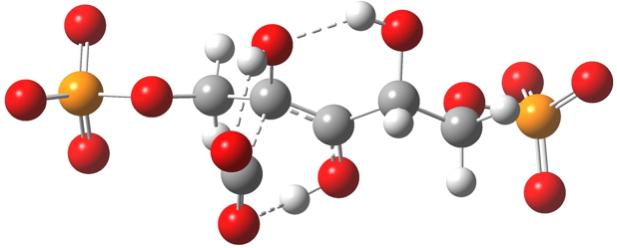
Note the network of hydrogen bonds formed at the transition state geometry (below) and the various gauche stereo-electronic alignments[11] which you should really explore in the Jmol 3D model invoked by clicking below.

carbox-TS

Click for 3D

  1. Addition of the phosphate groups has little effect on the energetics of the keto/enol equilibrium,
  2. or on the barrier to reaction with  carbon dioxide.
  3. But, they DO provide a new low energy sink I have not seen described before for the reaction (below), which makes the overall process from Ribulose-1,5-bisphosphate + CO2 exo-energic by -7.3 kcal/mol. Thus the phosphates provide the overall thermodynamic driving force for the carbon fixation.

    Click  for 3D

    Click for 3D. Cyclic low-energy cyclic chair isomer of 3-keto-2-carboxyarabinitol 1,5-bisphosphate

  4. Which leaves the role of the enzyme as one of reducing the overall activation barrier. The reaction MUST be enzymatically favoured, since the enzyme also needs to control when the cycle occurs, via a light-sensitive switch. If no enzyme-catalysis were needed, then carbon-fixation would occur in the dark, and consume all available ATP in the process. Inferred purely from the results in the table above, two functions can be listed:
    • The enzyme can help increase the effective molarity of the bimolecular reaction between Ribulose-1,5-bisphosphate + CO2. As noted above, increasing the concentration from e.g. 1 atmosphere (0.041M) to 1M reduces ΔG by 1.9 kcal/mol.
    • The most influential role the enzyme could play is to bind the enol form of Ribulose-1,5-bisphosphate preferentially over the keto form. If most of the substrate is bound in this form, that would reduce the overall barrier by 13 kcal/mol, more than enough to enable a room temperature reaction.
    • There may of course be many other subtle effects in operation, such as preferential stabilisation of the transition state, which cannot be inferred here without a detailed knowledge of the enzyme. I have deliberately tried to avoid doing that, since I wanted to see what might be concluded purely from the energetics found above.

There is one final step required; a very rapid decomposition of the 3-keto-2-carboxyarabinitol 1,5-bisphosphate (cyclic or not) to produce two molecules of 3-phosphoglycerate. I will leave my computational-energetic analysis and mechanism of that step to another post.


Postscript. An IRC on the full phosphate model took three days to run and has only just finished.[12] The profile is similar to that obtained for the phosphate-free model, with the exception of the IRC feature at -13, where one phosphate group rotates and starts to H-bond to the 3-keto-2-carboxyarabinitol, resulting in a lower energy conformation than that reported above. The energy of this new conformation[13] relative to the starting point (labelled as 0.0 above) is +2.3 kcal/mol (c.f. +11.5 for the previous conformation). The phosphates clearly remain a strong driving force for the reaction. It is quite possible that even more stable forms of this product could be found (by varying where the acidic protons reside) but at least we now know that the product can be more stable than the reactant (by at least -7.3 kcal/mol), which is the important conclusion.
carbox-prod1E
carbox-prod1G

Postscript 1. Yet another lower energy isomer of the product has popped out[14] being -13.1 kcal/mol lower than the initial reactants.


I do not describe much molecular biology on this blog, but an urge to rectify this was inspired by a TV program I watched four days ago charting how the pathway chronologically known first as the Calvin, then the Calvin-Benson and now the Calvin-Benson-Bassham cycle for carbon fixation became known (and how it gradually gathered attribution). As a chemist who was trained to try to understand reaction mechanisms, my immediate question (unsurprisingly not addressed at all in the TV program) was: what is the key carbon-carbon bond forming step? Here, I simply wanted initially to answer that one simple question and perhaps the aspect of the relative timing of any C-C bond formation and associated proton transfer. This latter idea in turn was hovering in the background of my mind from association with our previous project in proline-catalysed aldol reactions, where a similar question can be posed and indeed has been answered.[15] The rest of what you see here led directly from trying to answer that initial question. Peter Medawar’s 1963 talk Is the scientific paper a fraud? presented the argument that scientific journal articles give a misleading idea of the actual process of scientific discovery[16]. I hope that perhaps as a blog post, the above does give a little insight into the scientific process I experienced for myself over a period of the last two days (and with conclusions which may of course turn out to be quite wrong).

References

  1. H.S. Rzepa, "Gaussian Job Archive for C5H8O4", 2014. https://doi.org/10.6084/m9.figshare.1004015
  2. H.S. Rzepa, "Gaussian Job Archive for C5H8O4", 2014. https://doi.org/10.6084/m9.figshare.1004023
  3. H.S. Rzepa, "Gaussian Job Archive for C5H8O4", 2014. https://doi.org/10.6084/m9.figshare.1004011
  4. H.S. Rzepa, "Gaussian Job Archive for C5H8O4", 2014. https://doi.org/10.6084/m9.figshare.1004037
  5. H.S. Rzepa, "Gaussian Job Archive for C5H8O4", 2014. https://doi.org/10.6084/m9.figshare.1004038
  6. H.S. Rzepa, "Gaussian Job Archive for C6H8O13P2(4-)", 2014. https://doi.org/10.6084/m9.figshare.1004086
  7. H.S. Rzepa, "Gaussian Job Archive for C6H8O13P2(4-)", 2014. https://doi.org/10.6084/m9.figshare.1004066
  8. H.S. Rzepa, "Gaussian Job Archive for C6H8O13P2(4-)", 2014. https://doi.org/10.6084/m9.figshare.1004112
  9. H.S. Rzepa, "Gaussian Job Archive for C6H8O13P2(4-)", 2014. https://doi.org/10.6084/m9.figshare.1004085
  10. H.S. Rzepa, "Gaussian Job Archive for C6H8O13P2(4-)", 2014. https://doi.org/10.6084/m9.figshare.1004111
  11. H.S. Rzepa, "Gaussian Job Archive for C6H8O13P2(4-)", 2014. https://doi.org/10.6084/m9.figshare.1004026
  12. H.S. Rzepa, "Gaussian Job Archive for C6H8O13P2(4-)", 2014. https://doi.org/10.6084/m9.figshare.1004557
  13. H.S. Rzepa, "Gaussian Job Archive for C6H8O13P2(4-)", 2014. https://doi.org/10.6084/m9.figshare.1004614
  14. H.S. Rzepa, "Gaussian Job Archive for C6H8O13P2(4-)", 2014. https://doi.org/10.6084/m9.figshare.1004778
  15. A. Armstrong, R.A. Boto, P. Dingwall, J. Contreras-García, M.J. Harvey, N.J. Mason, and H.S. Rzepa, "The Houk–List transition states for organocatalytic mechanisms revisited", Chem. Sci., vol. 5, pp. 2057-2071, 2014. https://doi.org/10.1039/c3sc53416b
  16. S.M. Howitt, and A.N. Wilson, "Revisiting “Is the scientific paper a fraud?”", EMBO reports, vol. 15, pp. 481-484, 2014. https://doi.org/10.1002/embr.201338302

X-ray analysis and absolute configuration determination using porous complexes.

Wednesday, April 17th, 2013

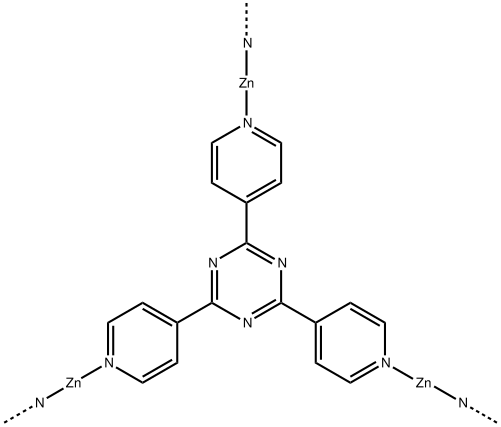
This is another in the occasional series of “what a neat molecule”. In this case, more of a “what a neat idea”. The s-triazine below, when coordinated to eg ZnI2, forms what is called a metal-organic-framework, or MOF. A recent article[1] shows how such frameworks can be used to help solve a long-standing problem in structure determination, how to get a crystal structure on a compound that does not crystallise on its own.


MOF

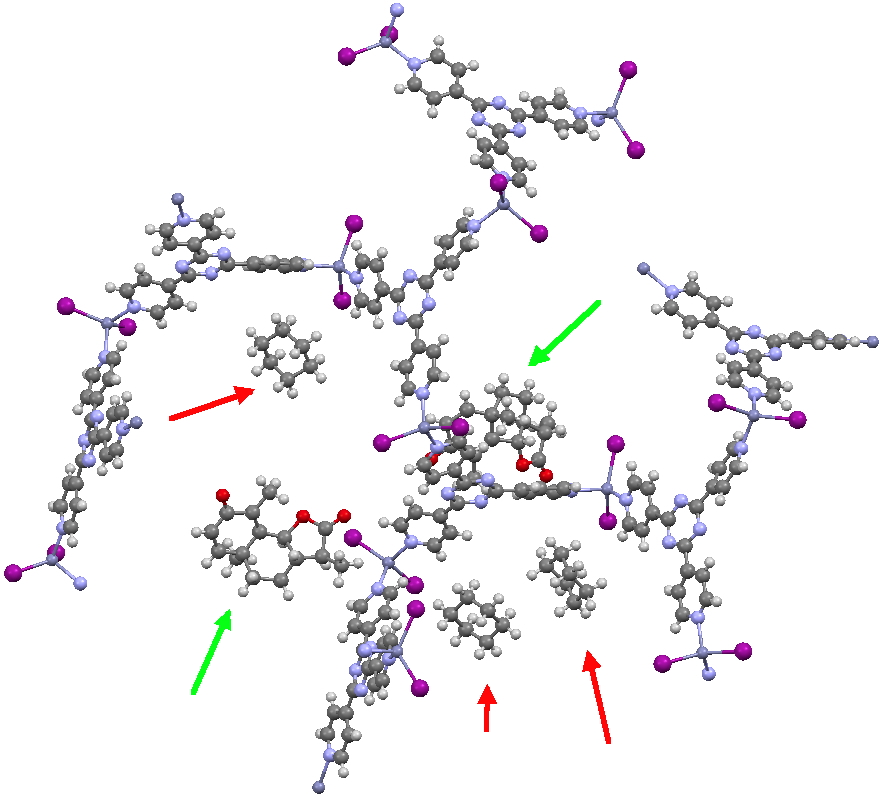
The essence of the technique is to select a small crystal of the MOF (which crystallises well) and allow your own molecule to diffuse in from solution. So captured inside the framework, the X-ray analysis can now be done on the absorbed host molecule together with the MOF framework. Below you can see two of the structures reported solved by this technique. The first shows the target molecule (green arrows) but also three molecules of cyclohexane (the diffusing solvent, red arrows), nicely illustrating its chair conformation.

Click for  3D.

Click for 3D.

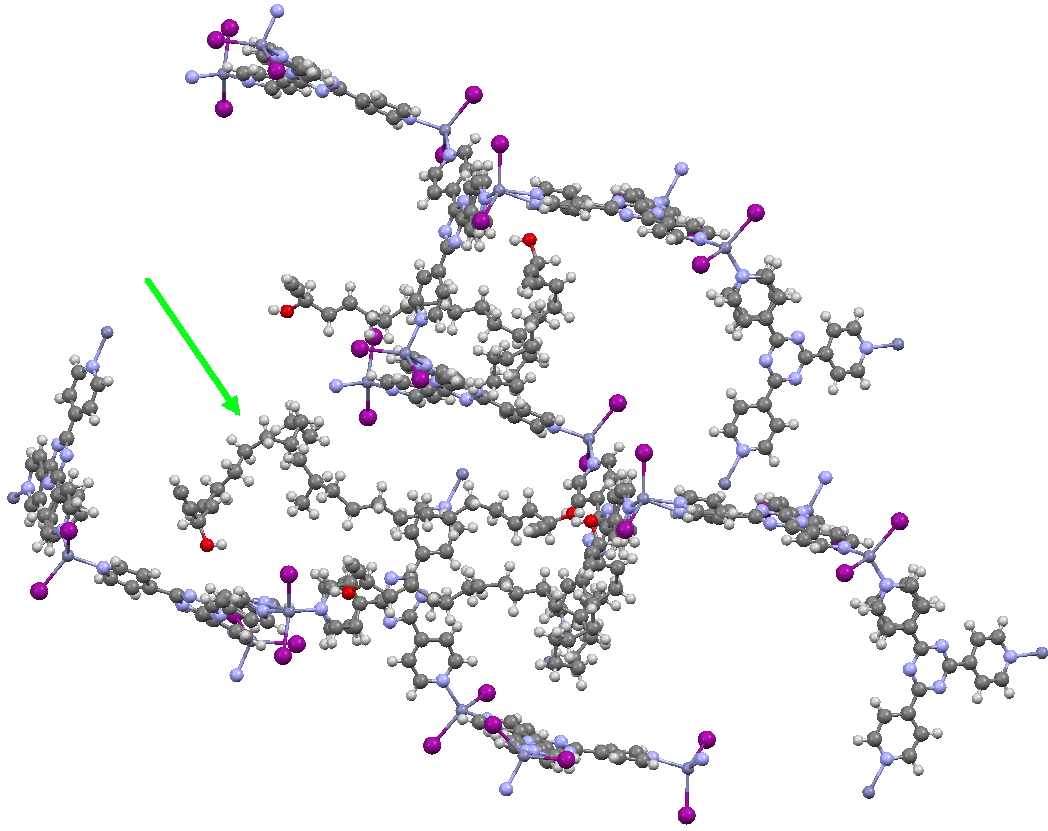
This second example shows the structure of a marine natural product, of which only  about 5µg was available (green arrow). The structure (of miyakosyne A) shows a conformationally flexible substituted saturated backbone, a molecule which traditionally might be expected to be disordered because of its flexibility. These structures were performed on a standard diffractometer, and the authors point out that if more intense synchrotron radiation were to be used, even smaller samples (< 10ng) could be determined. They also note that full occupancy of the MOF lattice does not need to be achieved for the method to succeed.

Click fdx.doi.org3D.

Click for 3D.

I end with noting that in an earlier post, I observed how chiroptical methods can nowadays be increasingly successfully used to determine absolute configurations of chiral molecules. Miyakosyne A, a molecule with three chiral centres had proved to be a challenge using such techniques; one of these centres (at C14) could not be determined by any chiroptical method. The configuration was however successfully determined as (S) by this new crystallographic technique. I think this is a huge contribution to the science of structure and configuration determination![2]

References

  1. Y. Inokuma, S. Yoshioka, J. Ariyoshi, T. Arai, Y. Hitora, K. Takada, S. Matsunaga, K. Rissanen, and M. Fujita, "X-ray analysis on the nanogram to microgram scale using porous complexes", Nature, vol. 495, pp. 461-466, 2013. https://doi.org/10.1038/nature11990
  2. https://doi.org/

Ring-flipping in cyclohexane in a different light

Friday, October 12th, 2012

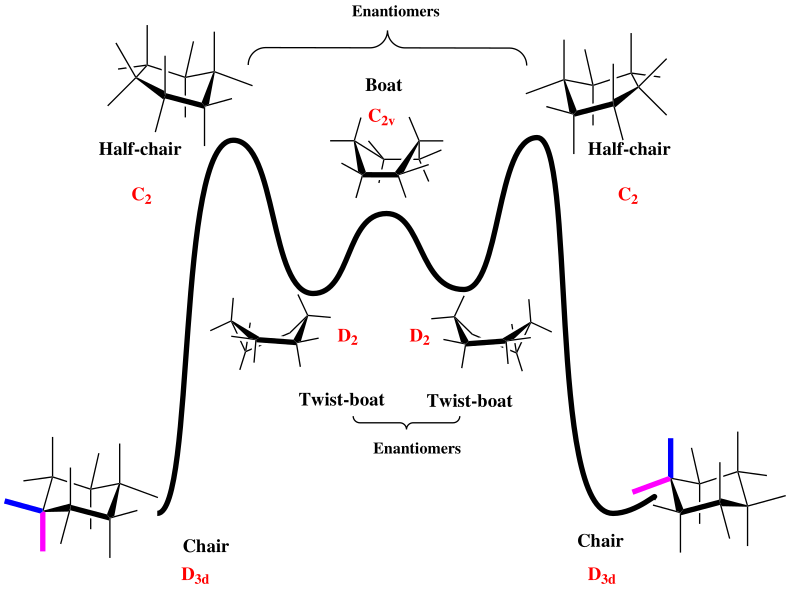
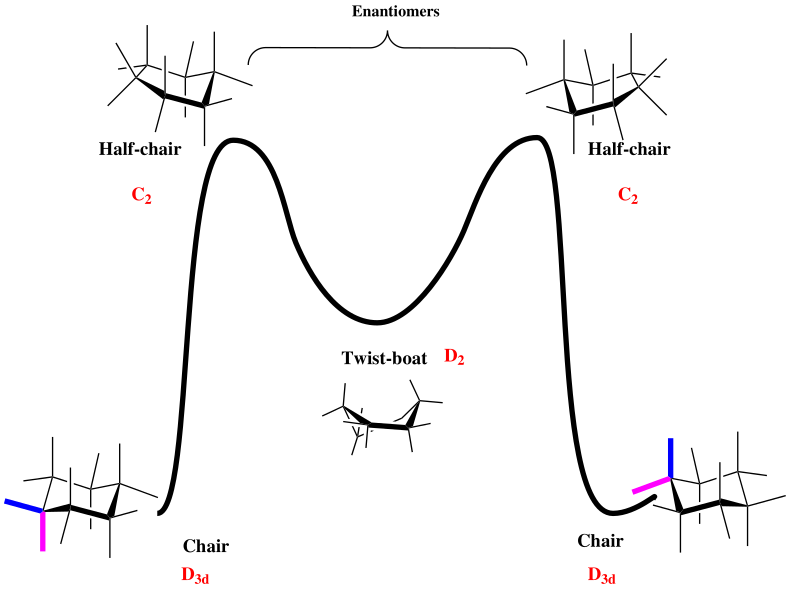
The conformational analysis of cyclohexane is a mainstay of organic chemistry. Is there anything new that can be said about it? Let us start with the diagram below:

This identifies the start of the process as a chair conformation of cyclohexane, with D3d symmetry. I have highlighted a pair of hydrogens attached to the left most carbon atom in blue (equatorial) and magenta (axial). On the right hand side of the diagram this pair has transposed position, with the blue now being axial and the magenta equatorial. The same is true of the other five pairs of methylene hydrogens. We need to identify the pathway by which this happens. The pathway shown above proceeds through a half-chair transition state of C2 symmetry, falling to the first intermediate twist-boat of D2 symmetry before reaching a second transition state of C2v symmetry known as the boat. The whole diagram is mirror-symmetric about this point. The point to note about this diagram is that the species labelled C2 and D2 are dissymetric (chiral), whereas the ones labelled D3d and C2v are not. This means that there are two enantiomeric half-chair transition states, as there are the two twist-boats. This introduction of (di)symmetry does rather change the way we look at the process!

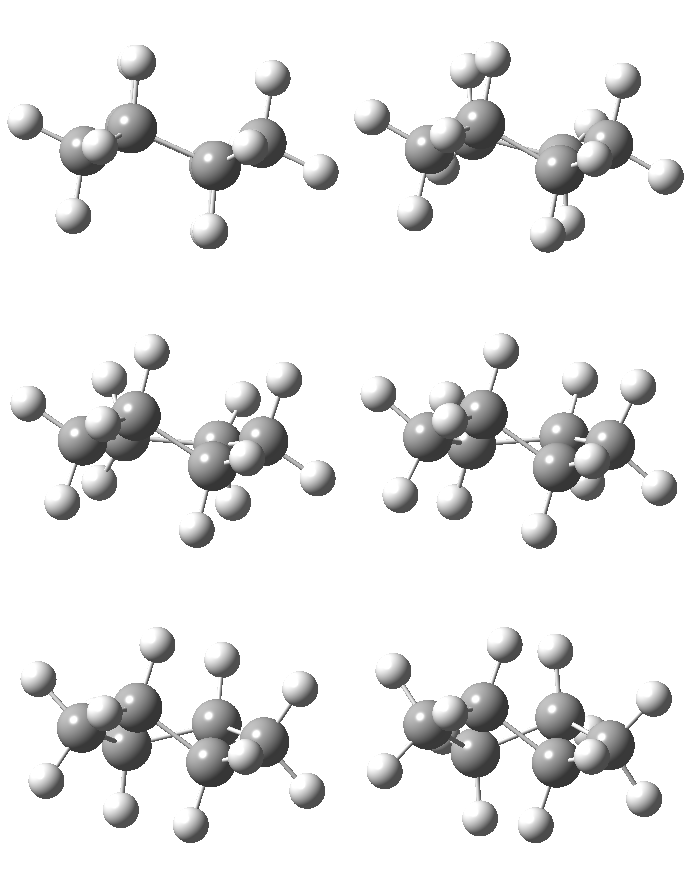
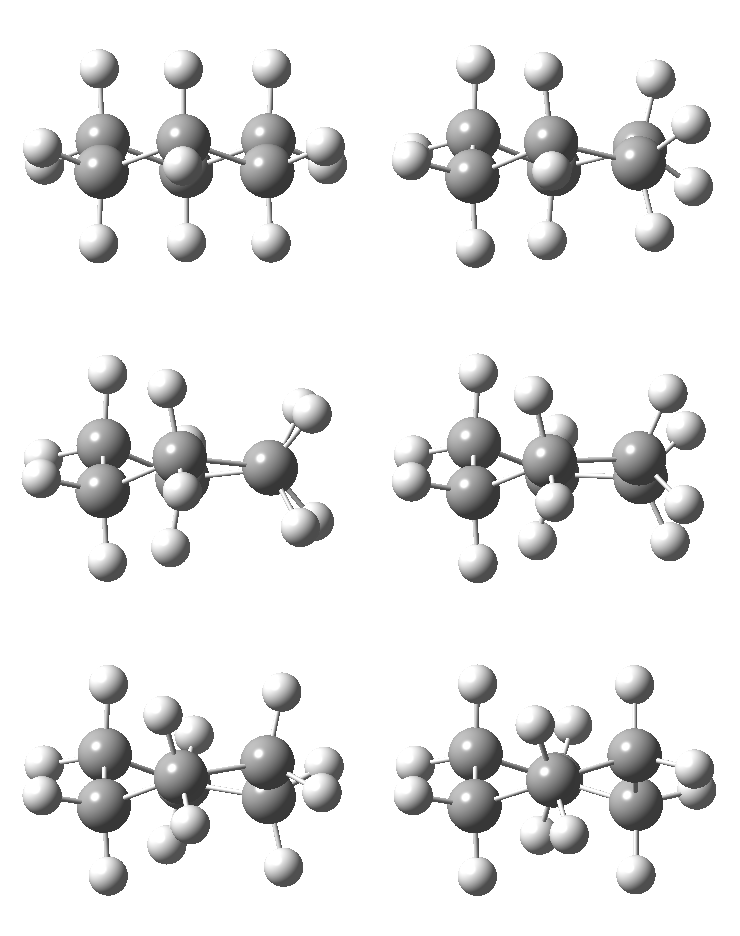
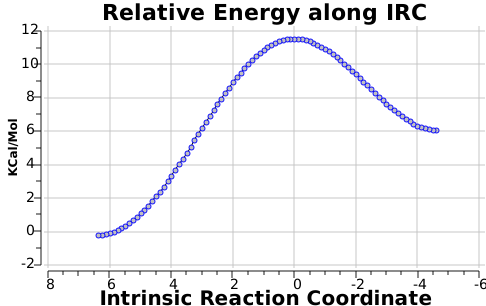
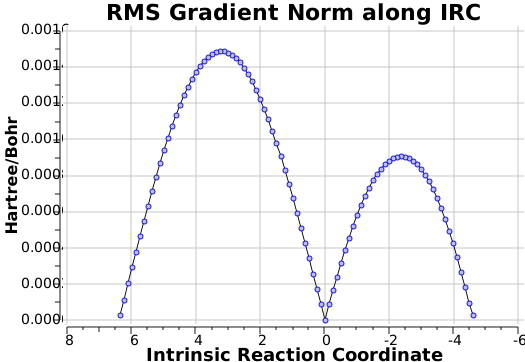
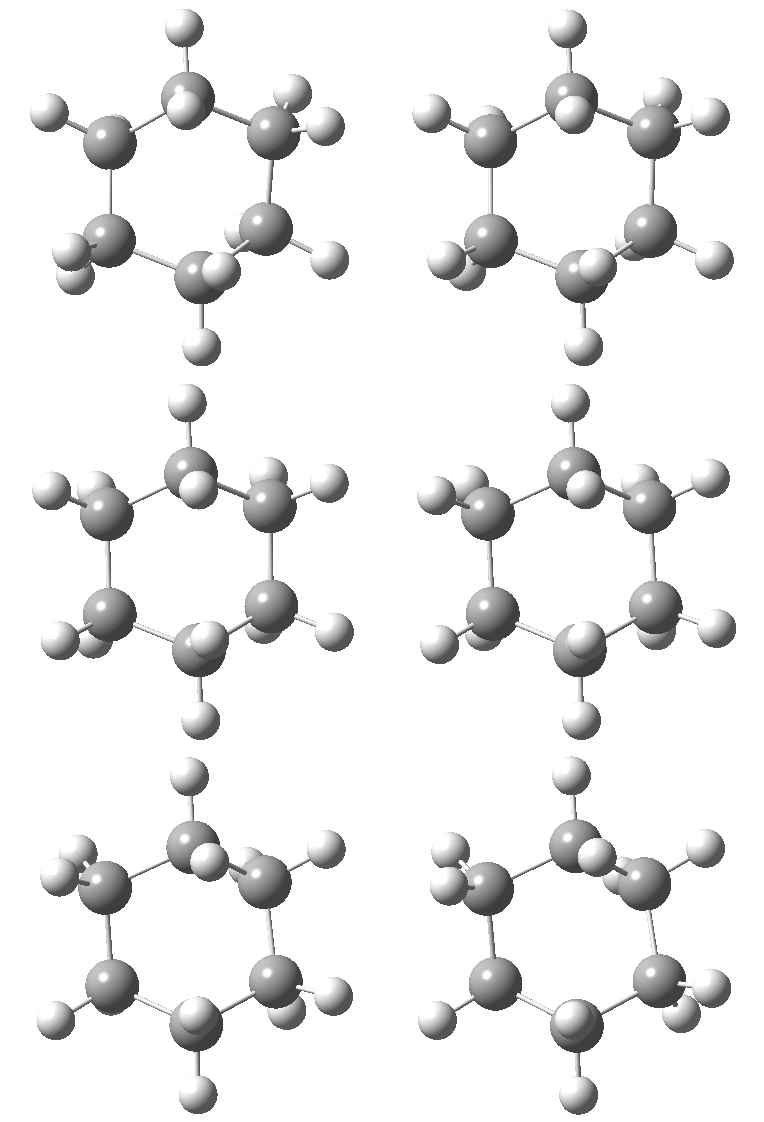
Now let me introduce the intrinsic reaction coordinate (IRC, ωB97XD/6-311G(d,p)/SCRF=cyclohexane), as followed from the half-chair transition state, and connecting the chair and the twist-boat.

View 1 (click to see Chair ) View 2 (click to see Twist-boat)

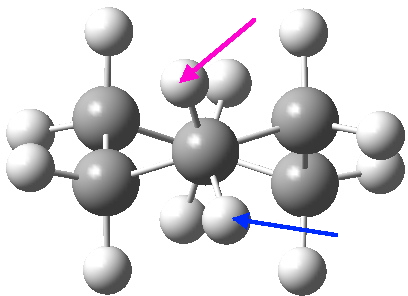
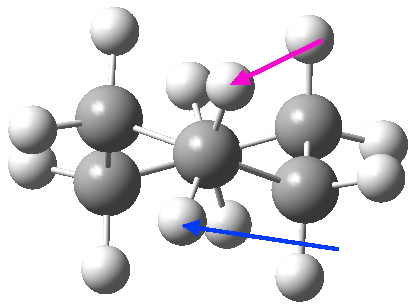
View 1 is looking down the C2 axis present in the half-chair transition state and both start and end points. View 2 rotates this by 90° along the y-axis, and is again looking down a C2 axis. This axis is present only when the IRC starts at the D3d chair conformation or reaches a D2 twist-boat conformation (becoming one of three at this point). The latter conformation is ~6 kcal/mol higher in energy than the chair. At this twist-boat geometry (shown below), the two hydrogens labelled with blue and magenta appear to be in an identical environment (in other words the axial or equatorial distinction between them is lost at this point). This might appear to be what we need to “flip” the environments of any pair of axial and equatorial hydrogens. But is it sufficient?

At the twist boat above, whilst the chemical environment of the pair of hydrogens identified with blue and magenta arrows is identical, their (pro)chirality is not. Because they both sit in a chiral molecule, their individual relationship to that chirality is said to be pro-chiral. The path shown above, on its own, does not interconvert the (pro)chirality of this pair of hydrogens. To do this, we need to get to the enantiomeric twist-boat conformation shown below, and this is achieved by passing through an achiral transition state of C2v symmetry, in other words a pure boat (see below).

Well, now I pose a question. Is the above route the ONLY way of transposing the axial/equatorial identity of pairs of methylene hydrogens in this molecule? If you check the text books, some will in fact show a different diagram, in which the C2v boat is entirely uninvolved and only one enantiomer of the D2 twist-boat conformations is shown, as below.

These two pathways do differ fundamentally. The first (longer) pathway passes through an achiral boat transition state. The second (shorter) one involves two chiral half-chair transition states connecting a single chiral twist-boat, but implies that there must be two such pathways, each the enantiomer of the other.  I should point out that since these two options share a common transition state, their energies are identical. Which one is the more realistic?  I think only the technique of molecular dynamics, in which the momentum of the trajectories along the path is factored in, will tell us. 


Postscript: The IRC for the enantiomerization of one twist boat into the other via a boat transition state is shown below. The axial-equatorial transpositions can be clearly seen in this view.

Updating a worked problem in conformational analysis. Part 1: the question.

Friday, May 13th, 2011

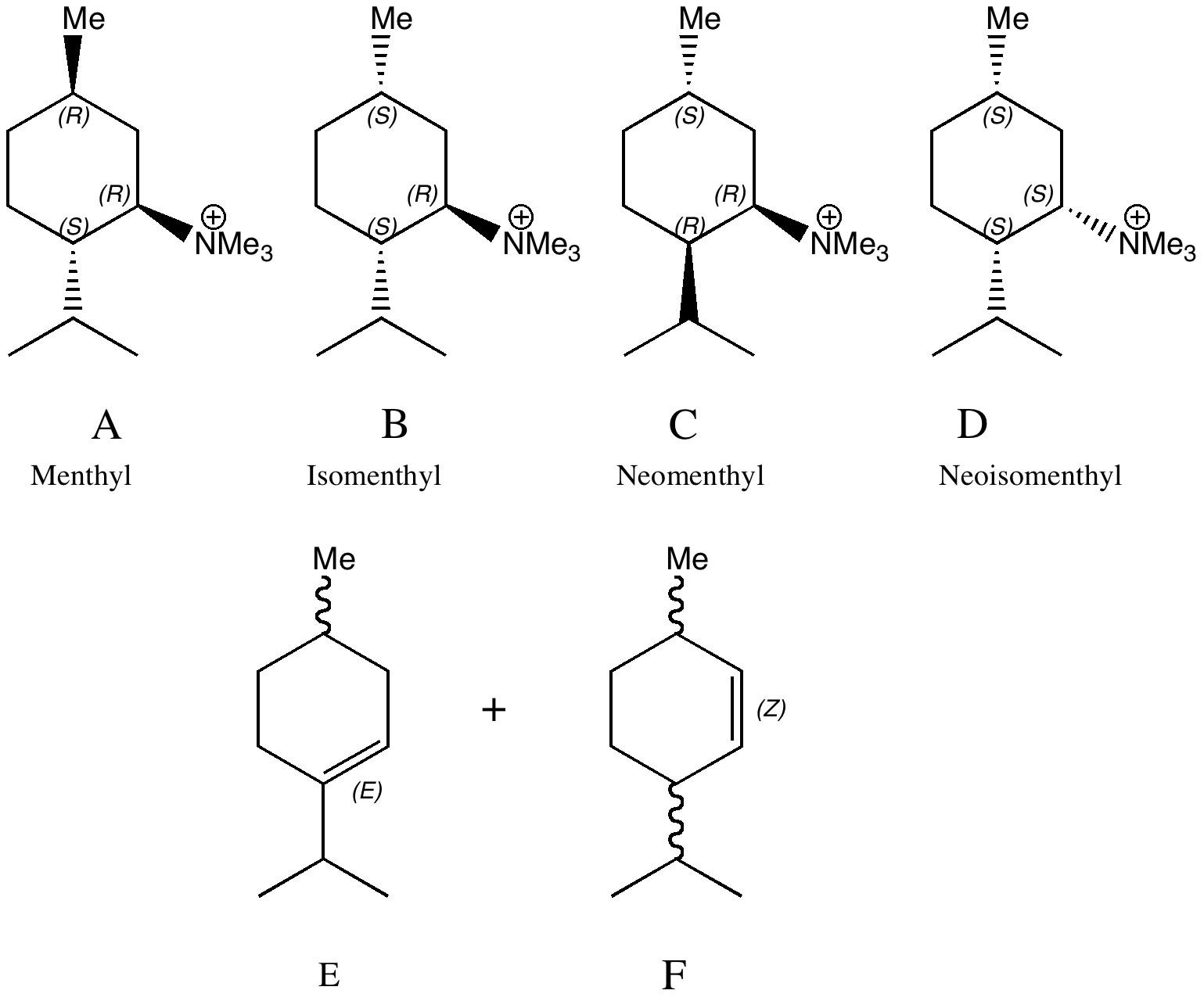
Conformational analysis comes from the classical renaissance of physical organic chemistry in the 1950s and 60s. The following problem is taken from E. D. Hughes and J. Wilby J. Chem. Soc., 1960, 4094-4101, DOI: 10.1039/JR9600004094, the essence of which is that Hofmann elimination of a neomenthyl derivative (C below) was observed as anomalously faster than its menthyl analogue. Of course, what is anomalous in one decade is a standard student problem (and one Nobel prize) five decades later.

Hofmann elimination from a family of cyclic systems.

One can pose two questions about these systems:

  1. What is the expected product formed by reaction of A-D; E or F or both?
  2. Can the four reactions be ranked in the order fastest to slowest (the hint that C is anomalously fast may or may not be given the students!)

Its a problem that simply requires a model to be built for its solution. And probably some hints. I give the students two:

  1. Each of the reactants can have two alternative chair conformations; let us call them A1 and A2 etc (although a really adventurous student might ask if any twist-boats are also possible). In general, only one of these two can react to eliminate the trimethylammonium group to form an alkene. The task is to determine which, and whether that also reveals whether E or F or both might be formed.
  2. The rate of reaction (all other things being equal, which they might not be) will be related to the concentration of the active conformation compared to the inactive one. So one has to decide which of the two conformations is likely to be lower in energy, and by how much. Here one can bring as many rules as you might find in the texts books (or lecture courses) to bear whilst you decide. If you are really keen, you can try building a model using suitable molecular modelling software.

So that I do not spoil your fun, I will not reveal (my) answers here, but in the next post. Try writing down answers to these two questions, and see if they agree with mine!

The Cyclol Hypothesis for protein structure: castles in the air.

Monday, April 4th, 2011

Most scientific theories emerge slowly, over decades, but others emerge fully formed virtually overnight as it were (think  Einstein in 1905). A third category is the supernova type, burning brightly for a short while, but then vanishing (almost) without trace shortly thereafter. The structure of DNA (of which I have blogged elsewhere) belongs to the second class, whilst one the brightest (and now entirely forgotten) examples of the supernova type concerns the structure of proteins. In 1936, it must have seemed a sure bet that the first person to come up with a successful theory of the origins of the (non-random) relatively rigid structure of proteins would inevitably win a Nobel prize (and of course this did happen for that other biologically important system, DNA, some 17 years later). Compelling structures for larger molecules providing reliable atom-atom distances based on crystallography were still in the future in 1936, and so structural theories contained a fair element of speculation and hopefully inspired guesswork (much as cosmological theories appear to have nowadays!).

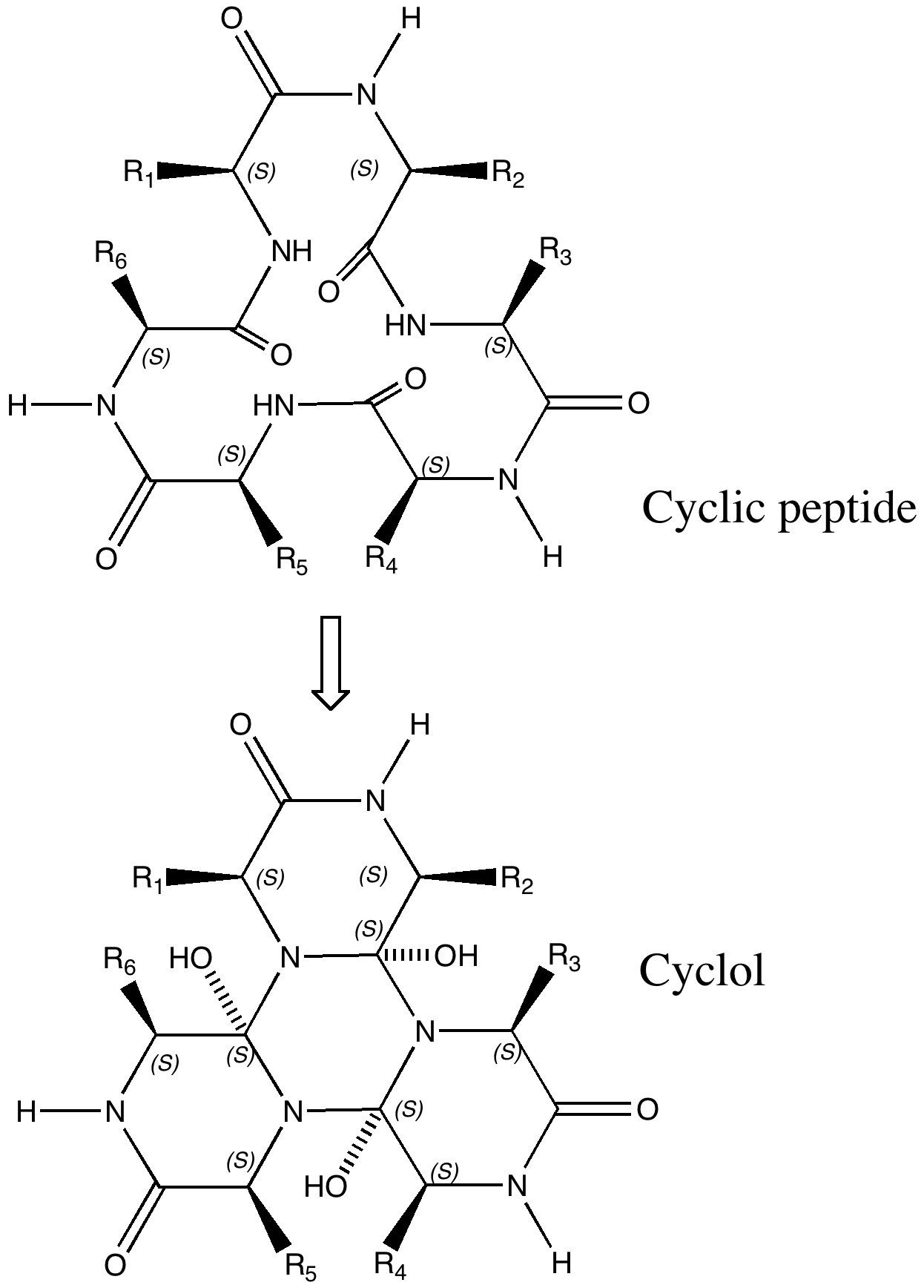
Dorothy Wrinch was a mathematician who came up with just such a hypothesis for rigid protein structure, based in effect on elegance and symmetry, coupled with some knowledge of chemistry and crystallography[1]. She had noticed that the repeating polypeptide motif might be folded such that a cyclisation could occur to give what she termed a cyclol (an organic chemist would call this an aminol, and we would also now recognize it as a three-fold tetrahedral intermediate of the type involved in the hydrolysis of peptides). Wrinch proposed that this cyclisation could be repeated on a large scale to produce rigid scaffolds for proteins. The three-fold symmetric elegance of such motifs clearly appealed to this mathematician (the interesting symmetrical and conformational properties of the central cyclohexane-like ring were still to be fully recognised by anyone. Since Wrinch built many 3D models of her cyclols, one can but wonder how that central ring was represented, and whether its chair conformation was at all recognised. Another Nobel prize awaited the discoverer of this, Derek Barton).

The Cyclol structure. Click for 3D.

An immense controversy immediately broke out (not least because little direct spectroscopic evidence for the OH groups could be found). The story is rivetingly told by Patrick Coffey in his book Cathedrals of Science (ISBN 978-0-19-532134-0). Linus Pauling entered the fray in 1939[2], and one of the arguments he deployed was not so much symmetric elegance but thermodynamics (he also suggested hydrogen bonding and  S-S linkages for rigidifying proteins). The proposed cyclisation, he suggested, led to a very high energy species. Whilst Wrinch attempted to refute this[3], Pauling’s arguments won almost everyone over. Although Wrinch forlornly continued to promote her idea, last reviewing the topic as late as in 1963[4], crystallography was now producing cast iron data for protein structures. None have ever emerged with a cyclol motif, and this hypothesis is now firmly consigned to untaught history[5]. To this day, no examples of the tris(aminol) cyclol ring are to be found in the Cambridge small molecule crystal structure database either (although some related tetrahedral intermediates are known as crystalline species, see for example here, and they can be quite easily characterised in solution, see for example[6].

When  I read the story, it struck me that modern theory could easily verify how valid Pauling’s thermodynamic argument was. I have picked (ala)6 as my model, and have calculated the relative free energy (ΔG298) of the following three isomers.

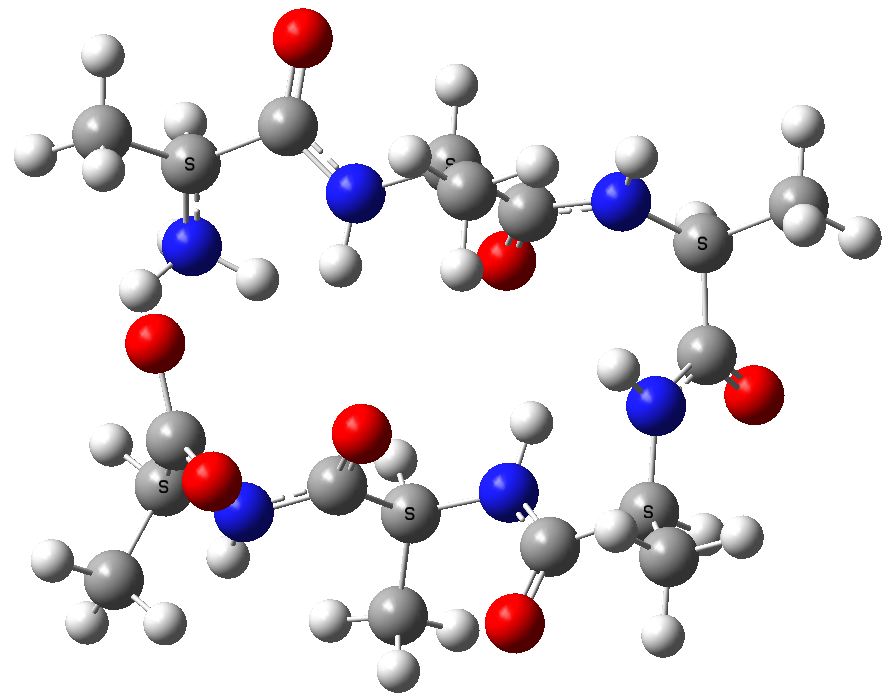
  1. An acyclic zwitterionic form of this hexapeptide, calculated with a SCRF reaction field for water to allow for the ionic nature (ωB97XD/6-31G(d,p)), reveals a proton transfer to a neutral system, with an energy of +7.3 kcal/mol

    Acyclic (ala)6, in zwitterionic form

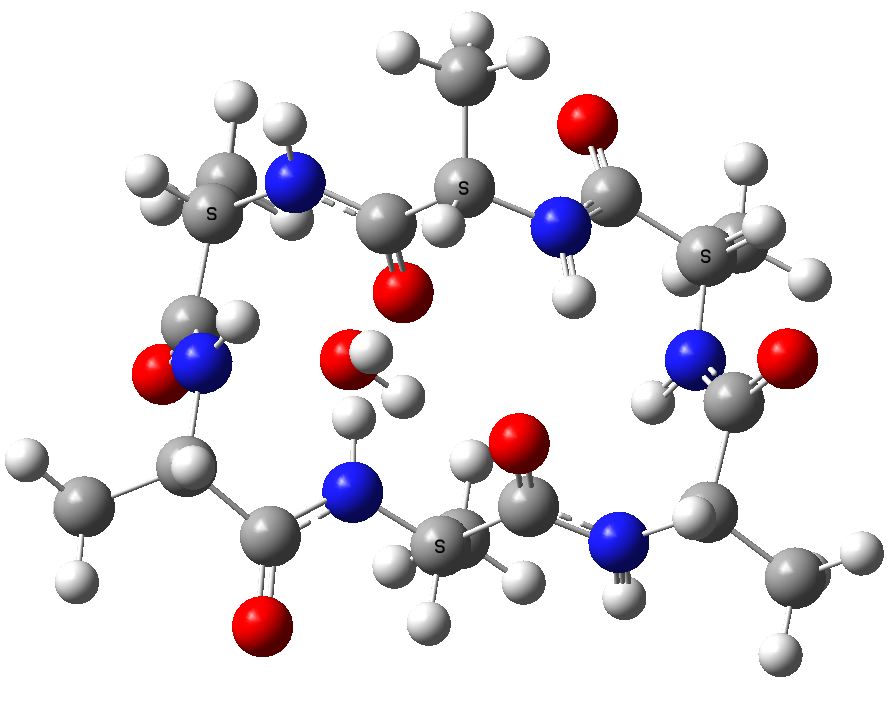
  2. A cyclic neutral peptide, which results from elimination of water from 1, again calculated with a water reaction field (DOI: 10042/to-8219), revealing a relative free energy of +0.0 kcal/mol

    Cyclic (ala)6

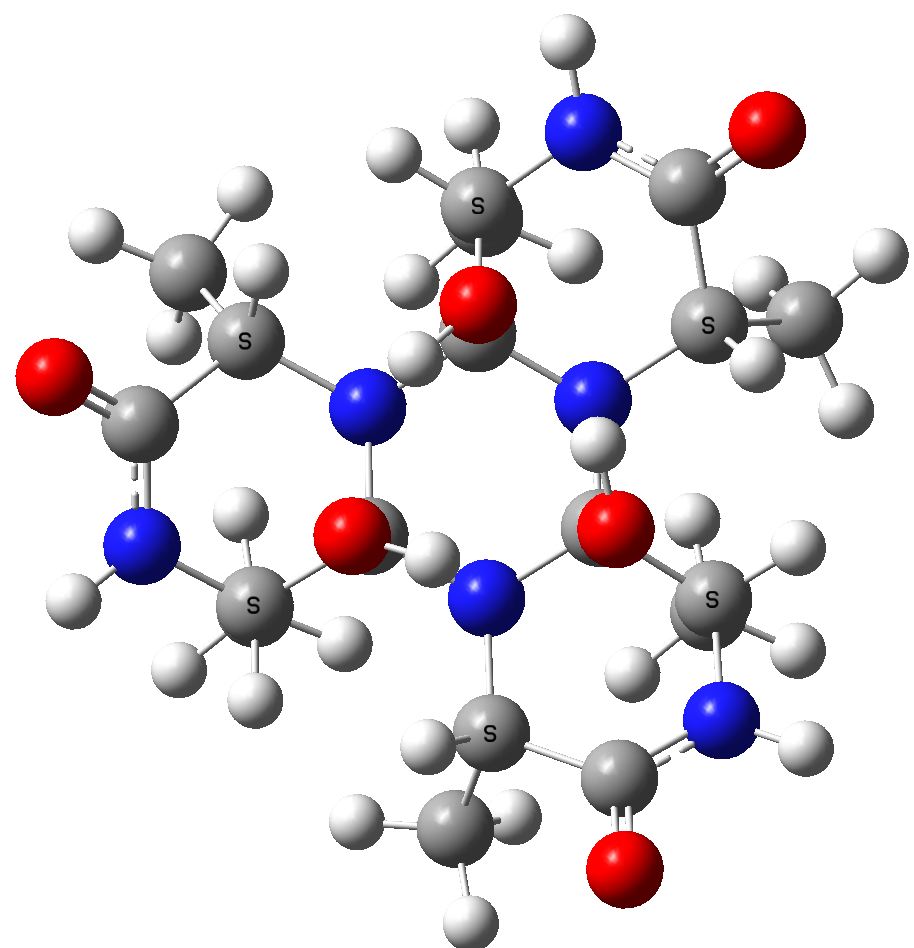
  3. The cyclic isomer 3 resulting from further cyclisation of 2 (DOI: 10042/to-8222) with a relative free energy of +69.0 kcal/mol

    Cyclol model for (ala)6.

From this, it appears that model 3 is ~69 kcal/mol less stable than the cyclic peptide 2, or 11.6 kcal/mol per amino acid residue. Pauling’s thermodynamic arguments suggested a value of ~28 kcal/mol (a value which Wrinch disputed as unreliable). So, in one sense, the above calculation is closer to Wrinch than to Pauling! In another, it still means Wrinch was wrong!! It is worth speculating why Pauling’s estimate is out. The cyclol 3 exhibits anomeric stabilizations, which of course were unknown in Pauling’s time. Both 2 and 3 exhibit attractive, but different, van der Waals attractions which contribute to their stabilities. And Pauling took no account of any entropy differences between 2 and 3. In retrospect,  3 was simply too rigid to allow most enzyme catalysis models to function, as we recognise them nowadays.

You might ask why I have revived a long forgotten theory as the topic of this post. Well, I think it is always worth revisiting the past, and re-examining old assumptions. When we do so, we find that Wrinch did not miss by as much as her detractors perhaps implied. With a little more luck, she might have gotten it right. Science is a bit like that, you need a dose of luck sometimes!

References

  1. "The cyclol hypothesis and the “globular” proteins", Proceedings of the Royal Society of London. Series A - Mathematical and Physical Sciences, vol. 161, pp. 505-524, 1937. https://doi.org/10.1098/rspa.1937.0159
  2. L. Pauling, and C. Niemann, "The Structure of Proteins", Journal of the American Chemical Society, vol. 61, pp. 1860-1867, 1939. https://doi.org/10.1021/ja01876a065
  3. D.M. Wrinch, "The Geometrical Attack on Protein Structure", Journal of the American Chemical Society, vol. 63, pp. 330-333, 1941. https://doi.org/10.1021/ja01847a004
  4. D. WRINCH, "Recent Advances in Cyclol Chemistry", Nature, vol. 199, pp. 564-566, 1963. https://doi.org/10.1038/199564a0
  5. C. Tanford, "How protein chemists learned about the hydrophobic factor", Protein Science, vol. 6, pp. 1358-1366, 1997. https://doi.org/10.1002/pro.5560060627
  6. H.S. Rzepa, A.M. Lobo, M.M. Marques, and S. Prabhakar, "Characterizing a tetrahedral intermediate in an acyl transfer reaction: An undergraduate 1H NMR demonstration", Journal of Chemical Education, vol. 64, pp. 725, 1987. https://doi.org/10.1021/ed064p725

Semantically rich molecules

Sunday, May 2nd, 2010

Peter Murray-Rust in his blog asks for examples of the Scientific Semantic Web, a topic we have both been banging on about for ten years or more (DOI: 10.1021/ci000406v). What we are seeking of course is an example of how scientific connections have been made using inference logic from semantically rich statements to be found on the Web (ideally connections that might not have previously been spotted by humans, and lie overlooked and unloved in the scientific literature). Its a tough cookie, and I look forward to the examples that Peter identifies. Meanwhile, I thought I might share here a semantically rich molecule. OK, I identified this as such not by using the Web, but as someone who is in the process of delivering an undergraduate lecture course on the topic of conformational analysis. This course takes the form of presenting a set of rules or principles which relate to the conformations of molecules, and which themselves derive from quantum mechanics, and then illustrating them with selected annotated examples. To do this, a great many semantic connections have to be made, and in the current state of play, only a human can really hope to make most of these. We really look to the semantic web as it currently is to perhaps spot a few connections that might have been overlooked in this process. So, below is a molecule, and I have made a few semantic connections for it (but have not actually fully formalised them in this blog; that is a different topic I might return to at some time). I feel in my bones that more connections could be made, and offer the molecule here as the fuse!

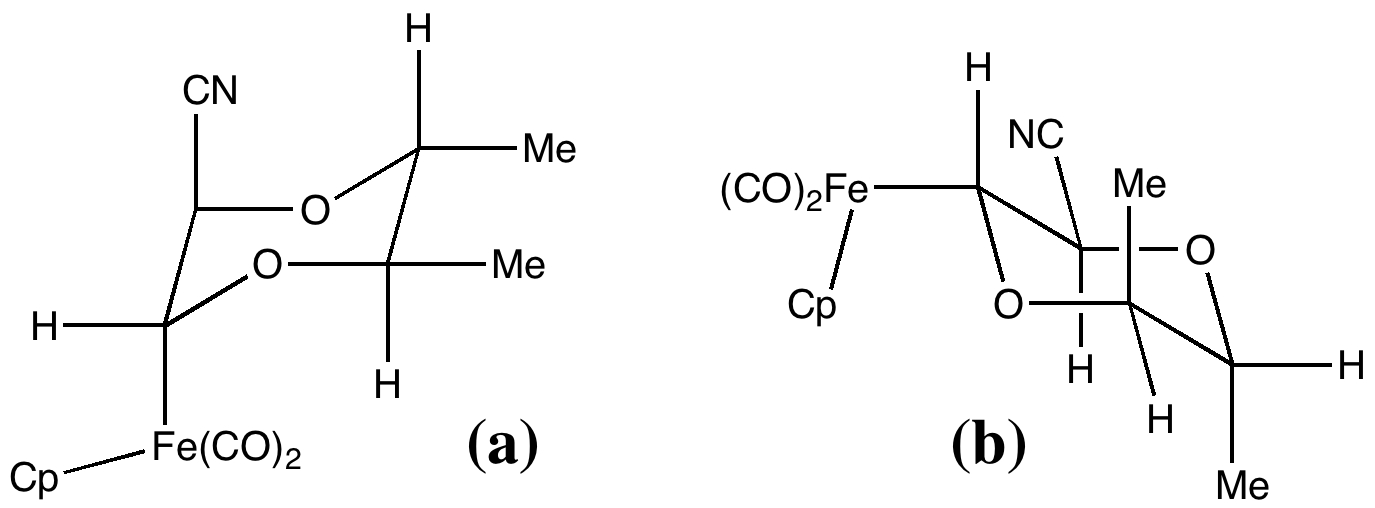
Two chair conformations of the molecule DULSAE. Click here for 3D. Note the (attractive) short H...H contacts.

To list all the likely semantics that a chemist would perceive in the graphic above would take far too long (by the time one would have finished, a text book would have been written). So here is a very very short summary in the context of conformational analysis.

  1. The molecule has a six membered ring as its backbone
  2. which can adopt two possible chair conformations
  3. which can interconvert by exchanging the axial and equatorial group pair for each of the four carbon atoms in the ring.
  4. An organic chemist will immediately notice a very unusual group, Fe(CO)2Cp, which itself is a semantic goldmine,
  5. but for the purposes here we will regard merely as a C-Fe bond!

The (semantic) question to be posed is “which of the two conformations shown above is the most stable“? That too of course has an abundance of implicit semantics, but most human chemists will probably know that this refers to asking which of the two geometries represents the lowest thermodynamic free energy (and we leave aside the issue of what medium the molecule is in, i.e. solid, solution or gas). A far trickier question is “why”?

So to (some interim) answers. Well, a ωB97XD/6-311G(d) calculation (wow, think of what is implied in that concise notation) predicts conformation (a) to be more stable by 2.3 kcal/mol (2.1 in ΔG, see DOI: 10042/to-4911). Now to the why. What connections would someone well versed in conformation analysis spot?

  1. The molecule has two methyl groups on adjacent atoms. They may prefer to be di-axial rather than di-equatorial to avoid excessive steric repulsions (whatever we mean by that!). That might prefer (b).
  2. The molecule has one carbon with both a cyano and an ether linkage. Well, that is susceptible to an anomeric effect (although, as I pointed out in an earlier post here, this connection has in fact often NOT been made in the literature). Only in conformation (a) is one of the oxygen lone pairs aligned anti-periplanar to the axis of the C-CN bond. The reasons why this is important are outlined in my Lecture course.
  3. Having spotted the last, the human might ask whether there is any possibility of an anomeric effect between an oxygen lone pair and the axis of the C-Fe bond? Well, I rather think that not a single human ever has asked that question! (I cannot know that of course, and perhaps someone has speculated upon this in the literature; this is where a full semantic web would help. That question could be posed of it! The reason  I suspect the connection might not have been made is that the anomeric effect is the domain of the organic chemistry, and  C-Fe bonds are those of the organometallic chemist. They do tend to see the chemical world rather differently, these two groups of chemists). If there was such an effect, it would favour (a).
  4. Then we have an X-C-C-Y motif. Depending on the nature of X and Y, the molecule might actually prefer a gauche conformation, i.e the dihedral angle XCCY would be around 60°. There are several such motifs one can detect; X=Y=O (twice). It might be that other permutations such as X=CN, Y=Fe(CO)2Cp, favour anti-periplanar. There are other permutations whose orientational preference may not even be recorded (in text books). Suddenly its gotten complicated!
  5. There are a number of short (~2.4Å) H…H contacts
  6. We are starting to understand that to unravel the conformation of this molecule, one may have to identify quite a number of different “rules”, and then to quantify each, and add up the numbers to get the final result. That energy of 2.3 kcal/mol may be composed of the result of applying quite a number of different rules. Hence the title of this post, a semantically rich molecule!

Well, I will leave it here for this post, without giving answers to the six points listed above, or really answering my main question posed above. That would make the post too complex (but I will follow this up!). I do want to end by planting the idea that answering this question involves making a great many chemical connections about the properties of this molecule, and then identifying quantitative ways (algorithms) in which an answer can be formulated. The molecule above is presented as a challenge for the Semantic Web to address!

Conformational analysis of cyclotriborazane

Sunday, February 14th, 2010

In an earlier post, I re-visited the conformational analysis of cyclohexane by looking at the vibrations of the entirely planar form (of D6h symmetry). The method also gave interesting results for the larger cyclo-octane ring. How about a larger leap into the unknown?

Let us proceed as follows. One fun game to play in chemistry is to invoke iso-electronic substitutions. In this case, we can subtitute a nitrogen and a boron atom for a pair of carbons. Thrice invoked, it leads to a molecule known as cyclotriborazane.

Cyclotriborazane.

This species is in fact very well known, and a crystal-structure was determined some time ago (DOI: 10.1021/ja00786a022). It is worth considering some of its properties.

  1. The species is crystalline, and sublimes rather than melts. Contrast this with the iso-electronic cyclohexane, which melts at around 6C (itself a surprisingly high value).
  2. The parent H3BNH3 also has a very high melting point of > 100C, which is attributed to an extensive array of so-called dihydrogen bonds in the crystal lattice, in which a positively charged hydrogen deriving from an NH is attracted to a negatively charged hydrogen deriving from a BH. Such dihydrogen bonds have been shown to be quite strong due to this electrostatic interaction, and are responsible for the extraordinary elevation of the melting point compared to the iso-electronic ethane.
  3. The chair form of cyclotriborazane aligns the three hydrogens shown in either blue or red in the axial positions. The three red hydrogens might be expected to be all negatively charged, and the three blue ones positively charged. So in the chair conformation, might we expected the electrostatic repulsions between either the blue or the red hydrogens to destabilize these axial positions, and hence perhaps even destabilize the chair conformation itself?

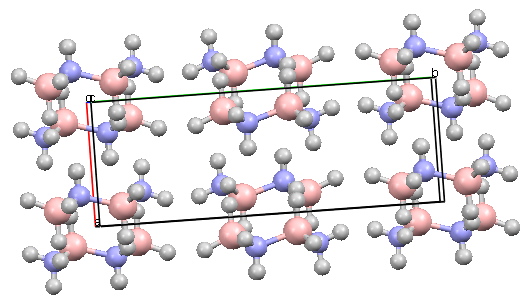
The crystal structure however shows clearly that the chair is still the favoured conformation. Equally intriguing, one might expect the three blue hydrogens to stack up to attract electrostatically to the three red hydrogens. But you can see from the crystal packing if you activate the model below that this does not happen!

Cyclotriborazane Crystal structure. Click for 3D

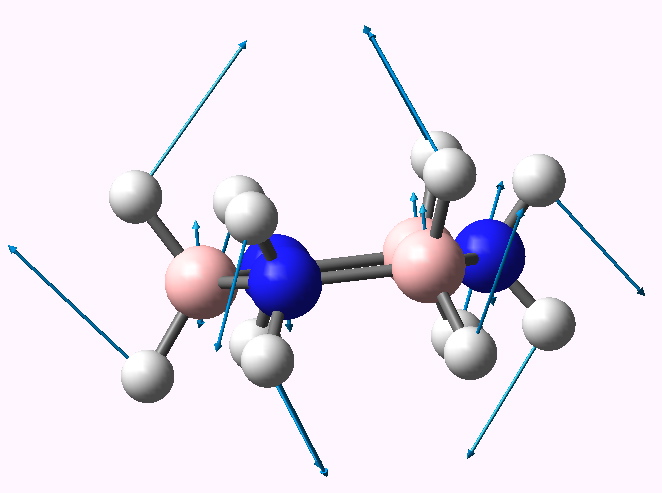
What of the vibrational analysis, conducted as it was for cyclohexane itself (DOI: 10042/to-4170). Well, just as before, for the planar geometry, three imaginary modes are calculated (A2“, E”) and just as before, they distort the geometry in the direction of a chair (Cs symmetry), a C2-disymmetric twist boat (with a predicted optical rotation of -54°) and a boat respectively (the latter, as before, being a transition state connecting the two C2-enantiomers).

Planar cyclotriborazane distorting to chair.

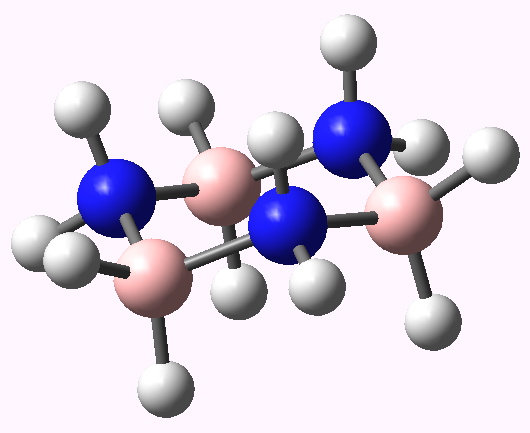
But here we get a surprise! According to the B3LYP/6-311G(d,p) model, the final resting energy for the chair is almost the same (indeed 0.2 kcal/mol higher in free energy) as the twist-boat. Perhaps that blue/red repulsion did have an effect after all! If you look at the calculated structure, you can indeed see that the blue/red hydrogens are splayed-out, avoiding each other!

Calculated geometry of the chair form of cyclotriborazane

This is one of those molecules where one might have expected surprises. In the end, it is surprising at how similar cyclotriborazane is to its iso-electronic cousin cyclohexane.

The conformation of cyclohexane

Thursday, January 28th, 2010

Like benzene, its fully saturated version cyclohexane represents an icon of organic chemistry. By 1890, the structure of planar benzene was pretty much understood, but organic chemistry was still struggling somewhat to fully embrace three rather than two dimensions. A grand-old-man of organic chemistry at the time, Adolf von Baeyer, believed that cyclohexane too was flat, and what he said went. So when a young upstart named Hermann Sachse suggested it was not flat, and furthermore could exist in two forms, which we now call chair and boat, no-one believed him. His was a trigonometric proof, deriving from the tetrahedral angle of 109.47 at carbon, and producing what he termed strainless rings.

Whilst the chair form of cyclohexane now delights all generations of chemistry students, the boat is rather more mysterious. Perhaps due to Sachse, it is still often referred to as a higher energy form of the chair (Barton, in the 1956 review that effectively won him the Nobel prize, clearly states that the boat is one of only two conformations free of angle strain, DOI: 10.1039/QR9561000044). Over the last 30 years or so, and especially with the advent of molecular modelling programs, the complexity of the conformations of cyclohexane has become realised. A nice recent illustration of that complexity is by Jonathan Goodman using commercial software. Here a slightly different take on that is presented.

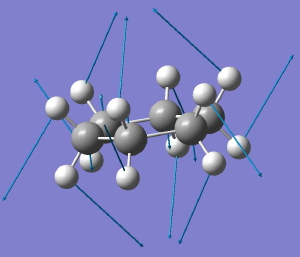
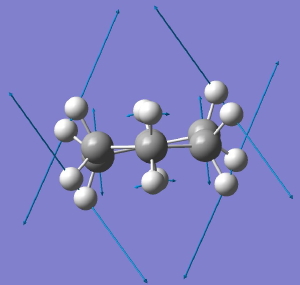
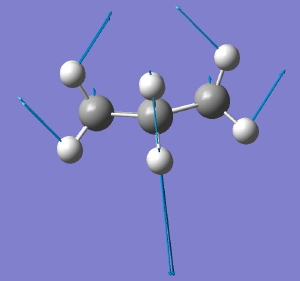
The starting point is the flat Baeyer model for cyclohexane. Like benzene, it has D6h symmetry. When subjected to a full force constant analysis using a modern program (in this instance Gaussian 09), this geometry is revealed (DOI: 10042/to-3708) to have three negative force constants, which in simple terms means it has three distortions which will reduce its energy. The eigenvectors of these force constants are shown below, and each set of vectors acts to reduce the symmetry of the species. Such symmetry-reduction is a well known aspect of group theory, and its analysis in the Lie symmetry groups is used in many areas of physics and mathematics, but it is a less used in chemistry.

348i cm-1 (B2g) 244i (E2u) 244i (E2u)
D6h to C2h for cyclohexane

D6h to C2h for cyclohexane. Click for animation.

D6h to D2

D6h to D2. Click for animation.

D6h to C2v

D6h to C2v. Click for animation.

The first of these symmetry-reducing vibrations (the B2g mode) converts the geometry immediately to the chair conformation of cyclohexane. So in some ways, this use of symmetry is a modern equivalent of the trigonometry used by Sachse to prove his point.

The next two modes are degenerate in energy, and the first of these reduces the symmetry to D2. The result is what we now call the twist-boat. It is interesting, because the D2 group is one of the (relatively few) chiral groups, and the twist-boat exhibits disymmetric symmetry. In other words, following the vibrational eigenvectors in one direction leads to one enantiomer of the twist boat, and in the other direction to the other enantiomer. So (in theory only), one might actually be able to produce chiral cyclohexane (the experiment and resolution would have to be done at very low temperatures!). It is also interesting that theory nowadays could quite reliably calculate the optical rotation of this species (and its circular dichroism spectrum), so we certainly would know what to look out for.

The second component of the degenerate E imaginary mode leads directly to a species of C2v symmetry, which we recognize as Sachse’s second possible form of cyclohexane. The symmetry-reductions of D6h to C2h, D2 and C2v all have paths on the grand diagram of the 32 crystallographic point groups and their sub groups, and is an interesting application of group theory to a mainstream topic in organic chemistry.

But the story is not quite complete yet. The C2v boat is not the final outcome of the last distortion! It too is a transition state, connecting again the two D2 forms. So the path from D6h to C2v is NOT a minimum energy reaction path, but a rather different type of path known as a valley-ridge inflection path. An example of such a surface can be seen for the dimerisation of cyclopentadiene (DOI: 10.1021/ja016622h) and effectively it connects one transition state to a second transition state, without involving any intermediates on the pathway. At some stage, the dynamics of the system takes over, and the symmetry breaks without the system ever actually reaching the second transition structure. This final aspect of the potential energy surface of cyclohexane was not discussed by Jonathan Goodman in his own article on the topic.

So symmetry-breaking is the topic of this blog, and its connection to physics and mathematics. And, I might add that the same approach can be taken for looking at the conformations of cyclobutane, pentane, heptane and octane. But that will be left for another post.

Postscript.  See this more recent post.