Posts Tagged ‘Derek Barton’

Concerted Nucleophilic Aromatic Substitution Mediated by the PhenoFluor Reagent.

Thursday, September 20th, 2018

Recently, the 100th anniversary of the birth of the famous chemist Derek Barton was celebrated with a symposium. One of the many wonderful talks presented was by Tobias Ritter and entitled “Late-stage fluorination for PET imaging” and this resonated for me. The challenge is how to produce C-F bonds under mild conditions quickly so that 18F-labelled substrates can be injected for the PET imaging. Ritter has several recent articles on this theme which you should read.[1],[2]

The resonance was that back in 1999 I had been collaborating with colleagues to study the mechanism of rapid fluoridation using R2IF reagents.[3]. This article, by the way, contains a very early example of the use of FAIR data (see here). A further resonance is that Ritter computes that the displacement of an aryl-O bond by a nucleophilic fluorine is a concerted process, unlike the stepwise Meisenheimer like complexes normally occurring in nucleophilic aromatic substitutions. A few years back I explored the possibility of concerted nucleophilic substitutions, finding that F in particular was very prone to such behaviour. So it is nice to see Ritter’s real-world example of such a mechanism and indeed that his reagents (PhenoFluor) represent a significant improvement on the R2IF ones we had been exploring.

To celebrate this new chemistry, I include some results of my own which augment Ritter’s. Firstly I should start with the structure of the reagent, which contains a carbon surrounded by four heteroatoms. There are few such motifs known. Thus a carbon attached to two N, one F and one O has no reported crystal structures. Relaxing the criterion to two N, one F and one other offers 71 examples, of which the most interesting are the outliers with C-F distances > 1.4Å. 

The one with the value 1.5Å (DOI: 10.5517/ccdc.csd.cc1njjg5) is probably an error, as is the one at 1.45Å[4]. So it was a surprise to find that the calculated structure of PhenoFluor (R=2,6-di-isopropyl, B3LYP+D3BJ/Def2-TZVPPD/SCRF=toluene) had a C-F distance of 1.456Å which is surely a candidate for the longest known C(sp3)-F bond. The computed Wiberg C-F bond order is 0.687, which is well reduced from a single bond order. This is probably due to strong anomeric effects from both nitrogens and the one oxygen, which “gang up” on the fluorine to weaken its bond and expel it as a nascent fluoride anion. Thus the E(2) NBO interaction energy is 25.1 kcal/mol for the N(Lp)-CFσ* interaction, which is unusually large, whereas the N(Lp)-COσ* interaction is only 9.2 kcal/mol.

The fluoridation is indeed computed as a concerted process, the IRC animation being shown below. Note that the trajectory of the F is initially away from the carbon but not towards the aryl group. Here it is simply forming a “hidden” fluoride anion intermediate. The trajectory then changes direction to attack the ipso-carbon. So it is a concerted but two-stage reaction path.

The IRC energy profile corresponds to a free energy barrier of 23 kcal/mol, as reported by Ritter. 

Here is a less well used property along the reaction path, the dipole moment response. This shows a very abrupt charge separation in the region of the transition state and its collapse shortly after which suggests that the reaction barrier might be sensitive to the polarity of the solvent.

The issue then arises as to how much aromatic resonance is lost at the transition state. A NICS(1) aromaticity probe placed 1Å above the centroid of the aryl ring has the value -9.3 ppm, close to the value of ~ -10ppm for benzene itself. So this relatively facile reaction is in part due to significant preservation of the aryl stabilisations by aromatic resonance.

To close, the Phenofluor reagent is commercially available as a 0.1M solution in toluene, which makes one wonder if it is possible to obtain crystals. It might be of course that when the solution is concentrated, it reverts to the iminium fluoride ion pair shown above. But if crystals are possible, then it would be interesting to verify that the C-F bond in this species is indeed unusually long, perhaps even a record holder?


The data represent an early use of the Chime plugin to present a visual 3D model. I really should re-work that page to allow use of eg JSmol, enabled here on this blog.

Excepting CF3X motifs.

FAIR data for the results reported here can be found at DOI: 10.14469/hpc/4713

References

  1. P. Tang, W. Wang, and T. Ritter, "Deoxyfluorination of Phenols", Journal of the American Chemical Society, vol. 133, pp. 11482-11484, 2011. https://doi.org/10.1021/ja2048072
  2. C.N. Neumann, and T. Ritter, "Facile C–F Bond Formation through a Concerted Nucleophilic Aromatic Substitution Mediated by the PhenoFluor Reagent", Accounts of Chemical Research, vol. 50, pp. 2822-2833, 2017. https://doi.org/10.1021/acs.accounts.7b00413
  3. M.A. Carroll, S. Martín-Santamaría, V.W. Pike, H.S. Rzepa, and D.A. Widdowson, "An ab initio and MNDO-d SCF-MO computational study of stereoelectronic control in extrusion reactions of R2I–F iodine(III) intermediates†", Journal of the Chemical Society, Perkin Transactions 2, pp. 2707-2714, 1999. https://doi.org/10.1039/a906212b
  4. T.N. Bhat, and H.L. Ammon, "Structure of N,N,N'N'-tetrakis(2-fluoro-2,2-dinitroethyl)oxamide by the consistent electron density approach", Acta Crystallographica Section C Crystal Structure Communications, vol. 46, pp. 112-116, 1990. https://doi.org/10.1107/s0108270189005044

Tetrahedral carbon and cyclohexane.

Wednesday, August 22nd, 2018

Following the general recognition of carbon as being tetrahedrally tetravalent in 1869 (Paterno) and 1874 (Van’t Hoff and Le Bell), an early seminal exploitation of this to the conformation of cyclohexane was by Hermann Sachse in 1890.[1] This was verified when the Braggs in 1913[2], followed by an oft-cited article by Mohr in 1918,[3] established the crystal structure of diamond as comprising repeating rings in the chair conformation. So by 1926, you might imagine that the shape (or conformation as we would now call it) of cyclohexane would be well-known. No quite so for everyone!

When The Journal of the Imperial College Chemical Society (Volume 6) was brought to my attention, I found an article by R. F Hunter;

He proceeds to argue as follows:

  1. The natural angle subtended at a tetrahedral carbon is 109.47°.
  2. “The internal angle between the carbon to carbon valencies of a six-membered ring cyclohexane will, if the ring is uniplanar, be … 120°.
  3. “When the cyclohexane ring is prepared … we must therefore have the pushing apart of two of the valencies”.
  4. The object of the experiments commenced in this College in 1914 was “to find what effect the pushing apart of the valencies …must have on the angle between the remaining pair of valencies“.
  5. You do wonder then why the assumption highlighted in red above was never really questioned during the twelve-year period of investigating angles around tetrahedral carbon.

The article itself is quite long, reporting the synthesis of many compounds in search of the postulated effect. Of course around twenty years later, Derek Barton used the by then generally accepted conformation of cyclohexane to explain reactivity in what become known as the theory of conformational analysis.

These two articles dating from 1926, and probably thought lost to science, show how some ideas can take decades to have any influence, whilst others can take root very much more quickly.


The chair cyclohexane structure is easily discerned from Figure 7 in the Braggs’ paper![2]

References

  1. H. Sachse, "Ueber die geometrischen Isomerien der Hexamethylenderivate", Berichte der deutschen chemischen Gesellschaft, vol. 23, pp. 1363-1370, 1890. https://doi.org/10.1002/cber.189002301216
  2. W.H. Bragg, and W.L. Bragg, "The structure of the diamond", Proceedings of the Royal Society of London. Series A, Containing Papers of a Mathematical and Physical Character, vol. 89, pp. 277-291, 1913. https://doi.org/10.1098/rspa.1913.0084
  3. E. Mohr, "Die Baeyersche Spannungstheorie und die Struktur des Diamanten", Journal für Praktische Chemie, vol. 98, pp. 315-353, 1918. https://doi.org/10.1002/prac.19180980123

The history of stereochemical notation: a search for the earliest example.

Wednesday, September 12th, 2012

All organic chemists are familiar with the stereochemical notation for bonds, as shown below. But I had difficulty tracking down when it was introduced, and by whom. I offer a suggestion here, but if anyone reading this blog has got a better/earlier attribution, please let us know!

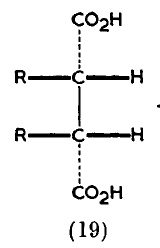
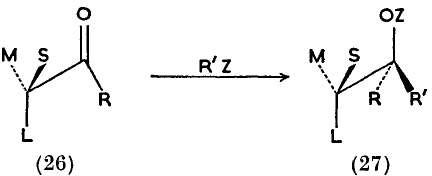
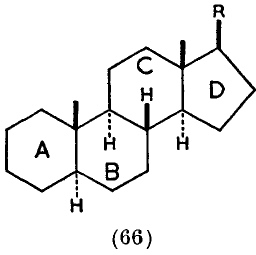
I suggest that the source is an article written by Derek Barton and R. C. Cookson in 1955 and published in 1956, entitled “The principles of conformational analysis” (DOI: http://dx.doi.org/10.1039/QR9561000044 ). Some examples are shown below. Compound 19 makes explicit the Fischer convention; 26/27 are indeed very modern, and 66 uses not wedges but bold bonds (which is very common nowadays but suffers from having a slightly different semantic interpretation which was proposed by Maehr).

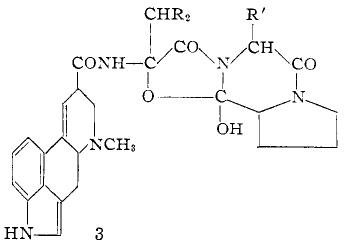
One might ask what another master of the period, R. B. Woodward was using. Thus in his 1956 article on the synthesis of lysergic acid, we see this. Plenty of stereochemistry, but not annotated as per above! What you do find  (and with Barton as well) is essentially modern use of the arrow pushing conventions, so by this period it was thoroughly established.

Going back to 1951, we see Stork offering a stereospecific synthesis (as far as I can tell, the first use of precisely this term in the literature). But in this example, there is no real need for clarification using the modern stereochemical notation.

So, can anyone find examples of modern notation earlier than Barton’s usage?

The Cyclol Hypothesis for protein structure: castles in the air.

Monday, April 4th, 2011

Most scientific theories emerge slowly, over decades, but others emerge fully formed virtually overnight as it were (think  Einstein in 1905). A third category is the supernova type, burning brightly for a short while, but then vanishing (almost) without trace shortly thereafter. The structure of DNA (of which I have blogged elsewhere) belongs to the second class, whilst one the brightest (and now entirely forgotten) examples of the supernova type concerns the structure of proteins. In 1936, it must have seemed a sure bet that the first person to come up with a successful theory of the origins of the (non-random) relatively rigid structure of proteins would inevitably win a Nobel prize (and of course this did happen for that other biologically important system, DNA, some 17 years later). Compelling structures for larger molecules providing reliable atom-atom distances based on crystallography were still in the future in 1936, and so structural theories contained a fair element of speculation and hopefully inspired guesswork (much as cosmological theories appear to have nowadays!).

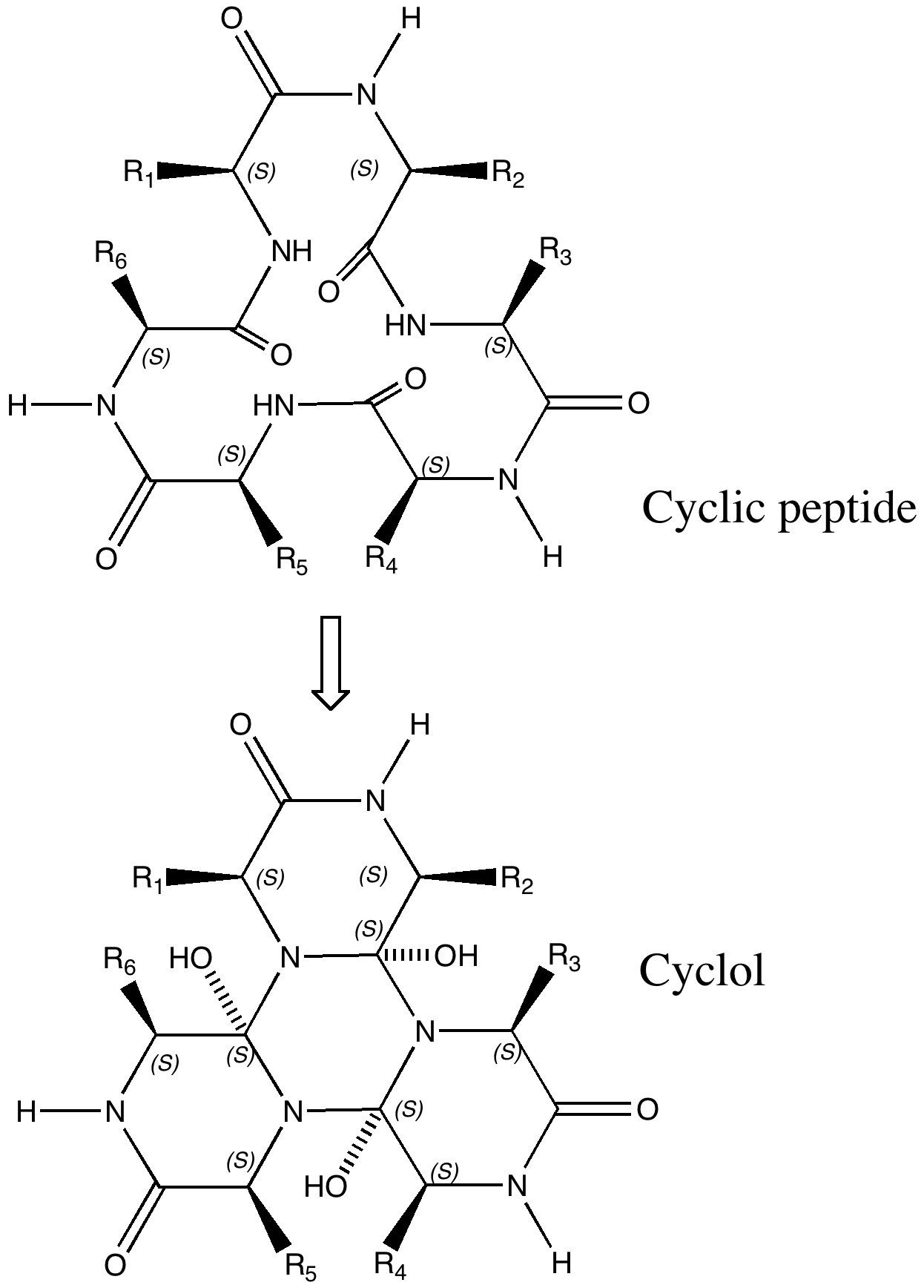
Dorothy Wrinch was a mathematician who came up with just such a hypothesis for rigid protein structure, based in effect on elegance and symmetry, coupled with some knowledge of chemistry and crystallography[1]. She had noticed that the repeating polypeptide motif might be folded such that a cyclisation could occur to give what she termed a cyclol (an organic chemist would call this an aminol, and we would also now recognize it as a three-fold tetrahedral intermediate of the type involved in the hydrolysis of peptides). Wrinch proposed that this cyclisation could be repeated on a large scale to produce rigid scaffolds for proteins. The three-fold symmetric elegance of such motifs clearly appealed to this mathematician (the interesting symmetrical and conformational properties of the central cyclohexane-like ring were still to be fully recognised by anyone. Since Wrinch built many 3D models of her cyclols, one can but wonder how that central ring was represented, and whether its chair conformation was at all recognised. Another Nobel prize awaited the discoverer of this, Derek Barton).

The Cyclol structure. Click for 3D.

An immense controversy immediately broke out (not least because little direct spectroscopic evidence for the OH groups could be found). The story is rivetingly told by Patrick Coffey in his book Cathedrals of Science (ISBN 978-0-19-532134-0). Linus Pauling entered the fray in 1939[2], and one of the arguments he deployed was not so much symmetric elegance but thermodynamics (he also suggested hydrogen bonding and  S-S linkages for rigidifying proteins). The proposed cyclisation, he suggested, led to a very high energy species. Whilst Wrinch attempted to refute this[3], Pauling’s arguments won almost everyone over. Although Wrinch forlornly continued to promote her idea, last reviewing the topic as late as in 1963[4], crystallography was now producing cast iron data for protein structures. None have ever emerged with a cyclol motif, and this hypothesis is now firmly consigned to untaught history[5]. To this day, no examples of the tris(aminol) cyclol ring are to be found in the Cambridge small molecule crystal structure database either (although some related tetrahedral intermediates are known as crystalline species, see for example here, and they can be quite easily characterised in solution, see for example[6].

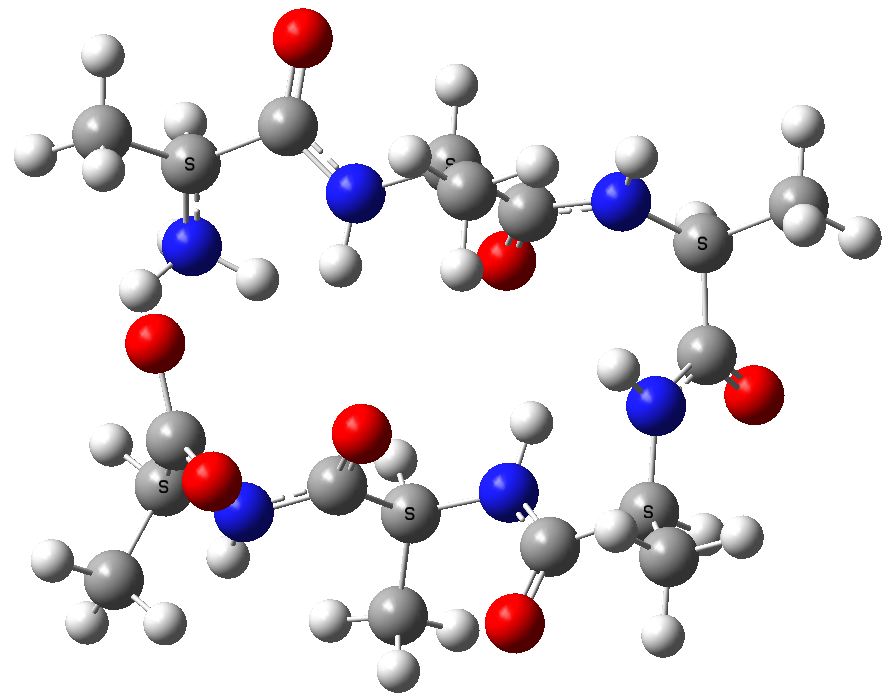
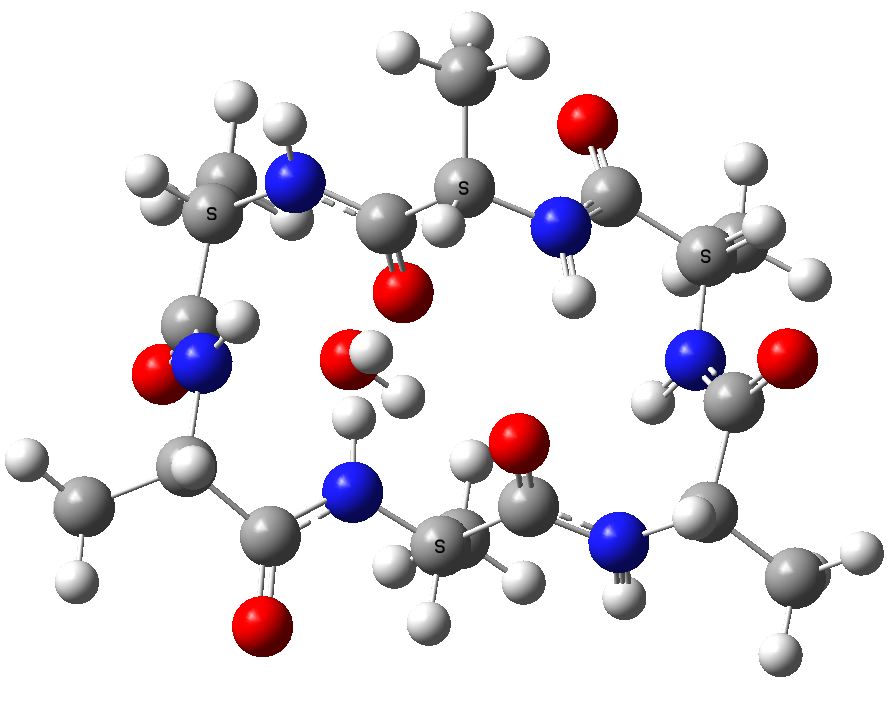
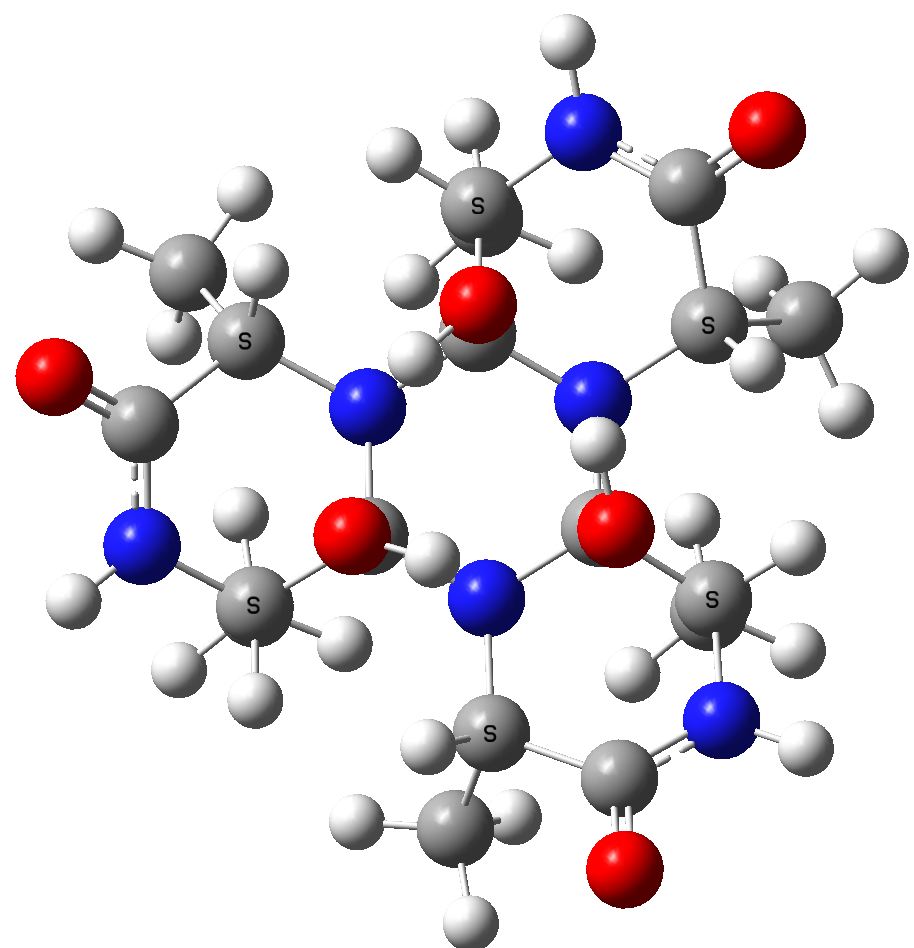
When  I read the story, it struck me that modern theory could easily verify how valid Pauling’s thermodynamic argument was. I have picked (ala)6 as my model, and have calculated the relative free energy (ΔG298) of the following three isomers.

  1. An acyclic zwitterionic form of this hexapeptide, calculated with a SCRF reaction field for water to allow for the ionic nature (ωB97XD/6-31G(d,p)), reveals a proton transfer to a neutral system, with an energy of +7.3 kcal/mol

    Acyclic (ala)6, in zwitterionic form

  2. A cyclic neutral peptide, which results from elimination of water from 1, again calculated with a water reaction field (DOI: 10042/to-8219), revealing a relative free energy of +0.0 kcal/mol

    Cyclic (ala)6

  3. The cyclic isomer 3 resulting from further cyclisation of 2 (DOI: 10042/to-8222) with a relative free energy of +69.0 kcal/mol

    Cyclol model for (ala)6.

From this, it appears that model 3 is ~69 kcal/mol less stable than the cyclic peptide 2, or 11.6 kcal/mol per amino acid residue. Pauling’s thermodynamic arguments suggested a value of ~28 kcal/mol (a value which Wrinch disputed as unreliable). So, in one sense, the above calculation is closer to Wrinch than to Pauling! In another, it still means Wrinch was wrong!! It is worth speculating why Pauling’s estimate is out. The cyclol 3 exhibits anomeric stabilizations, which of course were unknown in Pauling’s time. Both 2 and 3 exhibit attractive, but different, van der Waals attractions which contribute to their stabilities. And Pauling took no account of any entropy differences between 2 and 3. In retrospect,  3 was simply too rigid to allow most enzyme catalysis models to function, as we recognise them nowadays.

You might ask why I have revived a long forgotten theory as the topic of this post. Well, I think it is always worth revisiting the past, and re-examining old assumptions. When we do so, we find that Wrinch did not miss by as much as her detractors perhaps implied. With a little more luck, she might have gotten it right. Science is a bit like that, you need a dose of luck sometimes!

References

  1. "The cyclol hypothesis and the “globular” proteins", Proceedings of the Royal Society of London. Series A - Mathematical and Physical Sciences, vol. 161, pp. 505-524, 1937. https://doi.org/10.1098/rspa.1937.0159
  2. L. Pauling, and C. Niemann, "The Structure of Proteins", Journal of the American Chemical Society, vol. 61, pp. 1860-1867, 1939. https://doi.org/10.1021/ja01876a065
  3. D.M. Wrinch, "The Geometrical Attack on Protein Structure", Journal of the American Chemical Society, vol. 63, pp. 330-333, 1941. https://doi.org/10.1021/ja01847a004
  4. D. WRINCH, "Recent Advances in Cyclol Chemistry", Nature, vol. 199, pp. 564-566, 1963. https://doi.org/10.1038/199564a0
  5. C. Tanford, "How protein chemists learned about the hydrophobic factor", Protein Science, vol. 6, pp. 1358-1366, 1997. https://doi.org/10.1002/pro.5560060627
  6. H.S. Rzepa, A.M. Lobo, M.M. Marques, and S. Prabhakar, "Characterizing a tetrahedral intermediate in an acyl transfer reaction: An undergraduate 1H NMR demonstration", Journal of Chemical Education, vol. 64, pp. 725, 1987. https://doi.org/10.1021/ed064p725

The handedness of DNA: an unheralded connection.

Wednesday, December 29th, 2010

Science is about making connections. Plenty are on show in Watson and Crick’s famous 1953 article on the structure of DNA (DOI: 10.1038/171737a0), but often with the tersest of explanations. Take for example their statement “Both chains follow right-handed helices“. Where did that come from? This post will explore the subtle implications of that remark (and how in one aspect they did not quite get it right!).

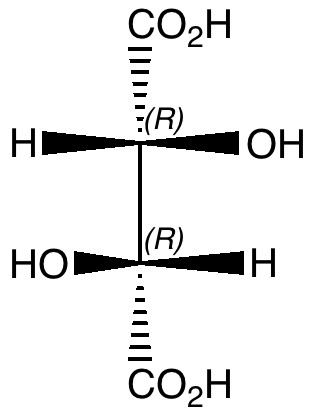
The right handed helix is illustrated in the article cited above as perhaps the most famous scientific diagram of the 20th century (as recounted in the TV program by Marcus du Sautoy). It was drawn by Odile Crick, a professional artist, and it is easily her best known work (the original, sadly, appears lost). Many say it has never been bettered; I do not reproduce it here for fear of copyright infringement, but you can see Odile (who died only recently) and her diagram here. One however has to go to the Watson-Crick (WC) full paper (DOI: 10.1098/rspa.1954.0101) for an explanation of why they decided the helix was right-handed, or (P)- in CIP terminology. In my opinion (as a chemist), this is a far better read than the short and more famous note in Nature. There (on page 87) one finds the immortal statement “we find by trial and error that the model can only be built in a right-handed sense”. They follow that remark with another which I will quote later in this post. But the preceding observation is footnoted, and that footnote must rank as one of the most unheralded in science (unlike e.g. Fermat’s). For this footnote notes another article, published just two years earlier (DOI: 10.1038/168271a0) in which the absolute handedness of a small molecule was finally confirmed after ~50 years. The molecule is shown below, and again in modern CIP terminology, the two chiral carbon atoms both have (R) configurations rather than (S). Until this point, the (R) configuration had merely been a guess with an evens chance of it being right (and had it been wrong, imagine how many textbook diagrams would have needed changing!).

The absolute configuration of natural tartaric acid.

Chemists had, in the preceding 50 years, by synthesis and transformation, connected the configuration of tartrate to the ribose sugars that form the linker in DNA, and so Watson and Crick built their famous model of DNA assured in the knowledge that the absolute configuration of their ribose sugar was correct. But that assurance, it is important to remember, had only come two years earlier! The (correct) structure of DNA was very much a discovery of its time, and this connection between tartrate and DNA I think deserves the accolade of great connections in science (I write this in the Semantic Web sense).

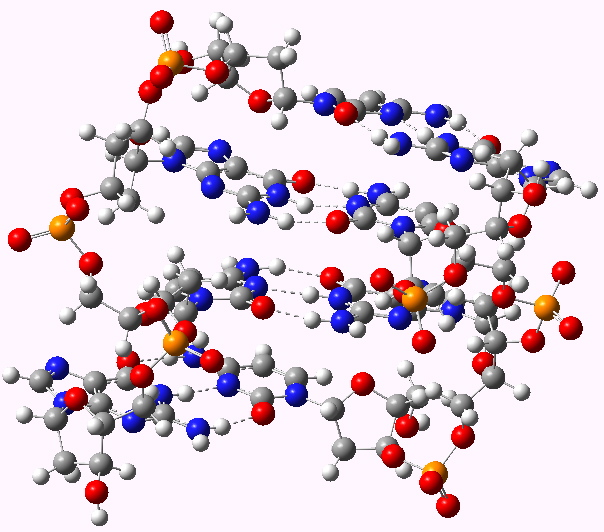
On to another statement to be found in the full WC article: “Left handed helices can only be constructed by violating the permissible van der Waals contacts” Given the nature of the molecular model building tools that WC had at their disposal,* I suspect we must forgive them this assertion. But of course, building models using the van der Waals constraints (amongst others of course) is what modern computers are really very good at. So what might a modern visitation of this very issue yield? Shown below is a small DNA duplex, named d(CGCG)2 (DOI: 10.2210/pdb1zna/pdb) This uses only the CG base-pairing motif (the other of course is AT). Well, it turns out that DNA constructed from CG-rich duplexes does NOT necessarily adopt a right handed helix after all! WC (for this particular condition) were in fact wrong, and clearly the van der Waals contacts are not after all objectionable. Left-handed helices (as a left hander myself, I am naturally drawn to them) are also known as Z-DNA (the right handed form is called B-DNA), although many left-handed representations have in fact been drawn in error.

The DNA duplex d(CGCG) showing a left handed helix. The ribose is in the 2E conformation. Click for 3D and see if you can find any objectionable van der Waals contacts!

The model when stripped of its water molecules, is then of a size (250 atoms) which is easily amenable to a modern quantum-mechanical DFT calculation. Importantly, this has to include dispersion corrections (the van der Waals contacts referred to above) to get the correct geometry, and one can use e.g. ωB97XD/6-31G(d) + continuum water solvation correction to compensate for the missing waters (see DOI: 10.1039/C0CC04023A for an example of its use for a large molecule, or indeed this post). In truth, this combination of characteristics in a model has only recently become possible for a molecule of such size.


Well, now that a good accuracy wavefunction for e.g. d(CGCG) is possible, what might one do with it? Well, the chiro-optical properties might be calculated (see DOI: 10.1002/chir.20804), including the optical rotation at a specified frequency, or e.g. the electronic circular dichroism spectrum. Such properties are normally computed only for much smaller molecules. Watch this space (or the journals).


* Note added in proof (as the saying goes): This article by Derek Barton published in 1947, some six years before WC claimed “violation of  the permissible van der Waals contacts“, established clearly the principles behind the model building by WC and in many ways could be described as the start of quantitative molecular model building. The very same equation used by Barton to model dispersion attractions is still used in e.g. the ωB97XD DFT method noted above.


Conformational analysis of biphenyls: an upside-down view

Friday, April 2nd, 2010

One of the (not a few) pleasures of working in a university is the occasional opportunity that arises to give a new lecture course to students. New is not quite the correct word, since the topic I have acquired is Conformational analysis. The original course at Imperial College was delivered by Derek Barton himself about 50 years ago (for articles written by him on the topic, see DOI 10.1126/science.169.3945.539 or the original 10.1039/QR9561000044), and so I have had an opportunity to see how the topic has evolved since then, and perhaps apply some quantitative quantum mechanical interpretations unavailable to Barton himself.

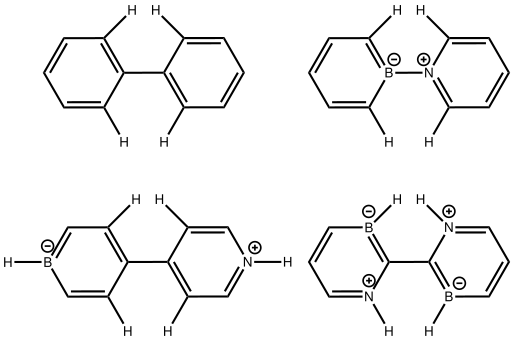
The example I have chosen to focus on here is biphenyl (a derivative of which also happens to be the first structure shown by Barton in his 1970 Science article noted above), but modified with iso-electronic B/N substitution for carbon for a particular reason.

biphenylFour hydrogen atoms are highlighted in the above drawings by virtue of how close they might approach each-other, and what impact this will have on the conformation of each species. Such close approaches are normally defined with reference to the so-called van der Waals radius of the element concerned. For hydrogen, this radius is either 1.2Å (if the contact is to another hydrogen) or 1.1Å (if its to any other element, see DOI: 10.1021/jp8111556). An interpretation of this value is that the van der Waals attraction due to to dispersion or long range correlation effects reaches a maximum for two non-bonded hydrogen atoms at ~2.4Å. Significantly, a slightly closer approach than this value might still be mildly attractive, but it would be generally agreed that any distance less than ~2.1Å now represents a genuine repulsion between the hydrogens (see also this post). This represents a somewhat more quantitative judgement on what used to be called steric interactions.
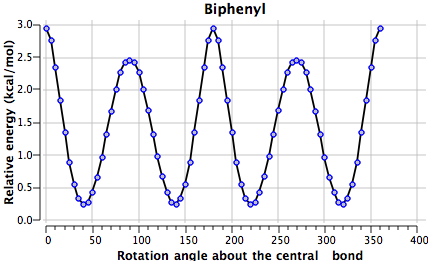
With the scene set, let me introduce the results of a calculation (wB97XD/6-31G(d,p), a DFT method selected because it treats the long range correlation effects with a specific correction)

Conformational analysis of biphenyl 1

One can see here minima at ~45, 135, 225 and 315° for 1 (see DOI 10042/to-4853). Due to symmetry, the first and last are identical as are 2nd and 3rd, and the 1st and 2nd minima are in fact enantiomers of each other (the symmetry is D2, which is chiral). Two different transition states connect these minima, one with angles of 0/180 and the other slightly lower energy at 90/270°.

The non-bonded H…H distance are as follows: 1.95Å@0°, 2.39Å@45° and 3.54Å@90°. We may conclude that the first of these is repulsive, the second attractive and the third non interacting. Counterbalancing this effect is of course resonance due to π-π-overlaps across the central bond, which decreases to zero as the angle moves to 90°. The conformational minimum @45° is such because of the maximal H…H dispersion attraction and the still significant π-π-overlap. This brief analysis suggests however that these two effects are finely balanced, and so the next question is whether one might be able to perturb the system to distort the balance. The perturbation chosen is to replace one or two pairs of carbon atoms with the iso-electronic combination B+N.

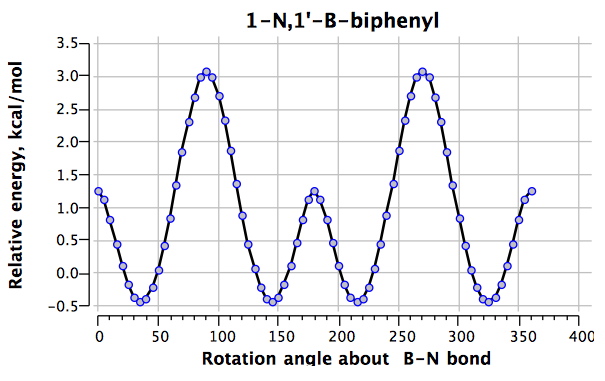
The first perturbation is to replace the central rotating bond by a B-N combination 2 (DOI: 10042/to-4854).

Rotation about the B-N bond in 2

For this species, the H…H distances are 2.02Å@0°, 2.36Å@45° and 3.61Å@90°, the only significant difference with 1 emerging as the 0° conformation being around 1 kcal/mol lower relative to the other two. It is tempting to attribute this to the longer H…H separation for this rotamer in 2 due to the B-N bond being longer (1.562Å) than the C-C bond it replaced (1.496Å)

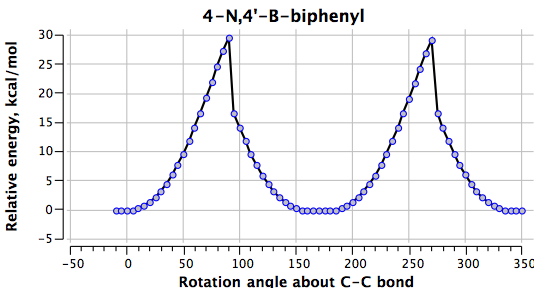
The next perturbation is to relocate the N/B pair as in 3 (DOI: 10042/to-4855). If one imagines that this will be a minor perturbation, take a look at the profile below.

Rotation about central C-C bond in 3.

The world has been turned upside down. What were transition states @0° and @180° are now minima and the reason is easy to find. The central C-C bond is now only 1.400Å long, having acquired substantial double bond character, and being accordingly very much more difficult to twist (the barrier being ~30 kcal/mol). The π-π-overlap has won out completely, and in the process has forced the H…H distance down to a presumably repulsive 1.918Å. The penalty for this is that the overall energy of 3 is some 22.8 kcal/mol higher than 2.

Added in proof (as the expression goes): If the above profile is conducted with full geometry optimization in a solvent field (water), which helps stabilise charge separations, the profile changes to the below. The solvation reduces the barrier to rotation considerably, the energy maxima now reveal a proper stationary point (rather than the cusp), the minima are very slightly non-planar, but the basic inversion of the potential energy surface compared to 1 or 2 is still observed.

Rotation about the C-C bond for 3, with solvation correction

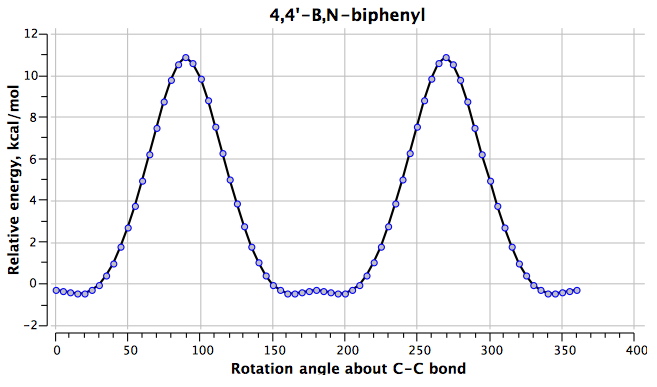
The final perturbation is 4 (DOI: 10042/to-4856) with the following rotational profile. Another surprise:

Rotation about the central C-C bond in 4.

The H…H distances are 1.930Å@0°, 1.789/2.275Å@180°. The difference from 1 is that the hydrogens now have opposite polarity for the N-H (which is positive) and the B-H (which is negative). At the rotation angle of 0°, two H(+)…(-)H style dihydrogen bonds (see also this post) are established (these are presumed to be very attractive); at an angle of 180°, the H(+)…(+)H and H(-)…(-)H interactions are presumed to be very repulsive. The difference between the two is ~18 kcal/mol.

We have learnt that conformational analysis for molecules such as these is a fight between π-π-overlaps, which themselves can have unexpected outcomes, weak van der Waals dispersion interactions between “neutral” non-bonded hydrogen atoms, and strong electrostatic attractions and repulsions between “ionic” hydrogens. Now perhaps the reason for the choice of the wB97XD DFT method can be seen; it is capable (at least in theory) of balancing these forces properly.

So the world of conformational analysis can be turned upside down, and analysing what happens from this topsy-turvy viewpoint can teach a lot!

Conformational analysis and enzyme activity: models for amide hydrolysis.

Sunday, April 12th, 2009

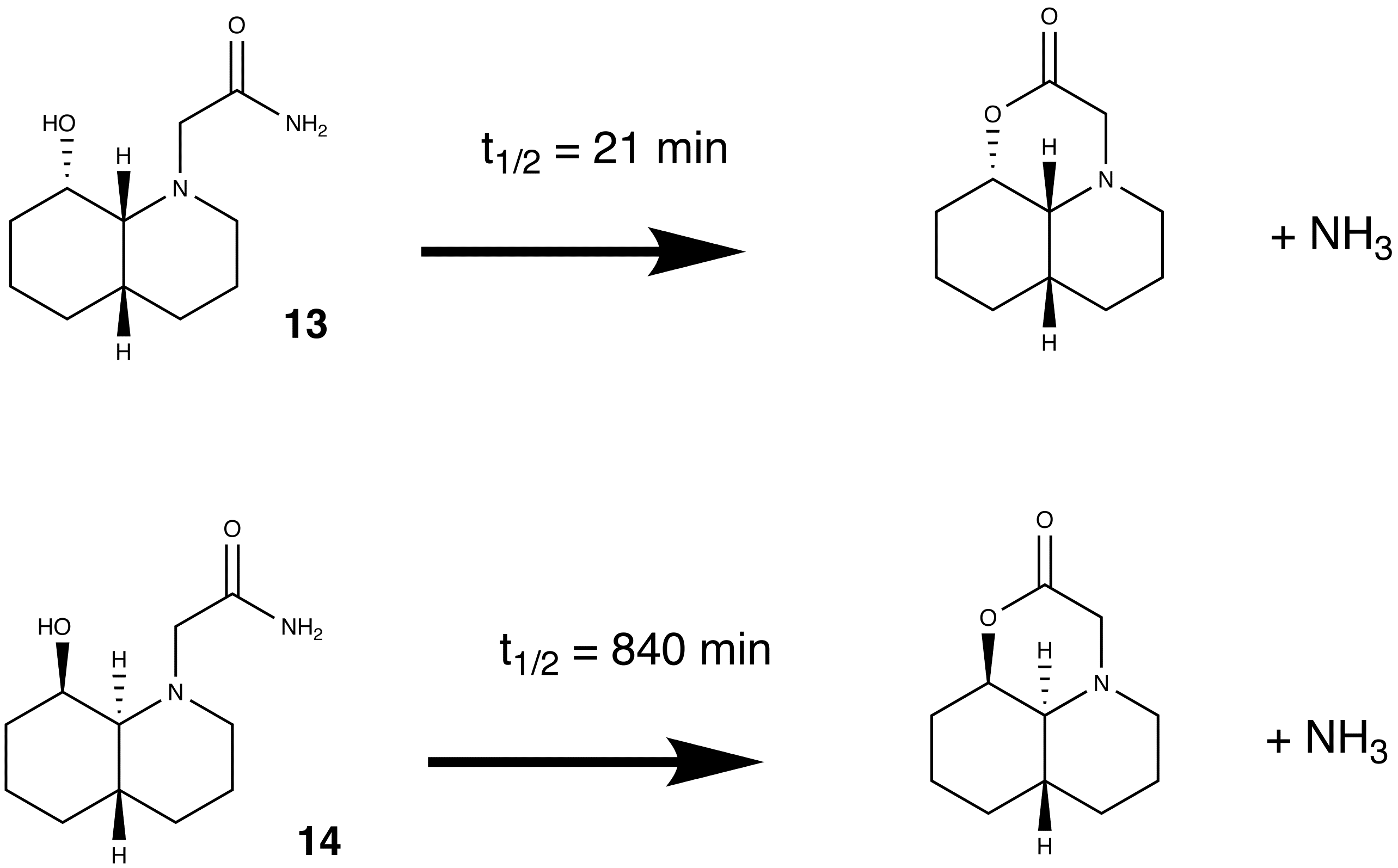
The diagram below summarizes an interesting result recently reported by Hanson and co-workers (DOI: 10.1021/jo800706y. At ~neutral pH, compound 13 hydrolyses with a half life of 21 minutes, whereas 14 takes 840 minutes. Understanding this difference in reactivity may allow us to understand why some enzymes can catalyze the hydrolysis of peptides with an acceleration of up to twelve orders of magnitude.

Models for peptide cleavage.

Models for peptide cleavage.

The secret to understanding this behaviour lies in a technique known as conformational analysis, for which Derek Barton was awarded a Nobel prize. Indeed, the very molecules for which he first developed his technique were the decalins, of which molecule  13 is an example of a cis-decalin and 14 a trans-decalin. Barton’s insight was to recognize that both types of ring prefer to exist in chair conformations rather than the alternative boat shape.

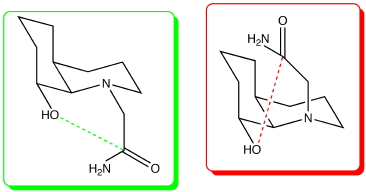
The technique pioneered by Barton for estimating the energies of these various conformations is called Molecular Mechanics, and can be used to explain the difference in reactivity. Considering first molecule 13, one can calculate its molecular mechanics energy for two conformations, differing in whether the N-alkyl sidechain is equatorial (left) or axial (right).

Cis amide

Cis amide. Click for Equatorial 3D.

The equatorial form (green box) comes out about 5 kcal/mol lower in energy than the axial (red box). One can also calculate the energy of the product, which arises from the OH attacking the carbon of the amide (dashed lines), evicting ammonia, and forming a cyclic lactone. Here, the most stable product (by ~10 kcal/mol) is again that resulting from the green bond forming. From the simple relationship ΔG = -RT Ln K (where K describes the position of the equatorial/axial equilibrium), one can conclude that the ratio equatorial/axialis ~4000, i.e. the favoured reaction arises from the most abundant reactant.

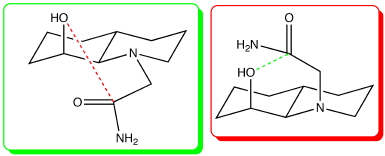
Trans amide

Trans amide. Click for 3D.

With the trans amide, the equatorial conformation (green box) is around 3 kcal/mol lower than the axial (red box), but now the most stable lactone product (by ~ 3 kcal/mol) arises (green bond) from the less stableaxial reactant. For reaction to occur, the equatorial reactant has to first isomerise to the axial, which imposes a ~3 kcal/mol penalty on the reaction. This is enough to slow the rate of the reaction significantly compared to the un-penalised cis-decalin reaction.