In his famous lecture in 1959, C. P. Snow wrote about the breakdown in communications between the “two cultures” of modern society — the sciences and the humanities (arts). That was then. This is now, and the occasion of my visit to a spectacular “city of arts and sciences complex” in Europe. An un-missable exhibit representing science and life was the 15m high model of DNA. Now to be fair this is styled an artist’s impression, and one presumes that an artist is allowed license. But how much license? And at how much expense to the science? And is there a counterbalance to the art where the science is fastidiously (but artistically) preserved?
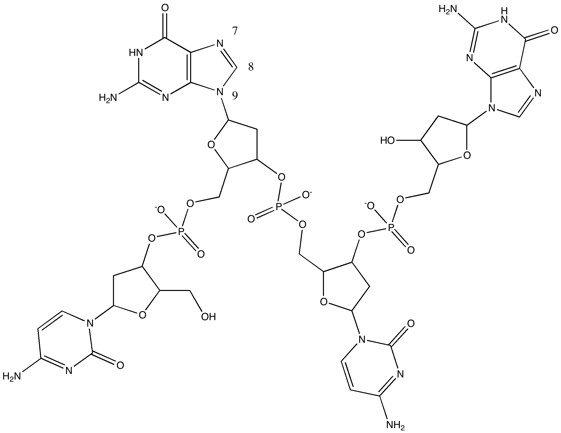
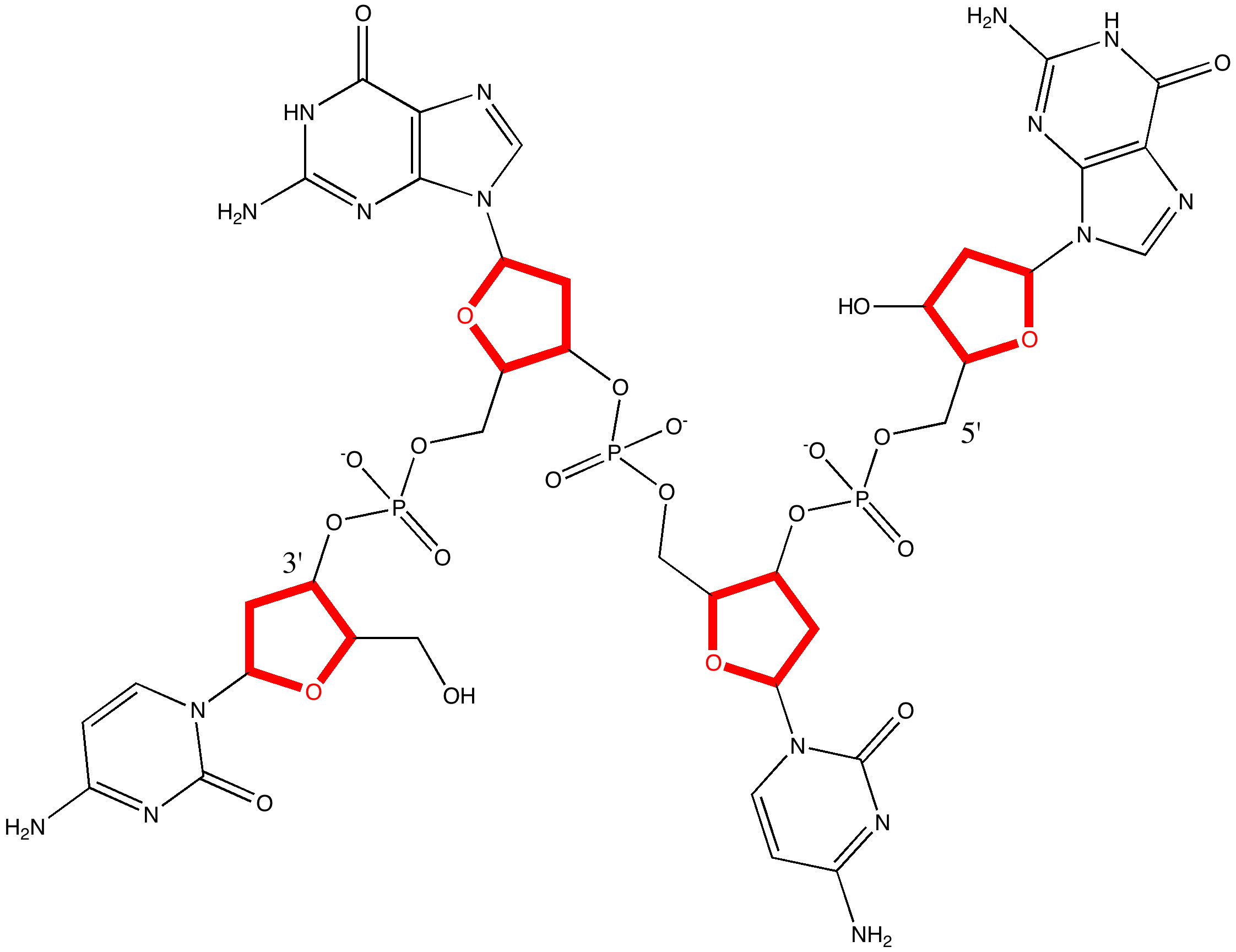
Let us start from the scientific end of this story, and try a mapping between the two representations. Below is a chemical diagram of one strand of the DNA duplex, showing two cytosines (the single 6-ring base) and two guanines (the 5+6 ring base) joined by a 5-ring ribofuranose to phosphates.
A scientific interpretation of DNA. Click for 3D model (of left handed duplex DNA!)The artist has mapped the phosphates to the blue spheres and is clearly taking the license of not showing all the atoms (and in particular the other heteroatoms, such as O and N). That is schematic and designed not to overwhelm. I am more or less still happy (although the missing carbonyls are strange). Next, the phosphates are linked to the ribose. If you look carefully you might spot that the link is built to the centre of a C-C bond (I am starting to get slightly worried now). You can also clearly see that the links to the guanines are via the 8-position of that ring, rather than the 9-position. Is this due to artistic license or the thought that it does not much matter? The pairs of bases, famously hydrogen bonded in a complementary manner, are now joined by a single “bond”, one end of which is now again attached at a bond mid-point. Little of the science of hydrogen bonding is preserved with this representation!
One more detail. These “rungs” joining the duplex have been rotated by 90° so that the planes of the bases are parallel to the helical axis, rather than perpendicular. How did the artist manage to construct his model in this orientation? Well, probably because he had been given a template similar to the (2D) structure diagram I showed above. A chemist would immediately “see” what is implicit in that diagram, which is all the C-H bonds. Chemists tend to miss these out, because they can be cluttered. But the hydrogen atoms are there, and they do occupy space. In the 3D model, they are still missing. If you imagine their positions in that model, you will immediately spot a number of locations where two hydrogen atoms are trying to occupy almost the same position in space! Of course, were you to rotate the sugar-base-base-sugar rungs by 90° this would create space for these invisible hydrogens.
So what about this breakdown in communication between the scientist and the artist? The latter has attempted two effects. One is to remove unnecessary detail so that one can directly go to the essentials. The other is to “move” the various components around so that they achieve greater “artistic effect”, but with a resulting substantial loss of scientific accuracy. I happen to believe that the model would have looked equally attractive if these scientific liberties had not been taken (perhaps even better!). Perhaps, as I suggest above, the artistic interpretation should be accompanied by a scientific one, to allow the visitor to the museum to see both? Or the communication between sculptor and scientist improved?
Well, I console myself with the observation that at least the artist represents a right rather than a left handed helix!
When Watson and Crick (WC) constructed their famous 3D model for DNA, they had to decide whether to make the double helix left or right handed. They chose a right-handed turn, on the grounds that their attempts at left-handed models all “violated permissible van der Waals contacts“. No details of what these might have been were given in their original full article (or the particular base-pairs which led to the observation). This follow-up to my earlier post explores this aspect, using a computer model.
One half of a (CGCG) DNA strand
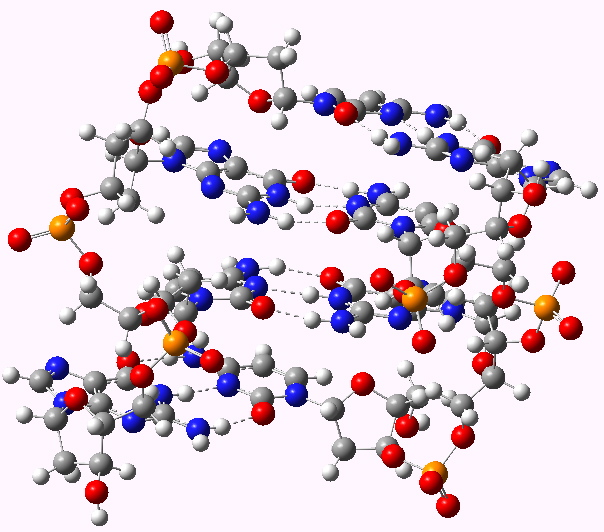
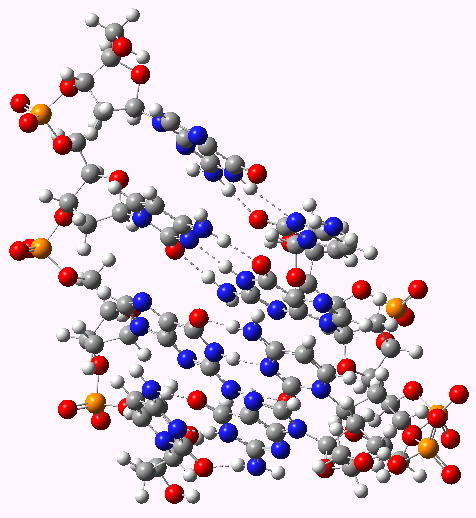
The DNA model used here is shown above; in shorthand it is d(CGCG)2. A crystal structure reveals it to form a (non-Watson-Crick) left-handed helix. If you open the 3D model below (based on a ωB97XD/6-31G(d)/SCRF=water optimisation), some of the short van der Waals contacts are measured. Most are around 2.25Å and the shortest is 2.1Å. It is worth noting that WC note in their article that a distance of 2.1Å for the B-form is acceptable (p92, bottom) and not a violation. All twelve hydrogen bond lengths H…O or H…N are normal, with lengths around 1.8Å. Given that a H…H distance is at its most attractive at ~2.4Å, and plenty of H…H distances of ~2.1Å are known from the crystal structures of organic molecules, one might conclude that (for the CG base pair), their hypothesis that the Z-form could be eliminated was wrong.
The DNA duplex d(CGCG) showing a left handed helix with short H…H contacts shown. Click for 3DBut might the original WC-right handed form for this system be at least competitive? There is one H…H of 2.05Å and quite a few at ~2.5Å (3D model below). The “violation” of van der Waals contacts is if anything slightly worse than with the left-handed helix. The total difference in the dispersion energy is a rather astonishing ~12 kcal/mol in favour of the Z-form. I will update this post (as a comment) when the relative free energies of the two forms are available (this calculation takes a while), but there is little doubt that the Z-form is indeed the more stable.
The DNA duplex d(CGCG) showing a right handed helix with short H…H contacts shown. Click for 3DWhat can also be said about the Watson-Crick right handed form is that the hydrogen bonding is not so optimal. One of the twelve interactions between a (terminal) CG pair has some signs of being “unzipped“, with an N-H…O=C distance of ~1.9Å (there is no sign of similar unzipping in the Z-form). One must wonder whether this difference in the Z- and B-helices for the CG pair has been exploited in nature.
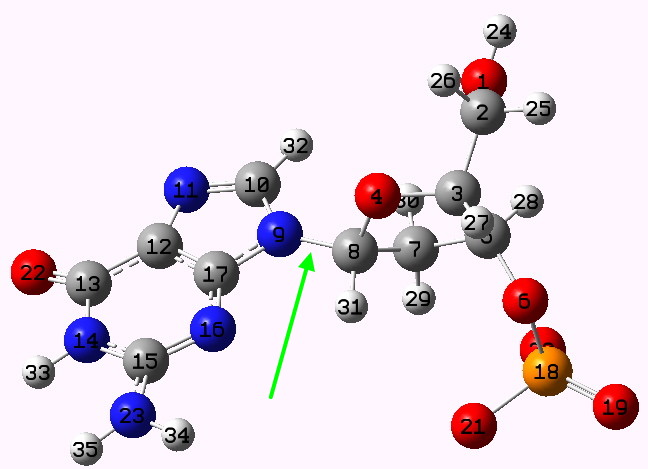
One crucial aspect of DNA is the local conformation about the bond connecting the base and the ribose, N9-C8 in the diagram below(green arrow).
Conformation of the base-ribose unitAn analysis of this bond can be expressed in terms of NBO theory. This clearly shows a strong interaction energy (E2) between the lone pair on N9 and the C8-O4 antibonding orbital of 13.3 kcal/mol, a classical anomeric effectin fact. In this case, it promotes the local conformation of this unit, which has a significant effect on the final model.
What else can analysis of the wavefunction tell us? Well, curiously, the optical rotation of this particular small oligomer has never been reported in the literature, and an intriguing question is whether it might have proved useful to distinguish between B- and Z-forms of the duplex? To do this, one needs a reasonably reliable way of computing [α]D for both isomers. This is because optical rotations are not reliably additive, and it is difficult to estimate them accurately based purely on the fragments present in the molecule. In 2011, is is now perfectly possible to calculate this quantity quantum mechanically, even for 250 atoms, using a reasonable basis set and making allowance for solvation (which is known to affect the calculated rotation). The values (CAM-B3LYP/6-31G(d)/SCRF=water) for the Z-isomer are 66° and 32° for the B-isomer. Of course the model is not complete, lacking a counterion for the phosphate and explicit water molecules, but even so, it might appear that the reason optical rotations are not reported is that they truly are not useful!
Acknowledgments
This post has been cross-posted in PDF format at Authorea.
Science is about making connections. Plenty are on show in Watson and Crick’s famous 1953 article on the structure of DNA[cite]10.1038/171737a0[/cite] but often with the tersest of explanations. Take for example their statement “Both chains follow right-handed helices“. Where did that come from? This post will explore the subtle implications of that remark (and how in one aspect they did not quite get it right!).
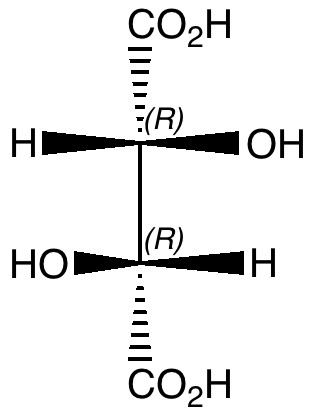
The right handed helix is illustrated in the article cited above as perhaps the most famous scientific diagram of the 20th century (as recounted in the TV program by Marcus du Sautoy). It was drawn by Odile Crick, a professional artist, and it is easily her best known work (the original, sadly, appears lost). Many say it has never been bettered; I do not reproduce it here for fear of copyright infringement, but you can see Odile (who died only recently) and her diagram here. One however has to go to the Watson-Crick (WC) full paper[cite]10.1098/rspa.1954.0101[/cite] for an explanation of why they decided the helix was right-handed, or (P)- in CIP terminology.[cite]10.1002/anie.196603851[/cite] In my opinion (as a chemist), this is a far better read than the short and more famous note in Nature. There (on page 87) one finds the immortal statement “we find by trial and error that the model can only be built in a right-handed sense”. They follow that remark with another which I will quote later in this post. But the preceding observation is footnoted, and that footnote must rank as one of the most unheralded in science (unlike e.g. Fermat’s). For this footnote notes another article, published just two years earlier[cite]10.1038/168271a0[/cite] in which the absolute handedness of a small molecule was finally confirmed after ~50 years. The molecule is shown below, and again in modern CIP terminology, the two chiral carbon atoms both have (R) configurations rather than (S). Until this point, the (R) configuration had merely been a guess with an evens chance of it being right (and had it been wrong, imagine how many textbook diagrams would have needed changing!).
The absolute configuration of natural tartaric acid.
Chemists had, in the preceding 50 years, by synthesis and transformation, connected the configuration of tartrate to the ribose sugars that form the linker in DNA, and so Watson and Crick built their famous model of DNA assured in the knowledge that the absolute configuration of their ribose sugar was correct. But that assurance, it is important to remember, had only come two years earlier! The (correct) structure of DNA was very much a discovery of its time, and this connection between tartrate and DNA I think deserves the accolade of great connections in science (I write this in the Semantic Web sense).
On to another statement to be found in the full WC article: “Left handed helices can only be constructed by violating the permissible van der Waals contacts” Given the nature of the molecular model building tools that WC[cite]10.1039/JR9480000340[/cite] had at their disposal,* I suspect we must forgive them this assertion.[cite]10.1016/0022-2836(79)90506-0[/cite],[cite]10.1038/287755a0[/cite] But of course, building models using the van der Waals constraints (amongst others of course) is what modern computers are really very good at. So what might a modern visitation of this very issue yield? Shown below is a small DNA duplex, named d(CGCG)2 (DOI: 10.2210/pdb1zna/pdb) This uses only the CG base-pairing motif (the other of course is AT). Well, it turns out that DNA constructed from CG-rich duplexes does NOT necessarily adopt a right handed helix after all! WC (for this particular condition) were in fact wrong, and clearly the van der Waals contacts are not after all objectionable. Left-handed helices (as a left hander myself, I am naturally drawn to them) are also known as Z-DNA (the right handed form is called B-DNA), although many left-handed representations have in fact been drawn in error.
The DNA duplex d(CGCG) showing a left handed helix. The ribose is in the 2E conformation. Click for 3D and see if you can find any objectionable van der Waals contacts!
The model when stripped of its water molecules, is then of a size (250 atoms) which is easily amenable to a modern quantum-mechanical DFT calculation. Importantly, this has to include dispersion corrections (the van der Waals contacts referred to above) to get the correct geometry, and one can use e.g. ωB97XD/6-31G(d) + continuum water solvation correction to compensate for the missing waters[cite]10.1039/C0CC04023A[/cite] for an example of its use for a large molecule, or indeed this post). In truth, this combination of characteristics in a model has only recently become possible for a molecule of such size.
Well, now that a good accuracy wavefunction for e.g. d(CGCG) is possible, what might one do with it? Well, the chiro-optical properties might be calculated[cite]10.1002/chir.20804[/cite] including the optical rotation at a specified frequency, or e.g. the electronic circular dichroism spectrum. Such properties are normally computed only for much smaller molecules. Watch this space (or the journals).
* Note added in proof (as the saying goes): This article[cite]10.1039/JR9480000340[/cite] by Derek Barton published in 1947, some six years before WC claimed “violation of the permissible van der Waals contacts“, established clearly the principles behind the model building by WC and in many ways could be described as the start of quantitative molecular model building. The very same equation used by Barton to model dispersion attractions is still used in e.g. the ωB97XD DFT method noted above.