Posts Tagged ‘PDF’
Saturday, February 16th, 2019
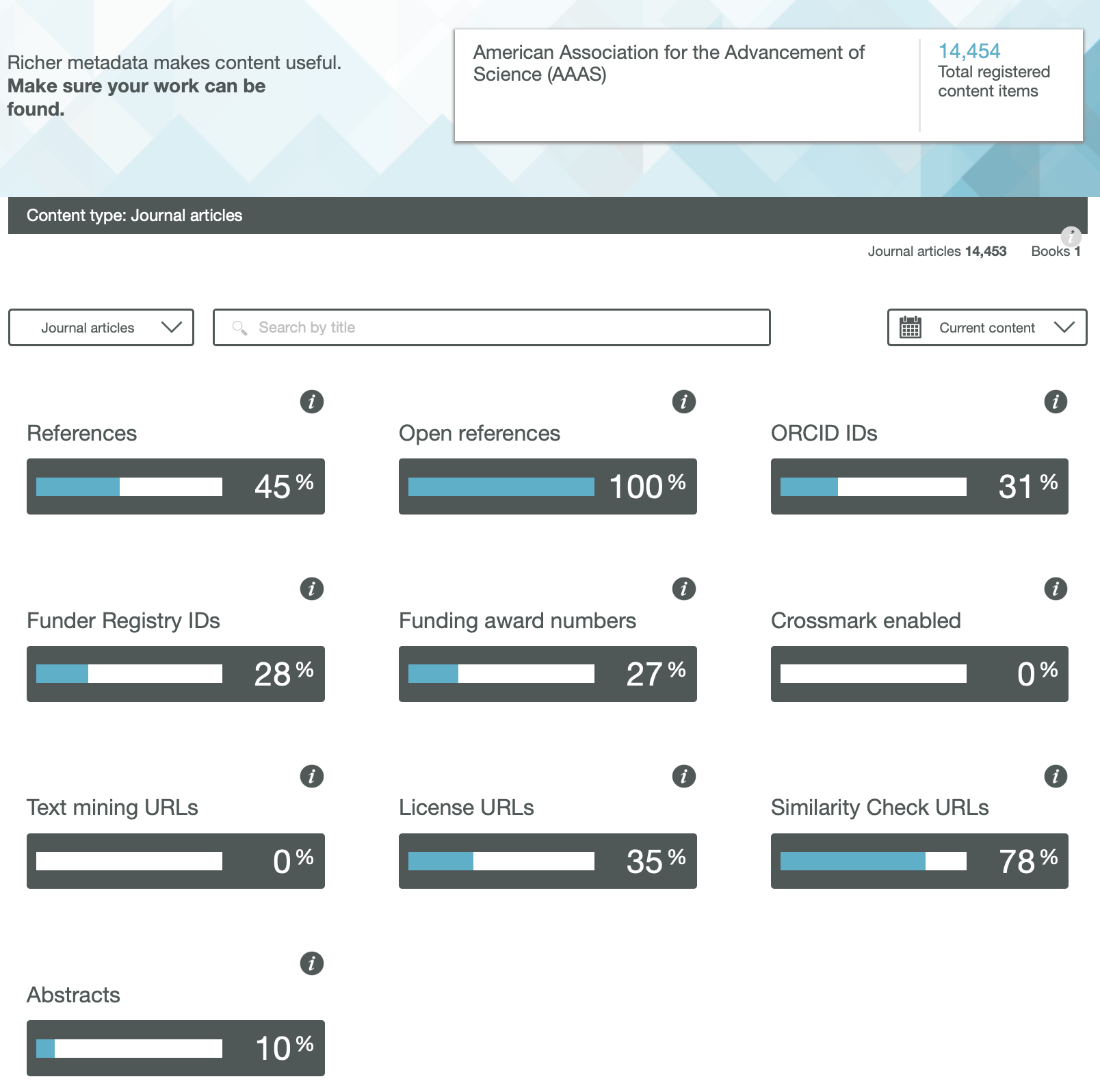
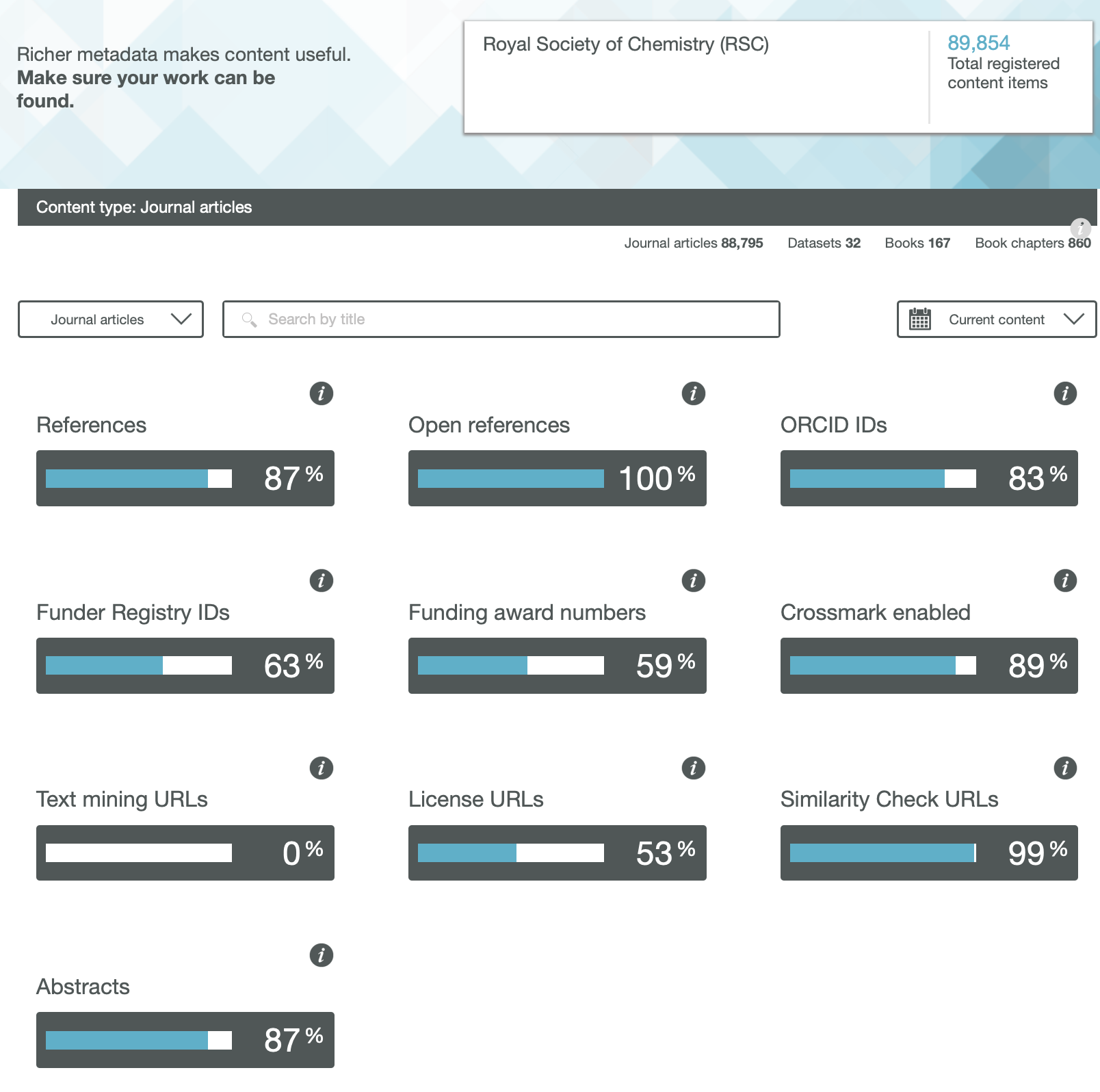
The title of this post comes from the site www.crossref.org/members/prep/ Here you can explore how your favourite publisher of scientific articles exposes metadata for their journal.
Firstly, a reminder that when an article is published, the publisher collects information about the article (the “metadata”) and registers this information with CrossRef in exchange for a DOI. This metadata in turn is used to power e.g. a search engine which allows “rich” or “deep” searching of the articles to be undertaken. There is also what is called an API (Application Programmer Interface) which allows services to be built offering deeper insights into what are referred to as scientific objects. One such service is “Event Data“, which attempts to create links between various research objects such as publications, citations, data and even commentaries in social media. A live feed can be seen here.
So here are the results for the metadata provided by six publishers familiar to most chemists, with categories including;
- References
- Open References
- ORCID IDs
- Text mining URLs
- Abstracts

RSC

ACS

Elsevier

Springer-Nature

Wiley

Science
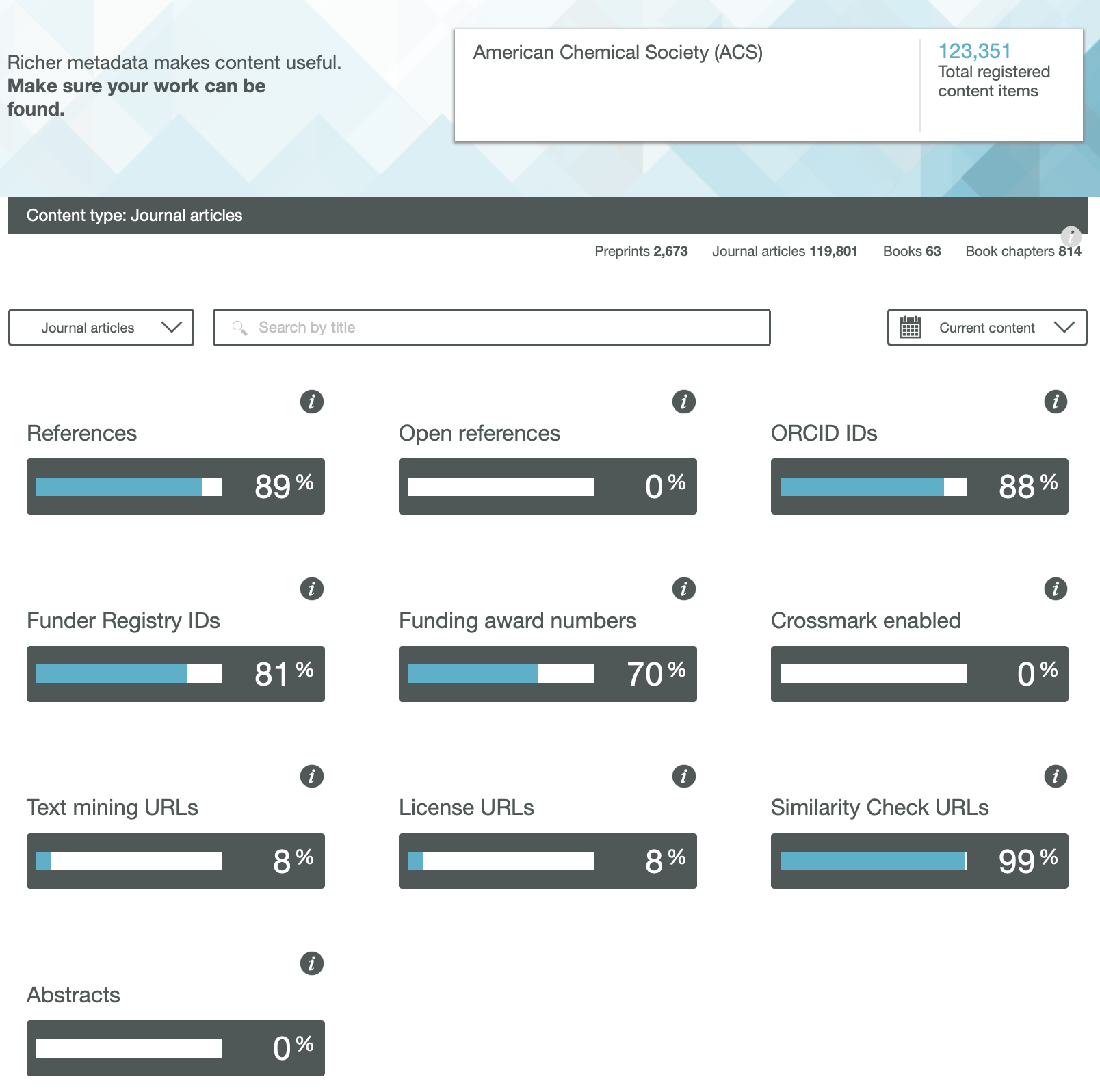
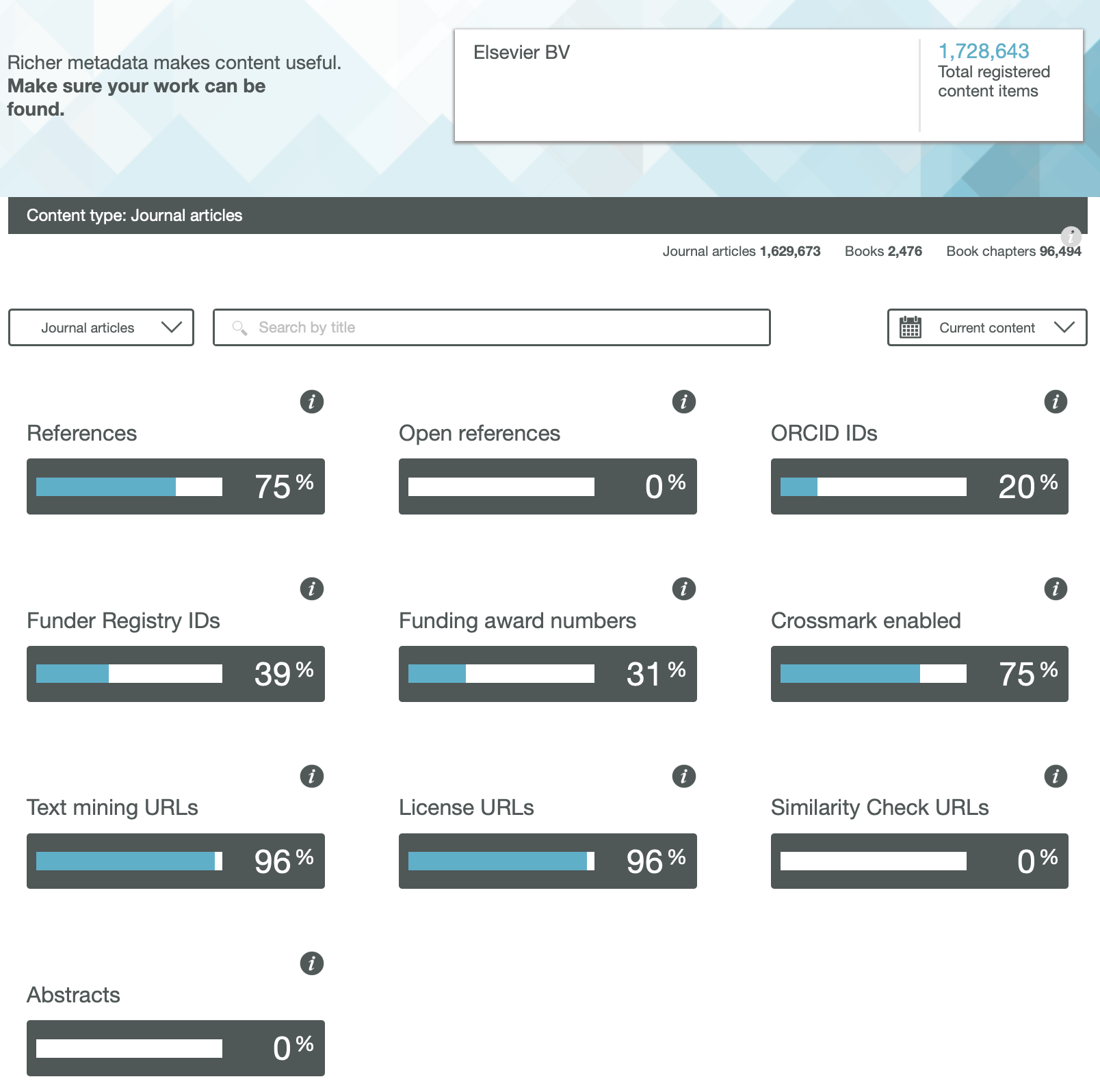
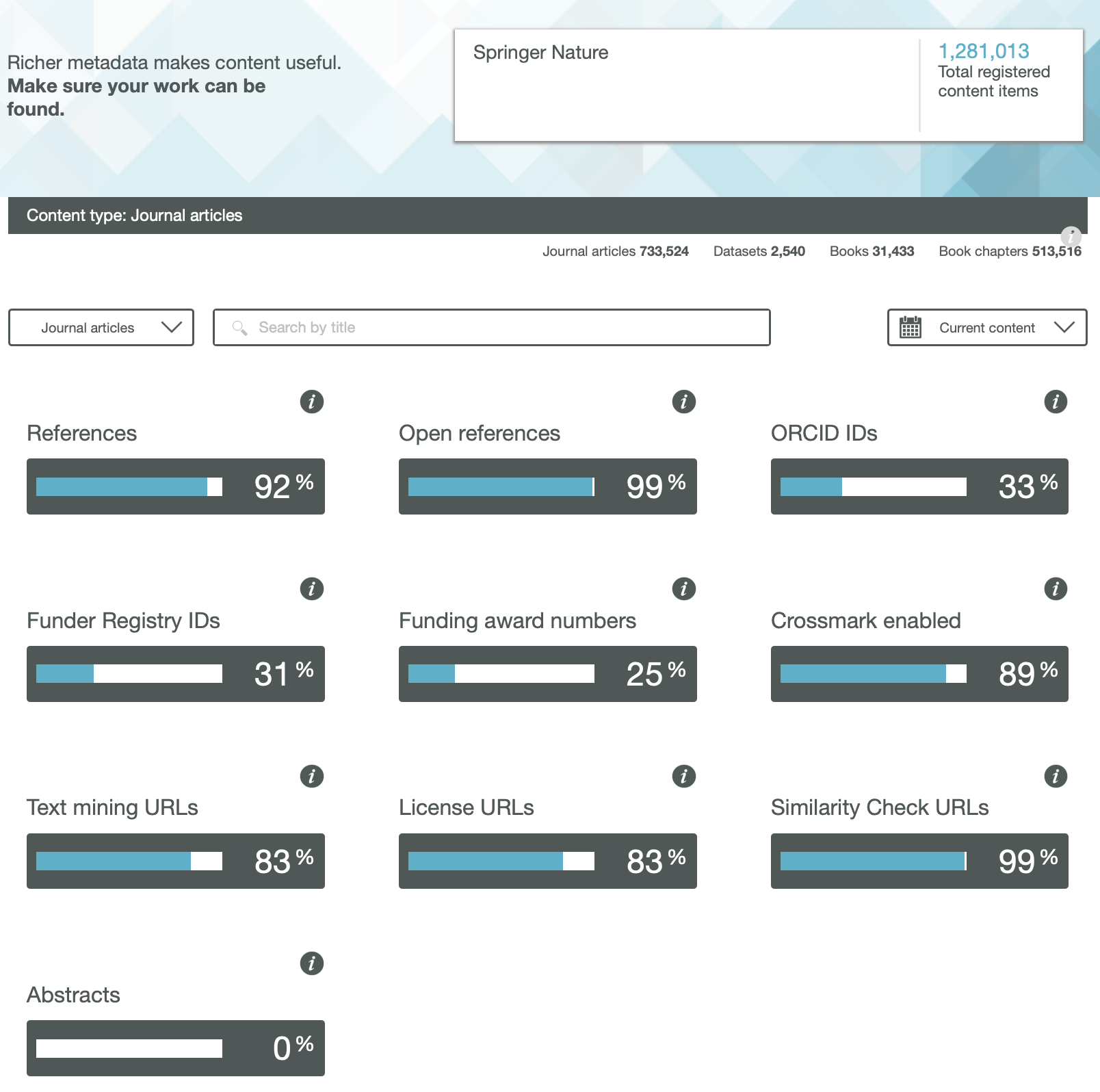
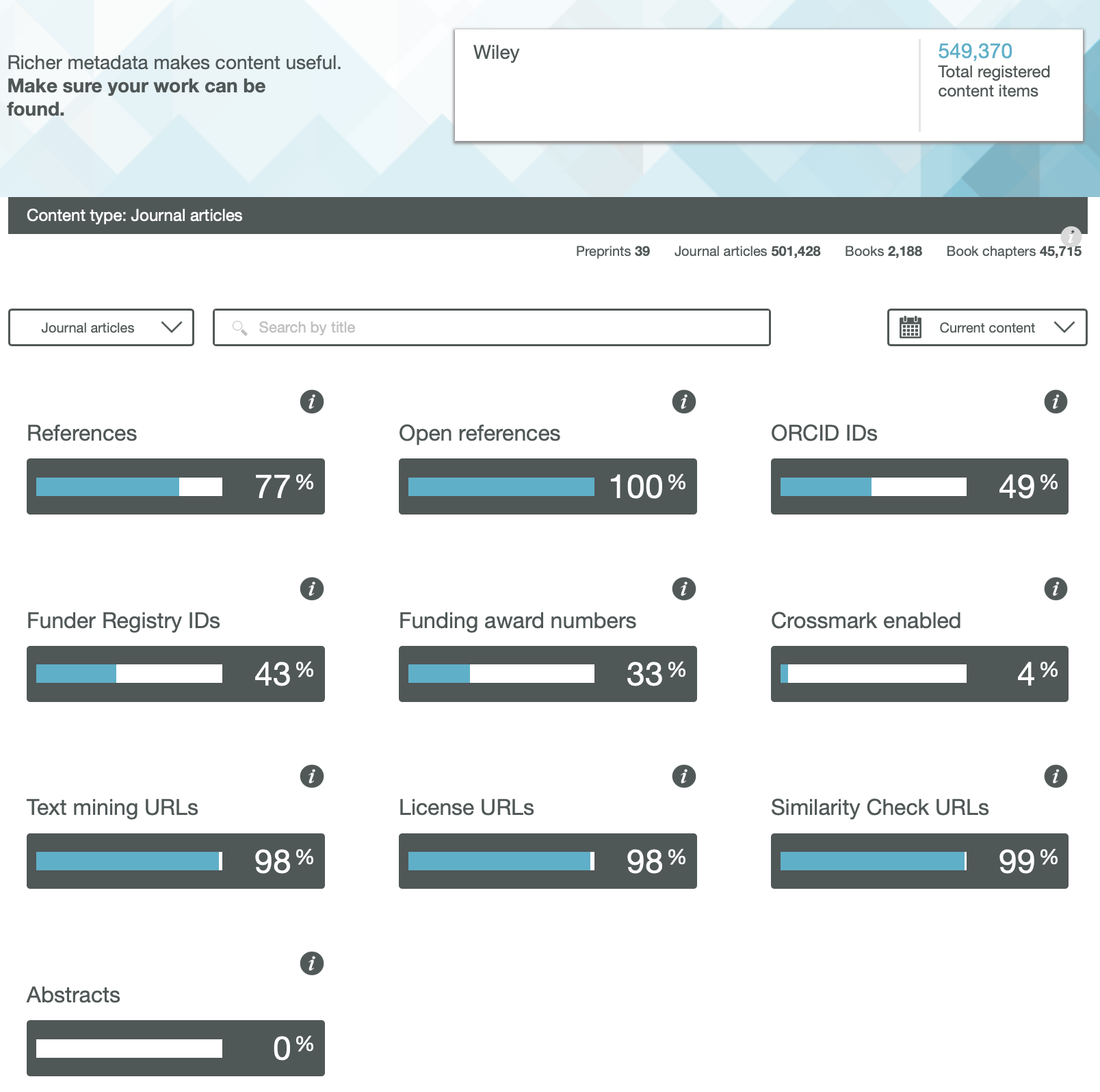
One immediately notices the large differences between publishers. Thus most have 0% metadata for the article abstracts, but one (the RSC) has 87%! Another striking difference is those that support open references (OpenCitations). The RSC and Springer Nature are 99-100% compliant whilst the ACS is 0%. Yet another variation is the adoption of the ORCID (Open Researcher and Collaborator Identifier), where the learned society publishers (RSC, ACS) achieve > 80%, but the commercial publishers are in the lower range of 20-49%.
To me the most intriguing was the Text mining URLs. From the help pages, “The Crossref REST API can be used by researchers to locate the full text of content across publisher sites. Publishers register these URLs – often including multiple links for different formats such as PDF or XML – and researchers can request them programatically“. Here the RSC is at 0%, ACS is at 8% but the commercial publishers are 80+%. I tried to find out more at e.g. https://www.springernature.com/gp/researchers/text-and-data-mining but the site was down when I tried. This can be quite a controversial area. Sometimes the publisher exerts strict control over how the text mining can be carried out and how any results can be disseminated. Aaron Swartz famously fell foul of this.
I am intrigued as to how, as a reader with no particular pre-assembled toolkit for text mining, I can use this metadata provided by the publishers to enhance my science. After all, 80+% of articles with some of the publishers apparently have a mining URL that I could use programmatically. If anyone reading this can send some examples of the process, I would be very grateful.
Finally I note the absence of any metadata in the above categories relating to FAIR data. Such data also has the potential for programmatic procedures to retrieve and re-use it (some examples are available here[1]), but apparently publishers do not (yet) collect metadata relating to FAIR. Hopefully they soon will.
References
- A. Barba, S. Dominguez, C. Cobas, D.P. Martinsen, C. Romain, H.S. Rzepa, and F. Seoane, "Workflows Allowing Creation of Journal Article Supporting Information and Findable, Accessible, Interoperable, and Reusable (FAIR)-Enabled Publication of Spectroscopic Data", ACS Omega, vol. 4, pp. 3280-3286, 2019. https://doi.org/10.1021/acsomega.8b03005
Tags:Aaron Swartz, Academic publishing, API, Business intelligence, CrossRef, data, Data management, Elsevier, favourite publisher, Identifiers, Information, Information science, Knowledge, Knowledge representation, metadata, mining, ORCiD, PDF, Pre-exposure prophylaxis, Publishing, Publishing Requirements for Industry Standard Metadata, Records management, Research Object, Scholarly communication, Scientific literature, search engine, social media, Technical communication, Technology/Internet, text mining, Written communication, XML
Posted in Interesting chemistry | 1 Comment »
Saturday, February 16th, 2019
The title of this post comes from the site www.crossref.org/members/prep/ Here you can explore how your favourite publisher of scientific articles exposes metadata for their journal.
Firstly, a reminder that when an article is published, the publisher collects information about the article (the “metadata”) and registers this information with CrossRef in exchange for a DOI. This metadata in turn is used to power e.g. a search engine which allows “rich” or “deep” searching of the articles to be undertaken. There is also what is called an API (Application Programmer Interface) which allows services to be built offering deeper insights into what are referred to as scientific objects. One such service is “Event Data“, which attempts to create links between various research objects such as publications, citations, data and even commentaries in social media. A live feed can be seen here.
So here are the results for the metadata provided by six publishers familiar to most chemists, with categories including;
- References
- Open References
- ORCID IDs
- Text mining URLs
- Abstracts

RSC

ACS

Elsevier

Springer-Nature

Wiley

Science
One immediately notices the large differences between publishers. Thus most have 0% metadata for the article abstracts, but one (the RSC) has 87%! Another striking difference is those that support open references (OpenCitations). The RSC and Springer Nature are 99-100% compliant whilst the ACS is 0%. Yet another variation is the adoption of the ORCID (Open Researcher and Collaborator Identifier), where the learned society publishers (RSC, ACS) achieve > 80%, but the commercial publishers are in the lower range of 20-49%.
To me the most intriguing was the Text mining URLs. From the help pages, “The Crossref REST API can be used by researchers to locate the full text of content across publisher sites. Publishers register these URLs – often including multiple links for different formats such as PDF or XML – and researchers can request them programatically“. Here the RSC is at 0%, ACS is at 8% but the commercial publishers are 80+%. I tried to find out more at e.g. https://www.springernature.com/gp/researchers/text-and-data-mining but the site was down when I tried. This can be quite a controversial area. Sometimes the publisher exerts strict control over how the text mining can be carried out and how any results can be disseminated. Aaron Swartz famously fell foul of this.
I am intrigued as to how, as a reader with no particular pre-assembled toolkit for text mining, I can use this metadata provided by the publishers to enhance my science. After all, 80+% of articles with some of the publishers apparently have a mining URL that I could use programmatically. If anyone reading this can send some examples of the process, I would be very grateful.
Finally I note the absence of any metadata in the above categories relating to FAIR data. Such data also has the potential for programmatic procedures to retrieve and re-use it (some examples are available here[1]), but apparently publishers do not (yet) collect metadata relating to FAIR. Hopefully they soon will.
References
- A. Barba, S. Dominguez, C. Cobas, D.P. Martinsen, C. Romain, H.S. Rzepa, and F. Seoane, "Workflows Allowing Creation of Journal Article Supporting Information and Findable, Accessible, Interoperable, and Reusable (FAIR)-Enabled Publication of Spectroscopic Data", ACS Omega, vol. 4, pp. 3280-3286, 2019. https://doi.org/10.1021/acsomega.8b03005
Tags:Aaron Swartz, Academic publishing, API, Business intelligence, CrossRef, data, Data management, Elsevier, favourite publisher, Identifiers, Information, Information science, Knowledge, Knowledge representation, metadata, mining, ORCiD, PDF, Pre-exposure prophylaxis, Publishing, Publishing Requirements for Industry Standard Metadata, Records management, Research Object, Scholarly communication, Scientific literature, search engine, social media, Technical communication, Technology/Internet, text mining, Written communication, XML
Posted in Interesting chemistry | 1 Comment »
Saturday, December 29th, 2018
The traditional structure of the research article has been honed and perfected for over 350 years by its custodians, the publishers of scientific journals. Nowadays, for some journals at least, it might be viewed as much as a profit centre as the perfected mechanism for scientific communication. Here I take a look at the components of such articles to try to envisage its future, with the focus on molecules and chemistry.
The formula which is mostly adopted by authors when they sit down to describe their chemical discoveries is more or less as follows:
- An introduction, setting the scene for the unfolding narrative
- Results. This is where much of the data from which the narrative is derived is introduced. Such data can be presented in the form of:
- Tables
- Figures and schemes
- Numerical and logical data embedded in narrative text
- Discussion, where the models constructed from the data are illustrated and new inferences presented. Very often categories 2 and 3 are conflated into one single narrative.
- Conclusions, where everything is brought together to describe the essential aspects of the new science.
- Bibliography, where previous articles pertinent to the narrative are listed.
In the last decade or so, the management of research data has developed as a field of its own, with three phases:
- Setting out a data management plan at the start of the project, often a set of aspirations together with putative actions,
- the day-to-day management of the data as it emerges in the form of an electronic laboratory notebook (ELN),
- the publication of selected data from the ELN into a repository, together with the registration of metadata describing the properties of the data.
In the latter category, item 8 can be said to be a game-changer, a true disruptive influence on the entire process. The key aspect is that it constitutes independent publication of data to sit alongside the object constructed from 1-5. More disruption emerges from the open citations project, whereby category 5 above can be released by publishers to adopt its own separate existence. So now we see that of the five essential anatomic components of a research article, two are already starting to achieve their own independence. Clearly the re-invention of the anatomy of the research article is well under way already.
Next I take a look at what sorts of object might be found in category 8, drawing very much on our own experience of implementing 7 and 8 over the last twelve years or so. I start by observing that in 2 above, figures are perhaps the object most in need of disruptive re-invention. In the 1980s, authors were much taken by the introduction of colour as a means of conveying information within a figure more clearly; although the significant costs then had to be borne directly by these authors (and with a few journals this persists to this day). By the early 1990s, the introduction of the Web[1] offered new opportunities not only of colour but of an extra dimension (or at least the illusion of one) by means of introducing interactivity for three-dimensional models. Some examples resulting from combining figures from category 2 with 8 above are listed in the table below.
Example 1 illustrates how a figure from category 2 above can be augmented with active hyperlinks specifying the DOI of the data in category 8 from which the figure is derived, thus creating a direct and contextual connection between the research article and the research data it is based upon. These links are embedded only in the Acrobat (PDF) version of the article as part of the production process undertaken by the journal publisher. Download Figure 9 from the link here and try it for yourself or try the entire article from the journal, where more figures are so enhanced.
Example 2 takes this one stage further. The hyperlinks in the published figure in example 1 were embedded in software capable of resolving them, namely a PDF viewer. But that is all that this software allows. By relocating the hyperlink into a Web browser instead, one can add further functionality in the form of Javascripts perhaps better described as workflows (supported by browsers but not supported by Acrobat). There are three such workflows in example 2.
- The first uses an image map to associate a region of the figure data object defined by a DOI.
- The second interrogates the metadata specifically associated with the DOI (the same DOIs that are seen in the figure itself) to see if there is any so-called ORE metadata available (ORE= Object Re-use and Exchange). If there is, it uses this information to retrieve the data itself and pass it through to
- the third workflow represented by a set of JavaScripts known as JSmol. These interpret the data received and construct an interactive visual 3D molecular model representing the retrieved data.
All this additional workflowed activity is implemented in a data repository. It is not impossible that it could also be implemented at the journal publisher end of things, but it is an action that would have to be supported by multiple publishers. Arguably this sort of enhancement is far better suited and more easily implemented by a specialised data publisher, i.e. a data repository.
Example 3 does the same thing for a table.
Example 4 enhances in a different manner. Conventionally NMR data is added to the supporting information file associated with a journal article, but such data is already heavily processed and interpreted. The raw instrumental data is never submitted to the journal and is pretty much always possibly only available by direct request from the original researchers (at least if the request is made whilst the original researchers are still contactable!). The data repository provides a new mechanism for making such raw instrumental (and indeed computational) data an integral part of the scientific process.
Example 5 shows how a bibliography can be linked to a secondary bibliography (citations 35 and 36 in this example in the narrative article) and perhaps in the future to Open Citations semantic searches for further cross references.
So by deconstructing the components of the standard scientific article, re-assembling some of them in a better-suited environment and then linking the two sets of components to each other, one can start to re-invent the genre and hopefully add more tools for researchers to use to benefit their basic research processes. The scope for innovation seems considerable. The issue of course is (a) whether publishers see this as a viable business model or whether they instead wish to protect their current model of the research article and whether (b) authors wish to undertake the learning curve and additional effort to go in this direction. As I have noted before, the current model is deficient in various ways; I do not think it can continue without significant reinvention for much longer. And I have to ask that if reinvention does emerge, will science be the prime beneficiary?
References
- H.S. Rzepa, B.J. Whitaker, and M.J. Winter, "Chemical applications of the World-Wide-Web system", Journal of the Chemical Society, Chemical Communications, pp. 1907, 1994. https://doi.org/10.1039/c39940001907
Tags:Academic publishing, Acrobat, Articles, chemical discoveries, data, Data management, ELN, Information, Molecules, Narrative, PDF, Publishing, Research, Scholarly communication, Science, Scientific Journal, Scientific method, Technical communication, Technology/Internet, Web browser
Posted in Chemical IT | No Comments »
Sunday, May 6th, 2018
The site fairsharing.org is a repository of information about FAIR (Findable, Accessible, Interoperable and Reusable) objects such as research data.

A project to inject chemical components, rather sparse at the moment at the above site, is being promoted by workshops under the auspices of e.g. IUPAC and CODATA and the GO-FAIR initiative. One aspect of this activity is to help identify examples of both good (FAIR) and indeed less good (unFAIR) research data as associated with contemporary scientific journal publications.
Here is one example I came across in 2017.[1]. The data associated with this article is certainly copious, 907 pages of it, not including data for 21 crystal structures! The latter is a good example of FAIR, being offered in a standard format (CIF) well-adapted for the type of data contained therein and for which there are numerous programs capable of visualising and inter-operating (i.e. re-using) it. The former is in PDF, not a format originally developed for data and one could argue is closer to the unFAIR end of the spectrum. More so when you consider this one 907-page paginated document contains diverse information including spectra on around 60 molecules. Thus the spectra are all purely visual; they are obviously data but in a form largely designed for human consumption and not re-use by software. The text-based content of this PDF does have numerous pattens, which lends itself to pattern recognition software such as OSCAR, but patterns are easily broken by errors or inexperience and so we cannot be certain what proportion of this can be recovered. The metadata associated with such a collection, if there is any at all, must be general and cannot be easily related to specific molecules in the collection. So I would argue that 907 pages of data as wrapped in PDF is not a good example of FAIR. But it is how almost all of the data currently being reported in chemistry journals is expressed. Indeed many a journal data editor (a relatively new introduction to the editorial teams) exerts a rigorous oversight over the data presented as part of article submissions to ensure it adheres to this monolithic PDF format.
You can also visit this article in Chemistry World (rsc.li/2HG7lTk) for an alternative view of what could be regarded as rather more FAIR data. The article has citations to the FAIR components, which is not published as part of the article or indeed by the journal itself but is held separately in a research data repository. You will find that at doi: 10.14469/hpc/3657 where examples of computational, crystallographic and spectroscopic data are available.
The workshop I allude to above will be held in July. Can I ask anyone reading this blog who has a favourite FAIR or indeed unFAIR example of data they have come across to share these here. We also need to identify areas simply crying out for FAIRer data to be made available as part of the publishing process beyond the types noted above. I hope to report back on both such feedback and the events at this workshop in due course.
References
- J.M. Lopchuk, K. Fjelbye, Y. Kawamata, L.R. Malins, C. Pan, R. Gianatassio, J. Wang, L. Prieto, J. Bradow, T.A. Brandt, M.R. Collins, J. Elleraas, J. Ewanicki, W. Farrell, O.O. Fadeyi, G.M. Gallego, J.J. Mousseau, R. Oliver, N.W. Sach, J.K. Smith, J.E. Spangler, H. Zhu, J. Zhu, and P.S. Baran, "Strain-Release Heteroatom Functionalization: Development, Scope, and Stereospecificity", Journal of the American Chemical Society, vol. 139, pp. 3209-3226, 2017. https://doi.org/10.1021/jacs.6b13229
Tags:above site, chemical components, Findability, Human behavior, Information, Information architecture, Information science, Institutional repository, journal data editor, Knowledge, Knowledge representation, Open access, Open access in Australia, Oscar, PDF, recognition software, Technology/Internet, Web design
Posted in Interesting chemistry | 2 Comments »
Wednesday, March 7th, 2018
C&EN has again run a vote for the 2017 Molecules of the year. Here I take a look not just at these molecules, but at how FAIR (Findable, Accessible, Interoperable and Reusable) the data associated with these molecules actually is.
I went about finding out as follows:
- The article DOI for all seven candidates was linked to the C&EN site.
- From there I manually tracked down the Supporting information
- Some of this SI gave a CCDC deposition number for crystal structure data for the molecule in question. The easiest way of going directly to the data was to use the search.datacite.org search engine and to enter the keywords CCDC + deposition number. This gives a DOI for the data, examples of which are included in the table below.
- In other examples, I used the CSD Conquest search program and entered the names of 2-3 of the authors of the articles. This also worked well.
- Most of the SI files, downloaded as PDF files also had static images of NMR spectra included. This is not active data, and hence does not fulfil the F and I of FAIR, and probably the A as well. None of it is FAIR as defined by my post here although it is actually really easy to make it so. One of the examples had ~116 spectra so unFAIRed.
- In another example there was also computational data, included simply as a set of XYZ coordinates and again contained in the PDF file. This too is not really FAIR, since one has to know how to extract it from this container and repurpose it. It also represents a tiny subset of the data potentially available.
The FAIRness of the data for these molecules of the year is largely rescued by the crystal structure data deposited with the CCDC in their CSD database and rendered F of FAIR by the persistent identifiers such as the (parochial) deposition numbers or the more general DOI. Now if the NMR and computational data were also covered in this way, we would be making great progress. There are of course many other types of data included with these examples, and procedures for making such data also FAIR have to be worked out by the community.
In order to construct the table above, I had to put about two hours of effort into tracking down the items (and this only because I have done this sort of search before). Perhaps next year I might persuade C&EN to include such a table in their own article!
Tags:Carotenoids, Chemistry, Epoxides, Macrocycles, Organic chemistry, Organofluorides, PDF, Peptides, search engine, search program, search.datacite.org search engine, Technology/Internet
Posted in Chemical IT, crystal_structure_mining, Interesting chemistry | No Comments »
Sunday, March 5th, 2017
Living in London, travelling using public transport is often the best way to get around. Before setting out on a journey one checks the status of the network. Doing so today I came across this page: our open data from Transport for London.
- I learnt that by making TFL travel data openly available, some 11,000 developers (sic!) have registered for access, out of which some 600 travel apps have emerged.
- The data is in XML, which makes it readily inter-operable.[1]
- This encourages crowd-sourced innovation.
- They have taken the trouble to produce an API (application programmable interface) which allows rich access to the data and information about e.g. AccidentStats, AirQuality, BikePoint, Journey, Line, Mode, Occupancy, Place, Road, Search, StopPointVehicle.
Chemists could learn some lessons here! Of course, there are quite a few chemical databases with APIs that are examples of open data, but the “ESI” (electronic supporting information) sources which almost all published articles rely upon to disseminate data are clearly struggling to cope. Take for example this recent article[2], where much of the data has been dropped into the inevitable PDF “coffin” and which is a breathtaking 907 pages long. To give the authors their due, they also provide 20 CIF files which ARE good sources of data. Rarely commented on, but clearly missing from the information associated with this (indeed most) articles is the metadata about the data. Thus the metadata for these CIF files amounts to just e.g. 229. To find out the context, one has to scour the article (or the 907 pages of the ESI) to identify compound 229 (I strongly suspect it’s a molecule because of the implied semantics of the term, not because its been explicitly declared). You will not find the metadata at e.g. data.datacite.org which is one open aggregator and global search engine based on deposited metadata.
I have commented elsewhere on this blog that other types of data could also be enhanced in the manner that CIF crystallographic files represent. For example the Mpublish NMR project,‡ examples of which are shown here, and for which typical data AND its metadata can be seen at DOI: 10.14469/hpc/1053. I fancy that if this method had been adopted,[2] those 907 pages might have shrunk somewhat, although of course not entirely. But my hope is that gradually the innovative chemistry community will find ways of exhuming more and more data from the PDF coffin and in the process reducing the paginated lengths of the PDF-based ESI further, perchance eventually even to zero?
If you are yourself preparing an article and sweating over the ESI at this very moment, do please take a look at the Mpublish method and how perhaps it can help make your NMR data at least more useful to others.
‡I understand an article describing this project is in preparation. If you cannot wait, this recent application of the Mpublish project has some details.[3]
References
- P. Murray-Rust, and H.S. Rzepa, "Chemical Markup, XML, and the Worldwide Web. 1. Basic Principles", Journal of Chemical Information and Computer Sciences, vol. 39, pp. 928-942, 1999. https://doi.org/10.1021/ci990052b
- J.M. Lopchuk, K. Fjelbye, Y. Kawamata, L.R. Malins, C. Pan, R. Gianatassio, J. Wang, L. Prieto, J. Bradow, T.A. Brandt, M.R. Collins, J. Elleraas, J. Ewanicki, W. Farrell, O.O. Fadeyi, G.M. Gallego, J.J. Mousseau, R. Oliver, N.W. Sach, J.K. Smith, J.E. Spangler, H. Zhu, J. Zhu, and P.S. Baran, "Strain-Release Heteroatom Functionalization: Development, Scope, and Stereospecificity", Journal of the American Chemical Society, vol. 139, pp. 3209-3226, 2017. https://doi.org/10.1021/jacs.6b13229
- M.J. Harvey, A. McLean, and H.S. Rzepa, "A metadata-driven approach to data repository design", Journal of Cheminformatics, vol. 9, 2017. https://doi.org/10.1186/s13321-017-0190-6
Tags:API, chemical databases, City: London, Company: TfL, Government, Greater London, Local government in London, London, Passenger Transportation Ground & Sea - NEC, PDF, Public transport, Route planning software, search engine, Sustainable transport, Technology/Internet, Transport, Transport for London, travel apps, travel data, XML
Posted in Chemical IT | No Comments »
Tuesday, August 16th, 2016
This week the ACS announced its intention to establish a “ChemRxiv preprint server to promote early research sharing“. This was first tried quite a few years ago, following the example of especially the physicists. As I recollect the experiment lasted about a year, attracted few submissions and even fewer of high quality. Will the concept succeed this time, in particular as promoted by a commercial publisher rather than a community of scientists (as was the original physicists model)?
The RSC (itself a highly successful commercial publisher) has picked up on this and run its own commentary. You will find quotes from yours truly there, along with Peter Murray-Rust, a long time ardent promoter of community driven open science. One interesting aspect is that the ACS runs around 50 journals, and the decision on whether each will accept preprints for publication will (shortly = next few weeks) be made by the individual editors. I wonder if the eventual list of those supporting the project will bring any surprises (bets on J. Am. Chem. Soc. preprints anyone)?
But I want to pick up on the declared aspiration “to promote early research sharing“. Here I couple research sharing with data sharing. If you share your research, you should also share the data resulting from that research. We are now entering a new era of data sharing (in part as a result of mandation by various funding bodies) and so one has to ask whether a pre-print server will encourage people to create and share FAIR data (data which is findable, accessible, inter-operable and re-usable) as a model to replace the current one of “supporting information” held in enormous PDF files (mostly unFAIR on at least three counts). This question is indeed posed in the RSC commentary. What I would like to see happen are projects such as that described here, which create what were described as “first class research objects”, and which I think amply fulfil the criteria of being FAIR. So, will ChemRxiv preprint servers help promote such FAIR data sharing as part of early research sharing? We will find out soon.
The ACS supports OA (Open Access) sharing of articles, provided the authors pay (or arrange payment of) the appropriate APC or article processing charge. These charges are complex, being subject to various discounts (for example if you as an author are an ACS member or not) but are generally not insignificant (> $1000). I wondered whether preprints might be subject to an APC, and so I asked the ACS. The response was “we don’t anticipate any submission or usages fees at this time“. I think that means free at point of submission, and free at point of readership “at this time“.
Finally, let me now summarise as I understand the current family of “research publications”:
- The preprint
- The final author version as submitted to a journal
- The “version of record” (VoR) as published by the journal
- Any FAIR published data associated with the article
All four of these are attempts at “research sharing”. Each may be located in a different location, and each may have its own DOI. And of course we cannot easily know how much overlap there is between each of them. Thus, how might 1-3 differ in terms of the story or “narrative” of scientific claims? Does 4 agree or support 1-3? Does 4 agree with perhaps data subsets contained in 1-3? If keeping abreast of the current research literature is a challenge, imagine having to cope with/reconcile up to four versions of each “publication”!
Lots of food for thought here. We have not heard the last of these themes.
Tags:Academia, Academic publishing, article processing charge, author, Data publishing, Data sharing, food, Grey literature, Open access, Open science, PDF, Peter Murray-Rust, pre-print server, Preprint, preprint server, Public sphere, Publishing, Scholarly communication, Technology/Internet
Posted in Chemical IT | 1 Comment »
Monday, August 1st, 2016
In March, I posted from the ACS meeting in San Diego on the topic of Research data: Managing spectroscopy-NMR, and noted a talk by MestreLab Research on how a tool called Mpublish in the forthcoming release of their NMR analysis software Mestrenova could help. With that release now out, the opportunity arose to test the system.
I will start by reminding that NMR data associated with a published article is (or should be) openly free: one should not need a subscription to the journal to access it (although one might in order to find it). Now, NMR data as it emerges from a spectrometer is highly sophisticated, comprising a collection of (sometimes) binary proprietary files containing the measured free induction decays (FID). Turning this raw data into an interpretable NMR spectrum, the visual form of the data that so appeals to human beings, is non trivial. This requires what may be highly sophisticated software and that in turn means that it may be a commercial product. Of course there are also examples of non-commercial open software packages that are best-of-breed; indeed in its early life-cycle MestreNova was known as MESTREC before becoming a commercial product. Could one achieve the benefits of both open and fully functional NMR data with no loss from the original instrument coupled with the ability to apply top-quality software for its analysis in an open manner? This is a demonstration of how Mpublish achieves this.
-
Invoke the URL data.datacite.org/chemical/x-mnpub/10.14469/hpc/1087 from a browser
-
This action queries the metadata deposited with DataCite for the doi 10.14469/hpc/1087 and retrieves the first instance of any file associated with that dataset that has the format type chemical/x-mnpub. You can directly view this metadata by invoking just data.datacite.org/10.14469/hpc/1087 where you can find both mnpub and mnova formats listed. A command such as data.datacite.org/chemical/x-mnpub/10.14469/hpc/1087 allows the file retrieval to be incorporated into automated workflows based just on the doi and the media type desired. Note my parenthetical comment above about finding data; here you only need its doi to retrieve it!
-
The URL above downloads a small text file with the suffix .mnpub which contains in essence two components:
-
A URL pointing directly to an .mnova file at the repository for which the doi has been issued
-
A signature key derived used to verify that the public key of the publisher (the data repository in this instance) was counter-signed by Mestrelab.
-
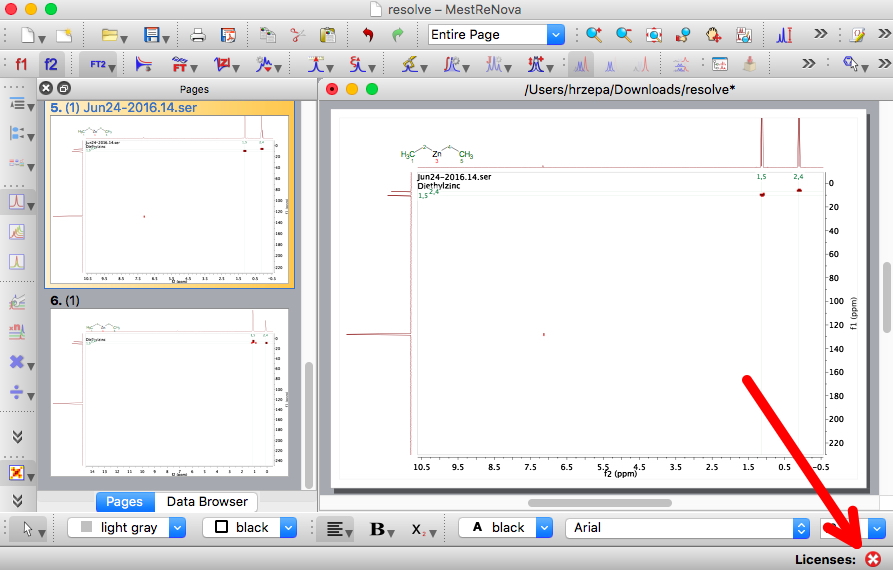
If you now download the application program and install it (but for the purpose of this demonstration, ignore any requests to try to license the program. Use it unlicensed) and open the .mnpub file using it, you should get the below.The application program has checked the signature key, and if valid, proceeds to download a full data file (a .mnova file in this case), and to analyze and display it within the program. The data is fully active; it can be manipulated and analysed. Notice in the picture below, the red arrow points to the state of the license, in this case not present.
-
It is also possible to apply this procedure to the raw data as it emerges from the (Bruker) spectrometer, and compressed into a .zip archive. The MestreNova software will automatically process the contents by applying various default parameters, although the result may not correspond exactly to that present in e.g. the equivalent .mnova file (which may have had specific parameters applied).
It is my hope that anyone who records NMR data and processes it using software such as MestreNova will now consider using the mechanism above to accompany their submitted articles, rather than just automatically pasting a static image of the spectrum into a PDF file as "supporting information". This is part of what is meant by "managed research data" (RDM).
One cannot help but note that many types of scientific instrument nowadays come with bespoke software for analysing the data they produce. Very often this software is unavailable to anyone who has not purchased the instrument itself. To make the data available to others, the processed data and its visual interpretation often have to be reduced, with much consequent information loss, to a lowest common denominator format such as Acrobat/PDF. Here we see a mechanism for avoiding any such information loss whilst enabling, for that dataset only, the full potential for (re)analysing the data. It will be interesting to see if other examples of this model or its equivalent emerge in the near future.
Tags:Acrobat, analysis software, chemical, Chemistry, City: San Diego, format type chemical/x-mnpub, media type, Mestrenova, non-commercial open software packages, Nuclear magnetic resonance, Nuclear magnetic resonance spectra database, Nuclear magnetic resonance spectroscopy, PDF, public key, Science, Scientific method, spectroscopy, Technology/Internet
Posted in Chemical IT | 3 Comments »
Friday, June 3rd, 2016
The title might give it away; this is my 500th blog post, the first having come some seven years ago. Very little online activity nowadays is excluded from measurement and so it is no surprise that this blog and another of my “other” scholarly endeavours, viz publishing in traditional journals, attract such “metrics” or statistics. The h-index is a well-known but somewhat controversial measure of the impact of journal articles; here I thought I might instead take a look at three less familiar ones – one relating to blogging, one specific to journal publishing and one to research data.
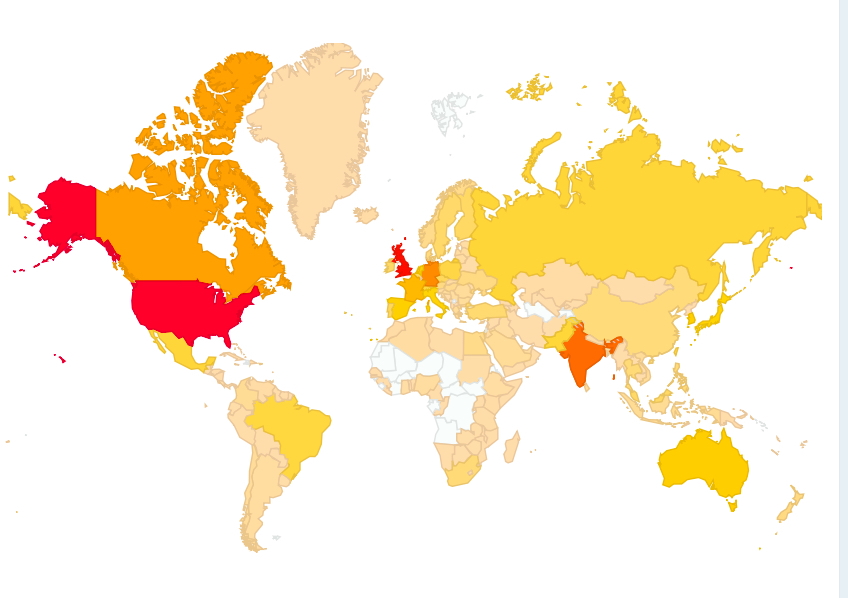
First, an update on the accumulated outreach of this blog over this seven-year period. The total number of country domains measured is 190. The African continent still has quite a few areas with zero hits (as does Svalbard, with a population of only 2600 for a land mass area 61,000 km2 or 23 km2 per person). Given the low blog readership density on the African continent, it would be interesting to find out whether journal readership is any better.

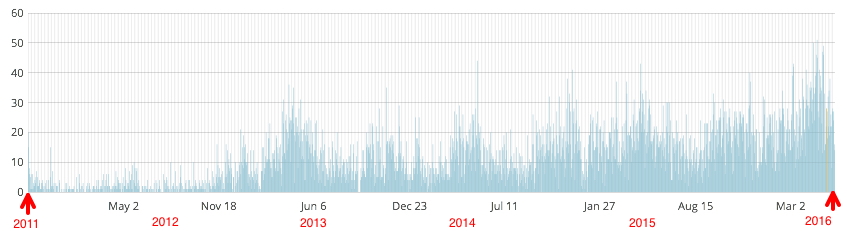
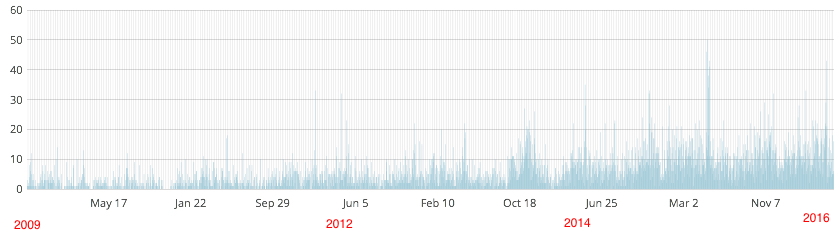
Next, I look at the temporal distribution for individual posts. The first has attracted the highest total; in five years it has had 19,262 views (the diagram below shows the number of views per day). Four others exceed 10,000 and 80 exceed 1000 views.

Of these five, the next is the oldest, going back to 2009. I was very surprised to find such longevity, with the number of views increasing rather than decreasing with the passage of time.

So time now to compare these statistics with the journals. And of course its chalk and cheese. A “view” for a post means someone (or something) accessing the post URL, which is then recorded in the server log. Resolving the URL does at least load the entire content of the post; whether its read or not is of course not recorded. Importantly, if you want to view the content at some later stage, a new “view” has to be made (although some browsers do save a web page and allow offline viewing at a later stage, but I suspect this usage is low). With electronic journal access, it’s rather different. Access to an article is now predominantly via two mechanisms:
- From the table of contents (this is somewhat analogous to browsing a blog)
- From the article DOI.
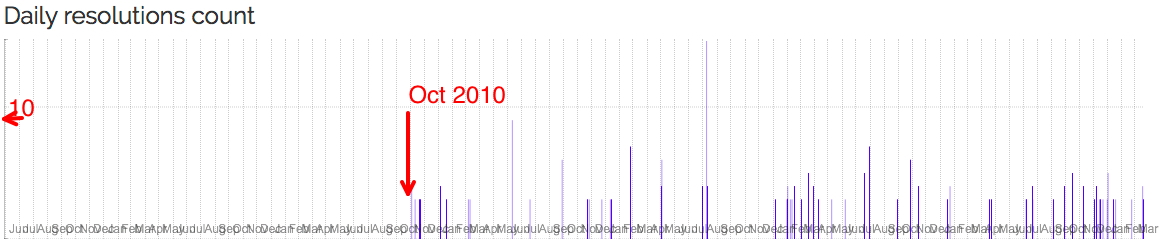
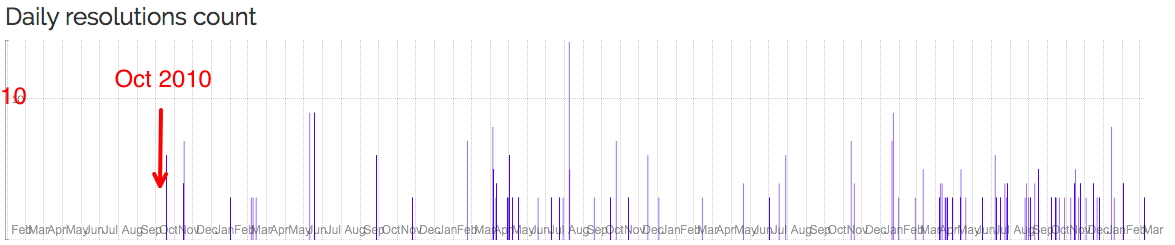
Statistics for these two methods are gathered differently. The new CrossRef resource chronograph.labs.crossref.org (CrossRef allocate all journal DOIs) can be used to measure what they call DOI “resolutions”. A DOI resolution however leads one only to what is called the “landing page”, where the interested reader can view the title, the graphical abstract and some other metadata. It does not mean of course that they go on to actually view the article (as HTML, equivalent to the blog above, or probably more often by downloading a PDF file). Here are a few results using this method:
What about the other main journal article access method, not via a DOI but from a table of contents page journal page? A Google search revealed this site: jusp.mimas.ac.uk (JUSP stands for Journal usage statistics portal, which sounded promising). This site collects “COUNTER compliant usage data”. COUNTER (Counting Online Usage of Networked Electronic Resources) is an initiative supported by many journal publishers and it sounds an interesting way of measuring “usage” (as opposed to “views” or “resolutions”; it’s that chalk and cheese again!). I would love to be able to show you some statistics using this resource, but the “small print” caught me out: “JUSP gives librarians a simple way of analysing the value and impact of their electronic journals”. Put simply, I am a researcher, not a librarian. As a researcher I do not have direct access; JUSP is a closed, restricted access (albeit taxpayer-funded) resource. I am discussing this with our head of information resources (who is a librarian) and hope to report back here on the outcome.
Finally research data. This is almost too new to be able to measure, but this resource stats.datacite.org is starting to collect statistics on data resolutions (similar to DOI resolutions).
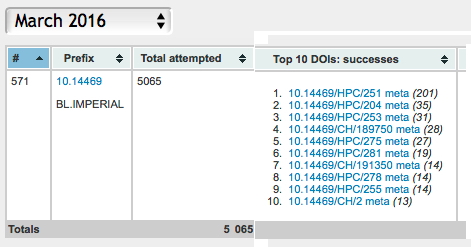
- You can see from the below for Imperial College (in fact this represents the two data repositories that we operate and which I cite here extensively on these blogs) that the resolution at running up to about 200 a month per dataset (more typically ~25 a month), with a total of 5065 resolutions for all items in March 2016 (the blog has ~12,000 views per month).

- Figshare is another data repository we have made use of:
So to the summary.
- Firstly, we see that I have shown three forms of impact, views, resolutions and usage. If one had statistics on all three, one might then try to see if they are correlated in any way. Even then, normalisation might be a challenge.
- Over ~7 years, five posts on this blog have attracted >10,000 views.
- Many of the blog posts have a long “finish” (to use a wine tasting term); the views continue regularly and often increase over time.
- My analysis of the three journal articles above (and about 15 others) shows that between 50-300 resolutions over a few years is fairly typical (for this researcher at least; I am sure most better known researchers attract far far more).
- The temporal distribution for article resolutions and blog views show both can have continuing impact over an extended period. None of the 18 articles I looked at show a significantly increasing impact with time but many of the blog posts do. This tends to suggest that the audiences for each are quite different; researchers for articles and a fair proportion of inquisitive students for the blog?
- I may speculate whether a correlation between my article resolutions and my h-index probably might be found, but the article resolution has a fine-grained temporal resolution (allowing a derivative wrt time to be obtained) that is perhaps potentially more valuable than just the coarse h-index integration (an article can of course be cited for both positive and negative reasons!).
- Initial analysis for data shows resolutions running at a similar rate to article resolutions. It is not yet possible to correlate data resolutions with article resolutions in which that data is discussed.
References
- S.M. Rappaport, and H.S. Rzepa, "Intrinsically Chiral Aromaticity. Rules Incorporating Linking Number, Twist, and Writhe for Higher-Twist Möbius Annulenes", Journal of the American Chemical Society, vol. 130, pp. 7613-7619, 2008. https://doi.org/10.1021/ja710438j
- A.E. Aliev, J.R.T. Arendorf, I. Pavlakos, R.B. Moreno, M.J. Porter, H.S. Rzepa, and W.B. Motherwell, "Surfing π Clouds for Noncovalent Interactions: Arenes versus Alkenes", Angewandte Chemie International Edition, vol. 54, pp. 551-555, 2014. https://doi.org/10.1002/anie.201409672
- K. Abersfelder, A.J.P. White, H.S. Rzepa, and D. Scheschkewitz, "A Tricyclic Aromatic Isomer of Hexasilabenzene", Science, vol. 327, pp. 564-566, 2010. https://doi.org/10.1126/science.1181771
Tags:Country: Svalbard and Jan Mayen, CrossRef, head of information resources, HTML, Imperial College, librarian, online activity, Online Usage, PDF, researcher, search engines, usage statistics portal
Posted in Chemical IT | 4 Comments »
Sunday, April 17th, 2016
I want to describe a recent attempt by a group of collaborators to share the research data associated with their just published article.[1]
I am here introducing things in a hierarchical form (i.e. not necessarily the serial order in which actions were taken).
-
The data repository selected for the data sharing is described by (m3data) doi: 10.17616/R3K64N[2]
-
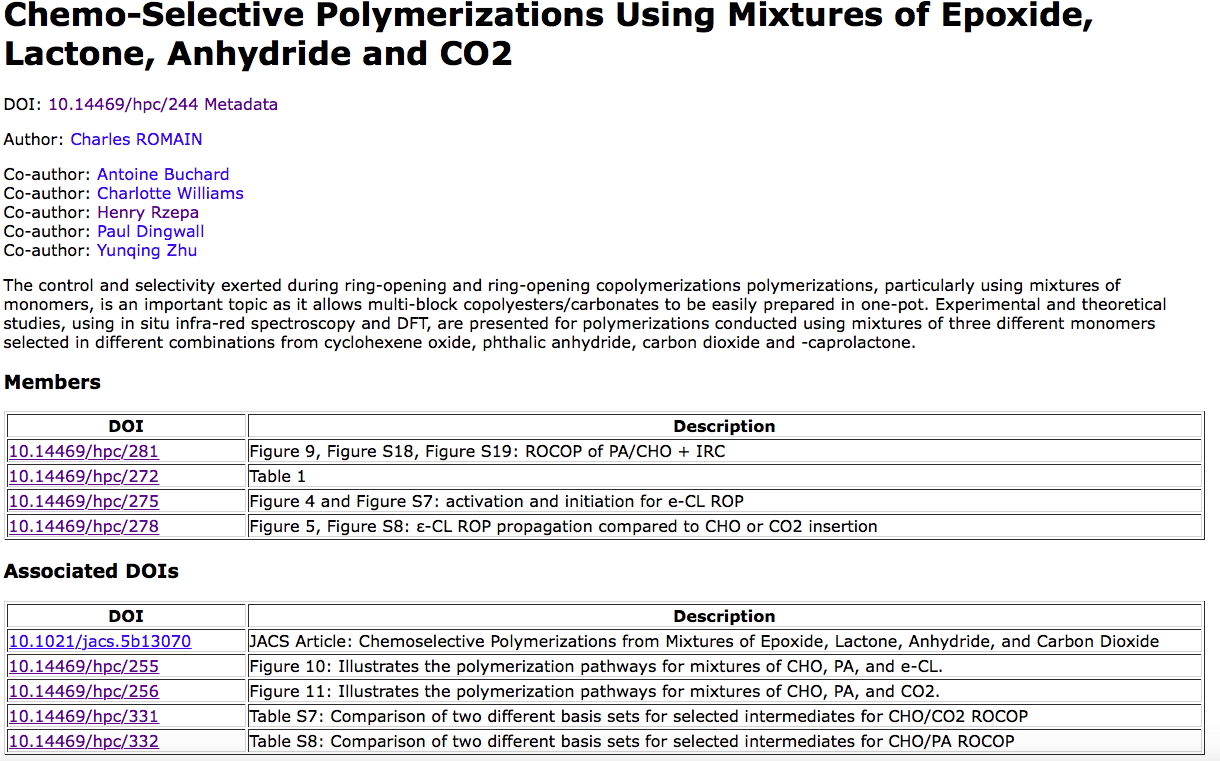
A collaborative project collection was established on this repository (doi: 10.14469/hpc/244[3]). This data collection has some of the following attributes:
-
Its metadata is sent here: https://search.datacite.org/ui?&q=10.14469/hpc/244 where it can be queried for other details.
-
The project collaborators are all identified by their ORCID, used to obtain further individual information about the researchers. This information is also propagated to the metadata sent to DataCite.
-
In the section labelled associated DOIs there is a link to the recently published peer-reviewed article, which itself cites the data via doi: 10.14469/hpc/244 and which thus establishes a bidirectional link between the article and its data.
-
Also in the associated DOIs section are other DOIs (to two figures and two tables) held in a separate location. One example: doi: 10.14469/hpc/332[4]) which illustrates the original type of data sharing we started about 10 years ago. This form has been variously called a "WEO" or Web-enhanced object (by the ACS) or interactivity boxes (RSC, etc). In such WEOs, we wrap the data into an interactive visual appearance using Jmol or JSmol software. The data itself is directly available to the reader using the Jmol export functions (right mouse click in the visual window).
-
In this specific example the WEO has been assigned its DOI using the repository noted above.[2]
-
We have in the past also used Figshare[5]) for this purpose, see e.g. 10.6084/m9.figshare.1181739‡
-
The WEO itself can itself reference a more complete set of data used to create the visual appearance, for example data that allows the wavefunction of the molecule to be computed, doi: 10.6084/m9.figshare.2581987.v1[6] In this instance this is held on the Figshare[5] repository.
-
The collection has another section labelled Members. These are individual datasets associated with the collection and held on the SAME repository as the collection itself. In this case, there are five such members, two of which are listed below:
-
10.14469/hpc/281[7] contains a variety of other data such as outputs from an IRC (intrinsic reaction coordinate), energy profile diagrams and ZIP archives of other calculations.
-
10.14469/hpc/272[8] itself contains five members, one of which is e.g.
-
10.14469/hpc/267[9] which contains a ZIP archive with NMR data (see here for how this might be packaged in the future) and a file for a GPC (chromatography) instrument.
-
This last item also contains a new section labelled Metadata, which includes e.g. the InChI key and InChI string for the molecule whose properties are reported.
If this mode of presenting data seems a little more complex than a single monolithic PDF file, its because its designed for:
-
collaboration between scientists, potentially at different locations and institutions.
-
attribution of provenance/credit for the individual items (via ORCID).
-
separate date stamping by the various contributors.
-
providing bi-directional links between data and publications.
-
holding what we call FAIR (findable, accessible, interoperable and reusable) data, rather than just data encapsulated in a PDF file.
-
Collecting, storing and sending metadata for aggregation in a formal way, i.e. to DataCite using a formal schema to render the metadata properly searchable.
Thus 10.14469/hpc/244 represents our most complex attempt yet at such collaborative FAIR data sharing with multiple contributors. The tools for packaging many of the datasets are still quite limited (see again here) and the design is still being optimised (call it α). When the repository[2] has been more extensively tested, we intend to make it available as open source for others to experiment with. And of course, when this happens the source code too will have its own DOI!
‡A refactoring of the Figshare site in December 2015 meant that the DOI no longer points directly to the WEO, and you have to follow a manually inserted link on that page to see it.
References
- C. Romain, Y. Zhu, P. Dingwall, S. Paul, H.S. Rzepa, A. Buchard, and C.K. Williams, "Chemoselective Polymerizations from Mixtures of Epoxide, Lactone, Anhydride, and Carbon Dioxide", Journal of the American Chemical Society, vol. 138, pp. 4120-4131, 2016. https://doi.org/10.1021/jacs.5b13070
- Re3data.Org., "Imperial College Research Computing Service Data Repository", 2016. https://doi.org/10.17616/r3k64n
- C. ROMAIN, "Chemo-Selective Polymerizations Using Mixtures of Epoxide, Lactone, Anhydride and CO2", 2016. https://doi.org/10.14469/hpc/244
- H. Rzepa, "Table S8: Comparison of two different basis sets for selected intermediates for CHO/PA ROCOP.", 2016. https://doi.org/10.14469/hpc/332
- Re3data.Org., "figshare", 2012. https://doi.org/10.17616/r3pk5r
- P. Dingwall, "Gaussian Job Archive for C6H10O", 2016. https://doi.org/10.6084/m9.figshare.2581987.v1
- C. ROMAIN, "Figure 9, Figure S18, Figure S19: ROCOP of PA/CHO + IRC", 2016. https://doi.org/10.14469/hpc/281
- C. ROMAIN, "Table 1 : Polymerizations Using Lactone, Epoxide, and CO2", 2016. https://doi.org/10.14469/hpc/272
- C. ROMAIN, "Table 1, entry 1 : Polymerizations Using Lactone, Epoxide, and CO2", 2016. https://doi.org/10.14469/hpc/267
Tags:10.17616, Academic publishing, DataCite, energy profile diagrams, Figshare, Identifiers, Open science, ORCiD, PDF, Scholarly communication, Technical communication, Technology/Internet, Web-enhanced object
Posted in Chemical IT | No Comments »