Posts Tagged ‘synthetic chemist’

One more WATOC 2017 Report.

Thursday, August 31st, 2017

Conferences can be intense, and this one is no exception. After five days, saturation is in danger of setting in. But before it does, I include two more (very) brief things I have learnt.

  1. Sason Shaik introduced a theme he first investigated years ago, but for which no experiment had been devised for verification. He revived his theme when a journalist contacted him last year to report exactly such an observation, which I now recount. A Diels-Alder adduct was captured between a flat layer of gold atoms and the tip of a scanning-tunneling microscope. With the molecule exactly oriented, a strong external electric field (OEEF) was applied, in both senses of polarisation. This is exactly the model studied by Sason, who had argued thus. A Diels-Alder reaction can be modelled using VB theory as the avoided crossing of a covalent ground state with ionic excited states at the transition state. Depending on the polarisation of an applied external electric field and the orientation of the molecule, one of these ionic states can stabilized or destabilised by about 8 kcal/mol, thus either stabilising or destabilising the transition state itself by mixing with the covalent state.

    And so it was that the oriented molecule caught between a gold layer and an STM probe could be persuaded to undergo a retro-Diels-Alder far more easily than it would thermally. The technique can even be tuned to selecting between endo and exo isomers. Sason held out the prospect that the toolbox of the synthetic chemist, which already includes Δ, hν and ? (ultrasound) as reagents, might be extended using OEEF. He called this a smart reagent since it can be tuned to the reaction required (as of course can light). At the moment this technique can only be applied to one molecule at a time, but it might be just a matter of designing a suitable apparatus!

  2. Pavel Hobza talked about non-covalent interactions, an occasional theme on this blog. Amongst many interesting observations was that the DNA helix is not stabilised as such by the hydrogen bonding between the base pairs but by the π-π stacking between them. One of these examples caught my eye, the known weak “hydrogen bonded” weak complex between benzene and chloroform in the gas phase. The C-H hydrogen points directly to the ring centroid and the C-H vibrational wavenumber is blue shifted by 12 cm-1. At the time this (experimental) observation caused consternation, since all known hydrogen bonds (both strong and weak) were routinely characterised by the magnitude of their red shift (up to ~100 cm-1). In fact, as Pavel showed, this interaction is less electrostatic in nature and more like dispersion attraction. Accurate calculations including dispersion also predict a blue shift for this system. A question from the audience suggested that as many π-facial “hydrogen bonds” in the crystal state tend to point not to the ring centroid but to the ring edge, what would happen if the chloroform H were to slide across the surface of the ring until it reached the edge; would the CH shift invert to become red, implying a change from dispersion interaction to whatever is implied by a hydrogen bond?

Apologies to all those who gave fascinating talks which are unrecorded here. I hope some tiny and selective flavour nevertheless emerges of WATOC 17.

Gravitational fields and asymmetric synthesis

Saturday, November 20th, 2010

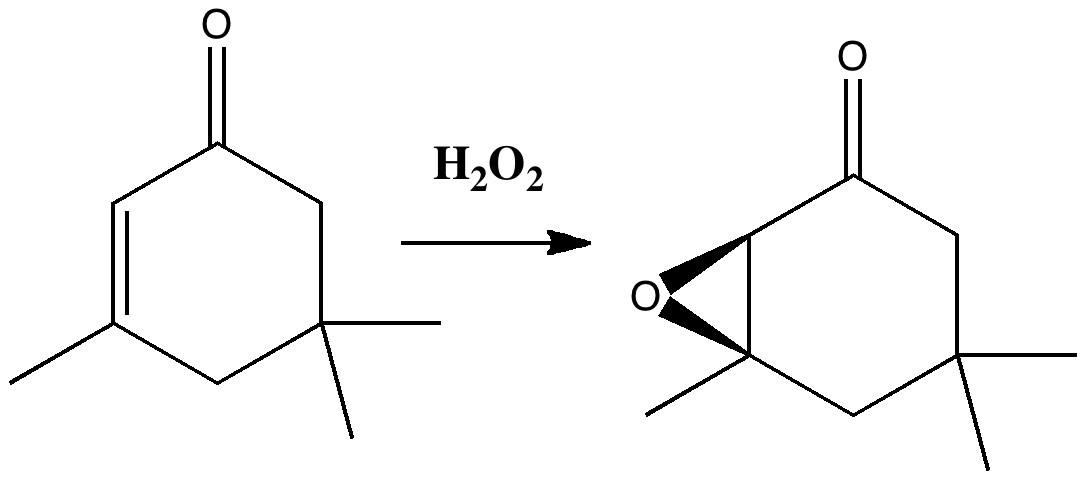
Our understanding of science mostly advances in small incremental and nuanced steps (which can nevertheless be controversial) but sometimes the steps can be much larger jumps into the unknown, and hence potentially more controversial as well. More accurately, it might be e.g. relatively unexplored territory for say a chemist, but more familiar stomping ground for say a physicist. Take the area of asymmetric synthesis, which synthetic chemists would like to feel they understand. But combine this with gravity, which is outside of their normal comfort zone, albeit one we presume is understood by physicists. Around 1980, chemists took such a large jump by combining the two, in an article spectacularly entitled Asymmetric synthesis in a confined vortex; Gravitational fields and asymmetric synthesis (DOI: 10.1021/ja00521a068). Their experiment was actually quite simple. They treated isophorone (a molecule with a plane of symmetry and hence achiral) with hydrogen peroxide and then measured the optical rotation.

Asymmetric synthesis of Isophorone oxide

Conventional wisdom is that the oxygen can be delivered with equal probability to either face of the alkene, resulting in a racemic (equal) mixture of the two enantiomers of the epoxide. But if one enantiomer is formed in slightly greater amount than the other, the reaction is said to proceed asymmetrically, and the product will exhibit an optical rotation. Normally, such asymmetry is induced by carrying out the reaction in the presence of a chiral molecule or catalyst. Light too can be chiral, but these brave chemists decided to use gravity. More specifically, the earth’s gravitational field. In the Northern Hemisphere. The reaction was conducted in a centrifuge in three ways. With the spun tube horizontally, and then vertically spinning clockwise or anticlockwise. The first of these produced product which exhibited no optical rotation within experimental error (e.g +0.2 ± 0.3 mdeg). The second gave results with a positive rotation (e.g. 12.8 ± 0.3 mdeg) and the third a negative rotation (-2.2 ± 0.2 mdeg). They considered that the reaction was occurring in e.g. a clockwise vortex constituting a P-helix (the vortex in other words was chiral) interacting with the earth’s coriolis force.  They speculated (but did not do the experiment) that the reverse effect would be seen in the Southern Hemisphere. Their paper concluded with the grand speculation that prebiotic organic synthesis could have been partially asymmetric as a result of being conducted in a chiral gravitational field (nothing like aiming high!).

Shortly after this was published, a rebuttal appeared (DOI: 10.1021/ja00544a051) penned not by a synthetic chemist but a physicist. In truth, most of the four-paragraph article presents arguments few chemists are familiar with (and probably do not understand). Only one sentence, the very last, made the impact (and it sounds as if it was added as a throw-away afterthought). It simply stated that the magnitude of the earth’s field (in so-called natural units) suggested that a parameter ω related to the spinning velocity was ~10-21 and that the corresponding value that would be required to induce the asymmetry observed (which can be computed from e.g. ΔG = -RT Ln K) was 10-14. Put in rather plainer English, the earth’s magnetic field was seven orders of magnitude too weak to have the effect claimed for it. That last sentence on its own pretty much sunk the theory, and it is no longer thought that gravitational fields can induce asymmetry in reactions. I tell this story (which, as it happened thirty years ago is now largely forgotten), since seven orders of magnitude is quite a large mismatch! Chemists rarely have the opportunity to be so spectacularly wrong when they propose a theory. In reality, even two orders of magnitude is unusual.

It’s when you approach factors of say less than one order of magnitude (the nuances) that arguments about which interpretation is correct may break out. So which category might the subject of this post belong to? As I there noted, it’s all about whether the two carbon atoms separating carbon dioxide and cyclobutadiene in a crystalline lattice by a distance of 1.5Å are interacting by a covalent bond, or a van der Waals attraction. In terms of energies, most chemists agree that these differ by around two orders of magnitude. This, I suggest, does not come into the category of nuance!

For a nice review of asymmetric synthesis under physical fields, see here.

Anatomy of an asymmetric reaction. The Strecker synthesis, part 1.

Monday, May 24th, 2010

The assembly of a molecule for a purpose has developed into an art form, one arguably (chemists always argue) that is approaching its 100th birthday (DOI: 10.1002/cber.191104403216) celebrating Willstätter’s report of the synthesis of cyclo-octatetraene. Most would agree it reached its most famous achievement with Woodward’s synthesis of quinine (DOI: 10.1021/ja01221a051) in 1944. To start with, the art was in knowing how and in which order to join up all the bonds of a target. The first synthesis in which (relative) stereocontrol of those bonds was the primary objective was reported in 1951 (10.1021/ja01098a039). The art can be taken one step further. It involves control of the absolute stereochemistry, involving making one enantiomer specifically (rather than the mirror image, which of course has the same relative stereochemistry). Nowadays, a synthesis is considered flawed if the enantiomeric excess (of the desired vs the undesired isomer) of such a synthesis does not achieve at least ~98%. It is routine. But ask the people who design such syntheses if they know exactly the reasons why their reaction has succeeded, you may get a less precise answer (or just a lot of handwaving; chemists also like to wave their hands as well as argue).

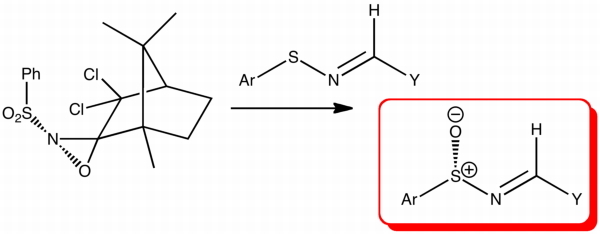
Here I set out one such asymmetrically stereospecific scheme, which is the first part of a reaction used to make both natural and un-natural configurations of aminoacids; the Strecker synthesis.

The asymmetric synthesis of an S(S) sulfoxide. Click for 3D model

It makes use of a natural product based on the camphor ring system which nature provides as a single enantiomer. It is converted to an oxaziridine, and this reagent is now used to transfer one oxygen atom to an imino-thioether (DOI: 10.1021/ja00030a045). The result is the formation of a single S(S) enantiomer (the enantiomeric excess is > 98%) of a sulfoxide. In the second stage, cyanide is then delivered asymmetrically (i.e. to one face rather than the other) of the C=N group, the precursor to forming a pure enantiomer of an amino acid. Here we will probe why the first reaction, the asymmetric oxygen atom delivery, is so specific. It would be fair to say that this reaction was probably originally designed with no fundamental understanding of how it might achieve its magic asymmetric delivery. For example, those two chlorine atoms on the camphor ring look as if they were selected by trial-and-error. What indeed IS their role? Steric? Electronic? Other?

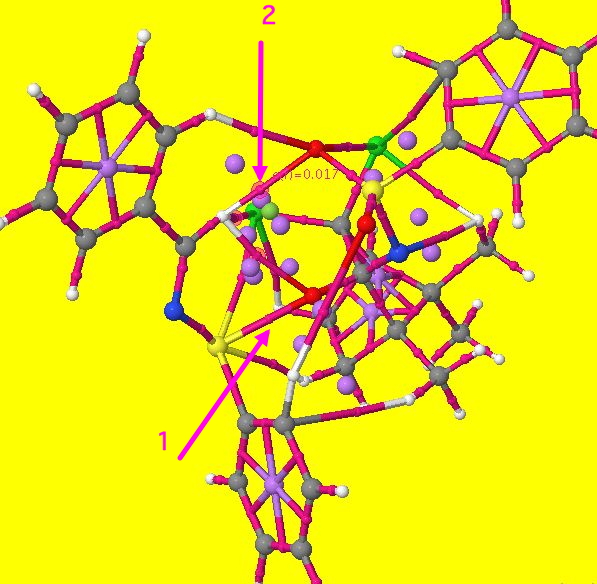
If you click on the diagram above, a rotatable 3D model should appear (a static version is shown below). This is an AIM (atoms-in-molecules) analysis of the curvature of the electron density in this transition state (see DOI: 10042/to-4929). To help you navigate, arrow 1 is pointing to the small purple sphere representing the BCP (bond critical point) for the forming S…O bond. Three more purple spheres are highlighted with a halo. One of these is pointed to by arrow 2 below (to see the other two, you really will need the 3D model). This represents a BCP which appears between the hydrogen of the N=CH group and one of the oxygen atoms of the sulphone group. The label indicates the electron density at that point (0.017 au). This is characteristic of a hydrogen bond, albeit an unusual C-H…O type (a type that is too rarely invoked when explanations of stereospecificity are sought), and the density indicates its a reasonably strong one!

AIM analysis of Transition state for oxygen transfer

In fact, two more BCPs can be located between this H and other groups, and they too are marked with halos. The first leads to the oxygen atom being transferred, and the second to specifically one of the two chlorine atoms (there are other interactions to the chlorines as well). Now, it turns out that these interactions are largely absent for the alternative transition state (which would form the enantiomeric R(S) sulfoxide). Since a C-H…O hydrogen bond can easily be worth ~2 kcal/mol, it is no surprise to find that the energy of the favoured transition state is overall 2.4 kcal/mol lower in free energy compared to the isomer not formed. This represents (@300K) a ratio of 60:1 in the predicted ratio of the two species, or indeed an ee ~98%.

Armed with this insight, one could design further experiments to test the hypothesis. For example, it appears only one of the two chlorines plays an active role. Replacing the passive chlorine with e.g. hydrogen might make little difference. Suppressing the hydrogen bonds by changing the N=CH to e.g. N=CF should have a big effect. The two oxygens of the sulfone also do not play equal roles. Perhaps this can be tested with a sulfoxide in place of the sulfone? All these hypotheses can of course first be tested with calculations. Of course, coming up with synthetic strategies for these new molecules might be tricky. But these experiments may give confidence (or demolish it) in the AIM technique used here to analyse the stereospecificity of this reaction.

So the next time you hear a synthetic chemist proudly announce a new enantioselective synthesis, ask them what their deeper understanding of why their reaction works is. And be prepared to run away fast if they growl at you!