Archive for the ‘Uncategorized’ Category

“For chemists, the AI revolution has yet to happen”.

Thursday, May 25th, 2023

This editorial from Nature[1] is a timely reminder of the importance of data. But also, not just any data, but “accurate and accessible training data“. Accessible of course is one of the attributes of FAIR (Findable, Accessible, Interoperable and Re-usable). The editorial also states “data need to be recorded in agreed and consistent formats, which they are not at present“. That is covered by the I and R of FAIR, often applied in conjunction with metadata recording the Media type that the data is held in (See DOI https://doi.org/jvk9 for examples of the use of Media types in chemical computation and chemical NMR). Again, “The best possible training sets would also include data on negative outcomes“. This relates to the separation of the two publication processes, namely the article itself (or the story behind the data) and the data itself as a first class scientific object. Thus when we publish FAIR data in association with articles, the data archive will often contain data that is not used in the article itself (perhaps because it led to a negative outcome), but is nevertheless part of the FAIR data collection for that topic. Even if the data does not lead to journal publication, publishing it in a data repository means it will not be lost. Somebody (or AI software) may still find it useful.

Whilst the acronym AI is increasingly used and hyped up, I would argue that FAIR should accompany the use of the term AI in most cases (as indeed it is at eg.[2]). Amongst other benefits, FAIR implies a metadata descriptor record is present, which if richly populated, would help address the “accurate” of “accurate and accessible” by adding context. As we show here[2], FAIR is also “AI-Ready“. Indeed an often used alternative expansion of the acronym is “FAIR is AI-Ready”. It is indeed designed to be so if the metadata is sufficiently rich. I also remind that an IUPAC working party is working to produce recommendations to help with this aspect.[3]

My final comment adds to the requirement of “accurate and accessible training data“. I would reformulate this as “accurate, accessible and complete training data“. Much data in chemical science is recorded on an instrument, or computed using modelling software. As it emerges from the instrument or the software package, it can be said to be “complete”. Nothing has been thrown away at this stage. But think of eg NMR data. This is acquired as a FID, and then subjected to analysis (A Fourier Transform, after weighting, which does introduce potential artefacts into the data!). It is the latter data type that is invariably published, often in a visual (PDF) form which may lack numerical accuracy and which is machine processable only with difficulty.  Or think of crystallography, where data emerges as diffraction images and is then transformed into structure factors and coordinates. Only the last form is often published (as a CIF file), but the original data is almost never so (see[4] for an example where complete crystallographic data is published). Then again, chemical computations. The full record of the computation is often produced as a “checkpoint” or “interoperability format” (see eg DOI: 10.14469/hpc/10043) which contains the computed wavefunction and which can be re-used to compute a wide variety of new properties. But most articles currently record computational data simply as a set of atom coordinates. If you are really lucky, you might get some keywords used to run the calculation. But nothing which would eg allow an AI-algorithm to easily compute a property it might need. We cannot be sure that a machine learning/AI procedure might not benefit from such complete data.

So, FAIR and AI are conjoined, they each need the other and should not be separated. And to repeat, where data is transformed before being published, please also add the complete dataset, not just any reduced form.


Post DOI: 10.14469/hpc/12586


References

  1. "For chemists, the AI revolution has yet to happen", Nature, vol. 617, pp. 438-438, 2023. https://doi.org/10.1038/d41586-023-01612-x
  2. H.S. Rzepa, and S. Kuhn, "A data‐oriented approach to making new molecules as a student experiment: artificial intelligence‐enabling FAIR publication of NMR data for organic esters", Magnetic Resonance in Chemistry, vol. 60, pp. 93-103, 2021. https://doi.org/10.1002/mrc.5186
  3. R.M. Hanson, D. Jeannerat, M. Archibald, I.J. Bruno, S.J. Chalk, A.N. Davies, R.J. Lancashire, J. Lang, and H.S. Rzepa, "IUPAC specification for the FAIR management of spectroscopic data in chemistry (IUPAC FAIRSpec) – guiding principles", Pure and Applied Chemistry, vol. 94, pp. 623-636, 2022. https://doi.org/10.1515/pac-2021-2009
  4. J. Almond-Thynne, A.J.P. White, A. Polyzos, H.S. Rzepa, P.J. Parsons, and A.G.M. Barrett, "Synthesis and Reactions of Benzannulated Spiroaminals: Tetrahydrospirobiquinolines", ACS Omega, vol. 2, pp. 3241-3249, 2017. https://doi.org/10.1021/acsomega.7b00482
A look at (one of) the dyes used in the Bayeaux tapestry.

Tuesday, January 3rd, 2023

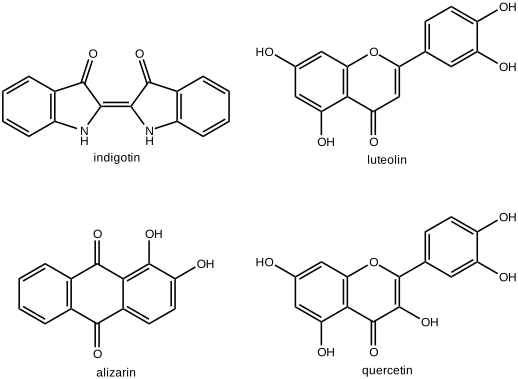
I have previously looked at the pigments used to colour the Book of Kells, which dates from around 800 AD and which contained arsenic sulfide as the yellow colourant. The Bayeaux tapestry is a later embroidery dating probably from around 1077 and here the colours are based entirely on mordanted natural dyes. These are generally acknowledged to be blue woad (principle component indigo), red madder (principle component alizarin) and the less well-known yellow weld, which comes from the plant Reseda Luteola and the principle component of which is luteolin.

Luteolin has an interesting chemical history. It was first purified in 1829, in the dawn of organic chemistry, and its formula C15H10Oestablished by 1864. A. G. Perkin, the son of the William Perkin who discovered the dye mauveine, then provided the chemical structure[1] in 1896. This latter article is well worth a modern read, since it beautifully illustrates how the art of structure determination was conducted in the days before crystallography and NMR.

Perkin obtains his structure by comparing luteolin to then known quercetin, concluding that the former must also contain an aromatic hydroxy group “ortho” to the carbonyl group, as in querecetin. The key experimental evidence was that alkylation of luteolin with iodoethane only produces a triethoxy derivative of luteolin, with “one hydroxy group resisting ethylation“. It was by then established, by four different sets of researchers, that hydroxy groups adjacent to the carbonyl in e.g. quercetin or alizarin resisted alkylation. The structure of luteolin was established (see eg 10.5517/cc798yq) by combining various such observations, a method (and skill) that has largely lapsed nowadays. 

A modern take on this selective alkylation might be to compute e.g. the wavefunction (ωB97XD/Def2-TZVPP/SCRF=water) of luteolin to inspect the energies of the orbitals associated with alkylation of the hydroxyl group, using the energy of the nucleophilic lone pair oxygen orbital (FAIR DOI: 10.14469/hpc/12185) as an indicator. The least stable such orbital (highest energy) is normally an indicator of the most nucleophilic electron pair. In this case, the highest (most reactive) such orbital is the one adjacent to the carbonyl group, which thereby reveals a mystery, since it is this very hydroxyl that resists alkylation! A transition state approach to this might be needed to resolve the mystery, factoring in perhaps steric effects etc.

-0.6951 au -0.7132 au
-0.7169 au -0.7205 au
<

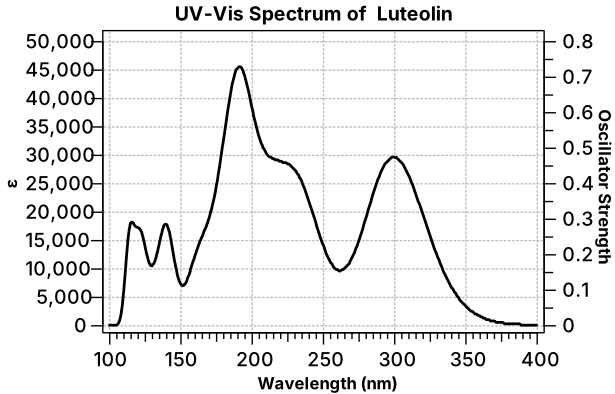
The calculated UV-Vis spectrum is shown below, showing the peak at ~300 NM responsible for the intense yellow colour (300-400 nm).


The strongest oscillator contribution to the transition is shown below.

LUMO au HOMO

So here I have cast a little more light on this relatively unknown natural yellow dye, that was used for many centuries to colour woollen materials.

References

  1. A.G. Perkin, "XLIX.—Luteolin. Part II", J. Chem. Soc., Trans., vol. 69, pp. 799-803, 1896. https://doi.org/10.1039/ct8966900799

Molecules of the year -2022. A closer look at the Megalo-Cavitands.

Thursday, December 15th, 2022

In the previous post, I discussed how data associated with two of the candidates for molecules of the year – 2022 could be retrieved and then used to inspect their three dimensional structures. Here I focus on the ultra large cavitands recently reported[1]. As I noted, these have an associated data coordinate archive published on Zenodo (DOI: 10.5281/zenodo.6953961) although this is not cited in the article itself.

Shown below are the coordinates of the A4-T molecule containing C70, the first being optimized at the PM6 level and the second at the PM7 level. The most obvious difference is that all the close C-H…H-C contacts of the host molecule shrink from between ~4Å to 2.6Å at PM6 geometries, down to about 2.1Å for PM7, a contraction of at least 0.5Å. Also, the gap between the host and the guest reduces from around 4.2Å to 3.45 Å (a distance typical of π-π stacking by the way), a significant reduction of ~0.75Å. Click on the two images below to view this model.

The difference in the dispersion terms for these two geometries emerges as 36.6 kcal/mol lower for the PM7 optimised geometry compared to the original PM6 geometry, a significant stabilisation. FAIR data is at DOI: 10.14469/hpc/12022 if you want to analyse the cavity sizes further.

Shown below is the NCI (non-covalent-interaction) surface, computed at the PM7 geometry and using the MNDO wavefunction. This illustrates the stabilisations occuring from the non-covalent density (takes a little while to load).


This post has DOI: 10.14469/hpc/12027


References

  1. J. Pfeuffer‐Rooschüz, S. Heim, A. Prescimone, and K. Tiefenbacher, "Megalo‐Cavitands: Synthesis of Acridane[4]arenes and Formation of Large, Deep Cavitands for Selective C70 Uptake", Angewandte Chemie International Edition, vol. 61, 2022. https://doi.org/10.1002/anie.202209885

Molecules of the year -2022. Data issues!

Tuesday, December 13th, 2022

The list of molecules of the year is out now at C&E News (but you have to have an account to view the list, unlike previous years). These three caught my eye:

  1. Electron in a cube: Synthesis and characterization of perfluorocubane as an electron acceptor,[1]. I have already written about this system and will not discuss it further, except to note this one topped the poll!
  2. Vernier template synthesis of molecular knots[2]
  3. Megalo-Cavitands: Synthesis of Acridane[4]arenes and Formation of Large, Deep Cavitands for Selective C70 Uptake[3]

The last two are examples of large three-dimensional molecules with unusual properties. The second is an example of a trefoil-of-trefoils, called a triskelion knot and I was very keen to get hold of its coordinates so that I could inspect the knotting. I thought I might summarise here the hierarchical procedures one might try for acquiring such data.

  • The most modern method of acquiring data associated with an article is to inspect the citation list at the end of the article. The trend encouraged by the FAIR data principles suggests that if such data has an associated DOI (as indeed the article itself does), then this DOI should be cited in the citations just like articles themselves. This concept is also known as treating data as a first class citizen of the scholarly processes. In this case no data was associated with the 81 citations listed at 10.1126/science.abm9247
  • The prevalent method since ~1996 has been to next download any ESI. That is linked here. I cannot help but note that the PDF format is not one optimised for data, but its better than nothing. This PDF has 114 pages, and one eventually finds the following on p 103: structures and corresponding energies uploaded to the Github database (https://github.com/kjhstenlid/AshbridgeVernier2022/). Github is known as a software repository, but its use as a data repository is unusual. Thus no DOI is assigned this data (which would explain why its not listed in the article citations). Here one learns from the readme that it contains Molecular knot structures in cif-file format for the Verner and Sheild knots.
  • To get this data one has to pretend it is code, and download the ZIP code archive. The CIF file found there however gives a fatal error when trying to load into a CIF viewer such as Mercury: Reading cell from Cif failed, could not retrieve ‘_cell_length+a’. The CIF is clearly not generated from a crystallographic analysis program but a modelling program and is clearly invalid as a CIF.
  • One now has to fall back seeing if the CIF file can be rescued using a text editor. This is non-trivial but about 10 minutes of editing finally produces a file that can be viewed.
  • Here is the 3D structure (click on the image to view).

Now for the Megalo-Cavitands (or not). Just as above, one ends up in a 49-page PDF file looking for coordinates. There one gets pictures of PM6-computed models starting on p 28, but alas apparently no associated coordinates.

So no 3D models to show here then (sorry, clicking on the image above will not produce them).

My concluding remark should be that when an interesting molecule is selected for inclusion in eg the molecules of the year – 2022, one of the criteria for its inclusion is that the availability of full and FAIR data describing its properties should be one of the essential criteria for selection.


I note the method used to generate these coordinates (PM6) is perhaps not ideal; it contains no dispersion attraction terms, which are probably important if modelling host-guest complexation. The PM7 method which does is far better for this sort of thing! This highlights the importance of providing data, in this case 3D coordinates. It would be interesting to recompute the dimensions of these molecules using a method that does allow for dispersion attractions to be included. For just such an example, see here.
I have contacted the authors of [3] and it turns out a reference to a Data repository submission was omitted from the article. The data is at DOI: 10.5281/zenodo.6953961 and I will report separately on my analysis of the effect of replacing PM6 with PM7.
See this open letter about changes at C&EN.


This post has DOI: 10.14469/hpc/12028


References

  1. M. Sugiyama, M. Akiyama, Y. Yonezawa, K. Komaguchi, M. Higashi, K. Nozaki, and T. Okazoe, "Electron in a cube: Synthesis and characterization of perfluorocubane as an electron acceptor", Science, vol. 377, pp. 756-759, 2022. https://doi.org/10.1126/science.abq0516
  2. Z. Ashbridge, E. Kreidt, L. Pirvu, F. Schaufelberger, J.H. Stenlid, F. Abild-Pedersen, and D.A. Leigh, "Vernier template synthesis of molecular knots", Science, vol. 375, pp. 1035-1041, 2022. https://doi.org/10.1126/science.abm9247
  3. J. Pfeuffer‐Rooschüz, S. Heim, A. Prescimone, and K. Tiefenbacher, "Megalo‐Cavitands: Synthesis of Acridane[4]arenes and Formation of Large, Deep Cavitands for Selective C70 Uptake", Angewandte Chemie International Edition, vol. 61, 2022. https://doi.org/10.1002/anie.202209885

Derek Lowe asks “What’s a Journal For?” – Knowledge graphs?

Friday, October 21st, 2022

What’s a Journal For? This debate has been raging ever since preprint servers were introduced as far back as 1991! Indeed, during my recent submission of a journal article, one of the questions asked was whether the article was already deposited in such a preprint server (in a positive sense, and not one excluding further submission progress). Since my previous comment on this theme was made more than three years ago, I thought I might update it.

I might start with the observation that some think the concept of a journal really comprises three separate components (up to eight have been suggested); the story or narrative being told, the data on which that story is based and the citations or bibliography which set the context of the story. The latter two components have both developed their own publishing models; the data in a repository and accompanied by rich metadata which provides at least some of the context and citations which have their own model. Article metadata also includes its own citations helping to place the data into a wider context or “bigger picture” as expressed by a knowledge graph,[1] which even CAS Scifinder will now reveal based on your specific search!. Such metadata is also now generally a component of the overall metadata associated with journal articles. The data component is being accompanied by extensive work to enhance the accompanying metadata models[2] and we might expect rapid progress to be made here in the near future.

So again to ask “what’s a journal for” if two of its essential components have their own publishing models? The story will always have an important role to play and peer review of that story will always be an important aspect of the journal – indeed perhaps the most important aspect. So should we focus in our attention on this?  I noted that in 2017, a brave new experiment claiming “Open access • Publication charge free • Public peer review • Wikipedia-integrated” of which public peer review was an important component, has accumulated relatively few publications since. I also noted an article[3] in which the reviewers (but not their reviews) are clearly indicated. This concept too has not made much headway. Will things change in the future? Some think that they have too, or the entire concept of scientific publishing will indeed fragment into many different models and no longer fully serve its purpose.


I cannot resist including my own knowledge graph here, which reveals nicely the impacts of some of the work I have been associated with, as represented by the fans on the outside of the central graph.

Although a major component of many peer reviews has the focus on the data and (missing) citations.

References

  1. H. Cousijn, R. Braukmann, M. Fenner, C. Ferguson, R. van Horik, R. Lammey, A. Meadows, and S. Lambert, "Connected Research: The Potential of the PID Graph", Patterns, vol. 2, pp. 100180, 2021. https://doi.org/10.1016/j.patter.2020.100180
  2. R.M. Hanson, D. Jeannerat, M. Archibald, I.J. Bruno, S.J. Chalk, A.N. Davies, R.J. Lancashire, J. Lang, and H.S. Rzepa, "IUPAC specification for the FAIR management of spectroscopic data in chemistry (IUPAC FAIRSpec) – guiding principles", Pure and Applied Chemistry, vol. 94, pp. 623-636, 2022. https://doi.org/10.1515/pac-2021-2009
  3. L. Li, M. Lei, Y. Xie, H.F. Schaefer, B. Chen, and R. Hoffmann, "Stabilizing a different cyclooctatetraene stereoisomer", Proceedings of the National Academy of Sciences, vol. 114, pp. 9803-9808, 2017. https://doi.org/10.1073/pnas.1709586114

Examples of inverted or hemispherical carbon?

Thursday, September 15th, 2022

In previously asking what the largest angle subtended at four-coordinate carbon might be, I noted that as the angle increases beyond 180°, the carbon becomes inverted, or hemispherical (all four ligands in one hemisphere). So what does a search for this situation reveal in the CSD? The query can be formulated as below, in which the distance from the centroid of the four ligands to the central carbon is specified to be in e.g. the range 0.8 to 1.1Å. For tetrahedral carbon surrounded by four carbon ligands, the value would be close to zero, so any value larger than say 0.8Å is worth inspecting.

Many of the 101 hits are false positives for inverted carbon (by inspection), but five turn out to be propellanes and eight contain the unusual motif shown below:

Here I give one example of each. SADHUA[1] is a crystalline [1.1.1]propellane in which the “central” bond length is a normal looking 1.558Å. In fact there is positive (experimental) difference electron density on both “exo” ends of this bond and negative difference density in the “endo” region, suggesting the bond is indeed unusual (FAIR DOI: 10.14469/hpc/11159).


One example of the other motif is SEWZID[2], where the four ligands to the inverted carbon comprise two C-C bonds and two apparent C-Fe bonds of length 2.04Å. A typical C-Fe bond length is in the region 1.8Å, so these are longish C-Fe bonds. Indeed, their Wiberg bond orders emerge as ~0.3, so they would not normally count as a “bond”. Nonetheless, they are indexed as such in the CSD! This highlights an interesting aspect of how to construct a searchable crystal structure database. You have to make a decision on whether any pair of atoms is “bonded” or not. And the decision for bonds with orders <1 can be particularly difficult, especially if calculations of these properties are not part of your assignment toolkit.

So we might conclude that inverted or hemispherical four-coordinate carbon is a rare beast; all the more surprising that the best known examples, the [1.1.1]-propellanes are so stable! Apart from the metallocarbons, one of which is illustrated above, are there any others?

References

  1. P. Seiler, J. Belzner, U. Bunz, and G. Szeimies, "Crystal Structure and Electron‐Density Distribution of Two [1.1.1] Propellane Derivatives at 81 K", Helvetica Chimica Acta, vol. 71, pp. 2100-2110, 1988. https://doi.org/10.1002/hlca.19880710827
  2. R. Rumin, F. Petillon, L. Manojlovic-Muir, and K.W. Muir, "Reactions of di- and polynuclear complexes. 6. Reaction of [(.eta.5-C5H5)(CO)Fe{.mu.-C(CF3)=C(CF3)SMe}2Fe(CO)(.eta.5-C5H5)] with [Fe3(CO)12]. Ligand exchange between metals: synthesis and characterization of di- and trinuclear iron-alkyne complexes. Crystal structure of [{Fe(CO)3}2{.mu.-(CF3)CCC[Fe(.eta.5-C5H5)(CO)2]}]", Organometallics, vol. 9, pp. 944-952, 1990. https://doi.org/10.1021/om00118a008

What is the largest angle possible at 4-coordinate carbon – 180°?

Sunday, September 11th, 2022

Four-coordinate carbon normally adopts a tetrahedral shape, where the four angles at the carbon are all 109.47°. But how large can that angle get, and can it even get to be 180°?

A search of the CSD (crystal structure database) reveals a spiropentane as having the largest such angle, VAJHAP with 164°[1]

Because crystal structures might have artefacts such as disorder etc, it is always good to check this with a calculation; hence ωB97XD/Def2-TZVPP (FAIR data DOI: 10.14469/hpc/11148) for which a calculated angle of 163.8° is reassuring. The smallest angle in this system by the way is 58°, pretty normal for three-membered rings.

The localised orbitals show the C-C region defining the large angle to be very “bent” (a banana bond) but otherwise fairly normal.

So can one “engineer” an even larger angle? Replacing the C=C of the benzo group with a shorter CHgroup produces the following, which is now almost linear (almost a “hemispherical” carbon).


What about the smallest angle at 4-coordinate carbon? Could it be significantly smaller than the 57° noted above for a three membered ring? Searching the CSD reveals XAQHIH[2] with an angle of 43° but the calculation above now does not confirm this, the angle changing from 43° to 59° during optimisation. A reminder that when exploring extreme geometric values, always check with a calculation!


The next candidate is CAZFUE[3] with an apparent measured angle of 48°. This appears to have C2 symmetry, and a calculation with this gives a value of 46.6°. But all is not what it seems. This is a classic example of a semibullvalene [3,3] Cope rearrangement, caught in the “middle” so to speak (See this post here). In fact this geometry is actually a transition state, and the crystal structure is the thermal average of two positions, making it appear symmetrical. The ground state for this structure as calculated is different! The two angles now emerge as 40 and 57° (average 48.6°). At the “transition state”, one of the four “bonds” to carbon is unusually long (2.07Å), which is the direct cause of the small 48° angle. If this is not allowed as a “bond”, the angle at the other true 4-coordinate carbon emerges as normal at 57°

So the answer to the smallest angle does seem to be around 57°, but it could be as small as 47° if one allows bonds of 2.07Å in one’s definition of 4-coordinate. The candidate for the largest bond angle, of almost 180°, seems a reasonable synthetic target!

References

  1. R. Boese, D. Blaeser, K. Gomann, and U.H. Brinker, "Spiropentane as a tensile spring", Journal of the American Chemical Society, vol. 111, pp. 1501-1503, 1989. https://doi.org/10.1021/ja00186a058
  2. M.V. Roux, J.Z. Dávalos, P. Jiménez, R. Notario, O. Castaño, J.S. Chickos, W. Hanshaw, H. Zhao, N. Rath, J.F. Liebman, B.S. Farivar, and A. Bashir-Hashemi, "Cubane, Cuneane, and Their Carboxylates:  A Calorimetric, Crystallographic, Calculational, and Conceptual Coinvestigation", The Journal of Organic Chemistry, vol. 70, pp. 5461-5470, 2005. https://doi.org/10.1021/jo050471+
  3. H. Quast, Y. Görlach, J. Christ, E. Peters, K. Peters, H.G. von Schnering, L.M. Jackman, A. Ibar, and A.J. Freyer, "Crystal and molecular structure and the cope activation barriers of some dicyano-1,5-dimethylsemibullvalenes", Tetrahedron Letters, vol. 24, pp. 5595-5598, 1983. https://doi.org/10.1016/s0040-4039(00)94150-9

Why does octafluorocubane have such a high sublimation point?

Thursday, September 8th, 2022

The recently reported synthesis[1] of octafluorocubane established a sublimation point as 168.1–177.1°C (a melting point was not observed). In contrast, the heavier perfluoro-octane has an m.p. of -25°C. Why the difference? Firstly, the crystal structure is shown below, albeit as a dimer rather than a periodic lattice (click on image to obtain 3D coordinates).

The distance between a fluorine and the centroid of the 4-membered carbon ring is 1.741Å. Our crystallographer (thanks Andrew!) gives me the following analysis of the periodic crystal lattice:

The asymmetric unit (crystal structure DOI: 10.5517/ccdc.csd.cc29z5p5) contains only two fluorine atoms (F1 and F2) and two carbon atoms (C3 and C4). Due to the symmetry/special positions, the C8F8 cube is formed of six C3’s, six F2’s, two C4’s and two F1’s. The 2.741Å contact comes from an F2 and hence there are six of these (and six faces). The closest F…C4(centroid) intermolecular separation for F1 is ca. 4.20Å. From the crystal structure one can indeed observe six C-F bonds of length 1.341Å and two of length 1.338Å, some 0.003Å shorter.

So time for some calculations (FAIR Data DOI: 10.14469/hpc/11132). The energies shown here are for the C2h-symmetric dimer relative to two monomers.

Method ΔE ΔH ΔG F…centroid distance, Å
HF/Def2-TZVPP -1.19 -0.01 +4.53 3.288
B3LYP/Def2-TZVPP -1.17 -0.00 +4.54 3.176

B3LYP+GD3+BJ/Def2-TZVPP

-5.24 -4.00 +2.87 2.859 (2.741 expt)

MP2/Def2-TZVPP

-7.42 2.718 (2.741 expt)

The three methods were chosen as approximations to establish (a) the effect of a dispersion/correlation correction, using the standard third-generation Grimme method and (b) the effect of more general dynamic correlations as being the difference between a Hartree-Fock calculation and DFT one. The values show the HFa and B3LYP-DFT as being very similar, but adding the GD3+BJ term stabilises the dimer significantly, as well as producing an F…centroid distance only a little longer than that measured. Each cube will sustain three pairs of such interactions, so the total stabilisation energy is  ~15 kcal/mol and the enthalpy stabilisation is ~12 kcal/mol. A periodic boundary calculation of the complete cell would certainly be an even better model of this system. Nonetheless one further test, of the trend in length between the six interacting F atoms with a ring centroid and the two that do not (exp Δ-0.003Å shorter for the latter) is also replicated by the B3LYP+GD3+BJ/Def2-TZVPP calculation (Δ-0.006Å) which suggests the simple dimer model is not badly wrong.

So from these results, it appears that the attractive interactions between molecules octafluorocubane resulting in its high sublimation temperature may not be simply electrostatic interactions (a HF calculation would model that) or indeed of dynamic correlation (modelled by DFT methods) but a more complete electron correlation of the type normally described as dispersion and eg available via multi-reference and/or coupled-cluster methods. It may indeed come as a surprise that this molecule is a high melting solid because of dispersion, but the unique geometry allows an F to interact with four carbons via such forces, and to accumulate six of these per molecule in the crystal structure. So really quite unusual.

To end, it would certainly seem worthwhile to apply higher levels of theory to confirm this result, since the GD3+BJ induced-dipole/induced-dipole dispersion model is a relatively simple one, and as I commented in my WATOC notes, much higher level models of this effect are now becoming available.


aAs suggested by Cina Foroutan-Nejad, a commentator on the previous blog post


This post has DOI: 10.14469/hpc/11135


References

  1. M. Sugiyama, M. Akiyama, Y. Yonezawa, K. Komaguchi, M. Higashi, K. Nozaki, and T. Okazoe, "Electron in a cube: Synthesis and characterization of perfluorocubane as an electron acceptor", Science, vol. 377, pp. 756-759, 2022. https://doi.org/10.1126/science.abq0516

Octafluorocubane radical anion – where does the extra electron sit?

Monday, August 29th, 2022

Derek Lowe reports the story[1] that the recently synthesized octafluorocubane can absorb one electron to form a radical anion – an electron in a cube. So I thought it would be fun to compute exactly where that electron sits!

A ωB97XD/Def2-TZVPPD/SCRF=chloroform calculation (DOI: 10.14469/hpc/11090) is carried out on the neutral system (optimizing its geometry) and then the radical anion at the same geometry. Cubes of total electron density are evaluated for both and then the neutral form is subtracted from the anion. The result is shown below (density isosurface value 0.0025 au; click on the image to load a rotatable 3D model of the density difference).

The below is at the optimised anion geometry for both species;

The colour code is that blue represents the location of the additional electron, and red indicates reduced electron density compared to the anion. Arrow 1 shows an additional sphere of density inside the cube – yes, an electron in a cube. But you probably would not have anticipated that the outer surface of the cube (arrow 2) is also surrounded by that electron and there is a reduced density layer on the inside surface of the cube. The C-F bonds have regions of both additional density and reduced density.


Postscript: Perfluorododecahedrane added as per comment

Postscript: Perfluorotetrahedrane added for completeness


References

  1. M. Sugiyama, M. Akiyama, Y. Yonezawa, K. Komaguchi, M. Higashi, K. Nozaki, and T. Okazoe, "Electron in a cube: Synthesis and characterization of perfluorocubane as an electron acceptor", Science, vol. 377, pp. 756-759, 2022. https://doi.org/10.1126/science.abq0516

Four stages in the evolution of interactive ESI as part of articles in chemistry journals.

Thursday, August 25th, 2022

A previous post was triggered by Peter alerting me that interactive electronic supporting information (IESI) we had submitted to a journal in 2005[1] appeared to be strangely missing from the article landing page. This set me off recollecting our journey, which had started around 1998, and to explore what the current state of these ancient IESIs were in 2022. I have now reached 2014 in this journey, which is being recorded as it happens in the comments page of the post. I discovered there were four distinct stages in that evolution of IESI which I thought it would be of interest to record here.

  1. From around 1998 to 2004, our efforts at IESI centred around a browser plugin called Chime, which was itself derived from stand-alone code called Rasmol and a collaboration between the company that implemented this (MDL) and Netscape, who happened to have offices in San Francisco close to each other. Chime came in two versions, free to use and a commercial version that added further functionality such as access to MDL databases etc. An example from 1998[2] can be seen at https://www.rsc.org/suppdata/perkin2/1998/2695/ and the code is shown below:
    <EMBED border=0 src="geom+vib/12e-dft.gau" name="12e-dft"
    align=center width=150 height=150 spiny=36 startspin=true
    display3D=sticks PLUGINSPAGE="http://www.ch.ic.ac.uk/cgi-bin/plugin.cgi"
    script="zoom 175;"></EMBED>

    I have to say that access to the data underpinning this IESI is still good; but the interactive component itself has long gone, along with Chime itself.

  2. By 2005, Jmol had emerged as a more general open-source browser plugin replacing Chime. This so-called Java “run time library” had to be installed by the user into their browser instance (and hence required admin rights). The interactivity in the first article where we deployed it[3] was invoked as per below.
    <applet height="300" archive="JmolApplet.jar"
    width="300" code="JmolApplet" name="TS2"
    mayscript="true" id="TS2">
    <param name="progressbar" value="true" />
    <param name="progresscolor" value="blue" />
    <param name="boxmessage"
    value="starting JmolApplet ..." />
    <param name="emulate" value="chime" />
    <param name="boxbgcolor" value="black" />
    <param name="load" value="RRSS_fm-5-ts2-49.xyz" />
    </applet>

    It is this invocation where the interactivity was rescued by Angel as described in the earlier post comments page in the form of an adaptor library that converts the syntax above to modern form.

  3. By 2007, this applet syntax had gone, to be replaced by a JavaScript version invoking the same Java-based Jmol.[4]
    <script type="text/javascript" src="JSmol.min.js"></script>
    <script type="text/javascript" src="js/Jmol2.js"></script>
    <!-- The second command is modern, to convert to using  JSmol -->

    and then to invoke a molecule:

    <script type="text/javascript">
    jmolApplet(300,"load GaL3.mol; select all; spacefill 0.25; 
    wireframe 0.1; center atomno=1")</script>

    Here again an adapter library to update this syntax is available as Jmol2.js.

  4. Around 2012, the development of a Java replacement of Jmol by the script-based JSmol had started (ten years ago almost to the day!). Our first deployment was in 2014[5] where you can see an example in operation at DOI: https://doi.org/10.14469/hpc/11017 You will notice that bets were being hedged and the viewer was given a choice of using either Jmol (Java) or JSmol (Javascript). The reason was that in terms of speed, Jmol was perhaps 15 times faster than JSmol and so more complex rendered objects such as orbital isosurfaces, or proteins, could be very slow in JSmol. As computers themselves have got faster, and Javascript implementations in browsers similarly so, the need for Java has largely faded other than some specialist applications. Now only
    <script type="text/javascript" src="JSmol.min.js"></script>

    is needed to set things up, whilst the molecule call is illustrated by eg

     <a href="javascript:Jmol.script(jmolApplet0, 
    'load 24880.log',%20';frame 13;spin 3;')">log</a>

Now, ten years on from the genesis of JSmol, the functionality and capability of this program have continued to increase by leaps and bounds, but the general form has remained stable.

One other change in our usage did also occur in 2014. Previously the content being viewed came from a local file installed on the web server, as per eg 24480.log above. However we were now starting to source such files directly from a data repository, being a specialist resource to host such content. All that would be needed was the DOI of the repository collection where the data was being hosted, along with the Media type of the desired file. But that comes with its own issues and this is another story that will be told elsewhere.

References

  1. H.S. Rzepa, and M.E. Cass, "A Computational Study of the Nondissociative Mechanisms that Interchange Apical and Equatorial Atoms in Square Pyramidal Molecules", Inorganic Chemistry, vol. 45, pp. 3958-3963, 2006. https://doi.org/10.1021/ic0519988
  2. C. Conesa, and H.S. Rzepa, "Re-engineering potential energy surfaces: trapezoidally distorted π2s + π2s thermal cycloaddition/elimination reactions", Journal of the Chemical Society, Perkin Transactions 2, pp. 2695-2698, 1998. https://doi.org/10.1039/a805668d
  3. E.L. Marshall, V.C. Gibson, and H.S. Rzepa, "A Computational Analysis of the Ring-Opening Polymerization of <i>r</i><i>ac</i>-Lactide Initiated by Single-Site β-Diketiminate Metal Complexes:  Defining the Mechanistic Pathway and the Origin of Stereocontrol", Journal of the American Chemical Society, vol. 127, pp. 6048-6051, 2005. https://doi.org/10.1021/ja043819b
  4. H.S. Rzepa, and M.E. Cass, "In Search of the Bailar and Rây−Dutt Twist Mechanisms That Racemize Chiral Trischelates:  A Computational Study of Sc<sup>III</sup>, Ti<sup>IV</sup>, Co<sup>III</sup>, Zn<sup>II</sup>, Ga<sup>III</sup>, and Ge<sup>IV</sup> Complexes of a Ligand Analogue of Acetylacetonate", Inorganic Chemistry, vol. 46, pp. 8024-8031, 2007. https://doi.org/10.1021/ic062473y
  5. A. Armstrong, R.A. Boto, P. Dingwall, J. Contreras-García, M.J. Harvey, N.J. Mason, and H.S. Rzepa, "The Houk–List transition states for organocatalytic mechanisms revisited", Chem. Sci., vol. 5, pp. 2057-2071, 2014. https://doi.org/10.1039/c3sc53416b