This is a little historical essay into the electronic structure of naphthalene, presented as key dates (and also collects comments made which were appended to other posts).
- 1890[1]: Henry Armstrong presents the following structure of naphthalene. Three words need translation into modern usage. Where he uses the word nuclei the closest translation now might be rings. Secondly, the term affinity is nowadays replaced by electron. This latter term was first coined by Stoney[2] one year after Armstrong wrote this article to mean a then hypothetical “atom of electricity”. Oddly Armstrong never updated his own usage even after Thomson actually discovered the electron in 1897. Radicle is a substituent on the ring, and the origin perhaps of the generic R used nowadays.

Notice that Armstrong talks about a cycle of ten carbons in which ten affinities/electrons act (he had previously accounted for the 22 affinities associated with what we would now call the 11 C-C σ-bonds) and is adamant that no separation of the central carbon atoms takes place as Bamburger had suggested. In modern parlance the central C-C bond has a σ-bond and he is describing a [10]annulene. The last sentence above presages the modern term delocalisation.

Armstrong next considers anthracene (above) and replaces the line representation of the affinities by a circle, abbreviated C (which represents six cyclic affinities, or electrons) and by four conventional double bonds, recovering 14 of what nowadays designate as π-electrons. What he does NOT do is consider the equally valid structure where his C is shown in the right hand ring, and then apply Kekule’s hypothesis to in effect average them on a chemical time scale. It is noteworthy that overall, Armstrong has discussed 6, 10 and 14 electrons, just a hint of the 4n+2 rule yet to come.
- 1922[3]:The next example comes from Robert Robinson, future Nobel prize winner, who collected all 32 electrons in naphthalene (excluding CH) into the representation show as XVL. This is an averaging (mean) that Armstrong did not do, of what we would nowadays call two resonance forms. Whereas Armstrong had clearly recognised two sets of electrons (22 and 10), this distinction is lost in this 1922 representation of the 32 ring electrons in naphthalene.

- 1925[4]Just three years later Robinson (re?)discovers the magic of six π-electrons (the term π was not yet coined) and decides to reapply it to naphthalene. Rather than average two equivalent structures, each with just six cyclic π-electrons (Armstrong’s C) he uses two such rings with twelve π-electrons. This means that he implies only 20 σ electrons (32-12=20), because to balance his count he has to remove two from the central C-C bond. When he writes that the deletion of the central connecting bond(s) is more apparent than real, he is really describing for the first time what we nowadays call a homo-π-bond, one with no underlying σ-bond (also called a suspended π-bond). On the premise one can never have too much of a good thing, he also applies this to anthracene.

- 2015: Posterity has now decided that Robinson’s 1922 effort has more or less survived and his 1925 effort has not. But one might ask whether this ill-fated suggestion could in fact inspire modern chemistry? Well, crystalline examples of such suspended π-bonds are now indeed known[5] and there are probably many more out there. I too have been inspired by the fun and games Robinson had with those two electrons;
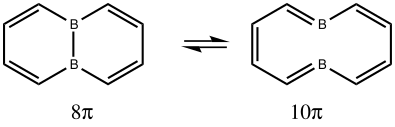
I have forcibly removed two electrons from the system by replacing the two central carbon atoms with boron. And now playing Armstrong and Robinson’s games leaves either only an 8π periphery with a central B-B σ-bond[6] or one can raid the two B-B electrons to top the π-periphery up to 10 electrons.[7]
- The first isomer, as a 8π-electron system is according to modern knowledge antiaromatic. A ωB97XD/6-311G(d) calculation shows this is not a stable minimum, with negative energy force constants showing a twisting motion trending to a Möbius ring? It never reaches this, since further C-B bonds are ultimately formed to create an unrelated structure[8].
- a 10π form is 35.7 kcal/mol lower than the first and reveals five π MOs, the highest energy of which is shown below with a suspended π-bond between the two central boron atoms and a LUMO corresponding to an empty B-B σ-bond.


I hope this illustrates how science often iterates to final solutions, but that even the incorrect oscillations can still teach us chemistry.
References
- "Proceedings of the Chemical Society, Vol. 6, No. 85", Proceedings of the Chemical Society (London), vol. 6, pp. 95, 1890. https://doi.org/10.1039/pl8900600095
- G.J. Stoney, "XLIX. <i>Of the “electron,” or atom of electricity</i>", The London, Edinburgh, and Dublin Philosophical Magazine and Journal of Science, vol. 38, pp. 418-420, 1894. https://doi.org/10.1080/14786449408620653
- W.O. Kermack, and R. Robinson, "LI.—An explanation of the property of induced polarity of atoms and an interpretation of the theory of partial valencies on an electronic basis", J. Chem. Soc., Trans., vol. 121, pp. 427-440, 1922. https://doi.org/10.1039/ct9222100427
- J.W. Armit, and R. Robinson, "CCXI.—Polynuclear heterocyclic aromatic types. Part II. Some anhydronium bases", J. Chem. Soc., Trans., vol. 127, pp. 1604-1618, 1925. https://doi.org/10.1039/ct9252701604
- A. Doddi, C. Gemel, M. Winter, R.A. Fischer, C. Goedecke, H.S. Rzepa, and G. Frenking, "Low‐Valent Ge<sub>2</sub> and Ge<sub>4</sub> Species Trapped by N‐Heterocyclic Gallylene", Angewandte Chemie International Edition, vol. 52, pp. 450-454, 2012. https://doi.org/10.1002/anie.201204440
- H.S. Rzepa, "C 8 H 8 B 2", 2015. https://doi.org/10.14469/ch/191378
- H.S. Rzepa, "C 8 H 8 B 2", 2015. https://doi.org/10.14469/ch/191380
- H.S. Rzepa, "C 8 H 8 B 2", 2015. https://doi.org/10.14469/ch/191379