Archive for the ‘Interesting chemistry’ Category

Hydrogenating the even more mysterious N≡N triple bond in a nitric oxide dimer.

Monday, August 25th, 2025

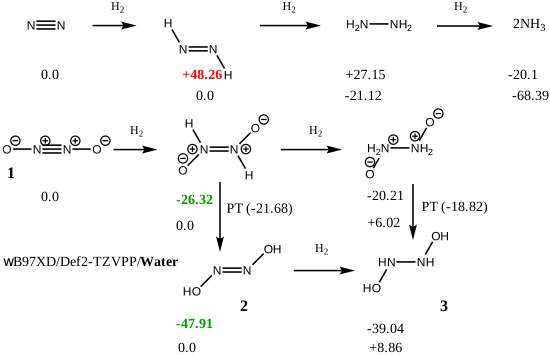
Previously[1] I looked at some of the properties of the mysterious dimer of nitric oxide  1 – not the known weak dimer but a higher energy form with a “triple” N≡N bond. This valence bond isomer of the weak dimer was some 24 kcal/mol higher in free energy than the two nitric oxide molecules it would be formed from. An energy decomposition analysis (NEDA) of 1 revealed an interaction energy[2] of +4.5 kcal/mol for the two radical fragments, compared to eg -27 kcal/mol for the equivalent analysis of the N=N double bond in nitrosobenzene dimer[3] So here I take a look at another property of N≡N bonds via their hydrogenation energy (Scheme), mindful that the dinitrogen molecule requires forcing conditions to hydrogenate, in part because of the unfavourable entropy terms (See Wiki and also here for a calculation of ΔG298).

Calculations at the ωB97XD/Def2-TZVPP/SCRF=water level[4] that whilst hydrogenation of the triple bond in N2 is strongly endo-energic, the same process for molecule 1 is exo-energic (ΔΔG -26.32 kcal/mol). The direct product is a zwitterion, but presumed rapid proton transfer to a neutral form 2 increases exo-energicity. Whilst the second hydrogenation step  of N2 is  exo-energic, the equivalent second step for 1 to  give 3 is now mildly endo-energic. Overall however, the thermodynamic energies of these two types of triple bond hydrogenation could not be more different.

So forming a N≡N triple bond by forcing two nitric oxide molecules to dimerise (using high pressure) in water produces a system where hydrogenation of that “difficult” N≡N bond is made very much easier thermodynamically. Time for an experiment?


This site reports a gas phase experimental value for ΔG -8.1 kcal/mol at 298K for this equilibrium, although the pressure is not given. The calculated value shown in the scheme above (-20.1 kcal/mol)  is for 298K and 1 atm for a model using water as solvent – which might be expected to differentially solvate the product ammonia and hence promote the reaction. In the limit of low pressure (0.0001M)[5] this reduces to -13.0 kcal/mol, increases to -26.6 kcal/mol at 10M and becomes -14.3 kcal/mol at 10M/800K, illustrating how higher pressures make the reaction more exo-energic and higher temperatures less exo-energic. This was of course the problem solved in the Haber process of finding the sweet spot between pressure and temperature.

Perhaps not, given the report that at high pressures, nitric oxide can become explosive.[6]


References

  1. H. Rzepa, "The even more mysterious N≡N triple bond in a nitric oxide dimer.", 2025. https://doi.org/10.59350/rzepa.29429
  2. H. Rzepa, "N2O2 as strong dimer? bent NEDA 0 1 0 2 0 -2 Total Interaction (E) : 4.520 Wiberg NN bond index 1.0072 NN stretch 2604 cm-1", 2025. https://doi.org/10.14469/hpc/15468
  3. H. Rzepa, "Nitrosobenzene dimer NEDA=2, 0,1 0,1 0,1 Total Interaction (E) : -27.564", 2025. https://doi.org/10.14469/hpc/15444
  4. H. Rzepa, "Hydrogenating the even more mysterious N≡N triple bond in a nitric oxide dimer.", 2025. https://doi.org/10.14469/hpc/15516
  5. G. Luchini, J.V. Alegre-Requena, I. Funes-Ardoiz, and R.S. Paton, "GoodVibes: automated thermochemistry for heterogeneous computational chemistry data", F1000Research, vol. 9, pp. 291, 2020. https://doi.org/10.12688/f1000research.22758.1
  6. T. Melia, "Decomposition of nitric oxide at elevated pressures", Journal of Inorganic and Nuclear Chemistry, vol. 27, pp. 95-98, 1965. https://doi.org/10.1016/0022-1902(65)80196-8

The spin-offs from adding citations to blog posts.

Tuesday, August 19th, 2025

I started adding citations to my blog posts around 2012 using the Kcite plugin. Rogue Scholar is a service that monitors registered blog sources and adds all sorts of value to the original post, including identifying such citations and creating a list of them.

I show the results for the previous blog[1] here.

Martin Fenner has just added some interesting new features[2] which I thought would be useful to share with you here.

  1. If you go to the Rogue Scholar archive of the post and scroll down to the References list, then click on the title of any of the references, you will get a list of all Rogue Scholar posts citing that reference: https://rogue-scholar.org/search?q=doi:10.1038/sdata.2016.18+references:10.1038/sdata.2016.18+citations:10.1038/sdata.2016.18
  2. If you click on the author name in any of the entries from the previous search, you get a list of all the posts published by that person.
    https://rogue-scholar.org/search?q=orcid:0000-0002-8635-8390&sort=newest

I think this idea of adding citations to a blog post can result in a considerably enhanced discovery process – if only you could do this with journals themselves!


This is temporarily not functional due to a php update on the site. I hope to get it working again soon. Update. Thanks to Martin Fenner, the Kcite plugin is working again at version 1.7.11 and upwards.[3]

References

  1. H. Rzepa, "More on rescuing articles from a now defunct early pioneering example of an Internet journal.", 2025. https://doi.org/10.59350/rzepa.29523
  2. M. Fenner, "Rogue Scholar links records via ORCID and DOI", 2025. https://doi.org/10.53731/yjq4w-5yr32
  3. M. Fenner, "Adding references to Wordpress posts: updated kcite plugin", 2025. https://doi.org/10.53731/326tr-95k32

More on rescuing articles from a now defunct early pioneering example of an Internet journal.

Tuesday, August 19th, 2025

Two years ago, I posted on the topic “Internet Archeology: reviving a 2001 article published in the Internet Journal of Chemistry (IJC)”.[1] The IJC had been founded in 1998,[2]  in part at least to “re-invent” the scholarly journal by elevating research data to being a more integrated part of the overall article, rather than as the previously conventional addendum of SI (Supporting Information). IJC was in one sense following on from an earlier such project dating from 1995[3] by taking it to the next level. Sadly, the pioneering IJC journal had gone off-line in 2004 and the content for around 100 articles was thought lost. It happened that I still retained the original source and associated data for one article of mine and my post[1] described how I managed to get it back into more or less full working order. Now Egon Willighagen[4] has cleverly found a way of rescuing many more of these lost articles, thanks to various Web-based infrastructures:

  1. From 1996 as the Internet archive (using a query such as https://web.archive.org/web/*/http://www.ijc.com/abstracts/*),
  2. From 2012, WikiData (see https://www.wikidata.org/wiki/Q27211732)
  3. Also from 2012, ORCID (Resarcher and collaborator) profiles. Some reserchers had the foresight (alas not me) to link their by then defunct IJC articles to their new ORCID profiles.

I link here to some examples of rescued articles as shown on Egon’s blog. I eagerly look forward to seeing what else is to come using such tools!

UJC


By around 2005, a clearer separation between the journal (the “story” or research narrative) and its associated research data was being seen as the way forward, with the data now being placed in a data repository (or Wikidata) separate from the journal, with added descriptive metadata to help make it a stand-alone object and this new entity to now be cited in the journal article (and bidirectionally the article from the data) using a persistent identifier – initially as a Handle, then as a DOI.[5] FAIR data as a concept had started to emerge from these developments, being formalised around a decade later in 2016.[6]


This post has DOI:10.59350/rzepa.29523

References

  1. H. Rzepa, "Internet Archeology: reviving a 2001 article published in the Internet Journal of Chemistry.", 2024. https://doi.org/10.59350/xqerh-wam97
  2. S.M. Bachrach, and S.R. Heller, "The<i>Internet Journal of Chemistry:</i>A Case Study of an Electronic Chemistry Journal", Serials Review, vol. 26, pp. 3-14, 2000. https://doi.org/10.1080/00987913.2000.10764578
  3. D. James, B.J. Whitaker, C. Hildyard, H.S. Rzepa, O. Casher, J.M. Goodman, D. Riddick, and P. Murray‐Rust, "The case for content integrity in electronic chemistry journals: The CLIC project", New Review of Information Networking, vol. 1, pp. 61-69, 1995. https://doi.org/10.1080/13614579509516846
  4. E. Willighagen, "The Internet Journal of Chemistry", 2025. https://doi.org/10.59350/2ss5b-jpr33
  5. J. Downing, P. Murray-Rust, A.P. Tonge, P. Morgan, H.S. Rzepa, F. Cotterill, N. Day, and M.J. Harvey, "SPECTRa: The Deposition and Validation of Primary Chemistry Research Data in Digital Repositories", Journal of Chemical Information and Modeling, vol. 48, pp. 1571-1581, 2008. https://doi.org/10.1021/ci7004737
  6. M.D. Wilkinson, M. Dumontier, I.J. Aalbersberg, G. Appleton, M. Axton, A. Baak, N. Blomberg, J. Boiten, L.B. da Silva Santos, P.E. Bourne, J. Bouwman, A.J. Brookes, T. Clark, M. Crosas, I. Dillo, O. Dumon, S. Edmunds, C.T. Evelo, R. Finkers, A. Gonzalez-Beltran, A.J. Gray, P. Groth, C. Goble, J.S. Grethe, J. Heringa, P.A. ’t Hoen, R. Hooft, T. Kuhn, R. Kok, J. Kok, S.J. Lusher, M.E. Martone, A. Mons, A.L. Packer, B. Persson, P. Rocca-Serra, M. Roos, R. van Schaik, S. Sansone, E. Schultes, T. Sengstag, T. Slater, G. Strawn, M.A. Swertz, M. Thompson, J. van der Lei, E. van Mulligen, J. Velterop, A. Waagmeester, P. Wittenburg, K. Wolstencroft, J. Zhao, and B. Mons, "The FAIR Guiding Principles for scientific data management and stewardship", Scientific Data, vol. 3, 2016. https://doi.org/10.1038/sdata.2016.18

The even more mysterious N≡N triple bond in a nitric oxide dimer.

Monday, August 18th, 2025

Previously, I pondered about the strange N=N double bond in nitrosobenzene dimer[1] as a follow up to commenting on the curly arrow mechanism of the dimerisation.[2] By the same curly arrow method, one can produce the below, showing how the simpler nitric oxide radical could potentially dimerise to a species with a N≡N triple bond! This involves a total of six electrons entering the N-N region, and hence raises the question of whether these all move in a single concerted/synchronous bond forming reaction, or whether they might go in (asynchronous) stages. Here are some calculations[3]) which might shed some light on this aspect.

The structure[4] of a nitric oxide dimer was shown in 1982 to have a very long (rather than short) N-N bond length of 2.237Å and a theoretical analysis[5] showed it to be a weak complex with a very complex wavefunction showing multi-reference character.

Firstly, an IRC-based reaction path (method: uωB97XD, scrf=(cpcm,solvent=water) guess=(mix,always) def2tzvpp to allow either an open shell biradical to form and also to encourage any ion pair formation). As you can see, the (total) energy goes up to a very  shallow transition state (with a tiny reverse barrier) to form a biradical  with <S2> 0.628. This species, as noted existing in a very shallow energy well, has an N-N bond length of 1.725Å.

The bonding for this species is complex (analysis for a later post), but the calculated biradical spin density below shows the unpaired electrons are in the π-system (click on the image to get a 3D rotatable model).

Further contraction of the N-N length results in an IRC energy potential to a transition state with a N-N length 1.294Å across a further barrier of ~12 kcal/mol (ΔE; ΔG 13.6 kcal/mol). The overall barrier from two nitric oxide molecules is ΔG 31.0 kcal/mol with the overall thermochemistry summarised in the table. Basically, this barrier is unsurmountable at normal temperatures and the reverse barrier of ΔG 6.7 kcal/mol ensures that the N≡N triple bonded species shown above is not likely stable and will not be observed experimentally. However this product is NOT a biradical but a normal closed shell singlet molecule.[6]

So to answer my first question, the six electrons appear to move in two stages, firstly two electrons form a weak N-N bond and then a further four electrons contract this to a triple bond. Their motion is effectively concerted, but asynchronous.

Species ΔG ΔH ΔΔG ΔΔH T.ΔS rNN, Å <S2> DOI
2*Nitric oxide -259.83494 -259.78839 0.0 0.0 29.2 0.753 15472[7]
Singlet biradical -259.80716 -259.77615 17.4 7.7 19.5 1.725 0.628 15476[8]
Triplet biradical -259.80865 -259.77672 16.5 7.3 20.0 1.779 2.016 15475[9]
Singlet TS -259.78550 -259.75579 31.0 (13.6) 20.5 (12.8) 18.6 1.294 0.000 15483[3]
Singlet N≡N dimer -259.79614 -259.76693 24.3  (7.8) 13.5 18.3 1.114 0.000 15467[10]

Now for a NEDA energy decomposition analysis[11]

Electrical (ES+POL+SE) :  -9414.608
   Charge Transfer (CT) :  -1363.597
       Core (XC+DEF-SE) :  10782.725                      
  Total Interaction (E) :      4.520 kcal/mol.

Normally NEDA total interaction energies are -ve, but this one is positive! So the triple bond dissociation energy is not merely small, but actually negative. That is a weak triple bond and as the title implies, a very mysterious bond. In some aspects however it is conventional. Thus calculated rNN 1.114Å and νNN 2604 cm-1. However partial occupancies of NBO antibonding BD* orbitals results in a calculated Wiberg bond order of only 1.01; there is still a great deal of mystery left about this species! Probably what is fairly certain is that the closed shell single-reference wavefunction used here is not appropriate for a full explanation and more complex multi-reference procedures would have to be used to get a more complete picture of this strange non-existing little molecule. It may even be that such procedures remove the small reverse barrier noted above, thus preventing the molecule from even existing in an energy well.


This species does not appear to have been previously discussed or suggested, according to SciFinder/CAS.
Might it exist at very high pressures in water?


To find all blog posts authored here, along with their DOIs, try https://rogue-scholar.org/search?q=orcid:0000-0002-8635-8390&sort=newest

References

  1. H. Rzepa, "The mysterious N=N double bond in nitrosobenzene dimer.", 2025. https://doi.org/10.59350/rzepa.29383
  2. H. Rzepa, "Mechanism of the dimerisation of Nitrosobenzene.", 2025. https://doi.org/10.59350/rzepa.28849
  3. H. Rzepa, "N2O2 as strong dimer TS as biradical cis, G = -259.785500", 2025. https://doi.org/10.14469/hpc/15483
  4. S.G. Kukolich, "The structure of the nitric oxide dimer", Journal of the American Chemical Society, vol. 104, pp. 4715-4716, 1982. https://doi.org/10.1021/ja00381a052
  5. N. Taguchi, Y. Mochizuki, T. Ishikawa, and K. Tanaka, "Multi-reference calculations of nitric oxide dimer", Chemical Physics Letters, vol. 451, pp. 31-36, 2008. https://doi.org/10.1016/j.cplett.2007.11.084
  6. H. Rzepa, "N2O2 as strong dimer? G = -259.796140, STABLE wavefunction!", 2025. https://doi.org/10.14469/hpc/15474
  7. H. Rzepa, "Nitric oxide monomer, G = -129.917471 *2 = -259.834942", 2025. https://doi.org/10.14469/hpc/15472
  8. H. Rzepa, "N2O2 as strong dimer singlet trans biradical state G = -259.807165", 2025. https://doi.org/10.14469/hpc/15476
  9. H. Rzepa, "N2O2 as strong dimer triplet state G = -259.808649 DG 16.5", 2025. https://doi.org/10.14469/hpc/15475
  10. H. Rzepa, "N2O2 as strong dimer? bent G = -259.796140", 2025. https://doi.org/10.14469/hpc/15467
  11. E.D. Glendening, and A. Streitwieser, "Natural energy decomposition analysis: An energy partitioning procedure for molecular interactions with application to weak hydrogen bonding, strong ionic, and moderate donor–acceptor interactions", The Journal of Chemical Physics, vol. 100, pp. 2900-2909, 1994. https://doi.org/10.1063/1.466432

Energy decomposition analysis of hindered alkenes: Tetra t-butylethene and others.

Wednesday, August 13th, 2025

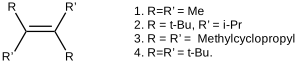
In the previous post,[1] I introduced the N=N double bond in nitrosobenzene dimer, arguing that even though it was a formal double bond, its bond dissociation energy made it nonetheless a very weak double bond! This was backed up by a technique known as energy decomposition analysis or EDA. Here I use a variant of this method  known as  NEDA to look at some other strained alkenes, including the famously non-existent tetra t-Butyl ethene.

The NEDA procedure gives a fragment interaction energy (decomposing it into fundamental quantum mechanically derived energies if required) with respect to a reference state for the fragments. In this case, the fragments are obtained by cutting the double bond, resulting in triplet state carbenes as the reference state. The calculations (B3LYP+GD3+BJ/Def2-TZVPP) are available here.[2]

  1. Compound 1, a relatively unstrained alkene, ΔE = -177.0 kcal/mol, RCC 1.341Å
  2. Compound 2 (PUVQUE, [3], [4]), ΔE = -164.3 kcal/mol, RCC 1.362Å, CC torsion 16.5°
  3. Compound 3 (CUBVOK, [5]) ΔE = -167.9 kcal/mol, RCC 1.351Å, CC torsion 9.2°
  4. Compound 4 (currently unknown) ΔE = -135.8 kcal/mol, RCC 1.380Å, CC torsion 54.5°

The NEDA interaction energy is directly proportional to both the CC bond length and the C-C=C-C torsion angle. What is interesting however is the large interaction energy gap in ΔE between the two known hindered alkenes (2 and 3) and the unknown tetra-t-butyl ethene 4. It seems moving from say compound 2 by converting the two iso-propyl substituents to full t-butyl ones is just too large a change to bridge. Unless one day isolated as a very very unstable species, compound 4 seems destined not to exist!


This post has DOI: 10.59350/rzepa.29410

References

  1. H. Rzepa, "The mysterious N=N double bond in nitrosobenzene dimer.", 2025. https://doi.org/10.59350/rzepa.29383
  2. H. Rzepa, "Energy decomposition analysis of hindered alkenes: Tetra-tert-butyl ethene and others.", 2025. https://doi.org/10.14469/hpc/15463
  3. R. Boese, W.R. Roth, D. Bläser, R. Latz, and A. Bäumen, "(<i>E</i>)-3,4-Diisopropyl-2,5-dimethylhex-3-ene at 125K", Acta Crystallographica Section C Crystal Structure Communications, vol. 54, pp. IUC9800055, 1998. https://doi.org/10.1107/s0108270198099247
  4. Boese, R.., Roth, W.R.., Blaser, D.., Latz, R.., and Baumen, A.., "CCDC 130610: Experimental Crystal Structure Determination", 1999. https://doi.org/10.5517/cc4cx7m
  5. J. Deuter, H. Rodewald, H. Irngartinger, T. Loerzer, and W. Lüttke, "Kristall- und molekularstruktur von tetrakis(1-methylcyclopropyl)ethylen", Tetrahedron Letters, vol. 26, pp. 1031-1034, 1985. https://doi.org/10.1016/s0040-4039(00)98504-6

The mysterious N=N double bond in nitrosobenzene dimer.

Monday, August 11th, 2025

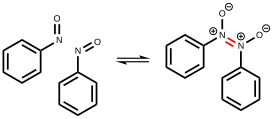
In an earlier blog, I discussed[1] the curly arrows associated with the known dimerisation of nitrosobenzene, and how the N=N double bond (shown in red below) forms in a single concerted process.

One of the properties of this molecule is that the equilibrium between the monomer and dimer can be detected[2], with significant concentrations of the dimer observed below 10°C. This dimer can even be crystalised, with around 20 well defined crystal structures known for the dimeric structure in the current version of the  CSD crystal structure dataset. Nitrosobenzene dimer itself forms a cis isomer, but others are known as trans (see below).

This detectable equilibrium means that the formal bond dissociation energy of that N=N bond must be very low – close to zero. This makes it an unusually weak double bond! Let’s explore how unusual by adopting a technique for analysing the energies in the molecule known as Natural Energy Decomposition Analysis or NEDA[3] (there are several other well-used methods for this, but I will concentrate on this one in this post at least). To explain what it is, I will paraphrase the NBO7 manual:

Natural energy decomposition analysis is an energy partitioning procedure for molecular interactions with contributions from Electrical interaction (EL), charge transfer (CT), and core repulsion (CORE) terms as evaluated for self-consistent field (SCF) wavefunctions.

  1. The electrical term EL = ES + POL + SE arises from classical electrostatic (ES) and polarization interactions (POL+SE). SE is the linear response self energy (energy penalty) of polarization.
  2. The CORE contribution CORE = EX + DEF − SE results principally from intermolecular exchange interactions (EX) and deformation (DEF), where the latter is the energy cost to distort a fragment wavefunction in the field of all other fragments of the complex. For DFT-based analysis, EX is replaced by the exchange-correlation interaction (XC).
  3. The total interaction energy is then given by 
  4. ΔE = EL + CT + CORE

So now for some calculations[4]. To do this, one has to consider an appropriate reference state[5] for the two fragments of the molecule, in this case nitrosobenzene itself. This is expressed via a set of charge,multiplicity definitions for the supermolecule and all the fragments. For the nitrosobenzene dimer, two possibilities can be considered

  1. 0,1 0,1 0,1 (which defines singlet states for all three species)
  2. 0,1 0,3 0,-3 (which defines triplet states for the two fragments, with a “spin flip” for the second).

Firstly  I will calculate ΔE  (Z)-1,2-diphenylethene, which is a classical C=C double bond alkene.

  1. For the reference state 0,1 0,3 0,-3
    Electrical (ES+POL+SE) :  -8691.975
       Charge Transfer (CT) :   -809.587
           Core (XC+DEF-SE) :   9327.995
                            ------------
      Total Interaction (E) :   -173.567 kcal/mol
  2. For the reference state 0,1 0,1 0,1 (which represents two carbenes)
     Electrical (ES+POL+SE) :  -7878.192
       Charge Transfer (CT) :   -918.005
           Core (XC+DEF-SE) :   8473.018
                            ------------
      Total Interaction (E) :   -323.179 kcal/mol

So this classical C=C double bond partitions into two interacting triplet carbenes, with a spin flip to align their interaction. Now for nitrosobenzene.

  1. For the reference state 0,1 0,1 0,1 (which represents two nitrosobenzenes each with a lone pair of electrons)
    Electrical (ES+POL+SE) : -18230.176
       Charge Transfer (CT) :   -818.925
           Core (XC+DEF-SE) :  19021.537
                            ------------
      Total Interaction (E) :    -27.564 kcal/mol
  2. For the reference state 0,1 0,3 0,-3
    Electrical (ES+POL+SE) : -17567.592
       Charge Transfer (CT) :   -677.676
           Core (XC+DEF-SE) :  18197.205
                            ------------
      Total Interaction (E) :    -48.063 kcal/mol

This shows completely different behaviour for the nitrosobenzene dimer and (effectively) the phenyl carbene dimer, with a different reference state for the two species. The electrical and charge transfer terms for the former are much larger than for the latter and this analysis does indeed conform the supposition made at the start that the N=N bond in nitrosobenzene dimer is indeed very unusual and very weak! Perhaps the weakest double bond known? If there are other candidates, I would love to hear about them!

Finally, I note that the relatively low NEDA energy for a triplet reference state for the nitrosobenzene dimer also matches with the observation made previously[1] that open shell (biradical) wavefunctions are needed to describe the curly arrows for the process.

Energy decomposition analysis is a good tool to have in one’s toolbox for analysing molecular behaviour and no doubt I will use it more in the future! Next, tetra-t-butylethene!


This post has DOI: 10.59350/rzepa.29383

References

  1. H. Rzepa, "Mechanism of the dimerisation of Nitrosobenzene.", 2025. https://doi.org/10.59350/rzepa.28849
  2. K.G. Orrell, V. Šik, and D. Stephenson, "Study of the monomer‐dimer equilibrium of nitrosobenzene using multinuclear one‐ and two‐dimensional NMR techniques", Magnetic Resonance in Chemistry, vol. 25, pp. 1007-1011, 1987. https://doi.org/10.1002/mrc.1260251118
  3. E.D. Glendening, and A. Streitwieser, "Natural energy decomposition analysis: An energy partitioning procedure for molecular interactions with application to weak hydrogen bonding, strong ionic, and moderate donor–acceptor interactions", The Journal of Chemical Physics, vol. 100, pp. 2900-2909, 1994. https://doi.org/10.1063/1.466432
  4. H. Rzepa, "The mysterious N=N double bond in nitrosobenzene dimer.", 2025. https://doi.org/10.14469/hpc/15455
  5. C.R. Landis, R.P. Hughes, and F. Weinhold, "Bonding Analysis of TM(cAAC)<sub>2</sub> (TM = Cu, Ag, and Au) and the Importance of Reference State", Organometallics, vol. 34, pp. 3442-3449, 2015. https://doi.org/10.1021/acs.organomet.5b00429

Cyclo-S6 (Hexathiane) – anomeric effects again!

Sunday, June 1st, 2025

I thought I was done with exploring anomeric effects in small sulfur rings. However, I then realised that all the systems that I had described had an odd number of atoms and that I had not looked at any even numbered rings. Thus hexasulfur is a smaller (known) ring version of S8, the latter by far the best known allotrope of this element of course.

Its crystal structure[1] shows it has D3d symmetry, with six identical S-S bond lengths of 2.068Å. A MN15-L/Def2-TZVPP calculation[2] replicates this pretty well.

Since anomeric effects manifest in crystal structures by unequal bond lengths, at first sight it seemed unlikely that this ring could be shown to exhibit them. But wait, another conformation can be found, what in cyclohexane would be called the twist-boat. It is however around 12 kcal/mol higher in free energy than the stable form.[3] and has lower (chiral) D2 symmetry. This now shows two slightly shorter bonds and four slightly longer bonds. The anomeric NBO E(2) perturbation energies are a relatively modest 7.93 kcal/mol (S1Lp-S2-S6σ*) resulting in modest S1-S2 bond shortening and comensurate S2-S6 lengthening. By symmetry, three other identical effects manifest.

So these stereoelectronic effects CAN manifest in even-numbered rings, but only in this case as a higher energy conformer.

I also show O6, with C2 symmetry. As with O7 and O5 discussed previously[4] the anomeric effect promotes (partial) dissociation into three molecules of O2[5], but this process is not complete (computationally)  and weak partial bonds of ~1.997 and 2.06Å remain between the three O2 species, which are probably in fact artefacts of using a single-determinantal wavefunction. However it is fun to observe that the NBO E(2) terms are now (O1Lp-O5-O6σ*) 135 kcal/mol and the even larger (O2Lp-O3-O4σ*) 218 kcal/mol (tending to ∞ for a fully broken bond). These absurdly large values are a consequence of the non-converging perturbation expansion, but they are still amusing to see.

If you want to see the orbital interactions (as shown on the earlier blogs on this topic), why not download the wavefunction (the .fchk file) from the repository archive at the DOIs shown above and reveal them for yourself using suitable programs (the free Avogadro2 program is one that can do this exceedingly well). After this, I hesitate to say I will not find some other aspects of small sulfur and oxygen rings to write about, but other topics call for the time being!

References

  1. J. Steidel, J. Pickardt, and R. Steudel, "Redetermination of the Crystal and Molecular Structure of Cyclohexasulfur, S<sub>6</sub> [1]", Zeitschrift für Naturforschung B, vol. 33, pp. 1554-1555, 1978. https://doi.org/10.1515/znb-1978-1238
  2. H. Rzepa, "S6, D3d, NBO7 G =-2388.986031", 2025. https://doi.org/10.14469/hpc/15261
  3. H. Rzepa, "S6, D2, NBO7 G = -2388.966504 DG = +12.25", 2025. https://doi.org/10.14469/hpc/15260
  4. H. Rzepa, "Cyclo-Heptasulfur, S<sub>7</sub> – a classic anomeric effect discovered during a pub lunch!", 2025. https://doi.org/10.59350/rzepa.28407
  5. H. Rzepa, "O6 NBO C2, G = -450.664220", 2025. https://doi.org/10.14469/hpc/15259

S7I1+: The largest anomeric effect exhibited by sulfur.

Wednesday, May 21st, 2025

In this series of posts about the electronic effects in small sulfur rings[1] I have explored increasingly large induced geometric effects. Here is the largest so far, for the compound S7I1+[2]


The calculated geometry[3] is shown below, with the crystallographic values in parentheses – the two matching very well.

The calculated NBO7 stereoelectronic analysis identifies an especially strong donor (S7) interaction with an acceptor S4-S7, the E(2) energy being 36.9 kcal/mol. The Wiberg S4-S5 bond index is 0.512 and the S-S stretching wavenumber is ν 131. The Wiberg index for S4-S7 is 1.4618 and the S-S stretch ν 667 cm-1, matching the shortest bond.

The electronic overlap is shown below (click on image to view as a 3D model).

So we end with the current record for an SLp/SSσ* interaction of 36.9 kcal/mol. Who would have thought that small sulfur rings could be such fun!

References

  1. H. Rzepa, "5-Imino-5λ<sup>4</sup>-heptathiepane 3-oxide. More exuberent anomeric effects.", 2025. https://doi.org/10.59350/rzepa.28615
  2. J. Passmore, G. Sutherland, P. Taylor, T.K. Whidden, and P.S. White, "Preparations and x-ray crystal structures of iodo-cyclo-heptasulfur hexafluoroantimonate(V) and hexafluoroarsenate(V), S7ISbF6 and S7IAsF6", Inorganic Chemistry, vol. 20, pp. 3839-3845, 1981. https://doi.org/10.1021/ic50225a048
  3. H. Rzepa, "S7I(+) ax G = -3083.654991", 2025. https://doi.org/10.14469/hpc/15236

5-Imino-5λ4-heptathiepane 3-oxide. More exuberent anomeric effects.

Tuesday, May 20th, 2025

The two previous  posts[1],[2] on the topic of anomeric effects in 7-membered sulfur rings illustrated how orbital interactions between the lone pairs in the molecules and S-S bonds produced widely varying S-S bond lengths in the molecules, some are shorter than normal (which is ~2.05Å for e.g. the S8 ring) by ~ 0.1Å and some are longer by ~0.24Å. Here we extend this to the unknown molecule shown below.

The usual  MN15L/Def2-TZVPP calculation[3] gives the calculated geometry shown below. In parentheses are the calculated S-S vibrational wavenumbers (some are marked with ~ since these modes are contaminated by mixing with other parts of the molecules).

The interaction energies between the donor and acceptor, E(2), are shown below. Numbers 5-8 are the same as was identified for the parent molecule S7, but the energies have increased substantially (previously 12.3/10.1 kcal/mol). The Wiberg bond index for the strongest bond (S2-S3) is 1.276 and the weakest (S1-S2) is 0.610, quite some variation! Given that the known S7O was already very unstable[4], it seems unlikely that the probably even more unstable S7ONH could ever be isolated, but there is a challenge!

# Acceptor S-S bond Donor Lp NBO E(2) Energy
1 S4-S5 O8 31.9
2 S1-S2 N9 29.6
3 S1-S6 N9 27.0
4 S5-S6 O8 20.4
5 S4-S5 S7 16.8
6 S1-S2 S3 16.4
7 S3-S7 S2 15.4
8 S3-S7 S4 15.2

There are numerous compounds with six, seven and eight membered sulfur rings, and it would always be worth keeping an eye out for unusually short or long S-S bonds in them, since they may well be more manifestations of these sulfur anomeric effects.

References

  1. H. Rzepa, "Cycloheptasulfur sulfoxide, S<sub>7</sub>O – Anomeric effects galore!", 2025. https://doi.org/10.59350/rzepa.28515
  2. H. Rzepa, "Cyclo-Heptasulfur, S<sub>7</sub> – a classic anomeric effect discovered during a pub lunch!", 2025. https://doi.org/10.59350/rzepa.28407
  3. H. Rzepa, "S7O2 NBO7 Cs symmetry", 2025. https://doi.org/10.14469/hpc/15235
  4. R. Steudel, R. Reinhardt, and T. Sandow, "Bond Interaction in Sulfur Rings: Crystal and Molecular Structure of <i>cyclo</i>‐Heptasulfur Oxide, S<sub>7</sub>O", Angewandte Chemie International Edition in English, vol. 16, pp. 716-716, 1977. https://doi.org/10.1002/anie.197707161

Cycloheptasulfur sulfoxide, S7O – Anomeric effects galore!

Monday, May 19th, 2025

The monosulfoxide of cyclo-heptasulfur was reported along with cycloheptasulfur itself in 1977,[1] along with the remarks that “The δ modification of S7 contains bonds of widely differing length: this has never been observed before in an unsubstituted molecule. and “the same effect having also been observed in other sulfur rings (S8O, S7I1+ and S7O).” Here I take a look at the last of these other molecules, the monosulfoxide of S7, as a follow up to the commentary on S7 itself.[2]

The axial oxygen isomer is calculated as being 3.68 kcal/mol more stable than the equatorial form[3] and a comparison of its calculated (MN15L/Def2-TZVPP) and observed structure is shown below. The S-S lengths do indeed vary widely.

As before, an explanation is provided by analysing the orbitals of the molecule using NBO7. The interactions tabled below are ordered by the largest first. That from the oxygen into the S4-S5 antibonding NBO (28.2 kcal/mol) is the biggest I have observed for an anomeric effect involving an S-S bond. The greatest all-sulfur effect (16.8 kcal/mol) is increased compared to that previously found for S7 itself (12.35 kcal/mol).

Donor lone Pair Acceptor antibonding NBO E(2), kcal/mol Acceptor bond distance, Å
O8 S4-S5 28.2 2.28
O8 S5-S6 20.2 2.15
S7 S4-S5 16.8 2.28
S4 S3-S7 14.8 2.18
S2 S3-S7 12.5 2.18
S3 S5-S6 10.3 2.15
O8 S5-S6 9.6 2.15
S6 S1-S2 9.1 2.10

E(2) NBO overlaps Click on image to load 3D rotatable model
28.2

20.0

16.8

14.8

12.5

10.3

9.6

9.1

The S-S stretching modes also vary by more than a factor of two; ν4-7 619 cm-1, ν2-3 528 cm-1, ν1-6 548 cm-1, ν3-7 368 cm-1, ν5-6 331 cm-1, ν4-5 287 cm-1.

It is indeed remarkable that this small molecule can exhibit as many as eight different anomeric interactions, including two unusually large ones and three regular ones. The result is the profusion of different S-S bond lengths originally commented[1] on accompanied by the wide variety of S-S stretching modes. Can this record be beaten, either in the number or the magnitude of the effects. The answer is YES, but not for a known molecule. See next post!

References

  1. R. Steudel, R. Reinhardt, and T. Sandow, "Bond Interaction in Sulfur Rings: Crystal and Molecular Structure of <i>cyclo</i>‐Heptasulfur Oxide, S<sub>7</sub>O", Angewandte Chemie International Edition in English, vol. 16, pp. 716-716, 1977. https://doi.org/10.1002/anie.197707161
  2. H. Rzepa, "Cyclo-Heptasulfur, S<sub>7</sub> – a classic anomeric effect discovered during a pub lunch!", 2025. https://doi.org/10.59350/rzepa.28407
  3. H. Rzepa, "Cyclo-Heptasulfur, S7 – a classic anomeric effect discovered during a pub lunch!", 2025. https://doi.org/10.14469/hpc/15228