This, the fourth candidate provided by C&EN for a vote for the molecule of the year as discussed here, lays claim to the World’s most polar neutral molecule (system 1 shown below).[1] Here I explore a strategy for extending that record.
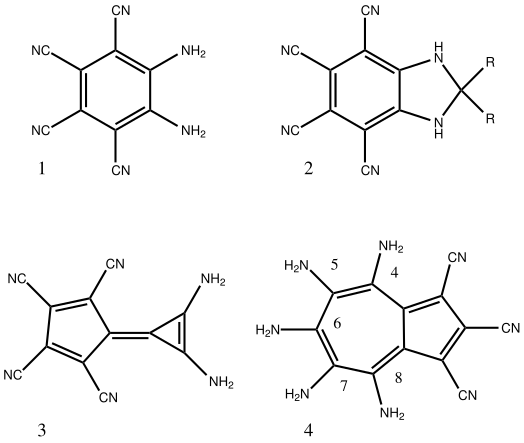
The claim for 1 (3 in [1]) is on the basis of its measured dipole moment which is 14.1± 0.7D in THF. This is qualified by the note that the dipole moment might be exalted by complex formation with dimethyl acetamide; the authors report a calculated smaller dipole moment of 9.6D (B3LYP/aug-cc-pVTZ) for the isolated molecule.
Inspection of 1 suggests that it is impossible for both the amino groups to be co-planar with the benzene ring due to steric clashes between the H…H atoms and that they must be twisted to avoid this. If so, the conjugation with the ring would be reduced and so would the charge transfer from the amino groups to the cyano groups (the phenomenon responsible for the polarity). I re-optimised the molecule myself (ωB97XD/Def2-TZVPP/SCRF=THF) and it has C2 symmetry, with both amino groups rotated to avoid those steric H…H clashes (DOI: 10.14469/hpc/1989). The calculated dipole moment (the basis set is a bit better‡ than in [1] and also the geometry is re-optimised in the solvent field) is 13.6D, which is rather closer to the measured value. An alternative explanation for the original mis-match between theory and experiment of 4.5D could be simply the lower quality basis set‡ used in the calculation and no modelled geometric relaxation in the thf solvent field.

The NC bond lengths shown above will be used as a probe to reveal the extent of conjugation. I tried 2 (R=H), a method of avoiding the steric clash and allowing both amino groups to fully conjugate (DOI: 10.14469/hpc/1987). Note how the amino CN bond length contracts by 0.017Å, whereas the o-cyano CN lengths also contract slightly. The calculated dipole moment for this variation is 16.1D, which seems a rational outcome of increasing the conjugation. However, measured dipole mment values of 10.9 and 12.2D are reported for 2 (5a, R=Me and 5b C7H16) respectively.[1] This is surprising given that these systems avoid any NH…HN steric clash and should therefore allow better conjugation and hence an increased dipole moment. Perhaps it is these molecules rather than 1 where the measured dipole moment is perturbed by other effects?

Inspired by these molecules, I thought: why not start with a base aromatic ring that was already polar and sprinkle amino and cyano groups around it? Thus 3 and 4 above. The latter is derived from azulene, which is well-known to have a noticeable dipole moment of its own, with the five ring carrying excess charge to aspire to 6π-electron aromaticity and the seven ring losing charge to again create a 6π-aromatic ring. The cyano and amino groups would serve to stabilize those respective charges.
Firstly 4: Amino groups on the azulene 5,7 positions twist out of plane and do not conjugate (long NC bonds) but all the remaining groups show effective conjugation (DOI: 10.14469/hpc/1988). So one could probably dispense with 5,7-amino substitution. The calculated dipole moment is 21.4D, which elevates the previous value significantly.

Seven 2- or 3-substituted cyanoazulenes are known in the CSD (Cambridge structure database) and likewise seven 4, 6 or 8 nitrogen substituted derivatives are known. So it should be possible to combine these two groups onto an azulene ring.
Finally 3, where the amino CN bonds are even shorter, indicating increased stabilization of the cyclopropenium cation ring formed by charge transfer (DOI: 10.14469/hpc/1990). The amino groups no longer clash sterically. The central CC bond (nominally a double bond) is lengthened considerably to facilitate the charge transfer between rings and hence mutual aromatization, the five 5-ring bonds are 1.405Å (typical aromatic values) and the 3-ring 1.367-1.38Å (again aromatic values). This candidate has a dipole moment of 21.7D, despite its smaller size decreasing the separation of the charges and hence the moment.

If the function of a molecule of the year is to inspire ideas in others, this one has certainly achieved its purpose! Now for the syntheses!
‡Anionic systems always benefit from better basis sets, much more so than neutral or cationic molecules.
References
- J. Wudarczyk, G. Papamokos, V. Margaritis, D. Schollmeyer, F. Hinkel, M. Baumgarten, G. Floudas, and K. Müllen, "Hexasubstituted Benzenes with Ultrastrong Dipole Moments", Angewandte Chemie International Edition, vol. 55, pp. 3220-3223, 2016. https://doi.org/10.1002/anie.201508249