Posts Tagged ‘Extreme umpolung’

Forking “The most polar neutral compound synthesized” into m-benzyne.

Wednesday, December 21st, 2016

A project fork is defined (in computing) as creating a distinct and separate strand from an existing (coding) project. Here I apply the principle to the polar azulene 4 explored in an earlier post, taking m-benzyne as a lower homologue of azulene as my starting point.
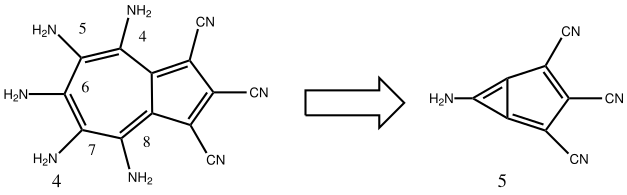
m-Benzyne is a less stable 1,3 isomer of o-benzyne (1,2-dehydrobenzene), and is often represented as a 1,3-biradical of 1,3-dehydrobenzene. But, could it be stabilized with cyano and amino groups as shown in 5 above? Here the idea is that charge transfer from the 3-ring to the 5-ring will create a lower homologue of azulene (a well known molecule), with the 3-ring a 4n+2 π-electron aromatic (n=0) and the five ring similarly so (n=1).

I start with the computed (wB97XD/Def2-TZVPP/SCRF=thf) structure of m-benzyne itself, as a closed shell molecule (DOI: 10.14469/hpc/1995). The C-C bond connecting the two rings is long (with a biradical tendency) and hence the conjugation is restricted to the outer periphery. The dipole moment is 0.51D (the dipole vector as shown in blue has the expected direction of polarity).

Now compare this to the substituted version 5; the bond lengths are all more characteristic of aromatic values and most significantly the central bond is as well (DOI: 10.14469/hpc/1996). The dipole moment is augmented thirty fold to 14.6D, which would rank alongside that reported for the most polar neutral molecule.

So I suggest this is substituted “m-benzyne” well worth trying to make and one very much unlikely to have any dispute about the nature of its wavefunction, i.e. biradical or closed shell.

Forking "The most polar neutral compound synthesized" into m-benzyne.

Wednesday, December 21st, 2016

A project fork is defined (in computing) as creating a distinct and separate strand from an existing (coding) project. Here I apply the principle to the polar azulene 4 explored in an earlier post, taking m-benzyne as a lower homologue of azulene as my starting point.

m-Benzyne is a less stable 1,3 isomer of o-benzyne (1,2-dehydrobenzene), and is often represented as a 1,3-biradical of 1,3-dehydrobenzene. But, could it be stabilized with cyano and amino groups as shown in 5 above? Here the idea is that charge transfer from the 3-ring to the 5-ring will create a lower homologue of azulene (a well known molecule), with the 3-ring a 4n+2 π-electron aromatic (n=0) and the five ring similarly so (n=1).

I start with the computed (wB97XD/Def2-TZVPP/SCRF=thf) structure of m-benzyne itself, as a closed shell molecule (DOI: 10.14469/hpc/1995). The C-C bond connecting the two rings is long (with a biradical tendency) and hence the conjugation is restricted to the outer periphery. The dipole moment is 0.51D (the dipole vector as shown in blue has the expected direction of polarity).

Now compare this to the substituted version 5; the bond lengths are all more characteristic of aromatic values and most significantly the central bond is as well (DOI: 10.14469/hpc/1996). The dipole moment is augmented thirty fold to 14.6D, which would rank alongside that reported for the most polar neutral molecule.

So I suggest this is substituted “m-benzyne” well worth trying to make and one very much unlikely to have any dispute about the nature of its wavefunction, i.e. biradical or closed shell.

1
Henry Rzepa, 2016. [Source]
2
Henry Rzepa, 2016. [Source]