Posts Tagged ‘Hypervalency’

Chasing ever higher bond orders; the strange case of beryllium.

Monday, February 7th, 2022

Ever since the concept of a shared two-electron bond was conjured by Gilbert N. Lewis in 1916,[1] chemists have been fascinated by the related concept of a bond order (the number of such bonds that two atoms can participate in, however a bond is defined) and pushing it ever higher for pairs of like-atoms. Lewis first showed in 1916[1] how two carbon atoms could share two, four or six electrons to achieve a bond order of up to three. It took quite a few decades for this to be extended to four for carbon (and nitrogen) and that only with some measure of controversy and dispute (for one recent brief summary, see[2]).

For the transition elements over the last forty years or so, bond orders of four, five and even six between like atom pairs have been mooted and many characterised.[3] Moving to the left of the transition elements in the periodic table, this hunt has looked at elements such as beryllium. Eleven years back, I explored here how a Be=Be double bond could be formed, strangely enough as an electronically excited state of the dispersion-bound weak Be2 dimer.[4] This species had a calculated Be-Be distance of 1.78Å, resulting from double excitation from the 2s σ*-antibonding orbital into the degenerate π-bonding orbital above it, giving four electrons in bonding valence orbitals. In 2019, three articles appeared which showed how this bond order might be extended to the lofty heights of three as in Be≡Be[5],[6],[7] for (hypothetical) molecules in their ground electronic state. Here I discuss one example from these articles and compare it to the excited state observations made previously.

A useful starting point is the standard molecular orbital diagram for Be2, illustrating why the ground state singlet actually has a bond order of zero.

The three 2019 suggestions[5],[6],[7] modified this to surround the Be2 core with e.g. six Li atoms, resulting in a stable singlet species with a Be-Be distance (calculated at e.g. the CCSD/Def2-TZVP level) of 1.99Å and exhibiting C2h symmetry. The role of the Li is to polarise and repopulate Be orbitals by delocalization of e.g. a 2c-2e bond in Be2 dimer into a 6c-2e bond in Be2Li6. The reported calculations (as successfully replicated here, FAIR DOI: 10.14469/hpc/10106) show the resulting molecular orbitals for Be2Li6 comprise an (accidentally) degenerate π-pair and a higher energy weak σ-orbital, together forming the proposed triple bond. This of course inverts the normal ordering of such bonds, for which the σ-orbital is lower in energy (more stable) than π-bonds. The form of the σ-orbital also reminds to some extent of the fourth σ-bond in C⩸C.

MOs for Be2Li6

HOMO, σ orbital

-0.158au

HOMO-1, π-pair,

-0.175au

HOMO-2, π-pair

-0.176au

Because the static 2D projections shown in the articles cited above do not always make for easy interpretation, if you click on the orbital thumbnails, you will get dynamic 3D isosurfaces to rotate and inspect. These were generated using the tool at https://www.ch.ic.ac.uk/rzepa/cub2jvxl/

The two lower energy 2s σ-orbitals, which taken together do not apparently contribute to the overall bond order in Be2Li6, are shown below.

Lower energy MOs for Be2Li6
σ -0.235au σ-0.496au

ELF (electron localisation function) integrations for Be2Li6 show each beryllium has two basins in the Be-Be region of about 2.5e each (red arrows) typical of triple bonds and two terminal Li-Be basins of 2.3e.

One aspect arising from my earlier post on the excited state Be=Be double bond relates to the reported calculated Be-Be bond length of 1.99Å and ν 718 cm-1 for ground state Be2Li6. To quote one article[5], “the Be≡Be triple bond in Li6Be2 may also be considered as another example of an ultraweak but ultrashort triple bond.” I had noted earlier that the electronically excited state of the Be2 dimer has a computed bond length of 1.78Å and ν 917 cm-1 for a double bond order, this being significantly shorter than the suggested ultrashort triple bond. We learn from this that the relationship between a bond order and a bond length may not always be linear. In other words, a longer bond may in fact have a higher bond order than a shorter bond between the same two atoms. The same was true as it happens with C⩸C; the mooted quadruple bond had a longer bond length than the triple bond in HC≡CH. That observation was controversial at the time; I suspect a similar phenomenon for Be has become less controversial.

To go back to the Be=Be dimer which started things off and that excited state with one electron in each of the degenerate π-orbitals (actually a triplet state). What would happen if two electrons were to be added, making an excited state of Be22-? Yes indeed, this species (CCSD/Def2-TZVPPD) has a calculated bond length of 1.885Å and ν 766 cm-1. If this di-anion is stabilised with a continuum water field (a milder version of surrounding the dimer with Li atoms), the Be-Be length contracts to 1.74Å, the Be-Be stretch increases to 949 cm-1 and the σ-orbital becomes more stable than the π-orbitals. At the higher CCSD(T)/Def2-TZVPPD/SCRF=water level, the bond length still has the ultrashort value of 1.761Å, which might be assumed as the natural value for Be≡Be, a classical triple bond. From that perspective, the “ultraweak but ultrashort triple bond” predicted for Be2Li6 actually emerges as a relatively long triple bond!

Our final exploration is to add two lithium atoms to Be2 to form the neutral LiBe≡BeLi. This was done in stages (see FAIR DOI 10.14469/hpc/10106), starting with a linear arrangement of atoms which revealed two negative force constants, a C2h shape with one negative force constant and ending with a C2 (chiral!) geometry with no negative force constants. This has a Be≡Be length of 1.705Å (ωB97XD/Def2-TZVPPD/SCRF=water), ν 1129 cm-1, a Wiberg bond index of 2.98 and a Li-Be bond index of 0.0065, indicating an entirely ionic lithium and again a central Be22- unit. As an excited state, it is 49.8 kcal/mol higher than the ground state of Be2Li2.

NBOs for LiBe≡BeLi

HOMO, π-pair,

-0.175au

HOMO, π-pair

-0.176au

HOMO-2, σ orbital

-0.158au

So to conclude, we have seen two different motifs for constructing a model of a Be≡Be triple bond, one recently reported in the literature for a ground state species with six lithium atoms surrounding the Be2 dimer and a simpler one with just two lithiums exhibiting a much shorter Be≡Be bond but which requires electronic excitation to achieve. So these two motifs are not equivalent. But hopefully this exercise shows how playing around with atoms and electrons can achieve very unusual bonding states and elevated bond orders from which one can learn a lot, although with the caveat that one does not always produce molecules capable of facile synthesis!


On a slightly different theme, Cs can be shown to sustain three bonds, albeit all to different atoms. See DOI: 10.6084/m9.figshare.861030 Li≡Li4- can also be calculated as the tetra-anion showing almost identical properties to Be≡Be2- with a Li≡Li triple bond distance of 2.11Å. See DOI: 10.14469/hpc/10122. Replication was necessary because the appropriate wavefunction files for analysis were not included in the supporting information. Only the coordinates were available for interoperation, and due to a quirk in the way Adobe Acrobat works, even those could not be easily transferred by a simple copy/paste operation to create a job input file. See e.g. here or DOI: 10.14469/hpc/10043 for more discussion. All the wavefunction files for this replication are available at the FAIR DOI noted above. The Be-Be distance in catena(dimethylberyllium), a polymer comprising two bridging Me units connecting Be atoms, is only slightly longer at 2.09Å[8] This fascinating transannular Be-Be interaction is one to be explored elsewhere.


The post has DOI: 10.14469/hpc/10125


References

  1. G.N. Lewis, "THE ATOM AND THE MOLECULE.", Journal of the American Chemical Society, vol. 38, pp. 762-785, 1916. https://doi.org/10.1021/ja02261a002
  2. H.S. Rzepa, "Routes involving no free C <sub>2</sub> in a DFT-computed mechanistic model for the reported room-temperature chemical synthesis of C <sub>2</sub>", Physical Chemistry Chemical Physics, vol. 23, pp. 12630-12636, 2021. https://doi.org/10.1039/d1cp02056k
  3. D. Lu, P.P. Chen, T. Kuo, and Y. Tsai, "The MoMo Quintuple Bond as a Ligand to Stabilize Transition‐Metal Complexes", Angewandte Chemie International Edition, vol. 54, pp. 9106-9110, 2015. https://doi.org/10.1002/anie.201504414
  4. P.J. Bruna, and J.S. Wright, "Strongly bound doubly excited states of Be<sub>2</sub>", Canadian Journal of Chemistry, vol. 74, pp. 998-1004, 1996. https://doi.org/10.1139/v96-111
  5. S.S. Rohman, C. Kashyap, S.S. Ullah, A.K. Guha, L.J. Mazumder, and P.K. Sharma, "Ultra‐Weak Metal−Metal Bonding: Is There a Beryllium‐Beryllium Triple Bond?", ChemPhysChem, vol. 20, pp. 516-518, 2019. https://doi.org/10.1002/cphc.201900051
  6. X. Liu, R. Zhong, M. Zhang, S. Wu, Y. Geng, and Z. Su, "BeBe triple bond in Be<sub>2</sub>X<sub>4</sub>Y<sub>2</sub> clusters (X = Li, Na and Y = Li, Na, K) and a perfect classical BeBe triple bond presented in Be<sub>2</sub>Na<sub>4</sub>K<sub>2</sub>", Dalton Transactions, vol. 48, pp. 14590-14594, 2019. https://doi.org/10.1039/c9dt03321a
  7. S.S. Rohman, C. Kashyap, S.S. Ullah, L.J. Mazumder, P.P. Sahu, A. Kalita, S. Reza, P.P. Hazarika, B. Borah, and A.K. Guha, "Revisiting ultra-weak metal-metal bonding", Chemical Physics Letters, vol. 730, pp. 411-415, 2019. https://doi.org/10.1016/j.cplett.2019.06.023
  8. A.I. Snow, and R.E. Rundle, "The structure of dimethylberyllium", Acta Crystallographica, vol. 4, pp. 348-352, 1951. https://doi.org/10.1107/s0365110x51001100

Never mind main group “hypervalency”, what about transition metal “hypervalency”?

Sunday, March 18th, 2018

I have posted often on the chemical phenomenon known as hypervalency, being careful to state that as defined it applies just to “octet excess” in main group elements. But what about the next valence shell, occurring in transition metals and known as the “18-electron rule”? You rarely hear the term hypervalency being applied to such molecules, defined presumably by the 18-electron valence shell count being exceeded. So the following molecule (drawn in three possible valence bond representations) first made in 1992 intrigues.[1]

The molecule comprises six phosphinidene ligands (RP:, R=tert-butyl), the P analogues of nitrenes and arranged around nickel to form an unusual hexagonal planar coordinate species and with three of the t-butyl groups facing up and three down. This arrangement totally obscures the two nickel diaxial positions, preventing any ligand from occupying them. One may even speculate that the dispersion attractions between the two pairs of three t-butyl groups might be unusually stabilising, maybe even on a par with those reported by Schreiner and co-workers for t-butyl substituted triphenylmethanes and noted on this blog.

Nitrenes can be represented coordinating to a metal as RN=M. If the analogy extends to P, the valence bond structure 1 above would result and the six P atoms would contribute 12 electrons to the Ni valence shell. Since the Ni shell is  [Ar].3d8.4s2 adding another 12 electrons would make 22 electrons, thus exceeding the 18-electron rule. In fact it was never suggested as such; in the 1992 analysis of the bonding[1], the authors clearly state “The electronic structure … cannot be described in terms of the 18e rule”. To support this, they draw the structure in form 3 above, which implies a Ni valence shell of 16e, albeit also implying a Ni bond index of ~6.

Time I thought for calculations (wB97XD/Def2-TZVPP). The calculated NBO bond index at Ni is in fact 2.38 and the individual Ni-P bond orders are 0.37. The P bond indices are each 3.24 and the P-P bond orders are 0.88. The final electronic configuration is [Ar]3d9.53.4s0.22.4p0.64.4d0.01.5p0.01 and the natural charge on Ni is -0.39. I show one NBO orbital which illustrates the two-electron-three-centre interaction spanning two P atoms and the Ni and giving rise to the modest Ni-P bond order.

The Ni electronic structure of [Ar].3d8.4s2 normally corresponds to its divalency, so in this sense it is mildly hypervalent. Overall, representation 2 above is perhaps more accurate than 3. The ELF (Electron localisation function) of the electron density is shown below (t-butyl groups represented by a single carbon) with the ELF basins highlighted. Basin 2 is a P lone pair, with an integration close to 2e. Basin 1 is a P-P basin with an integration of 1.89 and finally 3 is indeed a P-Ni basin, but with an integration of only 0.06e. 

So this molecule really is a ring of six P atoms, encapsulating at its centre a lone Ni(II) atom. Rather than being hypervalent, perhaps it is most interesting as a complex in which a metal atom is contained in and perturbed by a dispersion-stabilized sphere of ligands.[2] We need more examples!


The original authors[1] merely stated that electron correlation effects are decisive for the stability. Of course, dispersion attractions are indeed a form of electron correlation! FAIR data doi: 10.14469/hpc/3925

References

  1. R. Ahlrichs, D. Fenske, H. Oesen, and U. Schneider, "Synthesis and Structure of [Ni(P<i>t</i>Bu<sub>6</sub>)] and [Ni<sub>5</sub>(P<i>t</i>Bu)<sub>6</sub>(CO)<sub>5</sub>] and Calculations on the Electronic Structure of [Ni(P<i>t</i>Bu)<sub>6</sub>] and (PR)<sub>6</sub>, R = <i>t</i>Bu,Me", Angewandte Chemie International Edition in English, vol. 31, pp. 323-326, 1992. https://doi.org/10.1002/anie.199203231
  2. https://doi.org/

Identification of a simplest hypervalent hydrogen fluoride anion.

Friday, December 8th, 2017

An article with the title shown above in part recently appeared.[1] Given the apparent similarity of HF1- to CH3F1- and CH3F2-, the latter of which I introduced on this blog previously, I thought it of interest to apply my analysis to HF1-.

The authors[1] conclude that “the F atom of HF is negative and hypervalent and the bonding is more covalent than ionic“. So, firstly an NBO analysis. Shown below is the singly occupied NBO (ωB97XD/Def2-TZVPPD calculation, FAIR data DOI: 10.14469/hpc/3274)

The nature of this orbital is that most of it is located beyond the hydrogen and a node is apparent between the F and H (it is H-F antibonding). The Wiberg bond index for both H and F is 0.48, as is the F-H bond order. This matches with the observation of one electron in an orbital which is H-F antibonding. NBO analysis also indicates that the atomic orbital contributions to F[core]2S(1.93)2p(5.77)3S(0.05)3p(0.04)3d(0.01) and H 1S(0.96)2S(0.12)2p(0.10) show modest Rydberg character on the hydrogen, less on the fluorine. By this criterion, it is the hydrogen and not the fluorine that is hypervalent!

Next, the ELF analysis (respectively FAIR data DOI: DFT 10.14469/hpc/3377  and CASSCF(7,8) 10.14469/hpc/3394). 

DFT CASSCF(7,8)

Both these methods reveal a monosynaptic ELF basin located away from the H, with an integration of about 1 electron. The F lone pairs form a torus around the F and the total of electrons around the fluorine is <8. So again no evidence from ELF that the fluorine is hypervalent.

In fact this analysis resembles one feature of CLi6. With nominally 12e apparently contributing to the shared C-Li shell, CLi6 was described as hypervalent.[2] In fact ~3e of these are “expelled” from the shared C-Li regions into Li-Li regions, where they contribute only to lithium valency and not to the carbon valency. With HF1-, the additional electron apparently responsible for the hypervalency contributes only to the H, but not to the F valencies. With CH3F2-, the two injected electrons do appear to contribute to the C-F bond, making it a true hyperbond.

So based on the above, I cannot entirely agree with the assertion that “the F atom of HF is negative and hypervalent”[1], but I might suggest that something more unusual is happening, the hydrogen is (mildly) hypervalent! 

References

  1. M. Liu, H. Chen, C. Chin, T. Huang, Y. Chen, and Y. Wu, "Identification of a Simplest Hypervalent Hydrogen Fluoride Anion in Solid Argon", Scientific Reports, vol. 7, 2017. https://doi.org/10.1038/s41598-017-02687-z
  2. H. Kudo, "Observation of hypervalent CLi6 by Knudsen-effusion mass spectrometry", Nature, vol. 355, pp. 432-434, 1992. https://doi.org/10.1038/355432a0

A connected world (journals and blogs): The benzene dication.

Thursday, April 10th, 2014

Science is rarely about a totally new observation or rationalisation, it is much more about making connections between known facts, and perhaps using these connections to extrapolate to new areas (building on the shoulders of giants, etc). So here I chart one example of such connectivity over a period of six years.

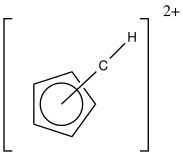
The story starts with this article[1], a preview talk about which (Hypervalent Carbon Atom: “Freezing” the SN2 Transition State) I actually saw at an ACS conference a year or so earlier. When the article was published, Steve Bachrach blogged about it, noting the claim for pentavalent carbon. The semantics of a valency vs a coordination are subtle, and I was not convinced that this frozen transition state deserved its elevation from penta-coordinate to pentavalent. After some discussion on Steve’s blog, I built upon these ideas with a few thoughts of my own on the present blog and then wondered whether they could be finally distilled into a more formal publication (testing the precedent in some ways of whether collaborative and public discussions of ideas could be published formally, or whether they would be rejected as having been already “published”). Well, these final distilled thoughts were indeed published in 2010[2], including their genesis in Steve’s blog (I wanted to put blogs more firmly into the acceptable scientific circle). This article included one species (numbered 5 in that article in 2010[2]) and pointed out an analogy to replacing CH2+ by e.g the isoelectronic BH1+, in as much as an example of the latter is indeed known as a stable crystalline compound.[3]. Iso-electronics is a very fruitful source of connections in chemistry!

5

Matters rested there until yesterday, when I spotted this on Steve’s blog where he discusses this recent article on the structure of the benzene dication.[4] Hey presto, there is that molecule again, but now there is firm experimental evidence of its existence! It was I think rather too much to expect the authors of this article to have spotted the connection to mine (although as it happens, both address the issue of complexes to He). The relationship between CH2+ and BH1+ is a little more subtle. From my point of view, it is always worth trawling through the crystal structure database in favour of evidence for hypothetical species (or their isoelectronic substitutions), and so it proved in this case!

There are other connections possible. Thus the dication of benzene has a (higher energy) isomer which is in fact a 4π antiaromatic species which avoids this antiaromaticity by a geometric distortion, with two C-H bonds bending above and below the ring. Such avoided antiaromaticity has been noted elsewhere here.

There is one final connection for me to make. My 2010 article[2] contained one of my interactive tables containing the data for the various structures (yes, although its data, you will need to have a subscription to the journal to access it). As it happens, last year we wished to reprise this style of publication, but as I blogged at the time, the journal had changed its production processes, and they could no longer offer me that opportunity. Some quick thinking came up with a replacement, which we now use extensively.[5] So the chain of connections resulting from that original talk some six years ago continues.

<

p>As for that chain, it arose distressingly randomly. I do not routinely read the entire ToC of JACS and so would not have discovered[4] the connection by that route. Fortunately, Steve Bachrach does and helped me make that connection to the molecule shown above. Although I did spend a few minutes thinking to myself “does that structure ring any bells?”. Fortunately, one did (eventually) ring. But for every connection made in this wonderfully human manner, I cannot help but think how many are not! However, if connections were much easier to make, could we as humans cope with the overwhelming deluge of new ideas?

References

  1. S. Pierrefixe, S. van Stralen, J. van Stralen, C. Fonseca Guerra, and F. Bickelhaupt, "Hypervalent Carbon Atom: “Freezing” the S<sub>N</sub>2 Transition State", Angewandte Chemie International Edition, vol. 48, pp. 6469-6471, 2009. https://doi.org/10.1002/anie.200902125
  2. H.S. Rzepa, "The rational design of helium bonds", Nature Chemistry, vol. 2, pp. 390-393, 2010. https://doi.org/10.1038/nchem.596
  3. C. Dohmeier, R. Köppe, C. Robl, and H. Schnöckel, "Kristallstruktur von [Cp★BBr][AlBr4]", Journal of Organometallic Chemistry, vol. 487, pp. 127-130, 1995. https://doi.org/10.1016/0022-328x(94)05089-t
  4. J. Jašík, D. Gerlich, and J. Roithová, "Probing Isomers of the Benzene Dication in a Low-Temperature Trap", Journal of the American Chemical Society, vol. 136, pp. 2960-2962, 2014. https://doi.org/10.1021/ja412109h
  5. A. Armstrong, R.A. Boto, P. Dingwall, J. Contreras-García, M.J. Harvey, N.J. Mason, and H.S. Rzepa, "The Houk–List transition states for organocatalytic mechanisms revisited", Chem. Sci., vol. 5, pp. 2057-2071, 2014. https://doi.org/10.1039/c3sc53416b

A connected world (journals and blogs): The benzene dication.

Thursday, April 10th, 2014

Science is rarely about a totally new observation or rationalisation, it is much more about making connections between known facts, and perhaps using these connections to extrapolate to new areas (building on the shoulders of giants, etc). So here I chart one example of such connectivity over a period of six years.

The story starts with this article[1], a preview talk about which (Hypervalent Carbon Atom: “Freezing” the SN2 Transition State) I actually saw at an ACS conference a year or so earlier. When the article was published, Steve Bachrach blogged about it, noting the claim for pentavalent carbon. The semantics of a valency vs a coordination are subtle, and I was not convinced that this frozen transition state deserved its elevation from penta-coordinate to pentavalent. After some discussion on Steve’s blog, I built upon these ideas with a few thoughts of my own on the present blog and then wondered whether they could be finally distilled into a more formal publication (testing the precedent in some ways of whether collaborative and public discussions of ideas could be published formally, or whether they would be rejected as having been already “published”). Well, these final distilled thoughts were indeed published in 2010[2], including their genesis in Steve’s blog (I wanted to put blogs more firmly into the acceptable scientific circle). This article included one species (numbered 5 in that article in 2010[2]) and pointed out an analogy to replacing CH2+ by e.g the isoelectronic BH1+, in as much as an example of the latter is indeed known as a stable crystalline compound.[3]. Iso-electronics is a very fruitful source of connections in chemistry!

5

Matters rested there until yesterday, when I spotted this on Steve’s blog where he discusses this recent article on the structure of the benzene dication.[4] Hey presto, there is that molecule again, but now there is firm experimental evidence of its existence! It was I think rather too much to expect the authors of this article to have spotted the connection to mine (although as it happens, both address the issue of complexes to He). The relationship between CH2+ and BH1+ is a little more subtle. From my point of view, it is always worth trawling through the crystal structure database in favour of evidence for hypothetical species (or their isoelectronic substitutions), and so it proved in this case!

There are other connections possible. Thus the dication of benzene has a (higher energy) isomer which is in fact a 4π antiaromatic species which avoids this antiaromaticity by a geometric distortion, with two C-H bonds bending above and below the ring. Such avoided antiaromaticity has been noted elsewhere here.

There is one final connection for me to make. My 2010 article[2] contained one of my interactive tables containing the data for the various structures (yes, although its data, you will need to have a subscription to the journal to access it). As it happens, last year we wished to reprise this style of publication, but as I blogged at the time, the journal had changed its production processes, and they could no longer offer me that opportunity. Some quick thinking came up with a replacement, which we now use extensively.[5] So the chain of connections resulting from that original talk some six years ago continues.

<

p>As for that chain, it arose distressingly randomly. I do not routinely read the entire ToC of JACS and so would not have discovered[4] the connection by that route. Fortunately, Steve Bachrach does and helped me make that connection to the molecule shown above. Although I did spend a few minutes thinking to myself “does that structure ring any bells?”. Fortunately, one did (eventually) ring. But for every connection made in this wonderfully human manner, I cannot help but think how many are not! However, if connections were much easier to make, could we as humans cope with the overwhelming deluge of new ideas?

References

  1. S. Pierrefixe, S. van Stralen, J. van Stralen, C. Fonseca Guerra, and F. Bickelhaupt, "Hypervalent Carbon Atom: “Freezing” the S<sub>N</sub>2 Transition State", Angewandte Chemie International Edition, vol. 48, pp. 6469-6471, 2009. https://doi.org/10.1002/anie.200902125
  2. H.S. Rzepa, "The rational design of helium bonds", Nature Chemistry, vol. 2, pp. 390-393, 2010. https://doi.org/10.1038/nchem.596
  3. C. Dohmeier, R. Köppe, C. Robl, and H. Schnöckel, "Kristallstruktur von [Cp★BBr][AlBr4]", Journal of Organometallic Chemistry, vol. 487, pp. 127-130, 1995. https://doi.org/10.1016/0022-328x(94)05089-t
  4. J. Jašík, D. Gerlich, and J. Roithová, "Probing Isomers of the Benzene Dication in a Low-Temperature Trap", Journal of the American Chemical Society, vol. 136, pp. 2960-2962, 2014. https://doi.org/10.1021/ja412109h
  5. A. Armstrong, R.A. Boto, P. Dingwall, J. Contreras-García, M.J. Harvey, N.J. Mason, and H.S. Rzepa, "The Houk–List transition states for organocatalytic mechanisms revisited", Chem. Sci., vol. 5, pp. 2057-2071, 2014. https://doi.org/10.1039/c3sc53416b

A connected world (journals and blogs): The benzene dication.

Thursday, April 10th, 2014

Science is rarely about a totally new observation or rationalisation, it is much more about making connections between known facts, and perhaps using these connections to extrapolate to new areas (building on the shoulders of giants, etc). So here I chart one example of such connectivity over a period of six years.

The story starts with this article[1], a preview talk about which (Hypervalent Carbon Atom: “Freezing” the SN2 Transition State) I actually saw at an ACS conference a year or so earlier. When the article was published, Steve Bachrach blogged about it, noting the claim for pentavalent carbon. The semantics of a valency vs a coordination are subtle, and I was not convinced that this frozen transition state deserved its elevation from penta-coordinate to pentavalent. After some discussion on Steve’s blog, I built upon these ideas with a few thoughts of my own on the present blog and then wondered whether they could be finally distilled into a more formal publication (testing the precedent in some ways of whether collaborative and public discussions of ideas could be published formally, or whether they would be rejected as having been already “published”). Well, these final distilled thoughts were indeed published in 2010[2], including their genesis in Steve’s blog (I wanted to put blogs more firmly into the acceptable scientific circle). This article included one species (numbered 5 in that article in 2010[2]) and pointed out an analogy to replacing CH2+ by e.g the isoelectronic BH1+, in as much as an example of the latter is indeed known as a stable crystalline compound.[3]. Iso-electronics is a very fruitful source of connections in chemistry!

5

Matters rested there until yesterday, when I spotted this on Steve’s blog where he discusses this recent article on the structure of the benzene dication.[4] Hey presto, there is that molecule again, but now there is firm experimental evidence of its existence! It was I think rather too much to expect the authors of this article to have spotted the connection to mine (although as it happens, both address the issue of complexes to He). The relationship between CH2+ and BH1+ is a little more subtle. From my point of view, it is always worth trawling through the crystal structure database in favour of evidence for hypothetical species (or their isoelectronic substitutions), and so it proved in this case!

There are other connections possible. Thus the dication of benzene has a (higher energy) isomer which is in fact a 4π antiaromatic species which avoids this antiaromaticity by a geometric distortion, with two C-H bonds bending above and below the ring. Such avoided antiaromaticity has been noted elsewhere here.

There is one final connection for me to make. My 2010 article[2] contained one of my interactive tables containing the data for the various structures (yes, although its data, you will need to have a subscription to the journal to access it). As it happens, last year we wished to reprise this style of publication, but as I blogged at the time, the journal had changed its production processes, and they could no longer offer me that opportunity. Some quick thinking came up with a replacement, which we now use extensively.[5] So the chain of connections resulting from that original talk some six years ago continues.

<

p>As for that chain, it arose distressingly randomly. I do not routinely read the entire ToC of JACS and so would not have discovered[4] the connection by that route. Fortunately, Steve Bachrach does and helped me make that connection to the molecule shown above. Although I did spend a few minutes thinking to myself “does that structure ring any bells?”. Fortunately, one did (eventually) ring. But for every connection made in this wonderfully human manner, I cannot help but think how many are not! However, if connections were much easier to make, could we as humans cope with the overwhelming deluge of new ideas?

References

  1. S. Pierrefixe, S. van Stralen, J. van Stralen, C. Fonseca Guerra, and F. Bickelhaupt, "Hypervalent Carbon Atom: “Freezing” the S<sub>N</sub>2 Transition State", Angewandte Chemie International Edition, vol. 48, pp. 6469-6471, 2009. https://doi.org/10.1002/anie.200902125
  2. H.S. Rzepa, "The rational design of helium bonds", Nature Chemistry, vol. 2, pp. 390-393, 2010. https://doi.org/10.1038/nchem.596
  3. C. Dohmeier, R. Köppe, C. Robl, and H. Schnöckel, "Kristallstruktur von [Cp★BBr][AlBr4]", Journal of Organometallic Chemistry, vol. 487, pp. 127-130, 1995. https://doi.org/10.1016/0022-328x(94)05089-t
  4. J. Jašík, D. Gerlich, and J. Roithová, "Probing Isomers of the Benzene Dication in a Low-Temperature Trap", Journal of the American Chemical Society, vol. 136, pp. 2960-2962, 2014. https://doi.org/10.1021/ja412109h
  5. A. Armstrong, R.A. Boto, P. Dingwall, J. Contreras-García, M.J. Harvey, N.J. Mason, and H.S. Rzepa, "The Houk–List transition states for organocatalytic mechanisms revisited", Chem. Sci., vol. 5, pp. 2057-2071, 2014. https://doi.org/10.1039/c3sc53416b

A connected world (journals and blogs): The benzene dication.

Thursday, April 10th, 2014

Science is rarely about a totally new observation or rationalisation, it is much more about making connections between known facts, and perhaps using these connections to extrapolate to new areas (building on the shoulders of giants, etc). So here I chart one example of such connectivity over a period of six years.

The story starts with this article[1], a preview talk about which (Hypervalent Carbon Atom: “Freezing” the SN2 Transition State) I actually saw at an ACS conference a year or so earlier. When the article was published, Steve Bachrach blogged about it, noting the claim for pentavalent carbon. The semantics of a valency vs a coordination are subtle, and I was not convinced that this frozen transition state deserved its elevation from penta-coordinate to pentavalent. After some discussion on Steve’s blog, I built upon these ideas with a few thoughts of my own on the present blog and then wondered whether they could be finally distilled into a more formal publication (testing the precedent in some ways of whether collaborative and public discussions of ideas could be published formally, or whether they would be rejected as having been already “published”). Well, these final distilled thoughts were indeed published in 2010[2], including their genesis in Steve’s blog (I wanted to put blogs more firmly into the acceptable scientific circle). This article included one species (numbered 5 in that article in 2010[2]) and pointed out an analogy to replacing CH2+ by e.g the isoelectronic BH1+, in as much as an example of the latter is indeed known as a stable crystalline compound.[3]. Iso-electronics is a very fruitful source of connections in chemistry!

5

Matters rested there until yesterday, when I spotted this on Steve’s blog where he discusses this recent article on the structure of the benzene dication.[4] Hey presto, there is that molecule again, but now there is firm experimental evidence of its existence! It was I think rather too much to expect the authors of this article to have spotted the connection to mine (although as it happens, both address the issue of complexes to He). The relationship between CH2+ and BH1+ is a little more subtle. From my point of view, it is always worth trawling through the crystal structure database in favour of evidence for hypothetical species (or their isoelectronic substitutions), and so it proved in this case!

There are other connections possible. Thus the dication of benzene has a (higher energy) isomer which is in fact a 4π antiaromatic species which avoids this antiaromaticity by a geometric distortion, with two C-H bonds bending above and below the ring. Such avoided antiaromaticity has been noted elsewhere here.

There is one final connection for me to make. My 2010 article[2] contained one of my interactive tables containing the data for the various structures (yes, although its data, you will need to have a subscription to the journal to access it). As it happens, last year we wished to reprise this style of publication, but as I blogged at the time, the journal had changed its production processes, and they could no longer offer me that opportunity. Some quick thinking came up with a replacement, which we now use extensively.[5] So the chain of connections resulting from that original talk some six years ago continues.

<

p>As for that chain, it arose distressingly randomly. I do not routinely read the entire ToC of JACS and so would not have discovered[4] the connection by that route. Fortunately, Steve Bachrach does and helped me make that connection to the molecule shown above. Although I did spend a few minutes thinking to myself “does that structure ring any bells?”. Fortunately, one did (eventually) ring. But for every connection made in this wonderfully human manner, I cannot help but think how many are not! However, if connections were much easier to make, could we as humans cope with the overwhelming deluge of new ideas?

References

  1. S. Pierrefixe, S. van Stralen, J. van Stralen, C. Fonseca Guerra, and F. Bickelhaupt, "Hypervalent Carbon Atom: “Freezing” the S<sub>N</sub>2 Transition State", Angewandte Chemie International Edition, vol. 48, pp. 6469-6471, 2009. https://doi.org/10.1002/anie.200902125
  2. H.S. Rzepa, "The rational design of helium bonds", Nature Chemistry, vol. 2, pp. 390-393, 2010. https://doi.org/10.1038/nchem.596
  3. C. Dohmeier, R. Köppe, C. Robl, and H. Schnöckel, "Kristallstruktur von [Cp★BBr][AlBr4]", Journal of Organometallic Chemistry, vol. 487, pp. 127-130, 1995. https://doi.org/10.1016/0022-328x(94)05089-t
  4. J. Jašík, D. Gerlich, and J. Roithová, "Probing Isomers of the Benzene Dication in a Low-Temperature Trap", Journal of the American Chemical Society, vol. 136, pp. 2960-2962, 2014. https://doi.org/10.1021/ja412109h
  5. A. Armstrong, R.A. Boto, P. Dingwall, J. Contreras-García, M.J. Harvey, N.J. Mason, and H.S. Rzepa, "The Houk–List transition states for organocatalytic mechanisms revisited", Chem. Sci., vol. 5, pp. 2057-2071, 2014. https://doi.org/10.1039/c3sc53416b

A connected world (journals and blogs): The benzene dication.

Thursday, April 10th, 2014

Science is rarely about a totally new observation or rationalisation, it is much more about making connections between known facts, and perhaps using these connections to extrapolate to new areas (building on the shoulders of giants, etc). So here I chart one example of such connectivity over a period of six years.

The story starts with this article[1], a preview talk about which (Hypervalent Carbon Atom: “Freezing” the SN2 Transition State) I actually saw at an ACS conference a year or so earlier. When the article was published, Steve Bachrach blogged about it, noting the claim for pentavalent carbon. The semantics of a valency vs a coordination are subtle, and I was not convinced that this frozen transition state deserved its elevation from penta-coordinate to pentavalent. After some discussion on Steve’s blog, I built upon these ideas with a few thoughts of my own on the present blog and then wondered whether they could be finally distilled into a more formal publication (testing the precedent in some ways of whether collaborative and public discussions of ideas could be published formally, or whether they would be rejected as having been already “published”). Well, these final distilled thoughts were indeed published in 2010[2], including their genesis in Steve’s blog (I wanted to put blogs more firmly into the acceptable scientific circle). This article included one species (numbered 5 in that article in 2010[2]) and pointed out an analogy to replacing CH2+ by e.g the isoelectronic BH1+, in as much as an example of the latter is indeed known as a stable crystalline compound.[3]. Iso-electronics is a very fruitful source of connections in chemistry!

5

Matters rested there until yesterday, when I spotted this on Steve’s blog where he discusses this recent article on the structure of the benzene dication.[4] Hey presto, there is that molecule again, but now there is firm experimental evidence of its existence! It was I think rather too much to expect the authors of this article to have spotted the connection to mine (although as it happens, both address the issue of complexes to He). The relationship between CH2+ and BH1+ is a little more subtle. From my point of view, it is always worth trawling through the crystal structure database in favour of evidence for hypothetical species (or their isoelectronic substitutions), and so it proved in this case!

There are other connections possible. Thus the dication of benzene has a (higher energy) isomer which is in fact a 4π antiaromatic species which avoids this antiaromaticity by a geometric distortion, with two C-H bonds bending above and below the ring. Such avoided antiaromaticity has been noted elsewhere here.

There is one final connection for me to make. My 2010 article[2] contained one of my interactive tables containing the data for the various structures (yes, although its data, you will need to have a subscription to the journal to access it). As it happens, last year we wished to reprise this style of publication, but as I blogged at the time, the journal had changed its production processes, and they could no longer offer me that opportunity. Some quick thinking came up with a replacement, which we now use extensively.[5] So the chain of connections resulting from that original talk some six years ago continues.

<

p>As for that chain, it arose distressingly randomly. I do not routinely read the entire ToC of JACS and so would not have discovered[4] the connection by that route. Fortunately, Steve Bachrach does and helped me make that connection to the molecule shown above. Although I did spend a few minutes thinking to myself “does that structure ring any bells?”. Fortunately, one did (eventually) ring. But for every connection made in this wonderfully human manner, I cannot help but think how many are not! However, if connections were much easier to make, could we as humans cope with the overwhelming deluge of new ideas?

References

  1. S. Pierrefixe, S. van Stralen, J. van Stralen, C. Fonseca Guerra, and F. Bickelhaupt, "Hypervalent Carbon Atom: “Freezing” the S<sub>N</sub>2 Transition State", Angewandte Chemie International Edition, vol. 48, pp. 6469-6471, 2009. https://doi.org/10.1002/anie.200902125
  2. H.S. Rzepa, "The rational design of helium bonds", Nature Chemistry, vol. 2, pp. 390-393, 2010. https://doi.org/10.1038/nchem.596
  3. C. Dohmeier, R. Köppe, C. Robl, and H. Schnöckel, "Kristallstruktur von [Cp★BBr][AlBr4]", Journal of Organometallic Chemistry, vol. 487, pp. 127-130, 1995. https://doi.org/10.1016/0022-328x(94)05089-t
  4. J. Jašík, D. Gerlich, and J. Roithová, "Probing Isomers of the Benzene Dication in a Low-Temperature Trap", Journal of the American Chemical Society, vol. 136, pp. 2960-2962, 2014. https://doi.org/10.1021/ja412109h
  5. A. Armstrong, R.A. Boto, P. Dingwall, J. Contreras-García, M.J. Harvey, N.J. Mason, and H.S. Rzepa, "The Houk–List transition states for organocatalytic mechanisms revisited", Chem. Sci., vol. 5, pp. 2057-2071, 2014. https://doi.org/10.1039/c3sc53416b

A connected world (journals and blogs): The benzene dication.

Thursday, April 10th, 2014

Science is rarely about a totally new observation or rationalisation, it is much more about making connections between known facts, and perhaps using these connections to extrapolate to new areas (building on the shoulders of giants, etc). So here I chart one example of such connectivity over a period of six years.

The story starts with this article[1], a preview talk about which (Hypervalent Carbon Atom: “Freezing” the SN2 Transition State) I actually saw at an ACS conference a year or so earlier. When the article was published, Steve Bachrach blogged about it, noting the claim for pentavalent carbon. The semantics of a valency vs a coordination are subtle, and I was not convinced that this frozen transition state deserved its elevation from penta-coordinate to pentavalent. After some discussion on Steve’s blog, I built upon these ideas with a few thoughts of my own on the present blog and then wondered whether they could be finally distilled into a more formal publication (testing the precedent in some ways of whether collaborative and public discussions of ideas could be published formally, or whether they would be rejected as having been already “published”). Well, these final distilled thoughts were indeed published in 2010[2], including their genesis in Steve’s blog (I wanted to put blogs more firmly into the acceptable scientific circle). This article included one species (numbered 5 in that article in 2010[2]) and pointed out an analogy to replacing CH2+ by e.g the isoelectronic BH1+, in as much as an example of the latter is indeed known as a stable crystalline compound.[3]. Iso-electronics is a very fruitful source of connections in chemistry!

5

Matters rested there until yesterday, when I spotted this on Steve’s blog where he discusses this recent article on the structure of the benzene dication.[4] Hey presto, there is that molecule again, but now there is firm experimental evidence of its existence! It was I think rather too much to expect the authors of this article to have spotted the connection to mine (although as it happens, both address the issue of complexes to He). The relationship between CH2+ and BH1+ is a little more subtle. From my point of view, it is always worth trawling through the crystal structure database in favour of evidence for hypothetical species (or their isoelectronic substitutions), and so it proved in this case!

There are other connections possible. Thus the dication of benzene has a (higher energy) isomer which is in fact a 4π antiaromatic species which avoids this antiaromaticity by a geometric distortion, with two C-H bonds bending above and below the ring. Such avoided antiaromaticity has been noted elsewhere here.

There is one final connection for me to make. My 2010 article[2] contained one of my interactive tables containing the data for the various structures (yes, although its data, you will need to have a subscription to the journal to access it). As it happens, last year we wished to reprise this style of publication, but as I blogged at the time, the journal had changed its production processes, and they could no longer offer me that opportunity. Some quick thinking came up with a replacement, which we now use extensively.[5] So the chain of connections resulting from that original talk some six years ago continues.

<

p>As for that chain, it arose distressingly randomly. I do not routinely read the entire ToC of JACS and so would not have discovered[4] the connection by that route. Fortunately, Steve Bachrach does and helped me make that connection to the molecule shown above. Although I did spend a few minutes thinking to myself “does that structure ring any bells?”. Fortunately, one did (eventually) ring. But for every connection made in this wonderfully human manner, I cannot help but think how many are not! However, if connections were much easier to make, could we as humans cope with the overwhelming deluge of new ideas?

References

  1. S. Pierrefixe, S. van Stralen, J. van Stralen, C. Fonseca Guerra, and F. Bickelhaupt, "Hypervalent Carbon Atom: “Freezing” the S<sub>N</sub>2 Transition State", Angewandte Chemie International Edition, vol. 48, pp. 6469-6471, 2009. https://doi.org/10.1002/anie.200902125
  2. H.S. Rzepa, "The rational design of helium bonds", Nature Chemistry, vol. 2, pp. 390-393, 2010. https://doi.org/10.1038/nchem.596
  3. C. Dohmeier, R. Köppe, C. Robl, and H. Schnöckel, "Kristallstruktur von [Cp★BBr][AlBr4]", Journal of Organometallic Chemistry, vol. 487, pp. 127-130, 1995. https://doi.org/10.1016/0022-328x(94)05089-t
  4. J. Jašík, D. Gerlich, and J. Roithová, "Probing Isomers of the Benzene Dication in a Low-Temperature Trap", Journal of the American Chemical Society, vol. 136, pp. 2960-2962, 2014. https://doi.org/10.1021/ja412109h
  5. A. Armstrong, R.A. Boto, P. Dingwall, J. Contreras-García, M.J. Harvey, N.J. Mason, and H.S. Rzepa, "The Houk–List transition states for organocatalytic mechanisms revisited", Chem. Sci., vol. 5, pp. 2057-2071, 2014. https://doi.org/10.1039/c3sc53416b

A connected world (journals and blogs): The benzene dication.

Thursday, April 10th, 2014

Science is rarely about a totally new observation or rationalisation, it is much more about making connections between known facts, and perhaps using these connections to extrapolate to new areas (building on the shoulders of giants, etc). So here I chart one example of such connectivity over a period of six years.

The story starts with this article[1], a preview talk about which (Hypervalent Carbon Atom: “Freezing” the SN2 Transition State) I actually saw at an ACS conference a year or so earlier. When the article was published, Steve Bachrach blogged about it, noting the claim for pentavalent carbon. The semantics of a valency vs a coordination are subtle, and I was not convinced that this frozen transition state deserved its elevation from penta-coordinate to pentavalent. After some discussion on Steve’s blog, I built upon these ideas with a few thoughts of my own on the present blog and then wondered whether they could be finally distilled into a more formal publication (testing the precedent in some ways of whether collaborative and public discussions of ideas could be published formally, or whether they would be rejected as having been already “published”). Well, these final distilled thoughts were indeed published in 2010[2], including their genesis in Steve’s blog (I wanted to put blogs more firmly into the acceptable scientific circle). This article included one species (numbered 5 in that article in 2010[2]) and pointed out an analogy to replacing CH2+ by e.g the isoelectronic BH1+, in as much as an example of the latter is indeed known as a stable crystalline compound.[3]. Iso-electronics is a very fruitful source of connections in chemistry!

5

Matters rested there until yesterday, when I spotted this on Steve’s blog where he discusses this recent article on the structure of the benzene dication.[4] Hey presto, there is that molecule again, but now there is firm experimental evidence of its existence! It was I think rather too much to expect the authors of this article to have spotted the connection to mine (although as it happens, both address the issue of complexes to He). The relationship between CH2+ and BH1+ is a little more subtle. From my point of view, it is always worth trawling through the crystal structure database in favour of evidence for hypothetical species (or their isoelectronic substitutions), and so it proved in this case!

There are other connections possible. Thus the dication of benzene has a (higher energy) isomer which is in fact a 4π antiaromatic species which avoids this antiaromaticity by a geometric distortion, with two C-H bonds bending above and below the ring. Such avoided antiaromaticity has been noted elsewhere here.

There is one final connection for me to make. My 2010 article[2] contained one of my interactive tables containing the data for the various structures (yes, although its data, you will need to have a subscription to the journal to access it). As it happens, last year we wished to reprise this style of publication, but as I blogged at the time, the journal had changed its production processes, and they could no longer offer me that opportunity. Some quick thinking came up with a replacement, which we now use extensively.[5] So the chain of connections resulting from that original talk some six years ago continues.

<

p>As for that chain, it arose distressingly randomly. I do not routinely read the entire ToC of JACS and so would not have discovered[4] the connection by that route. Fortunately, Steve Bachrach does and helped me make that connection to the molecule shown above. Although I did spend a few minutes thinking to myself “does that structure ring any bells?”. Fortunately, one did (eventually) ring. But for every connection made in this wonderfully human manner, I cannot help but think how many are not! However, if connections were much easier to make, could we as humans cope with the overwhelming deluge of new ideas?

References

  1. S. Pierrefixe, S. van Stralen, J. van Stralen, C. Fonseca Guerra, and F. Bickelhaupt, "Hypervalent Carbon Atom: “Freezing” the S<sub>N</sub>2 Transition State", Angewandte Chemie International Edition, vol. 48, pp. 6469-6471, 2009. https://doi.org/10.1002/anie.200902125
  2. H.S. Rzepa, "The rational design of helium bonds", Nature Chemistry, vol. 2, pp. 390-393, 2010. https://doi.org/10.1038/nchem.596
  3. C. Dohmeier, R. Köppe, C. Robl, and H. Schnöckel, "Kristallstruktur von [Cp★BBr][AlBr4]", Journal of Organometallic Chemistry, vol. 487, pp. 127-130, 1995. https://doi.org/10.1016/0022-328x(94)05089-t
  4. J. Jašík, D. Gerlich, and J. Roithová, "Probing Isomers of the Benzene Dication in a Low-Temperature Trap", Journal of the American Chemical Society, vol. 136, pp. 2960-2962, 2014. https://doi.org/10.1021/ja412109h
  5. A. Armstrong, R.A. Boto, P. Dingwall, J. Contreras-García, M.J. Harvey, N.J. Mason, and H.S. Rzepa, "The Houk–List transition states for organocatalytic mechanisms revisited", Chem. Sci., vol. 5, pp. 2057-2071, 2014. https://doi.org/10.1039/c3sc53416b