C2 (dicarbon) is certainly interesting from a theoretical point of view. Whether or not it can be described as having a quadruple bond has induced much passionate discussion[1],[2],[3],[4]. Its occurrence in space and in flames is also well-known. But does it have what might be called a conventional chemistry? Other highly reactive species (cyclobutadiene is a well-known example) can often be tamed by trapping as a ligand coordinated to a metal and so one might speculate upon how C2 responds to the proximity of a metal. As is noted here[2], dicarbon as a ligand has been known a long time as part of what is referred to as carbide chemistry. In this regard it is thought of as the di-anion, C22- (and isoelectronic therefore with dinitrogen). Thus calcium carbide, but in fact the degree to which the dicarbon can absorb electrons is thought to be wide (as judged by the resulting C-C bond length, see[2]). Here I take a look at just one metal carbide[5] that caught my eye (there are hundreds of others, many no doubt equally interesting!).
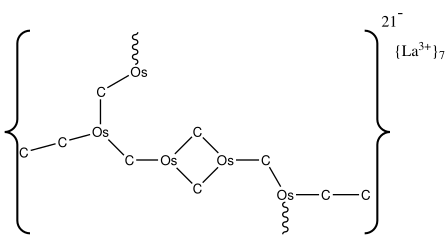
One first notices that the standard attempt at a representation above does not do it justice; a Lewis valence bond drawing (in which electrons are accounted by partitioning into bonds) it most certainly is not. Nine carbons and four osmiums have absorbed 21 electrons, donated (formally) from seven lanthanum atoms. But easily discerned is that of the nine carbons, four are dicarbon and five are mono carbon. It is worth exploring the immediate environment of each of these types. The monocarbon is in fact hexa-coordinated by two Os and four La, a form of carbon coordination that was only relatively recently identified.

Click for 3D
But the dicarbon unit is if anything even stranger. The C-C bond length is ~1.316Å (a relatively long distance compared to many carbides) more or less commensurate with a double bond. The carbons are both end-on σ-coordinated and also triply π-coordinated. with one more metal coordinating in a manner somewhat in-between these two modes. One carbon is 5-coordinate, the other 6-coordinate. The Os-C bond length has a relatively short value of 1.93Å (the sum of the double bond covalent radii for Os and C is 1.83, the single bond radii 2.04), and so it might be tempting to represent it as Os=C=C.

Click for 3D
This one example reminds us that even an element such as carbon, where one might imagine the bonding environments would be well-known, can still reveal unusual behaviours. Taking a look at the histogram below, which indicates C-C lengths in Metal-CC-Metal complexes (where the carbon coordination is restricted to 2) indicates the diversity of behaviour possible with this simple little ligand.

References
- S. Shaik, D. Danovich, W. Wu, P. Su, H.S. Rzepa, and P.C. Hiberty, "Quadruple bonding in C2 and analogous eight-valence electron species", Nature Chemistry, vol. 4, pp. 195-200, 2012. https://doi.org/10.1038/nchem.1263
- S. Shaik, H.S. Rzepa, and R. Hoffmann, "One Molecule, Two Atoms, Three Views, Four Bonds?", Angewandte Chemie International Edition, vol. 52, pp. 3020-3033, 2013. https://doi.org/10.1002/anie.201208206
- G. Frenking, and M. Hermann, "Critical Comments on “One Molecule, Two Atoms, Three Views, Four Bonds?”", Angewandte Chemie International Edition, vol. 52, pp. 5922-5925, 2013. https://doi.org/10.1002/anie.201301485
- D. Danovich, S. Shaik, H.S. Rzepa, and R. Hoffmann, "A Response to the Critical Comments on “One Molecule, Two Atoms, Three Views, Four Bonds?”", Angewandte Chemie International Edition, vol. 52, pp. 5926-5928, 2013. https://doi.org/10.1002/anie.201302350
- E. Dashjav, Y. Prots, G. Kreiner, W. Schnelle, F.R. Wagner, and R. Kniep, "Chemical bonding analysis and properties of La7Os4C9—A new structure type containing C- and C2-units as Os-coordinating ligands", Journal of Solid State Chemistry, vol. 181, pp. 3121-3130, 2008. https://doi.org/10.1016/j.jssc.2008.08.005