Archive for the ‘Uncategorized’ Category

Web page decay and Journals: How an interactive “ESI” from 2006 was rescued.

Friday, August 12th, 2022

In 2006[1] we published an article illustrating various types of pseudorotations in small molecules. It’s been cited 20 times since then, so reasonable interest! We described rotations known as Lever and Turnstile as well as the better known Berry mode. Because the differences between these rotations are quite subtle, we included an interactive electronic supporting information to illustrate them. That ESI was written in HTML and used Jmol to animate the rotations. Now, 16 years is a long time in the Web ecosystem (some early wag suggested, like dogs, that one year in normal time approximates to about 7 years in Web time) and inevitably, like e.g. both Rasmol[2] and Chime before it, Jmol no longer works when invoked from a Web browser; Java applets are very much dead and we are now on the fourth generation of molecule viewer, JSmol. Two days ago I was contacted by someone (thanks Peter!) who had noticed that the journal landing page did not seem to point to any ESI. Here I tell the story of what happened next.

Thus the landing page[1] does not mention any method for accessing any ESI. But since the page is paywalled, you have to login to see more. When you do this, you get a reference to “enhanced objects”, so I should explain what these were.

The norm nowadays seems to be that ESI is expressed as a PDF file, but that allows interactivity only with extreme difficulty. In 2006, if you wanted this feature, you used HTML. The publisher (ACS) coined the expression of WEO, or Web-enhanced object. We produced perhaps 50 or so of these for various publishers and in those days they were hosted on publishers’ own sites. At some stage since 2006, these pages have been moved and the enhanced object for this article has been (temporarily?) “lost”. It is perhaps easy to understand why, since changes to the publishers publication workflows would need to factor in such pages and probably there were not enough of them to merit inclusion in the workflow.

So on to 2022, when I was contacted by Peter about this issue. Whenever we submitted such interactive ESI, we always kept a local copy, and indeed this was quickly located at DOI: 10.14469/hpc/10849, now of course allocated its own DOI. By now the ESI had lost its interactivity, but more worryingly, was lacking any error messages. Why? This was the  HTML code then used:

<applet width="300" name="ClF5-gsA"
 height="250" archive="JmolApplet.jar" code="JmolApplet"
 mayscript="true">
 <param name="progressbar" value="true" />
 <param name="progresscolor" value="blue" />
 <param name="boxmessage"
 value="Downloading JmolApplet.jar" />
 <param name="boxbgcolor" value="black" />
 <param name="boxfgcolor" value="white" />
 <param name="load" value="ClF5-gsAC2vpTZ.mol" />
 <param name="script"
 value="select all; labels off; spacefill 0.25; 
 wireframe 0.1; center atomno=2" />
 </applet>

In modern web browsers this is simply ignored. So the solution is to rewrite this code into modern syntax, and for this I turned to a long time hero and expert, Angel, who is one of the active maintainers of JSmol, the successor to  Jmol.  A few hours later a conversion script came back. It is just 55 lines long!  It is invoked in the header of the HTML document as: 

<script type="text/javascript" src="JSmol.min.js"></script>
<script type="text/javascript" src="convertJmolApplets.js"></script>

and hey presto, all works as originally. I transclude a small snippet here to give a flavour, although the original is formatted for wide pages, so go see all the ESI there.

So what is the take home message? Well, it turns out that the Java/Jmol syntax developed for the Web more than 20 years ago has actually proved pretty resilient. And so pages where technology has overtaken them can sometimes be quite easily rescued and restored back to life. A number of those WEOs from the early naughties have indeed been rescued by expedients such as described above. And perhaps in 10 years time when Javascript and JSmol have themselves moved on, further rescues will be needed. But had I been asked back in 2006 or earlier whether I expected those interactive ESI pages to still be working 16+ years later, I may well have replied that it seemed unlikely. So it is a very pleasant surprise to find that they (now) are. All we need is for the journal itself to point to a working version; for that, keep your eyes peeled.

On a more general point, a history of “ESI” as used in chemistry would be an interesting topic. Although generally thought of as having its roots around 1996, it may well go back further. Any historians around?


Available at https://wiki.jmol.org/index.php/Jmol_JavaScript_Object/Legacy and 10.14469/hpc/10852


References

  1. H.S. Rzepa, and M.E. Cass, "A Computational Study of the Nondissociative Mechanisms that Interchange Apical and Equatorial Atoms in Square Pyramidal Molecules", Inorganic Chemistry, vol. 45, pp. 3958-3963, 2006. https://doi.org/10.1021/ic0519988
  2. O. Casher, G.K. Chandramohan, M.J. Hargreaves, C. Leach, P. Murray-Rust, H.S. Rzepa, R. Sayle, and B.J. Whitaker, "Hyperactive molecules and the World-Wide-Web information system", Journal of the Chemical Society, Perkin Transactions 2, pp. 7, 1995. https://doi.org/10.1039/p29950000007
Unexpected Isomerization of Oxetane-Carboxylic Acids – a viable mechanism

Friday, August 12th, 2022

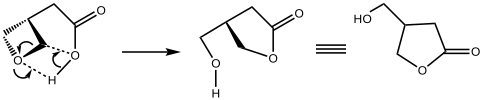
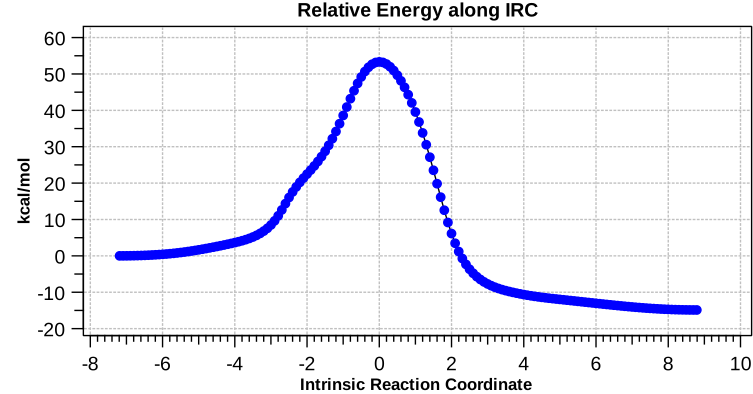
In the previous post, I looked at the intramolecular rearrangement of the oxetane carboxylic acid to a lactone, finding the barrier to the Sn2 reaction with retention was unfeasibly high. Here I explore alternatives.

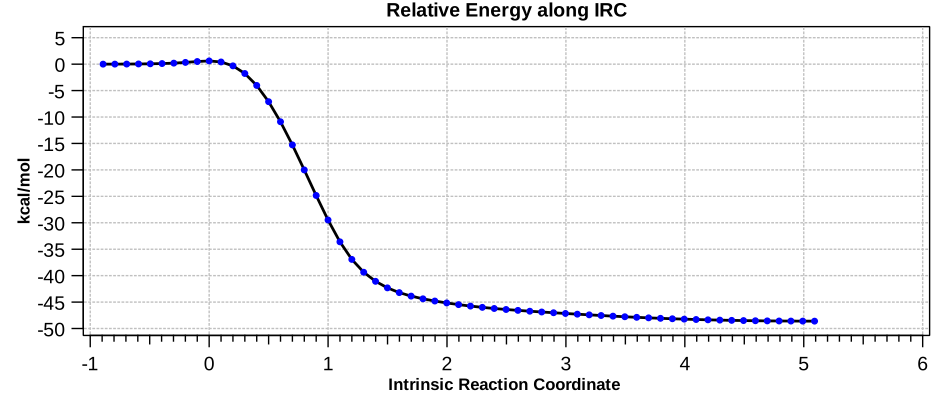
  1. This first attempt uses a second molecule of a carboxylic acid (modelled as formic acid for simplicity) to see if it can catalyse the reaction. All FAIR data at 10.14469/hpc/10820

    The reaction still occurs with retention at the Sn2 centre, and the free energy barrier is 47.9 kcal/mol (ωB97XD/Def2-TZVPP), very little different from the unimolecular reaction without additional acid (49.9 kcal/mol).
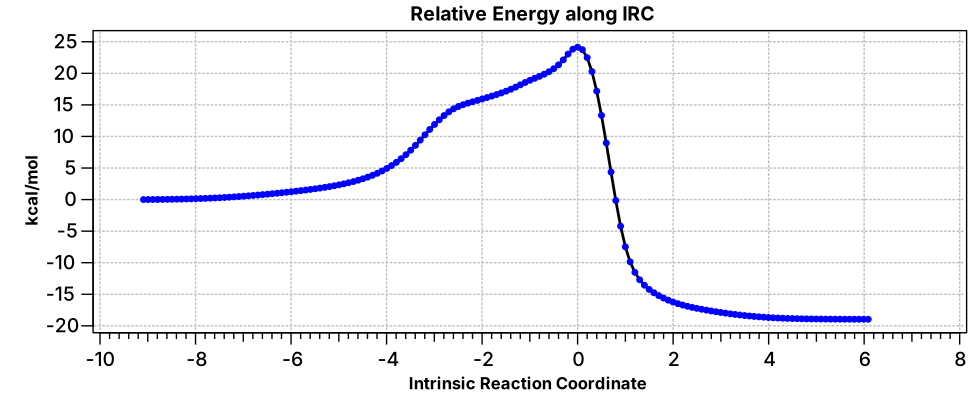
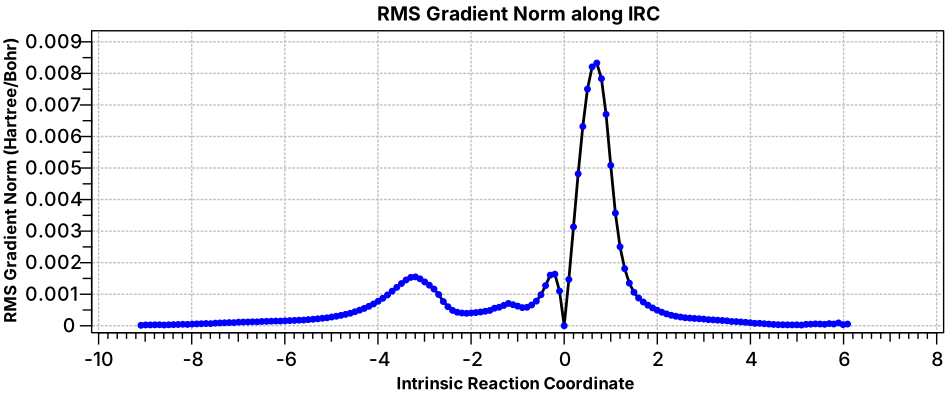
  2. How about inversion at the Sn2 centre? The energy profile now looks quite wrong, because the additional acid is too small to simultaneously straddle the entire molecule from the point of proton removal to the point of reprotonation, if inversion occurs at the Sn2 centre. The reaction ends up (or starts, depending on your point of view) with a proton in the wrong place!

  3. So the need to make the proton transfer agent larger, by now including TWO additional carboxylic acids.


    There are now three proton transfers, one at each end of the oxetane-carboxylate and the product lactone and one between the two transfer acids. Watch the animation carefully to note the sequence in which they occur. The free energy barrier is now 27.0 kcal/mol for a standard state of 1 atm (ωB97XD/Def2-TZVPP). This could be reduced (3.2 kcal/mol or more) for the higher effective molar concentrations in the liquid or solid state of the pure oxetane.
  4. The structure of this transition state (click image below to view 3D model) shows one interesting point of CH…O interaction between transfer catalyst and substrate.

The next steps will be to explore the impact of making substitutions in the oxetane ring; there now seems to be a viable model to use for this purpose.


DOI 10.14469/hpc/10848 and 10.14469/hpc/10862


A connected world (journals and blogs): The benzene dication.

Thursday, April 10th, 2014

Science is rarely about a totally new observation or rationalisation, it is much more about making connections between known facts, and perhaps using these connections to extrapolate to new areas (building on the shoulders of giants, etc). So here I chart one example of such connectivity over a period of six years.

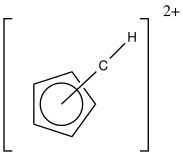
The story starts with this article[1], a preview talk about which (Hypervalent Carbon Atom: “Freezing” the SN2 Transition State) I actually saw at an ACS conference a year or so earlier. When the article was published, Steve Bachrach blogged about it, noting the claim for pentavalent carbon. The semantics of a valency vs a coordination are subtle, and I was not convinced that this frozen transition state deserved its elevation from penta-coordinate to pentavalent. After some discussion on Steve’s blog, I built upon these ideas with a few thoughts of my own on the present blog and then wondered whether they could be finally distilled into a more formal publication (testing the precedent in some ways of whether collaborative and public discussions of ideas could be published formally, or whether they would be rejected as having been already “published”). Well, these final distilled thoughts were indeed published in 2010[2], including their genesis in Steve’s blog (I wanted to put blogs more firmly into the acceptable scientific circle). This article included one species (numbered 5 in that article in 2010[2]) and pointed out an analogy to replacing CH2+ by e.g the isoelectronic BH1+, in as much as an example of the latter is indeed known as a stable crystalline compound.[3]. Iso-electronics is a very fruitful source of connections in chemistry!

5

Matters rested there until yesterday, when I spotted this on Steve’s blog where he discusses this recent article on the structure of the benzene dication.[4] Hey presto, there is that molecule again, but now there is firm experimental evidence of its existence! It was I think rather too much to expect the authors of this article to have spotted the connection to mine (although as it happens, both address the issue of complexes to He). The relationship between CH2+ and BH1+ is a little more subtle. From my point of view, it is always worth trawling through the crystal structure database in favour of evidence for hypothetical species (or their isoelectronic substitutions), and so it proved in this case!

There are other connections possible. Thus the dication of benzene has a (higher energy) isomer which is in fact a 4π antiaromatic species which avoids this antiaromaticity by a geometric distortion, with two C-H bonds bending above and below the ring. Such avoided antiaromaticity has been noted elsewhere here.

There is one final connection for me to make. My 2010 article[2] contained one of my interactive tables containing the data for the various structures (yes, although its data, you will need to have a subscription to the journal to access it). As it happens, last year we wished to reprise this style of publication, but as I blogged at the time, the journal had changed its production processes, and they could no longer offer me that opportunity. Some quick thinking came up with a replacement, which we now use extensively.[5] So the chain of connections resulting from that original talk some six years ago continues.

<

p>As for that chain, it arose distressingly randomly. I do not routinely read the entire ToC of JACS and so would not have discovered[4] the connection by that route. Fortunately, Steve Bachrach does and helped me make that connection to the molecule shown above. Although I did spend a few minutes thinking to myself “does that structure ring any bells?”. Fortunately, one did (eventually) ring. But for every connection made in this wonderfully human manner, I cannot help but think how many are not! However, if connections were much easier to make, could we as humans cope with the overwhelming deluge of new ideas?

References

  1. S. Pierrefixe, S. van Stralen, J. van Stralen, C. Fonseca Guerra, and F. Bickelhaupt, "Hypervalent Carbon Atom: “Freezing” the S<sub>N</sub>2 Transition State", Angewandte Chemie International Edition, vol. 48, pp. 6469-6471, 2009. https://doi.org/10.1002/anie.200902125
  2. H.S. Rzepa, "The rational design of helium bonds", Nature Chemistry, vol. 2, pp. 390-393, 2010. https://doi.org/10.1038/nchem.596
  3. C. Dohmeier, R. Köppe, C. Robl, and H. Schnöckel, "Kristallstruktur von [Cp★BBr][AlBr4]", Journal of Organometallic Chemistry, vol. 487, pp. 127-130, 1995. https://doi.org/10.1016/0022-328x(94)05089-t
  4. J. Jašík, D. Gerlich, and J. Roithová, "Probing Isomers of the Benzene Dication in a Low-Temperature Trap", Journal of the American Chemical Society, vol. 136, pp. 2960-2962, 2014. https://doi.org/10.1021/ja412109h
  5. A. Armstrong, R.A. Boto, P. Dingwall, J. Contreras-García, M.J. Harvey, N.J. Mason, and H.S. Rzepa, "The Houk–List transition states for organocatalytic mechanisms revisited", Chem. Sci., vol. 5, pp. 2057-2071, 2014. https://doi.org/10.1039/c3sc53416b

A connected world (journals and blogs): The benzene dication.

Thursday, April 10th, 2014

Science is rarely about a totally new observation or rationalisation, it is much more about making connections between known facts, and perhaps using these connections to extrapolate to new areas (building on the shoulders of giants, etc). So here I chart one example of such connectivity over a period of six years.

The story starts with this article[1], a preview talk about which (Hypervalent Carbon Atom: “Freezing” the SN2 Transition State) I actually saw at an ACS conference a year or so earlier. When the article was published, Steve Bachrach blogged about it, noting the claim for pentavalent carbon. The semantics of a valency vs a coordination are subtle, and I was not convinced that this frozen transition state deserved its elevation from penta-coordinate to pentavalent. After some discussion on Steve’s blog, I built upon these ideas with a few thoughts of my own on the present blog and then wondered whether they could be finally distilled into a more formal publication (testing the precedent in some ways of whether collaborative and public discussions of ideas could be published formally, or whether they would be rejected as having been already “published”). Well, these final distilled thoughts were indeed published in 2010[2], including their genesis in Steve’s blog (I wanted to put blogs more firmly into the acceptable scientific circle). This article included one species (numbered 5 in that article in 2010[2]) and pointed out an analogy to replacing CH2+ by e.g the isoelectronic BH1+, in as much as an example of the latter is indeed known as a stable crystalline compound.[3]. Iso-electronics is a very fruitful source of connections in chemistry!

5

Matters rested there until yesterday, when I spotted this on Steve’s blog where he discusses this recent article on the structure of the benzene dication.[4] Hey presto, there is that molecule again, but now there is firm experimental evidence of its existence! It was I think rather too much to expect the authors of this article to have spotted the connection to mine (although as it happens, both address the issue of complexes to He). The relationship between CH2+ and BH1+ is a little more subtle. From my point of view, it is always worth trawling through the crystal structure database in favour of evidence for hypothetical species (or their isoelectronic substitutions), and so it proved in this case!

There are other connections possible. Thus the dication of benzene has a (higher energy) isomer which is in fact a 4π antiaromatic species which avoids this antiaromaticity by a geometric distortion, with two C-H bonds bending above and below the ring. Such avoided antiaromaticity has been noted elsewhere here.

There is one final connection for me to make. My 2010 article[2] contained one of my interactive tables containing the data for the various structures (yes, although its data, you will need to have a subscription to the journal to access it). As it happens, last year we wished to reprise this style of publication, but as I blogged at the time, the journal had changed its production processes, and they could no longer offer me that opportunity. Some quick thinking came up with a replacement, which we now use extensively.[5] So the chain of connections resulting from that original talk some six years ago continues.

<

p>As for that chain, it arose distressingly randomly. I do not routinely read the entire ToC of JACS and so would not have discovered[4] the connection by that route. Fortunately, Steve Bachrach does and helped me make that connection to the molecule shown above. Although I did spend a few minutes thinking to myself “does that structure ring any bells?”. Fortunately, one did (eventually) ring. But for every connection made in this wonderfully human manner, I cannot help but think how many are not! However, if connections were much easier to make, could we as humans cope with the overwhelming deluge of new ideas?

References

  1. S. Pierrefixe, S. van Stralen, J. van Stralen, C. Fonseca Guerra, and F. Bickelhaupt, "Hypervalent Carbon Atom: “Freezing” the S<sub>N</sub>2 Transition State", Angewandte Chemie International Edition, vol. 48, pp. 6469-6471, 2009. https://doi.org/10.1002/anie.200902125
  2. H.S. Rzepa, "The rational design of helium bonds", Nature Chemistry, vol. 2, pp. 390-393, 2010. https://doi.org/10.1038/nchem.596
  3. C. Dohmeier, R. Köppe, C. Robl, and H. Schnöckel, "Kristallstruktur von [Cp★BBr][AlBr4]", Journal of Organometallic Chemistry, vol. 487, pp. 127-130, 1995. https://doi.org/10.1016/0022-328x(94)05089-t
  4. J. Jašík, D. Gerlich, and J. Roithová, "Probing Isomers of the Benzene Dication in a Low-Temperature Trap", Journal of the American Chemical Society, vol. 136, pp. 2960-2962, 2014. https://doi.org/10.1021/ja412109h
  5. A. Armstrong, R.A. Boto, P. Dingwall, J. Contreras-García, M.J. Harvey, N.J. Mason, and H.S. Rzepa, "The Houk–List transition states for organocatalytic mechanisms revisited", Chem. Sci., vol. 5, pp. 2057-2071, 2014. https://doi.org/10.1039/c3sc53416b

A connected world (journals and blogs): The benzene dication.

Thursday, April 10th, 2014

Science is rarely about a totally new observation or rationalisation, it is much more about making connections between known facts, and perhaps using these connections to extrapolate to new areas (building on the shoulders of giants, etc). So here I chart one example of such connectivity over a period of six years.

The story starts with this article[1], a preview talk about which (Hypervalent Carbon Atom: “Freezing” the SN2 Transition State) I actually saw at an ACS conference a year or so earlier. When the article was published, Steve Bachrach blogged about it, noting the claim for pentavalent carbon. The semantics of a valency vs a coordination are subtle, and I was not convinced that this frozen transition state deserved its elevation from penta-coordinate to pentavalent. After some discussion on Steve’s blog, I built upon these ideas with a few thoughts of my own on the present blog and then wondered whether they could be finally distilled into a more formal publication (testing the precedent in some ways of whether collaborative and public discussions of ideas could be published formally, or whether they would be rejected as having been already “published”). Well, these final distilled thoughts were indeed published in 2010[2], including their genesis in Steve’s blog (I wanted to put blogs more firmly into the acceptable scientific circle). This article included one species (numbered 5 in that article in 2010[2]) and pointed out an analogy to replacing CH2+ by e.g the isoelectronic BH1+, in as much as an example of the latter is indeed known as a stable crystalline compound.[3]. Iso-electronics is a very fruitful source of connections in chemistry!

5

Matters rested there until yesterday, when I spotted this on Steve’s blog where he discusses this recent article on the structure of the benzene dication.[4] Hey presto, there is that molecule again, but now there is firm experimental evidence of its existence! It was I think rather too much to expect the authors of this article to have spotted the connection to mine (although as it happens, both address the issue of complexes to He). The relationship between CH2+ and BH1+ is a little more subtle. From my point of view, it is always worth trawling through the crystal structure database in favour of evidence for hypothetical species (or their isoelectronic substitutions), and so it proved in this case!

There are other connections possible. Thus the dication of benzene has a (higher energy) isomer which is in fact a 4π antiaromatic species which avoids this antiaromaticity by a geometric distortion, with two C-H bonds bending above and below the ring. Such avoided antiaromaticity has been noted elsewhere here.

There is one final connection for me to make. My 2010 article[2] contained one of my interactive tables containing the data for the various structures (yes, although its data, you will need to have a subscription to the journal to access it). As it happens, last year we wished to reprise this style of publication, but as I blogged at the time, the journal had changed its production processes, and they could no longer offer me that opportunity. Some quick thinking came up with a replacement, which we now use extensively.[5] So the chain of connections resulting from that original talk some six years ago continues.

<

p>As for that chain, it arose distressingly randomly. I do not routinely read the entire ToC of JACS and so would not have discovered[4] the connection by that route. Fortunately, Steve Bachrach does and helped me make that connection to the molecule shown above. Although I did spend a few minutes thinking to myself “does that structure ring any bells?”. Fortunately, one did (eventually) ring. But for every connection made in this wonderfully human manner, I cannot help but think how many are not! However, if connections were much easier to make, could we as humans cope with the overwhelming deluge of new ideas?

References

  1. S. Pierrefixe, S. van Stralen, J. van Stralen, C. Fonseca Guerra, and F. Bickelhaupt, "Hypervalent Carbon Atom: “Freezing” the S<sub>N</sub>2 Transition State", Angewandte Chemie International Edition, vol. 48, pp. 6469-6471, 2009. https://doi.org/10.1002/anie.200902125
  2. H.S. Rzepa, "The rational design of helium bonds", Nature Chemistry, vol. 2, pp. 390-393, 2010. https://doi.org/10.1038/nchem.596
  3. C. Dohmeier, R. Köppe, C. Robl, and H. Schnöckel, "Kristallstruktur von [Cp★BBr][AlBr4]", Journal of Organometallic Chemistry, vol. 487, pp. 127-130, 1995. https://doi.org/10.1016/0022-328x(94)05089-t
  4. J. Jašík, D. Gerlich, and J. Roithová, "Probing Isomers of the Benzene Dication in a Low-Temperature Trap", Journal of the American Chemical Society, vol. 136, pp. 2960-2962, 2014. https://doi.org/10.1021/ja412109h
  5. A. Armstrong, R.A. Boto, P. Dingwall, J. Contreras-García, M.J. Harvey, N.J. Mason, and H.S. Rzepa, "The Houk–List transition states for organocatalytic mechanisms revisited", Chem. Sci., vol. 5, pp. 2057-2071, 2014. https://doi.org/10.1039/c3sc53416b

A connected world (journals and blogs): The benzene dication.

Thursday, April 10th, 2014

Science is rarely about a totally new observation or rationalisation, it is much more about making connections between known facts, and perhaps using these connections to extrapolate to new areas (building on the shoulders of giants, etc). So here I chart one example of such connectivity over a period of six years.

The story starts with this article[1], a preview talk about which (Hypervalent Carbon Atom: “Freezing” the SN2 Transition State) I actually saw at an ACS conference a year or so earlier. When the article was published, Steve Bachrach blogged about it, noting the claim for pentavalent carbon. The semantics of a valency vs a coordination are subtle, and I was not convinced that this frozen transition state deserved its elevation from penta-coordinate to pentavalent. After some discussion on Steve’s blog, I built upon these ideas with a few thoughts of my own on the present blog and then wondered whether they could be finally distilled into a more formal publication (testing the precedent in some ways of whether collaborative and public discussions of ideas could be published formally, or whether they would be rejected as having been already “published”). Well, these final distilled thoughts were indeed published in 2010[2], including their genesis in Steve’s blog (I wanted to put blogs more firmly into the acceptable scientific circle). This article included one species (numbered 5 in that article in 2010[2]) and pointed out an analogy to replacing CH2+ by e.g the isoelectronic BH1+, in as much as an example of the latter is indeed known as a stable crystalline compound.[3]. Iso-electronics is a very fruitful source of connections in chemistry!

5

Matters rested there until yesterday, when I spotted this on Steve’s blog where he discusses this recent article on the structure of the benzene dication.[4] Hey presto, there is that molecule again, but now there is firm experimental evidence of its existence! It was I think rather too much to expect the authors of this article to have spotted the connection to mine (although as it happens, both address the issue of complexes to He). The relationship between CH2+ and BH1+ is a little more subtle. From my point of view, it is always worth trawling through the crystal structure database in favour of evidence for hypothetical species (or their isoelectronic substitutions), and so it proved in this case!

There are other connections possible. Thus the dication of benzene has a (higher energy) isomer which is in fact a 4π antiaromatic species which avoids this antiaromaticity by a geometric distortion, with two C-H bonds bending above and below the ring. Such avoided antiaromaticity has been noted elsewhere here.

There is one final connection for me to make. My 2010 article[2] contained one of my interactive tables containing the data for the various structures (yes, although its data, you will need to have a subscription to the journal to access it). As it happens, last year we wished to reprise this style of publication, but as I blogged at the time, the journal had changed its production processes, and they could no longer offer me that opportunity. Some quick thinking came up with a replacement, which we now use extensively.[5] So the chain of connections resulting from that original talk some six years ago continues.

<

p>As for that chain, it arose distressingly randomly. I do not routinely read the entire ToC of JACS and so would not have discovered[4] the connection by that route. Fortunately, Steve Bachrach does and helped me make that connection to the molecule shown above. Although I did spend a few minutes thinking to myself “does that structure ring any bells?”. Fortunately, one did (eventually) ring. But for every connection made in this wonderfully human manner, I cannot help but think how many are not! However, if connections were much easier to make, could we as humans cope with the overwhelming deluge of new ideas?

References

  1. S. Pierrefixe, S. van Stralen, J. van Stralen, C. Fonseca Guerra, and F. Bickelhaupt, "Hypervalent Carbon Atom: “Freezing” the S<sub>N</sub>2 Transition State", Angewandte Chemie International Edition, vol. 48, pp. 6469-6471, 2009. https://doi.org/10.1002/anie.200902125
  2. H.S. Rzepa, "The rational design of helium bonds", Nature Chemistry, vol. 2, pp. 390-393, 2010. https://doi.org/10.1038/nchem.596
  3. C. Dohmeier, R. Köppe, C. Robl, and H. Schnöckel, "Kristallstruktur von [Cp★BBr][AlBr4]", Journal of Organometallic Chemistry, vol. 487, pp. 127-130, 1995. https://doi.org/10.1016/0022-328x(94)05089-t
  4. J. Jašík, D. Gerlich, and J. Roithová, "Probing Isomers of the Benzene Dication in a Low-Temperature Trap", Journal of the American Chemical Society, vol. 136, pp. 2960-2962, 2014. https://doi.org/10.1021/ja412109h
  5. A. Armstrong, R.A. Boto, P. Dingwall, J. Contreras-García, M.J. Harvey, N.J. Mason, and H.S. Rzepa, "The Houk–List transition states for organocatalytic mechanisms revisited", Chem. Sci., vol. 5, pp. 2057-2071, 2014. https://doi.org/10.1039/c3sc53416b

A connected world (journals and blogs): The benzene dication.

Thursday, April 10th, 2014

Science is rarely about a totally new observation or rationalisation, it is much more about making connections between known facts, and perhaps using these connections to extrapolate to new areas (building on the shoulders of giants, etc). So here I chart one example of such connectivity over a period of six years.

The story starts with this article[1], a preview talk about which (Hypervalent Carbon Atom: “Freezing” the SN2 Transition State) I actually saw at an ACS conference a year or so earlier. When the article was published, Steve Bachrach blogged about it, noting the claim for pentavalent carbon. The semantics of a valency vs a coordination are subtle, and I was not convinced that this frozen transition state deserved its elevation from penta-coordinate to pentavalent. After some discussion on Steve’s blog, I built upon these ideas with a few thoughts of my own on the present blog and then wondered whether they could be finally distilled into a more formal publication (testing the precedent in some ways of whether collaborative and public discussions of ideas could be published formally, or whether they would be rejected as having been already “published”). Well, these final distilled thoughts were indeed published in 2010[2], including their genesis in Steve’s blog (I wanted to put blogs more firmly into the acceptable scientific circle). This article included one species (numbered 5 in that article in 2010[2]) and pointed out an analogy to replacing CH2+ by e.g the isoelectronic BH1+, in as much as an example of the latter is indeed known as a stable crystalline compound.[3]. Iso-electronics is a very fruitful source of connections in chemistry!

5

Matters rested there until yesterday, when I spotted this on Steve’s blog where he discusses this recent article on the structure of the benzene dication.[4] Hey presto, there is that molecule again, but now there is firm experimental evidence of its existence! It was I think rather too much to expect the authors of this article to have spotted the connection to mine (although as it happens, both address the issue of complexes to He). The relationship between CH2+ and BH1+ is a little more subtle. From my point of view, it is always worth trawling through the crystal structure database in favour of evidence for hypothetical species (or their isoelectronic substitutions), and so it proved in this case!

There are other connections possible. Thus the dication of benzene has a (higher energy) isomer which is in fact a 4π antiaromatic species which avoids this antiaromaticity by a geometric distortion, with two C-H bonds bending above and below the ring. Such avoided antiaromaticity has been noted elsewhere here.

There is one final connection for me to make. My 2010 article[2] contained one of my interactive tables containing the data for the various structures (yes, although its data, you will need to have a subscription to the journal to access it). As it happens, last year we wished to reprise this style of publication, but as I blogged at the time, the journal had changed its production processes, and they could no longer offer me that opportunity. Some quick thinking came up with a replacement, which we now use extensively.[5] So the chain of connections resulting from that original talk some six years ago continues.

<

p>As for that chain, it arose distressingly randomly. I do not routinely read the entire ToC of JACS and so would not have discovered[4] the connection by that route. Fortunately, Steve Bachrach does and helped me make that connection to the molecule shown above. Although I did spend a few minutes thinking to myself “does that structure ring any bells?”. Fortunately, one did (eventually) ring. But for every connection made in this wonderfully human manner, I cannot help but think how many are not! However, if connections were much easier to make, could we as humans cope with the overwhelming deluge of new ideas?

References

  1. S. Pierrefixe, S. van Stralen, J. van Stralen, C. Fonseca Guerra, and F. Bickelhaupt, "Hypervalent Carbon Atom: “Freezing” the S<sub>N</sub>2 Transition State", Angewandte Chemie International Edition, vol. 48, pp. 6469-6471, 2009. https://doi.org/10.1002/anie.200902125
  2. H.S. Rzepa, "The rational design of helium bonds", Nature Chemistry, vol. 2, pp. 390-393, 2010. https://doi.org/10.1038/nchem.596
  3. C. Dohmeier, R. Köppe, C. Robl, and H. Schnöckel, "Kristallstruktur von [Cp★BBr][AlBr4]", Journal of Organometallic Chemistry, vol. 487, pp. 127-130, 1995. https://doi.org/10.1016/0022-328x(94)05089-t
  4. J. Jašík, D. Gerlich, and J. Roithová, "Probing Isomers of the Benzene Dication in a Low-Temperature Trap", Journal of the American Chemical Society, vol. 136, pp. 2960-2962, 2014. https://doi.org/10.1021/ja412109h
  5. A. Armstrong, R.A. Boto, P. Dingwall, J. Contreras-García, M.J. Harvey, N.J. Mason, and H.S. Rzepa, "The Houk–List transition states for organocatalytic mechanisms revisited", Chem. Sci., vol. 5, pp. 2057-2071, 2014. https://doi.org/10.1039/c3sc53416b

A connected world (journals and blogs): The benzene dication.

Thursday, April 10th, 2014

Science is rarely about a totally new observation or rationalisation, it is much more about making connections between known facts, and perhaps using these connections to extrapolate to new areas (building on the shoulders of giants, etc). So here I chart one example of such connectivity over a period of six years.

The story starts with this article[1], a preview talk about which (Hypervalent Carbon Atom: “Freezing” the SN2 Transition State) I actually saw at an ACS conference a year or so earlier. When the article was published, Steve Bachrach blogged about it, noting the claim for pentavalent carbon. The semantics of a valency vs a coordination are subtle, and I was not convinced that this frozen transition state deserved its elevation from penta-coordinate to pentavalent. After some discussion on Steve’s blog, I built upon these ideas with a few thoughts of my own on the present blog and then wondered whether they could be finally distilled into a more formal publication (testing the precedent in some ways of whether collaborative and public discussions of ideas could be published formally, or whether they would be rejected as having been already “published”). Well, these final distilled thoughts were indeed published in 2010[2], including their genesis in Steve’s blog (I wanted to put blogs more firmly into the acceptable scientific circle). This article included one species (numbered 5 in that article in 2010[2]) and pointed out an analogy to replacing CH2+ by e.g the isoelectronic BH1+, in as much as an example of the latter is indeed known as a stable crystalline compound.[3]. Iso-electronics is a very fruitful source of connections in chemistry!

5

Matters rested there until yesterday, when I spotted this on Steve’s blog where he discusses this recent article on the structure of the benzene dication.[4] Hey presto, there is that molecule again, but now there is firm experimental evidence of its existence! It was I think rather too much to expect the authors of this article to have spotted the connection to mine (although as it happens, both address the issue of complexes to He). The relationship between CH2+ and BH1+ is a little more subtle. From my point of view, it is always worth trawling through the crystal structure database in favour of evidence for hypothetical species (or their isoelectronic substitutions), and so it proved in this case!

There are other connections possible. Thus the dication of benzene has a (higher energy) isomer which is in fact a 4π antiaromatic species which avoids this antiaromaticity by a geometric distortion, with two C-H bonds bending above and below the ring. Such avoided antiaromaticity has been noted elsewhere here.

There is one final connection for me to make. My 2010 article[2] contained one of my interactive tables containing the data for the various structures (yes, although its data, you will need to have a subscription to the journal to access it). As it happens, last year we wished to reprise this style of publication, but as I blogged at the time, the journal had changed its production processes, and they could no longer offer me that opportunity. Some quick thinking came up with a replacement, which we now use extensively.[5] So the chain of connections resulting from that original talk some six years ago continues.

<

p>As for that chain, it arose distressingly randomly. I do not routinely read the entire ToC of JACS and so would not have discovered[4] the connection by that route. Fortunately, Steve Bachrach does and helped me make that connection to the molecule shown above. Although I did spend a few minutes thinking to myself “does that structure ring any bells?”. Fortunately, one did (eventually) ring. But for every connection made in this wonderfully human manner, I cannot help but think how many are not! However, if connections were much easier to make, could we as humans cope with the overwhelming deluge of new ideas?

References

  1. S. Pierrefixe, S. van Stralen, J. van Stralen, C. Fonseca Guerra, and F. Bickelhaupt, "Hypervalent Carbon Atom: “Freezing” the S<sub>N</sub>2 Transition State", Angewandte Chemie International Edition, vol. 48, pp. 6469-6471, 2009. https://doi.org/10.1002/anie.200902125
  2. H.S. Rzepa, "The rational design of helium bonds", Nature Chemistry, vol. 2, pp. 390-393, 2010. https://doi.org/10.1038/nchem.596
  3. C. Dohmeier, R. Köppe, C. Robl, and H. Schnöckel, "Kristallstruktur von [Cp★BBr][AlBr4]", Journal of Organometallic Chemistry, vol. 487, pp. 127-130, 1995. https://doi.org/10.1016/0022-328x(94)05089-t
  4. J. Jašík, D. Gerlich, and J. Roithová, "Probing Isomers of the Benzene Dication in a Low-Temperature Trap", Journal of the American Chemical Society, vol. 136, pp. 2960-2962, 2014. https://doi.org/10.1021/ja412109h
  5. A. Armstrong, R.A. Boto, P. Dingwall, J. Contreras-García, M.J. Harvey, N.J. Mason, and H.S. Rzepa, "The Houk–List transition states for organocatalytic mechanisms revisited", Chem. Sci., vol. 5, pp. 2057-2071, 2014. https://doi.org/10.1039/c3sc53416b

A connected world (journals and blogs): The benzene dication.

Thursday, April 10th, 2014

Science is rarely about a totally new observation or rationalisation, it is much more about making connections between known facts, and perhaps using these connections to extrapolate to new areas (building on the shoulders of giants, etc). So here I chart one example of such connectivity over a period of six years.

The story starts with this article[1], a preview talk about which (Hypervalent Carbon Atom: “Freezing” the SN2 Transition State) I actually saw at an ACS conference a year or so earlier. When the article was published, Steve Bachrach blogged about it, noting the claim for pentavalent carbon. The semantics of a valency vs a coordination are subtle, and I was not convinced that this frozen transition state deserved its elevation from penta-coordinate to pentavalent. After some discussion on Steve’s blog, I built upon these ideas with a few thoughts of my own on the present blog and then wondered whether they could be finally distilled into a more formal publication (testing the precedent in some ways of whether collaborative and public discussions of ideas could be published formally, or whether they would be rejected as having been already “published”). Well, these final distilled thoughts were indeed published in 2010[2], including their genesis in Steve’s blog (I wanted to put blogs more firmly into the acceptable scientific circle). This article included one species (numbered 5 in that article in 2010[2]) and pointed out an analogy to replacing CH2+ by e.g the isoelectronic BH1+, in as much as an example of the latter is indeed known as a stable crystalline compound.[3]. Iso-electronics is a very fruitful source of connections in chemistry!

5

Matters rested there until yesterday, when I spotted this on Steve’s blog where he discusses this recent article on the structure of the benzene dication.[4] Hey presto, there is that molecule again, but now there is firm experimental evidence of its existence! It was I think rather too much to expect the authors of this article to have spotted the connection to mine (although as it happens, both address the issue of complexes to He). The relationship between CH2+ and BH1+ is a little more subtle. From my point of view, it is always worth trawling through the crystal structure database in favour of evidence for hypothetical species (or their isoelectronic substitutions), and so it proved in this case!

There are other connections possible. Thus the dication of benzene has a (higher energy) isomer which is in fact a 4π antiaromatic species which avoids this antiaromaticity by a geometric distortion, with two C-H bonds bending above and below the ring. Such avoided antiaromaticity has been noted elsewhere here.

There is one final connection for me to make. My 2010 article[2] contained one of my interactive tables containing the data for the various structures (yes, although its data, you will need to have a subscription to the journal to access it). As it happens, last year we wished to reprise this style of publication, but as I blogged at the time, the journal had changed its production processes, and they could no longer offer me that opportunity. Some quick thinking came up with a replacement, which we now use extensively.[5] So the chain of connections resulting from that original talk some six years ago continues.

<

p>As for that chain, it arose distressingly randomly. I do not routinely read the entire ToC of JACS and so would not have discovered[4] the connection by that route. Fortunately, Steve Bachrach does and helped me make that connection to the molecule shown above. Although I did spend a few minutes thinking to myself “does that structure ring any bells?”. Fortunately, one did (eventually) ring. But for every connection made in this wonderfully human manner, I cannot help but think how many are not! However, if connections were much easier to make, could we as humans cope with the overwhelming deluge of new ideas?

References

  1. S. Pierrefixe, S. van Stralen, J. van Stralen, C. Fonseca Guerra, and F. Bickelhaupt, "Hypervalent Carbon Atom: “Freezing” the S<sub>N</sub>2 Transition State", Angewandte Chemie International Edition, vol. 48, pp. 6469-6471, 2009. https://doi.org/10.1002/anie.200902125
  2. H.S. Rzepa, "The rational design of helium bonds", Nature Chemistry, vol. 2, pp. 390-393, 2010. https://doi.org/10.1038/nchem.596
  3. C. Dohmeier, R. Köppe, C. Robl, and H. Schnöckel, "Kristallstruktur von [Cp★BBr][AlBr4]", Journal of Organometallic Chemistry, vol. 487, pp. 127-130, 1995. https://doi.org/10.1016/0022-328x(94)05089-t
  4. J. Jašík, D. Gerlich, and J. Roithová, "Probing Isomers of the Benzene Dication in a Low-Temperature Trap", Journal of the American Chemical Society, vol. 136, pp. 2960-2962, 2014. https://doi.org/10.1021/ja412109h
  5. A. Armstrong, R.A. Boto, P. Dingwall, J. Contreras-García, M.J. Harvey, N.J. Mason, and H.S. Rzepa, "The Houk–List transition states for organocatalytic mechanisms revisited", Chem. Sci., vol. 5, pp. 2057-2071, 2014. https://doi.org/10.1039/c3sc53416b

A connected world (journals and blogs): The benzene dication.

Thursday, April 10th, 2014

Science is rarely about a totally new observation or rationalisation, it is much more about making connections between known facts, and perhaps using these connections to extrapolate to new areas (building on the shoulders of giants, etc). So here I chart one example of such connectivity over a period of six years.

The story starts with this article[1], a preview talk about which (Hypervalent Carbon Atom: “Freezing” the SN2 Transition State) I actually saw at an ACS conference a year or so earlier. When the article was published, Steve Bachrach blogged about it, noting the claim for pentavalent carbon. The semantics of a valency vs a coordination are subtle, and I was not convinced that this frozen transition state deserved its elevation from penta-coordinate to pentavalent. After some discussion on Steve’s blog, I built upon these ideas with a few thoughts of my own on the present blog and then wondered whether they could be finally distilled into a more formal publication (testing the precedent in some ways of whether collaborative and public discussions of ideas could be published formally, or whether they would be rejected as having been already “published”). Well, these final distilled thoughts were indeed published in 2010[2], including their genesis in Steve’s blog (I wanted to put blogs more firmly into the acceptable scientific circle). This article included one species (numbered 5 in that article in 2010[2]) and pointed out an analogy to replacing CH2+ by e.g the isoelectronic BH1+, in as much as an example of the latter is indeed known as a stable crystalline compound.[3]. Iso-electronics is a very fruitful source of connections in chemistry!

5

Matters rested there until yesterday, when I spotted this on Steve’s blog where he discusses this recent article on the structure of the benzene dication.[4] Hey presto, there is that molecule again, but now there is firm experimental evidence of its existence! It was I think rather too much to expect the authors of this article to have spotted the connection to mine (although as it happens, both address the issue of complexes to He). The relationship between CH2+ and BH1+ is a little more subtle. From my point of view, it is always worth trawling through the crystal structure database in favour of evidence for hypothetical species (or their isoelectronic substitutions), and so it proved in this case!

There are other connections possible. Thus the dication of benzene has a (higher energy) isomer which is in fact a 4π antiaromatic species which avoids this antiaromaticity by a geometric distortion, with two C-H bonds bending above and below the ring. Such avoided antiaromaticity has been noted elsewhere here.

There is one final connection for me to make. My 2010 article[2] contained one of my interactive tables containing the data for the various structures (yes, although its data, you will need to have a subscription to the journal to access it). As it happens, last year we wished to reprise this style of publication, but as I blogged at the time, the journal had changed its production processes, and they could no longer offer me that opportunity. Some quick thinking came up with a replacement, which we now use extensively.[5] So the chain of connections resulting from that original talk some six years ago continues.

<

p>As for that chain, it arose distressingly randomly. I do not routinely read the entire ToC of JACS and so would not have discovered[4] the connection by that route. Fortunately, Steve Bachrach does and helped me make that connection to the molecule shown above. Although I did spend a few minutes thinking to myself “does that structure ring any bells?”. Fortunately, one did (eventually) ring. But for every connection made in this wonderfully human manner, I cannot help but think how many are not! However, if connections were much easier to make, could we as humans cope with the overwhelming deluge of new ideas?

References

  1. S. Pierrefixe, S. van Stralen, J. van Stralen, C. Fonseca Guerra, and F. Bickelhaupt, "Hypervalent Carbon Atom: “Freezing” the S<sub>N</sub>2 Transition State", Angewandte Chemie International Edition, vol. 48, pp. 6469-6471, 2009. https://doi.org/10.1002/anie.200902125
  2. H.S. Rzepa, "The rational design of helium bonds", Nature Chemistry, vol. 2, pp. 390-393, 2010. https://doi.org/10.1038/nchem.596
  3. C. Dohmeier, R. Köppe, C. Robl, and H. Schnöckel, "Kristallstruktur von [Cp★BBr][AlBr4]", Journal of Organometallic Chemistry, vol. 487, pp. 127-130, 1995. https://doi.org/10.1016/0022-328x(94)05089-t
  4. J. Jašík, D. Gerlich, and J. Roithová, "Probing Isomers of the Benzene Dication in a Low-Temperature Trap", Journal of the American Chemical Society, vol. 136, pp. 2960-2962, 2014. https://doi.org/10.1021/ja412109h
  5. A. Armstrong, R.A. Boto, P. Dingwall, J. Contreras-García, M.J. Harvey, N.J. Mason, and H.S. Rzepa, "The Houk–List transition states for organocatalytic mechanisms revisited", Chem. Sci., vol. 5, pp. 2057-2071, 2014. https://doi.org/10.1039/c3sc53416b