I mentioned in my last post an unjustly neglected paper from that golden age of 1951-1953 by Kirkwood and co. They had shown that Fischer’s famous guess for the absolute configurations of organic chiral molecules was correct. The two molecules used to infer this are shown below.
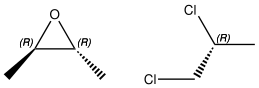
Using the theory Kirkwood had developed, the prediction for the optical rotation at the sodium D line for the (R,R) enantiomer of epoxybutene (Kirkwood did not use this R,R notation, which was still in the future) was +43°. The measured value was [α]D +59°. The (R,R) enantiomer did indeed correspond to Fischer notation.
QED.
A postscript is that a modern equivalent of Kirkwood’s result, using the ωB97XD/6-311+G(d,p) method gives +67° for the gas phase and +57° for solution (in CCl4). The experimental value relates to the pure liquid. In fact, Kirkwood had been very aware that solvation can influence the measured value of an optical rotation, and so even today, a match between experiment and calculation of ± 16 ° is considered a good fit.
But when it comes to the second molecule, (R)-1,2-dichloropropane, we are in a different ball park. In fact, most of Kirkwood’s article is devoted to unravelling this second system. This is because it was realised that it is conformationally flexible. Two conformations (this term was then often used interchangeably with configuration, which might confuse a modern audience) called trans and skew (now called anti and gauche) were considered and it was realised that the relative populations would be influenced by temperature and particularly, the solvent. I quote here the final conclusion: We have assigned the absolute configuration of Fig. 2 to the dextrorotatory isomer of 1,2-dichloropropane. This was done without any experimental data concerning the optically active forms of the molecule, using only the calculated dependence of the rotatory power on conformation (Table II) and the information about the potential of internal conformation obtained from the electron diffraction and dipole moment measurements.
Non trivial then! Perhaps this is why these techniques were not immediately picked up by synthetic chemists to verify the absolute configuration of their own molecules. But my point is that the use of such techniques now seems to be growing exponentially, which is why this post is headed the golden age of computational spectroscopy. So what of such a modern take on (R)-1,2-dichloropropane (in heptane, which corresponds to the measured value of +20 to +30, and -21° for the (S) enantiomer). Well, there are in fact three viable conformations, not two as Kirkwood supposed. He did not know that the gauche stereoelectronic effect favoured two of them despite the greater steric encumbrance. The calculated rotations are +53 (anti), +96 (gauche) and -182° (second gauche conformer). Such dependence on conformation is sadly not unusual, and it means you have to know the Boltzmann population very accurately indeed to infer an observed value. This might in part explain the rather circuitous argument used by Kirkwood for dichloropropane!
Fortunately, nowadays optical rotation (more accurately referred to as optical rotatory power, or ORP) is just one of a growing armoury of spectroscopic measurements that can be computed to the accuracy required to draw firm conclusions. These include ORD (optical rotatory dispersion, or variation with the frequency of the polarised light used), ECD (electronic circular dichroism) and VCD (vibrational circular dichroism). It is still not absolutely routine, but these techniques are now found in an increasing number of synthetic chemists’ toolkits.
And my final reflection is to ponder that the golden age of pharmaceutical synthesis (lets say 1950 – 2000, but I know I may get dissent), in which certainty about the separate physiological effects of both enantiomers of chiral drugs became mandatory, would not have been possible without Kirkwood’s pioneering article, along of course with Bijvoet’s independent result.