Posts Tagged ‘Hypervalency’

A connected world (journals and blogs): The benzene dication.

Thursday, April 10th, 2014

Science is rarely about a totally new observation or rationalisation, it is much more about making connections between known facts, and perhaps using these connections to extrapolate to new areas (building on the shoulders of giants, etc). So here I chart one example of such connectivity over a period of six years.

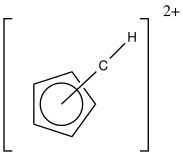
The story starts with this article[1], a preview talk about which (Hypervalent Carbon Atom: “Freezing” the SN2 Transition State) I actually saw at an ACS conference a year or so earlier. When the article was published, Steve Bachrach blogged about it, noting the claim for pentavalent carbon. The semantics of a valency vs a coordination are subtle, and I was not convinced that this frozen transition state deserved its elevation from penta-coordinate to pentavalent. After some discussion on Steve’s blog, I built upon these ideas with a few thoughts of my own on the present blog and then wondered whether they could be finally distilled into a more formal publication (testing the precedent in some ways of whether collaborative and public discussions of ideas could be published formally, or whether they would be rejected as having been already “published”). Well, these final distilled thoughts were indeed published in 2010[2], including their genesis in Steve’s blog (I wanted to put blogs more firmly into the acceptable scientific circle). This article included one species (numbered 5 in that article in 2010[2]) and pointed out an analogy to replacing CH2+ by e.g the isoelectronic BH1+, in as much as an example of the latter is indeed known as a stable crystalline compound.[3]. Iso-electronics is a very fruitful source of connections in chemistry!
5

Matters rested there until yesterday, when I spotted this on Steve’s blog where he discusses this recent article on the structure of the benzene dication.[4] Hey presto, there is that molecule again, but now there is firm experimental evidence of its existence! It was I think rather too much to expect the authors of this article to have spotted the connection to mine (although as it happens, both address the issue of complexes to He). The relationship between CH2+ and BH1+ is a little more subtle. From my point of view, it is always worth trawling through the crystal structure database in favour of evidence for hypothetical species (or their isoelectronic substitutions), and so it proved in this case!

There are other connections possible. Thus the dication of benzene has a (higher energy) isomer which is in fact a 4π antiaromatic species which avoids this antiaromaticity by a geometric distortion, with two C-H bonds bending above and below the ring. Such avoided antiaromaticity has been noted elsewhere here.

There is one final connection for me to make. My 2010 article[2] contained one of my interactive tables containing the data for the various structures (yes, although its data, you will need to have a subscription to the journal to access it). As it happens, last year we wished to reprise this style of publication, but as I blogged at the time, the journal had changed its production processes, and they could no longer offer me that opportunity. Some quick thinking came up with a replacement, which we now use extensively.[5] So the chain of connections resulting from that original talk some six years ago continues.

<

p>As for that chain, it arose distressingly randomly. I do not routinely read the entire ToC of JACS and so would not have discovered[4] the connection by that route. Fortunately, Steve Bachrach does and helped me make that connection to the molecule shown above. Although I did spend a few minutes thinking to myself “does that structure ring any bells?”. Fortunately, one did (eventually) ring. But for every connection made in this wonderfully human manner, I cannot help but think how many are not! However, if connections were much easier to make, could we as humans cope with the overwhelming deluge of new ideas?

References

  1. S. Pierrefixe, S. van Stralen, J. van Stralen, C. Fonseca Guerra, and F. Bickelhaupt, "Hypervalent Carbon Atom: “Freezing” the S<sub>N</sub>2 Transition State", Angewandte Chemie International Edition, vol. 48, pp. 6469-6471, 2009. https://doi.org/10.1002/anie.200902125
  2. H.S. Rzepa, "The rational design of helium bonds", Nature Chemistry, vol. 2, pp. 390-393, 2010. https://doi.org/10.1038/nchem.596
  3. C. Dohmeier, R. Köppe, C. Robl, and H. Schnöckel, "Kristallstruktur von [Cp★BBr][AlBr4]", Journal of Organometallic Chemistry, vol. 487, pp. 127-130, 1995. https://doi.org/10.1016/0022-328x(94)05089-t
  4. J. Jašík, D. Gerlich, and J. Roithová, "Probing Isomers of the Benzene Dication in a Low-Temperature Trap", Journal of the American Chemical Society, vol. 136, pp. 2960-2962, 2014. https://doi.org/10.1021/ja412109h
  5. A. Armstrong, R.A. Boto, P. Dingwall, J. Contreras-García, M.J. Harvey, N.J. Mason, and H.S. Rzepa, "The Houk–List transition states for organocatalytic mechanisms revisited", Chem. Sci., vol. 5, pp. 2057-2071, 2014. https://doi.org/10.1039/c3sc53416b

A connected world (journals and blogs): The benzene dication.

Thursday, April 10th, 2014

Science is rarely about a totally new observation or rationalisation, it is much more about making connections between known facts, and perhaps using these connections to extrapolate to new areas (building on the shoulders of giants, etc). So here I chart one example of such connectivity over a period of six years.

The story starts with this article[1], a preview talk about which (Hypervalent Carbon Atom: “Freezing” the SN2 Transition State) I actually saw at an ACS conference a year or so earlier. When the article was published, Steve Bachrach blogged about it, noting the claim for pentavalent carbon. The semantics of a valency vs a coordination are subtle, and I was not convinced that this frozen transition state deserved its elevation from penta-coordinate to pentavalent. After some discussion on Steve’s blog, I built upon these ideas with a few thoughts of my own on the present blog and then wondered whether they could be finally distilled into a more formal publication (testing the precedent in some ways of whether collaborative and public discussions of ideas could be published formally, or whether they would be rejected as having been already “published”). Well, these final distilled thoughts were indeed published in 2010[2], including their genesis in Steve’s blog (I wanted to put blogs more firmly into the acceptable scientific circle). This article included one species (numbered 5 in that article in 2010[2]) and pointed out an analogy to replacing CH2+ by e.g the isoelectronic BH1+, in as much as an example of the latter is indeed known as a stable crystalline compound.[3]. Iso-electronics is a very fruitful source of connections in chemistry!

5

Matters rested there until yesterday, when I spotted this on Steve’s blog where he discusses this recent article on the structure of the benzene dication.[4] Hey presto, there is that molecule again, but now there is firm experimental evidence of its existence! It was I think rather too much to expect the authors of this article to have spotted the connection to mine (although as it happens, both address the issue of complexes to He). The relationship between CH2+ and BH1+ is a little more subtle. From my point of view, it is always worth trawling through the crystal structure database in favour of evidence for hypothetical species (or their isoelectronic substitutions), and so it proved in this case!

There are other connections possible. Thus the dication of benzene has a (higher energy) isomer which is in fact a 4π antiaromatic species which avoids this antiaromaticity by a geometric distortion, with two C-H bonds bending above and below the ring. Such avoided antiaromaticity has been noted elsewhere here.

There is one final connection for me to make. My 2010 article[2] contained one of my interactive tables containing the data for the various structures (yes, although its data, you will need to have a subscription to the journal to access it). As it happens, last year we wished to reprise this style of publication, but as I blogged at the time, the journal had changed its production processes, and they could no longer offer me that opportunity. Some quick thinking came up with a replacement, which we now use extensively.[5] So the chain of connections resulting from that original talk some six years ago continues.

<

p>As for that chain, it arose distressingly randomly. I do not routinely read the entire ToC of JACS and so would not have discovered[4] the connection by that route. Fortunately, Steve Bachrach does and helped me make that connection to the molecule shown above. Although I did spend a few minutes thinking to myself “does that structure ring any bells?”. Fortunately, one did (eventually) ring. But for every connection made in this wonderfully human manner, I cannot help but think how many are not! However, if connections were much easier to make, could we as humans cope with the overwhelming deluge of new ideas?

References

  1. S. Pierrefixe, S. van Stralen, J. van Stralen, C. Fonseca Guerra, and F. Bickelhaupt, "Hypervalent Carbon Atom: “Freezing” the S<sub>N</sub>2 Transition State", Angewandte Chemie International Edition, vol. 48, pp. 6469-6471, 2009. https://doi.org/10.1002/anie.200902125
  2. H.S. Rzepa, "The rational design of helium bonds", Nature Chemistry, vol. 2, pp. 390-393, 2010. https://doi.org/10.1038/nchem.596
  3. C. Dohmeier, R. Köppe, C. Robl, and H. Schnöckel, "Kristallstruktur von [Cp★BBr][AlBr4]", Journal of Organometallic Chemistry, vol. 487, pp. 127-130, 1995. https://doi.org/10.1016/0022-328x(94)05089-t
  4. J. Jašík, D. Gerlich, and J. Roithová, "Probing Isomers of the Benzene Dication in a Low-Temperature Trap", Journal of the American Chemical Society, vol. 136, pp. 2960-2962, 2014. https://doi.org/10.1021/ja412109h
  5. A. Armstrong, R.A. Boto, P. Dingwall, J. Contreras-García, M.J. Harvey, N.J. Mason, and H.S. Rzepa, "The Houk–List transition states for organocatalytic mechanisms revisited", Chem. Sci., vol. 5, pp. 2057-2071, 2014. https://doi.org/10.1039/c3sc53416b

A connected world (journals and blogs): The benzene dication.

Thursday, April 10th, 2014

Science is rarely about a totally new observation or rationalisation, it is much more about making connections between known facts, and perhaps using these connections to extrapolate to new areas (building on the shoulders of giants, etc). So here I chart one example of such connectivity over a period of six years.

The story starts with this article[1], a preview talk about which (Hypervalent Carbon Atom: “Freezing” the SN2 Transition State) I actually saw at an ACS conference a year or so earlier. When the article was published, Steve Bachrach blogged about it, noting the claim for pentavalent carbon. The semantics of a valency vs a coordination are subtle, and I was not convinced that this frozen transition state deserved its elevation from penta-coordinate to pentavalent. After some discussion on Steve’s blog, I built upon these ideas with a few thoughts of my own on the present blog and then wondered whether they could be finally distilled into a more formal publication (testing the precedent in some ways of whether collaborative and public discussions of ideas could be published formally, or whether they would be rejected as having been already “published”). Well, these final distilled thoughts were indeed published in 2010[2], including their genesis in Steve’s blog (I wanted to put blogs more firmly into the acceptable scientific circle). This article included one species (numbered 5 in that article in 2010[2]) and pointed out an analogy to replacing CH2+ by e.g the isoelectronic BH1+, in as much as an example of the latter is indeed known as a stable crystalline compound.[3]. Iso-electronics is a very fruitful source of connections in chemistry!

5

Matters rested there until yesterday, when I spotted this on Steve’s blog where he discusses this recent article on the structure of the benzene dication.[4] Hey presto, there is that molecule again, but now there is firm experimental evidence of its existence! It was I think rather too much to expect the authors of this article to have spotted the connection to mine (although as it happens, both address the issue of complexes to He). The relationship between CH2+ and BH1+ is a little more subtle. From my point of view, it is always worth trawling through the crystal structure database in favour of evidence for hypothetical species (or their isoelectronic substitutions), and so it proved in this case!

There are other connections possible. Thus the dication of benzene has a (higher energy) isomer which is in fact a 4π antiaromatic species which avoids this antiaromaticity by a geometric distortion, with two C-H bonds bending above and below the ring. Such avoided antiaromaticity has been noted elsewhere here.

There is one final connection for me to make. My 2010 article[2] contained one of my interactive tables containing the data for the various structures (yes, although its data, you will need to have a subscription to the journal to access it). As it happens, last year we wished to reprise this style of publication, but as I blogged at the time, the journal had changed its production processes, and they could no longer offer me that opportunity. Some quick thinking came up with a replacement, which we now use extensively.[5] So the chain of connections resulting from that original talk some six years ago continues.

<

p>As for that chain, it arose distressingly randomly. I do not routinely read the entire ToC of JACS and so would not have discovered[4] the connection by that route. Fortunately, Steve Bachrach does and helped me make that connection to the molecule shown above. Although I did spend a few minutes thinking to myself “does that structure ring any bells?”. Fortunately, one did (eventually) ring. But for every connection made in this wonderfully human manner, I cannot help but think how many are not! However, if connections were much easier to make, could we as humans cope with the overwhelming deluge of new ideas?

References

  1. S. Pierrefixe, S. van Stralen, J. van Stralen, C. Fonseca Guerra, and F. Bickelhaupt, "Hypervalent Carbon Atom: “Freezing” the S<sub>N</sub>2 Transition State", Angewandte Chemie International Edition, vol. 48, pp. 6469-6471, 2009. https://doi.org/10.1002/anie.200902125
  2. H.S. Rzepa, "The rational design of helium bonds", Nature Chemistry, vol. 2, pp. 390-393, 2010. https://doi.org/10.1038/nchem.596
  3. C. Dohmeier, R. Köppe, C. Robl, and H. Schnöckel, "Kristallstruktur von [Cp★BBr][AlBr4]", Journal of Organometallic Chemistry, vol. 487, pp. 127-130, 1995. https://doi.org/10.1016/0022-328x(94)05089-t
  4. J. Jašík, D. Gerlich, and J. Roithová, "Probing Isomers of the Benzene Dication in a Low-Temperature Trap", Journal of the American Chemical Society, vol. 136, pp. 2960-2962, 2014. https://doi.org/10.1021/ja412109h
  5. A. Armstrong, R.A. Boto, P. Dingwall, J. Contreras-García, M.J. Harvey, N.J. Mason, and H.S. Rzepa, "The Houk–List transition states for organocatalytic mechanisms revisited", Chem. Sci., vol. 5, pp. 2057-2071, 2014. https://doi.org/10.1039/c3sc53416b

A connected world (journals and blogs): The benzene dication.

Thursday, April 10th, 2014

Science is rarely about a totally new observation or rationalisation, it is much more about making connections between known facts, and perhaps using these connections to extrapolate to new areas (building on the shoulders of giants, etc). So here I chart one example of such connectivity over a period of six years.

The story starts with this article[1], a preview talk about which (Hypervalent Carbon Atom: “Freezing” the SN2 Transition State) I actually saw at an ACS conference a year or so earlier. When the article was published, Steve Bachrach blogged about it, noting the claim for pentavalent carbon. The semantics of a valency vs a coordination are subtle, and I was not convinced that this frozen transition state deserved its elevation from penta-coordinate to pentavalent. After some discussion on Steve’s blog, I built upon these ideas with a few thoughts of my own on the present blog and then wondered whether they could be finally distilled into a more formal publication (testing the precedent in some ways of whether collaborative and public discussions of ideas could be published formally, or whether they would be rejected as having been already “published”). Well, these final distilled thoughts were indeed published in 2010[2], including their genesis in Steve’s blog (I wanted to put blogs more firmly into the acceptable scientific circle). This article included one species (numbered 5 in that article in 2010[2]) and pointed out an analogy to replacing CH2+ by e.g the isoelectronic BH1+, in as much as an example of the latter is indeed known as a stable crystalline compound.[3]. Iso-electronics is a very fruitful source of connections in chemistry!

5

Matters rested there until yesterday, when I spotted this on Steve’s blog where he discusses this recent article on the structure of the benzene dication.[4] Hey presto, there is that molecule again, but now there is firm experimental evidence of its existence! It was I think rather too much to expect the authors of this article to have spotted the connection to mine (although as it happens, both address the issue of complexes to He). The relationship between CH2+ and BH1+ is a little more subtle. From my point of view, it is always worth trawling through the crystal structure database in favour of evidence for hypothetical species (or their isoelectronic substitutions), and so it proved in this case!

There are other connections possible. Thus the dication of benzene has a (higher energy) isomer which is in fact a 4π antiaromatic species which avoids this antiaromaticity by a geometric distortion, with two C-H bonds bending above and below the ring. Such avoided antiaromaticity has been noted elsewhere here.

There is one final connection for me to make. My 2010 article[2] contained one of my interactive tables containing the data for the various structures (yes, although its data, you will need to have a subscription to the journal to access it). As it happens, last year we wished to reprise this style of publication, but as I blogged at the time, the journal had changed its production processes, and they could no longer offer me that opportunity. Some quick thinking came up with a replacement, which we now use extensively.[5] So the chain of connections resulting from that original talk some six years ago continues.

<

p>As for that chain, it arose distressingly randomly. I do not routinely read the entire ToC of JACS and so would not have discovered[4] the connection by that route. Fortunately, Steve Bachrach does and helped me make that connection to the molecule shown above. Although I did spend a few minutes thinking to myself “does that structure ring any bells?”. Fortunately, one did (eventually) ring. But for every connection made in this wonderfully human manner, I cannot help but think how many are not! However, if connections were much easier to make, could we as humans cope with the overwhelming deluge of new ideas?

References

  1. S. Pierrefixe, S. van Stralen, J. van Stralen, C. Fonseca Guerra, and F. Bickelhaupt, "Hypervalent Carbon Atom: “Freezing” the S<sub>N</sub>2 Transition State", Angewandte Chemie International Edition, vol. 48, pp. 6469-6471, 2009. https://doi.org/10.1002/anie.200902125
  2. H.S. Rzepa, "The rational design of helium bonds", Nature Chemistry, vol. 2, pp. 390-393, 2010. https://doi.org/10.1038/nchem.596
  3. C. Dohmeier, R. Köppe, C. Robl, and H. Schnöckel, "Kristallstruktur von [Cp★BBr][AlBr4]", Journal of Organometallic Chemistry, vol. 487, pp. 127-130, 1995. https://doi.org/10.1016/0022-328x(94)05089-t
  4. J. Jašík, D. Gerlich, and J. Roithová, "Probing Isomers of the Benzene Dication in a Low-Temperature Trap", Journal of the American Chemical Society, vol. 136, pp. 2960-2962, 2014. https://doi.org/10.1021/ja412109h
  5. A. Armstrong, R.A. Boto, P. Dingwall, J. Contreras-García, M.J. Harvey, N.J. Mason, and H.S. Rzepa, "The Houk–List transition states for organocatalytic mechanisms revisited", Chem. Sci., vol. 5, pp. 2057-2071, 2014. https://doi.org/10.1039/c3sc53416b

A connected world (journals and blogs): The benzene dication.

Thursday, April 10th, 2014

Science is rarely about a totally new observation or rationalisation, it is much more about making connections between known facts, and perhaps using these connections to extrapolate to new areas (building on the shoulders of giants, etc). So here I chart one example of such connectivity over a period of six years.

The story starts with this article[1], a preview talk about which (Hypervalent Carbon Atom: “Freezing” the SN2 Transition State) I actually saw at an ACS conference a year or so earlier. When the article was published, Steve Bachrach blogged about it, noting the claim for pentavalent carbon. The semantics of a valency vs a coordination are subtle, and I was not convinced that this frozen transition state deserved its elevation from penta-coordinate to pentavalent. After some discussion on Steve’s blog, I built upon these ideas with a few thoughts of my own on the present blog and then wondered whether they could be finally distilled into a more formal publication (testing the precedent in some ways of whether collaborative and public discussions of ideas could be published formally, or whether they would be rejected as having been already “published”). Well, these final distilled thoughts were indeed published in 2010[2], including their genesis in Steve’s blog (I wanted to put blogs more firmly into the acceptable scientific circle). This article included one species (numbered 5 in that article in 2010[2]) and pointed out an analogy to replacing CH2+ by e.g the isoelectronic BH1+, in as much as an example of the latter is indeed known as a stable crystalline compound.[3]. Iso-electronics is a very fruitful source of connections in chemistry!

5

Matters rested there until yesterday, when I spotted this on Steve’s blog where he discusses this recent article on the structure of the benzene dication.[4] Hey presto, there is that molecule again, but now there is firm experimental evidence of its existence! It was I think rather too much to expect the authors of this article to have spotted the connection to mine (although as it happens, both address the issue of complexes to He). The relationship between CH2+ and BH1+ is a little more subtle. From my point of view, it is always worth trawling through the crystal structure database in favour of evidence for hypothetical species (or their isoelectronic substitutions), and so it proved in this case!

There are other connections possible. Thus the dication of benzene has a (higher energy) isomer which is in fact a 4π antiaromatic species which avoids this antiaromaticity by a geometric distortion, with two C-H bonds bending above and below the ring. Such avoided antiaromaticity has been noted elsewhere here.

There is one final connection for me to make. My 2010 article[2] contained one of my interactive tables containing the data for the various structures (yes, although its data, you will need to have a subscription to the journal to access it). As it happens, last year we wished to reprise this style of publication, but as I blogged at the time, the journal had changed its production processes, and they could no longer offer me that opportunity. Some quick thinking came up with a replacement, which we now use extensively.[5] So the chain of connections resulting from that original talk some six years ago continues.

<

p>As for that chain, it arose distressingly randomly. I do not routinely read the entire ToC of JACS and so would not have discovered[4] the connection by that route. Fortunately, Steve Bachrach does and helped me make that connection to the molecule shown above. Although I did spend a few minutes thinking to myself “does that structure ring any bells?”. Fortunately, one did (eventually) ring. But for every connection made in this wonderfully human manner, I cannot help but think how many are not! However, if connections were much easier to make, could we as humans cope with the overwhelming deluge of new ideas?

References

  1. S. Pierrefixe, S. van Stralen, J. van Stralen, C. Fonseca Guerra, and F. Bickelhaupt, "Hypervalent Carbon Atom: “Freezing” the S<sub>N</sub>2 Transition State", Angewandte Chemie International Edition, vol. 48, pp. 6469-6471, 2009. https://doi.org/10.1002/anie.200902125
  2. H.S. Rzepa, "The rational design of helium bonds", Nature Chemistry, vol. 2, pp. 390-393, 2010. https://doi.org/10.1038/nchem.596
  3. C. Dohmeier, R. Köppe, C. Robl, and H. Schnöckel, "Kristallstruktur von [Cp★BBr][AlBr4]", Journal of Organometallic Chemistry, vol. 487, pp. 127-130, 1995. https://doi.org/10.1016/0022-328x(94)05089-t
  4. J. Jašík, D. Gerlich, and J. Roithová, "Probing Isomers of the Benzene Dication in a Low-Temperature Trap", Journal of the American Chemical Society, vol. 136, pp. 2960-2962, 2014. https://doi.org/10.1021/ja412109h
  5. A. Armstrong, R.A. Boto, P. Dingwall, J. Contreras-García, M.J. Harvey, N.J. Mason, and H.S. Rzepa, "The Houk–List transition states for organocatalytic mechanisms revisited", Chem. Sci., vol. 5, pp. 2057-2071, 2014. https://doi.org/10.1039/c3sc53416b

A connected world (journals and blogs): The benzene dication.

Thursday, April 10th, 2014

Science is rarely about a totally new observation or rationalisation, it is much more about making connections between known facts, and perhaps using these connections to extrapolate to new areas (building on the shoulders of giants, etc). So here I chart one example of such connectivity over a period of six years.

The story starts with this article[1], a preview talk about which (Hypervalent Carbon Atom: “Freezing” the SN2 Transition State) I actually saw at an ACS conference a year or so earlier. When the article was published, Steve Bachrach blogged about it, noting the claim for pentavalent carbon. The semantics of a valency vs a coordination are subtle, and I was not convinced that this frozen transition state deserved its elevation from penta-coordinate to pentavalent. After some discussion on Steve’s blog, I built upon these ideas with a few thoughts of my own on the present blog and then wondered whether they could be finally distilled into a more formal publication (testing the precedent in some ways of whether collaborative and public discussions of ideas could be published formally, or whether they would be rejected as having been already “published”). Well, these final distilled thoughts were indeed published in 2010[2], including their genesis in Steve’s blog (I wanted to put blogs more firmly into the acceptable scientific circle). This article included one species (numbered 5 in that article in 2010[2]) and pointed out an analogy to replacing CH2+ by e.g the isoelectronic BH1+, in as much as an example of the latter is indeed known as a stable crystalline compound.[3]. Iso-electronics is a very fruitful source of connections in chemistry!

5

Matters rested there until yesterday, when I spotted this on Steve’s blog where he discusses this recent article on the structure of the benzene dication.[4] Hey presto, there is that molecule again, but now there is firm experimental evidence of its existence! It was I think rather too much to expect the authors of this article to have spotted the connection to mine (although as it happens, both address the issue of complexes to He). The relationship between CH2+ and BH1+ is a little more subtle. From my point of view, it is always worth trawling through the crystal structure database in favour of evidence for hypothetical species (or their isoelectronic substitutions), and so it proved in this case!

There are other connections possible. Thus the dication of benzene has a (higher energy) isomer which is in fact a 4π antiaromatic species which avoids this antiaromaticity by a geometric distortion, with two C-H bonds bending above and below the ring. Such avoided antiaromaticity has been noted elsewhere here.

There is one final connection for me to make. My 2010 article[2] contained one of my interactive tables containing the data for the various structures (yes, although its data, you will need to have a subscription to the journal to access it). As it happens, last year we wished to reprise this style of publication, but as I blogged at the time, the journal had changed its production processes, and they could no longer offer me that opportunity. Some quick thinking came up with a replacement, which we now use extensively.[5] So the chain of connections resulting from that original talk some six years ago continues.

<

p>As for that chain, it arose distressingly randomly. I do not routinely read the entire ToC of JACS and so would not have discovered[4] the connection by that route. Fortunately, Steve Bachrach does and helped me make that connection to the molecule shown above. Although I did spend a few minutes thinking to myself “does that structure ring any bells?”. Fortunately, one did (eventually) ring. But for every connection made in this wonderfully human manner, I cannot help but think how many are not! However, if connections were much easier to make, could we as humans cope with the overwhelming deluge of new ideas?

References

  1. S. Pierrefixe, S. van Stralen, J. van Stralen, C. Fonseca Guerra, and F. Bickelhaupt, "Hypervalent Carbon Atom: “Freezing” the S<sub>N</sub>2 Transition State", Angewandte Chemie International Edition, vol. 48, pp. 6469-6471, 2009. https://doi.org/10.1002/anie.200902125
  2. H.S. Rzepa, "The rational design of helium bonds", Nature Chemistry, vol. 2, pp. 390-393, 2010. https://doi.org/10.1038/nchem.596
  3. C. Dohmeier, R. Köppe, C. Robl, and H. Schnöckel, "Kristallstruktur von [Cp★BBr][AlBr4]", Journal of Organometallic Chemistry, vol. 487, pp. 127-130, 1995. https://doi.org/10.1016/0022-328x(94)05089-t
  4. J. Jašík, D. Gerlich, and J. Roithová, "Probing Isomers of the Benzene Dication in a Low-Temperature Trap", Journal of the American Chemical Society, vol. 136, pp. 2960-2962, 2014. https://doi.org/10.1021/ja412109h
  5. A. Armstrong, R.A. Boto, P. Dingwall, J. Contreras-García, M.J. Harvey, N.J. Mason, and H.S. Rzepa, "The Houk–List transition states for organocatalytic mechanisms revisited", Chem. Sci., vol. 5, pp. 2057-2071, 2014. https://doi.org/10.1039/c3sc53416b

A connected world (journals and blogs): The benzene dication.

Thursday, April 10th, 2014

Science is rarely about a totally new observation or rationalisation, it is much more about making connections between known facts, and perhaps using these connections to extrapolate to new areas (building on the shoulders of giants, etc). So here I chart one example of such connectivity over a period of six years.

The story starts with this article[1], a preview talk about which (Hypervalent Carbon Atom: “Freezing” the SN2 Transition State) I actually saw at an ACS conference a year or so earlier. When the article was published, Steve Bachrach blogged about it, noting the claim for pentavalent carbon. The semantics of a valency vs a coordination are subtle, and I was not convinced that this frozen transition state deserved its elevation from penta-coordinate to pentavalent. After some discussion on Steve’s blog, I built upon these ideas with a few thoughts of my own on the present blog and then wondered whether they could be finally distilled into a more formal publication (testing the precedent in some ways of whether collaborative and public discussions of ideas could be published formally, or whether they would be rejected as having been already “published”). Well, these final distilled thoughts were indeed published in 2010[2], including their genesis in Steve’s blog (I wanted to put blogs more firmly into the acceptable scientific circle). This article included one species (numbered 5 in that article in 2010[2]) and pointed out an analogy to replacing CH2+ by e.g the isoelectronic BH1+, in as much as an example of the latter is indeed known as a stable crystalline compound.[3]. Iso-electronics is a very fruitful source of connections in chemistry!

5

Matters rested there until yesterday, when I spotted this on Steve’s blog where he discusses this recent article on the structure of the benzene dication.[4] Hey presto, there is that molecule again, but now there is firm experimental evidence of its existence! It was I think rather too much to expect the authors of this article to have spotted the connection to mine (although as it happens, both address the issue of complexes to He). The relationship between CH2+ and BH1+ is a little more subtle. From my point of view, it is always worth trawling through the crystal structure database in favour of evidence for hypothetical species (or their isoelectronic substitutions), and so it proved in this case!

There are other connections possible. Thus the dication of benzene has a (higher energy) isomer which is in fact a 4π antiaromatic species which avoids this antiaromaticity by a geometric distortion, with two C-H bonds bending above and below the ring. Such avoided antiaromaticity has been noted elsewhere here.

There is one final connection for me to make. My 2010 article[2] contained one of my interactive tables containing the data for the various structures (yes, although its data, you will need to have a subscription to the journal to access it). As it happens, last year we wished to reprise this style of publication, but as I blogged at the time, the journal had changed its production processes, and they could no longer offer me that opportunity. Some quick thinking came up with a replacement, which we now use extensively.[5] So the chain of connections resulting from that original talk some six years ago continues.

<

p>As for that chain, it arose distressingly randomly. I do not routinely read the entire ToC of JACS and so would not have discovered[4] the connection by that route. Fortunately, Steve Bachrach does and helped me make that connection to the molecule shown above. Although I did spend a few minutes thinking to myself “does that structure ring any bells?”. Fortunately, one did (eventually) ring. But for every connection made in this wonderfully human manner, I cannot help but think how many are not! However, if connections were much easier to make, could we as humans cope with the overwhelming deluge of new ideas?

References

  1. S. Pierrefixe, S. van Stralen, J. van Stralen, C. Fonseca Guerra, and F. Bickelhaupt, "Hypervalent Carbon Atom: “Freezing” the S<sub>N</sub>2 Transition State", Angewandte Chemie International Edition, vol. 48, pp. 6469-6471, 2009. https://doi.org/10.1002/anie.200902125
  2. H.S. Rzepa, "The rational design of helium bonds", Nature Chemistry, vol. 2, pp. 390-393, 2010. https://doi.org/10.1038/nchem.596
  3. C. Dohmeier, R. Köppe, C. Robl, and H. Schnöckel, "Kristallstruktur von [Cp★BBr][AlBr4]", Journal of Organometallic Chemistry, vol. 487, pp. 127-130, 1995. https://doi.org/10.1016/0022-328x(94)05089-t
  4. J. Jašík, D. Gerlich, and J. Roithová, "Probing Isomers of the Benzene Dication in a Low-Temperature Trap", Journal of the American Chemical Society, vol. 136, pp. 2960-2962, 2014. https://doi.org/10.1021/ja412109h
  5. A. Armstrong, R.A. Boto, P. Dingwall, J. Contreras-García, M.J. Harvey, N.J. Mason, and H.S. Rzepa, "The Houk–List transition states for organocatalytic mechanisms revisited", Chem. Sci., vol. 5, pp. 2057-2071, 2014. https://doi.org/10.1039/c3sc53416b

Hypervalency: Third time lucky?

Saturday, October 23rd, 2010

One approach to reporting science which is perhaps better suited to the medium of a blog than a conventional journal article is the opportunity to follow ideas in unexpected, even unconventional directions. Thus my third attempt, like a dog worrying a bone, to explore hypervalency. I have, somewhat to my surprise, found myself contemplating the two molecules I8 and At8. Perhaps it might be better to write them as I(I)7 and At(At)7. This makes it easier to relate both to the known molecule I(F)7. What led to these (allotropes) of the halogens? Well, as I noted before, hypervalency is a concept rooted in covalency, albeit an excess of it! And bonds with the same atom at each end are less likely to be accused of ionicity. I earlier suggested that the nicely covalent IH7 was not hypervalent, with all the electrons which might contribute to hypervalency actually to be found in the H…H regions. The next candidate, I(CN)7 ultimately proved a little too ionic for comfort. So we arrive at II7. At the D5h geometry, it proves not to be a minimum, but a (degenerate) transition state for reductive elimination of I2 (I note parabolically that the 2010 Nobel prize for chemistry was awarded for reactions which involve similar reductive elimination of Pd and other metals to form covalent C-C bonds). Thus I8 is useful only as a thought experiment molecule, and not a species that could actually be made.

I8, showing as a transition state for reductive elimination of iodine. Click for 3D

The Wiberg bond index (B3LYP/Def2-TZVPP basis+pseudopotential) of the central iodine comes out at 2.81; that of the two axial iodines is 1.05 and that of the five equatorial atoms is 1.50. Well, the axial iodines are clearly monovalent, the equatorial ones are higher because of I…I interactions around the 5-ring. The central iodine is clearly again, not hypervalent. The individual Wiberg bond orders radiating form the central atom are 0.47 for the axial and 0.374 for the equatorial atoms. The I…I bond orders between the five equatorial atoms are 0.336 for adjacent atoms. This latter observation matches with the frequency analysis, since any individual I-I bond is already 1/3 formed, just asking to be eliminated.

What of that other technique for finding electrons, ELF?

ELF analysis for I8. Click for 3D

All the I-I bonds radiating from the centre have well-defined disynaptic basins (the same is NOT true for e.g. IF7by the way, which comes out as ionic in ELF). The two axial covalent bonds have basins integrating to 1.35 electrons, and the five equatorial covalent bonds 0.77. The central iodine has a total of 6.55 electrons in bonds surrounding it. The five equatorial iodines have 7.7 electrons in two lone pairs, whilst the two axial iodines have 8.05 electrons in five monosynaptic basins. In summary, all eight iodines in this compound exhibit valence shells filled with an octet of electrons. Now, beyond any ambiguity, we can say this is NOT hypervalent.

Oh, for good measure, At8. The Wiberg index at the central atom is 2.77, the bond index is 0.46 for axial and 0.37 for equatorial At. The ELF basin integrations are 0.65 for equatorial, and 1.61 for axial, the former decreasing and the latter increasing compared to iodine.

ELF analysis for At8. Click for 3D.

Hypervalency: I(CN)7 is not hypervalent!

Sunday, October 17th, 2010

In the , IH7 was examined to see if it might exhibit true hypervalency. The iodine, despite its high coordination, turned out not to be hypervalent, with its (s/p) valence shell not exceeding eight electrons (and its d-shell still with 10, and the 6s/6p shells largely unoccupied). Instead, the 14 valence electrons (7 from H, 7 from iodine) fled to the H…H regions. Well, perhaps H is special in its ability to absorb electrons into the H…H regions. So how about I(CN)7? (the species has not hitherto been reported in the literature according to CAS). The cyano group is often described as a pseudohalide, but the advantage of its use here is that it is about the same electronegativity as I itself, and hence the I-C bond is more likely to be covalent (than for example an I-F bond). As noted in the earlier blog, if the potentially hypervalent atom is very ionic, it can be difficult to know whether the electrons are truly associated with that atom, or whether they are in fact in lone pairs associated with the other electronegative atom (e.g. F). It is also important to avoid large substituents, otherwise steric interactions will cause problems around the equator.

I(CN)7. Click for 3D

The calculated (B3LYP/Def2-TZVPP) geometry for I(CN)7 is similar to IH7, having essentially D5h symmetry. The C-I bond lengths range from 2.20Å (equatorial) to 2.10Å (axial); the Wiberg bond orders for these are respectively 0.482 and 0.609. The total bond orders are 3.94 (iodine), 3.91 (carbon) and 3.14 (nitrogen). The total carbon bond order for e.g. atom 2 is made up of 0.482 to I, 2.939 to N, 0.110 to C6, C7, 0.049 to C5, C8 and 0.040 to C3, C4. As with IH7, the erstwhile hypervalent iodine electrons have in fact departed from that atom, and taken up residence in the C…C regions. The NBO analysis confirms the electrons as originating from an effective iodine core (28), explicit I,C,N cores (46), 69.3 valence and 0.7 Rydberg (outer shell) electrons. The molecular orbitals are shown in this post.

Finally, for good measure, ELF analysis (on top of an effective core of 28) integrates to an outer core of 17.78 on iodine and a valence shell which includes 17.5 electrons distributed in seven explicit C-I disynaptic basins of ~2.5 electrons each. These 17.5 electrons can be considered as originating from ~10 (non-bonding?) electrons corresponding to the filled iodine 5d-shell, and ~7.5 shared bonding electrons in the iodine 5s/5p shell (the ELF procedure cannot distinguish between the 5d and 5s/5p electrons). There is no indication from these integrations that the iodine valence shells are expanded (i.e. from 10 for the 5d or from 8 for the 5s/5p).

As with IH7, this molecule shows absolutely no evidence of being hypervalent! So, if hypervalency is to survive as a concept, the hunt must surely be on for one unambiguous, as yet to be found, example of the phenomenon in the main group.

Hypervalency: Is it real?

Saturday, October 16th, 2010

The Wikipedia page on hypervalent compounds reveals that the concept is almost as old as that of normally valent compounds. The definition there,  is “a molecule that contains one or more main group elements formally bearing more than eight electrons in their valence shells” (although it could equally apply to e.g. transition elements that would contain e.g. more than 18 electrons in their valence shell). The most extreme example would perhaps be of iodine (or perhaps xenon). The normal valency of iodine is one (to formally complete the octet in the valence shell) but of course compounds such as IF7 imply the valency might reach 7 (and by implication that the octet of electrons expands to 14). So what of IF7? Well, there is a problem due to the high electronegativity of the fluorine. One could argue that the bonds in this molecule are ionic, and hence that the valence electrons really reside in lone pairs on the F. Thus the apparently hypervalent PF5 could be written PF4+…F, in which case the P is not really hypervalent after all. We need a compound with un-arguably covalent bonds. Well, what about IH7? One might probably still argue about ionicity (for example H+…IH6) but that puts electrons on I and not H, and hence does not change any hypervalency on the iodine. Surely, if hypervalency is a real phenomenon, it should manifest in IH7?

IH7. A true hypervalent molecule? Click for 3D

A reasonably high level calculation (B3LYP/Def2-TZVPP with pseudopotential on I to absorb relativistic effects) shows the molecule to be a minimum, with D5h symmetry. An NBO analysis shows 46 core (i.e. non-valence) electrons. These arise from a Kr core (=36) plus a filled iodine 5d shell of 10 electrons. So, only the 5s/5p orbitals can be used for valence bonding. The total minimal basis which one can construct valence molecular orbitals from is thus I 5s, 5p and H 1s, a total of eleven AOs, into which 14 electrons must pair up into 7 doubly-occupied molecular orbitals. Now, the real issue is whether this occupancy corresponds to seven I-H covalent single bonds, each with a two-electron Lewis pair. If so, the molecule is hypervalent! The occupied MOs are shown below.

MO 16 (E2'). Click for 3D

MO 15 (E2')

MO 14 (A1')

MO 13 (E1')

MO 12 (E1')

MO 11 (A2'')

MO 10 (A1')

One notices that whilst orbitals 10-14 are clearly bonding in the I-H region, orbitals 15-16 seem antibonding in that region (there is a node along the I-H bond). We are seeing much the same phenomenon that occurs when the bond order of 3 in N2 is reduced to 1 in F2 due to occupancy of anti-bonding orbitals. Can this be quantified? NBO (5.9) analysis reveals the following.

  1. The effective (pseudopotential) core has 28 electrons, and the outer core 18. The valence orbitals contain 13.79, and only 0.21 electrons are Rydberg (higher shell). So little occupancy of e.g. 6s/6p then!
  2. The Wiberg bond index indicates each H has a total bond order of very close to 1 (its natural valence state), whilst I is 3.45. Remember that the maximum total bond index of a covalently bound atom using a pure octet of valence electrons is 4 (8/2, think carbon). The iodine is NOT hypervalent!
  3. So why, if its not hypervalent, is it so strongly hypercoordinate? Well, there are 14 valence electrons, but they do NOT all occupy the I-H regions, which have bond orders between 0.46 (equatorial) or 0.57 (axial). The only other place they can be is in the H-H regions! Consider the bond order values between say hydrogen 2 to the four other equatorial atoms 4,5,7,8. They are respectively 0.05, 0.15, 0.05, 0.15. So each hydrogen has a total bond order of 1, but only slightly more than half of this comes from the I-H, the rest comes from H-H. To put it another (approximate) way, of the 14 valence electrons, ~8 might be considered to be associated with I-H bonds, and ~6 with H-H bonds. The hypervalency has been in effect absorbed into the H-H regions. This means no atom in this molecule is at all hypervalent.
  4. Well, if the iodine is not hypervalent, and some of its valence electrons occupy I-H anti-bonding orbitals, why is it stable at all (in the sense that all the vibrations are real, and it’s clearly a minimum in the potential energy surface). Here, I merely speculate. Iodine has a large core charge, and hence the inner core electrons are starting to exhibit relativistic contractions. This effect stabilizes the outer 5s/5p electrons, and so occupancy of  anti-bonding MOs generated from such AOs is not so unfavourable as one might expect. Perhaps, the  hypercoordination shown by  IH7 is after all a relativistic effect rather than a hypervalent effect?  In which case, what will  AsH7 show?

So, what might have been an archetypal covalent hypervalent molecule is no such! IH7 shows entirely normal valencies, one for H and the iodine does not even reach four (if anything, its sub-valent rather than hypervalent). One may be entitled to ask if ANY main group element exhibits hypervalency!