Unexpected Isomerization of Oxetane-Carboxylic Acids – an alternative autocatalytic mechanism evaluated.

August 17th, 2022

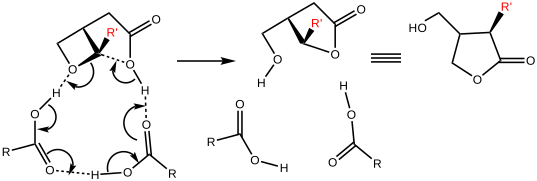
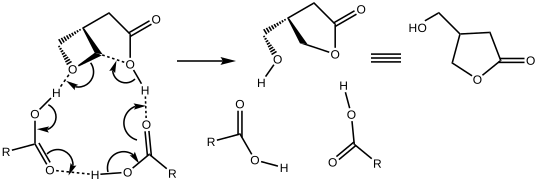
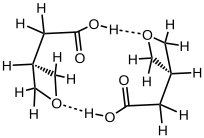
Previously, I looked at autocatalytic mechanisms where the carboxyl group of an oxetane-carboxylic acid could catalyse its transformation to a lactone, finding that a chain of two such groups were required to achieve the result. Here I look at an alternative mode where the oxetane-carboxylate itself acts as the transfer chain, via a H-bonded dimer shown below.

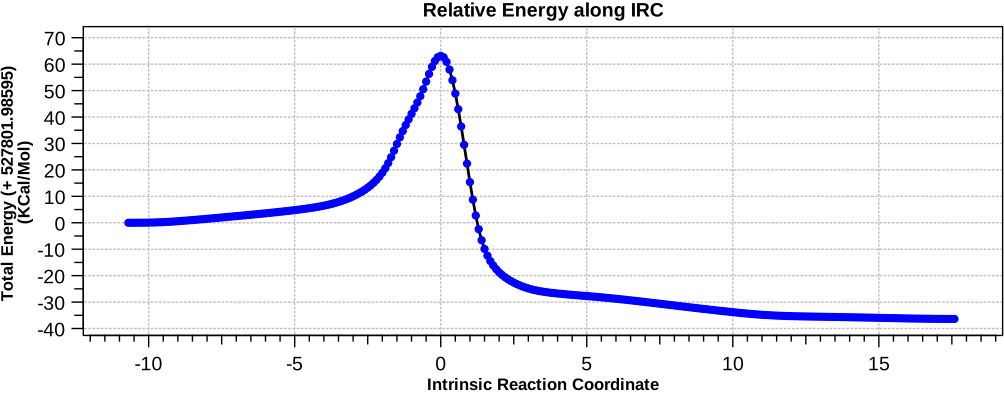
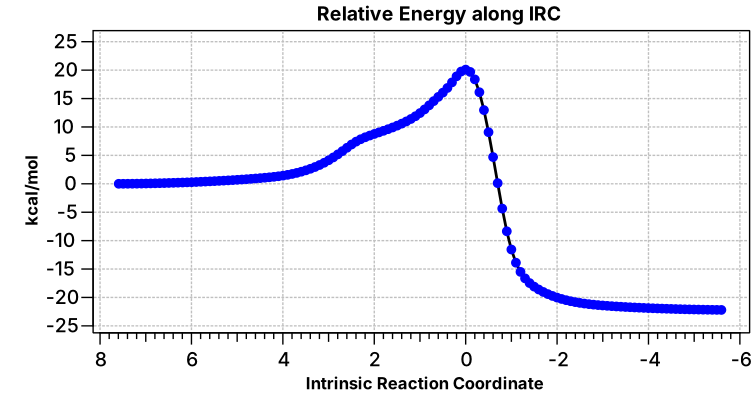
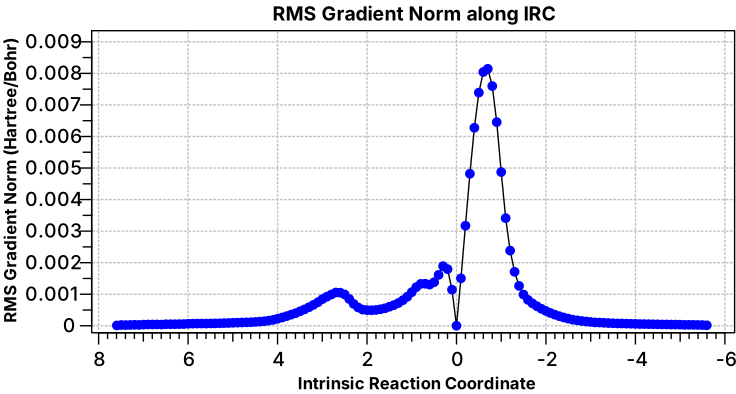
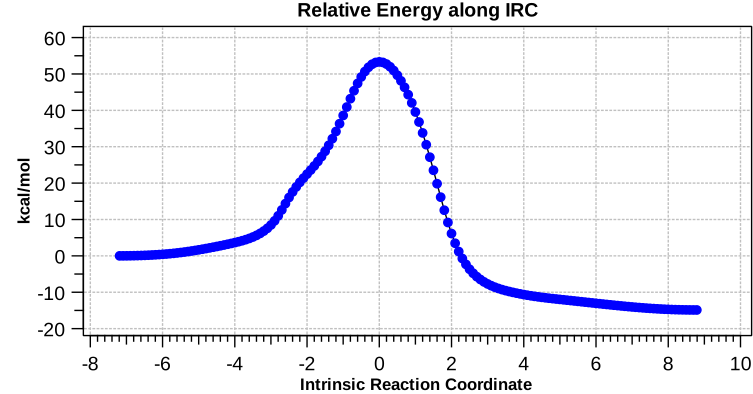
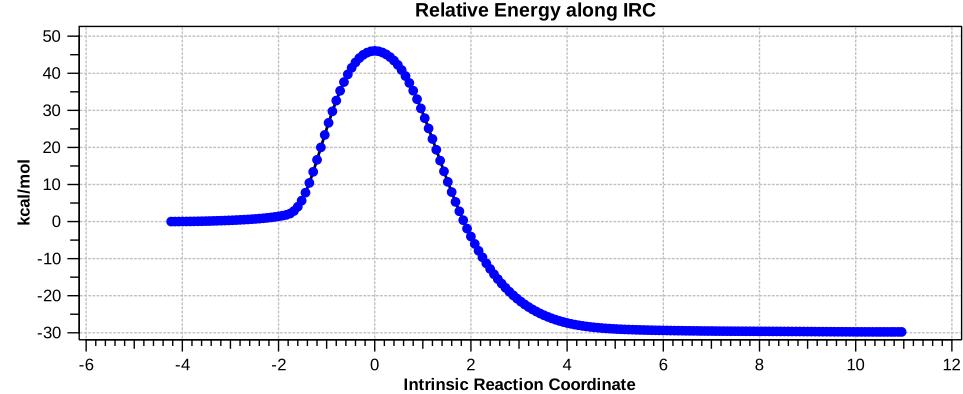
The IRC energy profile is shown below for a C2-symmetric stationary point in which each molecule catalyses the opening of the other in a concerted manner. The apparent free energy barrier is 72.6 kcal/mol (ωB97XD/Def2-SVPP).

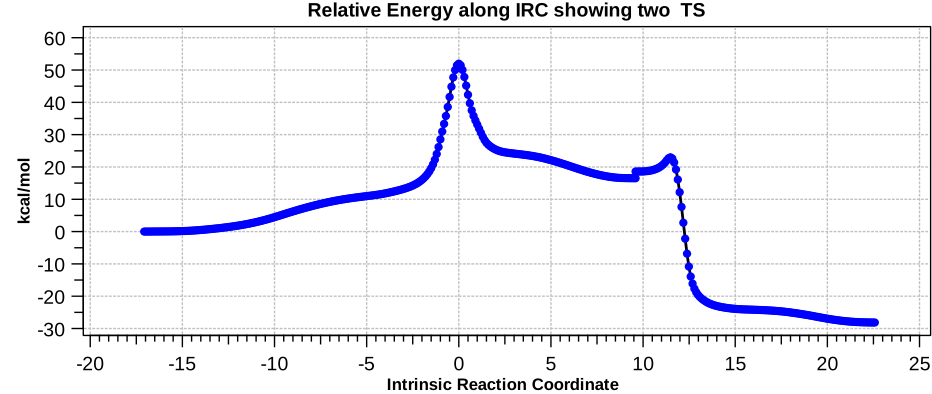
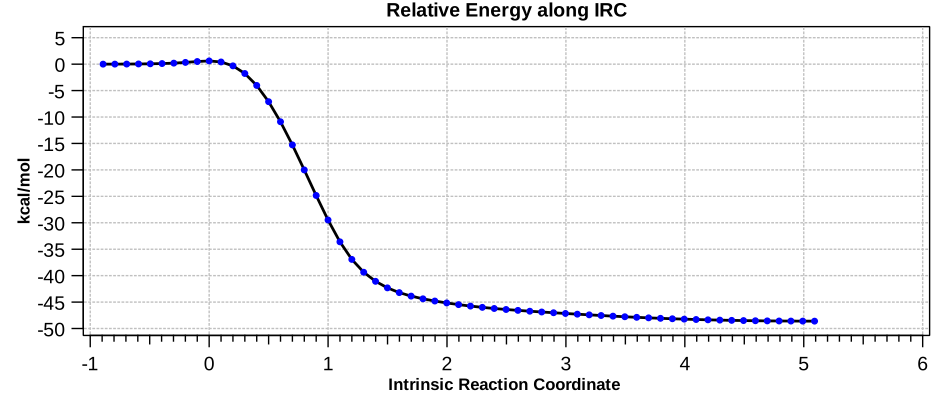
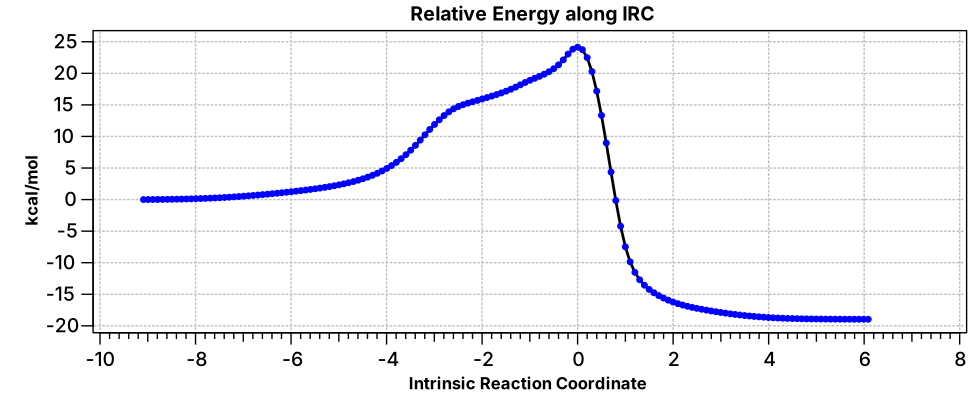
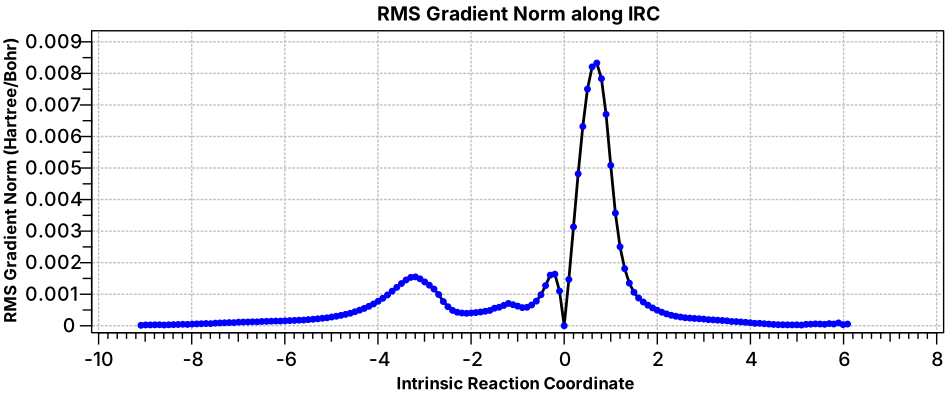
In fact this is what is called a second order saddle point, having two negative force constants in its calculated diagonalised force constant matrix. To remove the unwanted one, it is necessary to find transition states that accomplish the transfer consecutively rather than concurrently. There are two and their IRC energy profiles are stitched together below. This shows also that the proton transfers (IRC -1, +2) also happen asynchronously.

This results in a lower barrier (49.0 kcal/mol), but still far higher than the one obtained using a chain of two carboxylic acids. So this particular version of an autocatalytic transform is not in the event viable.


Unexpected Isomerization of Oxetane-Carboxylic Acids – substrate design.

August 14th, 2022

Having established a viable model for the unexpected isomerism of oxetane carboxylic acids to lactones[1], and taken a look at a variation in the proton transfer catalyst needed to accomplish the transformation, I now investigate the substrate itself.

R’ is set to have three values, R’=H (the original substituent), R’= CH3 and R’= CF3 (FAIR data DOI: 10.14469/hpc/10820)

R’ ΔG, kcal/mol
H 27.0
CH3 29.1
CF3 39.6

The inference is clear-cut; to inhibit the isomerisation to a lactone, CF3 groups substituted onto the methylene groups of the oxetane will effectively do this, with CH3 itself having a much weaker effect.


DOI: 10.14469/hpc/10861 and 10.14469/hpc/10862


References

  1. B. Chalyk, A. Grynyova, K. Filimonova, T.V. Rudenko, D. Dibchak, and P.K. Mykhailiuk, "Unexpected Isomerization of Oxetane-Carboxylic Acids", Organic Letters, vol. 24, pp. 4722-4728, 2022. https://doi.org/10.1021/acs.orglett.2c01402

Unexpected Isomerization of Oxetane-Carboxylic Acids – catalyst design.

August 13th, 2022

Previously, a mechanism with a reasonable predicted energy was modelled for the isomerisation of an oxetane carboxylic acid to a lactone by using two further molecules of acid to transfer the proton and in the process encouraging an Sn2 reaction with inversion to open the oxetane ring.

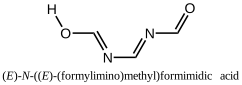
We are now ready to explore variations to this mechanism to see what happens. The first hypothesis is that of replacing two carboxylic acids with one molecule with similar properties, the argument being that bringing two acids together decreases their entropy and hence increases the free energy required for the process. If they come pre-joined, this entropic problem is eliminated and the free energy should reduce. Shown below is a small conjugated molecule with the central OHO motif replaced by NCN instead.

The activation free energy (ωB97XF/Def2-TZVPP, FAIR DOI: 10.14469/hpc/10820) is 18.4 kcal/mol, to be compared to 27.0 when using two carboxylic acids for the transfer. Of course, one would need to optimise the catalyst for many properties, including ease of synthesis, stability, size, isomerism etc, but you get the idea from the procedure here.

The catalyst “designed” here is for proton transfer. One has to wonder whether bespoke catalysts of this type might be useful for any reaction where proton transfer is a vital component!


DOI: 10.14469/hpc/10858 and 10.14469/hpc/10862


Web page decay and Journals: How an interactive “ESI” from 2006 was rescued.

August 12th, 2022

In 2006[1] we published an article illustrating various types of pseudorotations in small molecules. It’s been cited 20 times since then, so reasonable interest! We described rotations known as Lever and Turnstile as well as the better known Berry mode. Because the differences between these rotations are quite subtle, we included an interactive electronic supporting information to illustrate them. That ESI was written in HTML and used Jmol to animate the rotations. Now, 16 years is a long time in the Web ecosystem (some early wag suggested, like dogs, that one year in normal time approximates to about 7 years in Web time) and inevitably, like e.g. both Rasmol[2] and Chime before it, Jmol no longer works when invoked from a Web browser; Java applets are very much dead and we are now on the fourth generation of molecule viewer, JSmol. Two days ago I was contacted by someone (thanks Peter!) who had noticed that the journal landing page did not seem to point to any ESI. Here I tell the story of what happened next.

Thus the landing page[1] does not mention any method for accessing any ESI. But since the page is paywalled, you have to login to see more. When you do this, you get a reference to “enhanced objects”, so I should explain what these were.

The norm nowadays seems to be that ESI is expressed as a PDF file, but that allows interactivity only with extreme difficulty. In 2006, if you wanted this feature, you used HTML. The publisher (ACS) coined the expression of WEO, or Web-enhanced object. We produced perhaps 50 or so of these for various publishers and in those days they were hosted on publishers’ own sites. At some stage since 2006, these pages have been moved and the enhanced object for this article has been (temporarily?) “lost”. It is perhaps easy to understand why, since changes to the publishers publication workflows would need to factor in such pages and probably there were not enough of them to merit inclusion in the workflow.

So on to 2022, when I was contacted by Peter about this issue. Whenever we submitted such interactive ESI, we always kept a local copy, and indeed this was quickly located at DOI: 10.14469/hpc/10849, now of course allocated its own DOI. By now the ESI had lost its interactivity, but more worryingly, was lacking any error messages. Why? This was the  HTML code then used:

<applet width="300" name="ClF5-gsA"
 height="250" archive="JmolApplet.jar" code="JmolApplet"
 mayscript="true">
 <param name="progressbar" value="true" />
 <param name="progresscolor" value="blue" />
 <param name="boxmessage"
 value="Downloading JmolApplet.jar" />
 <param name="boxbgcolor" value="black" />
 <param name="boxfgcolor" value="white" />
 <param name="load" value="ClF5-gsAC2vpTZ.mol" />
 <param name="script"
 value="select all; labels off; spacefill 0.25; 
 wireframe 0.1; center atomno=2" />
 </applet>

In modern web browsers this is simply ignored. So the solution is to rewrite this code into modern syntax, and for this I turned to a long time hero and expert, Angel, who is one of the active maintainers of JSmol, the successor to  Jmol.  A few hours later a conversion script came back. It is just 55 lines long!  It is invoked in the header of the HTML document as: 

<script type="text/javascript" src="JSmol.min.js"></script>
<script type="text/javascript" src="convertJmolApplets.js"></script>

and hey presto, all works as originally. I transclude a small snippet here to give a flavour, although the original is formatted for wide pages, so go see all the ESI there.

So what is the take home message? Well, it turns out that the Java/Jmol syntax developed for the Web more than 20 years ago has actually proved pretty resilient. And so pages where technology has overtaken them can sometimes be quite easily rescued and restored back to life. A number of those WEOs from the early naughties have indeed been rescued by expedients such as described above. And perhaps in 10 years time when Javascript and JSmol have themselves moved on, further rescues will be needed. But had I been asked back in 2006 or earlier whether I expected those interactive ESI pages to still be working 16+ years later, I may well have replied that it seemed unlikely. So it is a very pleasant surprise to find that they (now) are. All we need is for the journal itself to point to a working version; for that, keep your eyes peeled.

On a more general point, a history of “ESI” as used in chemistry would be an interesting topic. Although generally thought of as having its roots around 1996, it may well go back further. Any historians around?


Available at https://wiki.jmol.org/index.php/Jmol_JavaScript_Object/Legacy and 10.14469/hpc/10852


References

  1. H.S. Rzepa, and M.E. Cass, "A Computational Study of the Nondissociative Mechanisms that Interchange Apical and Equatorial Atoms in Square Pyramidal Molecules", Inorganic Chemistry, vol. 45, pp. 3958-3963, 2006. https://doi.org/10.1021/ic0519988
  2. O. Casher, G.K. Chandramohan, M.J. Hargreaves, C. Leach, P. Murray-Rust, H.S. Rzepa, R. Sayle, and B.J. Whitaker, "Hyperactive molecules and the World-Wide-Web information system", Journal of the Chemical Society, Perkin Transactions 2, pp. 7, 1995. https://doi.org/10.1039/p29950000007
Unexpected Isomerization of Oxetane-Carboxylic Acids – a viable mechanism

August 12th, 2022

In the previous post, I looked at the intramolecular rearrangement of the oxetane carboxylic acid to a lactone, finding the barrier to the Sn2 reaction with retention was unfeasibly high. Here I explore alternatives.

  1. This first attempt uses a second molecule of a carboxylic acid (modelled as formic acid for simplicity) to see if it can catalyse the reaction. All FAIR data at 10.14469/hpc/10820

    The reaction still occurs with retention at the Sn2 centre, and the free energy barrier is 47.9 kcal/mol (ωB97XD/Def2-TZVPP), very little different from the unimolecular reaction without additional acid (49.9 kcal/mol).
  2. How about inversion at the Sn2 centre? The energy profile now looks quite wrong, because the additional acid is too small to simultaneously straddle the entire molecule from the point of proton removal to the point of reprotonation, if inversion occurs at the Sn2 centre. The reaction ends up (or starts, depending on your point of view) with a proton in the wrong place!

  3. So the need to make the proton transfer agent larger, by now including TWO additional carboxylic acids.


    There are now three proton transfers, one at each end of the oxetane-carboxylate and the product lactone and one between the two transfer acids. Watch the animation carefully to note the sequence in which they occur. The free energy barrier is now 27.0 kcal/mol for a standard state of 1 atm (ωB97XD/Def2-TZVPP). This could be reduced (3.2 kcal/mol or more) for the higher effective molar concentrations in the liquid or solid state of the pure oxetane.
  4. The structure of this transition state (click image below to view 3D model) shows one interesting point of CH…O interaction between transfer catalyst and substrate.

The next steps will be to explore the impact of making substitutions in the oxetane ring; there now seems to be a viable model to use for this purpose.


DOI 10.14469/hpc/10848 and 10.14469/hpc/10862


Unexpected Isomerization of Oxetane-Carboxylic Acids – a first look at the mechanism

August 7th, 2022

Derek Lowe’s blog has a recent post entitled A Downside to Oxetane Acids which picks up on a recent article[1] describing how these acids are unexpectedly unstable, isomerising to a lactone at a significant rate without the apparent need for any catalyst. This is important because these types of compound occur frequently in the medicinal chemistry literature.

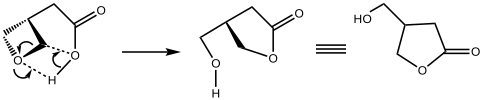
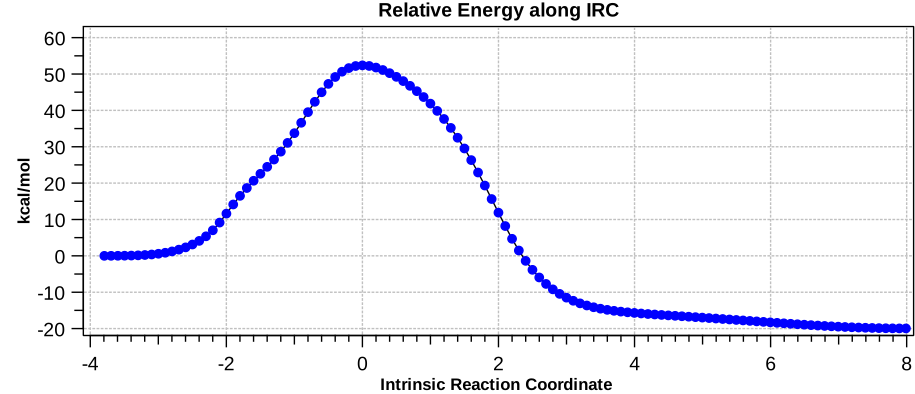
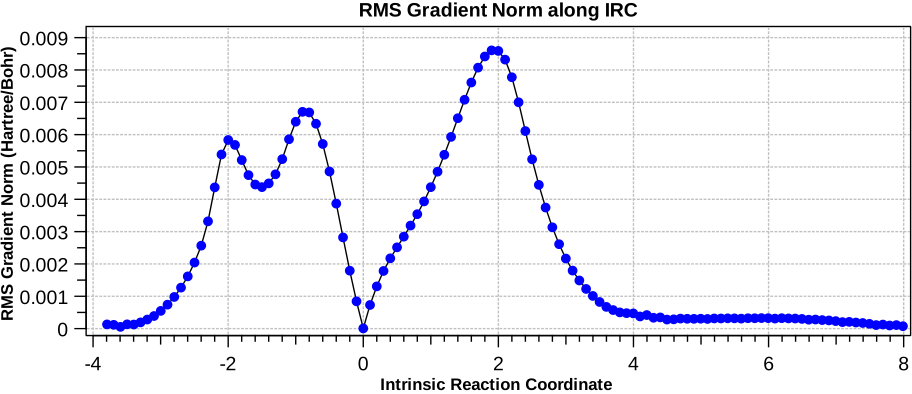
The isomerism is reported to occur quite slowly but significantly in the pure substance, being complete in around a year. Any uncatalysed mechanism must comprise a proton transfer to the oxygen of the oxetane followed by an Sn2 displacement at the methylene group in the protonated oxetane. This could be stepwise or concerted (the latter shown with arrows above). To determine the answer, an ωB97XD/Def2-TZVPP/SCRF=chloroform calculation was performed (FAIR data DOI: 10.14469/hpc/10820) which clearly shows a concerted reaction, albeit one in which a proton transfer (IRC ~-1.5) preceeds the Sn2 displacement with retention of configuration! The transition state appears to have no biradical character. The activation free energy is ΔG 49.9 kcal/mol and the reaction is clearly exoenergic.


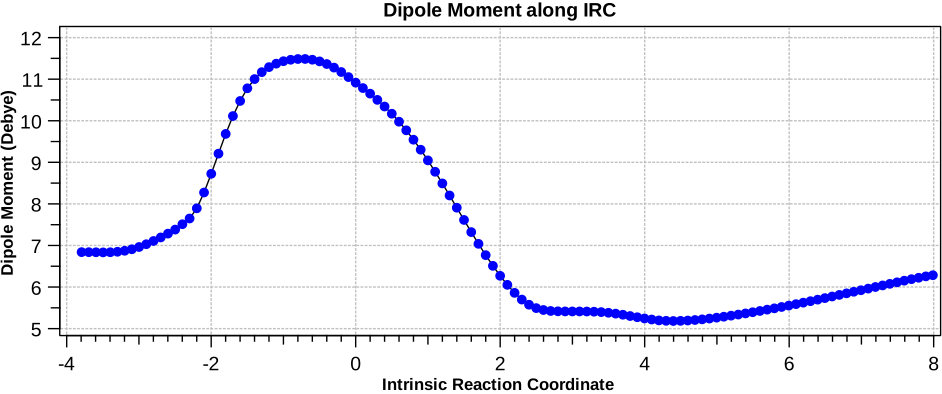
The dipole moment response shows that the proton transfer induces a larger dipole moment, which then reduces as the Sn2 reaction occurs.

The calculated free energy barrier of ~50 kcal/mol is ~15-20 kcal/mol too high to occur thermally and so the observed reaction either occurs via a different mechanism, perhaps bimolecular in which one molecule of the oxetane-carboxylic acid acts as a catalyst for a second molecule to rearrange, or one in which a stronger external acid catalyst operates, such as traces of other acid in the system. Exploring the sensitivity to substituents on the oxetane ring (CH3, CF3, etc) might also cast light on the mechanism, as might testing the stereochemistry of the two carbons next to the oxygen of the oxetane; do they retain, invert or scramble the configuration at these two centres?


DOI: 10.14469/hpc/10863 and 10.14469/hpc/10862


References

  1. B. Chalyk, A. Grynyova, K. Filimonova, T.V. Rudenko, D. Dibchak, and P.K. Mykhailiuk, "Unexpected Isomerization of Oxetane-Carboxylic Acids", Organic Letters, vol. 24, pp. 4722-4728, 2022. https://doi.org/10.1021/acs.orglett.2c01402

Personal Impressions from WATOC 2020 – Dispersion and non Born-Oppenheimer models.

July 11th, 2022

WATOC 2020 was just held in 2022 in Vancouver Canada, over one week. With many lectures held in parallel, it is not possible for one person to cover anything like the topics presented, so this is a personal view of some of those talks that I attended. As happens with many such events, common themes gradually emerge and here I highlight just two that struck me as important for the future of computational chemistry.

  1. Dispersion. This goes back to Fritz London and his formula: Edisp = -(C6/R6), where where coefficient C6 depends on the expectation values of the instantaneous dipole moments and average atomic excitation energies. The nature of this formula suggests that it decays rapidly with the distance between any pair of nuclei, R. But an increasing body of evidence is suggesting that such simple approaches (implemented as a correction in many e.g. DFT methods and known as e.g. D3+BJ, or D4 etc) may be underestimating the long range dispersion attractions. One nice example is what is known as the exfoliation of layers of graphite, where the forces holding the layers together can be measured quite accurately and which emerge as a great deal greater than the simple formulae suggest. It appears we now have a renaissance in developing new more accurate dispersion energy methods which include various higher order terms and are being applied to a variety of discrete molecule and solid state systems. One space to look out for!
  2. .Non Born-Oppenheimer behaviour. It is a mainstay of most solutions of the Schroedinger equation where the nuclei are treated as classical point charge objects with fixed positions in an electronic field described by a wavefunction. But there is now considerable activity in developing methods that generate an extended Hessian (2nd derivative matrix) describing the forces that depends on both the classical nuclear coordinates of non-hydrogen atoms and the expectation values of quantum proton coordinates. This matrix is diagonalised to obtain the coupled vibrational frequencies which now naturally include the anharmonicity of the now quantum-treated protons and recovers the electron-proton correlation. It impacts most directly on so-called proton tunnelling and isotope effects, which can slice off 2-4 kcal/mol from barriers, but is now seen as a manifestation of electron-proton correlations in non-Born Oppenheimer potentials. The classical approach is to shave these energies off using eg Eckart potentials, but is now being replaced by e.g. a nuclear-electronic orbital method (NEO) which calculate the barriers from first principles. Typical types of reactions that are affected by non-BO behaviour are proton coupled electron transfers (PCET, see here for an example) which are increasingly seen as important in many biological processes.

I have tried to highlight just two themes that emerged from WATOC of personal interest to me; of course there was a great deal of new and exciting stuff that I have not mentioned. The next WATOC will be in Oslo in 2025, and no doubt new and exciting themes will emerge there as well!

Dioxane tetraketone – an ACS molecule of the week with a mystery.

June 22nd, 2022

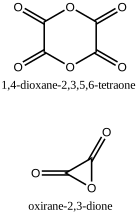
I have long been fascinated by polymers of either carbon dioxide, or carbon monoxide, or combinations of both. One such molecule, referred to as dioxane tetraketone when it was featured on the ACS molecule-of-the-week site and also known as the anhydride of oxalic acid, or more formally 1,4-dioxane-2,3,5,6-tetraone, has been speculated upon for more than a century.[1]

The history of chemistry has many molecules whose existence has been speculated upon, but where attempted syntheses have failed and for which sound theoretical reasons often only emerged many years later.[2]

The synthesis of dioxane tetraketone was finally achieved in 1998[3] at low temperatures (243K), although it was noted that in CDCl3/Et2O solutions at 273K it quickly decomposed to give equal quantities of carbon monoxide and dioxide. The characterisation was by 13C NMR, for which a single signal at 144.9 ppm was observed. The predicted value using the ACD/CNMR Predictor 2.0 Program (a so-called additive rule-based method) was 154 ppm (the value obtained using a similar tool available in Chemdraw is 150.9 ppm). The monomer oxirane-2,3-dione was also eliminated because of its predicted 13C shift using the same method of 167 ppm (155.3 using Chemdraw). Here I thought I would check these chemical shifts using a DFT-based method and also look at the barrier to the decomposition to see if it corresponds to a facile reaction at 273K (FAIR Data DOI: 10.14469/hpc/10619).

Firstly the NMR, using eg ωB97XD/aug-cc-pvdz/SCRF=chloroform. The calculated value of 148.2 ppm compares well with the observed value of 144.9 ppm. The value calculated for oxirane-2,3-dione was 156.6 ppm, rather lower than the ACD/Predictor method but in agreement with the Chemdraw implementation. The predicted IR spectrum (not reported) is shown below, should it ever be measured for this species.

Next, the reaction energy profile, this time calculated using ωB97XD/Def2-TZVPP for the reaction mechanism shown below.

The IRC reveals that the mechanism (black arrows) is followed, in a concerted process that reveals absolutely no sign of any ionic intermediate (red) which could then lead to oxirane-2,3-dione (blue). The barrier ΔG is 36.9 kcal/mol (it is lower than the total energy inferred below because the entropy is very positive, one molecule being converted to four during the reaction) which is far to high to correspond to a reaction that easily occurs at 273K. The value in water as solvent is very similar, again indicating that the ionic route is not enhanced by a polar solvent. The transition state has another feature of interest. It has C2 chiral symmetry, typical of a pericyclic reaction with Möbius topology, as indeed would be appropriate for an eight electron process.

So what about that mystery then? Well, experimentally dioxane tetraketone decomposes at 273K, which would correspond to a free energy barrier of around 14-15 kcal/mol. The calculated value is far higher, too high to be simply an error in the DFT method. So here is a suggestion. CDCl3, unless very carefully purified, contains HCl, which could very easily catalyse the reaction. So if another solvent were to be tried, lets say acetonitrile in which any trace of acid has been removed, would solutions of dioxane tetraketone then persist at room temperatures for far longer?  An experiment perhaps to be tried!


Perhaps the most fascinating is the cyclic trimer of carbon dioxide, which arguably has pretensions to be aromatic. It has very recently been synthesized.[4],[5]

References

  1. H. Staudinger, "Oxalylchlorid", Berichte der deutschen chemischen Gesellschaft, vol. 41, pp. 3558-3566, 1908. https://doi.org/10.1002/cber.19080410335
  2. H.M. Perks, and J.F. Liebman, "Paradigms and Paradoxes: Aspects of the Energetics of Carboxylic Acids and Their Anhydrides", Structural Chemistry, vol. 11, pp. 265-269, 2000. https://doi.org/10.1023/a:1009270411806
  3. P. Strazzolini, A. Gambi, A.G. Giumanini, and H. Vancik, "The reaction between ethanedioyl (oxalyl) dihalides and Ag2C2O4: a route to Staudinger’s elusive ethanedioic (oxalic) acid anhydride", Journal of the Chemical Society, Perkin Transactions 1, pp. 2553-2558, 1998. https://doi.org/10.1039/a803430c
  4. M.J. Rodig, A.W. Snow, P. Scholl, and S. Rea, "Synthesis and Low Temperature Spectroscopic Observation of 1,3,5-Trioxane-2,4,6-Trione: The Cyclic Trimer of Carbon Dioxide", The Journal of Organic Chemistry, vol. 81, pp. 5354-5361, 2016. https://doi.org/10.1021/acs.joc.6b00647
  5. H. Takeuchi, "Geometry Optimization of Carbon Dioxide Clusters (CO<sub>2</sub>)<sub><i>n</i></sub> for 4 ≤ <i>n</i> ≤ 40", The Journal of Physical Chemistry A, vol. 112, pp. 7492-7497, 2008. https://doi.org/10.1021/jp802872p

Checking a conclusion we made in 1987: Tetrahedral intermediates formed by nitrogen and oxygen attack of aromatic hydroxylamines on acetyl cyanide

June 11th, 2022

Minds (and memories) can work in wonderful ways. In 1987[1] we were looking at the properties of “stable” tetrahedral intermediates formed in carbonyl group reactions. The reaction involved adding phenylhydroxylamine to acetyl cyanide. NMR signals for two new species were detected, and we surmised one was due to N-attack on the carbonyl and one was due to O-attack, in each case to form a stable tetrahedral intermediate. To try to identify which was which, 15N labelled hydroxylamine was used and then the 15N-13C coupling constants were measured, which could either be 1-bondJ (for N-attack) or 2-bondJ (for O-attack).

Well, 35 years later, literally in a dream on the morning of 7th June, 2022, these results came back to me and the dream involved wondering whether we had gotten the assignments of the N- and O-species the correct way around. You see we had assigned the larger of the 15N-13C couplings to the two bond (O-attack, species 3 below) rather than one-bond (N-attack, species 4 below) coupling. In 1987, the art of accurately computing such couplings was still in its infancy, but now in 2022 it is quick and easy to do. So here I report the results, which 35 years on allows a check of those assignments.

The necessary calculations are assembled at FAIR DOI: 10.14469/hpc/10593 conducted at the ωB97XD/aug-cc-pvdz/scrf=acetonitrile level. Firstly, it is important that the conformational space of these molecules is explored, since they contain a plethora of interesting anomeric effects. I will not discuss this process, simply quoting what I believe to be the lowest energy conformation for both isomers.

# Property Species 3 Species 4
1 ΔG298 -608.600542 -608.598472
2 ΔG215 -608.586956 -608.585163
3 NBO E(2) 14.3,19.4,10.9,8.1 10.0,11.2,9.9
4 δC obs 94.3 ppm 85.0 ppm
5 δC calc 97.2 (Δδ 2.9) 88.1 (Δδ 3.1)
6 JN-C obs 2J ±2.5 Hz 1J ±1.3 Hz
7 JN-C calc 2J +1.7 1J +0.8
  1. The relative free energies ΔΔG298 favour 3 over 4 by 1.3 kcal/mol at 298K (9:1). The article notes that 3 is significantly favoured over 4 at higher temperatures (i.e. ~298K) but that the concentration of 4 increases at lower temperatures. 
  2. At 215K, ΔΔG215 reduces to 1.1 kcal/mol, but this equates to 13:1 at this temperature. ΔΔG215 would need to be about 0.8 kcal/mol for 4 to increase (6.5:1), but these are small errors in energy and a more accurate calculation would have to be done to get this aspect correct.
  3. The NBO E(2) terms indicating overlap between a lone pair and an acceptor orbital (the anomeric effect), show a dazzling variety of interactions for such a small molecule. Species 3 shows four significant interactions, species 4 one less.
  4. The chemical shifts measured for 3 and 4
  5. – are matched by the calculation, the error being similar for both species.
  6. The 15N-13C coupling constants –
  7. – are again matched, with the 1J coupling being about half the value of the 2J coupling for both obs and calculated values.

The nature of modern scientific research, and the funding available for it, means that old work is rarely re-investigated using more recent techniques. In this case, the reinvestigation does not require the molecules to be re-synthesized again, merely that a retrospective computational layer be applied. As a result of my dream of four days ago, this process has produced an interesting new layer which thankfully confirms the original conclusions.

References

  1. A.M. Lobo, M.M. Marques, S. Prabhakar, and H.S. Rzepa, "Tetrahedral intermediates formed by nitrogen and oxygen attack of aromatic hydroxylamines on acetyl cyanide", The Journal of Organic Chemistry, vol. 52, pp. 2925-2927, 1987. https://doi.org/10.1021/jo00389a050

3-Methyl-5-phenylpyrazole: a crystallographic enigma?

May 19th, 2022

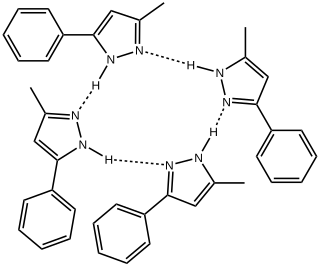
Previously, I explored the unusual structure of a molecule with a hydrogen bonded interaction between a phenol and a pyridine. The crystal structure name was RAKQOJ and it had been reported as having almost symmetrical N…H…O hydrogen bonds. This feature had been determined using neutron diffraction crystallography, which is thought very reliable at determining proton positions. Another compound with these characteristics is 3-methyl-5-phenylpyrazole or MEPHPY01.[1] Here the neutron study showed it to apparently have the structure represented below, where the solid N-H lines indicate a proton equidistant between two nitrogens.

Inspection of the ORTEP plot shows a very odd feature; the thermal elipsoids (red arrow) for two of the N-H-N motifs are more or less spherical, indicating little thermal motion (the temperature of the determination is not noted, and is assumed as probably room temperature) but the other two (magenta arrows) are highly elongated in the direction of motion between the two nitrogen atoms. This feature was largely unexplained at the time of publication (1975) and indeed to this day. Here I offer a possible insight into this enigma.

The conventional structure is shown below showing four N-H bonds and four H…N hydrogen bonds.

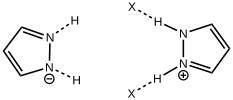
So now for the results of some calculations. Computed at various B3LYP(±GD3BJ)/Def2-SVPP/Def2-TZVPP levels (Table, FAIR data DOI: 10.14469/hpc/10406), the located minimum in the total energy, saddle=0, corresponds to the conventional proton-localized structure shown above, where all four hydrogens are firmly attached to the four nitrogen atoms by a regular bond and the distances are 1.032 for the NH and 1.855Å for the hydrogen bond it forms. A zwitterionic isomer comprises the ion-pair shown below, examples of each component of which are known in the CSD (crystal structure database). 

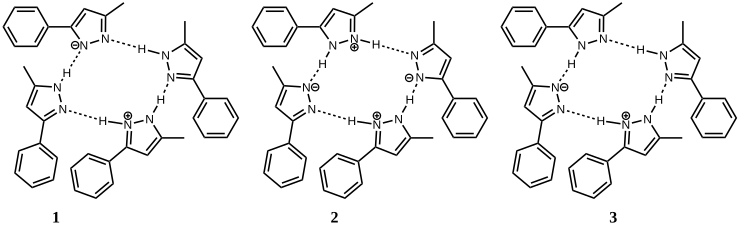
There are three ways of distributing this motif, of which only 1 is stable to proton transfer. Structure 2 has a higher degree of charge separation whilst 3 superficially appears to reduce the degree of charge separation compared to 1. In fact, the three-dimensional structure of 1 allows the negative ion to stack above the positive ion, thus actually achieving minimal separation of charges.

The stacking also depends on the type of calculation. If dispersion correction is included, the aromatic faces stack directly above each other (as above). If omitted, the stacking actually corresponds more closely to that observed in the reported crystal structure, since the attraction between faces occurs not only within a structure but between adjacent structures in the solid state (something not modelled when the dispersion correction is applied only to a single unit).

The lesson learnt from the previous post is that the position of protons as determined by quantum-chemical geometry location using minimisation of the total computed energy might be misleading. Better perhaps to use the computed free energy? When this is done, as we saw in the previous post, the transition state for proton transfer as located in the total energy surface can actually have a free energy that is lower than that of the total energy minimum. So, for MEPHPY01, a stationary point in which all four hydrogens correspond to the apparently symmetrical experimental neutron diffraction structure emerges as saddle=3, corresponding to three force constants being negative. The bond lengths for this geometry occur in pairs, two with NH 1.25/N…H 1.30 and two with 1.28/1.28, revealing interesting asymmetry.

The normal vibrational modes for these three -ve force constants are shown below. The first (ν 1315i cm-1) shows all four hydrogens exchanging between nitrogens, a quadruple proton transfer. The second (ν 896i cm-1) shows a double proton transfer between one pair exchanging between two nitrogens and the last (ν 801i cm-1) is similar in form, but shows the other pair exchanging between a second different pair of nitrogens. These last two vibrational modes correspond to the very thermal ellipsoids seen in the crystal structure diagram at the top, where one pair of hydrogens show little motion and the other pair involves much greater motion between a pair of nitrogen atoms.This would correspond to formation of a species exhibiting two conventional NH…H hydrogen bonds and two symmetrical N…H…N units.


Two further stationary points corresponding to saddle=2 and saddle=1 can also be located (Table).

stationary points B3LYP+GD3BJ/gas B3LYP+GD3BJ/DCM B3LYP/gas
SVPP, saddle=0, neutral -1984.448365(0.0) -1984.460070(0.0) -1984.241838(0.0)
SVPP, saddle=0, ion-pair -1984.426827(13.5) -1984.439305(13.0) -1984.218379(14.7)
TZVPP, saddle=0, neutral -1986.712743(0.0) -1986.725277 (0.0) -1986.509333(0.0)
TZVPP, saddle=0, ion-pair -1986.688467(15.2) -1986.703562 (13.6)  -1986.481384(17.5)

SVPP, saddle=1 -1984.428898(12.1) -1984.442004(11.3) -1984.220238(13.6)
SVPP, saddle=2 -1984.430085(11.5) -1984.442986(10.7) -1984.220968(13.1)
SVPP, saddle=3 -1984.431457(10.6)
1315, 896, 801
-1984.441075(11.9)
970, 603, 294
-1984.223176 (11.7)
1335, 782, 760
TZVPP, saddle=1 -1986.691518(13.2)
TZVPP, saddle=2 -1986.689979(14.3)
TZVPP, saddle=3
-1986.690265(14.1)

Now here is the wacky thing. At the gas phase SVPP basis set ± dispersion levels, these lower-order saddle points are actually HIGHER in free energy than the third order saddle point! Conventional wisdom is that the higher the order of the saddle point, the higher should its energy be! I am not aware of anyone reporting an inverse observation before. The effect however is solvation and also basis-set dependent, since adding dichloromethane as a continuum solvent changes the free energy minimum from the third to the second-order saddle point. It might well also be dependent on the density functional method.

What are we to conclude? The free energy barriers for all the proton transfer saddle points computed above are not that small, being ≥ 10 kcal/mol. But at room temperatures, these exchanges will in fact be fast kinetic processes and the measured neutral diffraction structure may well emerge as averaged in some way. The free energies of the higher order saddle points suggests the dynamics of this system may in fact be very complex and very different from any “normal” hydrogen bonded system. This is clearly not the final word yet, but it does hint that the proton transfer dynamics of 3-Methyl-5-phenylpyrazole may be a system very well worth looking at again! And indeed exploring how robust the effects noted above are to different density functionals.


This post has DOI: 10.14469/hpc/10512

References

  1. F.H. Moore, A.H. White, and A.C. Willis, "3-Methyl-5-phenylpyrazole: a neutron diffraction study", Journal of the Chemical Society, Perkin Transactions 2, pp. 1068, 1975. https://doi.org/10.1039/p29750001068