The story so far. Inspired by the report of the most polar neutral compound yet made, I suggested some candidates based on the azulene ring system that if made might be even more polar. This then led to considering a smaller π-analogue of azulene, m-benzyne. Here I ponder how a derivative of this molecule might be made, using computational profiling as one reality check.
One reaction as envisaged is to prepare the penta-substituted benzene as shown below.
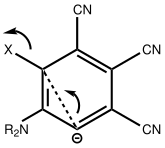
Abstraction of the proton using strong base might result in 1,3-elimination of the leaving group X to form the m-benzyne. For the substituent X=Cl, a ωB97XD/Def2-TZVPP/SCRF=thf calculation (DOI: 10.14469/hpc/2057) of the reaction profile shows a relatively large barrier to elimination, with an endothermic product.
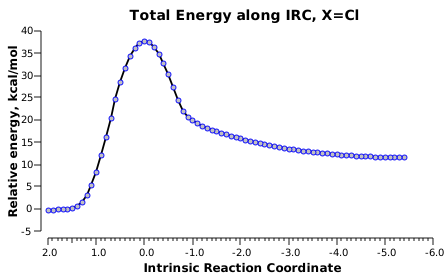
A better leaving group might be X=OTf. Unlike, X=Cl, this reaction is nicely exoenergic (ΔΔG -10.6 kcal/mol) with an accessible activation free energy of 22.5 kcal/mol (DOI: 10.14469/hpc/2066, 10.14469/hpc/2123, 10.14469/hpc/2096)

Perhaps then this, the smaller homologue of azulene, might indeed be capable of synthesis?