Posts Tagged ‘Imperial College Chemical Society’
Wednesday, August 22nd, 2018
Following the general recognition of carbon as being tetrahedrally tetravalent in 1869 (Paterno) and 1874 (Van’t Hoff and Le Bell), an early seminal exploitation of this to the conformation of cyclohexane was by Hermann Sachse in 1890.[1] This was verified when the Braggs in 1913[2], followed by an oft-cited article by Mohr in 1918,[3] established the crystal structure of diamond as comprising repeating rings in the chair conformation.† So by 1926, you might imagine that the shape (or conformation as we would now call it) of cyclohexane would be well-known. No quite so for everyone!
When The Journal of the Imperial College Chemical Society (Volume 6) was brought to my attention, I found an article by R. F Hunter;
He proceeds to argue as follows:
- The natural angle subtended at a tetrahedral carbon is 109.47°.
- “The internal angle between the carbon to carbon valencies of a six-membered ring cyclohexane will, if the ring is uniplanar, be … 120°.
- “When the cyclohexane ring is prepared … we must therefore have the pushing apart of two of the valencies”.
- The object of the experiments commenced in this College in 1914 was “to find what effect the pushing apart of the valencies …must have on the angle between the remaining pair of valencies“.
- You do wonder then why the assumption highlighted in red above was never really questioned during the twelve-year period of investigating angles around tetrahedral carbon.
The article itself is quite long, reporting the synthesis of many compounds in search of the postulated effect. Of course around twenty years later, Derek Barton used the by then generally accepted conformation of cyclohexane to explain reactivity in what become known as the theory of conformational analysis.
These two articles dating from 1926, and probably thought lost to science, show how some ideas can take decades to have any influence, whilst others can take root very much more quickly.
†The chair cyclohexane structure is easily discerned from Figure 7 in the Braggs’ paper![2]
References
- H. Sachse, "Ueber die geometrischen Isomerien der Hexamethylenderivate", Berichte der deutschen chemischen Gesellschaft, vol. 23, pp. 1363-1370, 1890. https://doi.org/10.1002/cber.189002301216
- W.H. Bragg, and W.L. Bragg, "The structure of the diamond", Proceedings of the Royal Society of London. Series A, Containing Papers of a Mathematical and Physical Character, vol. 89, pp. 277-291, 1913. https://doi.org/10.1098/rspa.1913.0084
- E. Mohr, "Die Baeyersche Spannungstheorie und die Struktur des Diamanten", Journal für Praktische Chemie, vol. 98, pp. 315-353, 1918. https://doi.org/10.1002/prac.19180980123
Tags:Carbon, chair, Chemistry, Conformation, Cycloalkanes, cyclohexane, Cyclohexane conformation, Derek Barton, Hermann Sachse, Hoff, Imperial College Chemical Society, Isomerism, Physical organic chemistry, R. F Hunter, Stereochemistry, Van 't Hof
Posted in Interesting chemistry | 1 Comment »
Wednesday, August 22nd, 2018
In 2012, I wrote a story of the first ever reaction curly arrows, attributed to Robert Robinson in 1924. At the time there was a great rivalry between him and another UK chemist, Christopher Ingold, with the latter also asserting his claim for their use. As part of the move to White City a lot of bookshelves were cleared out from the old buildings in South Kensington, with the result that yesterday a colleague brought me a slim volume they had found entitled The Journal of the Imperial College Chemical Society (Volume 6).‡
This journal is a record of lectures given to the chemistry department by visiting speakers, this one dating from 1926, about two years after the article by Robinson noted above.

There are a number of points of interest.
- Early on, Ingold introduces the topic of atoms in combination. Lewis (who is acknowledged to have introduced this concept in 1916) is mentioned in parentheses, if not actually in passing, as generalizing (Lewis) from this case, … As was the practice at the time, referencing one’s sources was not always common, and you do not here get an actual citation for Lewis!
- Next comes the topic changes in molecular structure (which could be a synonym for reactions) and here you get this diagram
 A modern version is shown below, scarcely different!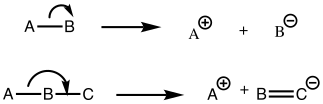
- Whilst the first example has examples such as SN1 ionizations, the second is perhaps not as common as might be imagined. It would only work if atom C (assuming it to be carbon) was e.g. a carbene (with six valence electrons) converting to a vinyl carbanion (with eight). Although we may speculate that Ingold thought that the second example might relate to common reactions, in the event both curly arrows are still entirely valid by modern standards. There is no acknowledgement of Robinson’s 1924 effort.
- Ingold goes on to discuss substitution patterns in benzene derivatives, and the o/p or m-directing abilities of substituents. He concludes that the Dewar formula for benzene is the most satisfactory vehicle for expressing the theory that electrical disturbances readily reach the o- and p-position, whilst only a small second order effect can reach the m-position. Here I think we can conclude that this approach has not survived into modern thinking. Robinson in his 1924 arrows had of course striven to explain the apparent propensity of nitrosobenzene towards electrophilic substitution in the p-position. Henry Armstrong some thirty years earlier in 1887[1] had arguably already made a pretty decent start, without requiring the use of Dewar benzene.
I suspect those who have dug through the historical archives to cast light on the Robinson/Ingold rivalry may not have appreciated that the Journal of the Imperial College Chemical Society might have been an interesting source!
‡There were nine volumes produced during 1921-1930. It then morphed into The Scientific Journal of the Royal College of Science which continued for an unknown number of years.
References
- H.E. Armstrong, "XXVIII.—An explanation of the laws which govern substitution in the case of benzenoid compounds", J. Chem. Soc., Trans., vol. 51, pp. 258-268, 1887. https://doi.org/10.1039/ct8875100258
Tags:arrow pushing, chemical reaction, Chemical Society, chemist, Chemistry, Christopher Ingold, Christopher Kelk Ingold, College of Science, Country: United Kingdom, Fellows of the Royal Society, Henry Armstrong, Imperial College Chemical Society, Imperial College London, Ingold, Knights Bachelor, Person Career, Robert Robinson, Royal College of Science, The Scientific Journal
Posted in Interesting chemistry | No Comments »
Wednesday, August 22nd, 2018
In 2012, I wrote a story of the first ever reaction curly arrows, attributed to Robert Robinson in 1924. At the time there was a great rivalry between him and another UK chemist, Christopher Ingold, with the latter also asserting his claim for their use. As part of the move to White City a lot of bookshelves were cleared out from the old buildings in South Kensington, with the result that yesterday a colleague brought me a slim volume they had found entitled The Journal of the Imperial College Chemical Society (Volume 6).‡
This journal is a record of lectures given to the chemistry department by visiting speakers, this one dating from 1926, about two years after the article by Robinson noted above.

There are a number of points of interest.
- Early on, Ingold introduces the topic of atoms in combination. Lewis (who is acknowledged to have introduced this concept in 1916) is mentioned in parentheses, if not actually in passing, as generalizing (Lewis) from this case, … As was the practice at the time, referencing one’s sources was not always common, and you do not here get an actual citation for Lewis!
- Next comes the topic changes in molecular structure (which could be a synonym for reactions) and here you get this diagram
 A modern version is shown below, scarcely different!
- Whilst the first example has examples such as SN1 ionizations, the second is perhaps not as common as might be imagined. It would only work if atom C (assuming it to be carbon) was e.g. a carbene (with six valence electrons) converting to a vinyl carbanion (with eight). Although we may speculate that Ingold thought that the second example might relate to common reactions, in the event both curly arrows are still entirely valid by modern standards. There is no acknowledgement of Robinson’s 1924 effort.
- Ingold goes on to discuss substitution patterns in benzene derivatives, and the o/p or m-directing abilities of substituents. He concludes that the Dewar formula for benzene is the most satisfactory vehicle for expressing the theory that electrical disturbances readily reach the o- and p-position, whilst only a small second order effect can reach the m-position. Here I think we can conclude that this approach has not survived into modern thinking. Robinson in his 1924 arrows had of course striven to explain the apparent propensity of nitrosobenzene towards electrophilic substitution in the p-position. Henry Armstrong some thirty years earlier in 1887[1] had arguably already made a pretty decent start, without requiring the use of Dewar benzene.
I suspect those who have dug through the historical archives to cast light on the Robinson/Ingold rivalry may not have appreciated that the Journal of the Imperial College Chemical Society might have been an interesting source!
‡There were nine volumes produced during 1921-1930. It then morphed into The Scientific Journal of the Royal College of Science which continued for an unknown number of years.
References
- H.E. Armstrong, "XXVIII.—An explanation of the laws which govern substitution in the case of benzenoid compounds", J. Chem. Soc., Trans., vol. 51, pp. 258-268, 1887. https://doi.org/10.1039/ct8875100258
Tags:arrow pushing, chemical reaction, Chemical Society, chemist, Chemistry, Christopher Ingold, Christopher Kelk Ingold, College of Science, Country: United Kingdom, Fellows of the Royal Society, Henry Armstrong, Imperial College Chemical Society, Imperial College London, Ingold, Knights Bachelor, Person Career, Robert Robinson, Royal College of Science, The Scientific Journal
Posted in Interesting chemistry | No Comments »


