Posts Tagged ‘Henry Armstrong’

Early “curly” (reaction) arrows. Those of Ingold in 1926.

Wednesday, August 22nd, 2018

In 2012, I wrote a story of the first ever reaction curly arrows, attributed to Robert Robinson in 1924. At the time there was a great rivalry between him and another UK chemist, Christopher Ingold, with the latter also asserting his claim for their use. As part of the move to White City a lot of bookshelves were cleared out from the old buildings in South Kensington, with the result that yesterday a colleague brought me a slim volume they had found entitled The Journal of the Imperial College Chemical Society (Volume 6). 

This journal is a record of lectures given to the chemistry department by visiting speakers, this one dating from 1926, about two years after the article by Robinson noted above.

There are a number of points of interest.

  1. Early on, Ingold introduces the topic of atoms in combination. Lewis (who is acknowledged to have introduced this concept in 1916) is mentioned in parentheses, if not actually in passing, as generalizing (Lewis) from this case, … As was the practice at the time, referencing one’s sources was not always common, and you do not here get an actual citation for Lewis!
  2. Next comes the topic changes in molecular structure (which could be a synonym for reactions) and here you get this diagramA modern version is shown below, scarcely different!
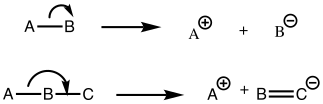
  3. Whilst the first example has examples such as SN1 ionizations, the second is perhaps not as common as might be imagined. It would only work if atom C (assuming it to be carbon) was e.g. a carbene (with six valence electrons) converting to a vinyl carbanion (with eight). Although we may speculate that Ingold thought that the second example might relate to common reactions, in the event both curly arrows are still entirely valid by modern standards. There is no acknowledgement of Robinson’s 1924 effort.
  4. Ingold goes on to discuss substitution patterns in benzene derivatives, and the o/p or m-directing abilities of substituents. He concludes that the Dewar formula for benzene is the most satisfactory vehicle for expressing the theory that electrical disturbances readily reach the o- and p-position, whilst only a small second order effect can reach the m-position. Here I think we can conclude that this approach has not survived into modern thinking. Robinson in his 1924 arrows had of course striven to explain the apparent propensity of nitrosobenzene towards electrophilic substitution in the p-position. Henry Armstrong some thirty years earlier in 1887[1] had arguably already made a pretty decent start, without requiring the use of Dewar benzene.

I suspect those who have dug through the historical archives to cast light on the Robinson/Ingold rivalry may not have appreciated that the Journal of the Imperial College Chemical Society might have been an interesting source!


There were nine volumes produced during 1921-1930. It then morphed into The Scientific Journal of the Royal College of Science which continued for an unknown number of years.

References

  1. H.E. Armstrong, "XXVIII.—An explanation of the laws which govern substitution in the case of benzenoid compounds", J. Chem. Soc., Trans., vol. 51, pp. 258-268, 1887. https://doi.org/10.1039/ct8875100258

Early "curly" (reaction) arrows. Those of Ingold in 1926.

Wednesday, August 22nd, 2018

In 2012, I wrote a story of the first ever reaction curly arrows, attributed to Robert Robinson in 1924. At the time there was a great rivalry between him and another UK chemist, Christopher Ingold, with the latter also asserting his claim for their use. As part of the move to White City a lot of bookshelves were cleared out from the old buildings in South Kensington, with the result that yesterday a colleague brought me a slim volume they had found entitled The Journal of the Imperial College Chemical Society (Volume 6). 

This journal is a record of lectures given to the chemistry department by visiting speakers, this one dating from 1926, about two years after the article by Robinson noted above.

There are a number of points of interest.

  1. Early on, Ingold introduces the topic of atoms in combination. Lewis (who is acknowledged to have introduced this concept in 1916) is mentioned in parentheses, if not actually in passing, as generalizing (Lewis) from this case, … As was the practice at the time, referencing one’s sources was not always common, and you do not here get an actual citation for Lewis!
  2. Next comes the topic changes in molecular structure (which could be a synonym for reactions) and here you get this diagramA modern version is shown below, scarcely different!
  3. Whilst the first example has examples such as SN1 ionizations, the second is perhaps not as common as might be imagined. It would only work if atom C (assuming it to be carbon) was e.g. a carbene (with six valence electrons) converting to a vinyl carbanion (with eight). Although we may speculate that Ingold thought that the second example might relate to common reactions, in the event both curly arrows are still entirely valid by modern standards. There is no acknowledgement of Robinson’s 1924 effort.
  4. Ingold goes on to discuss substitution patterns in benzene derivatives, and the o/p or m-directing abilities of substituents. He concludes that the Dewar formula for benzene is the most satisfactory vehicle for expressing the theory that electrical disturbances readily reach the o- and p-position, whilst only a small second order effect can reach the m-position. Here I think we can conclude that this approach has not survived into modern thinking. Robinson in his 1924 arrows had of course striven to explain the apparent propensity of nitrosobenzene towards electrophilic substitution in the p-position. Henry Armstrong some thirty years earlier in 1887[1] had arguably already made a pretty decent start, without requiring the use of Dewar benzene.

I suspect those who have dug through the historical archives to cast light on the Robinson/Ingold rivalry may not have appreciated that the Journal of the Imperial College Chemical Society might have been an interesting source!


There were nine volumes produced during 1921-1930. It then morphed into The Scientific Journal of the Royal College of Science which continued for an unknown number of years.

References

  1. H.E. Armstrong, "XXVIII.—An explanation of the laws which govern substitution in the case of benzenoid compounds", J. Chem. Soc., Trans., vol. 51, pp. 258-268, 1887. https://doi.org/10.1039/ct8875100258

Benzene: an oscillation or a vibration?

Wednesday, May 28th, 2014

In the preceding post, a nice discussion broke out about Kekulé’s 1872 model for benzene.[1] This model has become known as the oscillation hypothesis between two extreme forms of benzene (below). The discussion centered around the semantics of the term oscillation compared to vibration (a synonym or not?) and the timescale implied by each word. The original article is in german, but more significantly, obtainable only with difficulty. Thus I cannot access[1] the article directly since my university does not have the appropriate “back-number” subscription. So it was with delight that I tracked down an English translation in a journal that I could easily access.[2] Here I discuss what I found (on pages 614-615, the translation does not have its own DOI).

The oscillation hypothesis

The bent bond formula

The translation is by no other than Henry Armstrong, whose own contributions I have documented elsewhere. The pertinent points (it’s a long explanation) seem to be:

  1. Kekulé does not use the word oscillation anywhere. This seems to have been added by subsequent commentators.
  2. He does describe the atoms as being in continuous movement, actually using the very modern term intramolecular motion (as translated of course).
  3. He also describes this motion as returning to a mean position of equilibrium, and the separate atoms as possessing rectilinear motion, striking and recoiling against adjacent partners.
  4. He finally concludes by describing at some length what happens during two units of time involving what we would regard as one complete vibration to return the atoms to their starting point. This description is couched in words, and refers to what we would now call a normal (vibrational) mode evolving in time. You can see that written description below for yourself (in translation). It IS quite verbose; if ever a case could be made for replacing 1000 words with one picture, this is it!
The oscillation hypothesis

Armstrong’s translation

Perhaps I can attempt to replace the (1000?) words above with that one picture (below). Here, I think Kekulé does manage to complicate things by including a hydrogen (h) as part of his scheme. Carbon C1 is described as contacting C2, and then immediately a hydrogen (although since he does not number the hydrogens it is not absolutely clear he means the hydrogen on carbon 2 at this stage). The modern equivalent below shows relatively little motion from the (light) hydrogen atoms, and certainly no obvious contact between e.g. C1 and any hydrogen other than the one it is bonded to.

1318
We now replace the description above by using far more concise vectors to describe the movement of the atoms with respect to time. And of course Kekulé had no real idea of how long his cycle took (only that it must be short as inferred from the laboratory observation of not being able to isolate geometric isomers, perhaps shorter than 100 seconds?); we now know that it is about 10-14 s. Commentators to this day describe this as Kekulé’s oscillation hypothesis, but since Kekulé did not use the term at all but did use (thrice) the word vibration we really should call it his vibration hypothesis, as indeed Paul Schleyer noted in his comment on the original post.


There is little doubt that historical researches have become severely endangered by the increasing lack of access to older issues of many journals. In some cases, older can mean as little as ten years!

References

  1. A. Kekulé, "Ueber einige Condensationsproducte des Aldehyds", Justus Liebigs Annalen der Chemie, vol. 162, pp. 77-124, 1872. https://doi.org/10.1002/jlac.18721620110
  2. "Organic chemistry", Journal of the Chemical Society, vol. 25, pp. 605, 1872. https://doi.org/10.1039/js8722500605

Henry Armstrong: almost an electronic theory of chemistry!

Monday, November 7th, 2011

Henry Armstrong studied at the Royal College of Chemistry from 1865-7 and spent his subsequent career as an organic chemist at the Central College of the Imperial college of Science and technology until he retired in 1912. He spent the rest of his long life railing against the state of modern chemistry, saving much of his vitriol against (inter alia) the absurdity of ions, electronic theory in chemistry, quantum mechanics and nuclear bombardment in physics. He snarled at Robinson’s and Ingold’s new invention (ca 1926-1930) of electronic arrow pushing with the put down “bent arrows never hit their marks“.1  He was dismissed as an “old fogy, stuck in a time warp about 1894.”1 So why on earth would I want to write about him? Read on…

He did worthy (nowadays this could mean dull) chemistry on e.g. naphthalenes, but I want to focus on two articles from the period 1887-1890 (10.1039/CT8875100258  and 10.1039/PL8900600095). Let me set the scene by reminding of an earlier post showing the structure of a bis(stilbyl)ketone, dated 1921. The two aromatic groups (yes, they really are such) are drawn in the manner we would nowadays draw cyclohexane. This practice in fact continued in texts and articles for perhaps 30 more years! Not much sign of electronic accounting there then! And by a professor at Imperial College no less, where Armstrong had been.

Aromatic molecule, circa 1921

So when would you date the diagrams below? So called Clarrepresentations, originating from the 1950s? The one on the bottom below cites Clar and dates from 2010, DOI: 10.3390/sym2031653, but the one above it comes from Armstrong’s 1890 article!

Two representations of pyrene, 2010 and 1890.

Clar representations are used to count electrons (as coming in six packs). But there is little doubt that Armstrong’s use of a “C” (or inner circle, which is exactly what it is) means six as well. The evidence I present below, taken from his 1887 article.

Armstrongs six pack

  1. He counts the six carbons as having a total of 24 what he calls affinities (definition: An attraction or force between particles that causes them to combine), or four per carbon. Let us make life easy and equate affinity=electron (remember, the electron itself was not yet discovered or named!). He disposes of 12 affinities/electrons to form what we now call six carbon-carbon σ bonds, and a further six for the  six C-H bonds.
  2. He is left with exactly six affinities/electrons, which he presupposes to act upon each other, in the manner of resultants (the old term for vectors). In fact, he replaces these six vectors by a circle (the inner circle) in his second article of 1890.
  3. He invents delocalization in all but name when he states that any one atom has an influence on other atoms not contiguous to it in the ring (he really did have o/m/p directing influence in mind here).
  4. He compares the introduction of a substituent (R, which comes from the old name Radicle) perturbing the distribution of the affinity to how electric charges perturb each other. So, the affinity behaves as if it might have electrical (from which the name electron came of course) properties? And it might be described by a vector?
  5. Remember, this is a scientist who in later life did not believe in electronic theories of chemistry? Really? Well, again in 1890:

Is this an affinity (=electronic) theory of chemistry?

  1. Here, he is refining his vector representation of affinities, saying that these vectors in effect define a circle, an inner circle no less. One that can be disrupted  (Robinson some 30 years later wrote of how the cycle of six electrons are able to form a group that resists disruption) when an additive compound is formed (his examples are all electrophiles, what we now call electrophilic addition) such that the remaining carbons become merely unsaturated. There seems little doubt he is describing what we now call a Wheland Intermediate.
  2. Is this really a man who did not believe in electronic theories of chemistry? What about that concluding paragraph then? The laws of substitution require a knowledge of the inner structure of (what we now call the aromatic) hydrocarbons?
  3. And that such speculations may suggest fresh lines of experimental inquiry? This all sounds very much like the modern use of quantum mechanics and its electronic eigenvectors to describe the probability distribution of electrons (remember, Armstrong did not approve of this either) to probe the inner structure of molecules and to suggest new experiments.

We have a real mystery. Armstrong got so very close to a modern theory of chemistry. Was he asleep when Stoney named the electron around 1891 and Thomson discovered it in 1897? If only he had followed his own advice! Ah well, just as well he was ignored in the 20th century when he preached against it all.


  1. W. H. Brock, “The case of the Poisonous Socks”, chapter 20, RSC Publishing, 2011, 978-1-84973-324-3
  2. Clar, E. The Aromatic Sextet; Wiley: New York, NY, USA, 1972.

The oldest reaction mechanism: updated!

Tuesday, September 14th, 2010

Unravelling reaction mechanisms is thought to be a 20th century phenomenon, coincident more or less with the development of electronic theories of chemistry. Hence electronic arrow pushing as a term. But here I argue that the true origin of this immensely powerful technique in chemistry goes back to the 19th century. In 1890, Henry Armstrong proposed what amounts to close to the modern mechanism for the process we now know as aromatic electrophilic substitution [1]. Beyond doubt, he invented what is now known as the Wheland Intermediate (about 50 years before Wheland wrote about it, and hence I argue here it should really be called the Armstrong/Wheland intermediate). This is illustrated (in modern style) along the top row of the diagram.

The mechanism of aromatic electrophilic substitution

In 1887, Armstrong had tabulated the well known ortho/meta/para directing properties of substituents already on the ring towards this reaction[2]. He even offered an explanation, which is not entirely wrong, given that in 1890, the electron had not yet been discovered! That did not stop Armstrong, who invented an entity he called the affinity for the purpose of developing his theories (in this theory, benzene had an inner circle of six affinities, which had a tendency to resist disruption). Armstrong’s description of the properties of the affinity matches that of the (yet to be discovered) electron very closely! But that is enough of history. The mechanism shown above emerged in its present representation (and naming) during the heyday of physical organic chemistry between 1926 – 1940, and of course is an absolute staple of all text books on organic chemistry. But, sacrilege, is it correct? Could what is referred to as an intermediate instead be a transition state? (shown in the bottom pathway of the scheme).

Consider instead the following, in which X is replaced by an acetic acid motif;

Transition state alternative to the Wheland

The two steps, a bond formation between the benzene and E, and the proton abstraction from the benzene by X, are now synchronized into a single step, and the intermediate is now transformed into a transition state. Time to put this theory to the test. X is going to be made trifluoroacetate (R=CF3) and we are going to test it with E= NO+ and F+ (yes, trifluoroacetyl hypofluorite is a known chemical, and it really does fluorinate1 aromatic compounds at -78C). Firstly, E= NO+. A B3LYP/6-311G(d,p) calculation[3]  run in a solvent simulated as dichloromethane, reveals the mid point to indeed be a transition state and NOT an intermediate![4].

Wheland as a transition state. Click image for animation

There is one crucial aspect to this transition state that Armstrong himself made a point of. In the Wheland intermediate proper, the aromaticity of the benzene ring must be disrupted. As a transition state, it need not be (at least not completely). Thus the two bonds labeled as a have calculated lengths of ~1.415Å, only slightly longer than the aromatic length, and certainly not single bonds as implied by the Wheland intermediate! Notice also the significant motion by the hydrogen, which implies the reaction would be subject to a kinetic isotope effect (this would normally be interpreted in terms of the second stage of the stepwise reaction shown along the top a being rate limiting, but this result shows this need not be so). Thus, if the structure is favourable, this veritable old mechanism can be redesigned to give a new, 21st century look to a 19th century staple! By the way, the free energy of activation for this reaction is calculated as ~22 kcal/mol, a perfectly viable thermal reaction. No doubt, by suitable design of the group X, this might be reduced.

Now on to E=F+[5]. This looks a little different. F+ is now a much more voracious electrophile than the nitrosonium cation, and it therefore jumps ahead of the second mechanistic step, with no motion of the hydrogen being involved at this stage (one might also imagine making X a better base to swing things the other way).

Transition state E=F+ leading to Wheland Intermediate. Click for  3D model.

Genuine Wheland intermediate for E=F+ Click for 3D model

Now a full blown Armstrong/Wheland intermediate does indeed form (10042/to-5174); an intimate ion pair if you will, even in the relatively non polar dichloromethane as modelled solvent. The structure  (shown above) is rather unexpected.  This reaction has ΔG of ~5 kcal/mol,  which is significantly lower than for the E=NO+ system.

Chemistry is full of surprises, and it is always a wonder how a slightly different take on even the oldest of reactions can reveal something new.

Reference.

<

p>1. Umemoto, T.; Mukono, T.. 1-Acylamido-2-fluoro-4-acylbenzenes. Jpn. Kokai Tokkyo Koho  (1986), Patent number JP61246156.

References

  1. "Proceedings of the Chemical Society, Vol. 6, No. 85", Proceedings of the Chemical Society (London), vol. 6, pp. 95, 1890. https://doi.org/10.1039/pl8900600095
  2. H.E. Armstrong, "XXVIII.—An explanation of the laws which govern substitution in the case of benzenoid compounds", J. Chem. Soc., Trans., vol. 51, pp. 258-268, 1887. https://doi.org/10.1039/ct8875100258
  3. "C 8 H 6 F 3 N 1 O 3", 2010. http://doi.org/10042/to-5172
  4. S.R. Gwaltney, S.V. Rosokha, M. Head-Gordon, and J.K. Kochi, "Charge-Transfer Mechanism for Electrophilic Aromatic Nitration and Nitrosation via the Convergence of (ab Initio) Molecular-Orbital and Marcus−Hush Theories with Experiments", Journal of the American Chemical Society, vol. 125, pp. 3273-3283, 2003. https://doi.org/10.1021/ja021152s

Clar islands in a π Cloud

Wednesday, December 9th, 2009

Clar islands are found not so much in an ocean, but in a type of molecule known as polycyclic aromatic hydrocarbons (PAH). One member of this class, graphene, is attracting a lot of attention recently as a potential material for use in computer chips. Clar coined the term in 1972 to explain the properties of PAHs, and the background is covered in a recent article by Fowler and co-workers (DOI: 10.1039/b604769f). The concept is illustrated by the following hydrocarbon:

Clar islands in a polybenzenoid hydrocarbon

Clar islands in a polybenzenoid hydrocarbon

The Clar islands are shown in red, and represent in effect the resonance form of this species which maximises the number of aromatic electronic sextets possible to achieve via a cyclohexatriene resonance form. It encapsulates the concept that maximum stabilization is achieved when the π-electrons in the molecule cluster together (or localize) in cyclic groups of six (rather than eg other allowed values as predicted by the 4n+2 rule of aromaticity). As a historical note, although Clar popularized the concept in the 1970s, the (C) representation had in fact been introduced almost one hundred years earlier, by Henry Armstrong (DOI: 10.1039/PL8900600095). Many demonstrations that Clar islands are reasonably based in quantum mechanical reality have been made; a very graphical and convincing one is that by Fowler and coworkers in the reference noted above, using the calculated magnetic response property known as π current densities (although this shows that the six outer islands tend merge into a single continuous outer periphery).

Current density maps showing Clar islands (taken from DOI: 10.1039/b604769f
Current density maps showing Clar islands for the molecule above (taken from DOI: 10.1039/b604769f)

Previous posts on this blog have mentioned the application of another computed quantum mechanical property known as ELF, the electron localization function introduced by Becke and Edgecombe in 1990 (DOI: 10.1063/1.458517 ) and subsequently adapted for use with DFT-based wavefunctions. ELF is normally applied to help analyze the bonding in a molecule; the value of the function is normalized to lie between 1.0 (a simple interpretation is that this is the value associated with a perfectly localized electron pair) and 0.0. ELF has no association with magnetic response (the latter being an excitation phenomenon), but since the Clar islands can also be considered a localizing property of the π electrons, it is tempting to ask whether the ELF function can also reveal their characteristics (this question was first posed in DOI: 10.1039/b810147g).

The ELF function, as isosurfaces contoured at various thresholds

The ELF function, as isosurfaces contoured at various thresholds. Click for 3D

The diagram above shows the ELF function computed for the π-electrons of the molecule above (B3LYP/6-31G(d), as isosurfaces contoured at various values. At the value of 1.0, no features are discernible, but at 0.95 features which resemble basins associated with each atom centre have appeared, in the region of the 2p-valence atomic orbital on each carbon atom we regard as contributing the π-electron to the system. As the ELF threshold is reduced, these objects start to merge into what are called valence basins associated with bonds in the molecule. The outer periphery is the first to start coalescing. By a value of 0.75 (click on the diagram above to see a 3D model) the basins have merged to form seven clear-cut rings which happen to coincide exactly with the Clar islands. This feature persists down to a threshold of 0.55. Below this value, the seven individual basins merge into a single basin contiguous across the top (and bottom) surfaces of the molecule. One can also conceptualize the journey in the other direction. At low ELF values, the function is continuous, but as the threshold increases, it starts to bifurcate into separated basins. The first clear-cut bifurcation is indeed into the Clar islands, and this persists across a relatively wide range of ELF values, which suggests it is a significant feature. What is somewhat surprising is the close apparent correspondence of this way of analysing the electronic properties of the π electrons with their magnetic response computed via current densities. But association with aromaticity has previously been made (DOI: 10.1063/1.1635799). Thus Santos and co-workers have shown that the value of the ELF function at the point where it bifurcates from a ring into discrete valence or atomic basins can be related to other metrics of aromaticity. Here, that value is around 0.75 for the Clar basins, which is also within the range of values that Santos et al associate with prominent aromaticity (benzene itself has a value around  0.95).

A C114 PAH

A C114 PAH

The ELF function for the 114-carbon unit shown above again reveals prominent Clar islands, the inner heptet being very similar to the picture painted using current densities.

Clar islands in the  ELF function for a  C114 carbon PAH

Clar islands in the ELF function for a C114 carbon PAH

The final example involves diboranyl isophlorin (DOI: 10.1002/chem.200700046), a 20 π-electron antiaromatic system. Such systems are particularly prone to forming locally aromatic Clar islands as an alternative to global antiaromaticity (DOI: 10.1039/b810147g).

A Diborinyl system.

A Diboranyl isophlorin.

The ELF function is shown for both the neutral diboranyl system and its (supposedly more aromatic) dication. Here a mystery forms. No Clar islands are seen, and instead it is the periphery that bifurcates, at ELF thresholds of 0.5 for the neutral and 0.7 for the dication. The latter value clearly is that of an aromatic species, but the former is somewhat in no-man’s land, but certainly less aromatic that the dication. One for further study I fancy!

ELF Function for diboranyl molecules (red=neutral, green=dication). Click for 3D

ELF Function for diboranyl molecules (red=neutral, green=dication). Click for 3D

Does the ELF function have any possible advantage over the use of current density methods for analysing aromaticity? Well, the latter is normally applied to flat systems with planes of symmetry defining the π-system, and with respect to which an applied magnetic field is oriented. How to orient this magnetic field is not so obvious for prominently non-planar or helical molecules. Since the ELF function does not depend on the orientation of an applied magnetic field, it may be a useful adjunct for studying the properties of π-electrons in non-planar systems.