Posts Tagged ‘Paul Schleyer’

What is the (calculated) structure of a norbornyl cation anion-pair in water?

Saturday, April 1st, 2017

In a comment appended to an earlier post, I mused about the magnitude of the force constant relating to the interconversion between a classical and a non-classical structure for the norbornyl cation. Most calculations indicate the force constant for an “isolated” symmetrical cation is +ve, which means it is a true minimum and not a transition state for a [1,2] shift. The latter would have been required if the species equilibrated between two classical carbocations. I then pondered what might happen to both the magnitude and the sign of this force constant if various layers of solvation and eventually a counter-ion were to be applied to the molecule, so that a bridge of sorts between the different states of solid crystals, superacid and aqueous solutions might be built.

I augmented the model in stages. The results are summarised in the table below.

  • Firstly, adding a self-consistent-reaction-field (SCRF) continuum model for water.
  • Then adding to that four explicit water molecules symmetrically arranged around the four C-H groups mostly likely to be solvated via hydrogen bonds.
  • The final model added a chloride anion to complete the ion pair and a further three water molecules to act as its solvation sphere. A search of the Cambridge structure database for any instances of a molecule with a designated C+ and a nucleophilic halide with zero coordination number (a free halide anion) reveals no hits; such ion-pairs are clearly very unstable towards covalent bond formation, existing if at all only as transient species or when the counter-ion is non-nucleophilic such as R4B.
Calculated geometries, Def2-TZVPP/SCRF=water

Model

Apical C-C

distance,Å

Basal C-C

distance,Å

ν [1,2]

cm-1

DataDOI
Vacuum, cation
B3LYP+D3BJ
1.888 1.388 +140 10.14469/hpc/2410
Vacuum, cation
ωB97XD
1.830 1.388 +235 10.14469/hpc/2409
Vacuum, cation
B2PLYPD3
1.872 1.390 +194 10.14469/hpc/2238
SCRF, cation
ωB97XD
1.819 1.387 +236 10.14469/hpc/2413
SCRF, cation
B2PLYPD3
1.858 1.388 +202 10.14469/hpc/2243
SCRF+4H2O, cation
B2PLYPD3
1.838 1.390 +254 10.14469/hpc/2246
SCRF+7H2O+Cl ion pair
B3LYP+D3BJ
1.593, 2.485 1.510 10.14469/hpc/2408
SCRF+7H2O+Cl ion pair
ωB97XD
1.795, 1.817 1.385 +249 10.14469/hpc/2411

As the solvation and environment of the cationic model improves, the apical distance shortens significantly. But the crunch comes when a chloride counter-anion is added to desymmetrise this environment. Using the veritable B3LYP functional, but with an added dispersion term (D3BJ) and starting from a partially optimised ion-pair geometry, this geometry optimisation (shown animated below) rapidly quenches the ion-pair to form a covalent norbornyl chloride. It is noteworthy that the magnitude of the [1,2] vibration force constant (140 cm-1) is rather smaller using B3LYP than the other methods explored. 

The next method tried was ωB97XD, which contains a built-in dispersion term (D2) and also reveals a larger force constant for the gas phase [1,2] shift (≡235 cm-1). Starting from the same initial geometry as the B3LYP calculation, optimisation of the ion-pair proceeds remarkably slowly (even using the recalcfc=5 keyword to recompute the force constant matrix/search direction every five cycles to improve behaviour), suggesting that the potential energy surface is very flat indeed. The final geometry retains the ion-pair character (dipole moment 23D) but reveals distinct asymmetry in the resulting bridged structure, for which the [1,2] shift is ν 249 cm-1.

It is clear that the structure of the norbornyl ion-pair is balanced on a knife-edge. Perturbations such as change of density functional (e.g. B3LYP+D3BJ) can topple it over that edge. Weaker asymmetry can also be induced by the presence of the contact-anion and water molecules. I have selected just one solvation model, which includes seven water molecules and an explicit anion. Clearly a more statistical and dynamical approach to the number of waters and their orientation around the norbornyl ring system would sample a much larger set of models. It may be that some of them do again topple the symmetric bridge structure off its delicate perch whilst others retain it. Perhaps this is why the results from the enormous range of solvolysis mechanisms are so difficult to always reconcile. A crystal structure may also be a relatively large perturbation to the solution structure of this species!

The title of one of the last articles published (posthumously) with Paul Schleyer as a co-author[1] is “Norbornyl Cation Isomers Still Fascinate“. True indeed.


This renders refinement using the B2PLYPD3 double-hybrid method[2] an exceptionally slow process, since computing the force constant matrix using this method is very computationally intensive at the selected triple-ζ level.

References

  1. P.V.R. Schleyer, V.V. Mainz, and E.T. Strom, "Norbornyl Cation Isomers Still Fascinate", ACS Symposium Series, pp. 139-168, 2015. https://doi.org/10.1021/bk-2015-1209.ch007
  2. L. Goerigk, and S. Grimme, "Efficient and Accurate Double-Hybrid-Meta-GGA Density Functionals—Evaluation with the Extended GMTKN30 Database for General Main Group Thermochemistry, Kinetics, and Noncovalent Interactions", Journal of Chemical Theory and Computation, vol. 7, pp. 291-309, 2010. https://doi.org/10.1021/ct100466k

Halogen bonds: Part 1.

Saturday, November 29th, 2014

Halogen bonds are less familiar cousins to hydrogen bonds. They are defined as non-covalent interactions (NCI) between a halogen atom (X, acting as a Lewis acid, in accepting electrons) and a Lewis base D donating electrons; D….X-A vs D…H-A. They are superficially surprising, since both D and X look like electron rich species. In fact the electron distribution around X-X (A=X) is highly anisotropic, with the electron rich distribution (the “donor”)  being in a torus encircling the bond, and an electron deficient region (the “acceptor”) lying along the axis of the bond.

I will start this simple exploration of halogen bonds by a crystal structure search, defined as below, where A in the above definition is also any halogen, the donor D is a tri-alkyl nitrogen donating via a lone pair, the green contact is defined as an intermolecular distance equal to or shorter than the sum of the van der Waals radii together with an angle subtended as N…7A…7A.

halogen-search

The result of such a search is shown below:

halogen-search1
There are surprises.

  1. The sparsity of hits. If the search is repeated with A = N, O or S, only six further hits are obtained, all with A=N and X=I with one example of X=Br.
  2. There is a hot-spot at an N…I distance of 2.37Å, a massive 1.2Å shorter than the combined van der Waals radii of N and I, and with a linear N…I-I angle.

This next search replaces A with a carbon instead of a halogen. The hot-spot moves to ~2.8Å, still much shorter than the combined van der Waals radii,  and there are rather more hits this time.

N-IC

I will next start with a simple exploration of how the electron density on I2 changes when it accepts an electron from a donor D (ωB97XD/Def2-TZVPP-PP calculation). The following is an electron density difference isosurface (0.002au) showing how the density changes. The red phase is increased density, which adds exo to the bond, and the blue is decreased density, mostly at the iodine atom but also in the centre of the bond. These changes have axial symmetry along the axis of the I-I bond.

halogen-search1

As usual, if you want to view a 3D model of this surface, click on the graphic above.

This next difference map shows the inverse, i.e. what happens when an electron is removed from I2 to form a radical cation. Again blue shows decreased density, and this is not axially symmetric, coming from the π-system (more specifically just one of the π-MOs;  the orthogonal π-manifold actually gains red density). This is a nice way of showing that  I2  accepts electrons into the σ-manifold and looses them from the π-manifold. In other words, the density responds in a very anisotropic way to addition or loss of electrons.

halogen-search1

In part 2, I will focus on one of the examples, HEKZOO[1] as published in 2012[2]. This is a complex between the base DABCO and molecular iodine, in which the DABCO donates electrons into that I2 σ-manifold.


There are only three significant hits with D=di-alkyloxygen rather than nitrogen. The first two[3],[4] involve X-A=I-I with a D…X distance of 2.8Aring; and the third X-A=Cl-Cl.


I have now added also the density difference map for the base DABCO as a model for the donor D. Note that for this base, when an electron is lost to form the radical cation, the density reduces not just at the nitrogen lone pairs, but also the adjacent C-C bonds.

DABCO Density


This post is the first I have written since hearing the very sad news about the death of Paul Schleyer. He was a frequent commentator on these posts, and his towering presence over the last sixty years in chemistry will be sorely missed.


References

  1. Peuronen, A.., Valkonen, A.., Kortelainen, M.., Rissanen, K.., and Lahtinen, M.., "CCDC 879935: Experimental Crystal Structure Determination", 2013. https://doi.org/10.5517/ccyjn03
  2. A. Peuronen, A. Valkonen, M. Kortelainen, K. Rissanen, and M. Lahtinen, "Halogen Bonding-Based “Catch and Release”: Reversible Solid-State Entrapment of Elemental Iodine with Monoalkylated DABCO Salts", Crystal Growth & Design, vol. 12, pp. 4157-4169, 2012. https://doi.org/10.1021/cg300669t
  3. H. Bock, and S. Holl, "CCDC 147854: Experimental Crystal Structure Determination", 2001. https://doi.org/10.5517/cc4yvhd
  4. Walbaum, C.., Pantenburg, I.., and Meyer, G.., "CCDC 837899: Experimental Crystal Structure Determination", 2012. https://doi.org/10.5517/ccx3x0x

Benzene: an oscillation or a vibration?

Wednesday, May 28th, 2014

In the preceding post, a nice discussion broke out about Kekulé’s 1872 model for benzene.[1] This model has become known as the oscillation hypothesis between two extreme forms of benzene (below). The discussion centered around the semantics of the term oscillation compared to vibration (a synonym or not?) and the timescale implied by each word. The original article is in german, but more significantly, obtainable only with difficulty. Thus I cannot access[1] the article directly since my university does not have the appropriate “back-number” subscription. So it was with delight that I tracked down an English translation in a journal that I could easily access.[2] Here I discuss what I found (on pages 614-615, the translation does not have its own DOI).

The oscillation hypothesis

The bent bond formula

The translation is by no other than Henry Armstrong, whose own contributions I have documented elsewhere. The pertinent points (it’s a long explanation) seem to be:

  1. Kekulé does not use the word oscillation anywhere. This seems to have been added by subsequent commentators.
  2. He does describe the atoms as being in continuous movement, actually using the very modern term intramolecular motion (as translated of course).
  3. He also describes this motion as returning to a mean position of equilibrium, and the separate atoms as possessing rectilinear motion, striking and recoiling against adjacent partners.
  4. He finally concludes by describing at some length what happens during two units of time involving what we would regard as one complete vibration to return the atoms to their starting point. This description is couched in words, and refers to what we would now call a normal (vibrational) mode evolving in time. You can see that written description below for yourself (in translation). It IS quite verbose; if ever a case could be made for replacing 1000 words with one picture, this is it!
The oscillation hypothesis

Armstrong’s translation

Perhaps I can attempt to replace the (1000?) words above with that one picture (below). Here, I think Kekulé does manage to complicate things by including a hydrogen (h) as part of his scheme. Carbon C1 is described as contacting C2, and then immediately a hydrogen (although since he does not number the hydrogens it is not absolutely clear he means the hydrogen on carbon 2 at this stage). The modern equivalent below shows relatively little motion from the (light) hydrogen atoms, and certainly no obvious contact between e.g. C1 and any hydrogen other than the one it is bonded to.

1318
We now replace the description above by using far more concise vectors to describe the movement of the atoms with respect to time. And of course Kekulé had no real idea of how long his cycle took (only that it must be short as inferred from the laboratory observation of not being able to isolate geometric isomers, perhaps shorter than 100 seconds?); we now know that it is about 10-14 s. Commentators to this day describe this as Kekulé’s oscillation hypothesis, but since Kekulé did not use the term at all but did use (thrice) the word vibration we really should call it his vibration hypothesis, as indeed Paul Schleyer noted in his comment on the original post.


There is little doubt that historical researches have become severely endangered by the increasing lack of access to older issues of many journals. In some cases, older can mean as little as ten years!

References

  1. A. Kekulé, "Ueber einige Condensationsproducte des Aldehyds", Justus Liebigs Annalen der Chemie, vol. 162, pp. 77-124, 1872. https://doi.org/10.1002/jlac.18721620110
  2. "Organic chemistry", Journal of the Chemical Society, vol. 25, pp. 605, 1872. https://doi.org/10.1039/js8722500605

Aromatic electrophilic substitution. A different light on the bromination of benzene.

Wednesday, March 12th, 2014

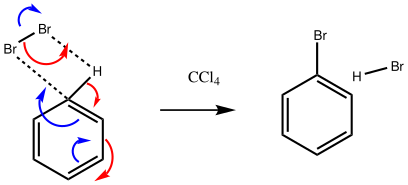
My previous post related to the aromatic electrophilic substitution of benzene using as electrophile phenyl diazonium chloride. Another prototypical reaction, and again one where benzene is too inactive for the reaction to occur easily, is the catalyst-free bromination of benzene to give bromobenzene and HBr. 

br2+benzenebr2+benzene

The “text-book” mechanism involves nucleophilic attack by the benzene on the bromine to form a “Wheland intermediate” (the blue arrows) followed in a clear second step by proton removal by the liberated bromide anion (the red arrows). But one group had other ideas[1], proposing in 2011 that the blue and red arrows conflate into a single concerted process which does NOT involve an explicit Wheland intermediate ion-pair. The text-books would have to be re-written! Paul Schleyer (a co-author of the above) recently contacted me about this reaction, noting that no explicit intrinsic reaction coordinate (IRC) had been reported in the 2011 article. Could I run one to establish that the course of this reaction really was concerted and “Whelandless“?

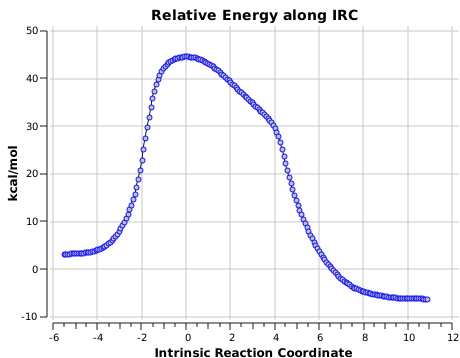
The level of theory used before[1] is rb3lyp/6-311++G(2d,2p)/SCRF=CCl4 (the r is added here, for reasons that will soon become apparent) and the animation[2] is shown below, which is followed by repeating the calculation with addition of a D3-type dispersion correction to the core rb3lyp DFT method.[3] Without dispersion, the final HBr becomes H-bonded to the other Br, but with dispersion it instead forms a π-facial hydrogen bond to the aromatic ring. Even for such a small molecule, one can easily observe the effects of dispersion forces!

Br2+benzeneBr2+benzene+D3

br2-d3br2+d3

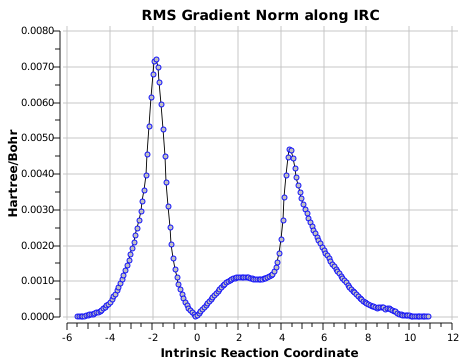
The reaction is indeed concerted, but it is also asynchronous as revealed by the characteristic feature at IRC ~3. We might conclude that the Wheland does make an appearance in this mechanism, but only as a “hidden intermediate“. It is a relay-race with the blue arrows above running first, and then without pause smoothly passing the baton of the reaction to the red arrows. The activation energy is high, commensurate with a reaction that in fact does not take place at normal temperatures.

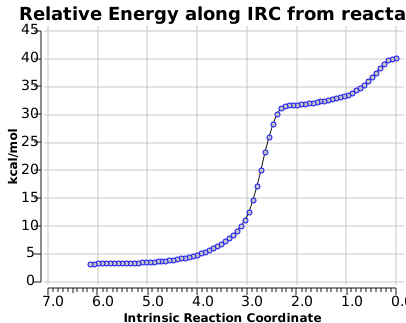
Boris Galabov (another co-author[1]) then pointed out to me that the spin-restricted wavefunction (r above) at the transition state is unstable with respect to spin unrestriction.[4] This means that some open-shell biradical character is present at least at the transition state if not the entire pathway. So what would happen if the IRC were repeated using ub3lyp instead of rb3lyp? Would allowing for biradical character still retain the concerted nature?

Before showing the results, I have to point out that the uIRC must be done in two stages, the first being the path to the transition state and the second the path down from it to products (the program I use to show the profiles is not capable has errors when splicing the two together). First the upward path[5] (without dispersion) ending at the TS, followed by the path down.[6]

urE

IRC profile for spin-unrestricted pathway 
ufE
ufG

On the approach path, the spin expectation operator <S2> starts at zero but at IRC ~2.0 it becomes non-zero (biradical character forms) and this persists to the transition state and to IRC ~-2 beyond on the downward path before reverting again to a closed shell singlet. In this central region we have what amounts to a “hidden biradicaloid intermediate”. Since the C-Br bond formation and the subsequent C-H bond cleavage are NOT synchronous, we also retain the hidden Wheland characteristics. So this system is perhaps best described as having a “hidden biradicaloid Wheland intermediate“; a double whammy in the vernacular.  The non zero value of  <S2> lowers the activation barrier from  ~42 kcal/mol to  ~37 kcal/mol, but it still remains a barrier which is insurmountable at room temperatures.

The bottom line remains: according to this quantum model, the reaction is concerted, as originally claimed.[1]


The technical explanation is as follows. The IRC is started at the TS, and the SCF is converged using a broken-symmetry keyword guess(mix). As the IRC proceeds on the path down to reactant, each step uses the density matrix from the previous step as the initial SCF guess. This ensures that the unrestricted wavefunction remains symmetry broken if that is the lowest energy solution. Before the reactant is reached however, <S2> has collapsed to zero. Then the forward path is started, again from the TS. However, the program continues to use the last density matrix and hence <S2> continues to be zero for this entire path. Hence the reason for performing two separate IRC calculations, to ensure that the correct value of <S2> is achieved on both pathways.


References

  1. J. Kong, B. Galabov, G. Koleva, J. Zou, H.F. Schaefer, and P.V.R. Schleyer, "The Inherent Competition between Addition and Substitution Reactions of Br<sub>2</sub> with Benzene and Arenes", Angewandte Chemie International Edition, vol. 50, pp. 6809-6813, 2011. https://doi.org/10.1002/anie.201101852
  2. H.S. Rzepa, "Gaussian Job Archive for C6H6Br2", 2014. https://doi.org/10.6084/m9.figshare.956223
  3. H.S. Rzepa, "Gaussian Job Archive for C6H6Br2", 2014. https://doi.org/10.6084/m9.figshare.956247
  4. M.J. Dewar, S. Olivella, and H.S. Rzepa, "MNDO study of ozone and its decomposition into (O2 + 0)", Chemical Physics Letters, vol. 47, pp. 80-84, 1977. https://doi.org/10.1016/0009-2614(77)85311-6
  5. H.S. Rzepa, "Gaussian Job Archive for C6H6Br2", 2014. https://doi.org/10.6084/m9.figshare.958784
  6. H.S. Rzepa, "Gaussian Job Archive for C6H6Br2", 2014. https://doi.org/10.6084/m9.figshare.958785

Patterns of behaviour: serendipity in action for enantiomerisation of F-S-S-Cl

Thursday, September 19th, 2013

Paul Schleyer sent me an email about a pattern he had spotted, between my post on F3SSF and some work he and Michael Mauksch had done 13 years ago with the intriguing title “Demonstration of Chiral Enantiomerization in a Four-Atom Molecule“.[1] Let me explain the connection, but also to follow-up further on what I discovered in that post and how a new connection evolved.FSSF3-gen

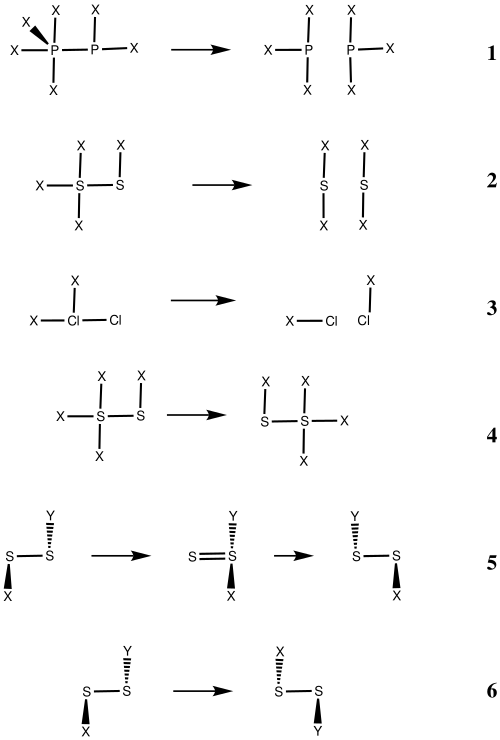
The prologue (or prequel). Reaction 2 is the path for decomposing the dimer of SF2 (X=F) to two monomers. In the previous post I (eventually) found the transition state for this process, with a relatively low energy barrier. As a mechanistic type, it is known as a reductive elimination (the reverse would be a oxidative addition) since the S atom on the left is reduced from a formal oxidation state of S(IV) to S(II) (or vice versa). Analogues of this reaction are 1 and 3. But before I managed to locate the transition state for reaction 2, I accidentally found the transition state for reaction 4. This retains the S-S bond (at the transition state, this bond is actually shorter than in reactant/product), and is what might be called a two-electron pericyclic redox reaction, since the S on the left is reduced to S(II) and the S on the right is oxidised to S(IV). I have not yet found whether this actually represents a new mechanistic type or not; it does not appear to have a name (should it be called periredox? Or redoxocyclic?). The lesson to be learnt here is that nature normally indulges in the (more or less) lowest energy route to a given target, but quantum chemists have the advantage that they can discover “chemistry in the clouds”; patterns of behaviour requiring too much energy to be seen in the real world and hence permanently hidden from us. But that does not mean we cannot learn chemistry from them.

Thus isomeric reaction 4 is very much higher in energy than 2. But it is what triggered Paul’s memory. Reaction 5 is related both to 4 in that it involves a [1,2] hydrogen shift of X (retaining the S-S bond) followed by a second [1,2] shift of Y. It is also related to 2 since it involves in effect an oxidative addition (by a lone pair) to an S-X bond to generate S(IV), followed by a reductive elimination back to S(II) to regenerate the enantiomer of the reactant (it is thus a two-step redox reaction). Thus if X and Y are different in 5, then all three of the species shown above are themselves chiral, and hence the reaction is indeed a “Demonstration of Chiral Enantiomerization in a Four-Atom Molecule”. The point here is that enantiomerisations do not necessarily have to proceed through an achiral transition state, but that the entire enantiomerisation pathway can be continuously chiral.

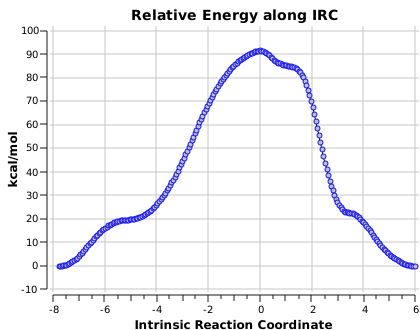
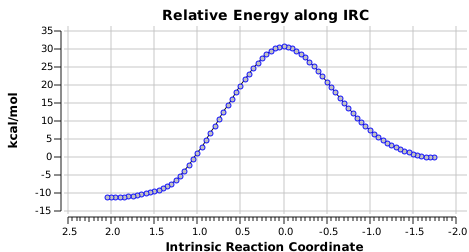
That was the intro! Now follows my calculated intrinsic reaction coordinate (ωB97XD/6-311G(d,p) for reaction 5.[2] My first attempt at the transition state was to use 2 as a template (rather than 4, which was far higher in energy). Well, talk about unexpected! The migration of X=Cl is 16.7 kcal/mol lower than X=F.  No problem there. Next, the IRC for X=F. The overall process certainly enantiomerises the two chiral gauche conformations, but without transposing X and Y, and not involving an intermediate S(IV) species as shown in reaction 5 (i.e. it goes directly, via reaction 6). 

FSSCl

But look at that energy! Way too high (above the clouds in fact). And although the start and end species are identical (apart from being enantiomers) the energy profile is far from being symmetrical. 

FSSClE

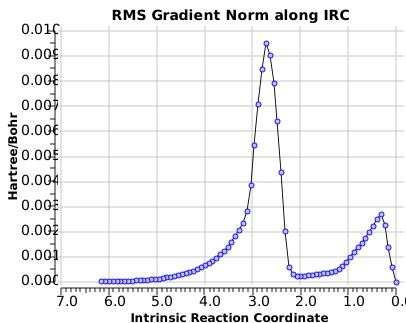
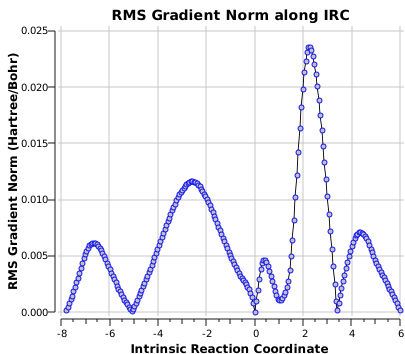
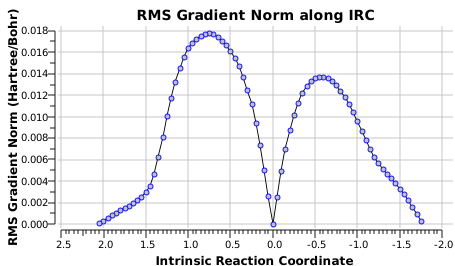
As for the gradient norms, where to begin? The TS as always is at IRC =0.0 But in between it and the start and end points one can see no less than THREE “hidden intermediates“. Two of them are in fact exactly cis (IRC=3.5) and trans (IRC = 5.0) planar forms of F-S-S-Cl. At these points, the pathway is clearly achiral! The third (IRC = 1.0) is a fascinating species in which the S-S bond is largely broken and it is bridged by an F. So this pathway involves S-S cleavage, just like 2. It is entirely serendipitous; no-one in their right mind would actually set out to find it! 

FSSClEG

Well, since 2 as a template led to the above, what happens when 4 is used? For F migrating[3] a barrier 11.6 kcal/mol higher is found than for Cl migrating[4], similar to that previously reported.[1]

FSSClpa

The energy and gradient norm profiles, in comparison to the previous, are uneventful.[5] The S-S bond stays intact throughout, and it is shorter at the transition state (1.846Å) than at  the start (1.950Å) or the end (1.874Å). This reaction has got its feet on the ground, rather than its head in the clouds!

FSSClpaG FSSClpaE

I am reminded of stories our crystallographer here tells. Students bring him synthesized molecules for their structures to be determined, and quite frequently it’s not at all the compound that was desired. For not a few highly focused students, the compound is quickly forgotten, even though it may have turned out to be very unusual. Likely it will not be deposited into a repository. And how many compounds that might otherwise have been the catalyst for new and unusual discoveries are thus lost?  So never throw away an unexpected result (yes, even a calculation).  There is probably something you could learn from it! 

References

  1. P.V.R. Schleyer, and M. Mauksch, "Demonstration of Chiral Enantiomerization in a Four‐Atom Molecule", Angewandte Chemie International Edition, 2000. http://doi.org/d8g2nw
  2. H.S. Rzepa, "Gaussian Job Archive for ClFS2", 2013. https://doi.org/10.6084/m9.figshare.801866
  3. H.S. Rzepa, "Gaussian Job Archive for ClFS2", 2013. https://doi.org/10.6084/m9.figshare.803096
  4. H.S. Rzepa, "Gaussian Job Archive for ClFS2", 2013. https://doi.org/10.6084/m9.figshare.802822
  5. H.S. Rzepa, "Gaussian Job Archive for ClFS2", 2013. https://doi.org/10.6084/m9.figshare.802821