As the title hints, I have been here before. The SN1 solvolysis mechanism of t-butyl chloride was central to the flourishing of physical organic chemistry from the 1920s onwards, and it appears early on in most introductory lecture courses and text books. There we teach that it is a two-stage mechanism. Firstly the C-Cl bond heterolyses to form a stable tertiary carbocation intermediate, which in a second stage reacts with nucleophile (water) to form e.g. t-butanol. This is contrasted with the SN2 mechanism, where these two stages are conflated into a single concerted process, involving no intermediates. Here I explore an intrinsic reaction coordinate for the hydrolysis of t-butyl chloride which attempts to tease out whether this simple picture is realistic.
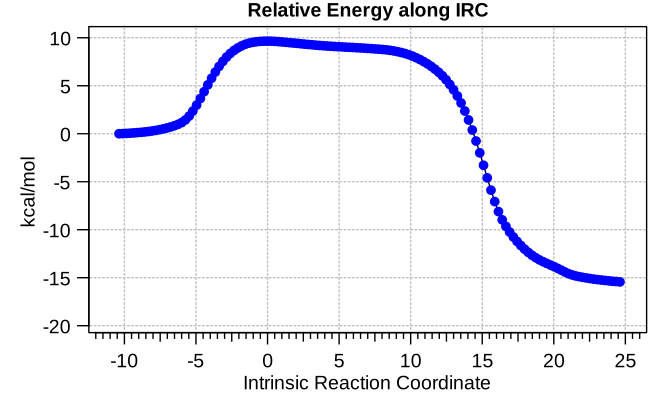
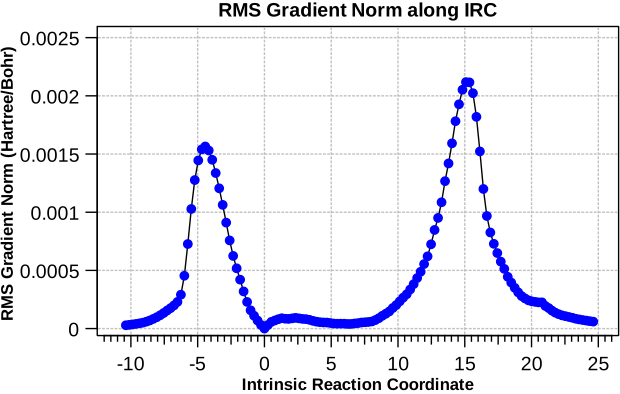
The basic model comprises t-butyl chloride and 16 water molecules. These are subjected to a wB97XD/6-311G(d,p) calculation with a continuum water solvent field applied throughout. The functional is different from the one I used last time, since I wanted one that included dispersion attractions. The basis set is also better.
- At IRC -5, we see the first stage of the mechanism, the cleavage of the C-Cl bond. Note how the methyl flag waves at this point.
- At IRC 0.0 we have the transition state, at which point the gradients of the energy are precisely zero.
- At IRC +5, we have a very slight dip/inflexion point in the potential, but the gradients do not actually go to zero. This is the point that would correspond to the formation of a carbocation. The SN1 mechanism proper would require a formal intermediate here, with zero gradients.
- At IRC ~+15, we see a new phenomenon, the attack of a water molecule on the “almost” carbocation, reflecting in fact an SN2 mechanism.
- At IRC ~+20, we see a slight blip, which in fact is reorganisation of the hydrogen bonds of the surrounding water molecules, accompanying the formation of an entirely ionic chloride.
- All these processes are animated in the diagram below, where you can see other features:
- Note the methyl rotation just after the Cl has started leaving, and another when the C-O bond formation is completing.
- Note the hydrogen bond reorganisation near the end.

(anharmonic) IRC for hydrolysis of t-butyl chloride. Click to see the (harmonic) transition normal mode.
As I noted in my previous post on the topic, there are other complexities, involving potential proton transfers amongst the water molecules which is not reflected here. As is not unusual in science, sometimes the most apparently simple processes turn out to have hidden complexities.