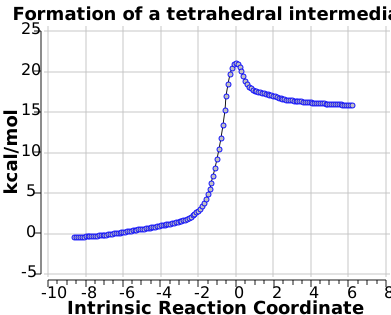
Posts Tagged ‘Tutorial material’

Mechanistic arrow pushing. A proposed addition to its rules.

Wednesday, June 12th, 2013

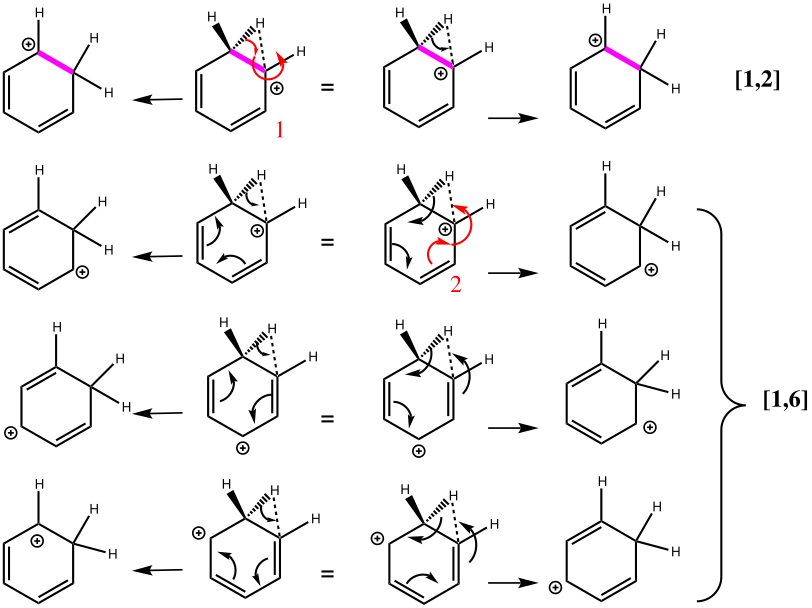
A little while ago, I set out some interpretations of how to push curly arrows. I also appreciate that some theoretically oriented colleagues regard the technique as neither useful nor in the least rigorous, whereas towards the other extreme many synthetically minded chemists view the ability to push a reasonable set of arrows for a proposed mechanism as of itself constituting evidence in its favour.[1] Like any language for expressing ideas, the tool needs a grammar (rules) and a vocabulary, and perhaps also an ability to carry ambiguity. These thoughts surfaced again via a question asked of me by a student: “is the mechanism for the hydrogens in protonated benzene whizzing around the ring a [1,2] or a [1,6] pericyclic sigmatropic shift?”. 
12-v-16

I must first explain the “rules” I used to produce the diagram above.

  1. An arrow comprises an (approximate) electron pair (in the Lewis sense)
  2. And it operates on individual resonance/valence bond representations
  3. A sigmatropic shift is a pericyclic reaction, and one should be able to construct arrows which both conjugate in a cyclic sense, and
  4. can be represented in either a clockwise or anticlockwise cyclic direction.
  5. As a thermally allowed pericyclic reaction, we will endeavour to use only 4n+2 electrons in our arrow pushing (an aromatic transition state for the process). For this molecule, it means either 2 or 6 electrons (one or three arrows, again in a Lewis sense)
  6. I also use the convention in which the origin of an arrow is the midpoint of a (covalent) bond, and its destination the midpoint of a forming (covalent) bond, represented above by a dashed line. Here, I am guided by the observation that the “coordinates” of the start and the end-point of such arrows can be obtained by QTAIM theory, which provides them via so-called “bond critical points“.

So for the 2-electron/one arrow process, we should be able to come up with two schemes, one clockwise, one anticlockwise. It is really easy to show one of these (rhs for [1,2]), but it is a true head-scratching time to produce the other. I have done so via the red arrow in representation 1 above. More of this in a moment.

For the 6-electron/3-arrow alternative, we start with three distinct resonance/valence bond forms for the pentadienyl cation, and each of these again should manifest as arrows drawn in both clock directions. Five cause no problems, but the sixth again carries a very odd arrow (red, representation 2 above). 

What does that red arrow mean? Dissected into smaller steps, it consists of two arrows, joined head to tail in a daisy chain, but still clearly counting as just a single electron pair. The first component of this portmanteau arrow represents the formation of benzene and a proton, the geometry of which in fact resembles the formation of a π-complex between the two. The second component represents the breakdown of this complex to reform a classical carbocation. The daisy-chained arrow passes through the middle of a single bond, which achieves the necessary cyclic conjugation, and then continues on its way to a final destination at the mid-point (approximately) of a C-H bond. If it is drawn as a simple arrow (avoiding passage through the single bond), the mechanism “does not work”; the wrong carbon gets connected to the shifting hydrogen.

So this little thought experiment has produced a new entry in the arrow-pushing vocabulary; a daisy-chained arrow, and a new rule which requires it to pass through (interact with) a bond, but without stopping. To ask if this invention has any connection to reality, its time for a full-blown quantum mechanical computation of that transition state (an IRC for which[2] is shown below).

12-16

If you look very carefully at how the representation of the magenta-coloured  bond (scheme above) changes during the IRC, you will note that at the transition state it is shorter (1.439Å) than at the start or the end (1.462Å). The magenta-bond order at the transition state is 1.17 (Wiberg), and the bond is clearly “involved” in the process. This does hint that the representation 1 or 2 in the scheme above may be making a significant contribution. None of the other forms of arrow pushing in that scheme involve any arrows either starting or ending at that bond, so they cannot account for the change in bond length/bond order of that bond. We interpret the daisy-chained arrow as carrying more information than a normal arrow would regarding the timing of the process; the path up to the transition state is represented by the first part of the double-headed arrow, and the path down to the product by the second component of that arrow. So up to the first arrow-head, electrons are moving towards the magenta bond, and in the second phase, they continue their journey by moving onwards and away from that bond.

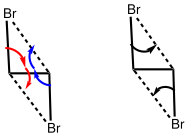
Is there any prior art (precedent) for such a process? We actually, there is a very nice example; the dyotropic rearrangement of a 1,2-dibromoethane (which was recently experimentally shown to be a concerted process with double inversion of configuration at the carbon bearing the bromine[3]). That too involves a transition state where the central C-C bond is shorter (1.41Å) than either reactant or product (1.50Å)[4]. We may represent the arrows involved in the process in two ways in a manner analogous to structure 1 above, but this time involving two daisy-chained arrows (red and blue below). This does not necessarily imply that at the transition state a full triple bond has formed, merely that as the arrow “passes through the bond” its bond-order temporarily increases. The conventional arrow pushing on the right implies no change whatsoever in that central bond. Like any set of (non-equivalent) resonance representations, these two sets of arrows taken together may be a more realistic one than either individually for the overall reaction.
dyotropic

I conclude with some thoughts about another question: is the process a [1,2] or a [1,6] sigmatropic pericyclic reaction? If you regard pericyclic reactions as manifestations of aromatic transition states, you could equally well ask; given a choice, does a system prefer 2-electron or 6-electron aromaticity (both of course conform to a 4n+2 rule). To try to cast light on that, I show the computed NICS values at two points (magenta spheres), the first being the RCP (ring critical point in a QTAIM analysis of the transition state) of the 6-ring and the second the BCP of the 3-ring. If we calibrate this to -10 ppm (for benzene itself), the 6-ring is seen to be only modestly aromatic on this scale. The 3-ring (corresponding to 2-electron aromaticity) appears to be highly aromatic, but this is probably due to a large contribution from local shielding effects; NICS for small rings is not reliable. But this does constitute a hint that, all other aspects being equal, 2-electron aromaticity may have the edge over 6-electron aromaticity. Clearly more work is needed on this aspect.

12-16

Whether or not you believe in the theoretical rigour of arrow pushing (or indeed its absence of rigour), I would suggest that it has proved a useful tool, a mechanism if you like, for helping to think about how reactions proceed. Certainly I also consider it desirable, if arrow pushing is to continue as a useful tool up to its 100th birthday, that some effort should be devoted to updating it for 21st century chemistry.

[5]

References

  1. M.J. Gomes, L.F. Pinto, P.M. Glória, H.S. Rzepa, S. Prabhakar, and A.M. Lobo, "N-heteroatom substitution effect in 3-aza-cope rearrangements", Chemistry Central Journal, vol. 7, 2013. https://doi.org/10.1186/1752-153x-7-94
  2. H.S. Rzepa, "Gaussian Job Archive for C6H7(1+)", 2013. https://doi.org/10.6084/m9.figshare.717183
  3. D. Christopher Braddock, D. Roy, D. Lenoir, E. Moore, H.S. Rzepa, J.I. Wu, and P. von Ragué Schleyer, "Verification of stereospecific dyotropic racemisation of enantiopure d and l-1,2-dibromo-1,2-diphenylethane in non-polar media", Chemical Communications, vol. 48, pp. 8943, 2012. https://doi.org/10.1039/c2cc33676f
  4. I. Fernández, M.A. Sierra, and F.P. Cossío, "Stereoelectronic Effects on Type I 1,2‐Dyotropic Rearrangements in Vicinal Dibromides", Chemistry – A European Journal, vol. 12, pp. 6323-6330, 2006. https://doi.org/10.1002/chem.200501517
  5. "C6H7(1+)", 2013. http://hdl.handle.net/10042/24720

Secrets of a university lecturer: 1981-1983.

Thursday, June 6th, 2013

Many moons ago, when I was a young(ish) lecturer, and much closer in time to my laboratory roots of organic synthesis, I made some chemistry videos. One of these has resurfaced, somewhat  (to me at least) unexpectedly. Nowadays of course, such demonstrations are all carried out using virtual simulations (Flash animations etc) as the equipment itself becomes less common.

trolley-pump

If anyone knows of any other unlikely video demonstrations, made by people who rarely practised what they were preaching, do leave a comment!

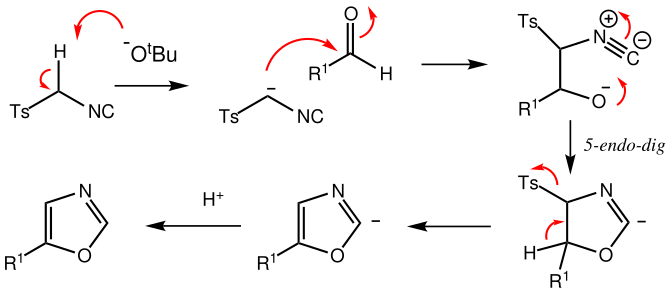
Mechanism of the Van Leusen reaction.

Wednesday, May 29th, 2013

This is a follow-up to comment posted by Ryan, who asked about isocyanide’s role (in the form of the anion of tosyl isocyanide, or TosMIC): “In Van Leusen, it (the isocyanide) acts as an electrophile”. The Wikipedia article (recently updated by myself) shows nucleophilic attack by an oxy-anion on the carbon of the C≡N group, with the isocyanide group acting as the acceptor of these electrons (in other words, the electrophile). In the form shown below, one negatively charged atom appears to be attacking another also carrying a negative charge. Surely this breaks the rules that like charges repel? So we shall investigate to see if this really happens.

VL1

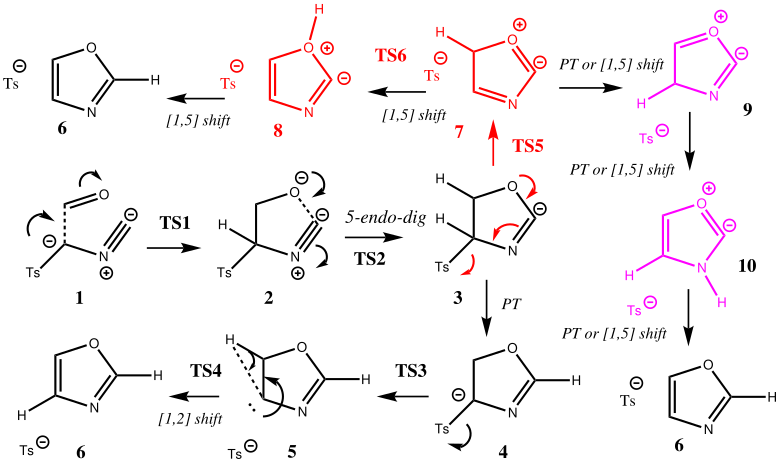
I have extended the basic mechanistic scheme below to investigate other possibilities (with the aim of probing using the ωB97XD/6-311G(d,p)/scrf=methanol theory to see how realistic any of these routes might be). Starting from 1, the product 6 can now be formed by three routes from the common intermediate 3 (there may be other routes of course not considered here). The relative computed free energies of these various species, and some of the transition states leading to them are listed in the table below.VanLeusen

The path leading to 3 is very low energy which may in part also be due to my using formaldehyde for expediency rather than a substituted aldehyde (I have to confess to having taken another short-cut, which is to miss out any counter-ion to the TosMIC anion). The first step is defined by TS1, which forms a C-C bond, and results in the intermediate 2. TS2 corresponds to O…C bond formation to yield 3. Getting to 3 is thus a two-stage process, or a stepwise cycloaddition. The alternative would have been to regard TosMIC anion as a 1,3-dipole (isoelectronic with e.g.diazomethane) in which these two steps are conflated into a concerted cycloaddition across the carbonyl group.

TS2 is the interesting step from the point of view of the question raised above. It has a very low free-energy barrier from either 1 or 2, and therefore appears very facile. The angle of approach by the oxy-anion to the triple bond (we established it as being triple in the previous post) is 87°. This angle explains why a carbon bearing (a formal) negative charge easily accepts attack on itself by a nucleophile (i.e. acting as an electrophile). The formal negative charge originates from an electron lone pair located in an sp-hybrid orbital lying along the axis of the C≡N bond. But the nucleophilic attack is occurring at 87° to this axis, putting electrons into the empty π* orbital of the C≡N bond. So in effect the two apparent “negative charges” in the mechanistic schemes above are orthogonal to each-other, which in a simplistic way explains why the diagram is not actually contradictory. The reaction itself is an example of Baldwin’s rules in action; one of these is that a 5-endo-dig cyclisation is allowed. This angle of attack and Baldwin’s rules may of course be related.

System Relative free energy
1 0.0
TS1 1.2
2 -3.1
TS2 1.7
3 -14.4
4 -16.7
TS3 5.9
5 4.0
TS4 17.7
6 -51.1
TS5 -2.3
7 -3.1
TS6 57.0
“8” -37.4
“9” -36.2
10 -25.3

After 3, the mechanism can channel several ways. For example, a proton transfer can precede the departure of Ts to give 4 and thence 5. The final [1,2] shift to form the product 6 has a relatively high barrier however. More likely is the Ts group heterolysing off 3 via TS5 to form 7. All that is now needed is to shift a proton from 7 to form 6, and this also can take several routes. One would involve base/acid catalysed deprotonation/reprotonation. Alternatively, the hydrogen could migrate by a series of uncatalysed [1,5]sigmatropic hydrogen shifts via e.g. 8, 9 or 10. In fact, the calculated geometries of both 8 and 9 show that the C…O bond is broken, thus forming entirely different products. Thus the most probable route is indeed a simple catalysed proton transfer from 7.

This computational exploration of the mechanism has reinforced the accepted one, and hopefully cast some light on why an isocyanide can appear to act as an electrophile.

Another Woodward pericyclic example dissected: all is not what it seems.

Wednesday, May 22nd, 2013

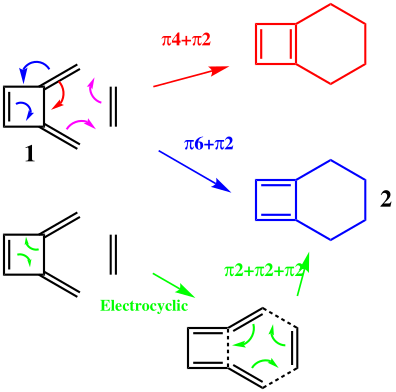
Here is another example gleaned from that Woodward essay of 1967 (Chem. Soc. Special Publications (Aromaticity), 1967, 21, 217-249), where all might not be what it seems.

W

Woodward notes that the reaction between the (highly reactive) 1 does not occur. This is attributed to it being a disallowed π6 + π2 cycloaddition (blue + magenta arrows) rather than an allowed π4 + π2 cycloaddition (red + magenta arrows). So what does quantum mechanics say? Well, a disallowed reaction can be broken down into several stages, each involving fewer electrons, and this is what happens. The first of these stages becomes instead an electrocyclic ring opening (green arrows) in which one σ-bond from the cyclobutene is “borrowed” to form a bis-allene intermediate, before being returned to the original bond in the second stage.

Electrocyclic ring opening[1]
we
w-e w-eG
2+2+2 cycloaddition[2]
w2+2+2
w2+2+2 w2+2+2G

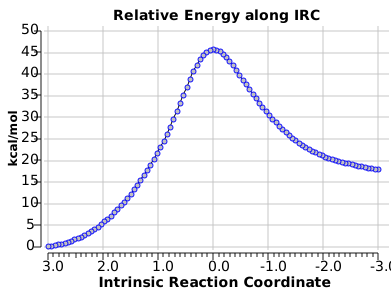
The first transition state for ring opening proceeds in the appropriate Woodward-Hoffmann conrotatory mode, and has a free energy barrier of ~ 45 kcal/mol. This is still 46.1 kcal/mol lower than the very unfavourable second step, which involves a 2+2+2 cycloaddition. Both are formally symmetry-allowed reactions, they just have very high barriers to reaction which accounts for the non-occurance experimentally. Of course, one interpretation of the WH rules is that any pericyclic with a high barrier could be regarded as forbidden, but in this case not on the grounds of symmetry.

References

  1. H.S. Rzepa, "Gaussian Job Archive for C8H10", 2013. https://doi.org/10.6084/m9.figshare.705831
  2. H.S. Rzepa, "Gaussian Job Archive for C8H10", 2013. https://doi.org/10.6084/m9.figshare.705830

Transition states for the (base) catalysed ring opening of propene epoxide.

Wednesday, May 8th, 2013

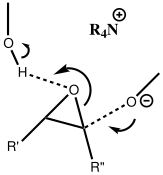
The previous post described how the acid catalysed ring opening of propene epoxide by an alcohol (methanol) is preceded by pre-protonation of the epoxide oxygen to form a “hidden intermediate” on the concerted intrinsic reaction pathway to ring opening. Here I take a look at the mechanism where a strong base is present, modelled by tetramethyl ammonium methoxide (R4N+.OMe), for the two isomers R=Me; R’=Me, R”=H and R’=H, R”=Me.

pe-base

As noted before[1], with alkoxide the dominant product is R’=Me, R”=H. A ωB97XD/6-311G(d,p)/SCRF=methanol) calculation of ΔΔG298 for the transition state for the process indeed favours this outcome, by 1.3 kcal/mol.[2],[3] This corresponds to ~90:10 for R’=Me, R”=H/R’=H, R”=Me. The barrier in this case is significantly smaller (~8 kcal/mol) than was observed for the route catalysed by trifluoracetic acid (~13 kcal/mol). From this emerges a possible explanation for the odd result I noted in the previous post; namely that the transition state ΔΔG for the pure water catalysed reaction was 1.7 kcal/mol lower for the formation of 2-alkoxy-1-propanol than for 1-alkoxy-2-propanol (i.e. of R’=H, R”=Me vs R’=Me, R”=H), whereas experiment showed the dominant product was the latter. But the pure water bimolecular rate contains contributions not only from water acting as catalyst but also from the background [H+] and [HO] rates as well (pKa methanol ~ 15.5, pKa water ~ 15.7). Of these three bimolecular rates, it is clear that the fastest is going to be the HO catalysed one, and so it seems likely that the experimental result in pure water actually arises from catalysis by the [HO] term and not by [H2O] itself.

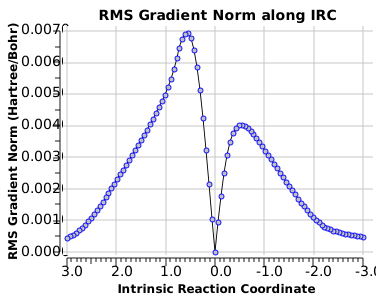
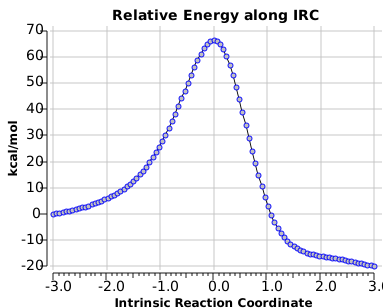
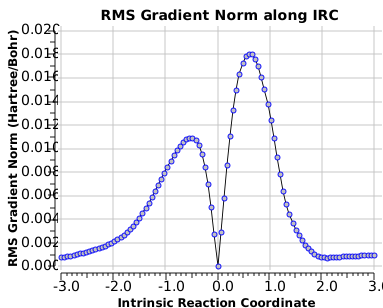
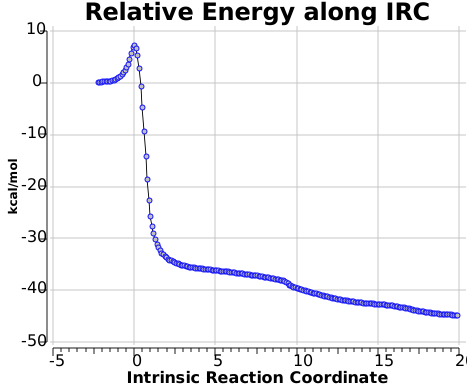
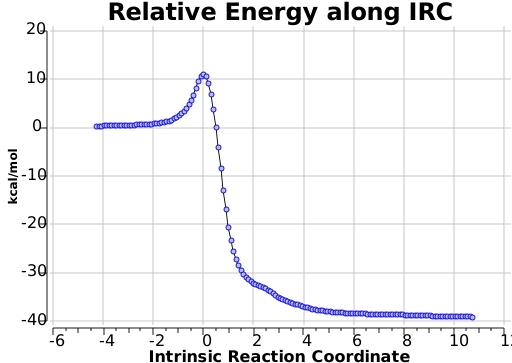
The next task is to show how realistic the conventional “arrow pushing” for the reaction (shown above) actually is. Remember how, with acid catalysis, an IRC showed a proton transfer preceding the transition state. In contrast, the pure water mediated reaction showed no such pre-transfer, and instead revealed a hidden zwitterionic or ion-pair like intermediate occurring only AFTER the transition state. The MeO catalysed reaction is similar, except of course that with the above models ion-pairs are present both at the start and end of the reaction, with the possibility of a third hidden ion pair occurring somewhere along the reaction pathway. The reactant ion pair of course does have to morph into the product ion pair by virtue of a proton transfer, and this occurs AFTER the transition state is passed, not before.

  R’=Me, R”=H R’=H, R”=Me
ΔΔG  0.0 +1.3

IRC

animation

 pe-base-obs  pe-base

IRC

energies

 pe-base-obs pe-base

IRC

Grad

 pe-base-obsG pe-baseG
doi: [4] [5]

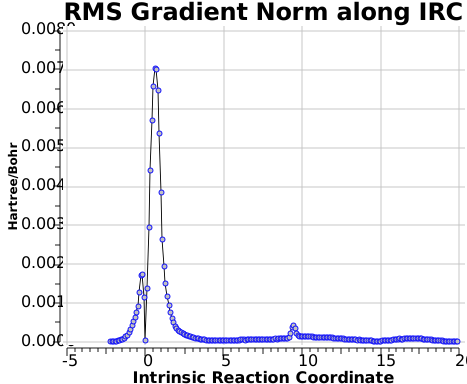
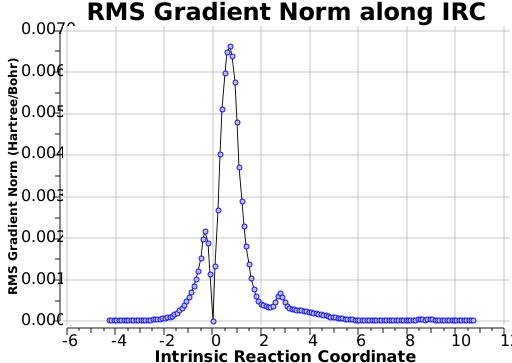
 The post-transition state proton transfer occurs driven by the need to minimise the charge separation in the ion-pair; a contact ion-pair is always likely to be more stable than a separated ion pair. For R’=H, R”=Me, a primary alkoxide is the initial product. This is relatively unstable, and so quite quickly (at about IRC 2.5) the system proceeds to acquire a proton from the adjacent methanol to reform a contact ion-pair. For R’=Me, R”=H, a secondary alkoxide is formed, which proves somewhat tardier in acquiring that proton, at IRC 9.5 in fact! Up to that point of course, the secondary alkoxide anion is a “hidden intermediate“, albeit very much on the verge of becoming a proper intermediate.

This third post on the topic I think ties up some of the loose ends, and seems to cast some interesting new light on what, at face value, seems a very simple organic reaction. There is, I think, still much to learn about such “simple” reactions.


References

  1. H.C. Chitwood, and B.T. Freure, "The Reaction of Propylene Oxide with Alcohols", Journal of the American Chemical Society, vol. 68, pp. 680-683, 1946. https://doi.org/10.1021/ja01208a047
  2. H.S. Rzepa, "Gaussian Job Archive for C9H25NO3", 2013. https://doi.org/10.6084/m9.figshare.698066
  3. H.S. Rzepa, "Gaussian Job Archive for C9H25NO3", 2013. https://doi.org/10.6084/m9.figshare.698172
  4. H.S. Rzepa, "Gaussian Job Archive for C9H25NO3", 2013. https://doi.org/10.6084/m9.figshare.700641
  5. H.S. Rzepa, "Gaussian Job Archive for C9H25NO3", 2013. https://doi.org/10.6084/m9.figshare.700652

How to predict the regioselectivity of epoxide ring opening.

Sunday, April 28th, 2013

I recently got an email from a student asking about the best way of rationalising epoxide ring opening using some form of molecule orbitals. This reminded me of the famous experiment involving propene epoxide.[1]

propenoxide

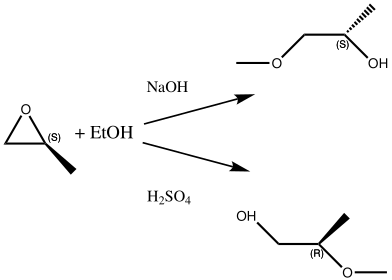
In the presence of 0.3% NaOH, propene epoxide reacts with ethanol at the unsubstituted carbon (~82% compared with 56% in pure water, with retention of configuration at the other carbon) but in 1.3% H2SO4, the predominant product involves attack of ethanol at the more substituted carbon (presumably with inversion of configuration at that carbon). There are many ways of modelling this, but here I choose a simple one; inspecting the energy of the lowest unoccupied orbital (the one that will interact with the lone pair orbital on the incoming nucleophile). The issue is what kind of orbital that should be? The best to choose in this sort of situation is a localized orbital, an NBO in fact.

NaOH H2SO4
Energy

Energy 0.353 au

Energy

Energy -0.004 au


Energy

Energy 0.347 au

 
Energy

Energy -0.061 au

In NaOH solutions (where protonation of the epoxide oxygen is suppressed), the lowest energy unoccupied NBO is the O-C  σ* orbital involving the unsubstituted carbon, but where the oxygen is protonated, it now becomes the O-C σ* orbital involving the substituted carbon.

One can also teach a simpler heuristic, namely that protonation of the epoxide encourages the early formation of a carbocation, and that the most substituted such cation is the most stable. In the absence of protonation, some (small) contribution from an incipient alkoxy anion favours the alkoxide formed on the more stable carbon.

References

  1. H.C. Chitwood, and B.T. Freure, "The Reaction of Propylene Oxide with Alcohols", Journal of the American Chemical Society, vol. 68, pp. 680-683, 1946. https://doi.org/10.1021/ja01208a047

Feist’s acid. Stereochemistry galore.

Thursday, April 4th, 2013

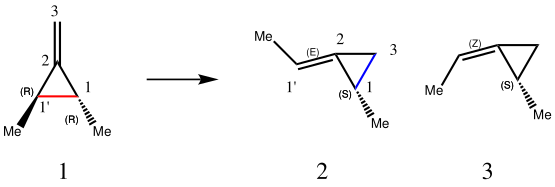
Back in the days (1893) when few compounds were known, new ones could end up being named after the discoverer. Thus Feist is known for the compound bearing his name; the 2,3 carboxylic acid of methylenecyclopropane (1, with Me replaced by CO2H). Compound 1 itself nowadays is used to calibrate chiroptical calculations[1], which is what brought it to my attention. But about four decades ago, and now largely forgotten, both 1 and the dicarboxylic acid were famous for the following rearrangement that gives a mixture of 2 and 3[2]. I thought I might here unpick some of the wonderfully subtle stereochemical analysis that this little molecule became subjected to.
methylene-cyclopropane

Feist’s acid and its derivatives have attracted constant attention a long while. The rearrangement shown above was identified in 1932, and by 1960 it was shown that 1 as a pure enantiomer gave products 2 and 3 that retained optical activity (read about all of this here[3]). By 1970 attention had shifted to the absolute configurations of the molecules involved and the mechanism of the reaction. Why? Woodward and Hoffmann had just put pericyclic reactions on the map[4], and one of the examples they cited was this one. They identified the reaction as a [1,3]sigmatropic rearrangement (the red bond breaks and the blue bond forms) and their new theory required the configuration at carbon 1 to be inverted by the reaction, from (R) to (S) as shown above. In order to verify this, von Doering (who had been a student of Woodward’s) subjected Feist’s ester and its rearrangement products to a series of chemical transformations[4] in order to relate its absolute stereochemistry to that of known compounds. Gajewski[5] took over and with four further chemical transformations, was able to assert that the (S,S)-dimethyl enantiomer of 1 has an optical rotation of -59.4°. The molecules 2 and 3 were subjected to a similar stereochemical analysis, which finally revealed them to have (S) configuration at the carbon labelled 1, thus confirming the inversion of configuration so confidently predicted by Woodward and Hoffmann. I imagine Feist never imagined the molecule which came to bear his name would be used as a confirmation of one of the pivotal 20th century stereochemical theories of organic chemistry.

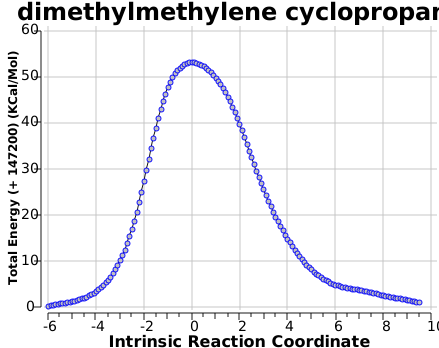
So what of the mechanism for this rearrangement? Well, a ωB97XD/6-311G(d,p) calculation reveals the transition state as shown below. The two dashed lines represent the red and blue bonds shown schematically above, and these bond either break or form to the same face of the three-carbon allyl fragment (suprafacially), but that carbon 1 (pointed to by the blue arrow below) suffers an Sn2-like inversion of configuration (= antarafacial) as proven by all that hard chemical synthesis noted above. methylene-cyclopropane

The reaction is concerted, with a predicted barrier of around 50 kcal/mol. This is a little higher than the measured value of ~41 kcal/mol[6]. This is taken to indicate that the wavefunction has a contribution from an open-shell biradical configuration (indeed it is unstable at the transition state, having a lower energy triplet state) which would lower the barrier by 10-15 kcal/mol. The observation that the product has NOT lost optical activity suggests that the mechanism cannot simply be that of an achiral biradical, and that a “memory” of the starting stereochemical configuration must be retained throughout the dynamic reaction trajectory. Modelling such a process requires more sophisticated (multi-configuration) techniques than the one I have illustrated here, and quite probably a smattering of reaction dynamics thrown in. It goes to show that quite innocent looking molecules can be devils to model (both for their reaction dynamics and their optical activity!). 

methylenecyclopropane[7] methylenecyclopropane

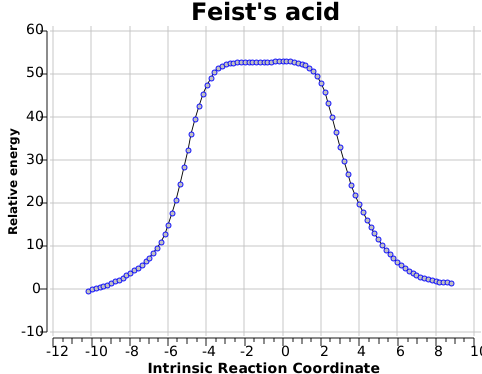
Feist’s acid itself reveals a profile for the computed rearrangement IRC (ωB97XD/6-311G(d,p)/SCRF=water) that I have never seen as prominently before, a veritable table top of a mountain! This feature (and its reflection in the gradient norm) is a nice example of a “hidden intermediate”. In this case, it is a species which may be either biradical or zwitterionic, and which sits atop the mountain plateau. It can drop (bifurcate) off the mountain to form either compound 2 or 3, a process which must likely be best studied by dynamics rather than purely as an intrinsic reaction coordinates.

feist1

Click for 3D


[8]
feiste
 feistg


See comment here.

References

  1. E.D. Hedegård, F. Jensen, and J. Kongsted, "Basis Set Recommendations for DFT Calculations of Gas-Phase Optical Rotation at Different Wavelengths", Journal of Chemical Theory and Computation, vol. 8, pp. 4425-4433, 2012. https://doi.org/10.1021/ct300359s
  2. J.J. Gajewski, "Hydrocarbon thermal degenerate rearrangements. IV. Stereochemistry of the methylenecyclopropane self-interconversion. Chiral and achiral intermediates", Journal of the American Chemical Society, vol. 93, pp. 4450-4458, 1971. https://doi.org/10.1021/ja00747a019
  3. W. von E. Doering, and H. Roth, "Stereochemistry of the methylenecyclopropane rearrangement", Tetrahedron, vol. 26, pp. 2825-2835, 1970. https://doi.org/10.1016/s0040-4020(01)92859-5
  4. R.B. Woodward, and R. Hoffmann, "The Conservation of Orbital Symmetry", Angewandte Chemie International Edition in English, vol. 8, pp. 781-853, 1969. https://doi.org/10.1002/anie.196907811
  5. J.P. Chesick, "<b>Kinetics of the Thermal Interconversion of 2-Methylmethylenecyclopropane and Ethylidenecyclopropane</b>", Journal of the American Chemical Society, vol. 85, pp. 2720-2723, 1963. https://doi.org/10.1021/ja00901a009
  6. H.S. Rzepa, "Gaussian Job Archive for C6H10", 2013. https://doi.org/10.6084/m9.figshare.670632
  7. H.S. Rzepa, "Gaussian Job Archive for C6H6O4", 2013. https://doi.org/10.6084/m9.figshare.674600

Feist's acid. Stereochemistry galore.

Thursday, April 4th, 2013

Back in the days (1893) when few compounds were known, new ones could end up being named after the discoverer. Thus Feist is known for the compound bearing his name; the 2,3 carboxylic acid of methylenecyclopropane (1, with Me replaced by CO2H). Compound 1 itself nowadays is used to calibrate chiroptical calculations[1], which is what brought it to my attention. But about four decades ago, and now largely forgotten, both 1 and the dicarboxylic acid were famous for the following rearrangement that gives a mixture of 2 and 3[2]. I thought I might here unpick some of the wonderfully subtle stereochemical analysis that this little molecule became subjected to.
methylene-cyclopropane

Feist’s acid and its derivatives have attracted constant attention a long while. The rearrangement shown above was identified in 1932, and by 1960 it was shown that 1 as a pure enantiomer gave products 2 and 3 that retained optical activity (read about all of this here[3]). By 1970 attention had shifted to the absolute configurations of the molecules involved and the mechanism of the reaction. Why? Woodward and Hoffmann had just put pericyclic reactions on the map[4], and one of the examples they cited was this one. They identified the reaction as a [1,3]sigmatropic rearrangement (the red bond breaks and the blue bond forms) and their new theory required the configuration at carbon 1 to be inverted by the reaction, from (R) to (S) as shown above. In order to verify this, von Doering (who had been a student of Woodward’s) subjected Feist’s ester and its rearrangement products to a series of chemical transformations[4] in order to relate its absolute stereochemistry to that of known compounds. Gajewski[5] took over and with four further chemical transformations, was able to assert that the (S,S)-dimethyl enantiomer of 1 has an optical rotation of -59.4°. The molecules 2 and 3 were subjected to a similar stereochemical analysis, which finally revealed them to have (S) configuration at the carbon labelled 1, thus confirming the inversion of configuration so confidently predicted by Woodward and Hoffmann. I imagine Feist never imagined the molecule which came to bear his name would be used as a confirmation of one of the pivotal 20th century stereochemical theories of organic chemistry.

So what of the mechanism for this rearrangement? Well, a ωB97XD/6-311G(d,p) calculation reveals the transition state as shown below. The two dashed lines represent the red and blue bonds shown schematically above, and these bond either break or form to the same face of the three-carbon allyl fragment (suprafacially), but that carbon 1 (pointed to by the blue arrow below) suffers an Sn2-like inversion of configuration (= antarafacial) as proven by all that hard chemical synthesis noted above. methylene-cyclopropane

The reaction is concerted, with a predicted barrier of around 50 kcal/mol. This is a little higher than the measured value of ~41 kcal/mol[6]. This is taken to indicate that the wavefunction has a contribution from an open-shell biradical configuration (indeed it is unstable at the transition state, having a lower energy triplet state) which would lower the barrier by 10-15 kcal/mol. The observation that the product has NOT lost optical activity suggests that the mechanism cannot simply be that of an achiral biradical, and that a “memory” of the starting stereochemical configuration must be retained throughout the dynamic reaction trajectory. Modelling such a process requires more sophisticated (multi-configuration) techniques than the one I have illustrated here, and quite probably a smattering of reaction dynamics thrown in. It goes to show that quite innocent looking molecules can be devils to model (both for their reaction dynamics and their optical activity!). 

methylenecyclopropane[7] methylenecyclopropane

Feist’s acid itself reveals a profile for the computed rearrangement IRC (ωB97XD/6-311G(d,p)/SCRF=water) that I have never seen as prominently before, a veritable table top of a mountain! This feature (and its reflection in the gradient norm) is a nice example of a “hidden intermediate”. In this case, it is a species which may be either biradical or zwitterionic, and which sits atop the mountain plateau. It can drop (bifurcate) off the mountain to form either compound 2 or 3, a process which must likely be best studied by dynamics rather than purely as an intrinsic reaction coordinates.

feist1

Click for 3D


[8]
feiste
 feistg


See comment here.

References

  1. E.D. Hedegård, F. Jensen, and J. Kongsted, "Basis Set Recommendations for DFT Calculations of Gas-Phase Optical Rotation at Different Wavelengths", Journal of Chemical Theory and Computation, vol. 8, pp. 4425-4433, 2012. https://doi.org/10.1021/ct300359s
  2. J.J. Gajewski, "Hydrocarbon thermal degenerate rearrangements. IV. Stereochemistry of the methylenecyclopropane self-interconversion. Chiral and achiral intermediates", Journal of the American Chemical Society, vol. 93, pp. 4450-4458, 1971. https://doi.org/10.1021/ja00747a019
  3. W. von E. Doering, and H. Roth, "Stereochemistry of the methylenecyclopropane rearrangement", Tetrahedron, vol. 26, pp. 2825-2835, 1970. https://doi.org/10.1016/s0040-4020(01)92859-5
  4. R.B. Woodward, and R. Hoffmann, "The Conservation of Orbital Symmetry", Angewandte Chemie International Edition in English, vol. 8, pp. 781-853, 1969. https://doi.org/10.1002/anie.196907811
  5. J.P. Chesick, "<b>Kinetics of the Thermal Interconversion of 2-Methylmethylenecyclopropane and Ethylidenecyclopropane</b>", Journal of the American Chemical Society, vol. 85, pp. 2720-2723, 1963. https://doi.org/10.1021/ja00901a009
  6. H.S. Rzepa, "Gaussian Job Archive for C6H10", 2013. https://doi.org/10.6084/m9.figshare.670632
  7. H.S. Rzepa, "Gaussian Job Archive for C6H6O4", 2013. https://doi.org/10.6084/m9.figshare.674600

The mechanism of ester hydrolysis via alkyl oxygen cleavage under a quantum microscope

Tuesday, April 2nd, 2013

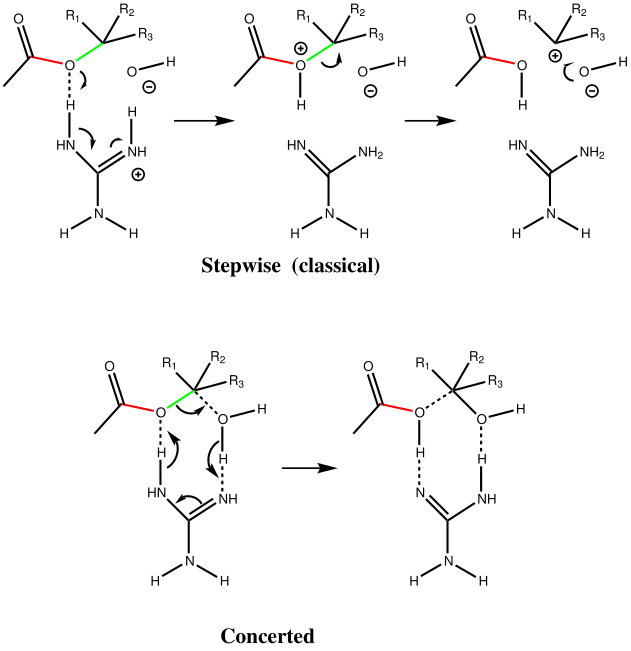
My previous dissection of the mechanism for ester hydrolysis dealt with the acyl-oxygen cleavage route (red bond). There is a much rarer[1] alternative: alkyl-oxygen cleavage (green bond) which I now place under the microscope.

alkyl-ester

Here, guanidine is used as a general acid/base, which results in a reasonable activation barrier for the hydrolysis (using pure water as the catalyst led to high barriers). What I will call the classical stepwise route is shown above, with charge-separated structures in abundance (particularly at the allyl group, where the possibility of forming a carbocation at this centre is central to the mechanism). My philosophy here is to allow quantum mechanics to decide whether to separate charge or not (in effect, only it is allowed decisions about where electrons are). So one can start with a concerted mechanism in which no formal charges are separated, and by subjecting them to wB97XD/6-311G(d,p)/SCRF=water calculation, decide where and if charges develop.

There are two distinct possibilities; hydrolysis with either retention or inversion of configuration at the alkyl group. The results for the transition states are shown below, with the analogous energy for acyl-oxygen cleavage shown for comparison.

Relative energies for hydrolysis of Alkyl acetate
R Acyl-oxygen Alkyl O,inversion Alkyl-O,retention
all H 0.0 15.3 42.5
Me 0.0 16.6 35.0
Me,Me 0.0 16.3 18.2
Me,Me,Me 0.0 16.4 (14.4)  ?

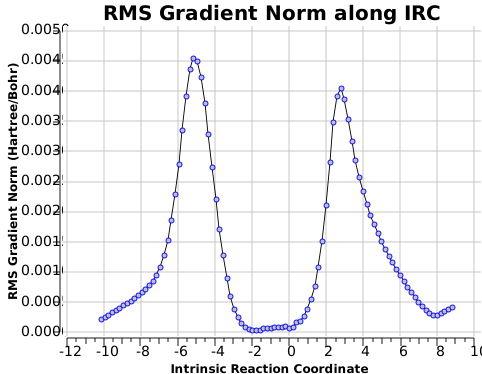
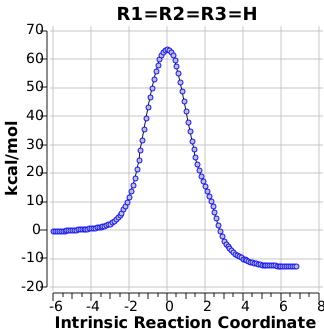
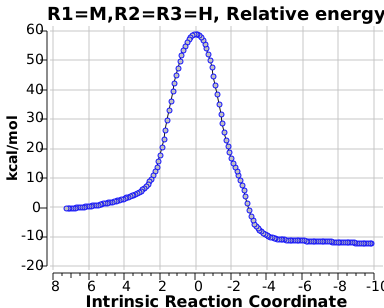
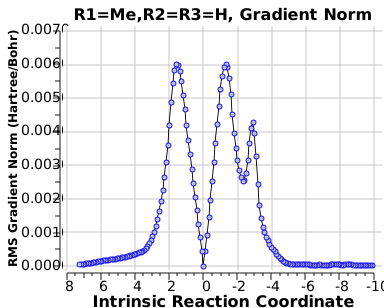
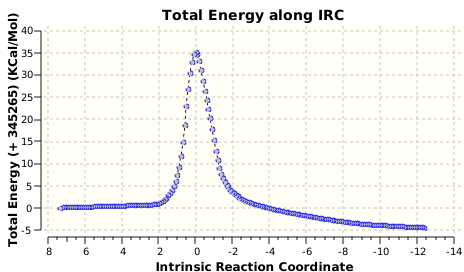
For R1=R2=R3=H and R1=Me,R2=R3=H proceeding with retention of configuration. The IRCs are as below, which reveal a “hidden intermediate” feature (visible as a dip in the gradient norm), which corresponds to a charge-separated zwitterionic intermediate immediately preceding the proton transfer. In other words, the non-charge-separated cyclic/concerted mechanism shown above is “interrupted” by charge separation in a hidden way during, and in an explicit way at the final stage, preferring finally to form the ionic ion-pair rather than neutral acetic acid and guanidine.

alkylg[2] alkylg
alkylMe[3] alkylMe
alkylMeG

For R1=R2=Me, R3=H, we have a change. The C-O bond lengths at the solvolysing methyl increase as the substitution at this carbon increases, e.g. 2.2Å (R=H) → 2.4Å (R1=Me) as the transition state becomes more carbocation like. With increasing carbocationic character, the acidity of the adjacent C-H group increases, until with R1=R2=Me, R3=H it has become acidic enough to be abstracted by any close-by base (in this instance, guanidine). Experimentally, the aqueous hydrolysis of t-butyl acetate is known to proceed with alkyl-oxygen cleavage[1]. In the computational model, the solvolysis mechanism has been intercepted by an elimination mechanism: the two potential surfaces under these circumstances are very close and they merge to ensure a different outcome of the reaction. You can see this effect below;

alkylG-Me2

Click for 3D.

The reaction barrier also drops as the degree of substitution at the migrating carbon increases. At time of writing, no TS had been located for R1=R2=R3 (? in table above) but as you can see the trend could easily take it below the energy for acyl oxygen hydrolysis.

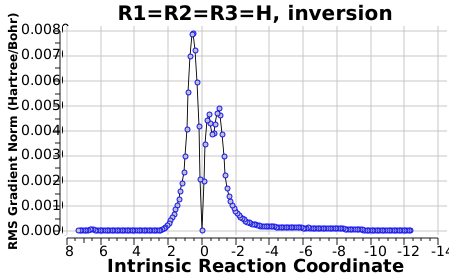
A much lower energy route however is apparently available for the alkyl-oxygen solvolysis route. For R1=R2=R3=H, it proceeds much more favourably with inversion of configuration, an intramolecular Sn2 solvolysis in fact.

alkylg-inva alkylg-inva
alkylg-invg

That for R1=R2=R3 shows a qualitative difference, in resembling the mechanism for Sn1 solvolysis of t-butyl chloride in water. In this case the bond O-C bond labelled 2.3 is cleaving, whilst the C-O bond labelled 3.1 has not yet started to form; an apparently classical Sn1 solvolysis. But take a look at the two atoms labelled [1] and [2]; this C-H bond is also set up to be abstracted by an adjacent base (the carboxylate), and indeed an IRC shows the formation of butene (not solvolysis) to be the final outcome. 

Click for 3D.

Click for 3D.

Unlike the mechanism involving retention of configuration, the barrier for the inversion route does not change much as the substitution at the carbon increases, remaining above the acyl-oxygen solvolysis for even the t-butyl ester (R1=R2=R3=Me). 

To summarise what we might have learnt. Firstly, the mechanism of the apparently simple hydrolysis of alkyl esters of ethanoic (acetic) acid suddenly got much more complicated. It might seem that solvolysis of the O-alkyl bond can proceed with either inversion or retention of configuration at the alkyl carbon; if the latter then the barrier seems to decrease as the stabilisation of the carbocation at this carbon increases. But for both retention and inversion, the mechanistic pathway can easily be subverted by a different reaction involving the formation of an alkene.

One starts to suspect that the model I am using here to study this reaction may be either the wrong kind, or certainly incomplete. In the absence of any explicit water (merely a continuum model acting on its behalf), it seems more basic molecules bound in by hydrogen bonds (guanidine or carboxylate) can take over by acting as bases and abstracting hydrogens from a H-C bond adjacent to the carbocationic centre. In order to redirect the mechanism onto the solvolysis pathway, one probably needs to have a few more explicit water molecules hanging around (so to speak) so as to quickly intercept the forming carbocation, before it can release its proton to the base. In other words, one needs to set up a more statistical model, in which the probability of the desired outcome is in part determined by the probability of having a favourable molecule adjacent to the reacting centre. Who would have thought such a basic prototype for organic chemistry could be so tricky to pin down in a computational model! 

References

  1. C.A. Bunton, and J.L. Wood, "Tracer studies on ester hydrolysis. Part II. The acid hydrolysis of tert.-butyl acetate", Journal of the Chemical Society (Resumed), pp. 1522, 1955. https://doi.org/10.1039/jr9550001522
  2. H.S. Rzepa, "Gaussian Job Archive for C4H13N3O3", 2013. https://doi.org/10.6084/m9.figshare.663603
  3. H.S. Rzepa, "Gaussian Job Archive for C5H15N3O3", 2013. https://doi.org/10.6084/m9.figshare.663619

A sideways look at the mechanism of ester hydrolysis.

Friday, March 29th, 2013

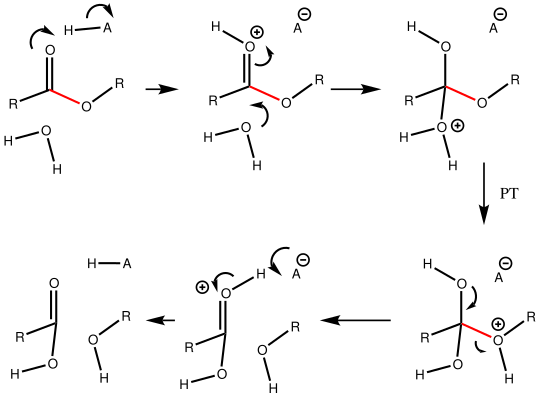
The mechanism of ester hydrolysis is a staple of examination questions in organic chemistry. To get a good grade, one might have to reproduce something like the below. Here, I subject that answer to a reality check.

actyl

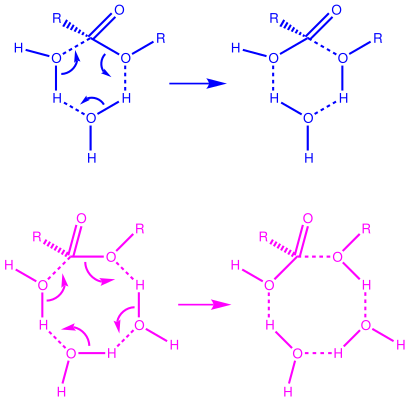
In this scheme, HA is a general acid, R=Me, and the net result is to break what is called the acyl-oxygen bond (red). The mechanism is actually incomplete, since the label PT designates a proton-transfer (the mechanism for which is left somewhat undefined). Additionally, a lot of charges come and go and five steps or so are involved. So a student might be tempted to “fast-track” the whole process. Below I show two such fast-tracks (I prefer to say simplifications):

acetyl-ester1

In the blue mechanism, the role of HA is actually played by one water molecule, and a second water is assisting the PT step (a far more thorough analysis of the mechanism can be found in this reference[1]). The reaction is bimolecular in ester and the HA (=water in this case). The third water would make it a termolecular reaction overall, but if the reaction takes place in water itself than [H2O] would be constant. It would correspond to what the text books call AAC2 since we consider one molecule as an acid HA. But, one could look at it differently and consider the second water as a nucleophile generated by concurrent deprotonation (by the first water). This would make it a BAC2 type. It turns out that if one makes the mechanism cyclic, the AAC2 and BAC2 annihilate each other in effect to create a single (peri)cyclic mechanism (which has no well known name, but might be referred to as the co-operative pathway). Such a mechanism can be extended using a third water molecule (magenta diagram); I will come to the reason for including that presently.

Why would one want to even consider such mechanisms? Because, if you look carefully, you will see no charges! Charge separation (= large dipole moment) takes energy. It is normally thought that this energy is more than compensated for by additional solvation (a process which is implicit rather than explicitly shown in text-book diagrams). But if you do not generate charge separation, you might not need that solvation energy. I will turn to quantum mechanics to try to decide what might be viable (I hesitate to use the term “going on”). 

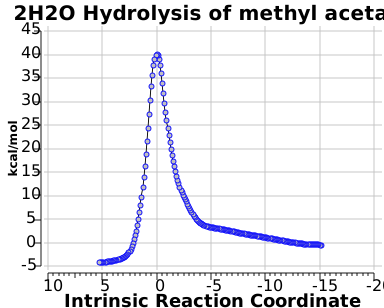
A ωB97XD/6-311G(d,p)/SCRF=water model (in which solvation is approximately included as a continuum model) calculation yields the following for the blue mechanism.

acyl-ester[2] acyl-ester
  1. Points to note are that it is concerted, in other words the quantum mechanics tells us that all the bonds CAN make and break in a single concerted process within a single kinetic step.
  2. The mechanism has an uncanny resemblance to the nucleophilic aromatic substitution I reported a couple of posts ago! It resembles an Sn2 displacement at an sp2 centre. Such juxtaposition of these two mechanisms is also not found in text-books. Recollect that with such aromatic substitution, it was possible to get both cncerted and stepwise mechanisms, depending on the substituents. Perhaps the same might be possible here?
  3. However, the energy barrier for the process with the substituents shown above (~45 kcal/mol) is rather too high (the experimental value is estimated as >22 kcal/mol[1]). There may be at least three reasons for this;
    • (a) a better solvation model would be needed to lower the energy,
    • (b) the angles subtended at the transferring protons are strained (they optimally should be linear) and
    • (c) water is a very poor general acid (or base)!

But as an answer in an examination, would the blue mechanism actually be wrong? You will have to ask the instructor setting the question how they might respond to that, although these authors[1] certainly conclude that such a concerted mechanism is the more “correct”, at least for hydrolysis in water without added acid or base.

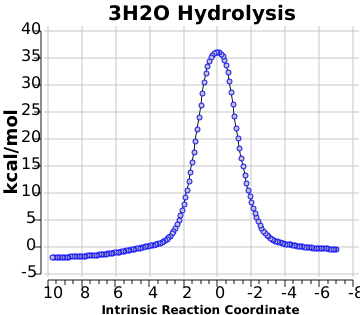
Point  (b) above can be addressed by adding another water molecule, as per the magenta mechanism so as to enlarge the ring and reduce the angular strain. But before I present the results, I need to “normalise” the system by ALSO adding one (solvating) water molecule to the blue route, as below, so that we can directly compare the energies of the blue and magenta pathways.

Click for  3D.

Click for 3D.

The result is a larger ring where the angular strain is clearly reduced. There is an entropic penalty for introducing that third water molecule, but despite this the free energy comes out 5.5 kcal/mol lower, and the activation barrier is also lower (~37 kcal/mol, still rather higher than experiment). It has been reported that incorporation of a 4th water molecule further improves matters[1].

acetyl3H2Oa[3]  acetyl3H2Oa

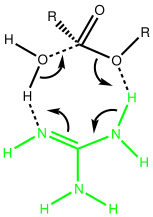
We can also address both points (b) and (c) above by replacing HA=H2O by HA=guanidiniumH+ (green), a better general acid. This polar modification introduces the ability for the system to better sustain charge separations, and indeed the initial product is now an ion pair tetrahedral intermediate (methoxide anion and guanidinium cation) carrying a dipole moment of 14.5D, an increase over the value for the transition state with three waters, 9.7D. The barrier (~21 kcal/mol) has gone in the opposite direction, decreasing significantly compared to the water catalysed reaction. The tetrahedral intermediate sits in an energy well of ~4 kcal/mol.

acetyl-ester2

acet-g[4] acet-g

A second transition state exiting the tetrahedral intermediate has a free energy barrier[5] about 2.5 kcal/ol lower than the one entering it.

Click for  3D.

Click for 3D.

What might we have learnt? That ester hydrolysis using pure water could proceed through a cyclic and concerted transition state, involving three (or perhaps more) water molecules passing a proton baton along the chain, and in the process avoiding any large build up of charge separation. Replace two of these waters with say guanidine as a general acid/conjugate base capable of conjugatively stabilising charge-separated species and the mechanism changes to a stepwise reaction involving a dipolar tetrahedral intermediate sitting in a relatively shallow energy well.

Not possibly a picture that we might expect a student sitting an introductory examination in organic chemistry to reflect in its entirety, but also one that perhaps the text-books might start to hint at? Or: at some stage, armed  merely with a “smart watch-cum-supercomputer”, a student taking such an exam might respond by performing the calculations described here as their submitted answer? Well, not for a year or two perhaps. But it has to be said that everything you see in this post was performed over less than two days of elapsed time, so these “reality checks” are not that time-consuming. Whether you choose to believe them or not of course is another matter.

References

  1. Z. Shi, Y. Hsieh, N. Weinberg, and S. Wolfe, "The neutral hydrolysis of methyl acetate — Part 2. Is there a tetrahedral intermediate?", Canadian Journal of Chemistry, vol. 87, pp. 544-555, 2009. https://doi.org/10.1139/v09-011
  2. H.S. Rzepa, "Gaussian Job Archive for C3H10O4", 2013. https://doi.org/10.6084/m9.figshare.661351
  3. H.S. Rzepa, "Gaussian Job Archive for C3H12O5", 2013. https://doi.org/10.6084/m9.figshare.661789
  4. H.S. Rzepa, "Gaussian Job Archive for C4H13N3O3", 2013. https://doi.org/10.6084/m9.figshare.661791
  5. H.S. Rzepa, "Gaussian Job Archive for C4H13N3O3", 2013. https://doi.org/10.6084/m9.figshare.661799