Posts Tagged ‘chemical transformations’

Organocatalytic cyclopropanation of an enal: (computational) assignment of absolute configurations.

Saturday, September 1st, 2018

I am exploring the fascinating diverse facets of a recently published laboratory experiment for undergraduate students.[1] Previously I looked at a possible mechanistic route for the reaction between an enal (a conjugated aldehyde-alkene) and benzyl chloride catalysed by base and a chiral amine, followed by the use of NMR coupling constants to assign relative stereochemistries. Here I take a look at some chiroptical techniques which can be used to assign absolute stereochemistries (configurations).

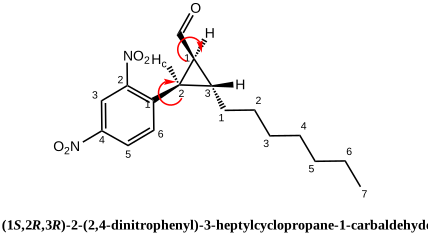
I will focus on the compound 4a, the major stereochemical product of this student laboratory reaction, with the stereochemistry as represented in e.g. the abstract of the main article[1] and shown below with added CIP (Cahn-Ingold-Prelog) notation as (1S,2R,3R);

Its enantiomer (not shown in the article) is of course;
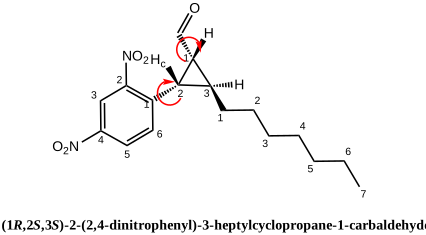
In the article supporting information[1]), the major diasteromer of 4a deriving from use of the S stereoisomer of the prolinol catalyst is reported as having an optical rotation (ORP) [α]D25 of -62.4°, p6 or -58.1°, p5), but the stereo-labels are not added there. On  p1 (“based on a student report”) 4a was however labelled as (1R,2S,3S) and the chirality (S) of the catalyst used was also noted in the adjacent experimental procedure. One might then reasonably match (1R,2S,3S)-4a to the S-catalyst and hence (1S,2R,3R)-4a to the R-catalyst.  However, in a laboratory environment where both S and R catalysts are in circulation, it is always useful to have procedures available for independent checks.

There are two methods of assigning absolute chirality, crystallography and chiroptical spectroscopy. The former does require crystalline samples; the latter can use solutions. To cut to the chase, the former method was used for a related compound where the n-heptyl group above is replaced by a p-chlorophenyl substituent (perhaps because the latter imparts suitable crystallinity). On p S123 of the SI of an earlier article[2] the assignment for the p-chlorophenyl derivative was as (1R,2S,3S)-4a for S-catalyst (see DOI: 10.5517/ccdc.csd.cc1mcqg5 OZAXEU). But this procedure is not entirely foolproof; the stereochemistry is decided by interactions between often bulky substituents at the transition state and it might be that here the p-chlorophenyl derivative has different properties from n-heptyl. Moreover bulk solutions may be different in their composition from single crystals. So it is useful to obtain independent proof.

An absolute assignment procedure based on chiroptical methods was first famously used by Kirkwood in 1951 (the Fischer convention is confirmed as a structurally correct representation of absolute configuration).[3] Such calculations need to take into account e.g. rotational conformers about the two bonds labelled in red above. In the previous post, I had noted variation of up to 2Hz in the calculated 3JHH coupling constants as a result of this mobility. This variation is probably too small to really influence any relative stereochemical interpretations, but is the same true for chiroptical assignments?

In Table 1 we can see whether this is still true for the predicted optical rotation of compound 4a, using two different functionals for the calculation (B3LYP and M062X respectively). The results rather surprised me; a simple bond rotation of an aryl or carbonyl group can invert the sign of the rotation. Clearly the observed optical rotation of -62.4° arises from a suitable combination of different Boltzmann populations of the individual bond rotamers, but to combine these accurately you would need to know the solution populations themselves very accurately and that is quite a challenge. So at this stage, we do not really have totally convincing independent evidence of whether the observed negative optical rotation corresponds to (1S,2R,3R)-4a or to its enantiomer (1R,2S,3S).

Table 1. Calculated Optical rotations for (1S,2R,3R)-4a. 

FAIR Data DOI: 10.14469/hpc/4678

Conformer

ORP [α]D, B3LYP+GD3BJ/Def2-TZVPP/SCRF=chloroform

ORP [α]D, M062X/Def2-TZVPP/SCRF=chloroform

4 +376 +238
3 -335 -301
2 -247 -223
1 +710 +522

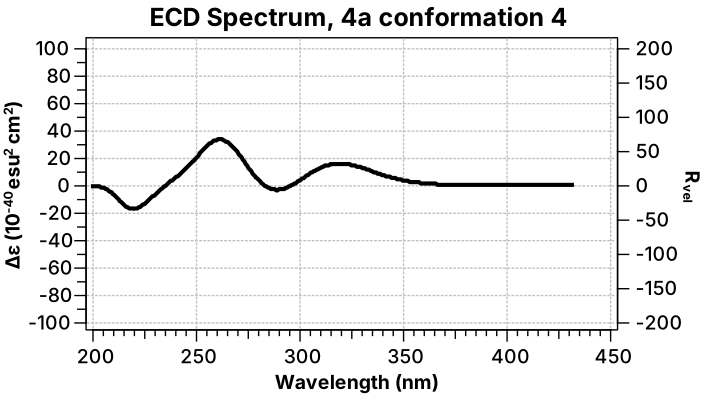
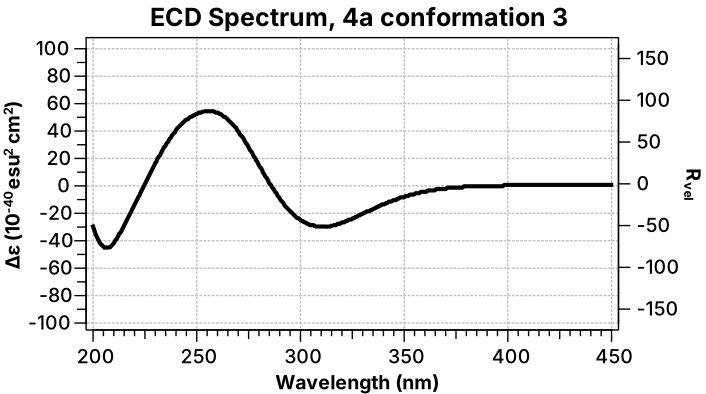
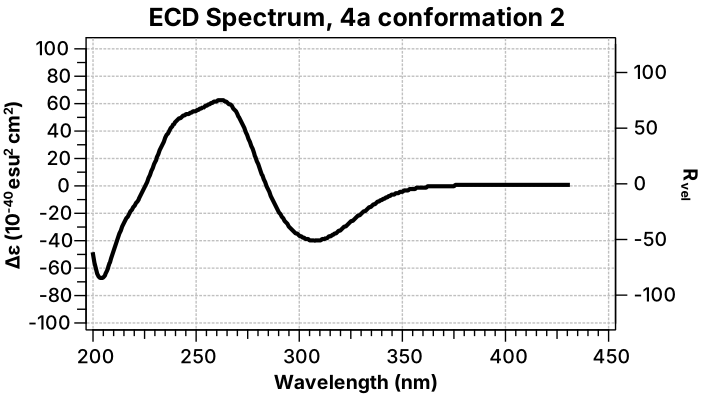
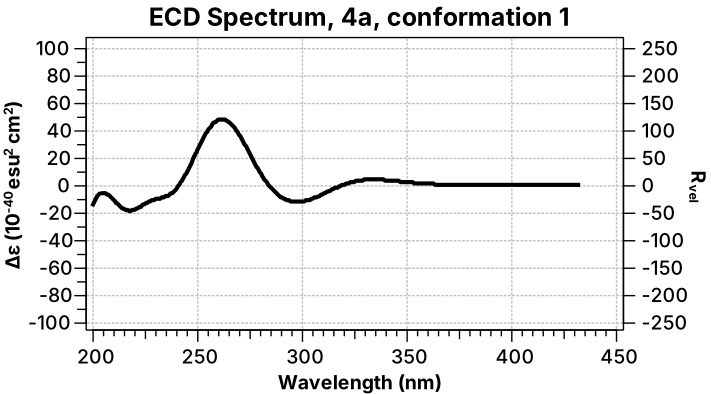
Next, another chiroptical technique, electronic circular dichroism, or ECD. Here, the sign of the difference in absorption of polarized light (Δε), and known at the Cotton effect, characterises the specific enantiomer. The experimental Cotton effect for compound 4a obtained from S-catalyst (known as 3d in the SI, p S142[2]) can be simply summarised as +ve@315nm and -ve@275nm. Comparison with calculated spectra (Figure S17, p S146-7[2])  was performed using a Boltzmann-averaging (albeit based on enthalpies rather than the formally correct free energies), for three significant populations and this procedure matched to (1R,2S,3S).  Since the reported calculations were apparently for gas phase (and replacing n-heptyl with methyl) here I have repeated them in the actual solvent used (acetonitrile) and with the heptyl present. Although the ECD responses can still be severely dependent on the conformation, three of the spectra qualitatively agree that the responses at ~300nm and 260 nm are respectively -ve and +ve. This confirms that (1S,2R,3R)-4a is the wrong enantiomer for S-catalyst and that the correct assignment is therefore (1R,2S,3S), as was indeed reported.[2]

Table 2. Calculated electronic circular dichroism for

 (1S,2R,3R)-4a. FAIR Data DOI: 10.14469/hpc/4678

Conformer

ECD calculation, ωB97XD/Def2-TZVPP

4
3
2
1

It is still true that the overall the fit between chiroptical experiment and theory can be sensitive to the Boltzmann population, as obtained from e.g. ΔΔG = -RT ln [1]/[2]), where 1 and 2 are two different conformers. ΔΔG is a difficult energy difference to compute accurately. Here is a suggested exercise in the statistics of error propagation. How does an error in ΔΔG propagate to the ratio of concentrations of two conformers [1]/[2]? Or, how accurately must ΔΔG be calculated in order to predict conformer populations to say better than 5%.

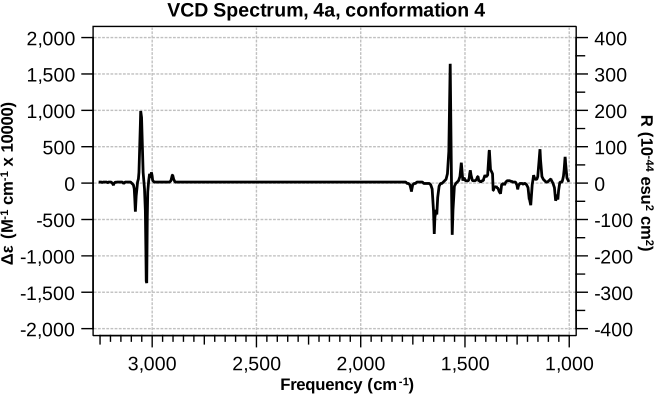
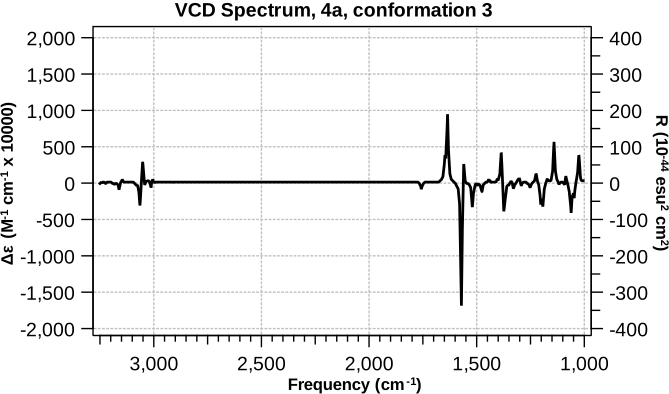
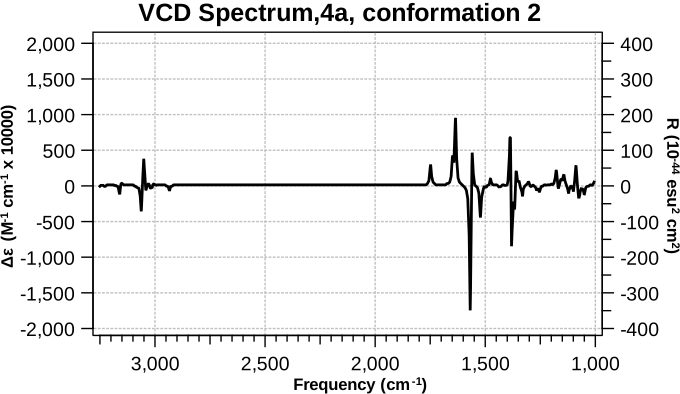
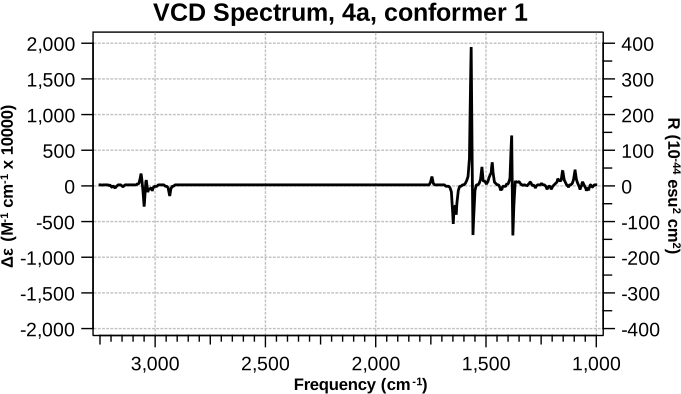
One more go at chiroptics, this time Vibrational Circular Dichroism, or VCD. The nature of the chromophore is different, but the principle is the same as ECD. I have deliberately truncated the spectrum to cut off all vibrations below 1000 cm-1 (these being the modes associated with group rotations) but to no avail, the four conformations all still look too different to avoid doing a Boltzmann averaging.

Table 3. Calculated VCD spectra for (1S,2R,3R)-4a. 

Conformer Spectrum
4
3
2
1

A modern VCD instrument does have one trick up its sleeve for coping with the conformer problem. The sample (as a thin-film) can be annealed down to very low temperatures before the spectrum is recorded. This effectively removes all higher energy forms, leaving just the most stable conformation as the only species present. However, that is an expensive experiment (and instrument!) to use.

There are perhaps some 2 million scalemic molecules (substances where one chiral form is in excess over the mirror image) for which chiroptical properties have been reported, but probably <50,000 crystal structures where absolute configurations have been assigned. Thus the vast majority of absolute configuration assignments have been done either chiroptically or by synthetic correlations (chemical transformations from molecules of known absolute configuration, with the assumption that you know how each transformation affects the chiral centres present). Given some of the difficulties and challenges noted above, it is tempting to conclude that a significant proportion of those 2 million molecules may have been mis-assigned (I once estimated up to 20%). However, we may conclude that the molecules discussed here are safely assigned correctly! 


No CIP-stereolabels appear in the article itself.[1] Perhaps this assignment is omitted in order to provide a student exercise? There are many errors in stereochemical assignments in the literature. A good many of them may be the result of simple sample mis-labelling.[4] The caption to Figure S17 states All the simulations are for the 1R,2R,3S absolute configuration. This is probably an error and should read 1R,2S,3SA correction of ~+15nm is sometimes applied to these values, but not done here.


References

  1. M. Meazza, A. Kowalczuk, S. Watkins, S. Holland, T.A. Logothetis, and R. Rios, "Organocatalytic Cyclopropanation of (<i>E</i>)-Dec-2-enal: Synthesis, Spectral Analysis and Mechanistic Understanding", Journal of Chemical Education, vol. 95, pp. 1832-1839, 2018. https://doi.org/10.1021/acs.jchemed.7b00566
  2. M. Meazza, M. Ashe, H.Y. Shin, H.S. Yang, A. Mazzanti, J.W. Yang, and R. Rios, "Enantioselective Organocatalytic Cyclopropanation of Enals Using Benzyl Chlorides", The Journal of Organic Chemistry, vol. 81, pp. 3488-3500, 2016. https://doi.org/10.1021/acs.joc.5b02801
  3. W.W. Wood, W. Fickett, and J.G. Kirkwood, "The Absolute Configuration of Optically Active Molecules", The Journal of Chemical Physics, vol. 20, pp. 561-568, 1952. https://doi.org/10.1063/1.1700491
  4. H.S. Rzepa, "The Chiro-optical Properties of a Lemniscular Octaphyrin", Organic Letters, vol. 11, 2009. https://doi.org/10.1021/ol901172g
Feist’s acid. Stereochemistry galore.

Thursday, April 4th, 2013

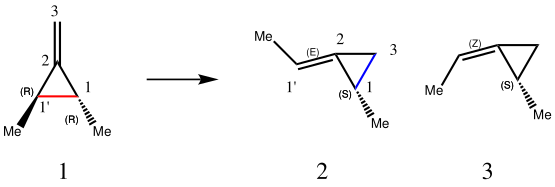
Back in the days (1893) when few compounds were known, new ones could end up being named after the discoverer. Thus Feist is known for the compound bearing his name; the 2,3 carboxylic acid of methylenecyclopropane (1, with Me replaced by CO2H). Compound 1 itself nowadays is used to calibrate chiroptical calculations[1], which is what brought it to my attention. But about four decades ago, and now largely forgotten, both 1 and the dicarboxylic acid were famous for the following rearrangement that gives a mixture of 2 and 3[2]. I thought I might here unpick some of the wonderfully subtle stereochemical analysis that this little molecule became subjected to.
methylene-cyclopropane

Feist’s acid and its derivatives have attracted constant attention a long while. The rearrangement shown above was identified in 1932, and by 1960 it was shown that 1 as a pure enantiomer gave products 2 and 3 that retained optical activity (read about all of this here[3]). By 1970 attention had shifted to the absolute configurations of the molecules involved and the mechanism of the reaction. Why? Woodward and Hoffmann had just put pericyclic reactions on the map[4], and one of the examples they cited was this one. They identified the reaction as a [1,3]sigmatropic rearrangement (the red bond breaks and the blue bond forms) and their new theory required the configuration at carbon 1 to be inverted by the reaction, from (R) to (S) as shown above. In order to verify this, von Doering (who had been a student of Woodward’s) subjected Feist’s ester and its rearrangement products to a series of chemical transformations[4] in order to relate its absolute stereochemistry to that of known compounds. Gajewski[5] took over and with four further chemical transformations, was able to assert that the (S,S)-dimethyl enantiomer of 1 has an optical rotation of -59.4°. The molecules 2 and 3 were subjected to a similar stereochemical analysis, which finally revealed them to have (S) configuration at the carbon labelled 1, thus confirming the inversion of configuration so confidently predicted by Woodward and Hoffmann. I imagine Feist never imagined the molecule which came to bear his name would be used as a confirmation of one of the pivotal 20th century stereochemical theories of organic chemistry.

So what of the mechanism for this rearrangement? Well, a ωB97XD/6-311G(d,p) calculation reveals the transition state as shown below. The two dashed lines represent the red and blue bonds shown schematically above, and these bond either break or form to the same face of the three-carbon allyl fragment (suprafacially), but that carbon 1 (pointed to by the blue arrow below) suffers an Sn2-like inversion of configuration (= antarafacial) as proven by all that hard chemical synthesis noted above. methylene-cyclopropane

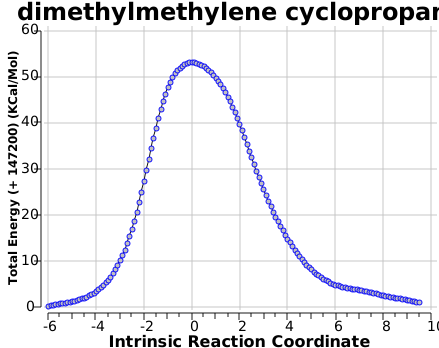
The reaction is concerted, with a predicted barrier of around 50 kcal/mol. This is a little higher than the measured value of ~41 kcal/mol[6]. This is taken to indicate that the wavefunction has a contribution from an open-shell biradical configuration (indeed it is unstable at the transition state, having a lower energy triplet state) which would lower the barrier by 10-15 kcal/mol. The observation that the product has NOT lost optical activity suggests that the mechanism cannot simply be that of an achiral biradical, and that a “memory” of the starting stereochemical configuration must be retained throughout the dynamic reaction trajectory. Modelling such a process requires more sophisticated (multi-configuration) techniques than the one I have illustrated here, and quite probably a smattering of reaction dynamics thrown in. It goes to show that quite innocent looking molecules can be devils to model (both for their reaction dynamics and their optical activity!). 

methylenecyclopropane[7] methylenecyclopropane

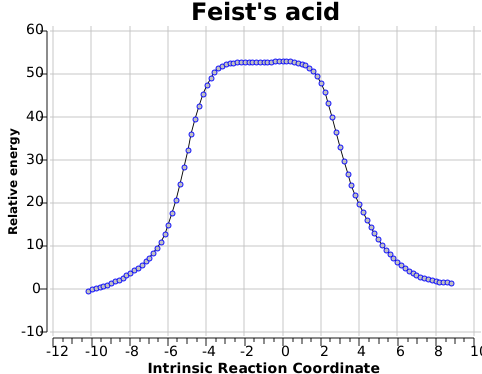
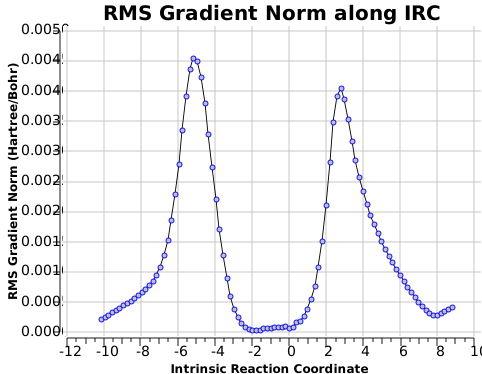
Feist’s acid itself reveals a profile for the computed rearrangement IRC (ωB97XD/6-311G(d,p)/SCRF=water) that I have never seen as prominently before, a veritable table top of a mountain! This feature (and its reflection in the gradient norm) is a nice example of a “hidden intermediate”. In this case, it is a species which may be either biradical or zwitterionic, and which sits atop the mountain plateau. It can drop (bifurcate) off the mountain to form either compound 2 or 3, a process which must likely be best studied by dynamics rather than purely as an intrinsic reaction coordinates.

feist1

Click for 3D


[8]
feiste
 feistg


See comment here.

References

  1. E.D. Hedegård, F. Jensen, and J. Kongsted, "Basis Set Recommendations for DFT Calculations of Gas-Phase Optical Rotation at Different Wavelengths", Journal of Chemical Theory and Computation, vol. 8, pp. 4425-4433, 2012. https://doi.org/10.1021/ct300359s
  2. J.J. Gajewski, "Hydrocarbon thermal degenerate rearrangements. IV. Stereochemistry of the methylenecyclopropane self-interconversion. Chiral and achiral intermediates", Journal of the American Chemical Society, vol. 93, pp. 4450-4458, 1971. https://doi.org/10.1021/ja00747a019
  3. W. von E. Doering, and H. Roth, "Stereochemistry of the methylenecyclopropane rearrangement", Tetrahedron, vol. 26, pp. 2825-2835, 1970. https://doi.org/10.1016/s0040-4020(01)92859-5
  4. R.B. Woodward, and R. Hoffmann, "The Conservation of Orbital Symmetry", Angewandte Chemie International Edition in English, vol. 8, pp. 781-853, 1969. https://doi.org/10.1002/anie.196907811
  5. J.P. Chesick, "<b>Kinetics of the Thermal Interconversion of 2-Methylmethylenecyclopropane and Ethylidenecyclopropane</b>", Journal of the American Chemical Society, vol. 85, pp. 2720-2723, 1963. https://doi.org/10.1021/ja00901a009
  6. H.S. Rzepa, "Gaussian Job Archive for C6H10", 2013. https://doi.org/10.6084/m9.figshare.670632
  7. H.S. Rzepa, "Gaussian Job Archive for C6H6O4", 2013. https://doi.org/10.6084/m9.figshare.674600

Feist's acid. Stereochemistry galore.

Thursday, April 4th, 2013

Back in the days (1893) when few compounds were known, new ones could end up being named after the discoverer. Thus Feist is known for the compound bearing his name; the 2,3 carboxylic acid of methylenecyclopropane (1, with Me replaced by CO2H). Compound 1 itself nowadays is used to calibrate chiroptical calculations[1], which is what brought it to my attention. But about four decades ago, and now largely forgotten, both 1 and the dicarboxylic acid were famous for the following rearrangement that gives a mixture of 2 and 3[2]. I thought I might here unpick some of the wonderfully subtle stereochemical analysis that this little molecule became subjected to.
methylene-cyclopropane

Feist’s acid and its derivatives have attracted constant attention a long while. The rearrangement shown above was identified in 1932, and by 1960 it was shown that 1 as a pure enantiomer gave products 2 and 3 that retained optical activity (read about all of this here[3]). By 1970 attention had shifted to the absolute configurations of the molecules involved and the mechanism of the reaction. Why? Woodward and Hoffmann had just put pericyclic reactions on the map[4], and one of the examples they cited was this one. They identified the reaction as a [1,3]sigmatropic rearrangement (the red bond breaks and the blue bond forms) and their new theory required the configuration at carbon 1 to be inverted by the reaction, from (R) to (S) as shown above. In order to verify this, von Doering (who had been a student of Woodward’s) subjected Feist’s ester and its rearrangement products to a series of chemical transformations[4] in order to relate its absolute stereochemistry to that of known compounds. Gajewski[5] took over and with four further chemical transformations, was able to assert that the (S,S)-dimethyl enantiomer of 1 has an optical rotation of -59.4°. The molecules 2 and 3 were subjected to a similar stereochemical analysis, which finally revealed them to have (S) configuration at the carbon labelled 1, thus confirming the inversion of configuration so confidently predicted by Woodward and Hoffmann. I imagine Feist never imagined the molecule which came to bear his name would be used as a confirmation of one of the pivotal 20th century stereochemical theories of organic chemistry.

So what of the mechanism for this rearrangement? Well, a ωB97XD/6-311G(d,p) calculation reveals the transition state as shown below. The two dashed lines represent the red and blue bonds shown schematically above, and these bond either break or form to the same face of the three-carbon allyl fragment (suprafacially), but that carbon 1 (pointed to by the blue arrow below) suffers an Sn2-like inversion of configuration (= antarafacial) as proven by all that hard chemical synthesis noted above. methylene-cyclopropane

The reaction is concerted, with a predicted barrier of around 50 kcal/mol. This is a little higher than the measured value of ~41 kcal/mol[6]. This is taken to indicate that the wavefunction has a contribution from an open-shell biradical configuration (indeed it is unstable at the transition state, having a lower energy triplet state) which would lower the barrier by 10-15 kcal/mol. The observation that the product has NOT lost optical activity suggests that the mechanism cannot simply be that of an achiral biradical, and that a “memory” of the starting stereochemical configuration must be retained throughout the dynamic reaction trajectory. Modelling such a process requires more sophisticated (multi-configuration) techniques than the one I have illustrated here, and quite probably a smattering of reaction dynamics thrown in. It goes to show that quite innocent looking molecules can be devils to model (both for their reaction dynamics and their optical activity!). 

methylenecyclopropane[7] methylenecyclopropane

Feist’s acid itself reveals a profile for the computed rearrangement IRC (ωB97XD/6-311G(d,p)/SCRF=water) that I have never seen as prominently before, a veritable table top of a mountain! This feature (and its reflection in the gradient norm) is a nice example of a “hidden intermediate”. In this case, it is a species which may be either biradical or zwitterionic, and which sits atop the mountain plateau. It can drop (bifurcate) off the mountain to form either compound 2 or 3, a process which must likely be best studied by dynamics rather than purely as an intrinsic reaction coordinates.

feist1

Click for 3D


[8]
feiste
 feistg


See comment here.

References

  1. E.D. Hedegård, F. Jensen, and J. Kongsted, "Basis Set Recommendations for DFT Calculations of Gas-Phase Optical Rotation at Different Wavelengths", Journal of Chemical Theory and Computation, vol. 8, pp. 4425-4433, 2012. https://doi.org/10.1021/ct300359s
  2. J.J. Gajewski, "Hydrocarbon thermal degenerate rearrangements. IV. Stereochemistry of the methylenecyclopropane self-interconversion. Chiral and achiral intermediates", Journal of the American Chemical Society, vol. 93, pp. 4450-4458, 1971. https://doi.org/10.1021/ja00747a019
  3. W. von E. Doering, and H. Roth, "Stereochemistry of the methylenecyclopropane rearrangement", Tetrahedron, vol. 26, pp. 2825-2835, 1970. https://doi.org/10.1016/s0040-4020(01)92859-5
  4. R.B. Woodward, and R. Hoffmann, "The Conservation of Orbital Symmetry", Angewandte Chemie International Edition in English, vol. 8, pp. 781-853, 1969. https://doi.org/10.1002/anie.196907811
  5. J.P. Chesick, "<b>Kinetics of the Thermal Interconversion of 2-Methylmethylenecyclopropane and Ethylidenecyclopropane</b>", Journal of the American Chemical Society, vol. 85, pp. 2720-2723, 1963. https://doi.org/10.1021/ja00901a009
  6. H.S. Rzepa, "Gaussian Job Archive for C6H10", 2013. https://doi.org/10.6084/m9.figshare.670632
  7. H.S. Rzepa, "Gaussian Job Archive for C6H6O4", 2013. https://doi.org/10.6084/m9.figshare.674600