Posts Tagged ‘Reaction Mechanism’

Mechanistic arrow pushing. A proposed addition to its rules.

Wednesday, June 12th, 2013

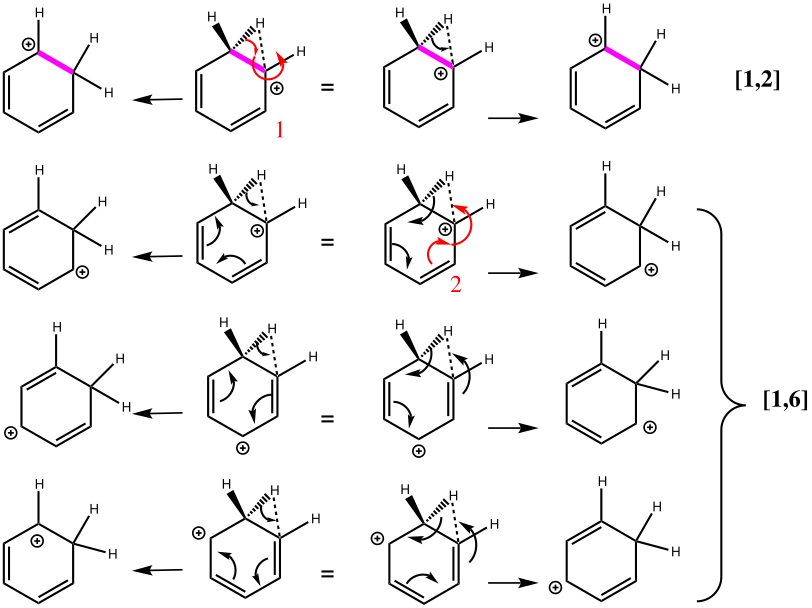
A little while ago, I set out some interpretations of how to push curly arrows. I also appreciate that some theoretically oriented colleagues regard the technique as neither useful nor in the least rigorous, whereas towards the other extreme many synthetically minded chemists view the ability to push a reasonable set of arrows for a proposed mechanism as of itself constituting evidence in its favour.[1] Like any language for expressing ideas, the tool needs a grammar (rules) and a vocabulary, and perhaps also an ability to carry ambiguity. These thoughts surfaced again via a question asked of me by a student: “is the mechanism for the hydrogens in protonated benzene whizzing around the ring a [1,2] or a [1,6] pericyclic sigmatropic shift?”. 
12-v-16

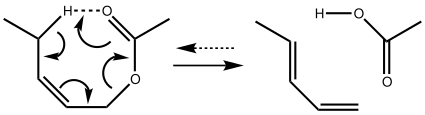
I must first explain the “rules” I used to produce the diagram above.

  1. An arrow comprises an (approximate) electron pair (in the Lewis sense)
  2. And it operates on individual resonance/valence bond representations
  3. A sigmatropic shift is a pericyclic reaction, and one should be able to construct arrows which both conjugate in a cyclic sense, and
  4. can be represented in either a clockwise or anticlockwise cyclic direction.
  5. As a thermally allowed pericyclic reaction, we will endeavour to use only 4n+2 electrons in our arrow pushing (an aromatic transition state for the process). For this molecule, it means either 2 or 6 electrons (one or three arrows, again in a Lewis sense)
  6. I also use the convention in which the origin of an arrow is the midpoint of a (covalent) bond, and its destination the midpoint of a forming (covalent) bond, represented above by a dashed line. Here, I am guided by the observation that the “coordinates” of the start and the end-point of such arrows can be obtained by QTAIM theory, which provides them via so-called “bond critical points“.

So for the 2-electron/one arrow process, we should be able to come up with two schemes, one clockwise, one anticlockwise. It is really easy to show one of these (rhs for [1,2]), but it is a true head-scratching time to produce the other. I have done so via the red arrow in representation 1 above. More of this in a moment.

For the 6-electron/3-arrow alternative, we start with three distinct resonance/valence bond forms for the pentadienyl cation, and each of these again should manifest as arrows drawn in both clock directions. Five cause no problems, but the sixth again carries a very odd arrow (red, representation 2 above). 

What does that red arrow mean? Dissected into smaller steps, it consists of two arrows, joined head to tail in a daisy chain, but still clearly counting as just a single electron pair. The first component of this portmanteau arrow represents the formation of benzene and a proton, the geometry of which in fact resembles the formation of a π-complex between the two. The second component represents the breakdown of this complex to reform a classical carbocation. The daisy-chained arrow passes through the middle of a single bond, which achieves the necessary cyclic conjugation, and then continues on its way to a final destination at the mid-point (approximately) of a C-H bond. If it is drawn as a simple arrow (avoiding passage through the single bond), the mechanism “does not work”; the wrong carbon gets connected to the shifting hydrogen.

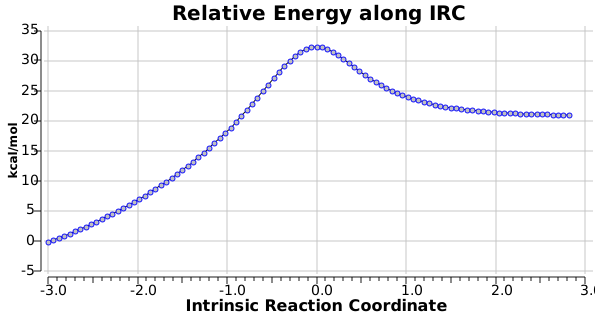
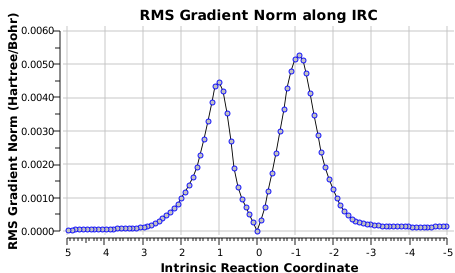
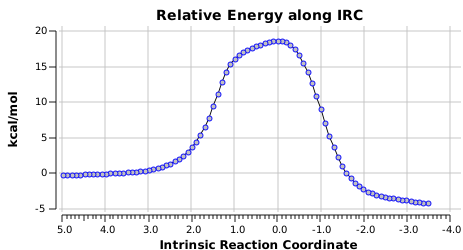
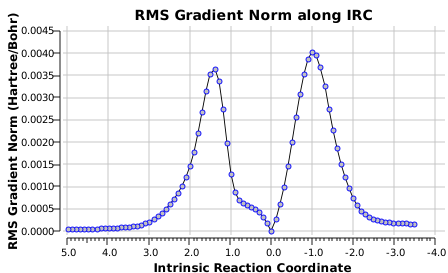
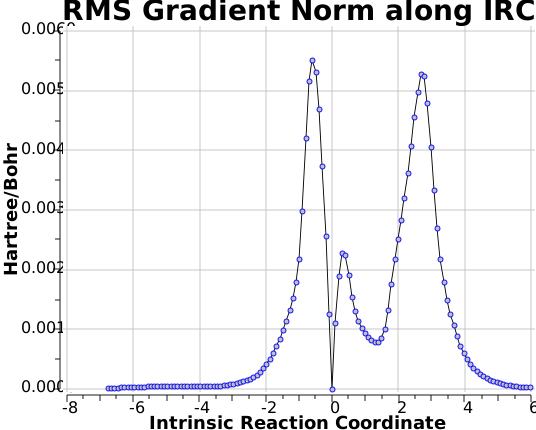
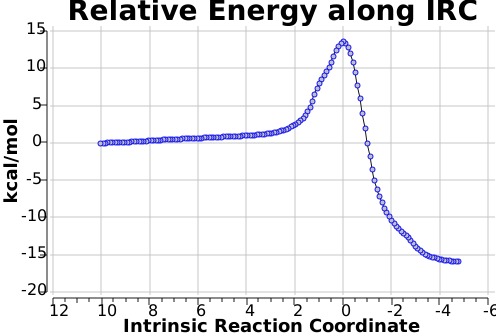
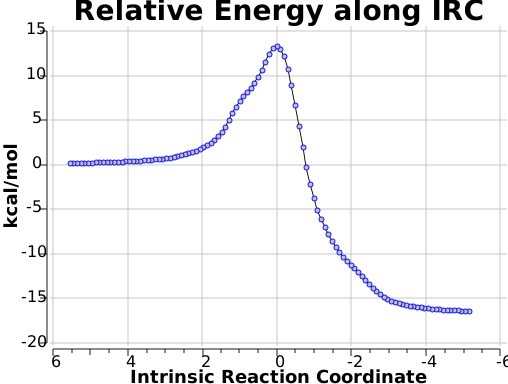
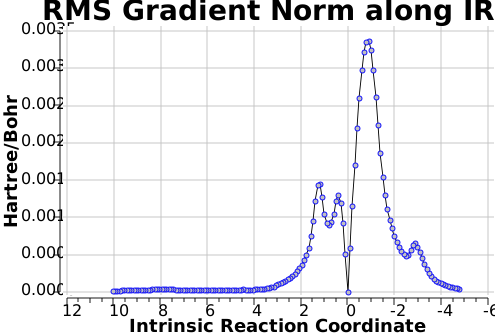
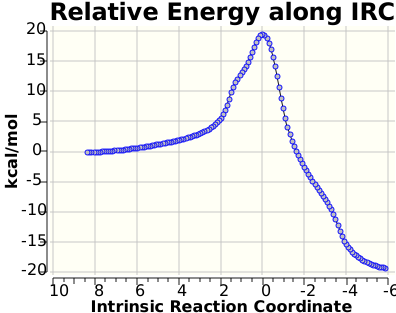
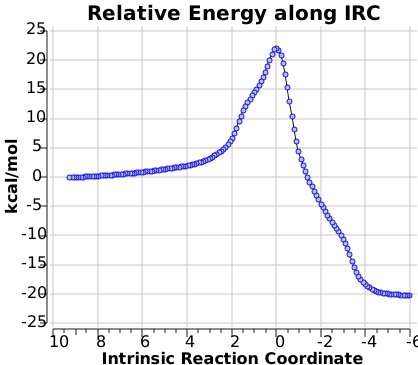
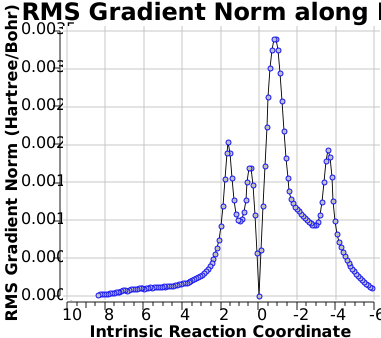
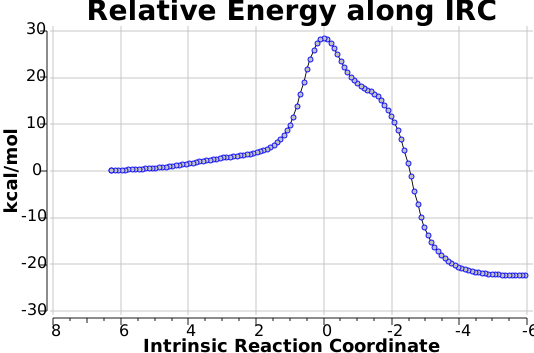
So this little thought experiment has produced a new entry in the arrow-pushing vocabulary; a daisy-chained arrow, and a new rule which requires it to pass through (interact with) a bond, but without stopping. To ask if this invention has any connection to reality, its time for a full-blown quantum mechanical computation of that transition state (an IRC for which[2] is shown below).

12-16

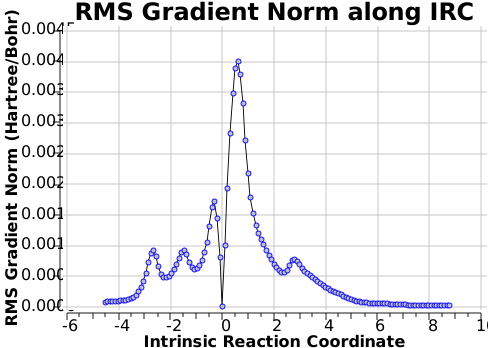
If you look very carefully at how the representation of the magenta-coloured  bond (scheme above) changes during the IRC, you will note that at the transition state it is shorter (1.439Å) than at the start or the end (1.462Å). The magenta-bond order at the transition state is 1.17 (Wiberg), and the bond is clearly “involved” in the process. This does hint that the representation 1 or 2 in the scheme above may be making a significant contribution. None of the other forms of arrow pushing in that scheme involve any arrows either starting or ending at that bond, so they cannot account for the change in bond length/bond order of that bond. We interpret the daisy-chained arrow as carrying more information than a normal arrow would regarding the timing of the process; the path up to the transition state is represented by the first part of the double-headed arrow, and the path down to the product by the second component of that arrow. So up to the first arrow-head, electrons are moving towards the magenta bond, and in the second phase, they continue their journey by moving onwards and away from that bond.

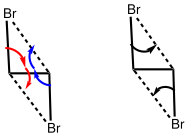
Is there any prior art (precedent) for such a process? We actually, there is a very nice example; the dyotropic rearrangement of a 1,2-dibromoethane (which was recently experimentally shown to be a concerted process with double inversion of configuration at the carbon bearing the bromine[3]). That too involves a transition state where the central C-C bond is shorter (1.41Å) than either reactant or product (1.50Å)[4]. We may represent the arrows involved in the process in two ways in a manner analogous to structure 1 above, but this time involving two daisy-chained arrows (red and blue below). This does not necessarily imply that at the transition state a full triple bond has formed, merely that as the arrow “passes through the bond” its bond-order temporarily increases. The conventional arrow pushing on the right implies no change whatsoever in that central bond. Like any set of (non-equivalent) resonance representations, these two sets of arrows taken together may be a more realistic one than either individually for the overall reaction.
dyotropic

I conclude with some thoughts about another question: is the process a [1,2] or a [1,6] sigmatropic pericyclic reaction? If you regard pericyclic reactions as manifestations of aromatic transition states, you could equally well ask; given a choice, does a system prefer 2-electron or 6-electron aromaticity (both of course conform to a 4n+2 rule). To try to cast light on that, I show the computed NICS values at two points (magenta spheres), the first being the RCP (ring critical point in a QTAIM analysis of the transition state) of the 6-ring and the second the BCP of the 3-ring. If we calibrate this to -10 ppm (for benzene itself), the 6-ring is seen to be only modestly aromatic on this scale. The 3-ring (corresponding to 2-electron aromaticity) appears to be highly aromatic, but this is probably due to a large contribution from local shielding effects; NICS for small rings is not reliable. But this does constitute a hint that, all other aspects being equal, 2-electron aromaticity may have the edge over 6-electron aromaticity. Clearly more work is needed on this aspect.

12-16

Whether or not you believe in the theoretical rigour of arrow pushing (or indeed its absence of rigour), I would suggest that it has proved a useful tool, a mechanism if you like, for helping to think about how reactions proceed. Certainly I also consider it desirable, if arrow pushing is to continue as a useful tool up to its 100th birthday, that some effort should be devoted to updating it for 21st century chemistry.

[5]

References

  1. M.J. Gomes, L.F. Pinto, P.M. Glória, H.S. Rzepa, S. Prabhakar, and A.M. Lobo, "N-heteroatom substitution effect in 3-aza-cope rearrangements", Chemistry Central Journal, vol. 7, 2013. https://doi.org/10.1186/1752-153x-7-94
  2. H.S. Rzepa, "Gaussian Job Archive for C6H7(1+)", 2013. https://doi.org/10.6084/m9.figshare.717183
  3. D. Christopher Braddock, D. Roy, D. Lenoir, E. Moore, H.S. Rzepa, J.I. Wu, and P. von Ragué Schleyer, "Verification of stereospecific dyotropic racemisation of enantiopure d and l-1,2-dibromo-1,2-diphenylethane in non-polar media", Chemical Communications, vol. 48, pp. 8943, 2012. https://doi.org/10.1039/c2cc33676f
  4. I. Fernández, M.A. Sierra, and F.P. Cossío, "Stereoelectronic Effects on Type I 1,2‐Dyotropic Rearrangements in Vicinal Dibromides", Chemistry – A European Journal, vol. 12, pp. 6323-6330, 2006. https://doi.org/10.1002/chem.200501517
  5. "C6H7(1+)", 2013. http://hdl.handle.net/10042/24720
Mechanism of the Van Leusen reaction.

Wednesday, May 29th, 2013

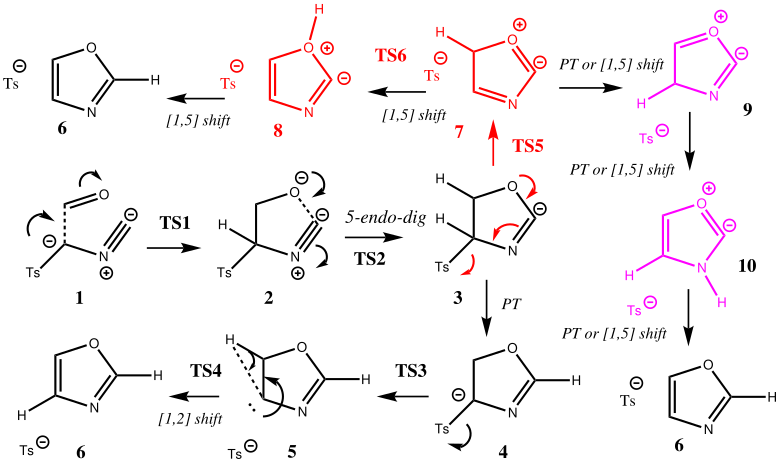
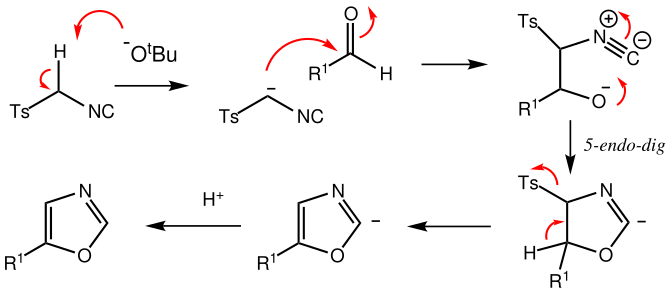
This is a follow-up to comment posted by Ryan, who asked about isocyanide’s role (in the form of the anion of tosyl isocyanide, or TosMIC): “In Van Leusen, it (the isocyanide) acts as an electrophile”. The Wikipedia article (recently updated by myself) shows nucleophilic attack by an oxy-anion on the carbon of the C≡N group, with the isocyanide group acting as the acceptor of these electrons (in other words, the electrophile). In the form shown below, one negatively charged atom appears to be attacking another also carrying a negative charge. Surely this breaks the rules that like charges repel? So we shall investigate to see if this really happens.

VL1

I have extended the basic mechanistic scheme below to investigate other possibilities (with the aim of probing using the ωB97XD/6-311G(d,p)/scrf=methanol theory to see how realistic any of these routes might be). Starting from 1, the product 6 can now be formed by three routes from the common intermediate 3 (there may be other routes of course not considered here). The relative computed free energies of these various species, and some of the transition states leading to them are listed in the table below.VanLeusen

The path leading to 3 is very low energy which may in part also be due to my using formaldehyde for expediency rather than a substituted aldehyde (I have to confess to having taken another short-cut, which is to miss out any counter-ion to the TosMIC anion). The first step is defined by TS1, which forms a C-C bond, and results in the intermediate 2. TS2 corresponds to O…C bond formation to yield 3. Getting to 3 is thus a two-stage process, or a stepwise cycloaddition. The alternative would have been to regard TosMIC anion as a 1,3-dipole (isoelectronic with e.g.diazomethane) in which these two steps are conflated into a concerted cycloaddition across the carbonyl group.

TS2 is the interesting step from the point of view of the question raised above. It has a very low free-energy barrier from either 1 or 2, and therefore appears very facile. The angle of approach by the oxy-anion to the triple bond (we established it as being triple in the previous post) is 87°. This angle explains why a carbon bearing (a formal) negative charge easily accepts attack on itself by a nucleophile (i.e. acting as an electrophile). The formal negative charge originates from an electron lone pair located in an sp-hybrid orbital lying along the axis of the C≡N bond. But the nucleophilic attack is occurring at 87° to this axis, putting electrons into the empty π* orbital of the C≡N bond. So in effect the two apparent “negative charges” in the mechanistic schemes above are orthogonal to each-other, which in a simplistic way explains why the diagram is not actually contradictory. The reaction itself is an example of Baldwin’s rules in action; one of these is that a 5-endo-dig cyclisation is allowed. This angle of attack and Baldwin’s rules may of course be related.

System Relative free energy
1 0.0
TS1 1.2
2 -3.1
TS2 1.7
3 -14.4
4 -16.7
TS3 5.9
5 4.0
TS4 17.7
6 -51.1
TS5 -2.3
7 -3.1
TS6 57.0
“8” -37.4
“9” -36.2
10 -25.3

After 3, the mechanism can channel several ways. For example, a proton transfer can precede the departure of Ts to give 4 and thence 5. The final [1,2] shift to form the product 6 has a relatively high barrier however. More likely is the Ts group heterolysing off 3 via TS5 to form 7. All that is now needed is to shift a proton from 7 to form 6, and this also can take several routes. One would involve base/acid catalysed deprotonation/reprotonation. Alternatively, the hydrogen could migrate by a series of uncatalysed [1,5]sigmatropic hydrogen shifts via e.g. 8, 9 or 10. In fact, the calculated geometries of both 8 and 9 show that the C…O bond is broken, thus forming entirely different products. Thus the most probable route is indeed a simple catalysed proton transfer from 7.

This computational exploration of the mechanism has reinforced the accepted one, and hopefully cast some light on why an isocyanide can appear to act as an electrophile.

Another Woodward pericyclic example dissected: all is not what it seems.

Wednesday, May 22nd, 2013

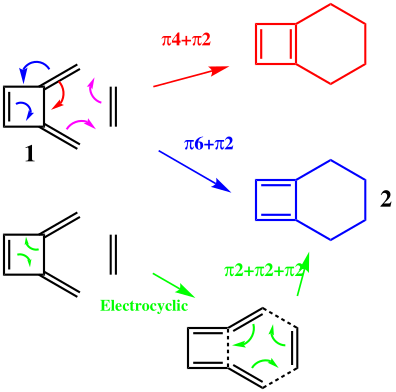
Here is another example gleaned from that Woodward essay of 1967 (Chem. Soc. Special Publications (Aromaticity), 1967, 21, 217-249), where all might not be what it seems.

W

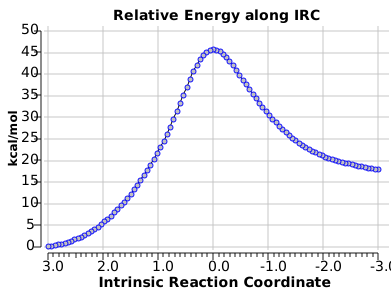
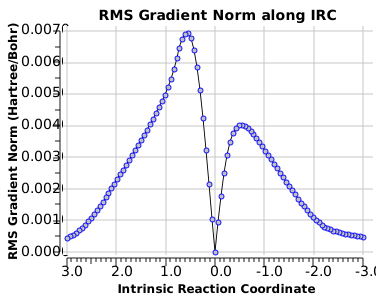
Woodward notes that the reaction between the (highly reactive) 1 does not occur. This is attributed to it being a disallowed π6 + π2 cycloaddition (blue + magenta arrows) rather than an allowed π4 + π2 cycloaddition (red + magenta arrows). So what does quantum mechanics say? Well, a disallowed reaction can be broken down into several stages, each involving fewer electrons, and this is what happens. The first of these stages becomes instead an electrocyclic ring opening (green arrows) in which one σ-bond from the cyclobutene is “borrowed” to form a bis-allene intermediate, before being returned to the original bond in the second stage.

Electrocyclic ring opening[1]
we
w-e w-eG
2+2+2 cycloaddition[2]
w2+2+2
w2+2+2 w2+2+2G

The first transition state for ring opening proceeds in the appropriate Woodward-Hoffmann conrotatory mode, and has a free energy barrier of ~ 45 kcal/mol. This is still 46.1 kcal/mol lower than the very unfavourable second step, which involves a 2+2+2 cycloaddition. Both are formally symmetry-allowed reactions, they just have very high barriers to reaction which accounts for the non-occurance experimentally. Of course, one interpretation of the WH rules is that any pericyclic with a high barrier could be regarded as forbidden, but in this case not on the grounds of symmetry.

References

  1. H.S. Rzepa, "Gaussian Job Archive for C8H10", 2013. https://doi.org/10.6084/m9.figshare.705831
  2. H.S. Rzepa, "Gaussian Job Archive for C8H10", 2013. https://doi.org/10.6084/m9.figshare.705830

Woodward's symmetry considerations applied to electrocyclic reactions.

Monday, May 20th, 2013

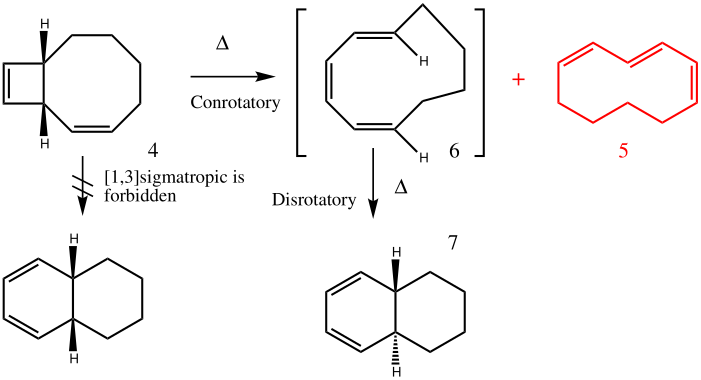
Sometimes the originators of seminal theories in chemistry write a personal and anecdotal account of their work. Niels Bohr[1] was one such and four decades later Robert Woodward wrote “The conservation of orbital symmetry” (Chem. Soc. Special Publications (Aromaticity), 1967, 21, 217-249; it is not online and so no doi can be given). Much interesting chemistry is described there, but (like Bohr in his article), Woodward lists no citations at the end, merely giving attributions by name. Thus the following chemistry (p 236 of this article) is attributed to a Professor Fonken, and goes as follows (excluding the structure in red):

wood

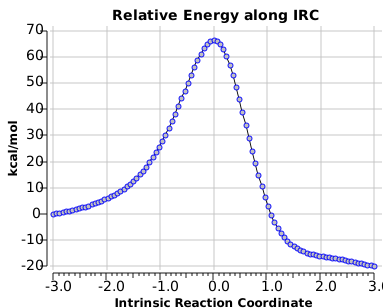
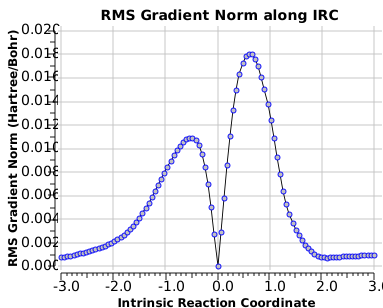
A search of the literature reveals only one published article describing this reaction[2] by Dauben and Haubrich, published some 21 years after Woodward’s description (we might surmise that Gerhard Fonken never published his own results). In fact this more recent study was primarily concerned with 193-nm photochemical transforms (they conclude that “the Woodward-Hoffmann rules of orbital symmetry are not followed”) but you also find that the thermal outcome of heating 4 is a 3:2 mixture of compounds 5 and 6, and that only 6 goes on to give the final product 7. It does look like a classic and uncomplicated example of Woodward-Hoffmann rules.

 So let us subject this system to the “reality check”. The transform of 4 → 5 rotates the two termini of the cleaving bond in a direction that produces the stereoisomer 5, with a trans alkene straddled by two cis-alkenes[3]. The two carbon atoms that define the termini of the newly formed hexatriene are ~ 4.7Å apart; too far to be able to close to form 7.

 4 → 5  4 → 6
8 8

But with any electrocyclic reaction, two directions of rotation are always possible, and it is a rotation in the other direction that gives 4 → 6[4], ending up with a hexatriene with the trans-alkene at one end and not the middle (for which the free energy of activation is 3.1 kcal/mol higher in energy). Now the two termini of the hexatriene end up ~3.0Å apart, much more amenable to forming a bond between them to form 7.

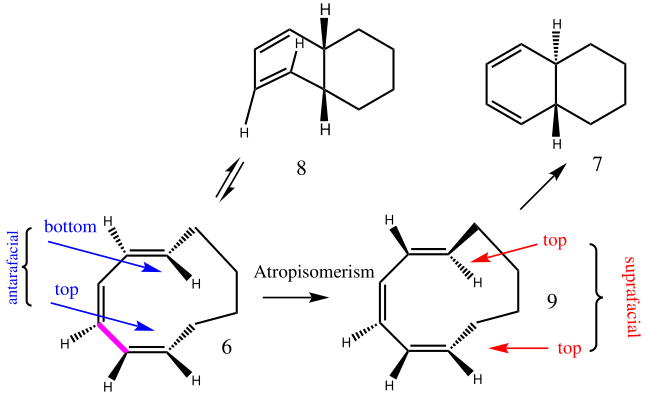
It is at this point that the apparently uncomplicated nature of this example starts to unravel. If one starts from the 3.0Å end-point of the above reaction coordinate and systematically contracts the bond between these two termini, a transition state is found leading not to 7 but to the (endothermic) isomer 8.[5]This form has a six-membered ring with a trans-alkene motif (which explains why it is so endothermic). 

wood1
6 ↠ 8
8 wood2

Before discussing the implications of this transition state, I illustrate another isomerism that 6 can undertake; a low-barrier atropisomerism[6] to form 9, followed by another reaction with a relatively low barrier, 9 ↠  7[7]to give the product that Woodward gives in his essay.

6 ↠ 9
6-atrop 6-atrop
9 ↠ 7
9to7a 9to7a

 We can now analyse the two transformations 6 ↠ 8 and 9 ↠  7. The first involves antarafacial bond formation (blue arrows) at the termini and an accompanying 180° twisting about the magenta bond which creates a second antarafacial component[8]. So this is a thermally allowed six-electron (4n+2) electrocyclisation with a double-Möbius twist[9]. The second reaction is a more conventional purely suprafacial version[10] (red arrows) of the type Woodward was certainly thinking of; it is 18.0 kcal/mol lower in free energy than the first (the transition state for 6 ↠ 9 is 10.8 kcal/mol lower than that for 9 ↠ 7).

I hope that this detailed exploration of what seems like a pretty simple example at first sight shows how applying a “reality-check” of computational quantum mechanics can cast (some unexpected?) new light on an old problem. We may of course speculate on how to inhibit the pathway 6 ↠ 9 ↠ 7 to allow only 6 ↠ 8 to proceed (the reverse barrier from 8 is quite low, so 8 would have to be trapped at very low temperatures). 

References

  1. N. Bohr, "Der Bau der Atome und die physikalischen und chemischen Eigenschaften der Elemente", Zeitschrift f�r Physik, vol. 9, pp. 1-67, 1922. https://doi.org/10.1007/bf01326955
  2. W.G. Dauben, and J.E. Haubrich, "The 193-nm photochemistry of some fused-ring cyclobutenes. Absence of orbital symmetry control", The Journal of Organic Chemistry, vol. 53, pp. 600-606, 1988. https://doi.org/10.1021/jo00238a023
  3. H.S. Rzepa, "Gaussian Job Archive for C10H14", 2013. https://doi.org/10.6084/m9.figshare.704833
  4. H.S. Rzepa, "Gaussian Job Archive for C10H14", 2013. https://doi.org/10.6084/m9.figshare.704834
  5. H.S. Rzepa, "Gaussian Job Archive for C10H14", 2013. https://doi.org/10.6084/m9.figshare.704755
  6. H.S. Rzepa, "Gaussian Job Archive for C10H14", 2013. https://doi.org/10.6084/m9.figshare.704754
  7. H.S. Rzepa, "Gaussian Job Archive for C10H14", 2013. https://doi.org/10.6084/m9.figshare.704844
  8. H.S. Rzepa, "Gaussian Job Archive for C10H14", 2013. https://doi.org/10.6084/m9.figshare.704841
  9. H.S. Rzepa, "Double-twist Möbius aromaticity in a 4n+ 2 electron electrocyclic reaction", Chemical Communications, pp. 5220, 2005. https://doi.org/10.1039/b510508k
  10. H.S. Rzepa, "Gaussian Job Archive for C10H14", 2013. https://doi.org/10.6084/m9.figshare.704995

Woodward’s symmetry considerations applied to electrocyclic reactions.

Monday, May 20th, 2013

Sometimes the originators of seminal theories in chemistry write a personal and anecdotal account of their work. Niels Bohr[1] was one such and four decades later Robert Woodward wrote “The conservation of orbital symmetry” (Chem. Soc. Special Publications (Aromaticity), 1967, 21, 217-249; it is not online and so no doi can be given). Much interesting chemistry is described there, but (like Bohr in his article), Woodward lists no citations at the end, merely giving attributions by name. Thus the following chemistry (p 236 of this article) is attributed to a Professor Fonken, and goes as follows (excluding the structure in red):

wood

A search of the literature reveals only one published article describing this reaction[2] by Dauben and Haubrich, published some 21 years after Woodward’s description (we might surmise that Gerhard Fonken never published his own results). In fact this more recent study was primarily concerned with 193-nm photochemical transforms (they conclude that “the Woodward-Hoffmann rules of orbital symmetry are not followed”) but you also find that the thermal outcome of heating 4 is a 3:2 mixture of compounds 5 and 6, and that only 6 goes on to give the final product 7. It does look like a classic and uncomplicated example of Woodward-Hoffmann rules.

 So let us subject this system to the “reality check”. The transform of 4 → 5 rotates the two termini of the cleaving bond in a direction that produces the stereoisomer 5, with a trans alkene straddled by two cis-alkenes[3]. The two carbon atoms that define the termini of the newly formed hexatriene are ~ 4.7Å apart; too far to be able to close to form 7.

 4 → 5  4 → 6
8 8

But with any electrocyclic reaction, two directions of rotation are always possible, and it is a rotation in the other direction that gives 4 → 6[4], ending up with a hexatriene with the trans-alkene at one end and not the middle (for which the free energy of activation is 3.1 kcal/mol higher in energy). Now the two termini of the hexatriene end up ~3.0Å apart, much more amenable to forming a bond between them to form 7.

It is at this point that the apparently uncomplicated nature of this example starts to unravel. If one starts from the 3.0Å end-point of the above reaction coordinate and systematically contracts the bond between these two termini, a transition state is found leading not to 7 but to the (endothermic) isomer 8.[5]This form has a six-membered ring with a trans-alkene motif (which explains why it is so endothermic). 

wood1
6 ↠ 8
8 wood2

Before discussing the implications of this transition state, I illustrate another isomerism that 6 can undertake; a low-barrier atropisomerism[6] to form 9, followed by another reaction with a relatively low barrier, 9 ↠  7[7]to give the product that Woodward gives in his essay.

6 ↠ 9
6-atrop 6-atrop
9 ↠ 7
9to7a 9to7a

 We can now analyse the two transformations 6 ↠ 8 and 9 ↠  7. The first involves antarafacial bond formation (blue arrows) at the termini and an accompanying 180° twisting about the magenta bond which creates a second antarafacial component[8]. So this is a thermally allowed six-electron (4n+2) electrocyclisation with a double-Möbius twist[9]. The second reaction is a more conventional purely suprafacial version[10] (red arrows) of the type Woodward was certainly thinking of; it is 18.0 kcal/mol lower in free energy than the first (the transition state for 6 ↠ 9 is 10.8 kcal/mol lower than that for 9 ↠ 7).

I hope that this detailed exploration of what seems like a pretty simple example at first sight shows how applying a “reality-check” of computational quantum mechanics can cast (some unexpected?) new light on an old problem. We may of course speculate on how to inhibit the pathway 6 ↠ 9 ↠ 7 to allow only 6 ↠ 8 to proceed (the reverse barrier from 8 is quite low, so 8 would have to be trapped at very low temperatures). 

References

  1. N. Bohr, "Der Bau der Atome und die physikalischen und chemischen Eigenschaften der Elemente", Zeitschrift f�r Physik, vol. 9, pp. 1-67, 1922. https://doi.org/10.1007/bf01326955
  2. W.G. Dauben, and J.E. Haubrich, "The 193-nm photochemistry of some fused-ring cyclobutenes. Absence of orbital symmetry control", The Journal of Organic Chemistry, vol. 53, pp. 600-606, 1988. https://doi.org/10.1021/jo00238a023
  3. H.S. Rzepa, "Gaussian Job Archive for C10H14", 2013. https://doi.org/10.6084/m9.figshare.704833
  4. H.S. Rzepa, "Gaussian Job Archive for C10H14", 2013. https://doi.org/10.6084/m9.figshare.704834
  5. H.S. Rzepa, "Gaussian Job Archive for C10H14", 2013. https://doi.org/10.6084/m9.figshare.704755
  6. H.S. Rzepa, "Gaussian Job Archive for C10H14", 2013. https://doi.org/10.6084/m9.figshare.704754
  7. H.S. Rzepa, "Gaussian Job Archive for C10H14", 2013. https://doi.org/10.6084/m9.figshare.704844
  8. H.S. Rzepa, "Gaussian Job Archive for C10H14", 2013. https://doi.org/10.6084/m9.figshare.704841
  9. H.S. Rzepa, "Double-twist Möbius aromaticity in a 4n+ 2 electron electrocyclic reaction", Chemical Communications, pp. 5220, 2005. https://doi.org/10.1039/b510508k
  10. H.S. Rzepa, "Gaussian Job Archive for C10H14", 2013. https://doi.org/10.6084/m9.figshare.704995

Concerted 1,4-addition of thioacetic acid: a (requested) reality check.

Saturday, May 11th, 2013

Lukas, who occasionally comments on this blog, sent me the following challenge. In a recent article[1] he had proposed that the stereochemical outcome (Z) of reaction between a butenal and thioacetic acid as shown below arose by an unusual concerted cycloaddtion involving an S-H bond. He wrote in the article “…this scheme … recommends itself for evaluation by in silico methods“. I asked if the answer could be posted here, and he agreed. So here it is.

Click for  3D

Click for 3D

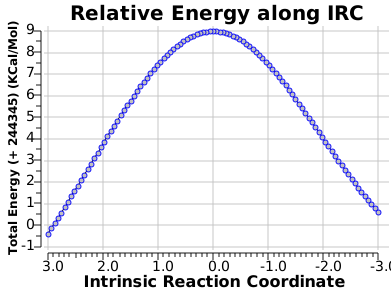
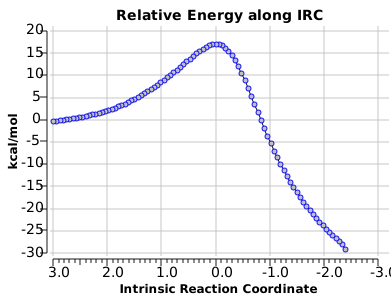
My initial instinct was that it might prove to be a reaction with “hidden intermediates” (for example transfer of the S-H proton onto the oxygen to form a zwitterionic “hidden intermediate”). Well, this is what the computed transition state[2] and the IRC[3] look like.

Lukas

 Lukas

LukasG

  1. For acrolein itself, the forward free-energy barrier ΔG298 is 25.8 kcal/mol (ωB97XD/6-311G(d,p)/SCRF=acetone) and the reverse barrier 27.7 kcal/mol, which makes the overall free energy for the reaction -1.8 kcal/mol. These values are not inconsistent with an equilibrium thermal reaction at room temperatures or above.
  2. The gradients show no sign of any “hidden intermediates”. The reaction indeed is nicely concerted, albeit with O-H bond formation asynchronously preceding that of C-S. This reaction should indeed be added to the pantheon of facile pericyclic (or pseudopericyclic) reaction types.
  3. For the methyl substituted system (R=Me) the forward barrier is a little lower than before (23.8 kcal/mol)[4] and the reverse likewise (25.5). The (Z) product far dominates the (E) (61:1). The IRC[5] is similar to the unsubstituted reaction, but with the faintest of hints of a hidden intermediate (at IRC ~0.8).

Lukas_mea

Lukas_meLukas_meG

The reaction itself is a smaller-ring thia-homologue of one reported by Birney[6] and classified there as a pseudopericyclic reaction, the point of interest being the difference in behaviour between the O-H acid and the S-H acid.birney

Well, that is the in silico counterpart to the in silica experiment. It took a few hours (about the same as a few NMR measurements?).


Slightly lower values are obtained for the s-cis conformation[7] of the thio-acid: ΔG298 is 21.0 kcal/mol for the forward and 22.0 for the reverse reactions.


References

  1. L. Hintermann, and A. Turočkin, "Reversible Generation of Metastable Enols in the 1,4-Addition of Thioacetic Acid to α,β-Unsaturated Carbonyl Compounds", The Journal of Organic Chemistry, vol. 77, pp. 11345-11348, 2012. https://doi.org/10.1021/jo3021709
  2. H.S. Rzepa, "Gaussian Job Archive for C5H8O2S", 2013. https://doi.org/10.6084/m9.figshare.701466
  3. H.S. Rzepa, "Gaussian Job Archive for C5H8O2S", 2013. https://doi.org/10.6084/m9.figshare.701174
  4. H.S. Rzepa, "Gaussian Job Archive for C6H10O2S", 2013. https://doi.org/10.6084/m9.figshare.701467
  5. H.S. Rzepa, "Gaussian Job Archive for C6H10O2S", 2013. https://doi.org/10.6084/m9.figshare.701468
  6. H. Ji, L. Li, X. Xu, S. Ham, L.A. Hammad, and D.M. Birney*, "Multiphoton Infrared Initiated Thermal Reactions of Esters: Pseudopericyclic Eight-Centered<i>cis</i>-Elimination", Journal of the American Chemical Society, vol. 131, pp. 528-537, 2008. https://doi.org/10.1021/ja804812c
  7. H.S. Rzepa, "Gaussian Job Archive for C6H10O2S", 2013. https://doi.org/10.6084/m9.figshare.701501

Transition states for the (base) catalysed ring opening of propene epoxide.

Wednesday, May 8th, 2013

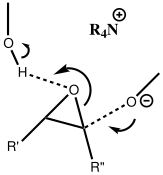
The previous post described how the acid catalysed ring opening of propene epoxide by an alcohol (methanol) is preceded by pre-protonation of the epoxide oxygen to form a “hidden intermediate” on the concerted intrinsic reaction pathway to ring opening. Here I take a look at the mechanism where a strong base is present, modelled by tetramethyl ammonium methoxide (R4N+.OMe), for the two isomers R=Me; R’=Me, R”=H and R’=H, R”=Me.

pe-base

As noted before[1], with alkoxide the dominant product is R’=Me, R”=H. A ωB97XD/6-311G(d,p)/SCRF=methanol) calculation of ΔΔG298 for the transition state for the process indeed favours this outcome, by 1.3 kcal/mol.[2],[3] This corresponds to ~90:10 for R’=Me, R”=H/R’=H, R”=Me. The barrier in this case is significantly smaller (~8 kcal/mol) than was observed for the route catalysed by trifluoracetic acid (~13 kcal/mol). From this emerges a possible explanation for the odd result I noted in the previous post; namely that the transition state ΔΔG for the pure water catalysed reaction was 1.7 kcal/mol lower for the formation of 2-alkoxy-1-propanol than for 1-alkoxy-2-propanol (i.e. of R’=H, R”=Me vs R’=Me, R”=H), whereas experiment showed the dominant product was the latter. But the pure water bimolecular rate contains contributions not only from water acting as catalyst but also from the background [H+] and [HO] rates as well (pKa methanol ~ 15.5, pKa water ~ 15.7). Of these three bimolecular rates, it is clear that the fastest is going to be the HO catalysed one, and so it seems likely that the experimental result in pure water actually arises from catalysis by the [HO] term and not by [H2O] itself.

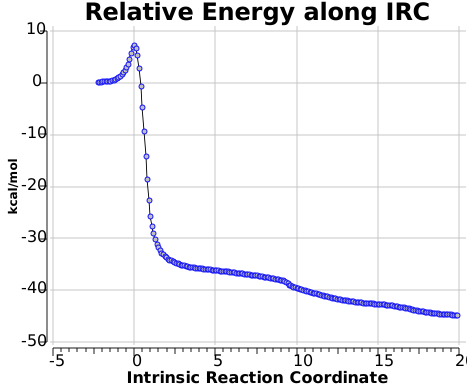
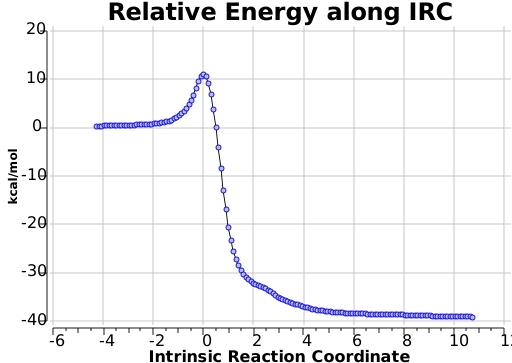
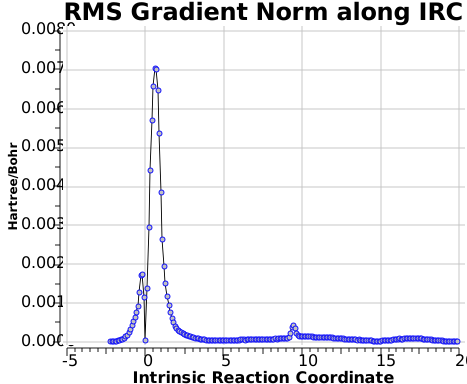
The next task is to show how realistic the conventional “arrow pushing” for the reaction (shown above) actually is. Remember how, with acid catalysis, an IRC showed a proton transfer preceding the transition state. In contrast, the pure water mediated reaction showed no such pre-transfer, and instead revealed a hidden zwitterionic or ion-pair like intermediate occurring only AFTER the transition state. The MeO catalysed reaction is similar, except of course that with the above models ion-pairs are present both at the start and end of the reaction, with the possibility of a third hidden ion pair occurring somewhere along the reaction pathway. The reactant ion pair of course does have to morph into the product ion pair by virtue of a proton transfer, and this occurs AFTER the transition state is passed, not before.

  R’=Me, R”=H R’=H, R”=Me
ΔΔG  0.0 +1.3

IRC

animation

 pe-base-obs  pe-base

IRC

energies

 pe-base-obs pe-base

IRC

Grad

 pe-base-obsG pe-baseG
doi: [4] [5]

 The post-transition state proton transfer occurs driven by the need to minimise the charge separation in the ion-pair; a contact ion-pair is always likely to be more stable than a separated ion pair. For R’=H, R”=Me, a primary alkoxide is the initial product. This is relatively unstable, and so quite quickly (at about IRC 2.5) the system proceeds to acquire a proton from the adjacent methanol to reform a contact ion-pair. For R’=Me, R”=H, a secondary alkoxide is formed, which proves somewhat tardier in acquiring that proton, at IRC 9.5 in fact! Up to that point of course, the secondary alkoxide anion is a “hidden intermediate“, albeit very much on the verge of becoming a proper intermediate.

This third post on the topic I think ties up some of the loose ends, and seems to cast some interesting new light on what, at face value, seems a very simple organic reaction. There is, I think, still much to learn about such “simple” reactions.


References

  1. H.C. Chitwood, and B.T. Freure, "The Reaction of Propylene Oxide with Alcohols", Journal of the American Chemical Society, vol. 68, pp. 680-683, 1946. https://doi.org/10.1021/ja01208a047
  2. H.S. Rzepa, "Gaussian Job Archive for C9H25NO3", 2013. https://doi.org/10.6084/m9.figshare.698066
  3. H.S. Rzepa, "Gaussian Job Archive for C9H25NO3", 2013. https://doi.org/10.6084/m9.figshare.698172
  4. H.S. Rzepa, "Gaussian Job Archive for C9H25NO3", 2013. https://doi.org/10.6084/m9.figshare.700641
  5. H.S. Rzepa, "Gaussian Job Archive for C9H25NO3", 2013. https://doi.org/10.6084/m9.figshare.700652

Hidden intermediates in the (acid catalysed) ring opening of propene epoxide.

Monday, May 6th, 2013

In a previous post on the topic, I remarked how the regiospecific ethanolysis of propene epoxide[1] could be quickly and simply rationalised by inspecting the localized NBO orbital calculated for either the neutral or the protonated epoxide. This is an application of Hammond’s postulate[[2] in extrapolating the properties of a reactant to its reaction transition state. This approach implies that for acid-catalysed hydrolysis, the fully protonated epoxide is a good model for the subsequent transition state. But is this true? Can this postulate be tested? Here goes.

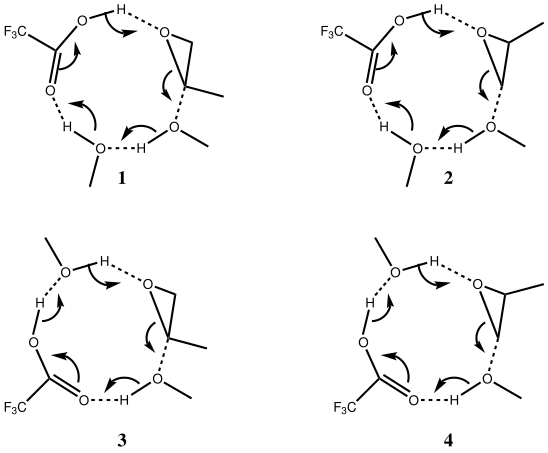
pe_cf3Here, I show eight transition state models. As the acid I use CF3CO2H, with methanol as the nucleophile attacking propene epoxide, and I have initially included one additional methanol helping facilitate the proton transfers. Isomeric transition states differ in where the methyl substituent is located (1/2 and 3/4) and in the relative position of the acid and the additional methanol (1/3 and 2/4). In 1/2, the acid is directly protonating the oxygen of the epoxide. In 3/4, it is instead inducing methanol to act as its proxy. Two further transition states 5 and 6 directly replace the CF3CO2H with one (much less acidic) methanol, to test the effect the presence of the acid has on the reaction barriers. Finally,  7 and 8 remove from these models the non-nucleophilic proxy methanol from the ring to test the effect of reducing ring size from 10 to 8.

With no catalyst present, we know that the rate of hydrolysis is very slow[1], and that the major product (55%) is the 1-alkoxy-2-propanol, with the 2-alkoxy-1-propanol being the minor component (16%). As acid concentration increases, the amount of the latter eventually exceeds the former. The computed barriers (ωB97XD/6-311G(d,p)SCRF=methanol) for this mode (transition states 5 and 6) are ~29 kcal/mol, which pretty much matches the experimental observation (for ethanol). What does not match is the preference for nucleophilic attack at the least substituted carbon resulting in 1-alkoxy-2-propanol; instead the  2-alkoxy-1-propanol is predicted to have the lower free energy barrier of activation by 1.7 kcal/mol. This will need further investigation in a future post.


Property 5, 2-alkoxy-1-propanol 6, 1-alkoxy-2-propanol.
ΔΔG‡, kcal/mol 0.0 +1.7
IRC animation pe-meOH pe-meOH-iso
IRC Energy pe-meOH pe-meOH-iso
IRC Gradients pe-meOHG pe-meOH-isoG
IRC [3] [4]

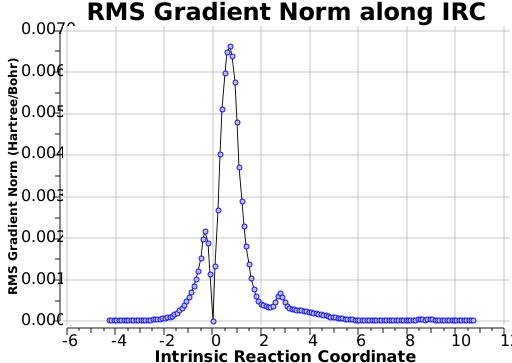
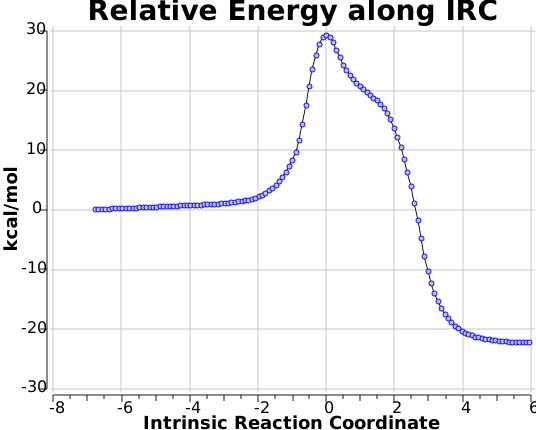
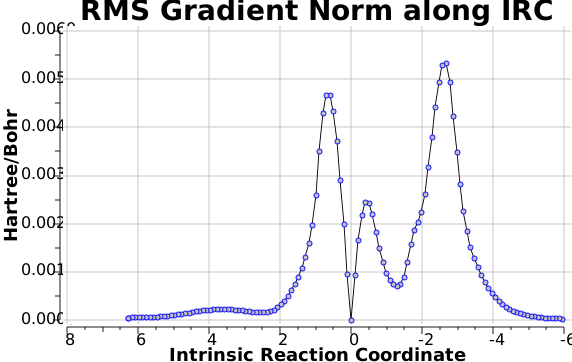
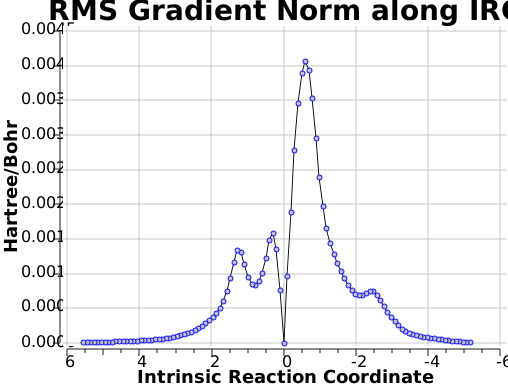
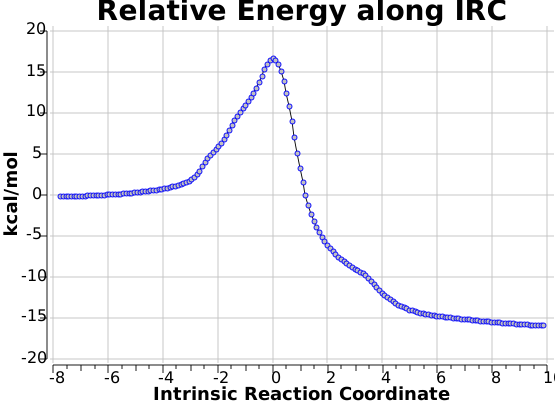
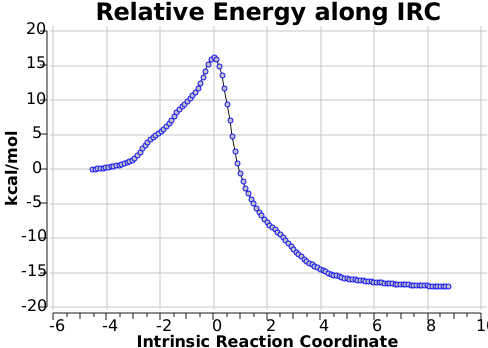
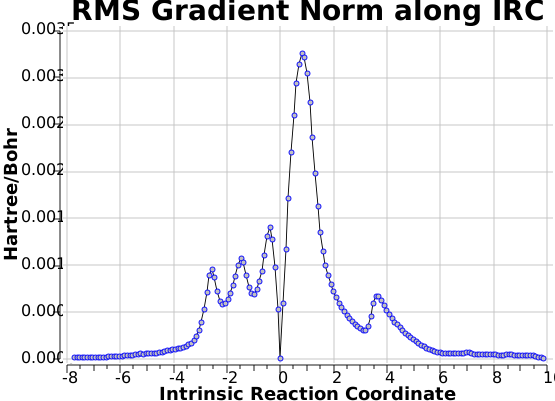
What of the IRCs? Both isomers show an interesting dip in the gradient norms (at~-1.5 for 5 and +1.5 for 6), typical of a “hidden intermediate“. The geometry at this point (below) shows that the erstwhile epoxide bonds are largely formed/cleaved, and this has resulted in a zwitterionic intermediate attempting to form (the nucleophilic oxonium being +ve and the cleaved oxyanion -ve). Such species have no permanence however (not for even one molecular vibration), and are immediately destroyed by three more or less synchronous proton transfers (IRC -2.5 or +3.0). I would add that in many a text-book illustration of this process, this “hidden intermediate” would in fact be exposed as an explicit actual intermediate.

Click for  3D.

Click for 3D.

What happens when we replace one methanol in the above model with one molecule of trifluoracetic acid, resulting in transition states 14 (below). 

  1. The barrier drops dramatically, from ~29 kcal/mol to ~13 kcal/mol. This changes the reaction from a very slow one at room temperatures to a very fast one at room temperatures.
  2. The IRC now shows an extra “hidden intermediatebefore the transition state, as well as one after. The synchronicity of the proton transfers is broken, and now they occur in two distinct stages, one before and one after the transition state. The one before corresponds to protonation of the epoxide oxygen by the trifluoracetic acid, which occurs before the C-O bond is formed/cleaved at the transition state itself. The second hidden intermediate corresponds to the zwitterion arising from the  trifluoracetic anion and the oxonium cation located at the original attacking methanol. This is then subjected to proton transfer (IRC ~ -2.5 in both cases) to transfer the proton onto the auxiliary methanol to form what appears to be the final ring-opened neutral product in the presence of methyl oxonium trifluoroacetate.
  3. So adding a species which can form a stable anion (in other words a strong acid) de-synchronises the reaction. However, all the intermediates are still hidden, and the process is still concerted!
  4. But, oddly, the predicted preference for 1 is if anything slightly decreased compared to the use of methanol only in the model (i.e. 5/6). This does not seem to correspond to the increased prevalence of 1 in the presence of acid as observed in the experiments.

Property 1,2-alkoxy-1-propanol 2, 1-alkoxy-2-propanol.
ΔΔG 0.0  +1.4 
IRC animation pe-MeOH-CF3CO2Ha pe-MeOH-CF3CO2H-isoa
IRC Energy pe-MeOH-CF3CO2Ha pe-MeOH-CF3CO2H-isoa
IRC Gradients pe-MeOH-CF3CO2HG pe-MeOH-CF3CO2H-isoG
IRC [5] [6]

Before moving on to the last models 7/8, I must mention the aspect of where the strong acid is located in the model. If it is located away from the epoxide oxygen, the IRC changes again, now revealing three hidden intermediates.

  1. The first corresponds to the acid transferring a proton to the non-nucleophilic methanol to form incipient methyl oxonium trifluoracetate
  2. The second has the methyl oxonium as an acid transferring its proton to the epoxide oxygen.
  3. Then comes the transition state when the O-C bonds are formed/broken.
  4. The last hidden intermediate is the oxonium trifluoracetate zwitterion resulting from ring opening, prior to a final proton transfer to reform trifluoroacetic acid.
  5. This pathway overall in free energy, is about 2.0 kcal/mol higher than the previous one involving direct proton transfer from the acid itself.

Property 3, 2-alkoxy-1-propanol 4, 1-alkoxy-2-propanol.
ΔΔG 1.8 +3.5 
IRC animation pe-MeOH-CF3CO2H-other  pe-cf3-other
IRC Energy pe-MeOH-CF3CO2H-other  pe-cf3-other
IRC Gradients pe-MeOH-CF3CO2H-otherG  pe-cf3-otherG
IRC [7] [8]

The final model 7/8 tests what happens when that additional methanol is removed from the proton transfer sequence in 1-4. The smaller ring for the transition state induces an increase in the barrier from ~13 to ~20 kcal/mol; this model also naturally “absorbs” an addition methanol to decrease the free energy and mutate into 1-4. The preference for 7 over 8 is increased compared to the other models. The presence of two hidden intermediates in this model is particularly noticeable.


Property 7, 2-alkoxy-1-propanol 8, 1-alkoxy-2-propanol
ΔΔG 0.0 +3.5 
IRC animation  pe-cf3+meoha pe-cf3-nome-othera 
IRC Energy  pe-cf3+meoh  pe-cf3-nome-other
IRC Gradients  pe-cf3+meohG  pe-cf3-nome-otherG

To answer the question posed at the start of this post, in the IRC explorations above we see that in the presence of trifluoroacetic acid, the transition state is indeed preceded by a proton transfer. This reassures that Hammond’s principle can indeed be applied. The (relative) free energies of the acid catalysed transition state models used here all correctly predict the observed regiochemistry, but we still have to explore the base catalysed route. Watch this space.

References

  1. H.C. Chitwood, and B.T. Freure, "The Reaction of Propylene Oxide with Alcohols", Journal of the American Chemical Society, vol. 68, pp. 680-683, 1946. https://doi.org/10.1021/ja01208a047
  2. G.S. Hammond, "A Correlation of Reaction Rates", Journal of the American Chemical Society, vol. 77, pp. 334-338, 1955. https://doi.org/10.1021/ja01607a027
  3. H.S. Rzepa, "Gaussian Job Archive for C6H18O4", 2013. https://doi.org/10.6084/m9.figshare.694931
  4. H.S. Rzepa, "Gaussian Job Archive for C6H18O4", 2013. https://doi.org/10.6084/m9.figshare.694918
  5. H.S. Rzepa, "Gaussian Job Archive for C7H15F3O5", 2013. https://doi.org/10.6084/m9.figshare.694894
  6. H.S. Rzepa, "Gaussian Job Archive for C7H15F3O5", 2013. https://doi.org/10.6084/m9.figshare.694907
  7. H.S. Rzepa, "Gaussian Job Archive for C7H15F3O5", 2013. https://doi.org/10.6084/m9.figshare.697508
  8. https://doi.org/

Why diphenyl peroxide does not exist.

Monday, April 29th, 2013

A few posts back, I explored the “benzidine rearrangement” of diphenyl hydrazine. This reaction requires diprotonation to proceed readily, but we then discovered that replacing one NH by an O as in N,O-diphenyl hydroxylamine required only monoprotonation to undergo an equivalent facile rearrangement. So replacing both NHs by O to form diphenyl peroxide (Ph-O-O-Ph) completes this homologous series. I had speculated that PhNHOPh might exist if all traces of catalytic acid were removed, but could the same be done to PhOOPh? Not if it continues the trend and requires no prior protonation at all!

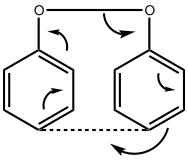
PhOOPh

Here is the results of a ωB97XD/6-311G(d,p)/SCRF=water calculation. Now I should explain that the conventional explanation for the non-existence of PhOOPh is that the O-O bond homolyses very readily to form phenoxy radicals[1]. But of course other peroxides such as t-Bu-O-O-t-Bu do exist (although they are rather fragile) and so the phenyl analogue is clearly special.

PhOOPh  PhOOPha1 
 PhOOPh2 PhOOPha1 

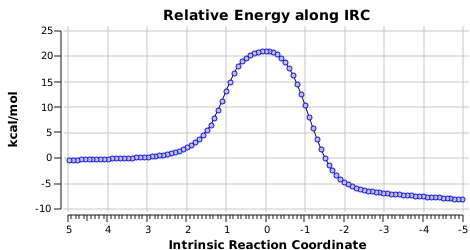
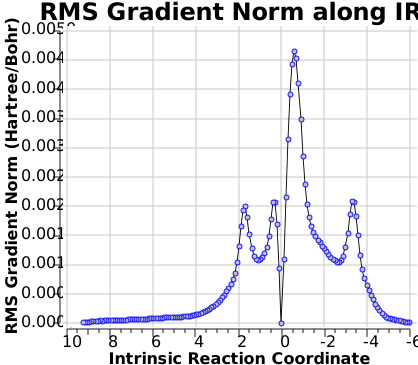
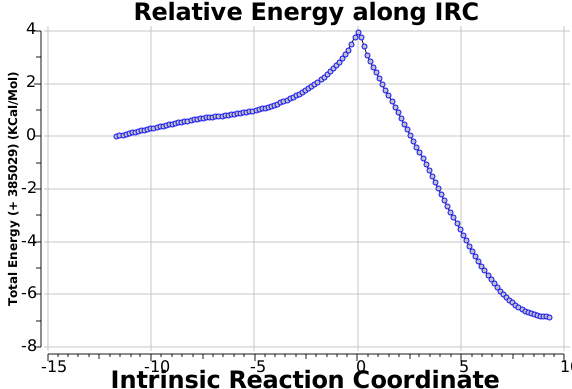
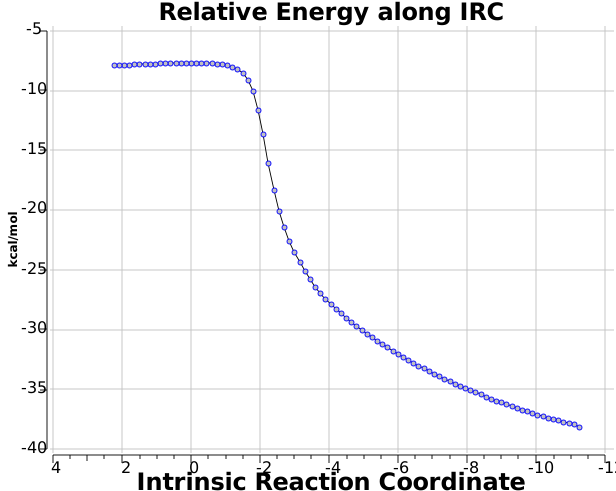
You will notice from the IRC profiles shown above that even without any prior protonation, the barrier to O-O cleavage is really very small (~ 4 kcal/mol). But the method I have used to calculate this is a closed shell DFT procedure. This does not allow the formation of the (open shell) biradical that two phenoxy radicals would represent. The barrier is low even without the formation of phenoxy radicals! Of course, as with the two previous examples, the actual initial product formed is the π-complex as first suggested by Michael Dewar. The wavefunction of such a species requires special treatment, since it is best described as a linear combination of two closed-shell configurations, what is called a multi-configuration or multi-reference wavefunction. So the single-configuration closed shell calculation that the above IRC represents must be an upper bound to a proper description of the energy transition state. In other words, if the description is improved, the barrier can only get even lower! 

Notice in the above that the π-complex formed in the first stage (of two) is actually lower in energy than the diphenyl peroxide itself, and that the barrier for this π-complex to then collapse to form the C-C bond between the two 4-positions is also tiny. This π-complex in other words is very transient indeed, probably not surviving for even one molecular vibration. To all intents and purposes, this really is a concerted [5,5] sigmatropic shift, as shown in the schematic at the top of this post. But the bottom line is that the homolysis argument need not be the only one (although it  is not necessarily incorrect). One can just as readily explain why PhOOPh does not exist by invoking facile formation of Dewar-like π-complex instead.


Another deceptively simple little molecule that requires such a treatment is C2, the topic of much recent debate![2], [3]

References

  1. R. Benassi, U. Folli, S. Sbardellati, and F. Taddei, "Conformational properties and homolytic bond cleavage of organic peroxides. I. An empirical approach based upon molecular mechanics and <i>ab initio</i> calculations", Journal of Computational Chemistry, vol. 14, pp. 379-391, 1993. https://doi.org/10.1002/jcc.540140402
  2. S. Shaik, H.S. Rzepa, and R. Hoffmann, "One Molecule, Two Atoms, Three Views, Four Bonds?", Angewandte Chemie International Edition, vol. 52, pp. 3020-3033, 2013. https://doi.org/10.1002/anie.201208206
  3. J.M. Matxain, F. Ruipérez, I. Infante, X. Lopez, J.M. Ugalde, G. Merino, and M. Piris, "Communication: Chemical bonding in carbon dimer isovalent series from the natural orbital functional theory perspective", The Journal of Chemical Physics, vol. 138, 2013. https://doi.org/10.1063/1.4802585

How to predict the regioselectivity of epoxide ring opening.

Sunday, April 28th, 2013

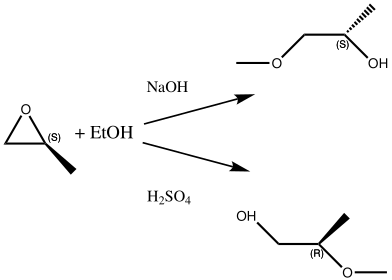
I recently got an email from a student asking about the best way of rationalising epoxide ring opening using some form of molecule orbitals. This reminded me of the famous experiment involving propene epoxide.[1]

propenoxide

In the presence of 0.3% NaOH, propene epoxide reacts with ethanol at the unsubstituted carbon (~82% compared with 56% in pure water, with retention of configuration at the other carbon) but in 1.3% H2SO4, the predominant product involves attack of ethanol at the more substituted carbon (presumably with inversion of configuration at that carbon). There are many ways of modelling this, but here I choose a simple one; inspecting the energy of the lowest unoccupied orbital (the one that will interact with the lone pair orbital on the incoming nucleophile). The issue is what kind of orbital that should be? The best to choose in this sort of situation is a localized orbital, an NBO in fact.

NaOH H2SO4
Energy

Energy 0.353 au

Energy

Energy -0.004 au


Energy

Energy 0.347 au

 
Energy

Energy -0.061 au

In NaOH solutions (where protonation of the epoxide oxygen is suppressed), the lowest energy unoccupied NBO is the O-C  σ* orbital involving the unsubstituted carbon, but where the oxygen is protonated, it now becomes the O-C σ* orbital involving the substituted carbon.

One can also teach a simpler heuristic, namely that protonation of the epoxide encourages the early formation of a carbocation, and that the most substituted such cation is the most stable. In the absence of protonation, some (small) contribution from an incipient alkoxy anion favours the alkoxide formed on the more stable carbon.

References

  1. H.C. Chitwood, and B.T. Freure, "The Reaction of Propylene Oxide with Alcohols", Journal of the American Chemical Society, vol. 68, pp. 680-683, 1946. https://doi.org/10.1021/ja01208a047