Posts Tagged ‘final product’

Organocatalytic cyclopropanation of an enal: (computational) mechanistic understanding.

Saturday, August 25th, 2018

Symbiosis between computation and experiment is increasingly evident in pedagogic journals such as J. Chemical Education. Thus an example of original laboratory experiments[1],[2] that later became twinned with a computational counterpart.[3] So when I spotted this recent lab experiment[4] I felt another twinning approaching.

The reaction under consideration is that between dec-2-enal and 2,4-dinitrobenzyl chloride as catalysed by an α,α-diphenylprolinol trimethylsilyl ester with addition of further base (di-isopropylamine?). The proposed mechanism can be seen in figure 7 of the journal article[4] and also scheme 2 of an earlier article.[5] The following is my interpretation of their published mechanism (the compound numbering is the same as in Figure 7).

  1. The initiating step is the condensation between the alkyl enal (1) and the prolinol derivative (3), with elimination of water and the formation of a positive iminium cation (5). One might wonder at this stage what the counter ion to this cation is.
  2. 5 then reacts with 2,4-dinitrobenzyl chloride (2) with apparent elimination of HCl to form 6. This corresponds to 1,4-Michael addition to 5 with the formation of the first new  C-C bond and the creation of two new stereogenic centres.
  3. 6 then cyclises to form a second new C-C bond and a third new stereogenic centre as in 7.
  4. 7 is then hydrolysed to give the final product 4.

A total of three (starred) stereogenic centres are therefore created in 4, implying 23 = 8 steroisomers, arranged as four diastereomers and their enantiomers. A computational mechanistic analysis might strive to cast light on the following questions.

  • Is the sequence shown in figure 7 reasonable? If not can a more reasonable cycle be constructed that has energetics corresponding to a facile reaction at 0°C?
  • What are the predicted relative yields of the four possible diastereomeric products and do they match those observed?
  • If  R=α,α-diphenylprolinol trimethylsilyl ester, then this fourth chiral centre increases the total number of stereoisomers to 16, arranged in eight pairs of diastereomers. Does this result in the diastereomers of 4 forming with an excess of one enantiomer over the other (an ee ≠ 0)?

This post addresses just the first question (R=R’=H, R”=isopropylamine) leaving the other two questions for later analysis.
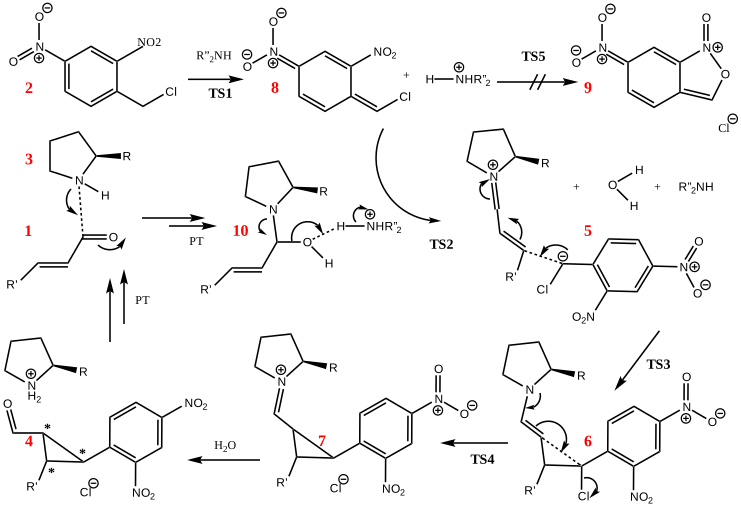
My analysis (figure above) of the mechanism, as cast for computational analysis, differs in various details from Figure 7/Scheme 2 of the published articles.[4],[5]

  1. The issue of defining a counterion to 5 is solved by in fact starting the cycle with proton abstraction from 2 by di-isopropylamine to form a benzylic anion, as stabilized by the 2,4-dinitro groups and with the positive counter-ion being the protonated amine base.
  2. The next step is reaction between 1 and 3 to form an aminol 10, a tetrahedral intermediate.
  3. To remove water from this to form an iminium cation 5, one has to protonate the hydroxy group and this can now be done using the cationic ammonium species formed in step 5 above.
  4. The benzylic anion can now react with the iminium cation to form the first C-C bond and the first two stereocentres via 1,4-Michael addition to form 6
  5. The species 6 can now eliminate chloride anion to form the cyclopropyl iminium cation/anion pair 7, generating the 3rd stereogenic centre.
  6. Hydrolysis forms the product 4 and returns the system to the starting point in the catalytic cycle.
  7. Also included is whether an alternative mechanism is viable, involving elimination of Cl from 8 to form a “carbene”, which could then potentially add to the alkene in 1.

Species (transition state)

FAIR Data DOI
10.14469/hpc/4642

ΔG273.15, Hartree
(ΔΔG273.15, kcal/mol)

Structure
(click for 3D model)

Reactants -1837.174744 (0.0)
TS1 -1837.150502 (15.2)
TS2 -1837.154923 (12.4)
TS3 -1837.147927 (16.8)
TS4 -1837.175723 (-0.6)
TS5 -1837.101534 (45.9)

The (relative) free energies of the transition states at the B3LYP+GD3BJ/6-311G(d,p)/SCRF=chloroform level shown in the table above (click on the thumbnail images to show the 3D model of each transition state) reveal that the highest point corresponds to TS3, a C-C bond forming reaction. This is noteworthy because it constitutes the reaction between an ion-pair, albeit ions which are both heavily stabilized by delocalisation. Since the reaction is known to proceed over 3 hours at 0°C, the activation barrier of 16.8 kcal/mol is also entirely reasonable. TS5, the putative formation of a carbene from the benzyl chloride, has a very high barrier and in fact cyclises to form 9. This pathway can therefore be safely ignored.

The next stage would be to investigate the stereochemical implications of this mechanism (atoms in 4 marked with a *) using the actual substituents for R and R’. Because the mechanism includes ion-pairs throughout, this does actually present some tricky issues. Unlike molecules with covalent bonds, where the shapes are relatively easy to predict, ion-pairs are more flexible and can often adopt a variety of poses, the relative energy of which is frequently determined simply by the magnitudes of their dipole moments.[6] If I manage to sort this out, I will report back here.


I would love to show you figure 7 here, but the publisher asserts that I would need to pay them $87.75 to do so and so you will have to acquire the article yourself to see it.

Various guiding rules include constructing the entire catalytic cycle using exactly the same number of atoms so that the cycle can show only relative (free) energies and using neutral ion-pair models rather than just charged species alone.

Almost all the chemical diagrams on this blog for some ten years now have been in SVG (scalable vector graphics) format. Most modern web browsers for a number of years now have had excellent support for SVG. Until recently SVG could not be generated directly from a drawing program such as e.g. ChemDraw. Instead I saved as EPS (encapsulated postscript) and then used a program called Scribus to convert to SVG. In fact with Chemdraw V18.0, the direct conversion to SVG seems to be working very well, including honoring color maps. To scale up a diagram, click on it to open a new browser window containing only it and then use the browser zoom-in control to magnify it. Unlike e.g. a pixel image, SVG images magnify/scale correctly.

This relates to metadata as described in this post in performing a global search of any species matching this Gibbs Energy.

If the mechanism is set up without any base, then proton abstraction must occur directly from the benzyl chloride. Under these circumstances, the barrier for proton removal is 27.5 kcal/mol, whilst that for C-C bond formation is only 13.6.

References

  1. A. Burke, P. Dillon, K. Martin, and T.W. Hanks, "Catalytic Asymmetric Epoxidation Using a Fructose-Derived Catalyst", Journal of Chemical Education, vol. 77, pp. 271, 2000. https://doi.org/10.1021/ed077p271
  2. J. Hanson, "Synthesis and Use of Jacobsen's Catalyst: Enantioselective Epoxidation in the Introductory Organic Laboratory", Journal of Chemical Education, vol. 78, pp. 1266, 2001. https://doi.org/10.1021/ed078p1266
  3. K.K.(. Hii, H.S. Rzepa, and E.H. Smith, "Asymmetric Epoxidation: A Twinned Laboratory and Molecular Modeling Experiment for Upper-Level Organic Chemistry Students", Journal of Chemical Education, vol. 92, pp. 1385-1389, 2015. https://doi.org/10.1021/ed500398e
  4. M. Meazza, A. Kowalczuk, S. Watkins, S. Holland, T.A. Logothetis, and R. Rios, "Organocatalytic Cyclopropanation of (<i>E</i>)-Dec-2-enal: Synthesis, Spectral Analysis and Mechanistic Understanding", Journal of Chemical Education, vol. 95, pp. 1832-1839, 2018. https://doi.org/10.1021/acs.jchemed.7b00566
  5. M. Meazza, M. Ashe, H.Y. Shin, H.S. Yang, A. Mazzanti, J.W. Yang, and R. Rios, "Enantioselective Organocatalytic Cyclopropanation of Enals Using Benzyl Chlorides", The Journal of Organic Chemistry, vol. 81, pp. 3488-3500, 2016. https://doi.org/10.1021/acs.joc.5b02801
  6. J. Clarke, K.J. Bonney, M. Yaqoob, S. Solanki, H.S. Rzepa, A.J.P. White, D.S. Millan, and D.C. Braddock, "Epimeric Face-Selective Oxidations and Diastereodivergent Transannular Oxonium Ion Formation Fragmentations: Computational Modeling and Total Syntheses of 12-Epoxyobtusallene IV, 12-Epoxyobtusallene II, Obtusallene X, Marilzabicycloallene C, and Marilzabicycloallene D", The Journal of Organic Chemistry, vol. 81, pp. 9539-9552, 2016. https://doi.org/10.1021/acs.joc.6b02008

The mechanism of borohydride reductions. Part 1: ethanal.

Sunday, April 12th, 2015

Sodium borohydride is the tamer cousin of lithium aluminium hydride (LAH). It is used in aqueous solution to e.g. reduce aldehydes and ketones, but it leaves acids, amides and esters alone. Here I start an exploration of why it is such a different reducing agent.
BH4

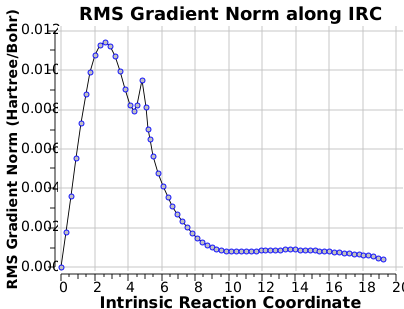
Initially, I am using Li, not Na (X=Li), to enable a more or less equal comparison with LAH, with water molecules to solvate rather than ether (n=2,3,5) and R set to Me. First, n=2, for which the IRC is shown below. In this model, we will assume that the carbonyl has not first reacted with water to form a gem-diol. The free energy barrier is 9.6 kcal/mol (ωB97XD/6-311+G(d,p)/SCRF=water) which corresponds to a very fast reaction at room temperatures.

BH4a
The immediate product is, if anything, more interesting than the transition state[1] with quite a stretched length for the newly formed C-H bond and predicted stretching wavenumber for this bond of 2137 cm-1. This effect is similar to that seen for the LAH reduction of cinnamaldehyde, and is due to stereoelectronic antiperiplanar alignment of the oxyanionic oxygen lone pair with the C-H bond. This species is also some 6.5 kcal/mol higher in energy than the reactant, and is clearly not the final product of the reaction (which must contain e.g. B-O bonds), the mechanism for which will not be investigated here immediately.
BH4-2p
For n=3, we see new solvation patterns, including a dihydrogen bond formed between water and the borohydride at the transition state; ΔG is 10.0 kcal.mol.

Click for  3D.

Click for 3D.

Finally, n=5, where the TS is showing a cage-like structure of complex weak interactions, ΔG† is 11.3 kcal.mol. We see a model where inclusion of explicit solvent molecules can have a significant influence on the size of the barrier obtained.

Click for  3D

Click for 3D


BH4-5

NCI surface. Click for  3D.

NCI surface. Click for 3D. Blue=strong attractions, green=weak.

n ΔG298 FAIR Data citation
2 9.6 [2]
3 10.0 [3]
5 11.3 [4]

With a mechanistic prototype now identified, it is time to start varying some of the parameters, such as X and R. This will enable us to assess the models built here to see if they reflect reality.

References

  1. H.S. Rzepa, and H.S. Rzepa, "C 2 H 12 B 1 Li 1 O 3", 2015. https://doi.org/10.14469/ch/191186
  2. H.S. Rzepa, and H.S. Rzepa, "C 2 H 12 B 1 Li 1 O 3", 2015. https://doi.org/10.14469/ch/191188
  3. H.S. Rzepa, and H.S. Rzepa, "C 2 H 14 B 1 Li 1 O 4", 2015. https://doi.org/10.14469/ch/191189
  4. H.S. Rzepa, and H.S. Rzepa, "C 2 H 18 B 1 Li 1 O 6", 2015. https://doi.org/10.14469/ch/191192

A better model for the mechanism of Lithal (LAH) reduction of cinnamaldehyde?

Friday, April 10th, 2015

Previously on this blog: modelling the reduction of cinnamaldehyde using one molecule of lithal shows easy reduction of the carbonyl but a high barrier at the next stage, the reduction of the double bond. Here is a quantum energetic exploration of what might happen when a second LAH is added to the brew (the usual ωB97XD/6-311+G(d,p)/SCRF=diethyl ether).

LAH1

In a comment at the end of the first post on this theme, I had noted some crystal structures containing in effect HxAl.Li(OR)y units (x=3,4; y=0-3), noting the variety of structural motifs. The current exploration does not even attempt to cover this range of possibilities, but it is informed by the types of weak interaction that these structures reveal. I will nevertheless accept that whatever pathway is revealed here is likely to represent an energetic upper bound and recognise that lower energy pathways may well exist but are yet to be explored.

  1. At the I12 stage, a second AlH4.Li(OMe)2 is added and hydride transfer occurs antiperiplanar across the C=C bond (TS34-1). The computed free energy barrier ΔG298 is ~24 kcal/mol. The magnitude of this barrier corresponds to a relatively slow reaction occurring around room temperatures or slightly higher.
    Click for  3D

    TS. Click for 3D


    TS34a
    Click for  3D

    NCI Isosurface (green regions are dispersion stabilizing) Click for 3D

  2. A transient shallow intermediate I34-1 is formed in which the benzylic anion is stabilised by an adjacent solvated Li centre. The energy of this species (Table below) needs some explanation. Can its free energy really be 1.5 kcal/mol higher than that of the preceding transition state? Yes, because its entropy is lower! The transition state is located on a total energy surface, which does not include thermal and entropic corrections; these are always applied AFTER the stationary points are located. If one inspects these total energies, I34-1 emerges as 1.2 kcal/mol lower than the preceding transition state. This sort of result serves to remind us of the dynamic nature of a potential energy surface, and that static energies may on occasion lead to odd results. Its geometry is shown below, and this too has an interesting feature. The C-H bond just created from the LAH is antiperiplanar to the benzylic anion (locked anti by the Li) and the resulting stereoelectronic effect reduces its C-H calculated[1] stretching wavenumber from the normal value of ~3100 cm-1 to 2231 cm-1, a remarkable reduction.
    Click for  3D

    I34-1. Click for 3D

  3. The C-O-AlH3.Li(OMe)2 ligand now needs to rotate to I34-2 so that metal exchange on the benzylic carbon can occur, with Al displacing Li at that position. As with I34-1, the free energy of this species is actually slightly higher than that of TS34-1. Two AlH3 groups now exist at this stage (each of them formed by hydride donation as part of the reduction process, see below). A hydride transfer metathesis between them (H2Al-H-Al3 is actually a stable bridged species) will generate an AlH2 as part of the 5-ring aluminate ester in P34 and regenerate a molecule of LAH. Transition states for these processes (i.e. TS34-2) proved difficult to locate; it may be that the ligand rotation and the hydride metathesis are part of the same concerted process but that is not proven yet.
    Click for  3D

    I34-2. Click for 3D

  4. The final product prior to hydrolysis is appropriately exoenergic.
  5. I would also remark that many aspects of this reaction remain unexplored. For example, AlH4 can deliver up to four hydrides, becoming progressively substituted as Al(OR)nHy and in the process loosing Al-H…Li weak interactions. What influence this has on the barriers remains unknown.
Species Relative ΔG298, kcal/mol FAIR Data-DOI
I12 0.0 [2]
TS34-1 24.1 [3]
I34-1 25.5 [1]
I34-2 25.0 [4]
P34 -8.8 [5]

In summary, the first step in the reduction of cinnamaldehyde to cinnamyl alcohol requires just one molecule of “LiAlH4” as reductant and has a very low barrier to reaction. To construct a reasonable model to account for the slower further reduction of the C=C bond requires adding a further LiAlH4, the key feature being the availability of a lithium centre to stabilise out the forming benzylic carbanion. No doubt even better models might include the effects of adding e.g. a third molecule of LAH, and a much more extensive exploration of the various conformational options. But I think the present model might be good enough to augment the apparently relatively limited mechanistic speculations found in text books on the topic.


You sometimes see this phrase in articles reporting transition state location. What is means it that I tried a half-dozen what I thought were reasonable possibilities, and none of them satisfactorily converged. This semi-random exploration of the potential energy surface revealed a very flat energy potential, with lots of conformational possibilities. At this point, you have to decide whether it is worth the time to continue hunting.


References

  1. H.S. Rzepa, and H.S. Rzepa, "C 17 H 40 Al 2 Li 2 O 5", 2015. https://doi.org/10.14469/ch/191178
  2. H.S. Rzepa, and H.S. Rzepa, "C 17 H 40 Al 2 Li 2 O 5", 2015. https://doi.org/10.14469/ch/191172
  3. H.S. Rzepa, and H.S. Rzepa, "C 17 H 40 Al 2 Li 2 O 5", 2015. https://doi.org/10.14469/ch/191177
  4. H.S. Rzepa, and H.S. Rzepa, "C 17 H 40 Al 2 Li 2 O 5", 2015. https://doi.org/10.14469/ch/191181
  5. H.S. Rzepa, and H.S. Rzepa, "C 17 H 40 Al 2 Li 2 O 5", 2015. https://doi.org/10.14469/ch/191171

Woodward’s symmetry considerations applied to electrocyclic reactions.

Monday, May 20th, 2013

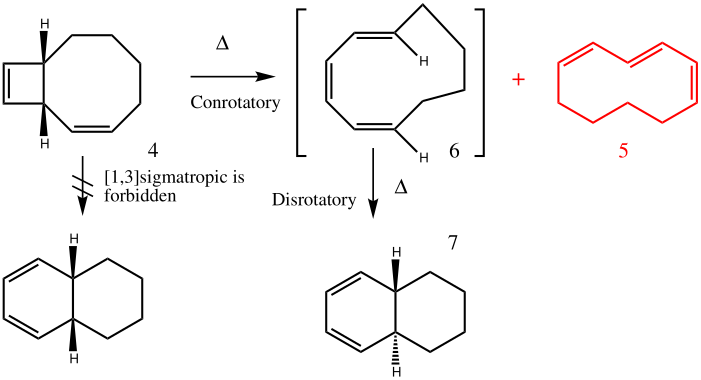
Sometimes the originators of seminal theories in chemistry write a personal and anecdotal account of their work. Niels Bohr[1] was one such and four decades later Robert Woodward wrote “The conservation of orbital symmetry” (Chem. Soc. Special Publications (Aromaticity), 1967, 21, 217-249; it is not online and so no doi can be given). Much interesting chemistry is described there, but (like Bohr in his article), Woodward lists no citations at the end, merely giving attributions by name. Thus the following chemistry (p 236 of this article) is attributed to a Professor Fonken, and goes as follows (excluding the structure in red):

wood

A search of the literature reveals only one published article describing this reaction[2] by Dauben and Haubrich, published some 21 years after Woodward’s description (we might surmise that Gerhard Fonken never published his own results). In fact this more recent study was primarily concerned with 193-nm photochemical transforms (they conclude that “the Woodward-Hoffmann rules of orbital symmetry are not followed”) but you also find that the thermal outcome of heating 4 is a 3:2 mixture of compounds 5 and 6, and that only 6 goes on to give the final product 7. It does look like a classic and uncomplicated example of Woodward-Hoffmann rules.

 So let us subject this system to the “reality check”. The transform of 4 → 5 rotates the two termini of the cleaving bond in a direction that produces the stereoisomer 5, with a trans alkene straddled by two cis-alkenes[3]. The two carbon atoms that define the termini of the newly formed hexatriene are ~ 4.7Å apart; too far to be able to close to form 7.

 4 → 5  4 → 6
8 8

But with any electrocyclic reaction, two directions of rotation are always possible, and it is a rotation in the other direction that gives 4 → 6[4], ending up with a hexatriene with the trans-alkene at one end and not the middle (for which the free energy of activation is 3.1 kcal/mol higher in energy). Now the two termini of the hexatriene end up ~3.0Å apart, much more amenable to forming a bond between them to form 7.

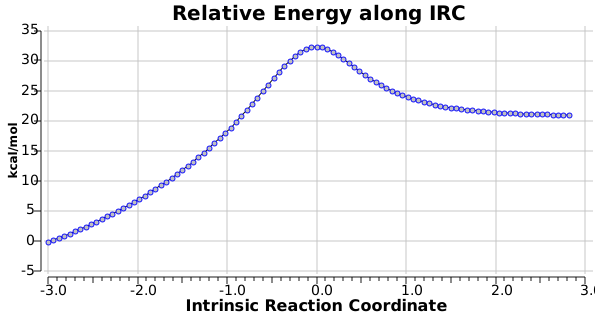
It is at this point that the apparently uncomplicated nature of this example starts to unravel. If one starts from the 3.0Å end-point of the above reaction coordinate and systematically contracts the bond between these two termini, a transition state is found leading not to 7 but to the (endothermic) isomer 8.[5]This form has a six-membered ring with a trans-alkene motif (which explains why it is so endothermic). 

wood1
6 ↠ 8
8 wood2

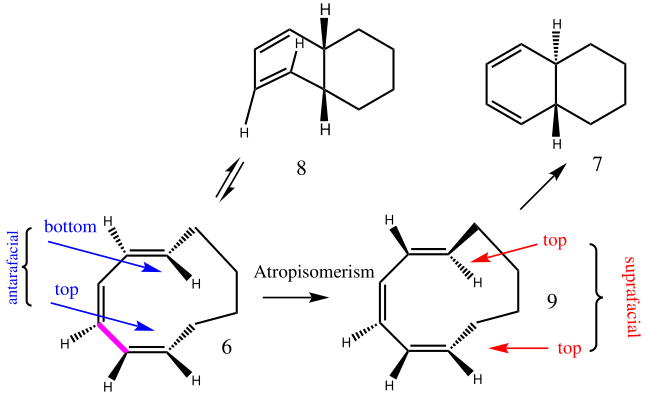
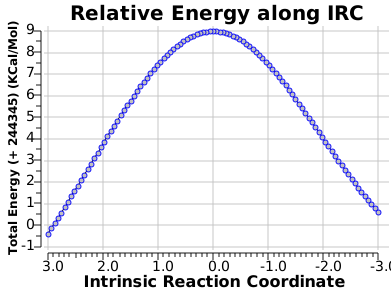
Before discussing the implications of this transition state, I illustrate another isomerism that 6 can undertake; a low-barrier atropisomerism[6] to form 9, followed by another reaction with a relatively low barrier, 9 ↠  7[7]to give the product that Woodward gives in his essay.

6 ↠ 9
6-atrop 6-atrop
9 ↠ 7
9to7a 9to7a

 We can now analyse the two transformations 6 ↠ 8 and 9 ↠  7. The first involves antarafacial bond formation (blue arrows) at the termini and an accompanying 180° twisting about the magenta bond which creates a second antarafacial component[8]. So this is a thermally allowed six-electron (4n+2) electrocyclisation with a double-Möbius twist[9]. The second reaction is a more conventional purely suprafacial version[10] (red arrows) of the type Woodward was certainly thinking of; it is 18.0 kcal/mol lower in free energy than the first (the transition state for 6 ↠ 9 is 10.8 kcal/mol lower than that for 9 ↠ 7).

I hope that this detailed exploration of what seems like a pretty simple example at first sight shows how applying a “reality-check” of computational quantum mechanics can cast (some unexpected?) new light on an old problem. We may of course speculate on how to inhibit the pathway 6 ↠ 9 ↠ 7 to allow only 6 ↠ 8 to proceed (the reverse barrier from 8 is quite low, so 8 would have to be trapped at very low temperatures). 

References

  1. N. Bohr, "Der Bau der Atome und die physikalischen und chemischen Eigenschaften der Elemente", Zeitschrift f�r Physik, vol. 9, pp. 1-67, 1922. https://doi.org/10.1007/bf01326955
  2. W.G. Dauben, and J.E. Haubrich, "The 193-nm photochemistry of some fused-ring cyclobutenes. Absence of orbital symmetry control", The Journal of Organic Chemistry, vol. 53, pp. 600-606, 1988. https://doi.org/10.1021/jo00238a023
  3. H.S. Rzepa, "Gaussian Job Archive for C10H14", 2013. https://doi.org/10.6084/m9.figshare.704833
  4. H.S. Rzepa, "Gaussian Job Archive for C10H14", 2013. https://doi.org/10.6084/m9.figshare.704834
  5. H.S. Rzepa, "Gaussian Job Archive for C10H14", 2013. https://doi.org/10.6084/m9.figshare.704755
  6. H.S. Rzepa, "Gaussian Job Archive for C10H14", 2013. https://doi.org/10.6084/m9.figshare.704754
  7. H.S. Rzepa, "Gaussian Job Archive for C10H14", 2013. https://doi.org/10.6084/m9.figshare.704844
  8. H.S. Rzepa, "Gaussian Job Archive for C10H14", 2013. https://doi.org/10.6084/m9.figshare.704841
  9. H.S. Rzepa, "Double-twist Möbius aromaticity in a 4n+ 2 electron electrocyclic reaction", Chemical Communications, pp. 5220, 2005. https://doi.org/10.1039/b510508k
  10. H.S. Rzepa, "Gaussian Job Archive for C10H14", 2013. https://doi.org/10.6084/m9.figshare.704995

Woodward's symmetry considerations applied to electrocyclic reactions.

Monday, May 20th, 2013

Sometimes the originators of seminal theories in chemistry write a personal and anecdotal account of their work. Niels Bohr[1] was one such and four decades later Robert Woodward wrote “The conservation of orbital symmetry” (Chem. Soc. Special Publications (Aromaticity), 1967, 21, 217-249; it is not online and so no doi can be given). Much interesting chemistry is described there, but (like Bohr in his article), Woodward lists no citations at the end, merely giving attributions by name. Thus the following chemistry (p 236 of this article) is attributed to a Professor Fonken, and goes as follows (excluding the structure in red):

wood

A search of the literature reveals only one published article describing this reaction[2] by Dauben and Haubrich, published some 21 years after Woodward’s description (we might surmise that Gerhard Fonken never published his own results). In fact this more recent study was primarily concerned with 193-nm photochemical transforms (they conclude that “the Woodward-Hoffmann rules of orbital symmetry are not followed”) but you also find that the thermal outcome of heating 4 is a 3:2 mixture of compounds 5 and 6, and that only 6 goes on to give the final product 7. It does look like a classic and uncomplicated example of Woodward-Hoffmann rules.

 So let us subject this system to the “reality check”. The transform of 4 → 5 rotates the two termini of the cleaving bond in a direction that produces the stereoisomer 5, with a trans alkene straddled by two cis-alkenes[3]. The two carbon atoms that define the termini of the newly formed hexatriene are ~ 4.7Å apart; too far to be able to close to form 7.

 4 → 5  4 → 6
8 8

But with any electrocyclic reaction, two directions of rotation are always possible, and it is a rotation in the other direction that gives 4 → 6[4], ending up with a hexatriene with the trans-alkene at one end and not the middle (for which the free energy of activation is 3.1 kcal/mol higher in energy). Now the two termini of the hexatriene end up ~3.0Å apart, much more amenable to forming a bond between them to form 7.

It is at this point that the apparently uncomplicated nature of this example starts to unravel. If one starts from the 3.0Å end-point of the above reaction coordinate and systematically contracts the bond between these two termini, a transition state is found leading not to 7 but to the (endothermic) isomer 8.[5]This form has a six-membered ring with a trans-alkene motif (which explains why it is so endothermic). 

wood1
6 ↠ 8
8 wood2

Before discussing the implications of this transition state, I illustrate another isomerism that 6 can undertake; a low-barrier atropisomerism[6] to form 9, followed by another reaction with a relatively low barrier, 9 ↠  7[7]to give the product that Woodward gives in his essay.

6 ↠ 9
6-atrop 6-atrop
9 ↠ 7
9to7a 9to7a

 We can now analyse the two transformations 6 ↠ 8 and 9 ↠  7. The first involves antarafacial bond formation (blue arrows) at the termini and an accompanying 180° twisting about the magenta bond which creates a second antarafacial component[8]. So this is a thermally allowed six-electron (4n+2) electrocyclisation with a double-Möbius twist[9]. The second reaction is a more conventional purely suprafacial version[10] (red arrows) of the type Woodward was certainly thinking of; it is 18.0 kcal/mol lower in free energy than the first (the transition state for 6 ↠ 9 is 10.8 kcal/mol lower than that for 9 ↠ 7).

I hope that this detailed exploration of what seems like a pretty simple example at first sight shows how applying a “reality-check” of computational quantum mechanics can cast (some unexpected?) new light on an old problem. We may of course speculate on how to inhibit the pathway 6 ↠ 9 ↠ 7 to allow only 6 ↠ 8 to proceed (the reverse barrier from 8 is quite low, so 8 would have to be trapped at very low temperatures). 

References

  1. N. Bohr, "Der Bau der Atome und die physikalischen und chemischen Eigenschaften der Elemente", Zeitschrift f�r Physik, vol. 9, pp. 1-67, 1922. https://doi.org/10.1007/bf01326955
  2. W.G. Dauben, and J.E. Haubrich, "The 193-nm photochemistry of some fused-ring cyclobutenes. Absence of orbital symmetry control", The Journal of Organic Chemistry, vol. 53, pp. 600-606, 1988. https://doi.org/10.1021/jo00238a023
  3. H.S. Rzepa, "Gaussian Job Archive for C10H14", 2013. https://doi.org/10.6084/m9.figshare.704833
  4. H.S. Rzepa, "Gaussian Job Archive for C10H14", 2013. https://doi.org/10.6084/m9.figshare.704834
  5. H.S. Rzepa, "Gaussian Job Archive for C10H14", 2013. https://doi.org/10.6084/m9.figshare.704755
  6. H.S. Rzepa, "Gaussian Job Archive for C10H14", 2013. https://doi.org/10.6084/m9.figshare.704754
  7. H.S. Rzepa, "Gaussian Job Archive for C10H14", 2013. https://doi.org/10.6084/m9.figshare.704844
  8. H.S. Rzepa, "Gaussian Job Archive for C10H14", 2013. https://doi.org/10.6084/m9.figshare.704841
  9. H.S. Rzepa, "Double-twist Möbius aromaticity in a 4n+ 2 electron electrocyclic reaction", Chemical Communications, pp. 5220, 2005. https://doi.org/10.1039/b510508k
  10. H.S. Rzepa, "Gaussian Job Archive for C10H14", 2013. https://doi.org/10.6084/m9.figshare.704995

Secrets of a university tutor: unravelling a mechanism using spectroscopy.

Thursday, January 31st, 2013

It is always rewarding when one comes across a problem in chemistry that can be solved using a continuous stream of rules and logical inferences from them. The example below[1] is one I have been using as a tutor in organic chemistry for a few years now, and I share it here. It takes around 50 minutes to unravel with students.

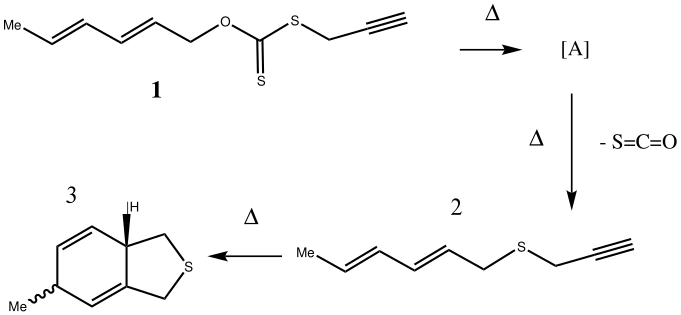
14

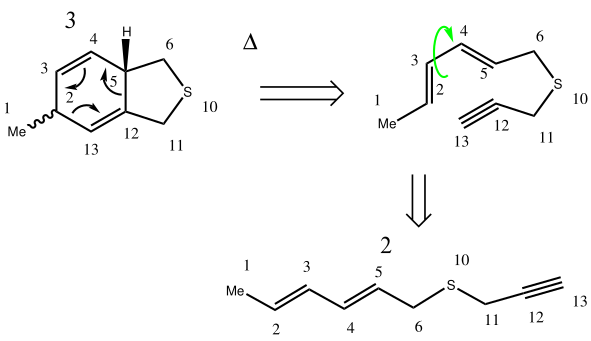
The narrative is that attempted preparation of 1 resulted instead in a mysterious compound [A], which when heated extruded S=C=O to give 2, and upon further heating gave 3. The challenge is to identify [A] with the help of the spectroscopic information provided, to infer the mechanism of its formation and further to suggest what the stereochemistry of the methyl group in 3 might be.

The 1H NMR of [A] is set out below for future reference: δ 1.70 (3H,d,6Hz), 2.23 (1H, t, 3Hz), 3.73 (2H, d, 3Hz), 4.84 (1H, dd, 7,8Hz), 5.15 (1H, d, 10Hz), 5.27 (1H, d, 17Hz), 5.51 (1H, dd, 8,16.5 Hz), 5.77 (1H, dq, 6,16.5 Hz), 5.88 (1H, ddd, 7,10,17Hz). 

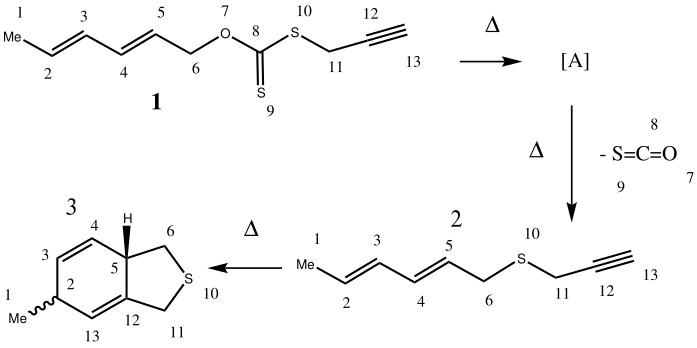
As usual, one has to start somewhere, and here the task is to number the atoms, and then try to “reaction map” them to the products.

14a

  1. The first real decision is how to map S9 or S10. Occam’s razor suggests that the sulfur in the SCO comes from S9 (this would allow C10-C11 to be left alone), but if that hypothesis is wrong, we can always return and try the alternative. Let us go with the simpler option first.
  2. Another relatively simple decision is to map C12-C13 as shown in 3, since this only changes its bond order by one (few mechanisms require a change in bond order of > 1 in any single mechanistic step). 

Analysis of the 1H NMR starts with the most obvious (marker) group, the methyl:

  1. The methyl is J-coupled to C2-H (6Hz), and hence this is assigned to 5.77 ppm.
  2. C2-H is J-coupled to C3-H (16.5 Hz) and hence this is assigned to 5.51 ppm
  3. C3-H is J-coupled to C4-H (8 Hz) and hence this is assigned to 4.84 ppm. 
  4. We now encounter a problem. C4-H has a chemical shift which suggests it is not attached to an sp2-C, but has become sp3-hybridized. But the relatively high chemical shift suggests that this carbon may be attached to electronegative substituents. C4 is flagged for attention below.
  5. C4-H is J-coupled via J 7 Hz to the peak at 5.88 ppm. The chemical shift is typical of sp2-C, and is assigned as C5-H.
  6. C5-H is J-coupled via two couplings of 10 and 17 Hz to peaks at 5.15 and 5.27 ppm. Both these are also sp2-C, which may be assigned as C6-H. As such it can only carry three attached atoms (two Hs and a C-C) and so the C6-O7 bond cannot be retained. C6 is flagged for attention below.
  7. The remaining peaks can be assigned as C11-H and C13-H from their mutual 4J coupling of 3Hz.

Armed with these inferences, a list of to-dos can now be assembled.

  1.  For the transform 1 → [A], break C6-O7
  2. Form a bond to C4 using if possible an electronegative atom.

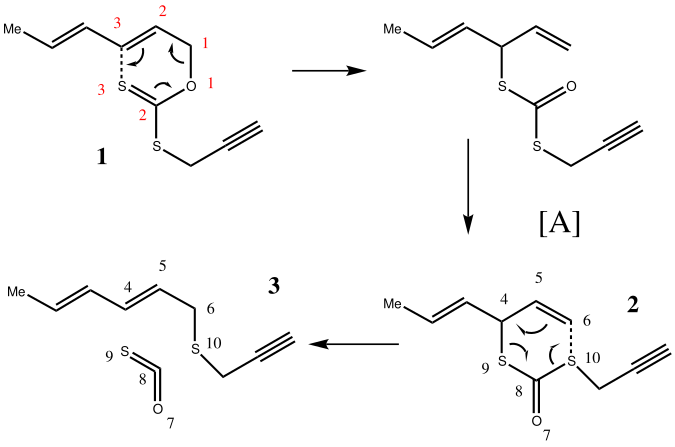
This pattern of break one σ-bond/form one σ-bond, reminds of a sigmatropic pericyclic reaction. A typical example is the Cope rearrangement, in which a bond forms between the termini of two double bonds separated by three σ-bonds. The penny drops when one re-draws the original compound by rotating about a single bond (a perfectly allowed operation):

14b

A [3,3] Cope is now exposed. The (re)-numbering in red shows the pattern described above, and completes the assignment of the bond forming above to C4 as C4-S9. The next step is to find out how to extrude S=C=O. 

  1. To get to 2, one needs to create the C6-S10 bond (it is  sp2-C in [A]). 
  2. The O8-S10 bond needs to break.
  3. The recently formed C4-S9 bond needs to break again, with the result of extruding the required S=C=O.

This pattern of forming and breaking bonds, but in unequal number reminds of the so-called ene class of pericyclic reaction. Both the Cope and now the ene are six-electron thermal pericyclic processes.

We can now turn our attention to the last reaction shown above. Since we have both structures now, we can do a retrosynthetic analysis, which reveals that in the final step, C2-C13 and C5-C12 have both got to form. Such a pattern is another six-electron pericyclic reaction, the Diels-Alder π2s + π4s cycloaddition. Again, we have to rotate about the C3-C4 single bond (green arrow) to get the diene of the reactant into a conformation capable of undertaking this reaction. We are helped in this by ensuring that the trans hydrogens at both C2-C3 and C4-C5 (which we inferred from the values of the J-couplings above) are not transformed during our redrawing of this conformation.

14c

The conclusion to this tutorial comes in assigning the stereochemistry of that methyl group. The π4s component of the cycloaddition mandates that the two bonds forming to C5 and to C2 must both form suprafacially across this four-carbon unit. We know that the bond to C5 must form on the bottom face, so as to rotate the C5-H up. Therefore it must form on the bottom face also of C2, likewise rotating the attached hydrogen up. Therefore the methyl must point  down in the final product.

QED.

But not quite, since nowadays, one can take the NMR analysis one step further. In another post, I will perform a full quantum mechanical prediction of the above NMR spectrum to see how well it matches what is reported above.

References

  1. K. Harano, M. Eto, K. Ono, K. Misaka, and T. Hisano, "Sequential pericyclic reactions of unsaturated xanthates. One-pot synthesis of hydrobenzo[c]thiophenes", Journal of the Chemical Society, Perkin Transactions 1, pp. 299, 1993. https://doi.org/10.1039/p19930000299

Dynamic effects in nucleophilic substitution at trigonal carbon.

Monday, July 16th, 2012

Singleton and co-workers have produced some wonderful work showing how dynamic effects and not just transition states can control the outcome of reactions. Steve Bachrach’s blog contains many examples, including this recent one.

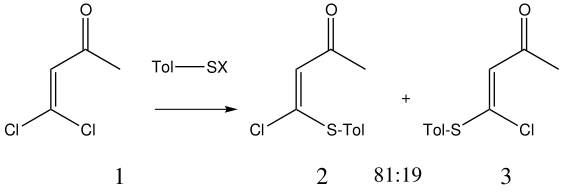
This shows that tolyl thiolate (X=Na) reacts with the dichlorobutenone to give two substitution products in a 81:19 ratio. Singleton and Bogle argue[1] that this arises from a single transition state, and that the two products arise from a statistical distribution of dynamic trajectories bifurcating out of a transition state favouring 2 over 3. Steve puts it very elegantly “I think most organic chemists hold dear to their hearts the notion that selectivity is due to crossing over different transition states“. When I read this, Occam’s razor came to mind: could a simpler (in this casemore conventional) answer in fact be better? 

My thoughts in fact followed a point I have been making here recently, the principle that modelling a complete system is probably better than a partial one. Now, if you look at Figure 1 of the Singleton/Bogle article, captioned “Qualitative energy surface for the reaction of 1 with sodium p-tolyl thiolate” I was struck by something missing; the sodium (X=Na), and possibly also explicit solvent (ethanol). I wanted to see if these missing components may influence the mechanism.

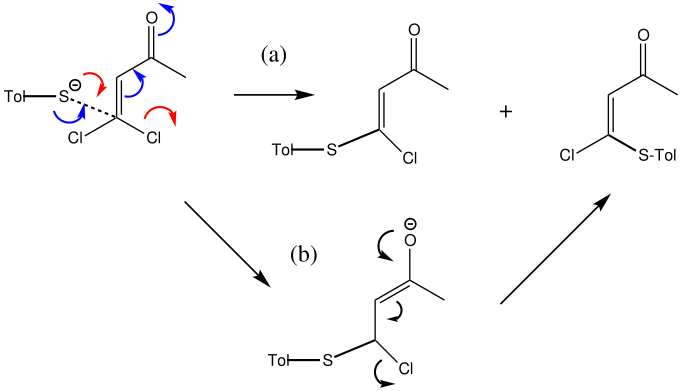
The red arrows follow the proposed mechanism (a), whereas the blue arrows represent a more conventional 1,4-nucleophilic addition to form an intermediate enol anion, this then eliminating to the final product. Singleton & co. explored the potential energy surface using the following computational model: B3LYP/6-31+G(d,p)/PCM(ethanol) for the anionic system (defined by setting an overall charge of -1 during the calculation), finding the potential energy surface corresponded to path (a). They then went on to explore the dynamics of the system emerging out of this single TS, showing that in fact both products would be formed in more or less exactly the ratio observed. 

I thought two things could be considered missing from this model; X+ (the counterion) and explicit solvent (continuum solvent was invoked using the PCM model). On the latter point, I have thought for a little while that there are two types of solvent; those which act via their dielectric field, and those that act via hydrogen bonds. Ethanol does both, and so in this case (I argue) it should be explicitly included (actually, in the first instance it can be approximated using water instead of ethanol). The missing counter-ion is a greater challenge. In what follows I am going to approximate it too, using H+ (Na+ itself I reserve for a future post). The objective is to find out what (if anything) changes when this more complete model is built. It is shown below as the first transition state encountered. Its features include:

First transition state TS1. Click for 3D

  1. Two explicit solvent (water) molecules.
  2. A H+ (I will discuss Na+ in another post), attached to one of the water molecules as a hydronium ion.
  3. The hydronium ion bridges to the carbonyl group (this is the final optimised position; the second water molecule serves only to H-bond to the hydronium ion). 
  4. This overall system is neutral, charge=0 (I like to say it might be found in a bottle or flask; pure anions of course cannot be bottled). 
  5. The model used was B3LYP/6-31+G(d,p)/CPCM(ethanol); I find the CPCM method to be better for calculating intrinsic reaction coordinates (IRC).
  6. Using this transition state to initiate an IRC shows that the presence of this solvent bridge allows X (=H+) to smoothly transfer from sulfur to oxygen as part of a concerted process. This avoids excessive build up of charge separation.
  7. This now forms an intermediate (we are clearly following path (b) and not path (a) now). This is because the enolate anion is stabilised by protonation and a hydrogen bond from the proton to the solvent water, and so this becomes an explicit intermediate in the potential energy surface.

    Intermediate in reaction. Click for 3D

This intermediate now collapses along path (b) to the final product, via the transition state shown below. Again, an IRC shows a solvent bridge allows X to be concertedly transferred, this time from the oxygen to form hydronium chloride and 2 (I have not yet found the equivalent pathway to 3, but given the hydrogen bonds involved it is bound to be different).

Second transition state TS2. Click for 3D 

ΔG (kcal/mol) along this sequence is 1 (0.0), TS1 (28.2), Int (8.0), TS2 (12.6); the intermediate existing only in a shallow well of 4.6 kcal/mol. The activation barrier is on the high side (the reaction occurs easily at room temperature), and it might be expected that (in part) this might be due to using X=H+ rather than X=Na+ for the model. Watch this space!

What might we conclude from this? That the presence of additional molecules (H3O+ and H2O) can result in structures which can depend on other features of the molecule, in this case the carbonyl group, one that plays little role in mechanism (a). In path (b), the carbonyl group is far from passive, receiving and then releasing X during the course of the reaction. This must mean that the transition state for forming product 2 may indeed be a separate one from the transition state for forming product 3, since the relationship of these two to the carbonyl is different. To re-quote Steve again “I think most organic chemists hold dear to their hearts the notion that selectivity is due to crossing over different transition states”.

Perhaps the explanation might indeed be due to different transition states rather than different dynamics? Clearly, more research needs to be done; I for one do not regard the case as closed on this example just yet.

References

  1. X.S. Bogle, and D.A. Singleton, "Dynamic Origin of the Stereoselectivity of a Nucleophilic Substitution Reaction", Organic Letters, vol. 14, pp. 2528-2531, 2012. https://doi.org/10.1021/ol300817a

The mechanism of the Baeyer-Villiger rearrangement.

Monday, May 7th, 2012

The Baeyer-Villiger rearrangement was named after its discoverers, who in 1899 described the transformation of menthone into the corresponding lactone using Caro’s acid (peroxysulfuric acid). The mechanism is described in all text books of organic chemistry as involving an alkyl migration. Here I take a look at the scheme described by Alvarez-Idaboy, Reyes and Mora-Diez[1], and which may well not yet have made it to all the text books!

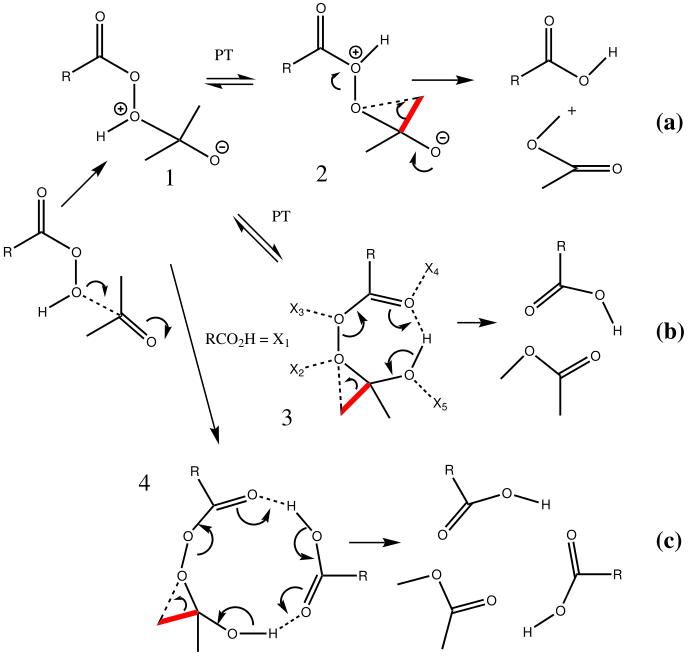
The text-book mechanism involves pathway (a, R=CF3) via species 1 and 2. A characteristic feature of many a mechanism of this type is the need for a step often labelled just PT (proton transfer). Very often, a proton will find itself attached to the wrong atom, and before the mechanism can be completed, it must be transferred to the correct location. Confusingly, there can be many ways of doing this, differing in the timing of the proton choreography. Deciding that running order can be perplexing to new students of chemistry. Tutors often will say that since PTs are very fast, it does not matter when this step occurs, since in effect all paths will lead to the final product. But we might imagine that the energies of all the various pathways can be (in principle) obtained from quantum calculations and that one will prevail over the others.

Path (b) is just one such variation, but with a twist, since it involves starting from 3 and proceeding via a cyclic transition state in which the migrating alkyl group (shown in red above) moves in concert with the relocating proton. I have repeated the original calculations (from 2007) using a somewhat updated procedure, much in the same way that the transition state for the aldol reaction was. A ωB97XD/6-311G(d,p)/SCRF=dichloromethane calculation of step (b) gives the transition state and associated intrinsic reaction coordinate (IRC) shown below.

Cyclic 7-ring mechanism for the Baeyer-Villiger. Click for 3D.

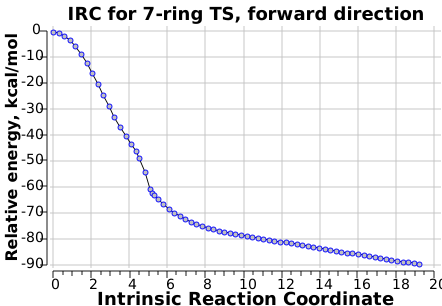
IRC for 7-ring TS, forward direction only.

Choreographically, this transition state is quite complex. Five bonds, all different in some aspect, are changing in asynchronous concert.

  1. Following the transition state towards the product, between IRC=0 and +4, we see the cleavage of the O-O bond occurring in synchrony with the migration of the alkyl (methyl) group towards the oxygen (think of it as an SN2 reaction at oxygen). Notice the antiperiplanar stereoelectronic alignment of the migrating (methyl) and the axis of the O-O bond, which strongly differentiates which of the two alkyl groups migrates. The non-migrating group is essentially orthogonal to the O-O bond.
  2. At IRC = +5 we see a sudden abrupt feature, which corresponds to transfer of the proton, and which is complete by IRC = +6. Protons, being light, do tend to move quickly when they decide to.
  3. The final noteworthy feature from IRC=+6 to >20 is the rotation of the newly formed methoxy group, starting from orthogonality with the carbonyl group (~IRC +6) to co-planarity (IRC > 20). The origins of this effect are associated with the same orthogonal/antiperiplanar stereoelectronic alignments that determined which alkyl group migrated earlier.
  4. Notice a minor feature, which is the rotation of the methyl groups to set up weaker stereoelectronic interactions.

Path (c) is another variation, where an extra molecule of acid (X1, 4) helps catalyse the reaction, this time by creating an 11-membered ring 4 leading to a transition state with potentially two proton transfers as well as the alkyl migration. By involving an additional second molecule of acid as catalyst, we now have seven participating bond changes. Whilst the original path (b) six endo and two exo electrons move in a cycle which is tantalisingly close to but not quite pericyclic (?), path (c) extends this by four electrons. It might be tempting to try to apply a selection rule here (such as 4n+2) but I am not sure it would be justified. 

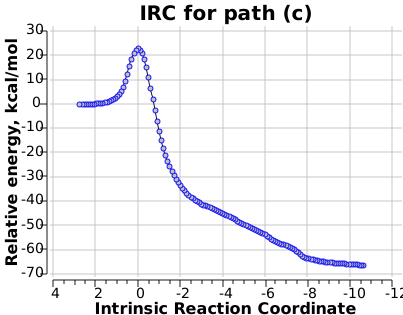
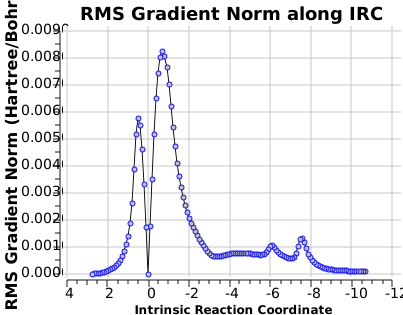
Baeyer-Villiger, 11-ring transition state. Click for 3D

  1. IRC +3 represents the starting tetrahedral intermediate 4 hydrogen bonded to an extra (trifluoroacetic) acid molecule.
  2. The transition state occurs at IRC =0.
  3. By IRC -2, O-O cleavage and methyl migration are essentially complete, but no protons have moved.
  4. From IRC -2 to -5, the methoxy group rotates to adopt the planar conformation of an ester.
  5. Only after this rotation does the first proton transfer start, at IRC -6, and this is then followed in rapid succession by a second at  -7 to complete the reaction to form ethyl ethanoate and two molecules of (trifluoroacetic) acid. This is a reversal of the sequence seen with path (b). Because no intermediates are discernible in the IRC, one must describe this as a concerted rearrangement, but in fact the bond choreography is far from synchronous. This is one aspect which conventional  arrow pushing does not capture.

To directly compare the energies of paths (b) and (c), we can repeat (b) with the addition of a more passive acid catalyst, in four new positions 3, X2 – X5. None of these are lower than 4 itself. There is one more surprise. Species 1 is not actually a minimum, but rearranges to e.g. the cyclic ring shown below. Its free energy is still higher than that of 3.

I will end with the following speculation. The point of interest to most students of the Baeyer-Villiger reaction is not the nature of the actual transition state, but deciding which of the two possible alkyl groups will migrate (in the example above both are methyls, but if one were e.g. phenyl it would migrate in preference to the methyl). The transition state teaches us that the group antiperiplanar to the O-O bond migrates. Can a system be devised where the antiperiplanar preference takes precedence over the migratory aptitude? For example, based on the following (click to see 3D structure below in which one R group is clearly pre-disposed to migrate in preference to the other).

References

  1. J.R. Alvarez-Idaboy, L. Reyes, and N. Mora-Diez, "The mechanism of the Baeyer–Villiger rearrangement: quantum chemistry and TST study supported by experimental kinetic data", Organic & Biomolecular Chemistry, vol. 5, pp. 3682, 2007. https://doi.org/10.1039/b712608e