Posts Tagged ‘Hydrogen bond’
Sunday, March 24th, 2019
There is a predilection amongst chemists for collecting records; one common theme is the length of particular bonds, either the shortest or the longest. A particularly baffling type of bond is that between the very electronegative F atom and an acid hydrogen atom such as that in OH. Thus short C-N…HO hydrogen bonds are extremely common, as are C-O…HO.‡ But F atoms in C-F bonds are largely thought to be inert to hydrogen bonding, as indicated by the use of fluorine in many pharmaceuticals as inert isosteres.[1] Here I do an up-to-date search of the CSD crystal structure database, which is now on the verge of accumulating 1 million entries, to see if any strong C-F…HO hydrogen bonding may have been recently discovered.
The search query uses the CF…HO distance as one variable, and the C-F-H angle as the second. The first diagram shows just intermolecular interactions, up to a distance of 2.7Å which is the sum of the van der Waals radii of the two elements. The hot spot occurs at this value, and an angle of ~95°.
 The intra-molecular plot shows a similar value for the most common F…H distance, with the interesting variation that the angle subtended at F is about 80°.
 The outlier at the short end of the spectrum (arrow) was observed in 2014[2] with the structure shown below. It is indeed the current record holder by some margin! This length by the way is however a great deal longer than the shortest O…HO hydrogen bonds, which can be in the region of 1.2Å (with the proton sometimes symmetrically disposed between the two oxygen atoms). The value is also very similar to the record holder for the shortest C-H…H-C interaction.
It is always useful to check up on crystallographic hydrogen atom positions using a quantum calculation, so here is one at the ωB97XD/Def2-TZVPP level (Data DOI: 10.14469/hpc/5131) which replicates the values nicely.

ωB97XD/Def2-TZVPP Calculation
A QTAIM analysis of the critical points shows that the F…H BCP has a high value of ρ(r) (most hydrogen bonds only reach about 0.03 au).

NBO analysis indicates the E(2) perturbation energy for donation from an F lone pair into the H-O σ* orbital is 21.2 kcal/mol, which indicates a strong H-bond (typical C-O…HO values are 18-22 kcal/mol). The F…H bond order is 0.05.
This molecule has another interesting property, also noted in the original article;[2] the shift in wavenumber of the O-H stretching vibration. Most hydrogen bonds are characterised by the shift (mostly red and recently discovered blue shifts) that occurs in the OH group when it hydrogen bonds. These shifts are typically 100-200 cm-1 but in this molecule there is no shift, which is described as “exceptional”.
The 1H NMR shift of the OH proton is observed at δ 4.8 ppm, with the value calculated here (ωB97XD/Def2-TZVPP) being 4.75 ppm. A very large H-F coupling was observed of 68 Hz, again a very high value for a “through space” hydrogen bond.
So another record for the molecule makers to try to break!
‡Respectively 7142 and 31428 intermolecular (3859 and 10602 intra) examples using the same search parameters as above, with the shortest values being ~1.28 and ~1.2Å. 

References
- S. Purser, P.R. Moore, S. Swallow, and V. Gouverneur, "Fluorine in medicinal chemistry", Chem. Soc. Rev., vol. 37, pp. 320-330, 2008. https://doi.org/10.1039/b610213c
- M.D. Struble, C. Kelly, M.A. Siegler, and T. Lectka, "Search for a Strong, Virtually “No‐Shift” Hydrogen Bond: A Cage Molecule with an Exceptional OH⋅⋅⋅F Interaction", Angewandte Chemie International Edition, vol. 53, pp. 8924-8928, 2014. https://doi.org/10.1002/anie.201403599
Tags:Chemical bond, chemical bonding, Chemical elements, Chemistry, Fluorine, Hydrogen, Hydrogen bond, Intermolecular forces, Natural sciences, perturbation energy, pharmaceuticals, Physical sciences, Refrigerants, search parameters, search query, Supramolecular chemistry
Posted in crystal_structure_mining | No Comments »
Wednesday, August 8th, 2018
White City is a small area in west london created as an exhibition site in 1908, morphing over the years into an Olympic games venue, a greyhound track, the home nearby of the BBC (British Broadcasting Corporation) and most recently the new western campus for Imperial College London.♣ The first Imperial department to move into the MSRH (Molecular Sciences Research Hub) building is chemistry. As a personal celebration of this occasion, I here dedicate three transition states located during my first week of occupancy there, naming them the White City trio following earlier inspiration by a string trio and their own instruments.
The chemistry revisits the mechanism of amide formation from an acid and an amine, which I first described on this blog about four years ago. I had constructed a model of one amine and one carboxylic acid, to which I added a further acid in recognition that proton transfers are a key aspect of the mechanism. When the model is quantified using quantum calculations (ωB97XD/6-311G(d,p)/SCRF=p-toluene) it resulted in a free energy barrier ΔG298‡ of about 22 kcal/mol. Re-reading what I wrote, I see I did rather gloss over this value, which implies a decently rapid reaction! In fact, the reaction occurs relatively slowly at the temperature of refluxing toluene. Perhaps some alarm bells should have been tinkling at this stage (although the sluggish reaction might for example instead be due to poor solubility) and so here I have a rethink of the model used to see if that modest barrier really is correct.
The new premise is to test if the required proton transfers can instead be mediated using a second molecule of amine instead of acid; thus two molecules of carboxylic acid are now accompanied by two of amine, one of which will be used to transfer protons. The second acid is retained to facilitate comparison. As before, the mechanism is characterised by three transition states and two tetrahedral intermediates. The new mechanism is summarised below, with TS1-3 being the White City Trio.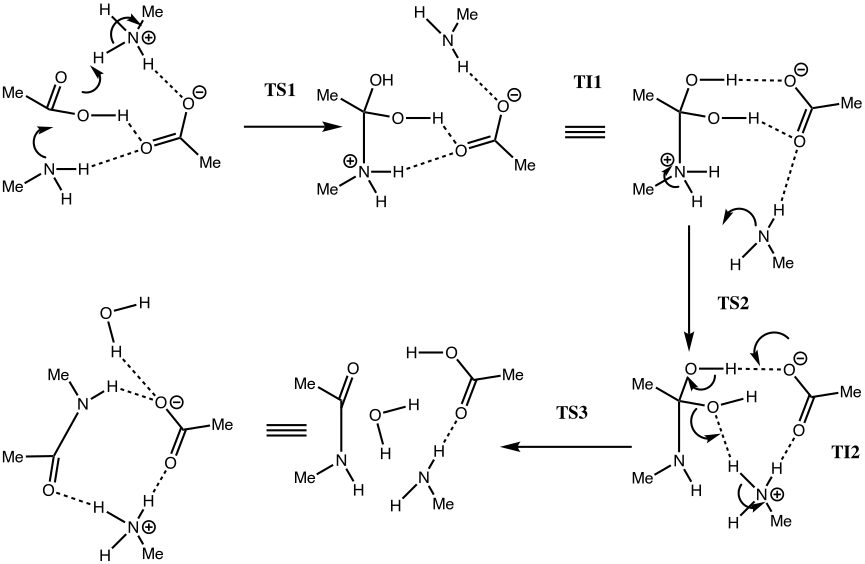
The free energies are summarised in the table below. TS3, the rate limiting step, is slightly lower in energy if the amine is used for the proton transfer than via carboxylic acid. This is the wrong direction; we really want the barrier to increase to explain the relative difficulty of the reaction as observed in refluxing toluene! Fear not however, the new barrier is indeed a much more sluggish 28.6 kcal/mol (30.5 using a larger basis set).
How did this happen? It’s the reactants! The original reactant model was based on the known structure of acetic acid dimer, with an amine weakly hydrogen bonded. Adding an extra amine now allows an entirely new motif to form, in which the amine disrupts the acetic dimer to form a cyclic system with a pair of very strong (-)O-H-N(+)-H-O(-) hydrogen bond units.† The original model did not have sufficient components to fully allow this to happen.
 So the White City Trio achieve a performance which helps explain why a reaction is sluggish rather than facile (normally one strives to show the opposite). Perhaps however it should be the White City quartet, in recognition that the reactant also had a role to play?
♣A photograph of the building under construction can be seen here. ‡Def2-TZVPPD basis set. †There does not appear to be a recorded structure for methylammonium acetate. We hope to obtain one to check what the extended structure actually is. ♥I will elaborate an interesting new use of this value in a separate post.
Tags:acetic acid, Acid, Amide, Amine, carboxylic acid, Chemistry, Company: BBC, Company: British Broadcasting Corporation, energy, Ester, exhibition site, free energy barrier, Functional groups, Hydrogen bond, Imperial College, Imperial College London, Ionic product, Newspaper & Magazine Printing Services, Non-ionic product, Olympic games, Organic chemistry, White City Trio
Posted in Interesting chemistry | 6 Comments »
Wednesday, August 8th, 2018
White City is a small area in west london created as an exhibition site in 1908, morphing over the years into an Olympic games venue, a greyhound track, the home nearby of the BBC (British Broadcasting Corporation) and most recently the new western campus for Imperial College London.♣ The first Imperial department to move into the MSRH (Molecular Sciences Research Hub) building is chemistry. As a personal celebration of this occasion, I here dedicate three transition states located during my first week of occupancy there, naming them the White City trio following earlier inspiration by a string trio and their own instruments.
The chemistry revisits the mechanism of amide formation from an acid and an amine, which I first described on this blog about four years ago. I had constructed a model of one amine and one carboxylic acid, to which I added a further acid in recognition that proton transfers are a key aspect of the mechanism. When the model is quantified using quantum calculations (ωB97XD/6-311G(d,p)/SCRF=p-toluene) it resulted in a free energy barrier ΔG298‡ of about 22 kcal/mol. Re-reading what I wrote, I see I did rather gloss over this value, which implies a decently rapid reaction! In fact, the reaction occurs relatively slowly at the temperature of refluxing toluene. Perhaps some alarm bells should have been tinkling at this stage (although the sluggish reaction might for example instead be due to poor solubility) and so here I have a rethink of the model used to see if that modest barrier really is correct.
The new premise is to test if the required proton transfers can instead be mediated using a second molecule of amine instead of acid; thus two molecules of carboxylic acid are now accompanied by two of amine, one of which will be used to transfer protons. The second acid is retained to facilitate comparison. As before, the mechanism is characterised by three transition states and two tetrahedral intermediates. The new mechanism is summarised below, with TS1-3 being the White City Trio.
The free energies are summarised in the table below. TS3, the rate limiting step, is slightly lower in energy if the amine is used for the proton transfer than via carboxylic acid. This is the wrong direction; we really want the barrier to increase to explain the relative difficulty of the reaction as observed in refluxing toluene! Fear not however, the new barrier is indeed a much more sluggish 28.6 kcal/mol (30.5 using a larger basis set).
How did this happen? It’s the reactants! The original reactant model was based on the known structure of acetic acid dimer, with an amine weakly hydrogen bonded. Adding an extra amine now allows an entirely new motif to form, in which the amine disrupts the acetic dimer to form a cyclic system with a pair of very strong (-)O-H-N(+)-H-O(-) hydrogen bond units.† The original model did not have sufficient components to fully allow this to happen.
 So the White City Trio achieve a performance which helps explain why a reaction is sluggish rather than facile (normally one strives to show the opposite). Perhaps however it should be the White City quartet, in recognition that the reactant also had a role to play?
♣A photograph of the building under construction can be seen here. ‡Def2-TZVPPD basis set. †There does not appear to be a recorded structure for methylammonium acetate. We hope to obtain one to check what the extended structure actually is. ♥I will elaborate an interesting new use of this value in a separate post.
Tags:acetic acid, Acid, Amide, Amine, carboxylic acid, Chemistry, Company: BBC, Company: British Broadcasting Corporation, energy, Ester, exhibition site, free energy barrier, Functional groups, Hydrogen bond, Imperial College, Imperial College London, Ionic product, Newspaper & Magazine Printing Services, Non-ionic product, Olympic games, Organic chemistry, White City Trio
Posted in Interesting chemistry | 6 Comments »
Thursday, April 13th, 2017
Layer stacking in structures such as graphite is well-studied. The separation between the π-π planes is ~3.35Å, which is close to twice the estimated van der Waals (vdW) radius of carbon (1.7Å). But how much closer could such layers get, given that many other types of relatively weak interaction such as hydrogen bonding can contract the vdW distance sum by up to ~0.8Å or even more? This question was prompted by the separation calculated for the ion-pair cyclopropenium cyclopentadienide (~2.6-2.8Å).
The search query for the Cambridge structure database is shown below.

The query (dataDOI: 10.14469/hpc/2471) defines centroids for two benzenoid rings, both comprising only 3-coordinated carbons. The sine of an angle subtended at each centroid to the other and to one ring carbon attempts to track how parallel the two rings are (strictly speaking, 12 such angles should be included). If the sines of both angles are 1.00, then the two centroids overlap orthogonally. A search constrained to no disorder, no errors and R < 0.05 reveals 1107 hits at a centroid-centroid distance of < 3.5Å. The colour code (red) indicates the distances in the range 3.4-3.5Å, which matches that of graphite, while distances down to 3.2Å (yellow-green) are not uncommon.

Here is another way of representing these results, in which the centroid-centroid distances (measured from the positions of 12 carbon atoms and hence statistically more reliable than any individual atom pair distance) are multiplied by either sin(ANGa) or sin(ANGb). The number of occurrences with distances < 3.2Å is less than 32 (out of 1107).
Taking a look at some of these outliers, PAZJEG has two entries, one with a short distance (dataDOI: 10.5517/ccsffzl) and one with a normal distance[1], which does tend to cast doubt on the former.

ZOMSEB[2], DataDOI: 10.5517/CCZS2MF) appears to have the planes of the molecules stacked ~2.5Å apart.
OXUDES02[cite10.1016/j.poly.2016.09.046[/cite], DataDOI: 10.5517/CCDC.CSD.CC1MBBFQ) has a separation of ~2.6Å.
Verifying these and other outliers would require expert inspection of the crystallographic data and its refinement. This might require access to the hkl structure factors, data which are now being “strongly encouraged”‡ for deposition with the CSD, but which are not present for most structures deposited before ~2016. In extreme cases, the original diffraction images collected by the cameras would allow for a fully independent re-analysis, data which however is rarely if ever deposited.
So the separation of π-π stacked six-membered benzenoid rings is only infrequently less than ~3.2Å in measured crystal structures. There are hints it might reach as short as ~2.6Å, but such examples with values significantly less than 3.2Å do require expert validation before they can be called real.
‡See structuredepositioninformation/ “We strongly encourage data to be deposited either with imbedded structure factor data or with an associated FCF or HKL structure factor file.”
References
- J. Rogan, D. Poleti, and L. Karanović, "Synthesis, Structure, and Thermal Properties of Two New Inorganic‐organic Framework Compounds: Hexaaqua(<i>μ</i><sub>2</sub>‐1,2,4,5‐benzenetetracarboxylato)‐bis(<i>N</i>,<i>N′</i>‐1,10‐phenathroline)dicobalt(II) Dihydrate and Hexaaqua(<i>μ</i><sub>2</sub>‐1,2,4,5‐benzenetetracarboxylato)‐bis(<i>N</i>,<i>N′</i>‐2,2′‐dipyridylamine)dinickel(II) Tetrahydrate", Zeitschrift für anorganische und allgemeine Chemie, vol. 632, pp. 133-139, 2005. https://doi.org/10.1002/zaac.200500292
- P. Das, C.K. Jain, S.K. Dey, R. Saha, A.D. Chowdhury, S. Roychoudhury, S. Kumar, H.K. Majumder, and S. Das, "Synthesis, crystal structure, DNA interaction and in vitro anticancer activity of a Cu(<scp>ii</scp>) complex of purpurin: dual poison for human DNA topoisomerase I and II", RSC Adv., vol. 4, pp. 59344-59357, 2014. https://doi.org/10.1039/c4ra07127a
Tags:Carbon, chemical bonding, Chemistry, Cyclopentadienyl anion, Graphite, Hydrogen bond, Intermolecular forces, Nature, Organic chemistry, search query, Stacking, Supramolecular chemistry, VDW
Posted in crystal_structure_mining | 1 Comment »
Thursday, April 6th, 2017
Enols are simple compounds with an OH group as a substituent on a C=C double bond and with a very distinct conformational preference for the OH group. Here I take a look at this preference as revealed by crystal structures, with the theoretical explanation.

First, a search of the Cambridge structure database (CDS), using the search query shown below (DOI: 10.14469/hpc/2429)


The first search (no errors, no disorder, R < 0.05) is unconstrained in the sense that the HO group is free to hydrogen bond itself. The syn conformer has the torsion of 0° and it has a distinct preponderance over the anti isomer (180°). There is the first hint that the most probable C=C distance for the syn isomer may be longer than that for the anti, but this is not yet entirely convincing.
 To try to make it so, a constrained search is now performed, in which only structures where the HO group has no contact (hydrogen bonding) interaction are included. This is achieved using a “Boolean” search;

The number of hits approximately halves, but the proportion of syn examples increases considerably. There is an interesting double “hot-spot” distribution, which amplifies the lengthening of the C=C bond compared to the anti orientation.

The next constraint added is that the data collection must be <100K (to reduce thermal noise) which reduces the hits considerably but now shows the lengthening of the C=C bond for the syn isomer very clearly.
A final plot is of the C=C length vs the C-O length (no temperature, but HO interaction constraint). If there were no correlation, the distribution would be ~circular. In fact it clearly shows that as the C=C bond lengthens, the C-O bond contracts.

Now for some calculations (ωB97XD/Def2-TZVPP, DOI: 10.14469/hpc/2429) which reveal the following:
- The free energy of the syn isomer is 1.2 kcal/mol lower than that of the syn. The effect is small, and hence easily masked by other interactions such as hydrogen bonding to the OH group. Hence the reason why removing such interactions from the search above increased the syn population compared to anti.
- The syn C=C bond length (1.325Å) is longer than the anti (1.322Å).
- The syn isomer has one unique σO-Lp/σ*C-C NBO orbital interaction (below) with a value of E(2) 7.7 kcal/mol, which is absent in the anti form. As it happens, a πO/π*C=C interaction is present in both forms but is also stronger in the syn isomer (E(2)= 46.8 vs 44.2 kcal/mol).
| unoccupied NBO, σ*C-C |

|
| Occupied NBO, σO-Lp |
 |
- The overlap of the filled σO-Lp with the empty σ*C-C orbital is shown below (blue overlaps with purple, red overlaps with orange).

To view the overlap in rotatable 3D, click on any of the colour diagrams above.‡
It is nice to see how experiment (crystal structures) and theory (the calculation of geometries and orbital interactions) can quickly and simply be reconciled. Both these searches and the calculations can be done in just one day of “laboratory time” and I think it would make for an interesting undergraduate chemistry lab experiment.
‡ This visualisation uses Java. Increasingly this browser plugin is becoming more onerous to activate (because of increased security) and some browsers do not support it at all. The macOS Safari browser is one that still does, but you do have to allow it via the security permissions.
Tags:Chemical bond, chemical bonding, Chemistry, Conformational isomerism, constrained search, Enol, free energy, Gauche effect, Hydrogen bond, Isomerism, Java, Physical organic chemistry, search query, Stereochemistry, Supramolecular chemistry
Posted in crystal_structure_mining, reaction mechanism | 2 Comments »
Friday, March 10th, 2017
A few years back, I did a post about the Pirkle reagent[1] and the unusual π-facial hydrogen bonding structure[2] it exhibits. For the Pirkle reagent, this bonding manifests as a close contact between the acidic OH hydrogen and the edge of a phenyl ring; the hydrogen bond is off-centre from the middle of the aryl ring. Here I update the topic, with a new search of the CSD (Cambridge structure database), but this time looking at the positional preference of that bond and whether it is on or off-centre.

The search (February 2017 database, DOI:10.14469/hpc/2233) is shown above, QA = N, O, F, Cl and other constraints are R < 0.01, no errors, no disorder. Two distances are plotted, one (DIST1) is from the H to the ring centroid and the second (DIST2) from the H to an edge carbon atom. The colour code relates to ANG1, the angle subtended at the centroid. A value of 90° would indicate the H is orthogonal to the plane of the aromatic ring.

You can see from the above that the yellow dots correspond to ~90° and that by and large the H…centroid distances are shorter than the H…C distances.

The above is another representation of this search, again showing that the preferred angle is 90°, although there is a fair bit of scatter. The extreme outliers may be crystallographic errors, but one point caught my eye and is circled in red above; ammonium tetrafluoroborate (3D model DOI: 10.5517/CC4V6TZ). This has a very short distance from the H to the centroid (2.07Å), shorter than the Pirkle reagent that we looked at all those years back. The authors[3] note that “The N-H…Ph distances, H…M 2.067Å … are exceptionally short (M = aromatic midpoint)” but also that “even at 20 K the ammonium ion performs large amplitude motions which allow the N-H vectors to sample the entire face of the aromatic system.” This implies that such bonds are largely agnostic about whether they bind to the centroid of the ring or to its edge and that the most probable position might arise simply because of crystal packing. An interesting variation on this molecule is a crystal that includes a further 5NH3 in addition to ammonium tetraphenylborate (3D model DOI: 10.5517/cc7bly2). Here an ammonia intervenes between the ammonium cation and a phenyl ring, resulting in a binding of the ammonia with two NHs closer to the edge of the ring and one NH interacting in parallel mode.

Time therefore for a calculation, using B3LYP+GD3BJ/Def2-TZVPP, the functional being chosen because the dispersion contribution is not built in, but uses what is currently thought to be the best representation of these attractions. The issue now is what molecular unit to use? This is an ionic structure and so a periodic boundary model is most appropriate, but given its size I reduced this to two models comprising smaller discrete fragments.
- A unit just comprising the simple ion pair. This leaves two of the four N-H bonds devoid of hydrogen bonding (DOI:10.14469/hpc/2234). The optimisation adopts a pose where two NH groups are directed towards a carbon atom rather than the ring centroid. How much of this is due to the smallness of this model?

- A unit comprising a double ion pair, which allows one ammonium group to participate with all four NH groups across four phenyl rings and exhibiting six NH interactions in total with six rings (DOI: 10.14469/hpc/2235). The NH hydrogen vectors all interact with ring carbons rather than the ring centroid.

This brief computational exploration has covered only one method (the B3LYP DFT procedure), albeit with what is thought to be a good dispersion attraction term added and a reasonable basis set. It does seem to show that hydrogen bonds interacting with the centroid of a phenyl ring are not the preferred mode, which is instead an interaction with the edge of the ring. The quote above, “even at 20 K the ammonium ion performs large amplitude motions which allow the N-H vectors to sample the entire face of the aromatic system” suggests that whilst the average position might be the centroid, a true hydrogen bond to the centroid might be rarer than thought. Although most of the crystallographic examples located in the searches above deem to show a preference for the ring centroid, this might be more apparent than real.
References
- H.S. Rzepa, M.L. Webb, A.M.Z. Slawin, and D.J. Williams, "? Facial hydrogen bonding in the chiral resolving agent (S)-2,2,2-trifluoro-1-(9-anthryl)ethanol and its racemic modification", Journal of the Chemical Society, Chemical Communications, pp. 765, 1991. https://doi.org/10.1039/c39910000765
- H.S. Rzepa, M.H. Smith, and M.L. Webb, "A crystallographic AM1 and PM3 SCF-MO investigation of strong OH ⋯π-alkene and alkyne hydrogen bonding interactions", J. Chem. Soc., Perkin Trans. 2, pp. 703-707, 1994. https://doi.org/10.1039/p29940000703
- T. Steiner, and S.A. Mason, "Short N<sup>+</sup>—H...Ph hydrogen bonds in ammonium tetraphenylborate characterized by neutron diffraction", Acta Crystallographica Section B Structural Science, vol. 56, pp. 254-260, 2000. https://doi.org/10.1107/s0108768199012318
Tags:Ammonia, Ammonium, aromaticity, Cations, Centroid, chemical bonding, Chemistry, Hydrogen bond, Phenyl group
Posted in crystal_structure_mining | No Comments »
Saturday, December 31st, 2016
My holiday reading has been Derek Lowe’s excellent Chemistry Book setting out 250 milestones in chemistry, organised by year. An entry for 1920 entitled hydrogen bonding seemed worth exploring in more detail here.
As with many historical concepts, it can often take a few years to coalesce into something we would readily recognise today, and hydrogen bonds are no exception. Wikipedia is another source of the history and it cites a 1912 article as the origin of the term in relation to the solvation of amines[1] but also notes that the better known setting of water occurs later in 1920.[2] Here I try to capture the essence of the concept with a few diagrams taken from these two articles.
Firstly “The state of amines in aqueous solution“[1] which is mostly concerned with the measurement of ionization constants of primary, secondary and tertiary amines. It boils down to the below:


and the connection to ionization is laid out as:


Since in 1912, Lewis’ electron pair theory of the covalent bond had not yet emerged, the authors use the terms “strong union” and “weak union”, and of course it is the “weak union” that we now know of as the hydrogen bond. Some other comments about this seminal diagram:
- The article contains the very explicit and modern term stereochemical, which is used in a manner that suggests it was already common.‡ But there is only a hint at most that the nitrogen atoms might be tetrahedral, or that the “weak union” between (what we now think of as the lone pair on) the nitrogen and the hydrogen of the water is directional.
- The second weak union between the tetramethyl ammonium (which we now describe as a cation) and the hydroxide (now described as an anion; both terms are however implied by the description strong electrolyte) is probably not what we would now call a hydrogen bond, more an intimate ion-pair.
The second article in 1920 on water itself[2] is post-Lewis, but perhaps applied in a manner which we would not entirely agree with nowadays. Thus dinitrogen, N≡N is shown as below with just a single connecting bond.

Then we get the interaction between ammonia and water,† analogous to the example shown above:

and for water itself:♠

which in each case shows the central hydrogen having what we now call a valence shell of four electrons,♣ and hence more equivalent to the “strong unions” above. This shows that in 1920 chemists were rapidly adopting Lewis’ representations, but not always entirely successfully.
On balance, I think the 1912 article sets out the modern concept of a hydrogen bond representing a weak union to a hydrogen rather better than the Latimer and Rodebush attempt (at least diagrammatically).
‡Stereochemical notation is discussed in this post, and it dates from the 1930s.
†The modern take is explored here, in which the equilibrium set up between a “weak union” between ammonia and water (the weak electrolyte) and an isomeric “strong union” which represents ionization into an ammonium hydroxide ion-pair (the strong electrolyte) is favoured for the former by ΔG ~6 kcal/mol.
♠The equilibrium between a “weak union” of two water molecules and the fully ionized strong union of hydronium hydroxide favours the former by ΔG ~23 kcal/mol.
♣ This 1920 representation does imply symmetry for the hydrogen, being ~equally disposed between the two oxygens. We now know that such symmetric hydrogen bonding is not unusual (see this post for how to fine-tune a hydrogen bond into this situation) but rather than requiring four electrons as implied in the diagram above, it is now better described as a three-centre-two-electron bond instead.
References
- T.S. Moore, and T.F. Winmill, "CLXXVII.—The state of amines in aqueous solution", J. Chem. Soc., Trans., vol. 101, pp. 1635-1676, 1912. https://doi.org/10.1039/ct9120101635
- W.M. Latimer, and W.H. Rodebush, "POLARITY AND IONIZATION FROM THE STANDPOINT OF THE LEWIS THEORY OF VALENCE.", Journal of the American Chemical Society, vol. 42, pp. 1419-1433, 1920. https://doi.org/10.1021/ja01452a015
Tags:10.1021, aqueous solution, Chemical bond, chemical bonding, Chemistry, Derek Lowe, Hydrogen, Hydrogen bond, Intermolecular forces, Lowe's, Nature, Supramolecular chemistry
Posted in Historical | 2 Comments »
Saturday, December 31st, 2016
My holiday reading has been Derek Lowe’s excellent Chemistry Book setting out 250 milestones in chemistry, organised by year. An entry for 1920 entitled hydrogen bonding seemed worth exploring in more detail here.
As with many historical concepts, it can often take a few years to coalesce into something we would readily recognise today, and hydrogen bonds are no exception. Wikipedia is another source of the history and it cites a 1912 article as the origin of the term in relation to the solvation of amines[1] but also notes that the better known setting of water occurs later in 1920.[2] Here I try to capture the essence of the concept with a few diagrams taken from these two articles.
Firstly “The state of amines in aqueous solution“[1] which is mostly concerned with the measurement of ionization constants of primary, secondary and tertiary amines. It boils down to the below:


and the connection to ionization is laid out as:


Since in 1912, Lewis’ electron pair theory of the covalent bond had not yet emerged, the authors use the terms “strong union” and “weak union”, and of course it is the “weak union” that we now know of as the hydrogen bond. Some other comments about this seminal diagram:
- The article contains the very explicit and modern term stereochemical, which is used in a manner that suggests it was already common.‡ But there is only a hint at most that the nitrogen atoms might be tetrahedral, or that the “weak union” between (what we now think of as the lone pair on) the nitrogen and the hydrogen of the water is directional.
- The second weak union between the tetramethyl ammonium (which we now describe as a cation) and the hydroxide (now described as an anion; both terms are however implied by the description strong electrolyte) is probably not what we would now call a hydrogen bond, more an intimate ion-pair.
The second article in 1920 on water itself[2] is post-Lewis, but perhaps applied in a manner which we would not entirely agree with nowadays. Thus dinitrogen, N≡N is shown as below with just a single connecting bond.

Then we get the interaction between ammonia and water,† analogous to the example shown above:

and for water itself:♠

which in each case shows the central hydrogen having what we now call a valence shell of four electrons,♣ and hence more equivalent to the “strong unions” above. This shows that in 1920 chemists were rapidly adopting Lewis’ representations, but not always entirely successfully.
On balance, I think the 1912 article sets out the modern concept of a hydrogen bond representing a weak union to a hydrogen rather better than the Latimer and Rodebush attempt (at least diagrammatically).
‡Stereochemical notation is discussed in this post, and it dates from the 1930s.
†The modern take is explored here, in which the equilibrium set up between a “weak union” between ammonia and water (the weak electrolyte) and an isomeric “strong union” which represents ionization into an ammonium hydroxide ion-pair (the strong electrolyte) is favoured for the former by ΔG ~6 kcal/mol.
♠The equilibrium between a “weak union” of two water molecules and the fully ionized strong union of hydronium hydroxide favours the former by ΔG ~23 kcal/mol.
♣ This 1920 representation does imply symmetry for the hydrogen, being ~equally disposed between the two oxygens. We now know that such symmetric hydrogen bonding is not unusual (see this post for how to fine-tune a hydrogen bond into this situation) but rather than requiring four electrons as implied in the diagram above, it is now better described as a three-centre-two-electron bond instead.
References
- T.S. Moore, and T.F. Winmill, "CLXXVII.—The state of amines in aqueous solution", J. Chem. Soc., Trans., vol. 101, pp. 1635-1676, 1912. https://doi.org/10.1039/ct9120101635
- W.M. Latimer, and W.H. Rodebush, "POLARITY AND IONIZATION FROM THE STANDPOINT OF THE LEWIS THEORY OF VALENCE.", Journal of the American Chemical Society, vol. 42, pp. 1419-1433, 1920. https://doi.org/10.1021/ja01452a015
Tags:10.1021, aqueous solution, Chemical bond, chemical bonding, Chemistry, Derek Lowe, Hydrogen, Hydrogen bond, Intermolecular forces, Lowe's, Nature, Supramolecular chemistry
Posted in Historical | 2 Comments »
Monday, November 14th, 2016
Chloroform, often in the deuterated form CDCl3, is a very common solvent for NMR and other types of spectroscopy. Quantum mechanics is increasingly used to calculate such spectra to aid assignment and the solvent is here normally simulated as a continuum rather than by explicit inclusion of one or more chloroform molecules. But what are the features of the hydrogen bonds that form from chloroform to other acceptors? Here I do a quick search for the common characteristics of such interactions.
- This first search (R < 0.05, no errors, no disorder) is for interactions from the CH… O, and is a plot of that distance against the angle subtended at the oxygen.

Note that there are not that many crystalline examples. The “hotspot” is at a distance of ~2.3Å, but real examples down to 1.9Å exist. The angle subtended at the oxygen is close to 120° (the angle subtended at the hydrogen is always close to 180°). The plot below constrains the search to data collected below 140K to reduce the thermal noise in the measurements, with the hotspot shortening slightly to 2.2Å. 
- The next search is for interactions to N rather than O (T < 140K). There are rather fewer hits, but again with similar features.

- Finally, an attempt to see if there is a correlation between the C-H length and the H…O length.

This has odd characteristics, which suggests that in most cases the C-H distance is not measured from the diffraction data but simply “idealised” (and which therefore renders this plot meaningless). Unless its been added recently, it is not possible to specify in the search how the hydrogen positions have been refined, if at all and hence to restrict the search only to those structures where the C-H distance is meaningful.
In the last ten years or so, great progress has been made in assigning experimental spectra with the help of quantum calculations. This is true of chemical shifts in NMR, but especially so for chiroptical measurements such as ORP, ECD and VCD. Given that explicit hydrogen bonds can introduce anisotropy into the otherwise isotropic solvent continuum, it might be worth including perhaps one chloroform molecule into these calculations, especially if the CH…O distance is <2Å (which suggests it is fairly strong). If nothing else, chloroform is rather big and might exert effects based on dispersion attractions or steric repulsions as well as the H-bonding.
Tags:chemical shifts, Chloroform, Deuterated chloroform, Deuterated methanol, Hydrogen bond, Nuclear magnetic resonance, spectroscopy
Posted in crystal_structure_mining | 5 Comments »
Monday, August 8th, 2016
The previous post contained an exploration of the anomeric effect as it occurs at an atom centre X for which the effect is manifest in crystal structures. Here I quantify the effect, by selecting the test molecule MeO-X-OMe, where X is of two types:
- A two-coordinate atom across the series B-O and Al-S, and carrying the appropriate molecular charge such that X carries two lone pairs of electrons (thus the charge is 0 for O, but -3 for B).
- A four-coordinate atom across the series B-O and Al-S, with X-H bonds replacing the lone pairs on this centre in the previous example, and again with appropriate molecule charges (e.g. +2 for SH2).
The donor in the anomeric interaction always originates on the oxygen of the MeO group attached to X. The acceptor is always the X-O σ* empty orbital. The results (table below, ωB97XD/Def2-TZVPP calculation, NBO E(2) in kcal/mol) confirm that as X gets more electronegative, the X-O σ* empty orbital becomes a better acceptor, and so the NBO E(2) interaction energy which quantifies the anomeric interaction gets larger. Eventually (with X=OH2) the donation of electrons into the X-O σ* empty orbital becomes so effective that the X-O bond (in this case O-O) dissociates fully and the NBO perturbation cannot be computed. Also for reference, a “normal” anomeric interaction (such as is found in e.g. sugars) is around 18 kcal/mol. Anything larger than this could be considered especially strong, and anything less than ~10 kcal/mol would be regarded as weak.
| X[1]* |
| BH2 |
CH2 |
NH2 |
OH2 |
| 12.5 |
17.7 |
18.5 |
dissociates |
| AlH2 |
SiH2 |
PH2 |
SH2 |
| 6.9 |
12.9 |
21.9 |
31.3 |
| B |
C |
N |
O |
| 8.3 |
11.7 |
12.9 |
14.2 |
| Al |
Si |
P |
S |
| 4.8 |
6.6 |
11.2 |
18.2 |
For the entry X=S, the E(2) term is actually larger than for the oxygen. I should note that the Me group itself is not passive in this process. The C-H bonds can also act as significant electron donors, but here I am not going to analyse this additional complexity.
This table reveals that there is nothing special about carbon as an anomeric centre, and here also the normal intimate association with the term anomeric and heterocyclohexanes such as found in sugars.
* Here I introduce a refinement to my normal process of citing the data produced for any specific calculation. Rather than including 16 individual citations for each cell in the table, I have gathered all these calculations into a collection and cite here only the DOI of that collection. When resolved, the individual members of that collection can then be inspected for the actual data.
References
- H. Rzepa, "Anomeric interactions at atom centres", 2016. https://doi.org/10.14469/hpc/1221
Tags:Anomer, Anomeric effect, Atomic orbital, Carbohydrate chemistry, Carbohydrates, Chemical bond, chemical bonding, Chemistry, Hydrogen bond, interaction energy, Lone pair, Physical organic chemistry, Quantum chemistry
Posted in Interesting chemistry | No Comments »
 The intra-molecular plot shows a similar value for the most common F…H distance, with the interesting variation that the angle subtended at F is about 80°.
 The outlier at the short end of the spectrum (arrow) was observed in 2014[2] with the structure shown below. It is indeed the current record holder by some margin! This length by the way is however a great deal longer than the shortest O…HO hydrogen bonds, which can be in the region of 1.2Å (with the proton sometimes symmetrically disposed between the two oxygen atoms). The value is also very similar to the record holder for the shortest C-H…H-C interaction.


