Posts Tagged ‘carboxylic acid’
Wednesday, August 8th, 2018
White City is a small area in west london created as an exhibition site in 1908, morphing over the years into an Olympic games venue, a greyhound track, the home nearby of the BBC (British Broadcasting Corporation) and most recently the new western campus for Imperial College London.♣ The first Imperial department to move into the MSRH (Molecular Sciences Research Hub) building is chemistry. As a personal celebration of this occasion, I here dedicate three transition states located during my first week of occupancy there, naming them the White City trio following earlier inspiration by a string trio and their own instruments.
The chemistry revisits the mechanism of amide formation from an acid and an amine, which I first described on this blog about four years ago. I had constructed a model of one amine and one carboxylic acid, to which I added a further acid in recognition that proton transfers are a key aspect of the mechanism. When the model is quantified using quantum calculations (ωB97XD/6-311G(d,p)/SCRF=p-toluene) it resulted in a free energy barrier ΔG298‡ of about 22 kcal/mol. Re-reading what I wrote, I see I did rather gloss over this value, which implies a decently rapid reaction! In fact, the reaction occurs relatively slowly at the temperature of refluxing toluene. Perhaps some alarm bells should have been tinkling at this stage (although the sluggish reaction might for example instead be due to poor solubility) and so here I have a rethink of the model used to see if that modest barrier really is correct.
The new premise is to test if the required proton transfers can instead be mediated using a second molecule of amine instead of acid; thus two molecules of carboxylic acid are now accompanied by two of amine, one of which will be used to transfer protons. The second acid is retained to facilitate comparison. As before, the mechanism is characterised by three transition states and two tetrahedral intermediates. The new mechanism is summarised below, with TS1-3 being the White City Trio.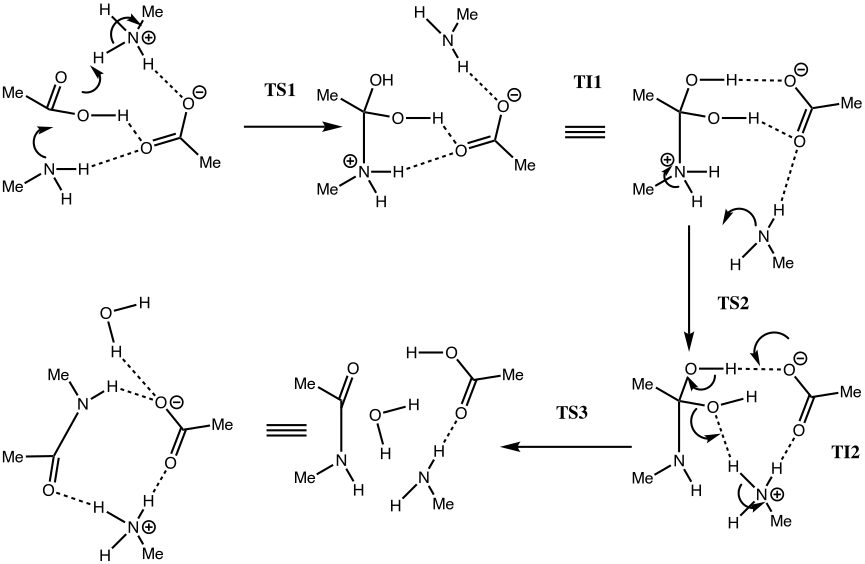
The free energies are summarised in the table below. TS3, the rate limiting step, is slightly lower in energy if the amine is used for the proton transfer than via carboxylic acid. This is the wrong direction; we really want the barrier to increase to explain the relative difficulty of the reaction as observed in refluxing toluene! Fear not however, the new barrier is indeed a much more sluggish 28.6 kcal/mol (30.5 using a larger basis set).
How did this happen? It’s the reactants! The original reactant model was based on the known structure of acetic acid dimer, with an amine weakly hydrogen bonded. Adding an extra amine now allows an entirely new motif to form, in which the amine disrupts the acetic dimer to form a cyclic system with a pair of very strong (-)O-H-N(+)-H-O(-) hydrogen bond units.† The original model did not have sufficient components to fully allow this to happen.
 So the White City Trio achieve a performance which helps explain why a reaction is sluggish rather than facile (normally one strives to show the opposite). Perhaps however it should be the White City quartet, in recognition that the reactant also had a role to play?
♣A photograph of the building under construction can be seen here. ‡Def2-TZVPPD basis set. †There does not appear to be a recorded structure for methylammonium acetate. We hope to obtain one to check what the extended structure actually is. ♥I will elaborate an interesting new use of this value in a separate post.
Tags:acetic acid, Acid, Amide, Amine, carboxylic acid, Chemistry, Company: BBC, Company: British Broadcasting Corporation, energy, Ester, exhibition site, free energy barrier, Functional groups, Hydrogen bond, Imperial College, Imperial College London, Ionic product, Newspaper & Magazine Printing Services, Non-ionic product, Olympic games, Organic chemistry, White City Trio
Posted in Interesting chemistry | 6 Comments »
Wednesday, August 8th, 2018
White City is a small area in west london created as an exhibition site in 1908, morphing over the years into an Olympic games venue, a greyhound track, the home nearby of the BBC (British Broadcasting Corporation) and most recently the new western campus for Imperial College London.♣ The first Imperial department to move into the MSRH (Molecular Sciences Research Hub) building is chemistry. As a personal celebration of this occasion, I here dedicate three transition states located during my first week of occupancy there, naming them the White City trio following earlier inspiration by a string trio and their own instruments.
The chemistry revisits the mechanism of amide formation from an acid and an amine, which I first described on this blog about four years ago. I had constructed a model of one amine and one carboxylic acid, to which I added a further acid in recognition that proton transfers are a key aspect of the mechanism. When the model is quantified using quantum calculations (ωB97XD/6-311G(d,p)/SCRF=p-toluene) it resulted in a free energy barrier ΔG298‡ of about 22 kcal/mol. Re-reading what I wrote, I see I did rather gloss over this value, which implies a decently rapid reaction! In fact, the reaction occurs relatively slowly at the temperature of refluxing toluene. Perhaps some alarm bells should have been tinkling at this stage (although the sluggish reaction might for example instead be due to poor solubility) and so here I have a rethink of the model used to see if that modest barrier really is correct.
The new premise is to test if the required proton transfers can instead be mediated using a second molecule of amine instead of acid; thus two molecules of carboxylic acid are now accompanied by two of amine, one of which will be used to transfer protons. The second acid is retained to facilitate comparison. As before, the mechanism is characterised by three transition states and two tetrahedral intermediates. The new mechanism is summarised below, with TS1-3 being the White City Trio.
The free energies are summarised in the table below. TS3, the rate limiting step, is slightly lower in energy if the amine is used for the proton transfer than via carboxylic acid. This is the wrong direction; we really want the barrier to increase to explain the relative difficulty of the reaction as observed in refluxing toluene! Fear not however, the new barrier is indeed a much more sluggish 28.6 kcal/mol (30.5 using a larger basis set).
How did this happen? It’s the reactants! The original reactant model was based on the known structure of acetic acid dimer, with an amine weakly hydrogen bonded. Adding an extra amine now allows an entirely new motif to form, in which the amine disrupts the acetic dimer to form a cyclic system with a pair of very strong (-)O-H-N(+)-H-O(-) hydrogen bond units.† The original model did not have sufficient components to fully allow this to happen.
 So the White City Trio achieve a performance which helps explain why a reaction is sluggish rather than facile (normally one strives to show the opposite). Perhaps however it should be the White City quartet, in recognition that the reactant also had a role to play?
♣A photograph of the building under construction can be seen here. ‡Def2-TZVPPD basis set. †There does not appear to be a recorded structure for methylammonium acetate. We hope to obtain one to check what the extended structure actually is. ♥I will elaborate an interesting new use of this value in a separate post.
Tags:acetic acid, Acid, Amide, Amine, carboxylic acid, Chemistry, Company: BBC, Company: British Broadcasting Corporation, energy, Ester, exhibition site, free energy barrier, Functional groups, Hydrogen bond, Imperial College, Imperial College London, Ionic product, Newspaper & Magazine Printing Services, Non-ionic product, Olympic games, Organic chemistry, White City Trio
Posted in Interesting chemistry | 6 Comments »
Tuesday, April 11th, 2017
Following my conformational exploration of enols, here is one about a much more common molecule, a carboxylic acid.
 The components of the search are shown as four queries below, which will be combined in various Boolean senses (DOI: 10.14469/hpc/2462).
- Query one defines the carboxylic acid, with 3-coordinate carbon specified at the carbonyl along with 1-coordinate for the carbonyl oxygen. Then the HO-C=O torsion (o° for the syn conformation shown on the left above and 180° for the anti-conformation shown on the right) and the length of the O-C bond as variables.
- Query two defines a contact as ≤ the sum of van der Waals radii between QA (=N,O,F,Cl) and the hydrogen of the carboxylic acid (pink).
- Query three defines a contact as ≤ the sum of van der Waals radii between QA-H (QA=N,O,F,Cl) and the oxygen of the acid (pink).
- Query four defines a temperature of <100K for the data collection temperature.

The first search uses just Query 1, with additional constraints of no errors, no disorder and R < 0.05.

This can then be focused by combining Query 1 + Query 4, which shows a clear preference for the syn conformation.

Next, Query 1 with NOT query 2, which restricts the search to carboxylic acids that do not have contacts to the hydrogen of the OH group. This excludes carboxylic acid dimers, as shown above. The predominant hot-spot now corresponds to the anti conformation.

Again this is narrowed using Query 4, which removes almost all the syn examples.

Now using Query 3 (as shown above), which restricts the search to examples where the oxygen of the HO group is itself not in contact with an acidic hydrogen. This allows carboxylic acid dimers. This now reveals the syn preference again.

At <100K reinforces this effect.

Finally, Query 1 and NOT query 2 (no dimers) and NOT query 3, where a smaller preference for anti is seen.

So it seems that an interesting difference emerges between enols and carboxylic acids in that when no hydrogen bonding to the HO group is allowed, an anti preference emerges. The electronic origins of this effect will be probed in a future post.
Tags:Acid, Alcohols, carboxylic acid, Chemistry, Enol, Functional groups, Organic chemistry, search uses
Posted in crystal_structure_mining | No Comments »
Sunday, January 10th, 2016
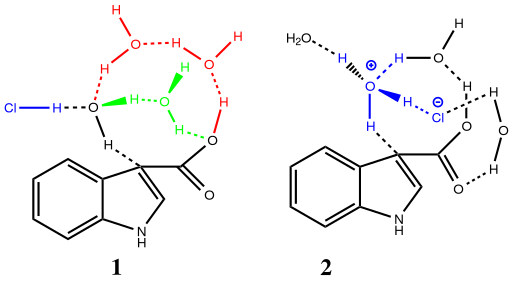
Earlier I explored models for the heteroaromatic electrophilic protiodecarboxylation of an 3-substituted indole, focusing on the role of water as the proton transfer and delivery agent. Next, came models for both water and the general base catalysed ionization of indolinones. Here I explore general acid catalysis by evaluating the properties of two possible models for decarboxylation of 3-indole carboxylic acid, one involving proton transfer (PT) from neutral water in the presence of covalent un-ionized HCl (1) and one with PT from a protonated water resulting from ionised HCl (2).
The original study[1] noted that the rate of decarboxylation fitted well to the kinetic expression: rate = {a + b[L3O+]/(1 + c[L3O+])}[indole], where L can be H or D. Experimentally, [L3O+] is controlled by adding a strong general acid such as HCl, which when the appropriate number of water molecules are added[2] fully ionizes to H3O+.OH–. Now for B3LYP+D3/Def2-TZVPD/SCRF=water calculations:
- Model 1 takes the pure water model and adds HCl (blue above) via hydrogen bonding to the H2O that is transferring the proton to the indole ring. Three water molecules are hydrogen bonding to the carboxylate oxygens to create a bicyclic network in which a ring of either 8 or 10 atoms can act as the proton relay structure. The question now arises whether the proton relay takes the longer (red) route or the slightly shorter green route.
- Isomeric model 2 uses H3O+ for proton transfer, with an adjacent Cl– to complete the ion-pair.
‡Reactant as a non-ionised covalent HCl. †reactant as an isomeric ionized H3O+.Cl– beng 2.0 kcal/mol higher in energ within this solvation model.
- An IRC for Model 1 shows that the proton relay takes the red path, whereas without the HCl the green path is followed.

The transition state free energy however is ..
- 10.6‡ or 8.6† kcal/mol higher than model 2 (click on the image below to load a 3D model). The general acid catalysed model is therefore preferred. The difference in free energy between the two models corresponds to a rate acceleration of >106, which is indeed similar to that observed[1].

The clincher comes with calculation[3] of the kinetic isotope effects (KIE). For general acid catalysis, they were measured as kH/kD ~2.5.[1]
- For model 1, using an un-ionised reactant and un-ionised transition state, the calculated KIE is 5.69 (very similar to that calculated for the water catalysed reaction, 5.66) but not a good fit to experiment.
- For model 2, using the same un-ionised reactant but an ionised transition state, KIE = 2.04, a much better fit.
- For model 2, using ionised reactant AND transition state, KIE = 2.45, an even better fit to experiment.
So we now have a model for the general acid catalysed decarboxylation of a 3-indole carboxylate which agrees with both the kinetic behaviours and the isotope effects measured for this reaction. Since the barrier is a relatively large one, proton tunnelling may play a lesser role in this interpretation, and the stage is set to use this model to e.g. explore how isotope effects are indeed influenced by tuning the reactivity using ring substitutents, the original purpose of my researches all those years ago. Perhaps the catch phrase I’ve started so I’ll start is now more apposite.
References
- B.C. Challis, and H.S. Rzepa, "Heteroaromatic hydrogen exchange reactions. Part 9. Acid catalysed decarboxylation of indole-3-carboxylic acids", Journal of the Chemical Society, Perkin Transactions 2, pp. 281, 1977. https://doi.org/10.1039/p29770000281
- A. Vargas‐Caamal, J.L. Cabellos, F. Ortiz‐Chi, H.S. Rzepa, A. Restrepo, and G. Merino, "How Many Water Molecules Does it Take to Dissociate HCl?", Chemistry – A European Journal, vol. 22, pp. 2812-2818, 2016. https://doi.org/10.1002/chem.201504016
- H. Rzepa, "Ionic model for general acid catalysed decarboxylation", 2016. https://doi.org/10.14469/hpc/204
- H.S. Rzepa, "C 9 H 16 Cl 1 N 1 O 6", 2016. https://doi.org/10.14469/ch/191792
- H.S. Rzepa, "C 9 H 16 Cl 1 N 1 O 6", 2016. https://doi.org/10.14469/ch/191795
- H.S. Rzepa, "C 9 H 16 Cl 1 N 1 O 6", 2016. https://doi.org/10.14469/ch/191794
- H.S. Rzepa, "C9H16ClNO6", 2016. https://doi.org/10.14469/ch/191767
- H.S. Rzepa, "C 9 H 16 Cl 1 N 1 O 6", 2016. https://doi.org/10.14469/ch/191790
Tags:Acid, Acids, bicyclic network, carboxylic acid, free energy, Functional groups, Hydrogen bond, Indole, transition state free energy
Posted in Interesting chemistry | 1 Comment »
Sunday, October 16th, 2011
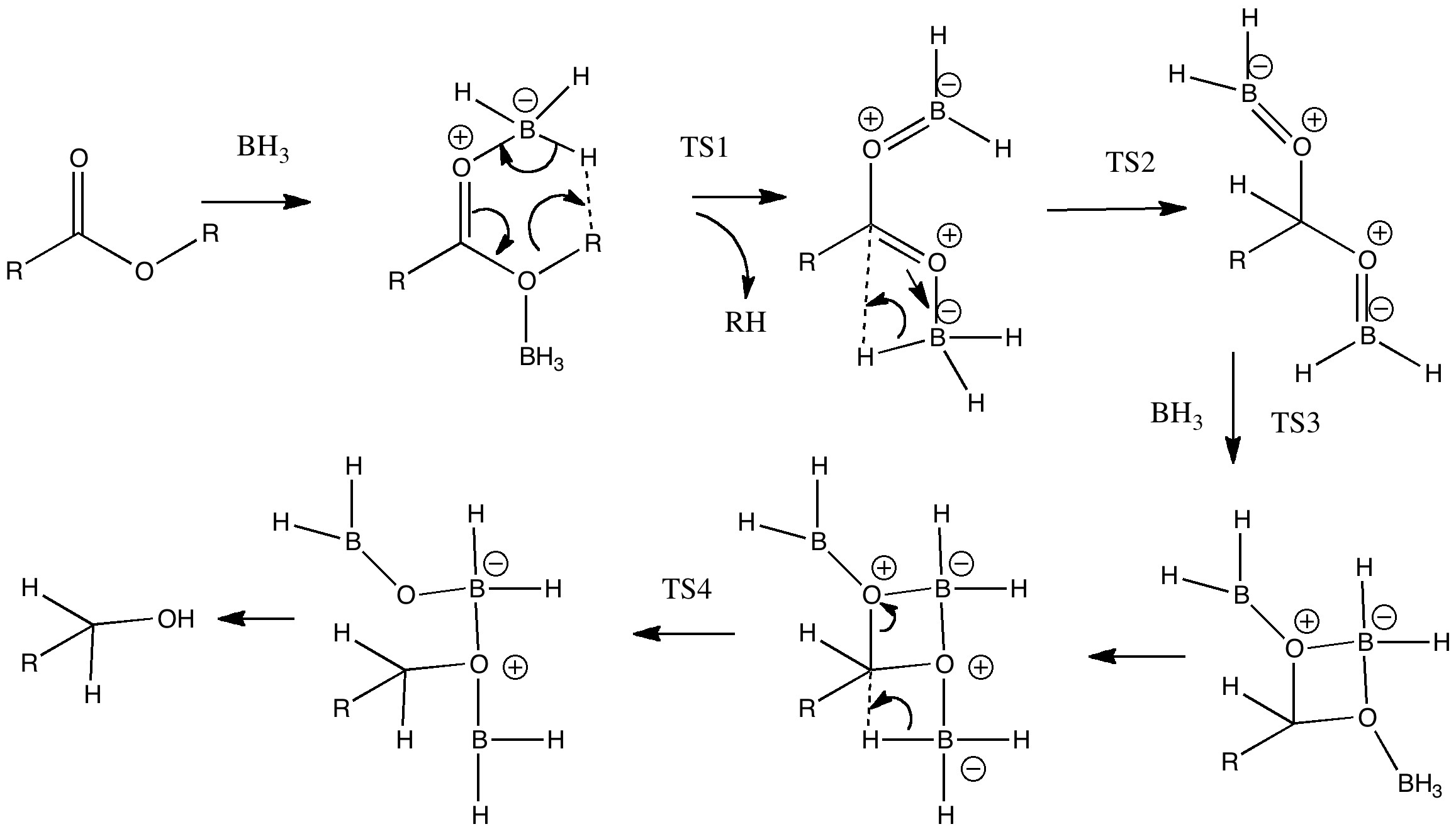
I asked a while back whether blogs could be considered a serious form of scholarly scientific communication (and so has Peter Murray-Rust more recently). A case for doing so might be my post of about a year ago, addressing why borane reduces a carboxylic acid, but not its ester, where I suggested a possible mechanism. Well, colleagues have raised some interesting questions, both on the blog itself and more silently by email to me. As a result, I have tried to address some of these questions, and accordingly my original scheme needs some revision! This sort of iterative process of getting to the truth with the help of the community (a kind of crowd-sourced chemistry) is where I feel blogs do have a genuine role to play.
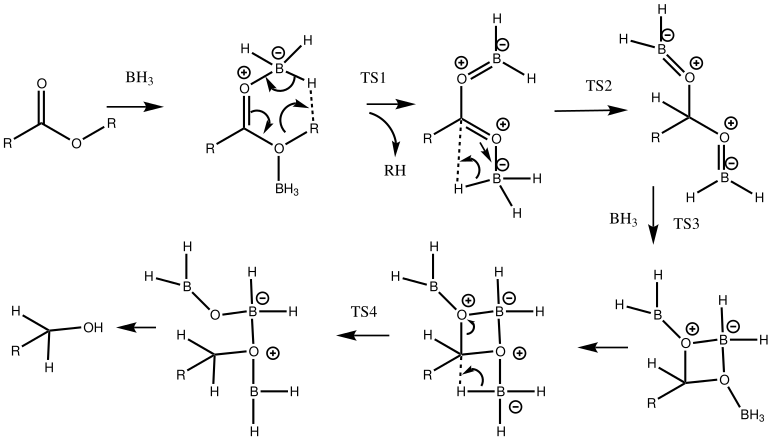
The reduction of a carboxylic acid by borane
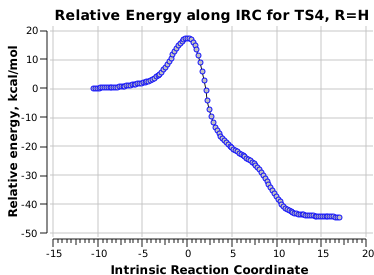
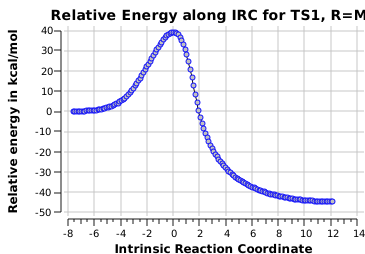
TS1 in this scheme is modified from before to include an extra borane coordinating to the oxygen of the O-R group. I will include here the intrinsic reaction coordinate [computed at ωB97XD/6-311G(d,p)], since it shows some fascinating features.
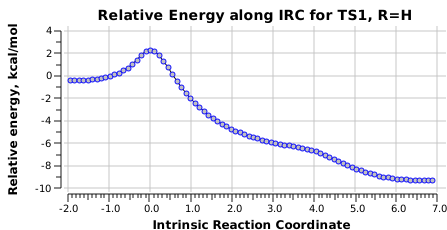
One notes that the barrier for extrusion (R=H) is lower than before, due to the effect of the extra coordinated BH3 group. But notice the “bump” at an IRC value of ~4.0. If one inspects the gradients along the IRC, they reveal that the ejecting H-H molecule is tempted to coordinate to the boron to form a 5-coordinate species (a “hidden intermediate”) before abruptly changing direction and flying off into space!
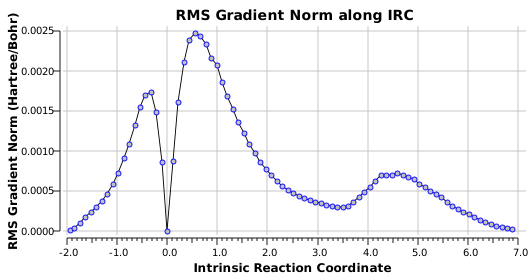
You can see an animation by invoking this link or below:

What happens if R=Me (an ester)? Well, the activation energy is now closer to 40 kcal/mol, which means the rate of the reaction would be very slow. Notice the bump corresponding to 5-coordinate boron has now vanished!
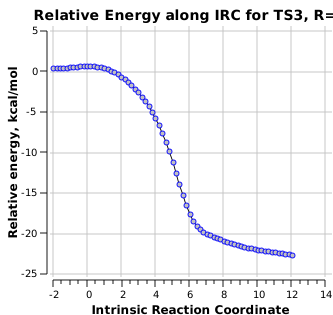
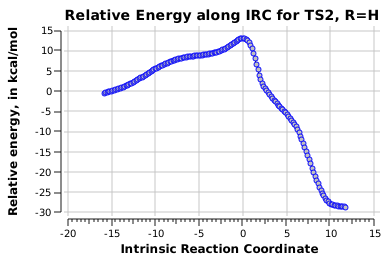
Again, a link for IRC animation of the reaction (it is rather nice, even if a say so myself). QED? Well, not quite. One still has to show that TS2 – TS4 do not control things! The IRC for TS2 (the first addition of a hydrogen to the carbon) is shown below, again with fascinating bumps along the way. The TS2 animation is here. The free energy of TS2 is 6.9 kcal/mol lower than TS1 (even though the actual activation barrier is higher), which makes the latter the rate determining step. Note the bumps at IRC = -8 and +5. These are due to rotations setting up the reaction.
TS3, a ring closing reaction (animation) shows an unexpected feature which I leave you to discover for yourself. TS4 is the second and final addition of a hydrogen to the carbon, with animation and resembling an SN2 inversion. The reaction is completed by hydrolysis.
The relative free energies of TS1, 2, 3 and 4 are respectively 0.0, -6.9, -35.0 and -19.4 kcal/mol, which makes the overall rate limiting step TS1. If that is the case, then this explains why borane reduces only a carboxylic acid and not an ester.
Now all I have to do is explain all of this to my tutorial group! Mind you, this is a deceptively complex mechanism, and who knows if it may yet spring surprises.
Tags:activation energy, animation, carboxylic acid, carboxylic ester, diborane, free energy, pericyclic, Peter Murray-Rust, Reaction Mechanism, reduction, Tutorial material
Posted in Interesting chemistry | 8 Comments »
Wednesday, May 26th, 2010
In the first part of the post on this topic, I described how an asymmetric sulfoxide could be prepared as a pure enantiomer using a chiral oxygen transfer reagent. In the second part, we now need to deliver a different group, cyano, to a specific face of the previously prepared sulfoxide-imine. The sulfoxide is now acting as a chiral auxilliary, and helps direct the delivery of the cyanide group to specifically one face of the imine rather than the other. After removal of the aluminum carrier for the cyano group and hydrolysis of the cyano group to a carboxylic acid group, we end up with an enantiomerically pure amino acid.

The Strecker synthsis: asymmetric delivery of cyanide anion. Click for 3D model of transition state
Two transition states can be computed (ωB97XD/6-311G(d,p)/SCRF[dichloromethane], see DOI
10042/to-4927) and the S,S(S) diastereomer is found to be 1.35 kcal/mol lower in total free energy than the R,S(S) isomer. This agrees with the observed specificity. Again, a reason for the specificity needs identifying, and again we use AIM.

AIM analysis for the asymmetric delivery of cyanide to an imine, S,S(S) form.
In the favoured diastereomer, a BCP or bond-critical-point (green arrow above) can be found connecting a hydrogen from an aryl group to the oxygen of the Al-OMe group
via a weak hydrogen bond (H…O distance 2.25Å). In the disfavoured form, this interaction vanishes, and is instead replaced by a repulsive close N=CH…C-aryl contact of 2.49Å (for which there is no BCP, red arrow below).

Disfavoured transition state. R,S(S) form.
The take home message from these two posts is that quite unusual interactions may often be responsible for asymmetric induction in a stereospecific reaction, and that helpful clues to these interactions may well be derived from an AIM analysis. Indeed, anyone doing stereospecific synthesis in the lab should be familiar with these methods! You have to be a jack-of-all-trades nowadays to keep up!
Tags:aluminum carrier, carboxylic acid, chiroptical, cyano, free energy, Interesting chemistry
Posted in Interesting chemistry | No Comments »