Posts Tagged ‘pericyclic’

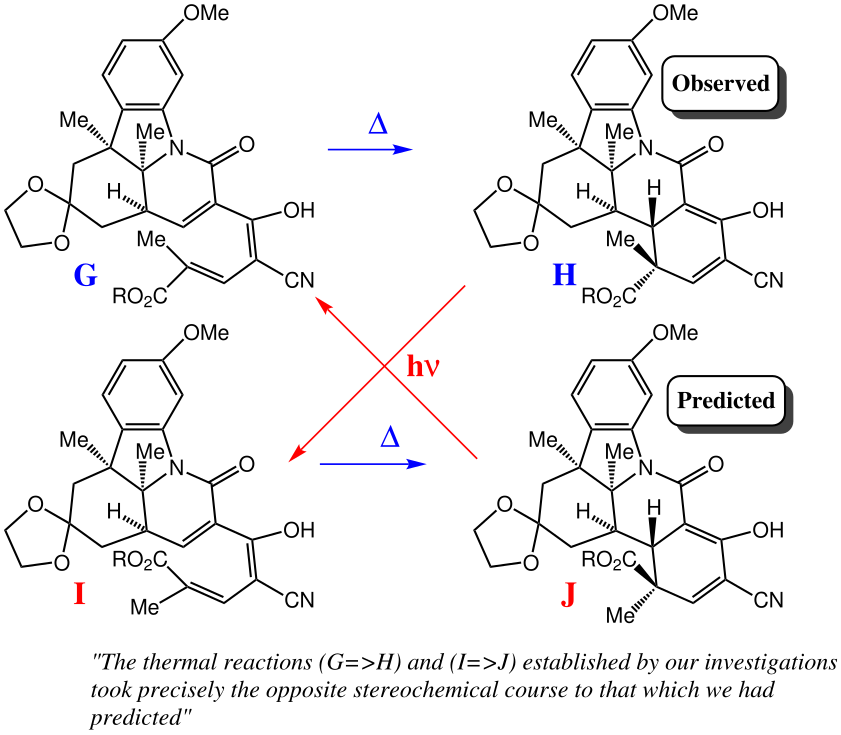
The thermal reactions … took precisely the opposite stereochemical course to that which we had predicted. A non-covalent-interaction view of the model.

Wednesday, February 3rd, 2021

Another foray into one of the more famous anecdotal chemistry “models”, the analysis of which led directly to the formulation of the WoodWard-Hoffmann (stereochemical) rules for pericyclic reactions. Previously, I tried to produce a modern computer model of what Woodward might have had to hand when discovering that the stereochemical outcome of a key reaction in his vitamin B12 synthesis was opposite to that predicted using his best model of the reaction.

Vitamin B12 synthesis

Such computer models generate quite accurate 3D coordinates of the transition state for the reaction and this can be most simply analysed for finding e.g. steric clashes. These are when two atoms (mostly hydrogen) approach too close to one another. But we now know that in the region 1.9 – 2.4Å these close approaches can be attractive as well as repulsive and so distances alone are not the complete story. Here I analyse these models using a technique known as non-covalent-interactions (NCI). This is based on the electron density and its reduced density gradients and it explores not merely simply distances between atoms but the non-bonded or weakly interacting regions of a molecule, generating a colour coded surface of interaction rather than pairwise distances. The colour coding goes from red (strongly destabilising, or repulsive regions) to blue (stabilising or attractive regions), with green representing weakly stabilising and yellow weakly destabilising. It gives a much more rounded picture of the entire molecule.

Disrotatory TS for G to H, Click for 3D

Conrotatory “TS” for G to J, Click for 3D

The NCI surfaces are shown above and are best expanded into a rotatable 3D model by clicking on either image. Regions of interest are shown with arrows. The region of the “steric clash” identified for the (thermal) transition state G to H (the one actually found by experiment) can be seen with the arrow in the top right. It is colour coded light blue (attractive; note the very attractive dark blue for the O…HO hydrogen bond in the system), but it is immediately next to a yellow/orange region (repulsive). This again reminds us that “stabilising” and “destabilizing” regions of a molecule can be adjacent to each other, something that physical models cannot convey. The steric clash for the “transition state” G to J (in quotes because it is actually a transition state calculated for the excited triplet state and not the ground state) is indicated with the arrow, being a clash of two methyl groups. It is coded green, indicating weak NCI stabilization.

So, in this analysis, steric clashes become more complex as indicators of reaction outcomes, since it is the overall balance of stabilisation and destabilisation that determines this. You might argue that Woodward would have found this modern analysis far too woolly to be useful in the sense he used, which is as an alert for the possibility of a new principle in organic reaction mechanisms and certainly a Nobel prize for his collaborator Hoffmann!


The region of the C-C bond which is forming in this transition state has a very non-standard electron density, to which this analysis cannot really be applied. So that region should be disregarded for the “non-covalent” analysis being done here. Plots a reduced density isosurface, colour mapped with ABS(ρ)*SIGN(λ2), where λ2 is the middle eigenvalue of the Hessian matrix of the electron density. A web page for generating such surfaces can be found at DOI: ftkt.

The thermal reactions … took precisely the opposite stereochemical course to that which we had predicted

Wednesday, January 20th, 2021

The quote of the post title comes from R. B. Woodward explaining the genesis of the discovery of what are now known as the Woodward-Hoffmann rules for pericyclic reactions.[1] I first wrote about this in 2012, noting that “for (that) blog, I do not want to investigate the transition states”. Here I take a closer look at this aspect.

Vitamin B12 synthesis

I will start by explaining my then reluctance to discuss transition states. Woodward in describing this discovery (in Chem. Soc. Special Publications (Aromaticity), 1967, 21, 217; a historic article which unfortunately remains off-line) notes the “steric preference for attack below the plane for C-5 and a gentle spiral for the cyclization to achieve the required stereochemistry at C-6″. In reference to the diagram above, he is talking about the reaction G to J which he thought was favoured over G to H on steric grounds. We must now try to judge what criteria might have been used to establish these steric grounds. He might have been referring to the relative thermodynamic stabilities of H vs J, which is the aspect I addressed in my earlier blog. But it has now been pointed out to me that Woodward is more likely to have been thinking about the transition state for the reaction, in referring to a “gentle spiral” for the reaction path as inferred by model building. So why my reluctance in 2012 to look at this aspect? As Woodward himself quickly came to realise, the transition state for G to H is electronically “allowed” but the transition state for G to J is electronically “forbidden”. Let me qualify that. The latter is only forbidden on the ground state electronic surface, but it is allowed on an open shell excited state (photochemical) surface. It is very difficult (if not impossible) to directly compare the energies of these two electronic states for any steric differences that might be hidden or embedded within them. So how did Woodward initially infer a “steric preference” between these two reactions?

Model building reached its peak as an essential tool for understanding chemistry in the 1950s, with the likes of Pauling and Watson + Crick making Nobel-prize winning discoveries using this technique. By the 1960s, one could buy commercial model building kits, such as Dreiding stereomodels (1958) which focused on the bonds themselves and CPK or spacefilling models (~1952[2]) based on the size of the atom (a technique pioneered by Loschmidt as long ago as 1860). I would point out that such models are constructed for molecules in their presumed ground electronic state! So Woodward must have been constructing models for G to H and G to J with the implicit assumption that they were in the ground electronic state. Clearly he noticed something which led him to conclude that these models predicted G to J over G to H. I do not know if his models have survived to posterity and are now in a museum somewhere; the chances are we will never know exactly what it was that alerted him that the formation of G to H was so unexpected that it triggered a Nobel-prize winning theory!

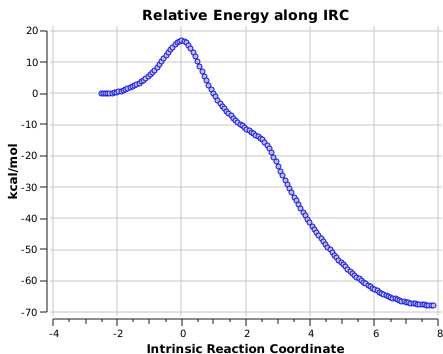
Having declined to build TS models in my original musings on this topic, I now decided to bite the bullet and try to now locate at least approximate models for both possible stereochemical outcomes. The disrotatory transition state for G to H is relatively trivial. Here I used the PM7 method, which I noted previously nicely absorbs dispersion corrections which may be important! It also allows a full IRC for the reaction path to be constructed in just a few hours (a DFT approach would take quite a lot longer). The FAIR data for my models can be found at DOI: 10.14469/hpc/7806

I then realised that the electronically “forbidden” transformation G to J (something that makes locating a transition state on the ground state surface unlikely) was in fact allowed for an open shell triplet state (a excited state). In this state, transition state location actually proceeds without issue to find a nice conrotatory transition state.

The two key transition state models are each shown below in two representations. The clashes noted are approaches of two atoms closer than the sum of the van der Waals radii. First, I note that transition state G to H clashes a hydrogen with the adjacent methyl group (H…H contact 1.937Å using the PM7 semi-empirical method, 1.942Å using the ωB97XD/6-311G(d,p) density functional method).

G to H, ball and stick representation. Click to view 3D

G to H, spacefilling representation

G to J also exhibits a clash, albeit a lesser one, between the hydrogens of two methyl groups (2.01Å for PM7, 2.03Å for ωB97XD/6-311G(d,p)). So one could argue that G to J is indeed favoured on steric grounds over G to H, but only by about 0.07Å in the close approach of pairs of non-bonded hydrogen atoms. I also note that Woodward’s gentle spiral or spiral of low pitch is in fact a left-handed one!

G to J, ball and stick representation. Click to view 3D

G to J, spacefilling representation.

To get another perspective on what this means in reality, I conducted a search of the CSD (Cambridge structure database) for the sub-structure shown below:

The results show H…H contacts down to about 2.03Å, which suggests that the steric clash for G to H probably is slightly repulsive, whilst that for G to J could be on the verge of being attractive.

We might conclude that there is probably only a small steric difference between the two quantitative reaction models G to H and G to J as evaluated here, probably favouring the latter and assuming that the sterics are expressed entirely by van der Waals distances and have not been absorbed into bond angles etc. Of course much of what I have done and explained here was not common in the 1960s. The details of how Woodward’s models were actually constructed and how quantitative they were may never be discovered. It matters not of course, since the surprise of finding the actual product was H and not J went on to catalyse one of the great theories of organic chemistry!


My thanks to Jeff Seeman and Dean Tantillo for contacting me about this, inspiring the above revisitation and much interesting discussion; J. Seeman and D. Tantillo, “On the Structural Assignments Underlying R. B. Woodward’s Most Personal Data Point That Led to the Woodward-Hoffmann Rules. Related Research by E. J. Corey and Alfred G. Hortmann.”, Chem. Euro. J., 2021, in press. As noted elsewhere on this blog, H…H contacts as short as 1.5Å have been measured experimentally. To turn the 3D view of the molecule into a spacefill model, right-click in the model window and invoke Scheme/CPK Spacefill as shown below:

References

  1. R.B. Woodward, and R. Hoffmann, "Stereochemistry of Electrocyclic Reactions", Journal of the American Chemical Society, vol. 87, pp. 395-397, 1965. https://doi.org/10.1021/ja01080a054
  2. R.B. Corey, and L. Pauling, "Molecular Models of Amino Acids, Peptides, and Proteins", Review of Scientific Instruments, vol. 24, pp. 621-627, 1953. https://doi.org/10.1063/1.1770803

Trimerous pericyclic reactions: what is the effect of changing the electron count by two?

Monday, November 2nd, 2020

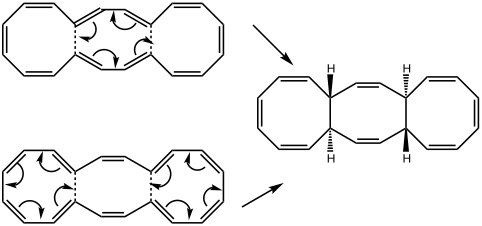
In an earlier post, I pondered on how the “arrow pushing” for the thermal pericyclic reactions of some annulenes (cyclic conjugated hydrocarbons) could be represented in terms of either two separate electrocyclic reactions or of one cycloaddition reaction. Each reaction is governed by selection rules which can be stated in terms of the anticipated aromaticity of the pericyclic transition state as belonging to a 4n or a 4n+2 class. This in turn determines whether the topology of the transition state belongs to a class of aromatic species known as either Hückel or Möbius. Here I play with the observation that by adding or removing two electrons from the molecule, the two classes 4n and 4n+2 can be swapped. What happens to the aromaticities of the transition states if that is done?

The test bed is a [20]annulene, which might undertake either a eight electron (4n) 4s+4s cycloaddition in the inner ring, or two eight electron (4n) electrocyclic reactions in the outer rings in which the new bond is formed antarafacially from opposite faces. The selection rules suggest that the former must proceed through an anti or non-aromatic Hückel transition state and the latter through an aromatic Möbius transition state.

We are measuring the aromaticity by using the so-called NICS NMR method, for which an aromatic value is a negative chemical shift for the NICS probe, a non-aromatic value is ~0 and an anti-aromatic value a positive chemical shift. The location of these probes is determined by analysis of the critical points in the electron density of the transition states and placement at either the ring or the cage critical point so determined.

# System Charge ν(s) ν(a) NICS (outer rings) NICS (inner ring) ΔG DOI
1 trans, D2 0 -399 -433 -6.7 -0.3 -774.036424 7483
2 trans, D2 +2 -388 -399 +4.0 +2.1 -773.381567 7490
3 trans, D2 -2 -412 -324 -15.0 -12.9 -774.179873 7526
4 cis, Cs 0 -413 -369 -8.6 -5.4 -774.048172 7482
5 cis, Cs +2 -640 -453 +11.1 +2.1 -773.386424 7493
6 cis, C2 0 -491 -459 -8.3 +1.4 -774.059141 7486
7 cis, C2 +2 -685 -479 +10.5 +2.3/+3.7 -773.392100 7497
8 cis, C2 -2 -926 -533 +8.4 -13.9 -774.2029900 7525

Each of the stationary points located is in fact a saddle point of order 2 (and in some cases 3), with ν(s) corresponding to normal vibrational mode for synchronous formation of both bonds, and ν(a) to formation of one C-C bond but cleavage of the other. The fact that both the force constants for these modes are negative suggests that the two electrocyclic reactions are independent and occur consecutively rather than concurrently. This then argues against it being a synchronous cycloaddition reaction, but could of course still be a highly asynchronous one.

The first three examples are in fact for a [20]annulene with a central trans rather than cis double bond (as illustrated above), resulting in D2 symmetry. The neutral system has the outer ring aromatic (-ve NICS) and the inner ring non-aromatic, as appropriate for the rules stated above. Removing two electrons might you would imagine swap these two, but of course the electrons are removed from the entire [20]annulene as a whole, and not from specific regions. In fact it results in mildly anti-aromatic rings in both regions. Adding two electrons now makes the rings strongly aromatic, behaving as if the two electrons have really only modified the inner cycloaddition reaction.

The reactions with a cis stereochemistry at the central bond again confirm for the rules for the neutral annulene, but now the dianion predicts the outer ring to be anti-aromatic and the inner one aromatic, with a reversal of aromaticity for both sets of rings. Despite the cycloaddition now being an aromatic transition state, the force constants still indicate it to be asynchronous. But the observation that ν(s) is now significantly larger than ν(a) suggests that perhaps the reaction can indeed now be considered as at least in part an asymmetric cycloaddition. 

Click to view vibrational modes

What is the point of doing these calculations, you may well ask? Its unlikely that they could ever be subjected to experimental tests! Well, here we are using quantum mechanical calculations as an experimental procedure in its own right, to try to push the simple pericyclic selection rules beyond anything envisaged by its original formulators.

Trimerous pericyclic reactions.

Thursday, October 8th, 2020

I occasionally spot an old blog that emerges, if only briefly, as “trending”. In this instance, only the second blog I ever wrote here, way back in 2009 as a follow up to this article.[1] With something of that age, its always worth revisiting to see if any aspect needs updating or expanding, given the uptick in interest. It related to the observation that there can be more than one way of expressing the “curly arrows” for some pericyclic reactions. These alternatives may each represent different types of such reactions, hence leading to a conundrum for students of how to label the mechanism. I had noted in that blog that I intended to revisit the topic and so a mere eleven years later here it is!

Annulenes, or cyclic conjugated polyenes can (hypothetically) indulge in transannular cyclisations which can be regarded as either two electrocyclic reactions, or one cycloaddition reaction, or perhaps a chimera of all three which here I describe as trimerous. Locating the transition states for such a trimerous reaction is quite straightforward and here I give the FAIR data DOI for all the examples shown below (DOI: 10.14469/hpc/7440). The calculations are all at the B3LYP+GD3BJ/Def2-TZVPP level.

The central reaction can be represented as a cycloaddition in which two new bonds form between the termini of two conjugated alkenes. The stereochemistry for each alkene component is defined as either suprafacial (the two new bonds form to the same face of that alkene) or antarafacial (the two new bonds form on opposite faces of that alkene). Another way of representing the curly arrow mechanism is to draw to separate electrocyclic reactions, in which one new bond is formed between the termini of a conjugated alkene. If this bond connects at each end to the same face of that alkene, the bond forms suprafacially, if it connects opposite faces of that alkene it forms antarafacially. One must also count the number of cyclic curly arrows used in each representation; the examples above illustrate two, three or four curly arrows, representing four, six or eight electrons. One can now combine these attributes to form some selection rules.

For thermal reactions, one can state that if the total electron count represented by an odd number of curly arrows corresponding to the formula 4n+2 (n = 0,1,2, etc, the n is NOT the same as that shown in the scheme above) and there are either no (or an even number of) antarafacial components, the reaction will be “allowed” and proceed through a “Huckel aromatic transition state“. Alternatively, if the total electron count corresponds to an even number of curly arrows matching the formula 4n (n=1,2, etc) and there is one (or an odd number of) antarafacial components, the reaction will this time proceed through a “Mobius aromatic transition state“. These are in fact a concise alternative statement of the Woodward-Hoffmann selection rules for thermal pericyclic reactions.

Entry # n (scheme only) [ ]-Annulene
TS
 electron count
in each ring
s/a
components
NICS for each
ring centroid
1 0 10 endo 4,6,4 a,s+s,a -3.5,-15.3,-3.5
2 0 10 exo 4,6,4 a,s+s,a -2.8,-11.6,-2.8
3 0 12, saddle=1 4,8,4 s,s+a,* -0.1,-10.3,-2.0
4 0 12, saddle=2 4,8,4 *,s+a,* -0.9,-10.7,-0.9
5 1 14 endo 6,6,6 a,s+s,a +2.2,-17.1,+2.2
6 1 14 exo 6,6,6 a,s+s,a +9.7,-11.1,+9.7
7 1 16 6,8,6 a,s+a,a +9.1,-9.6,+9.1
8 2 18 endo, saddle=1 8,6,8 s,s+s,a -2.0,-15.0,-
9 2 18 endo, saddle=2 8,6,8 *,s+s,* -0.5,-17.1,-0.5
10 2 18 exo,saddle=1 8,6,8 a,s+s,a -6.2,-4.5,-3.7
11 2 18 exo,saddle=2 8,6,8 a,s+s,a -8.2,-1.4,-8.2
12 2 20,saddle=3 8,8,8 a,s+*,a -8.5,+0.3,-8.5

No ring centroid in AIM analysis.The symmetrical geometry has two negative force constants (saddle=2), representing an asymmetric distortion to a true transition state (saddle=1).

For the reactions shown in the scheme above, we will determine the NICS (Nucleus independent chemical shift) value at the ring centroid of each reaction to ascertain the aromaticity in that ring. The effective ring centroid in turn is located by performing an AIM analysis of the topology of the electron density and locating the RCP (ring critical points in that density; a critical point itself is one where the first derivatives of the density with respect to the three cartesian coordinates is zero) or in several examples the CCP (Cage critical point). I will discuss some of these systems individually, but in fact there is a wealth of information available for each one and to discover it all, you should go to the data files and inspect all the structures for yourself. Firstly, the colour code in the table above:

  • In the s/a column, blue represents systems where the electrocyclic component forms a bond antarafacially. whereas the cycloaddition component forms both bonds suprafacially to both the alkene and the diene.
  • Red represents systems where the electrocyclic component forms a terminus bond antarafacially and the cycloaddition component forms a bond suprafacially to the alkene but antarafacially to the diene.
  • Where the π-system in the pericyclic transition state has a local orthogonality (i.e. the pericyclic π-system is locally twisted by 90°±6 at one point) it is not possible to confidently distinguish between supra and antarafacial. Such instances are declared non-aromatic and are shown in black.
  • In the NICS column, green represents an aromatic value and red an antiaromatic value. Black is effectively non-aromatic.

Individual entries

The way to read the table above is the following. In the 4th column (electron count in each ring, corresponding to the curly arrows representing the reaction at that ring), determine if the count belongs to the 4n or the 4n+2 rule.  Next for each ring, is the number of antarafacial components odd, or zero. Finally, does the NICS aromaticity index match with the inference from the first two properties, i.e. 4n+2 + zero a = aromatic, 4n + odd a = aromatic and the corollary of 4n+2 + odd a = anti-aromatic, 4n + zero a = anti-aromatic.

Entry 1:  All three rings correspond to aromatic pericyclic transition states, but with the cycloaddition ring far more aromatic than the electroclisation rings. This is reflected in the bond lengths in the rings. The cycloaddition ring has lengths close to the “aromatic” value of 1.4Å. whereas the electrocyclic rings have highly alternating bond lengths. The calculated lengths correspond to the “cycloaddition” curly arrows in the scheme above and not to the “electrocyclic” arrows. This reaction does not have the characteristics of three simultaneous pericyclic reactions, or to use the parlance of the title of this post, it is not trimerous.

Click image to see 3D model.

Entry 6: This time, the central ring is again strongly aromatic (4n+2 + zero a = aromatic) but the two outer rings are strongly antiaromatic (4n+2 + odd a = anti-aromatic). Again the curly arrows correspond to cycloaddition and not electrocyclisation.

Click image to see 3D model.

Entry 11: As with entry 1, all three rings should again be aromatic (4n+2 + zero a = aromatic;4n + odd a = aromatic).In reality the bond lengths and  aromaticity indicate that this time the curly arrows are those of two concurrent electrocyclic reactions and NOT of one cycloaddition.  But there is a sting in the tail. This symmetrical system is NOT a true transition state. 

Click image to see 3D model.

Entry 10: This is the true transition state corresponding to entry 11, in which completion of one electrocyclic reaction preceeds the other; they are no longer synchronous but asynchronous, with one C-C bond (1.946Å) formed before the other (2.790Å). This pericyclic reaction can indeed be now considered trimerous, albeit with the three individual pericyclic reactions happening at different rates.

Click image to see 3D model

We can see that allowed pericyclic reactions in which three separate modes operate in concert (trimerous) are unlikely to happen. In effect the “aromaticity” tends to localise in one region rather than operate simultaneously in three rings. The collection of examples above also nicely illustrates the operation of the Woodward-Hoffmann rules as recast in terms of transition state aromaticity.


The original blog was also data rich, containing the encouragement to Click above to obtain model. It did not however cite the DOI of the repository entry for this data, an omission here rectified. †Or even, but no examples of this in the table.

References

  1. H.S. Rzepa, "The Aromaticity of Pericyclic Reaction Transition States", Journal of Chemical Education, vol. 84, pp. 1535, 2007. https://doi.org/10.1021/ed084p1535
Three-for-one: a pericyclic brain teaser.

Sunday, January 12th, 2014

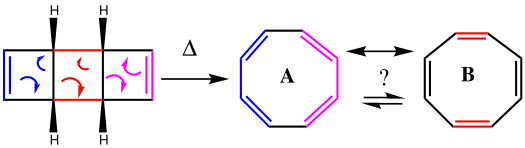
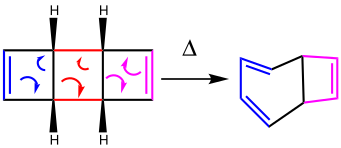
A game one can play with pericyclic reactions is to ask students to identify what type a given example is. So take for example the reaction below.

p34c

The alternatives are:

  1. A cyclo-elimination reaction (red arrows).
  2. Two concurrent electrocyclic ring openings (blue and magenta arrows)
  3. Two consecutive electrocyclic ring openings
  4. Or could it be a hybrid with characteristics of both the first two?

All the first three are four electron thermal processes; all should occur with involvement of one antarafacial mode (a Möbius transition state). But where are those antarafacial modes? Or do all or any of these pericyclic reactions not follow the standard rules? And the rules have nothing to say about whether two separate processes can be concurrent or must be consecutive.

The solution is to concede the limitations of simple electron counting rules, and evaluate the reaction using a quantum mechanical method (ωB97XD/6-311G(d,p))

  1. The first attempt is to locate a stationary point with symmetry, C2 in this case. Here it is.[1]p34c
    2+2E
    • Points of interest include the formation of the cyclo-octatetraene in the valence bond form B rather than A. This points to it being a cyclo-elimination rather than an electrocyclic reaction. For this product, little change occurs for the terminal alkenes (blue or magenta in the reactant), and indeed the C-C length at the stationary point is 1.349Å, only slightly longer than a normal alkene, and not at all the value of ~1.40Å expected for an aromatic transition state expected of an electrocyclic.
    • The stereochemistry of this elimination is entirely suprafacial, as evidenced by the formation of cis-alkenes. The formal pericyclic rule that disallows such stereochemistry for a 4n-electron thermal reaction is however over-turned by the transition state adopting a trapezoidal character.
    • The initial sense of rotation of the two pairs of hydrogens show above is however conrotatory (a consequence of the trapezoidal motions), as in fact required of a thermal 4n-electron electrocyclic reaction. It is only well after the transition state is passed that the motion of one pair of these hydrogens reverses itself, and we end up with a cis-alkene after all.
    • So at the transition state, we see features of both a cycloelimination (trapezoidal geometry) but ALSO of two concurrent electrocyclic ring openings (conrotation). In other words, one gets the characteristics of three pericyclic reactions in one! Very much a chimera!
    • There is only one fly in the ointment. This stationary point is in fact a second-order saddle-point and not a transition state.[2] There are two imaginary frequencies, and the smaller of the two corresponds to desymmetrising the two C-C breaking central bonds
  2. So we turn to the proper transition states in this reaction, the first of which corresponds to the initial of two consecutive electrocyclic ring openings.[3] p34c
    • This looks very different from the preceding pathway. As the (blue) arrows take effect, an antarafacial mode takes hold, ending in the formation of an intermediate bicyclic system with a trans-alkene forming. This proper transition state is 8.1 kcal/mol lower in free energy than the earlier second-order point. The C=C bond length at the transition state becomes 1.392Å, now a typical aromatic value.
    • This transition state leads to an intermediate which is 12.7 lower than the preceding transition state, and is then followed by …p34d
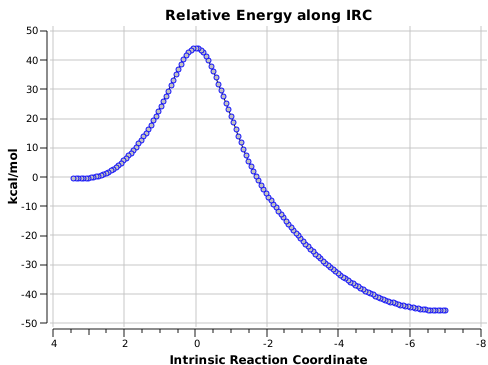
    • a second transition state, with an energy 2.5 kcal/mol higher than the first (but still 5.6 kcal/mol lower than the second-order saddle). The IRC for this step (below) in effect opens up the second ring in a follow-up electrocyclic. The C=C bond in the second cyclobutene now becomes 1.338Å, which is not characteristic of a cyclobutene ring-opening. Notice how again the initial motion of the two hydrogens of the second ring tentatively try a conrotatory motion as before, but this antarafacial motion in fact is soon taken over by rotation of the trans-alkene formed in the second step! This reverses the first antarafacial mode, and the net result is that none of these modes survive into the final product cyclo-octatetraene which is now in the valence bond form A rather than B.[4]p34c2+2-step2E
      2+2-step2G
    • This second reaction is clearly part of a pericyclic sequence, but quite unlike any I have ever come across previously. In particular, the morphing of the antarafacial mode away from the cyclobutene ring and onto the trans-alkene is indeed quite a novel feature!
    • The IRC (above) shows the clear presence of a hidden intermediate (IRC = 2.3), which corresponds to the following (C2-symmetric) species (which might have biradical or zwitterionic character). The central bond threatens to form, but ultimately does not!2+2-step2G

So to answer the question posed at the start. Quantum mechanics (but not simply electron counting) suggests the reaction comprises two consecutive electrocyclic ring openings. But the second of these has most unusual features, which perhaps could not have been anticipated. It is not really an electrocyclic, so one could reasonably argue that the answer to the first question posed is in fact none of the above (and I might add that biradical mechanisms have not been considered either).

Perhaps indeed we should start contemplating that the era of simplistic arrow-pushing is coming to an end, and instead we should more routinely start replacing it with quantum mechanical computations. Just a thought! 


It is perfectly possible that substituents could alter the balance between the cyclo-elimination mode and the two-fold electrocyclic, and resulting in the former being in fact the preferred mode. For example, replacing H by thioformyl (HC=S) flips the mechanism to the 2+2 elimination (it removes that second imaginary frequency).[5]2+2S

References

  1. H.S. Rzepa, "Gaussian Job Archive for C8H8", 2014. https://doi.org/10.6084/m9.figshare.899759
  2. H.S. Rzepa, "Gaussian Job Archive for C8H8", 2014. https://doi.org/10.6084/m9.figshare.899760
  3. H.S. Rzepa, "Gaussian Job Archive for C8H8", 2014. https://doi.org/10.6084/m9.figshare.899763
  4. H.S. Rzepa, "Gaussian Job Archive for C8H8", 2014. https://doi.org/10.6084/m9.figshare.899762
  5. H.S. Rzepa, "Gaussian Job Archive for C10H8S2", 2014. https://doi.org/10.6084/m9.figshare.899809

A simple pericyclic reaction encapsulating the four thermal selection rules.

Thursday, January 2nd, 2014

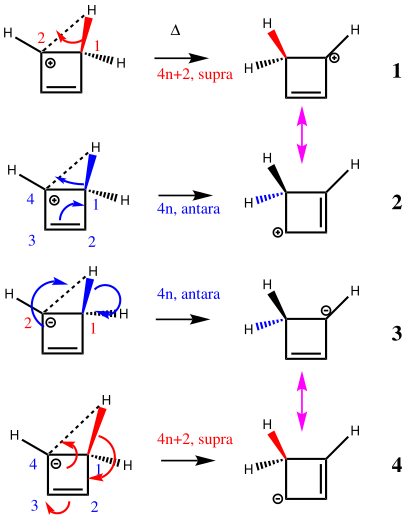
As my previous post hints, I am performing my annual spring-clean of lecture notes on pericyclic reactions. Such reactions, and their stereochemistry, are described by a set of selection rules. I am always on the lookout for a simple example which can most concisely summarise these rules. The (hypothetical) one shown below I think nicely achieves this, and raises some interesting issues in the process.14vs12

The reaction is a hydrogen shift (as either a proton or a hydride), and the interesting issue is immediately how the nomenclature of either process should be applied. 

  1. This cationic rearrangement is shown as a [1,2] sigmatropic proton shift. The rules declare that as a thermal process involving 4n+2 electrons (two electrons, n=0, red arrow) the shift should occur suprafacially (red hydrogen) with a plane of symmetry at the transition state.
  2. BUT! It could also be represented as a four electron process (4n, n=1, blue arrows) involving a [1,4] shift. There is now a conflict in the outcome. The magenta coloured resonance arrow implies the same product is formed as with the [1,2] shift. But the pericyclic rules declare that this cannot be the case. The resolution is to declare that a [1,4] shift would result in a different stereochemical outcome (blue hydrogen, an antarafacial shift from the top face of the reactant to the bottom face of the product) with an axis of symmetry.
  3. The anionic series involves two more electrons, an increment that inverts the 4n+2/4n assignment. Reaction 3 is still a [1,2] shift, but it now belongs to the 4n rule and so we infer it should proceed antarafacially (blue hydrogen, but a 1,2 antarafacial shift would be unprecedented).
  4. The anionic series can also be represented alternatively (red arrows) as a 4n+2 process, involving a [1,4] suprafacial shift.

So for both cation and anion, two different pericyclic circulations are possible, leading to different stereochemical outcomes. Which might actually occur in practice? This is where the simple selection rules have to be augmented with calculations, ωB97XD/6-311G(d,p) in this case.

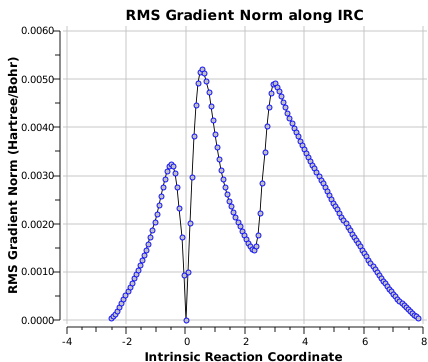
  1. The IRC for reaction 1 is shown below.[1] It shows a smooth suprafacial migration of a hydrogen. The transition state has a Cs plane of symmetry. This calculation also reveals another important facet of pericyclic reactions; their transition states are aromatic. One can infer this from the length of the C1-C2 bond (from which the [1,2] numbering is derived), which is 1.383Å[2], which is a typically aromatic value, compared with the very non-aromatic value for the cyclobutene alkene bond of 1.332Å. The starting values for both lengths were respectively 1.509Å and 1.382Aring;. In other words, the C-C bond along which migration takes place changes from a single bond to a (delocalized) aromatic bond at the transition state, and the spectating remote C=C bond changes from that for a delocalised allylic cation to a conspicuously localised alkene.12Ca
  2. How about the antarafacial mode, reaction 2? The stereochemistry clearly involves a migration from the bottom face of the reactant to the top face of the product. Notice the chirality indicated at the transition state (R,R), associated with the disymmetric C2 axis of symmetry present at this point.[3]14CSuch contortions bring a penalty, the energy of this mode is a lot higher (85 kcal/mol in free energy) What of the bond lengths? The length of the C-C bond along which the H apparently migrates is 1.509Å at the start and 1.527Å at the transition state. This latter value is clearly NOT aromatic! As for the C2-C3 bond, it starts at 1.382Å (the same typical allylic cation) but is largely unchanged at the transition state is 1.396Å (also a typical aromatic value). So clearly it is the [1,4] shift that sustains the aromaticity, not any [1,2] shift. 
  3. Now for the anionic series, with two extra electrons involved. Again, an antarafacial path is attempted.[4]‡ Although C2 disymmetric symmetry is achieved, the distortion required for the antarafacial stereochemistry across just a single bond brings a heavy toll, and the C1-C2 bond springs open. What little can be inferred is that the remote C=C bond does not seem to achieve aromatic status at the transition state, preferring localisation (1.356Å). We have pushed the system a bit too far.12A
  4. Route 4 is again a conventional suprafacial migration[5]. The C-C length for the apparent [1,2] migration starts at 1.542Å and achieves 1.583Å at the transition state. Not aromatic then. The C2-C3 bond starts at 1.407Å (a typical delocalized allylic anion) and changes merely to 1.405Å (a very delocalized aromatic value). So we again see clear evidence of a [1,4] rather than a [1,2] shift, involving a very aromatic six electrons.14A

So here we have a simple reaction involving only four carbon atoms that can be used to exemplify the four thermal selection rules for pericyclic processes. It is doubtful that such an example could ever be obtained by synthesis and experiment; rather it represents a quantum mechanical experiment on the rules. And we have teased out the associated transition state aromaticities from the computed geometries.


This is not actually computed as a transition but as a second-order saddle point, diverting the reaction to another manifold which is not of interest here. If you want to explore this diversion yourself, get the files yourself[6].

I am not concerned with explaining the overall reaction barriers here; in such a small ring system they are all actually too large to be feasible reactions. Rather, the point is merely to use quantum mechanics to illustrate the geometric and stereochemical characteristics of the transition states.

References

  1. H.S. Rzepa, "Gaussian Job Archive for C4H5(1+)", 2014. https://doi.org/10.6084/m9.figshare.892333
  2. H.S. Rzepa, "Gaussian Job Archive for C4H5(1+)", 2014. https://doi.org/10.6084/m9.figshare.892335
  3. H.S. Rzepa, "Gaussian Job Archive for C4H5(1+)", 2014. https://doi.org/10.6084/m9.figshare.892332
  4. H.S. Rzepa, "Gaussian Job Archive for C4H5(1-)", 2014. https://doi.org/10.6084/m9.figshare.892371
  5. H.S. Rzepa, "Gaussian Job Archive for C4H5(1-)", 2014. https://doi.org/10.6084/m9.figshare.892334
  6. H.S. Rzepa, "Gaussian Job Archive for C4H5(1+)", 2014. https://doi.org/10.6084/m9.figshare.892336

Woodward's symmetry considerations applied to electrocyclic reactions.

Monday, May 20th, 2013

Sometimes the originators of seminal theories in chemistry write a personal and anecdotal account of their work. Niels Bohr[1] was one such and four decades later Robert Woodward wrote “The conservation of orbital symmetry” (Chem. Soc. Special Publications (Aromaticity), 1967, 21, 217-249; it is not online and so no doi can be given). Much interesting chemistry is described there, but (like Bohr in his article), Woodward lists no citations at the end, merely giving attributions by name. Thus the following chemistry (p 236 of this article) is attributed to a Professor Fonken, and goes as follows (excluding the structure in red):

wood

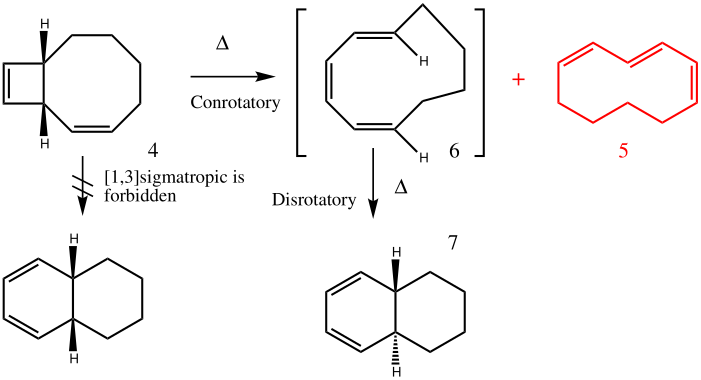
A search of the literature reveals only one published article describing this reaction[2] by Dauben and Haubrich, published some 21 years after Woodward’s description (we might surmise that Gerhard Fonken never published his own results). In fact this more recent study was primarily concerned with 193-nm photochemical transforms (they conclude that “the Woodward-Hoffmann rules of orbital symmetry are not followed”) but you also find that the thermal outcome of heating 4 is a 3:2 mixture of compounds 5 and 6, and that only 6 goes on to give the final product 7. It does look like a classic and uncomplicated example of Woodward-Hoffmann rules.

 So let us subject this system to the “reality check”. The transform of 4 → 5 rotates the two termini of the cleaving bond in a direction that produces the stereoisomer 5, with a trans alkene straddled by two cis-alkenes[3]. The two carbon atoms that define the termini of the newly formed hexatriene are ~ 4.7Å apart; too far to be able to close to form 7.

 4 → 5  4 → 6
8 8

But with any electrocyclic reaction, two directions of rotation are always possible, and it is a rotation in the other direction that gives 4 → 6[4], ending up with a hexatriene with the trans-alkene at one end and not the middle (for which the free energy of activation is 3.1 kcal/mol higher in energy). Now the two termini of the hexatriene end up ~3.0Å apart, much more amenable to forming a bond between them to form 7.

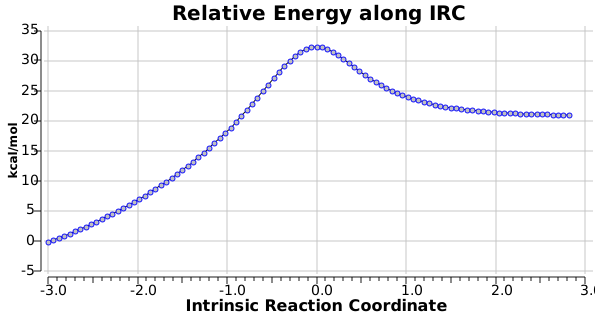
It is at this point that the apparently uncomplicated nature of this example starts to unravel. If one starts from the 3.0Å end-point of the above reaction coordinate and systematically contracts the bond between these two termini, a transition state is found leading not to 7 but to the (endothermic) isomer 8.[5]This form has a six-membered ring with a trans-alkene motif (which explains why it is so endothermic). 

wood1
6 ↠ 8
8 wood2

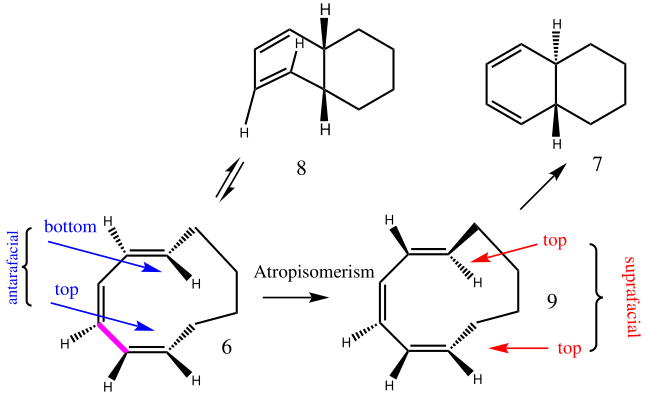
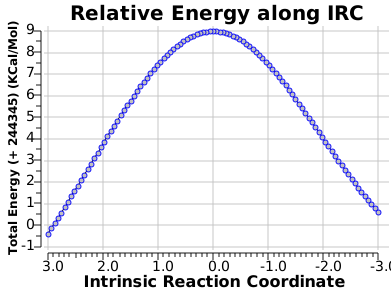
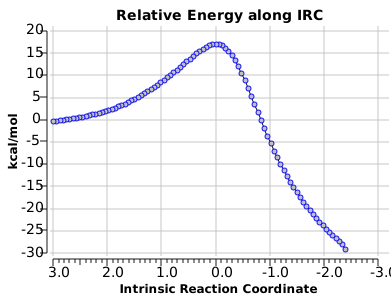
Before discussing the implications of this transition state, I illustrate another isomerism that 6 can undertake; a low-barrier atropisomerism[6] to form 9, followed by another reaction with a relatively low barrier, 9 ↠  7[7]to give the product that Woodward gives in his essay.

6 ↠ 9
6-atrop 6-atrop
9 ↠ 7
9to7a 9to7a

 We can now analyse the two transformations 6 ↠ 8 and 9 ↠  7. The first involves antarafacial bond formation (blue arrows) at the termini and an accompanying 180° twisting about the magenta bond which creates a second antarafacial component[8]. So this is a thermally allowed six-electron (4n+2) electrocyclisation with a double-Möbius twist[9]. The second reaction is a more conventional purely suprafacial version[10] (red arrows) of the type Woodward was certainly thinking of; it is 18.0 kcal/mol lower in free energy than the first (the transition state for 6 ↠ 9 is 10.8 kcal/mol lower than that for 9 ↠ 7).

I hope that this detailed exploration of what seems like a pretty simple example at first sight shows how applying a “reality-check” of computational quantum mechanics can cast (some unexpected?) new light on an old problem. We may of course speculate on how to inhibit the pathway 6 ↠ 9 ↠ 7 to allow only 6 ↠ 8 to proceed (the reverse barrier from 8 is quite low, so 8 would have to be trapped at very low temperatures). 

References

  1. N. Bohr, "Der Bau der Atome und die physikalischen und chemischen Eigenschaften der Elemente", Zeitschrift f�r Physik, vol. 9, pp. 1-67, 1922. https://doi.org/10.1007/bf01326955
  2. W.G. Dauben, and J.E. Haubrich, "The 193-nm photochemistry of some fused-ring cyclobutenes. Absence of orbital symmetry control", The Journal of Organic Chemistry, vol. 53, pp. 600-606, 1988. https://doi.org/10.1021/jo00238a023
  3. H.S. Rzepa, "Gaussian Job Archive for C10H14", 2013. https://doi.org/10.6084/m9.figshare.704833
  4. H.S. Rzepa, "Gaussian Job Archive for C10H14", 2013. https://doi.org/10.6084/m9.figshare.704834
  5. H.S. Rzepa, "Gaussian Job Archive for C10H14", 2013. https://doi.org/10.6084/m9.figshare.704755
  6. H.S. Rzepa, "Gaussian Job Archive for C10H14", 2013. https://doi.org/10.6084/m9.figshare.704754
  7. H.S. Rzepa, "Gaussian Job Archive for C10H14", 2013. https://doi.org/10.6084/m9.figshare.704844
  8. H.S. Rzepa, "Gaussian Job Archive for C10H14", 2013. https://doi.org/10.6084/m9.figshare.704841
  9. H.S. Rzepa, "Double-twist Möbius aromaticity in a 4n+ 2 electron electrocyclic reaction", Chemical Communications, pp. 5220, 2005. https://doi.org/10.1039/b510508k
  10. H.S. Rzepa, "Gaussian Job Archive for C10H14", 2013. https://doi.org/10.6084/m9.figshare.704995

Woodward’s symmetry considerations applied to electrocyclic reactions.

Monday, May 20th, 2013

Sometimes the originators of seminal theories in chemistry write a personal and anecdotal account of their work. Niels Bohr[1] was one such and four decades later Robert Woodward wrote “The conservation of orbital symmetry” (Chem. Soc. Special Publications (Aromaticity), 1967, 21, 217-249; it is not online and so no doi can be given). Much interesting chemistry is described there, but (like Bohr in his article), Woodward lists no citations at the end, merely giving attributions by name. Thus the following chemistry (p 236 of this article) is attributed to a Professor Fonken, and goes as follows (excluding the structure in red):

wood

A search of the literature reveals only one published article describing this reaction[2] by Dauben and Haubrich, published some 21 years after Woodward’s description (we might surmise that Gerhard Fonken never published his own results). In fact this more recent study was primarily concerned with 193-nm photochemical transforms (they conclude that “the Woodward-Hoffmann rules of orbital symmetry are not followed”) but you also find that the thermal outcome of heating 4 is a 3:2 mixture of compounds 5 and 6, and that only 6 goes on to give the final product 7. It does look like a classic and uncomplicated example of Woodward-Hoffmann rules.

 So let us subject this system to the “reality check”. The transform of 4 → 5 rotates the two termini of the cleaving bond in a direction that produces the stereoisomer 5, with a trans alkene straddled by two cis-alkenes[3]. The two carbon atoms that define the termini of the newly formed hexatriene are ~ 4.7Å apart; too far to be able to close to form 7.

 4 → 5  4 → 6
8 8

But with any electrocyclic reaction, two directions of rotation are always possible, and it is a rotation in the other direction that gives 4 → 6[4], ending up with a hexatriene with the trans-alkene at one end and not the middle (for which the free energy of activation is 3.1 kcal/mol higher in energy). Now the two termini of the hexatriene end up ~3.0Å apart, much more amenable to forming a bond between them to form 7.

It is at this point that the apparently uncomplicated nature of this example starts to unravel. If one starts from the 3.0Å end-point of the above reaction coordinate and systematically contracts the bond between these two termini, a transition state is found leading not to 7 but to the (endothermic) isomer 8.[5]This form has a six-membered ring with a trans-alkene motif (which explains why it is so endothermic). 

wood1
6 ↠ 8
8 wood2

Before discussing the implications of this transition state, I illustrate another isomerism that 6 can undertake; a low-barrier atropisomerism[6] to form 9, followed by another reaction with a relatively low barrier, 9 ↠  7[7]to give the product that Woodward gives in his essay.

6 ↠ 9
6-atrop 6-atrop
9 ↠ 7
9to7a 9to7a

 We can now analyse the two transformations 6 ↠ 8 and 9 ↠  7. The first involves antarafacial bond formation (blue arrows) at the termini and an accompanying 180° twisting about the magenta bond which creates a second antarafacial component[8]. So this is a thermally allowed six-electron (4n+2) electrocyclisation with a double-Möbius twist[9]. The second reaction is a more conventional purely suprafacial version[10] (red arrows) of the type Woodward was certainly thinking of; it is 18.0 kcal/mol lower in free energy than the first (the transition state for 6 ↠ 9 is 10.8 kcal/mol lower than that for 9 ↠ 7).

I hope that this detailed exploration of what seems like a pretty simple example at first sight shows how applying a “reality-check” of computational quantum mechanics can cast (some unexpected?) new light on an old problem. We may of course speculate on how to inhibit the pathway 6 ↠ 9 ↠ 7 to allow only 6 ↠ 8 to proceed (the reverse barrier from 8 is quite low, so 8 would have to be trapped at very low temperatures). 

References

  1. N. Bohr, "Der Bau der Atome und die physikalischen und chemischen Eigenschaften der Elemente", Zeitschrift f�r Physik, vol. 9, pp. 1-67, 1922. https://doi.org/10.1007/bf01326955
  2. W.G. Dauben, and J.E. Haubrich, "The 193-nm photochemistry of some fused-ring cyclobutenes. Absence of orbital symmetry control", The Journal of Organic Chemistry, vol. 53, pp. 600-606, 1988. https://doi.org/10.1021/jo00238a023
  3. H.S. Rzepa, "Gaussian Job Archive for C10H14", 2013. https://doi.org/10.6084/m9.figshare.704833
  4. H.S. Rzepa, "Gaussian Job Archive for C10H14", 2013. https://doi.org/10.6084/m9.figshare.704834
  5. H.S. Rzepa, "Gaussian Job Archive for C10H14", 2013. https://doi.org/10.6084/m9.figshare.704755
  6. H.S. Rzepa, "Gaussian Job Archive for C10H14", 2013. https://doi.org/10.6084/m9.figshare.704754
  7. H.S. Rzepa, "Gaussian Job Archive for C10H14", 2013. https://doi.org/10.6084/m9.figshare.704844
  8. H.S. Rzepa, "Gaussian Job Archive for C10H14", 2013. https://doi.org/10.6084/m9.figshare.704841
  9. H.S. Rzepa, "Double-twist Möbius aromaticity in a 4n+ 2 electron electrocyclic reaction", Chemical Communications, pp. 5220, 2005. https://doi.org/10.1039/b510508k
  10. H.S. Rzepa, "Gaussian Job Archive for C10H14", 2013. https://doi.org/10.6084/m9.figshare.704995

Lithiation of heteroaromatic rings: analogy to electrophilic substitution?

Saturday, March 16th, 2013

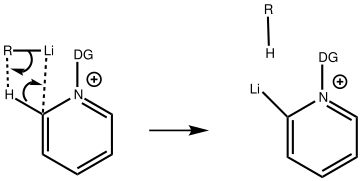
Functionalisation of a (hetero)aromatic ring by selectively (directedly) removing protons using the metal lithium is a relative mechanistic newcomer, compared to the pantheon of knowledge on aromatic electrophilic substitution. Investigating the mechanism using quantum calculations poses some interesting challenges, ones I have not previously discussed on this blog.

Li

My model will be the system above, based on the pyridine ring, and also carrying a directing group (R=Me, DG = O). The reagent used to remove the hydrogen and to substitute it (with a carbon-metal bond) is an alkyl lithium. The arrow pushing I have shown is speculative, since at this stage we have no idea if it really is such a pericyclic process. Indeed things are about to get complicated when we find out that the structure of the electron deficient lithium alkyls is much more complex than one might imagine.

Fortunately, crystal structures are available. Let me start with n-butyl lithium, a very commonly used reagent[1]. This forms a complex cluster of six lithiums, in which each metal is surrounded by three CH2 terminii of the n-butyl anion, and vice-versa, each  CH2 group is in contact with three lithium atoms (making the carbanionic carbon in effect hexa-coordinate).

SUHBEC. CLICK FOR 3D.

SUHBEC. CLICK FOR 3D.

Another frequently used lithium alkyl is the t-butyl derivative, which has a different tetrameric motif, again with each Me3C coordinated to three Li atoms (making this carbon again hexa-coordinate).

SUHBIG. Click for 3D.

SUHBIG. Click for 3D.

The interesting issue now is whether these metal alkyls react in these oligomeric forms or whether they are in equilibrium with a reduced monomeric form that constitutes the reactive species. With n-butyl lithium, it is possible to try to achieve this chemically by adding tetramethylethylenediamine. As you can see from the structure below, this strategy can be only partially successful; in this instance the  CH2  coordination is reduced from three Li atoms to two[2]. With t-butyl lithium, this strategy reduces the structure to a true monomer[3], the Me3C now being just 4-coordinate.

WAFJAO. Click for 3D.

WAFJAO. Click for 3D.

LOKTAH. Click for 3D.

LOKTAH. Click for 3D.

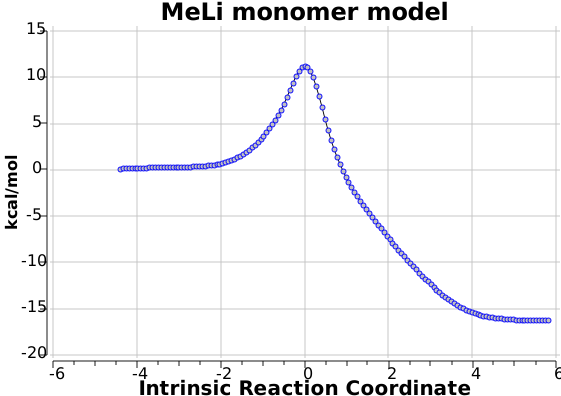
These systems are all pretty large to investigate using modelling, and so I will start the process by reducing the alkyl lithium model down to just a monomeric CH3Li molecule, placing it and pyridine-N-oxide into a continuum solvent cavity (ωB97XD/6-311G(d,p)/SCRF=benzene) and seeing what happens[4]. You can see it is both facile and a concerted process, corresponding pretty much to the arrow pushing illustrated at the top of this post.

Li1a  Li1a

But wait, where have we seen an aromatic substitution reaction which does exactly this in a single concerted step, first remove a proton and then replace it with an electrophile? This was in fact revealed in the IRC for electrophilic substitution of indole in the 1-position! Of course, there is a difference. With indole, we had pseudo-inversion at the nitrogen centre (a pseudo-Sn2 reaction if you will), whereas here it is pseudo-retention at the 2-carbon.

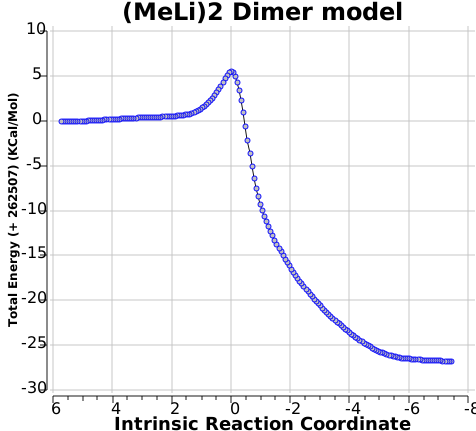
Is this model robust? Let us try a dimeric (MeLi)2 model coordinated to one pyridine-N-oxide. The IRC[5] is very similar, but the initial barrier to proton transfer is lower.

Li2 Li2

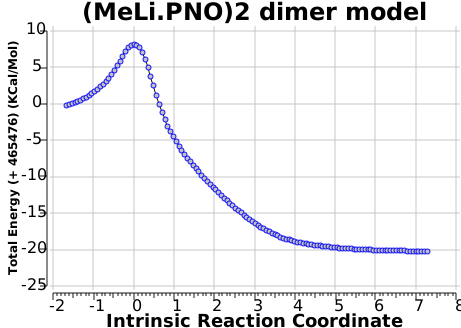
Next, we have a model in which two molecules of pyridine-N-oxide (PNO) aggregate around two molecules of MeLi. This model is starting to resemble the tetramethylethylenediamine partially de-aggregated n-butyl lithium structure shown as WAFJAO above. The basic features[6] of the process remain intact, including the small barrier.

Li2d Li2d

Finally, I go back to the simple model, but with the directing group (DG) removed to give just pyridine. The profile[7] is the same, but the barrier is much larger. So perhaps both aggregation and coordination to a directing group help accelerate the reaction?

Li0a Li0a

So two reaction types, not normally associated with each other, turn out to have some intriguing similarities and an interesting difference.

References

  1. T. Kottke, and D. Stalke, "Structures of Classical Reagents in Chemical Synthesis: (<i>n</i>BuLi)<sub>6</sub>, (<i>t</i>BuLi)<sub>4</sub>, and the Metastable (<i>t</i>BuLi · Et<sub>2</sub>O)<sub>2</sub>", Angewandte Chemie International Edition in English, vol. 32, pp. 580-582, 1993. https://doi.org/10.1002/anie.199305801
  2. M.A. Nichols, and P.G. Williard, "Solid-state structures of n-butyllithium-TMEDA, -THF, and -DME complexes", Journal of the American Chemical Society, vol. 115, pp. 1568-1572, 1993. https://doi.org/10.1021/ja00057a050
  3. V.H. Gessner, and C. Strohmann, "Lithiation of TMEDA and its Higher Homologous TEEDA: Understanding Observed α- and β-Deprotonation", Journal of the American Chemical Society, vol. 130, pp. 14412-14413, 2008. https://doi.org/10.1021/ja8058205
  4. H.S. Rzepa, "Gaussian Job Archive for C6H8LiNO", 2013. https://doi.org/10.6084/m9.figshare.651068
  5. H.S. Rzepa, "Gaussian Job Archive for C7H11Li2NO", figshare, 2013. https://doi.org/10.6084/m9.figshare.651764
  6. "C12H16Li2N2O2", 2013. http://doi.org/10042/24399
  7. H.S. Rzepa, "Gaussian Job Archive for C6H8LiN", 2013. https://doi.org/10.6084/m9.figshare.653672

Secrets of a university tutor: unravelling a mechanism using spectroscopy.

Thursday, January 31st, 2013

It is always rewarding when one comes across a problem in chemistry that can be solved using a continuous stream of rules and logical inferences from them. The example below[1] is one I have been using as a tutor in organic chemistry for a few years now, and I share it here. It takes around 50 minutes to unravel with students.

14

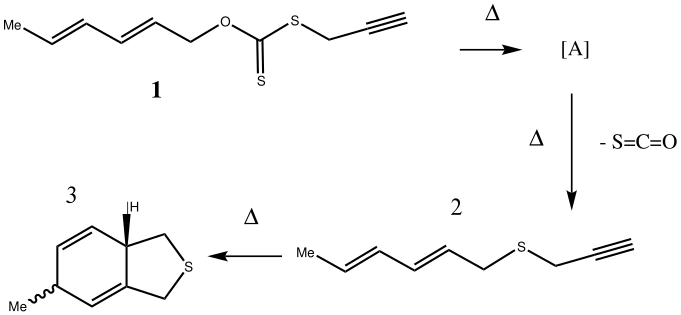
The narrative is that attempted preparation of 1 resulted instead in a mysterious compound [A], which when heated extruded S=C=O to give 2, and upon further heating gave 3. The challenge is to identify [A] with the help of the spectroscopic information provided, to infer the mechanism of its formation and further to suggest what the stereochemistry of the methyl group in 3 might be.

The 1H NMR of [A] is set out below for future reference: δ 1.70 (3H,d,6Hz), 2.23 (1H, t, 3Hz), 3.73 (2H, d, 3Hz), 4.84 (1H, dd, 7,8Hz), 5.15 (1H, d, 10Hz), 5.27 (1H, d, 17Hz), 5.51 (1H, dd, 8,16.5 Hz), 5.77 (1H, dq, 6,16.5 Hz), 5.88 (1H, ddd, 7,10,17Hz). 

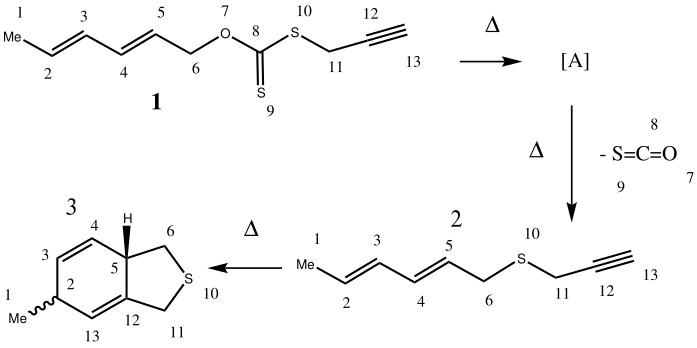
As usual, one has to start somewhere, and here the task is to number the atoms, and then try to “reaction map” them to the products.

14a

  1. The first real decision is how to map S9 or S10. Occam’s razor suggests that the sulfur in the SCO comes from S9 (this would allow C10-C11 to be left alone), but if that hypothesis is wrong, we can always return and try the alternative. Let us go with the simpler option first.
  2. Another relatively simple decision is to map C12-C13 as shown in 3, since this only changes its bond order by one (few mechanisms require a change in bond order of > 1 in any single mechanistic step). 

Analysis of the 1H NMR starts with the most obvious (marker) group, the methyl:

  1. The methyl is J-coupled to C2-H (6Hz), and hence this is assigned to 5.77 ppm.
  2. C2-H is J-coupled to C3-H (16.5 Hz) and hence this is assigned to 5.51 ppm
  3. C3-H is J-coupled to C4-H (8 Hz) and hence this is assigned to 4.84 ppm. 
  4. We now encounter a problem. C4-H has a chemical shift which suggests it is not attached to an sp2-C, but has become sp3-hybridized. But the relatively high chemical shift suggests that this carbon may be attached to electronegative substituents. C4 is flagged for attention below.
  5. C4-H is J-coupled via J 7 Hz to the peak at 5.88 ppm. The chemical shift is typical of sp2-C, and is assigned as C5-H.
  6. C5-H is J-coupled via two couplings of 10 and 17 Hz to peaks at 5.15 and 5.27 ppm. Both these are also sp2-C, which may be assigned as C6-H. As such it can only carry three attached atoms (two Hs and a C-C) and so the C6-O7 bond cannot be retained. C6 is flagged for attention below.
  7. The remaining peaks can be assigned as C11-H and C13-H from their mutual 4J coupling of 3Hz.

Armed with these inferences, a list of to-dos can now be assembled.

  1.  For the transform 1 → [A], break C6-O7
  2. Form a bond to C4 using if possible an electronegative atom.

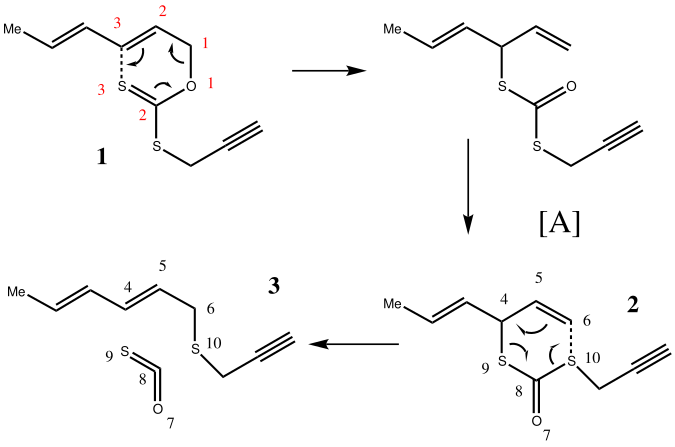
This pattern of break one σ-bond/form one σ-bond, reminds of a sigmatropic pericyclic reaction. A typical example is the Cope rearrangement, in which a bond forms between the termini of two double bonds separated by three σ-bonds. The penny drops when one re-draws the original compound by rotating about a single bond (a perfectly allowed operation):

14b

A [3,3] Cope is now exposed. The (re)-numbering in red shows the pattern described above, and completes the assignment of the bond forming above to C4 as C4-S9. The next step is to find out how to extrude S=C=O. 

  1. To get to 2, one needs to create the C6-S10 bond (it is  sp2-C in [A]). 
  2. The O8-S10 bond needs to break.
  3. The recently formed C4-S9 bond needs to break again, with the result of extruding the required S=C=O.

This pattern of forming and breaking bonds, but in unequal number reminds of the so-called ene class of pericyclic reaction. Both the Cope and now the ene are six-electron thermal pericyclic processes.

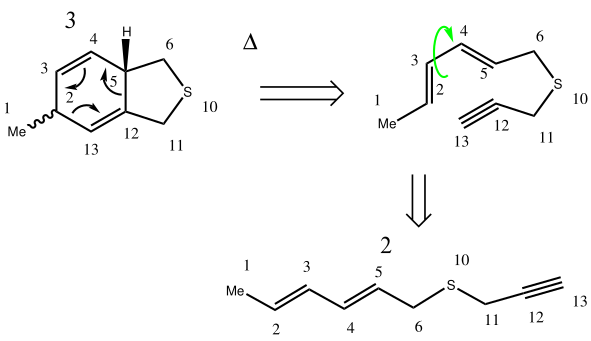
We can now turn our attention to the last reaction shown above. Since we have both structures now, we can do a retrosynthetic analysis, which reveals that in the final step, C2-C13 and C5-C12 have both got to form. Such a pattern is another six-electron pericyclic reaction, the Diels-Alder π2s + π4s cycloaddition. Again, we have to rotate about the C3-C4 single bond (green arrow) to get the diene of the reactant into a conformation capable of undertaking this reaction. We are helped in this by ensuring that the trans hydrogens at both C2-C3 and C4-C5 (which we inferred from the values of the J-couplings above) are not transformed during our redrawing of this conformation.

14c

The conclusion to this tutorial comes in assigning the stereochemistry of that methyl group. The π4s component of the cycloaddition mandates that the two bonds forming to C5 and to C2 must both form suprafacially across this four-carbon unit. We know that the bond to C5 must form on the bottom face, so as to rotate the C5-H up. Therefore it must form on the bottom face also of C2, likewise rotating the attached hydrogen up. Therefore the methyl must point  down in the final product.

QED.

But not quite, since nowadays, one can take the NMR analysis one step further. In another post, I will perform a full quantum mechanical prediction of the above NMR spectrum to see how well it matches what is reported above.

References

  1. K. Harano, M. Eto, K. Ono, K. Misaka, and T. Hisano, "Sequential pericyclic reactions of unsaturated xanthates. One-pot synthesis of hydrobenzo[c]thiophenes", Journal of the Chemical Society, Perkin Transactions 1, pp. 299, 1993. https://doi.org/10.1039/p19930000299