Posts Tagged ‘Niels Bohr’

Woodward’s symmetry considerations applied to electrocyclic reactions.

Monday, May 20th, 2013

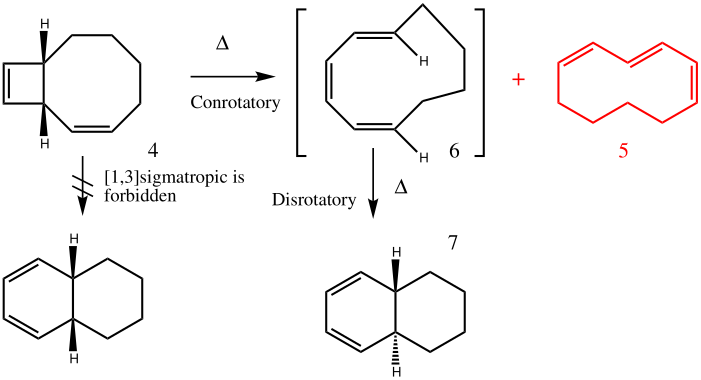
Sometimes the originators of seminal theories in chemistry write a personal and anecdotal account of their work. Niels Bohr[1] was one such and four decades later Robert Woodward wrote “The conservation of orbital symmetry” (Chem. Soc. Special Publications (Aromaticity), 1967, 21, 217-249; it is not online and so no doi can be given). Much interesting chemistry is described there, but (like Bohr in his article), Woodward lists no citations at the end, merely giving attributions by name. Thus the following chemistry (p 236 of this article) is attributed to a Professor Fonken, and goes as follows (excluding the structure in red):
wood

A search of the literature reveals only one published article describing this reaction[2] by Dauben and Haubrich, published some 21 years after Woodward’s description (we might surmise that Gerhard Fonken never published his own results). In fact this more recent study was primarily concerned with 193-nm photochemical transforms (they conclude that “the Woodward-Hoffmann rules of orbital symmetry are not followed”) but you also find that the thermal outcome of heating 4 is a 3:2 mixture of compounds 5 and 6, and that only 6 goes on to give the final product 7. It does look like a classic and uncomplicated example of Woodward-Hoffmann rules.

 So let us subject this system to the “reality check”. The transform of 4 → 5 rotates the two termini of the cleaving bond in a direction that produces the stereoisomer 5, with a trans alkene straddled by two cis-alkenes[3]. The two carbon atoms that define the termini of the newly formed hexatriene are ~ 4.7Å apart; too far to be able to close to form 7.

 4 → 5  4 → 6
8 8

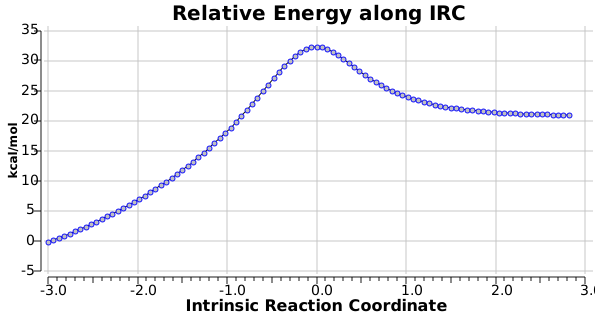
But with any electrocyclic reaction, two directions of rotation are always possible, and it is a rotation in the other direction that gives 4 → 6[4], ending up with a hexatriene with the trans-alkene at one end and not the middle (for which the free energy of activation is 3.1 kcal/mol higher in energy). Now the two termini of the hexatriene end up ~3.0Å apart, much more amenable to forming a bond between them to form 7.

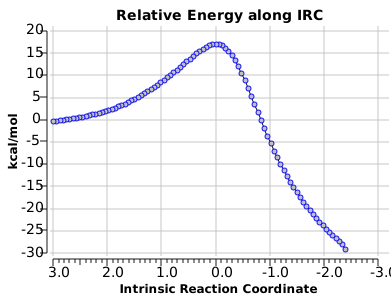
It is at this point that the apparently uncomplicated nature of this example starts to unravel. If one starts from the 3.0Å end-point of the above reaction coordinate and systematically contracts the bond between these two termini, a transition state is found leading not to 7 but to the (endothermic) isomer 8.[5]This form has a six-membered ring with a trans-alkene motif (which explains why it is so endothermic). 
wood1
6 ↠ 8
8 wood2

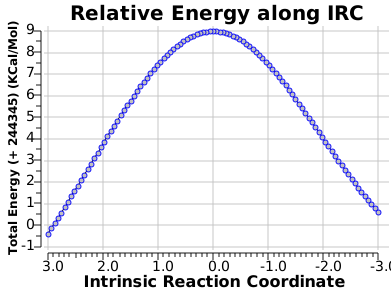
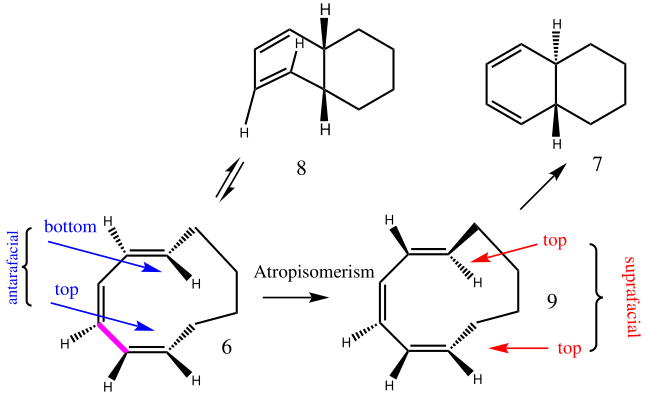
Before discussing the implications of this transition state, I illustrate another isomerism that 6 can undertake; a low-barrier atropisomerism[6] to form 9, followed by another reaction with a relatively low barrier, 9 ↠  7[7]to give the product that Woodward gives in his essay.

6 ↠ 9
6-atrop 6-atrop
9 ↠ 7
9to7a 9to7a

 We can now analyse the two transformations 6 ↠ 8 and 9 ↠  7. The first involves antarafacial bond formation (blue arrows) at the termini and an accompanying 180° twisting about the magenta bond which creates a second antarafacial component[8]. So this is a thermally allowed six-electron (4n+2) electrocyclisation with a double-Möbius twist[9]. The second reaction is a more conventional purely suprafacial version[10] (red arrows) of the type Woodward was certainly thinking of; it is 18.0 kcal/mol lower in free energy than the first (the transition state for 6 ↠ 9 is 10.8 kcal/mol lower than that for 9 ↠ 7).

I hope that this detailed exploration of what seems like a pretty simple example at first sight shows how applying a “reality-check” of computational quantum mechanics can cast (some unexpected?) new light on an old problem. We may of course speculate on how to inhibit the pathway 6 ↠ 9 ↠ 7 to allow only 6 ↠ 8 to proceed (the reverse barrier from 8 is quite low, so 8 would have to be trapped at very low temperatures). 

References

  1. N. Bohr, "Der Bau der Atome und die physikalischen und chemischen Eigenschaften der Elemente", Zeitschrift f�r Physik, vol. 9, pp. 1-67, 1922. https://doi.org/10.1007/bf01326955
  2. W.G. Dauben, and J.E. Haubrich, "The 193-nm photochemistry of some fused-ring cyclobutenes. Absence of orbital symmetry control", The Journal of Organic Chemistry, vol. 53, pp. 600-606, 1988. https://doi.org/10.1021/jo00238a023
  3. H.S. Rzepa, "Gaussian Job Archive for C10H14", 2013. https://doi.org/10.6084/m9.figshare.704833
  4. H.S. Rzepa, "Gaussian Job Archive for C10H14", 2013. https://doi.org/10.6084/m9.figshare.704834
  5. H.S. Rzepa, "Gaussian Job Archive for C10H14", 2013. https://doi.org/10.6084/m9.figshare.704755
  6. H.S. Rzepa, "Gaussian Job Archive for C10H14", 2013. https://doi.org/10.6084/m9.figshare.704754
  7. H.S. Rzepa, "Gaussian Job Archive for C10H14", 2013. https://doi.org/10.6084/m9.figshare.704844
  8. H.S. Rzepa, "Gaussian Job Archive for C10H14", 2013. https://doi.org/10.6084/m9.figshare.704841
  9. H.S. Rzepa, "Double-twist Möbius aromaticity in a 4n+ 2 electron electrocyclic reaction", Chemical Communications, pp. 5220, 2005. https://doi.org/10.1039/b510508k
  10. H.S. Rzepa, "Gaussian Job Archive for C10H14", 2013. https://doi.org/10.6084/m9.figshare.704995

Woodward's symmetry considerations applied to electrocyclic reactions.

Monday, May 20th, 2013

Sometimes the originators of seminal theories in chemistry write a personal and anecdotal account of their work. Niels Bohr[1] was one such and four decades later Robert Woodward wrote “The conservation of orbital symmetry” (Chem. Soc. Special Publications (Aromaticity), 1967, 21, 217-249; it is not online and so no doi can be given). Much interesting chemistry is described there, but (like Bohr in his article), Woodward lists no citations at the end, merely giving attributions by name. Thus the following chemistry (p 236 of this article) is attributed to a Professor Fonken, and goes as follows (excluding the structure in red):

wood

A search of the literature reveals only one published article describing this reaction[2] by Dauben and Haubrich, published some 21 years after Woodward’s description (we might surmise that Gerhard Fonken never published his own results). In fact this more recent study was primarily concerned with 193-nm photochemical transforms (they conclude that “the Woodward-Hoffmann rules of orbital symmetry are not followed”) but you also find that the thermal outcome of heating 4 is a 3:2 mixture of compounds 5 and 6, and that only 6 goes on to give the final product 7. It does look like a classic and uncomplicated example of Woodward-Hoffmann rules.

 So let us subject this system to the “reality check”. The transform of 4 → 5 rotates the two termini of the cleaving bond in a direction that produces the stereoisomer 5, with a trans alkene straddled by two cis-alkenes[3]. The two carbon atoms that define the termini of the newly formed hexatriene are ~ 4.7Å apart; too far to be able to close to form 7.

 4 → 5  4 → 6
8 8

But with any electrocyclic reaction, two directions of rotation are always possible, and it is a rotation in the other direction that gives 4 → 6[4], ending up with a hexatriene with the trans-alkene at one end and not the middle (for which the free energy of activation is 3.1 kcal/mol higher in energy). Now the two termini of the hexatriene end up ~3.0Å apart, much more amenable to forming a bond between them to form 7.

It is at this point that the apparently uncomplicated nature of this example starts to unravel. If one starts from the 3.0Å end-point of the above reaction coordinate and systematically contracts the bond between these two termini, a transition state is found leading not to 7 but to the (endothermic) isomer 8.[5]This form has a six-membered ring with a trans-alkene motif (which explains why it is so endothermic). 

wood1
6 ↠ 8
8 wood2

Before discussing the implications of this transition state, I illustrate another isomerism that 6 can undertake; a low-barrier atropisomerism[6] to form 9, followed by another reaction with a relatively low barrier, 9 ↠  7[7]to give the product that Woodward gives in his essay.

6 ↠ 9
6-atrop 6-atrop
9 ↠ 7
9to7a 9to7a

 We can now analyse the two transformations 6 ↠ 8 and 9 ↠  7. The first involves antarafacial bond formation (blue arrows) at the termini and an accompanying 180° twisting about the magenta bond which creates a second antarafacial component[8]. So this is a thermally allowed six-electron (4n+2) electrocyclisation with a double-Möbius twist[9]. The second reaction is a more conventional purely suprafacial version[10] (red arrows) of the type Woodward was certainly thinking of; it is 18.0 kcal/mol lower in free energy than the first (the transition state for 6 ↠ 9 is 10.8 kcal/mol lower than that for 9 ↠ 7).

I hope that this detailed exploration of what seems like a pretty simple example at first sight shows how applying a “reality-check” of computational quantum mechanics can cast (some unexpected?) new light on an old problem. We may of course speculate on how to inhibit the pathway 6 ↠ 9 ↠ 7 to allow only 6 ↠ 8 to proceed (the reverse barrier from 8 is quite low, so 8 would have to be trapped at very low temperatures). 

References

  1. N. Bohr, "Der Bau der Atome und die physikalischen und chemischen Eigenschaften der Elemente", Zeitschrift f�r Physik, vol. 9, pp. 1-67, 1922. https://doi.org/10.1007/bf01326955
  2. W.G. Dauben, and J.E. Haubrich, "The 193-nm photochemistry of some fused-ring cyclobutenes. Absence of orbital symmetry control", The Journal of Organic Chemistry, vol. 53, pp. 600-606, 1988. https://doi.org/10.1021/jo00238a023
  3. H.S. Rzepa, "Gaussian Job Archive for C10H14", 2013. https://doi.org/10.6084/m9.figshare.704833
  4. H.S. Rzepa, "Gaussian Job Archive for C10H14", 2013. https://doi.org/10.6084/m9.figshare.704834
  5. H.S. Rzepa, "Gaussian Job Archive for C10H14", 2013. https://doi.org/10.6084/m9.figshare.704755
  6. H.S. Rzepa, "Gaussian Job Archive for C10H14", 2013. https://doi.org/10.6084/m9.figshare.704754
  7. H.S. Rzepa, "Gaussian Job Archive for C10H14", 2013. https://doi.org/10.6084/m9.figshare.704844
  8. H.S. Rzepa, "Gaussian Job Archive for C10H14", 2013. https://doi.org/10.6084/m9.figshare.704841
  9. H.S. Rzepa, "Double-twist Möbius aromaticity in a 4n+ 2 electron electrocyclic reaction", Chemical Communications, pp. 5220, 2005. https://doi.org/10.1039/b510508k
  10. H.S. Rzepa, "Gaussian Job Archive for C10H14", 2013. https://doi.org/10.6084/m9.figshare.704995

Hafnium and Niels Bohr

Sunday, June 5th, 2011

In 1923, Coster and von Hevesey (DOI: 10.1038/111182a0) claimed discovery of the element Hafnium, atomic number 72 (latin Hafnia, meaning Copenhagen, where the authors worked) on the basis of six lines in its X-ray spectrum. The debate had long raged as to whether (undiscovered) element 72 belonged to the rare-earth group 3 of the periodic table below yttrium, or whether it should be placed in group 4 below zirconium. Establishing its chemical properties finally placed it in group 4. Why is this apparently arcane and obscure re-assignment historically significant? Because, in June 1922, in Göttingen, Niels Bohr had given a famous series of lectures now known as the Bohr Festspiele on the topic of his electron shell theory of the atom. Prior to giving these lectures he had submitted his collected thoughts in January 1922[1].

Like Mendeleev before, who had predicted ekasilicon, ekaaluminium and ekaboron (eventually discovered as germaniumgallium and scandium), Bohr had used his electron shell theory to (correctly) predict the properties of element 72. In modern terms, he had concluded that its electron shell structure must be 2.8.18.32.10.2 or [Xe].4f14.5d2.6s2. Classification as a rare earth would have resulted in the 4f shell having 15 electrons, impossible in Bohr’s theory. Coster and von Hevesey note in their article that Bohr’s striking prediction was now verified.

Why I am writing all of this? For various reasons:

  1. Unlike Mendeleev, Bohr’s prediction of the properties of a (then uncharacterized) element, whilst famous at the time, is nowadays largely forgotten by chemists. It is one of the great achievements of the then new quantum theory.
  2. Reading the 67 pages of Bohr’s article on the topic reveals no discussion of element 72 (articles of this era are nowadays only available as scanned images, not full text, and one must rely on a human visual scan of all 67 pages, which of course may not be reliable) but its (absence) in the table below is striking. Here VI means the 6th row of the periodic table.

    Niels Bohr’s Periodic table, 1922.

  3. Notice the only other missing elements, Technetium (43), Promethium (61), Astatine (85), Francium (87) and Rhenium (75, the only non-radioactive one remaining to be discovered),
  4. I must presume that Bohr introduced his discussion of element 72 into his June lectures to make an impact with his audience! One might have hoped that tracking down what happened between January 1922, when Bohr fails to make much of the missing element 72, and June in the same year would be possible from Coster and von Hevesey’s citation of Bohr in 1923. But it was the practice of the time to rarely cite one’s sources. Thus they give no published citation to Bohr, and one might conclude that they might instead be quoting Bohr from his lectures rather than his writings (who, I wonder, was poor old Bury, now forgotten!).

    Coster and Hevesey’s allusion to Bohr’s theory.

  5. Bohr’s own 1922 article on the topic is also visually striking. It contains in its 67 pages:
    1. 13 (short) equations
    2. Two figures (the second a variation on the first)
    3. One table (above).
    4. and lots of text (in German).
    5. No citations at the end, not even one, although many people are acknowledged in the text itself.
    6. No explicit statement of shell structures as e.g. 2.8.18.32.10.2 or [Xe].4f14.5d2.6s2.

    Given that Bohr’s article can be regarded as one of the most influential of the 20th century (even prior to its being placed on a firm theoretical footing by  solution of the Schroedinger equation for the hydrogen atom), I find it interesting how quickly it achieved this status (Bohr won the Nobel prize in 1922 as well). One might conclude that reputations were made as much via verbal presentations as by the immediate visual impact of the associated publications.

Finally, I note the striking contrast between Bohr’s article and Langmuir’s, written about a year earlier in 1921. Here, Langmuir sets out some postulates, the first of which is shown below.

Langmuir’s 1921 postulate.

The filled electron shells are clearly set out here (much more clearly than in Bohr’s 1922 article). But yet again, we remain baffled as to how Langmuir arrived at this postulate. Although he (very briefly) mentions Bohr in his own paper, it is only in the context of speculating about what prevents the electrons from falling into the nucleus, and few citations are again given (a notable exception is to Pease for suggesting the triple bond). We may only suspect that Langmuir had heard Bohr talking about his theory, and had extended G. N. Lewis’ concept (also not directly cited) of (filled) valence shells for his own theory of chemical bonding.

Well, in a little less than 90 years, we have progressed from finding almost no sources cited in some of the most influential papers of the 20th century, to the DOI (or URL) embedded in everything. I think that when the history of the present era is written, the introduction of the DOI/URL will take its place in the pantheon of great scientific events. Its the connections that matter, stupid!


Postscript. Hevesey in this review written in 1925 sets out a good history of Hafnium. This article contains (on p7) a clear statement of the electron shell structure of Hafnium as 2.8.18.32.8.2.2, which is cited as Bohr’s result. Hevesey quotes Bohr via reference 12, which is in fact to a book Bohr published in 1924. There is no mention of  Langmuir in Hevesey’s review.

Postscript1: Hafnium (as its oxide) is now an essential element to the ever smaller fabrication of silicon chips (32nm and smaller). It is one of 14 elements considered essential to the future green technologies (six of which, but not including  Hafnium, are considered in critical risk of supply disruption by 2015).

References

  1. N. Bohr, "Der Bau der Atome und die physikalischen und chemischen Eigenschaften der Elemente", Zeitschrift f�r Physik, vol. 9, pp. 1-67, 1922. https://doi.org/10.1007/bf01326955