Archive for the ‘General’ Category

An unusually small (doubly) aromatic molecule: C4.

Tuesday, March 15th, 2022

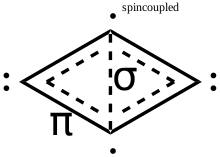
When you talk π-aromaticity, benzene is the first molecule that springs to mind. But there are smaller molecules that can carry this property; cyclopropenylidene (five atoms) is the smallest in terms of atom count I could think of until now, apart that is from H3+ which is the smallest possible molecule that carries σ-aromaticity. So here I have found what I think is an even smaller aromatic molecule containing only four carbon atoms. And it is not only π-aromatic but σ-aromatic.

Let me go through the analysis (using a CCSD(T)/Def2-TZVPPD calculation, DOI: 10.14469/hpc/10226).

  1. Four carbons contain 16 valence electrons for bonding.
  2. Eight of these are conventional, forming four C-C single bonds around the 4-ring.
  3. Eight are left over, and these partition into a set of six and a set of two.
  4. The set of two are in p-π atomic orbitals and form a 4n+2 (n=0) aromatic system
  5. The set of six are in σ-sp AOs and form a 4n+2 (n=1) aromatic system.
  6. The three σ-MOs all contribute to the central C-C bond, particularly σ3 and σ2 in different ways.
  7. σ2 also reminds of [1.1.1]-propellane, where the two σ-electrons are in effect external to the central C-C bond, but spin coupled to form what might be called a σ exo-bond. There is also similarity to the exo bond in C2.
  8. The dissociation energy of the central bond can be estimated at 28 kcal/mol from the triplet state energy.
Bonding MOs for C4.
Click image to load 3D model
π1
σ3 σ2
σ1

So this little molecule carries a lot of diversity in its chemical bonding; an ideal candidate perhaps for a tutorial in bonding theory of organic molecules?


The post has DOI: 10.14469/hpc/10252

First came Molnupiravir – now there is Paxlovid as a SARS-CoV-2 protease inhibitor. An NCI analysis of the ligand.

Saturday, November 13th, 2021

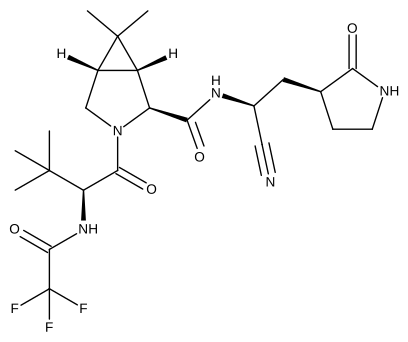
Earlier this year, Molnupiravir hit the headlines as a promising antiviral drug. This is now followed by Paxlovid, which is the first small molecule to be aimed by design at the SAR-CoV-2 protein and which is reported as reducing greatly the risk of hospitalization or death when given within three days of symptoms appearing in high risk patients.

The Wikipedia page (first created in 2021) will display a pretty good JSmol 3D model of this; the coordinates being generated automatically on the fly from a SMILES string, which specifies only what atoms are connected in the structure by bonds. Given that the structure of this molecule as embedded in the SARS-CoV-2 main protease[1] has been determined (and can be viewed here), I thought I might display those coordinates as an alternative to the Wikipedia/JSmol generated structure.

Click to get 3D model

I extracted the ligand from the PDF file and then added hydrogens manually to obtain the above result. There are two noteworthy points about these representations:

  1. A mystery concerns the nominal C≡N group on the top right, which displays an angle at the carbon of 117°. A cyano group is of course linear (180°). This is not a defect of the crystal structure determination, but an indication of a rather stronger interaction occurring (as indeed noted[1]). The distance between the carbon of the cyano group and an adjacent sulfur is 1.814Å, which indicates a covalent bond has formed to the cyano group. The nitrogen of the erstwhile cyano group is 3.013Å away from an adjacent NH group, which suggests it is stabilised by a hydrogen bond.
  2. Crystal structure searching of units with S…C…N in which the N has only one bond reveals zero hits, but searches of S…C…NH reveal nine hits, with S…C distances in the range 1.74 – 1.80Å and C…N distances in the region 1.25-1.27&Aring. The reported CN distance is 1.251&ARing, confirming that when bound to the protein, the cyano group is replaced by an S-C=NH group and hence is clearly an important component of the mode of action of Paxlovid.
  3. The conformation of Paxlovid is in one respect not fully represented by the Wikipedia diagram, as shown below. This implies the t-butyl group (on the left) as being well separated from the pyrrolidinone ring system at the right of the molecule.

    In fact the two groups are adjacent, being held in that conformation by probably a combination of weak dispersion forces and a contribution from the surrounding protein in the crystal structure. This is more graphically shown by the NCI (non-covalent-interaction) diagram below (DOI: 10.14469/hpc/9964), where the green areas in the region between the two groups (ringed in red) represent stabilising interactions between them. You might also spot other green/cyan regions indicating additional weak hydrogen bonds between C-H groups and oxygen!

PAXLOVID NCI analysis

There are only a small number of crystal structures of small molecules containing the S-C=NH motif. I will try to find out how common this is in protein-ligand structures.


There are many tools for performing this operation. I used the following procedure. I downloaded the PDB file (https://files.rcsb.org/download/7vh8.cif), opened it in CSD Mercury, selected the ligand (by identifying the CF3 group and clicking on one atom), inverted the selection so that everything but the ligand was then selected and using edit/structure, I deleted the selected atoms, leaving only the ligand.

Postsript

The cyanopyrrolidine group such as in Paxlovid is well known as a specific probe.[2],[3],[4] CovalentInDB is a comprehensive database facilitating the discovery of such covalent inhibitors[5] and is available here. There is also a program called DataWarrior that is potentially able to find such probes.

References

  1. Y. Zhao, C. Fang, Q. Zhang, R. Zhang, X. Zhao, Y. Duan, H. Wang, Y. Zhu, L. Feng, J. Zhao, M. Shao, X. Yang, L. Zhang, C. Peng, K. Yang, D. Ma, Z. Rao, and H. Yang, "Crystal structure of SARS-CoV-2 main protease in complex with protease inhibitor PF-07321332", Protein & Cell, vol. 13, pp. 689-693, 2021. https://doi.org/10.1007/s13238-021-00883-2
  2. N. Panyain, A. Godinat, A.R. Thawani, S. Lachiondo-Ortega, K. Mason, S. Elkhalifa, L.M. Smith, J.A. Harrigan, and E.W. Tate, "Activity-based protein profiling reveals deubiquitinase and aldehyde dehydrogenase targets of a cyanopyrrolidine probe", RSC Medicinal Chemistry, vol. 12, pp. 1935-1943, 2021. https://doi.org/10.1039/d1md00218j
  3. N. Panyain, A. Godinat, T. Lanyon-Hogg, S. Lachiondo-Ortega, E.J. Will, C. Soudy, M. Mondal, K. Mason, S. Elkhalifa, L.M. Smith, J.A. Harrigan, and E.W. Tate, "Discovery of a Potent and Selective Covalent Inhibitor and Activity-Based Probe for the Deubiquitylating Enzyme UCHL1, with Antifibrotic Activity", Journal of the American Chemical Society, vol. 142, pp. 12020-12026, 2020. https://doi.org/10.1021/jacs.0c04527
  4. C. Bashore, P. Jaishankar, N.J. Skelton, J. Fuhrmann, B.R. Hearn, P.S. Liu, A.R. Renslo, and E.C. Dueber, "Cyanopyrrolidine Inhibitors of Ubiquitin Specific Protease 7 Mediate Desulfhydration of the Active-Site Cysteine", ACS Chemical Biology, vol. 15, pp. 1392-1400, 2020. https://doi.org/10.1021/acschembio.0c00031
  5. H. Du, J. Gao, G. Weng, J. Ding, X. Chai, J. Pang, Y. Kang, D. Li, D. Cao, and T. Hou, "CovalentInDB: a comprehensive database facilitating the discovery of covalent inhibitors", Nucleic Acids Research, vol. 49, pp. D1122-D1129, 2020. https://doi.org/10.1093/nar/gkaa876

The chemistry of scents: Vetifer oil.

Sunday, February 28th, 2021

I have occasionally covered the topic of colours here, such as those of flowers and minerals, since it is at least possible to illustrate these using photographs or colour charts to illustrate the theme. But when Derek Lowe took a break from his remarkable coverage of the COVID pandemic to highlight a recent article on the active smelling principle in Vetifer oil[1] I could not resist adding a tiny amount to his must-read story.

It would be great to illustrate this with an example of the scent, but digital scent technology has not yet taken off to the point of delivering these to the home.‡  So we will have to make do with a 3D model of the most active ingredient in Vetifer oil, which is species 10 in the scheme below[1]

But first a bit of history. I wrote about one of my chemical heroes William Perkin, whose factory first produced synthetic dyes in quantities that reduced the cost of colourful fabrics to the point of affordability by most people. Less well known is that when he retired from running his factory, he devoted much of the rest of his life to experimenting in his home laboratory, where he discovered a simple and cheap synthesis of coumarin. This substance is an essential component of the so-called fougère genre of perfume and as with his discovery of synthetic dyes, the introduction of synthetic coumarin was to revolutionise the scent industry (although in this case, for other reasons, synthetic components did not reduce the price of perfumes as much as they did that of colourful clothes).

If you read Derek’s blog on the topic and peruse the diagram above, you will appreciate that Vetifer grass is the source of many essential oils and forms the basis of more than ⅓ of all fragrances. So, like Perkin, to have a synthesis of the most odiferous component, species 10 above, is a major breakthrough and one can only wonder whether new entirely synthetic variants might produce entirely new perfumes! As with flowers, changing a methyl group here or a stereochemistry there can have profound effects on the resulting properties!

2-epi-ziza-6(13)-en-3-one. Click for 3D model

The absolute configuration of 10 is not in doubt in any way, but it was done indirectly via another compound. As as an additional check (and because it is very quick to do) I add here the calculated optical rotation (at 589nm; a ωB97XD/Def2-TZVPP/SCRF=chloroform calculation) as being +106°. The measured value is +132° which is considered reasonably good agreement and certainly confirms the absolute configuration. For good measure, the calculated 13C spectrum (mpw1pw91/aug-cc-pVDZ/SCRF=choroform calculation) also matches that reported (For FAIR data of this analysis, see 10.14469/hpc/7965).

So as I noted, its a shame that the scent of 10 cannot be delivered here. But perhaps there would be health and safety issues if that were to be possible!


Around 1993 I was interested in how information about digital scents might be delivered to computers using the Media (or MIME) standard and went as far as informally proposing it be added to the seven existing primary Media types. Rather too tongue-in-cheek I fear, and as far as I know, no olefactory media type has been added to this day! However, an article relating to all of this has recently appeared.[2] The John Bright collection illustrates the colourful aspects of clothes over the ages. Colours were not absent during e.g. the Victorian era as the collection shows, but one may presume that they were also not affordable by most of the population. In the same manner that in earlier times, eg Tyrian Purple was available only to Roman Emperors and other elites.

References

  1. J. Ouyang, H. Bae, S. Jordi, Q.M. Dao, S. Dossenbach, S. Dehn, J.B. Lingnau, C. Kanta De, P. Kraft, and B. List, "The Smelling Principle of Vetiver Oil, Unveiled by Chemical Synthesis", Angewandte Chemie International Edition, vol. 60, pp. 5666-5672, 2021. https://doi.org/10.1002/anie.202014609
  2. A.B. Wiltschko, "Building an interdisciplinary team set on bringing the sense of smell to computers", iScience, vol. 24, pp. 102136, 2021. https://doi.org/10.1016/j.isci.2021.102136

Question for the day – Einstein, special relativity and atomic weights.

Saturday, July 25th, 2020

Sometimes a (scientific) thought just pops into one’s mind. Most are probably best not shared with anyone, but since its the summer silly season, I thought I might with this one.

Famously, according to Einstein, m  = E/c^^2, the equivalence of energy to mass. Consider a typical exoenergic chemical reaction:

 A → B, ΔG -100 kJ/mol.  

According to the above, the molecule looses 100 kJ ≡ 1.112650056053618e-18 g after transformation from A to  B. Not much, but possibly measurable using today’s very best technology.

Now for the questions that might arise.

  1. What sort of energy applies above?  If its a free energy, then thermal (zero point and entropic vibrational) energy must clearly contribute. Or is it total energy without thermal and entropic contributions? 
  2. Is the mass loss distributed equally amongst all the atoms. In other words, how much mass does any particular atom lose after reaction or is this question meaningless?
  3. Since clearly the atoms must each lose some mass, that must mean that their atomic weight is a function of the energy content of the molecule they are part of.  A molecule with a lot of internal energy (lets say octanitrocubane, which decomposes to carbon dioxide and nitrogen) must have heavier atoms in the form of cubane than as nitrogen gas.
  4. And to recapitulate the question above, how many orders of magnitude away (if any) might we be from being able to measure this? Or, one can repose this question by asking whether one can measure the mass lost by a battery after discharging?

As with most spontaneous questions, the answers are probably all out there somewhere. Just a matter of finding them!


Here is a real-world example. At the large hadron collider at CERN, about 1011 protons are accelerated to almost the speed of light. During this process, they acquire a mass approaching kgs (I do not recollect the exact value). It certainly is a surprisingly large mass! And it is a surprisingly large amount of energy that has to be injected to achieve this. And when the beam is quenched, that mass is very quickly lost (and a lot of heat is generated in the quenching tunnel).

Silicon drug analogues.

Sunday, January 14th, 2018

I don’t normally write about the pharmaceutical industry, but I was intrigued by several posts by Derek Lowe (who does cover this area) on the topic of creating new drugs by deuterating existing ones. Thus he covered the first deuterated drug receiving FDA approval last year, having first reviewed the concept back in 2009. So when someone introduced me to sila-haloperidol, I checked to see if Derek had written about it. Apparently not, so here are a few details.

The idea appears to take a well-known drug, in this case haloperidol and selectively replacing a carbon atom with a silicon atom to form silahaloperidol.[1] The compound was actually reported in 2004 (see data citation 10.5517/cc7yhc0) but its drug-like properties were only reported four years later in 2008. Haloperidol itself has some undesirable side-effects, including those due to the metabolic products of the drug and so there are certainly reasons for trying to reduce these. Here are the main conclusions:

  1. The sila drug shows a significantly higher affinity for hD2 receptors (Table 1).
  2. Silahaloperidol exhibits higher subtype selectivity at dopamine and σ receptors
  3. The substitution by silicon has little effect on physico-chemical profiles
  4. The in-vivo half-life of the sila analogue was 3.6 times shorter (~18 minutes).
  5. An almost three-fold inhibitory effect against CYP3A4 was noted.
  6. The sila-drug displayed “a completely altered metabolic fate while otherwise maintaining a similar pharmacokinetic profile”.

These do seem to add up to a promising route for optimising drug activities. The authors themselves note the “great potential” for drug design. A review in 2017[2] concurs. So along with deuterated drugs, perhaps siladrugs are ones to watch in the future!

References

  1. R. Tacke, F. Popp, B. Müller, B. Theis, C. Burschka, A. Hamacher, M. Kassack, D. Schepmann, B. Wünsch, U. Jurva, and E. Wellner, "Sila‐Haloperidol, a Silicon Analogue of the Dopamine (D <sub>2</sub> ) Receptor Antagonist Haloperidol: Synthesis, Pharmacological Properties, and Metabolic Fate", ChemMedChem, vol. 3, pp. 152-164, 2008. https://doi.org/10.1002/cmdc.200700205
  2. R. Ramesh, and D.S. Reddy, "Quest for Novel Chemical Entities through Incorporation of Silicon in Drug Scaffolds", Journal of Medicinal Chemistry, vol. 61, pp. 3779-3798, 2017. https://doi.org/10.1021/acs.jmedchem.7b00718

Two stories about Open Peer Review (OPR), the next stage in Open Access (OA).

Thursday, October 5th, 2017

We have heard a lot about OA or Open Access (of journal articles) in the last five years, often in association with the APC (Article Processing Charge) model of funding such OA availability. Rather less discussed is how the model of the peer review of these articles might also evolve into an Open environment. Here I muse about two experiences I had recently.

Organising the peer review of journal articles is often now seen as the single most important activity a journal publisher can undertake on behalf of the scientific community; the very reputation of the journal depends on this process being conducted responsibly, thoroughly and with integrity by the selected reviewers. Reviewers conduct this process voluntarily, mostly anonymously, without remuneration or recognition and often with short deadlines for completion. After one such process, I recently received an interesting follow-up email from the journal, suggesting I register my activity with Publons.com, a site set up to register and give non-anonymous credit for reviewing activities. I should say that Publons is a commercial company, set up in 2012 to to “address the static state of peer-reviewing practices in scholarly communication, with a view to encourage collaboration and speed up scientific development”. Worthy aims, but like many a .com company nowadays, one might ask what the back-story might be. Thus many of the Internet giants, Google, Facebook, Twitter etc, do have back-stories, which often underpin their business models, but which may only emerge years after their founding. With only a hazy idea of what Publons’ back-story might be, I went ahead and registered my reviewing activity.

After doing so, I then accessed my entry. You only learn that I have reviewed for a particular journal, but nothing about the actual process itself. I did not really think that this experiment had done much to encourage collaboration and speed up scientific development. It might be useful for early career researchers to get their name exposed however.

I can almost understand why the review itself might not be publicly displayed, but as a result you learn nothing about the factual basis of the review and whether it might have been conducted responsibly, thoroughly and with integrity. Instead, I now suspect that the presence of my name on this site might merely encourage other publishers to deluge me with requests for further (freely donated) refereeing.

Discussing this at lunch, a colleague (thanks Ed!) reminded me of a veritable journal called Organic Syntheses. Here, authors submit a synthetic procedure and open identified “checkers” are invited to repeat the procedure and comment on it. The two roles are kept separate (i.e. the checkers do not become co-authors), but they could get credit for their activity. Thus if you view a typical recent entry[1] you will see a full biography and affiliation of the checkers given at the end, with footnotes often describing their own observations if they differ from those of the authors. 

This set me thinking whether an open peer review process might also contain such an element of checking, as well as informed comment, nay opinion, about the article itself and the conclusions it makes. The opportunity arose when I was contacted by an author who was about to submit a computational article to a journal. This journal allowed open peer review. If I agreed to review, my name would be attached to the article if accepted for publication. I undertook this on the basis that I would use this review to conduct some limited checking of the computations and other assumptions underpinning the conclusions in the submitted article. I also wanted this open process to include the data on which my review was based. Most importantly if anyone wished to replicate my replication, the barriers to doing so should be as low as is possible. Shortly thereafter, I received a formal invitation from the journal and I set about my task. Crucially, all my own calculations supporting the review were archived in a data repository, albeit under embargo. In my cover letter I included the DOI for my data and the embargo access code, so that the authors (and the editor of the journal if they so wished) could inspect the data against which I wrote my review.

Then followed standard procedures, whereby the authors took my comments into consideration, revised the article and the final version was indeed accepted and published.[2] You will find the two referees/checkers listed, although unlike Organic Syntheses,  there is no bibliographic information about them or their affiliation. I did ask the journal if they could at least link my ORCID identifier to my name, but that request was refused. If my name had been a common one, then disambiguating it into a unique identity could be a challenge. There was also no mechanism to associate my identity on the journal with any data on which I had based my review. Really, the only open aspect of this process was just my (potentially ambiguous) name, nothing else. No follow-up was received from the journal to add the review to Publons. 

The next stage was to contact the author who had originally set the process under way to ask them if they would mind my releasing the data on which my review had been based. They agreed, as also they did to my telling this story. The overall outcome is thus a published article with the reviewers (if not their reviews or any supporting evidence for their review) openly named. In this specific case, there is also an open dataset with a formal link back to the article in the form of a DOI (10.14469/hpc/2640, although I suspect this aspect is unique, even precedent setting), but one driven by the reviewer and not the journal. It would be nice to have bidirectional links between both article and the review data, but I do not know any publishers currently operating such a mechanism (if anyone knows such, please tell).

Now to the broader questions about the process described above. I think that the aspiration to encourage collaboration and speed up scientific development may indeed have been promoted by this association between article and the data assembled by the reviewer. Whether the final article was improved as a result of the processes described here I will leave the authors to comment if they wish. As with the checkers employed by Organic Syntheses, such a review process takes not just time, but resources. Resources that currently have to be freely donated by the reviewers and their host institution and which clearly cannot become expensive, time-consuming or onerous. That was not the case as it happens here; my contributions were facilitated by my having sufficient expertise to perform the tasks I undertook really quite quickly.

I will raise one more issue; that of whether to add my review to the dataset which is now openly available. In fact it is not included, in part because it related to the initially submitted version of the MS. The final MS version has been revised and so many of the comments in my review may only make sense if you have the first version to hand. It would be perhaps unreasonable to make the first drafts of manuscripts routinely available (although historians of science would probably love that!) alongside the reviews of that first draft. But I could also see a case for doing so if the community agreed to it. One to discuss for the future I think. There is also the associated issue of what should happen to any dataset associated with a review in the event that the final article is rejected and not accepted. Should the data remain permanently under embargo and the reviewer’s identity permanently anonymous? Perhaps opening up even such datasets might nevertheless  encourage collaboration and speed up scientific development, but I fancy some would consider that a step too far!

References

  1. J. Zhu, "Preparation of N-Trifluoromethylthiosaccharin: A Shelf-Stable Electrophilic Reagent for Trifluoromethylthiolation", Organic Syntheses, vol. 94, pp. 217-233, 2017. https://doi.org/10.15227/orgsyn.094.0217
  2. L. Li, M. Lei, Y. Xie, H.F. Schaefer, B. Chen, and R. Hoffmann, "Stabilizing a different cyclooctatetraene stereoisomer", Proceedings of the National Academy of Sciences, vol. 114, pp. 9803-9808, 2017. https://doi.org/10.1073/pnas.1709586114
Wild flowers in West London.

Monday, July 24th, 2017

Bees are having a tough time around the world. Oddly, they are surviving very well in cities. One reason are the wild flower meadows in London and for some summer relief I thought I would tell you the story of the one shown below.

We live in west London, in an area that was farmland as recently as the 1930s and used to produce vegetables and milk for the population of London. When the London underground (the “tube”) was extended into this rural west, housing sprung up around the central and metropolitan lines (Metroland). In our case, the large meadows adjacent to the new housing were left undeveloped due to their propensity to become waterlogged and flooded from the nearby river Brent. Flood prevention schemes have now made such flooding largely a thing of the past and part of the meadows have been turned into a golf course. But the area that you see above is largely left to nature and in the normal course of events the grasses grow copiously and cause the local population to suffer mightily from hay fever between June-August.

Not this year, when a tractor from the local council (Ealing) turned up in March and ploughed the grassy area up! For two months it lay fallow because there was almost no rain in May or June, but after several decent showers the area started to bloom and we all realized that the tractor must also have sown wild flower seeds. Its been a riot of colour for more than a month now and looks likely to continue for a little while yet. The bees love it (it’s not been such a good year for butterflies however). So do the human residents; you can see our house in the background! On a number of occasions now, contemplating the start of a new day, I have wandered out into the meadow, frankly with all thoughts of writing a blog abandoned. Except this one, since I did feel like sharing our pleasure. I cannot share the scent of the flowers however, which is also pretty heady. I should perhaps also mention that rather to the left of the photo above is the river Brent and along its route grows wild mustard in spring and many a bramble bearing luscious fruits in July. Foraging for these is another delight! 

Update on  4th August, 2017. Perivale Park, UB6 9BG

Update on  20th August, 2017. Perivale Park, UB6 9BG

Update on  6th September, 2017. Perivale Park, UB6 9BG

Update on  17th August, 2017. Cayton Green Park. UB6 8BJ.

Update on  11th August, 2017. King George’s Playing Fields, UB1 2QA

Update on  11th August, 2017. Jubilee Park, UB1 2TJ

Open science and the chemistry lab of the future.

Thursday, February 9th, 2017

The title refers to an upcoming symposium on the topic on 22-24 May, 2017.  I quote here some of the issues tabled for discussion:

  • Which data do we want to save, how and why and how long?
  • What really needs to be reproducible?
  • Are current reporting standards being used sufficiently?
  • Are the current procedures for depositing data too onerous for scientists?
  • Will technology, through increasing automation, fix most of the problems?
  • Is bureaucracy killing creativity in science?
  • Have we got a reproducibility crisis?
  • If we save and share data routinely, what is the future of the publication?
  • Are funding agencies causing science to be too short term in their quest for value for money?
  • Are chemists repeating too many experiments?
  • What can chemistry learn from other areas and what can they learn from chemistry?

For more information, visit www.beilstein-institut.de/en/symposia/open-science. If you have your own questions,  or indeed comments at this stage, do append them as a comment.  I don’t know what “social media” will be used to allow people to participate (science by Twitter feed?) and whether recordings will be made, but after the event I will update here with any further interesting news.

OpenCon (2016)

Friday, November 25th, 2016

Another conference, a Cambridge satellite meeting of OpenCon, and I quote here its mission: “OpenCon is a platform for the next generation to learn about Open Access, Open Education, and Open Data, develop critical skills, and catalyze action toward a more open system of research and education” targeted at students and early career academic professionals. But they do allow a few “late career” professionals to attend as well!

I could only attend the morning session, for which the keynote speaker was Erin McKiernanorcid The presentation was entitled How open science helps researchers succeedpresented as an exploration of an article written by Erin and colleagues with the same name and published in eLife[1] Erin has created a support page at http://whyopenresearch.org to augment the presentation and it’s well worth a visit.

One striking point made was the assertion that Open publications get more citations! 
Open publications get more citations

As with many metrics of the impacts of the science publication processes, a citation itself lacks the context of why it was made (see this post for further discussion), but the expectation is that a citation is “good”. From my perspective as a chemist, I did wonder why molecular science was missing from the graphic above. Do open chemistry publications also get more citations?

Which brings me to another point made during the talk, the increasingly controversial aspect of (journal) impact factors and the pressure placed on early career researchers to publish only in those with “high” impact factors, and for their careers to be assessed at least in part based on these and the anticipated “h-index”. The audience was indeed encouraged to go visit http://www.ascb.org/Dora/ (Declaration on Research Assessment, or Putting science into the assessment of research). Have you signed it yet?

Another manifestation of the modern trend to analyse impact metrics is the site Impactstory.org. This is a scripted resource that starts from your ORCID identifier and (optionally) your Twitter account (yes, apparently Tweets matter!) to derive a more complex alternative metric of a individual’s impacts. I had not tried this one before and so I submitted my ORCID and my Twitter account, and watched as the system went off to http://orcid.scopusfeedback.com (Scopus is an Elsevier product) to attempt to create my profile. It ground for quite a while, reporting initially that I had no publications! This was followed by an unexpected error; I did not get my impact back! But this experiment served to highlight one aspect that was discussed at the meeting; data and other research objects. The graphic above refers only to the citation of journal articles, it does not yet include the citation of data. However ORCID DOES include data and research objects as works.  And because the granularity of my data and research objects is very fine (one molecule = one work), I have quite a few. In fact ~200,000! ORCID gets to about 8000 before it gives up. I suspect http://orcid.scopusfeedback.com queries ORCID, gets back ~8000 entries and crashes. No doubt the programmer tasked with implementing this resource did not anticipate that any individual could accumulate 8000+ entries! Or probably factor in that the vast majority of these would of course not be journal articles but data. If the site gets back to me about the crash I experienced, I will update here.

Simon Deakin was the next speaker with (open) data as the focus and the worries many researchers have in being scooped by others who have re-used your open data without proper attributions. The discussion teased out that if data is properly deposited, it will indeed have full associated metadata and in particular a date stamp that could help protect an author’s interests.

It was really good to meet so many early career researchers who espouse the open ethos. Perhaps, in 20 years time,  another graphic akin to the one above might demonstrate that open researchers get more promotions!

References

  1. E.C. McKiernan, P.E. Bourne, C.T. Brown, S. Buck, A. Kenall, J. Lin, D. McDougall, B.A. Nosek, K. Ram, C.K. Soderberg, J.R. Spies, K. Thaney, A. Updegrove, K.H. Woo, and T. Yarkoni, "How open science helps researchers succeed", eLife, vol. 5, 2016. https://doi.org/10.7554/elife.16800

What’s in a name? Carbenes: a reality check.

Sunday, September 11th, 2016

To quote from Wikipedia: in chemistry, a carbene is a molecule containing a neutral carbon atom with a valence of two and two unshared valence electrons. The most ubiquitous type of carbene of recent times is the one shown below as 1, often referred to as a resonance stabilised or persistent carbene. This type is of interest because of its ability to act as a ligand to an astonishingly wide variety of metals, with many of the resulting complexes being important catalysts. The Wiki page on persistent carbenes shows them throughout in form 1 below, thus reinforcing the belief that they have a valence of two and by implication six (2×2 shared + 2 unshared) electrons in the valence shell of carbon. Here I consider whether this name is really appropriate.

carbenes

Let us start by counting the electrons in the 2p atomic orbitals on the ring atoms of 1, forming what we call a π-system. There are six; two from the carbons shown connected by a double bond, C=C and a further four from the two nitrogen lone pairs. Now in benzene, we also have six π-electrons in a ring and this molecule is of course famously aromatic due to the diatropic ring current created by the circulation of these six electrons. Moreover, all the C-C bonds are equal in length, ~1.4Å long (although the reasons for this equality are subtle).

So does 1 behave similarly? A ωB97XD/Def2-TZVPP calculation[1] shows the following calculated structure, in which all the bonds are clearly intermediate between single and double. The N-C(“carbene”) length of 1.357Å in particular is much shorter than a C-N single bond (~1.44AÅ), which tends to suggest that the resonance form 2 is a better representation than 1. This form is also pretty similar to pyrrole, itself a well-known hetero-aromatic species.nhc1

An alternative reality check is crystal structures. There are 42 examples (no errors, no disorder, R < 0.05) in the Cambridge structure database (CSD) and the distribution of C-N bond lengths below is indeed quite similar to the calculation shown above for the unsubstituted parent, with the lhs “hot-spot” almost exactly coincident. The C-C length similarly corresponds.

nhc2

nhc3

Let us try a technique for explicitly counting electrons, the ELF (electron localisation method), which works directly on a function of the electron density to identify the centroids of localized “basins” containing the integrated density. The three surrounding the “carbene” atom sum to 7.54e (with small seepage also into the carbon 1s core; 2.08e). A “normal” carbon on the C=C bond is 7.65e. The localization below turns out to closely resemble resonance structure 2 above.

nhc4

Further in-silico experiments can be carried out with species 3 and 4, in which a carbon atom replaces each of the nitrogens. This reduces the total electron count by two and now this poor molecule has a difficult choice to make. Should it be the π-system that sacrifices these two electrons, or could it be the σ-lone-pair found on the two-coordinate carbon? We will let the quantum mechanical solution decide[2] (with a constraint that the molecule be planar). The electrons arrange themselves to resemble the resonance form 4, choosing to retain the six π-electrons and sacrifice the carbene “unshared pair”. The 2-coordinate carbon as a vinyl cation now does have ~6 valence electrons (ELF indicates 5.23e). nhc5

What about the other choice? By promoting two electrons from HOMO to LUMO one can also calculate 3 (again constrained to planarity)[3] which finally does correspond to the classical description of a carbene.

nhc6

The arrow connecting 3 and 4 in the scheme at the top is NOT in this case an electronic resonance, but a a real equilibrium between two different species separated by an energy barrier. With only four π-electrons in a cycle it is also antiaromatic, and so the two localised alkene bonds avoid any conjugation with each other. This form has a free energy some 5.7 kcal/ml higher than the aromatic form. In fact, the molecule is very keen to avoid all antiaromaticity and hence if the planar constraint is lifted, it will distort with no activation to a non-planar diene (just as cyclo-octatetraene does to a non-planar tetra-ene). And to complete the tale, even though 4 is aromatic, it too distorts without activation to an odd-looking non-planar form with no symmetry[4],[5],[6] (but that is another story).

The final word should be that the naming of these types of persistent carbene does need a reality check; they should not be called this at all! They are really dipolar species or carbon-ylides as shown in 2. As it happens, a very closely related species in which one sulfur replaces one nitrogen is a very familiar compound, vitamin B1 or thiamine. The only example of a stable deprotonated thiamine derivative is referred to as a carbene[7], perhaps because with an acid catalyst it can dimerise in the manner expected of a real carbene. Significantly however, without acid catalyst this does not happen; a true carbene would not require such a catalyst.

References

  1. H. Rzepa, "NHC wfn", 2016. https://doi.org/10.14469/hpc/1473
  2. H. Rzepa, "butadiene carbene aromatic -192.700746", 2016. https://doi.org/10.14469/hpc/1581
  3. H. Rzepa, "butadiene carbene antiaromatic guess=alter -192.691607", 2016. https://doi.org/10.14469/hpc/1582
  4. H. Rzepa, "C5H4 non-planar, Cs symmetry", 2016. https://doi.org/10.14469/hpc/1583
  5. H. Rzepa, "C5H4 non-planar, C2 symmetry", 2016. https://doi.org/10.14469/hpc/1584
  6. H. Rzepa, "C5H4 non-planar, no symmetry", 2016. https://doi.org/10.14469/hpc/1585
  7. A.J. Arduengo, J.R. Goerlich, and W.J. Marshall, "A Stable Thiazol‐2‐ylidene and Its Dimer", Liebigs Annalen, vol. 1997, pp. 365-374, 1997. https://doi.org/10.1002/jlac.199719970213