Posts Tagged ‘City: Cambridge’

OpenCon (2016)

Friday, November 25th, 2016

Another conference, a Cambridge satellite meeting of OpenCon, and I quote here its mission: “OpenCon is a platform for the next generation to learn about Open Access, Open Education, and Open Data, develop critical skills, and catalyze action toward a more open system of research and education” targeted at students and early career academic professionals. But they do allow a few “late career” professionals to attend as well!

I could only attend the morning session, for which the keynote speaker was Erin McKiernanorcid The presentation was entitled How open science helps researchers succeedpresented as an exploration of an article written by Erin and colleagues with the same name and published in eLife[1] Erin has created a support page at http://whyopenresearch.org to augment the presentation and it’s well worth a visit.

One striking point made was the assertion that Open publications get more citations! 
Open publications get more citations

As with many metrics of the impacts of the science publication processes, a citation itself lacks the context of why it was made (see this post for further discussion), but the expectation is that a citation is “good”. From my perspective as a chemist, I did wonder why molecular science was missing from the graphic above. Do open chemistry publications also get more citations?

Which brings me to another point made during the talk, the increasingly controversial aspect of (journal) impact factors and the pressure placed on early career researchers to publish only in those with “high” impact factors, and for their careers to be assessed at least in part based on these and the anticipated “h-index”. The audience was indeed encouraged to go visit http://www.ascb.org/Dora/ (Declaration on Research Assessment, or Putting science into the assessment of research). Have you signed it yet?

Another manifestation of the modern trend to analyse impact metrics is the site Impactstory.org. This is a scripted resource that starts from your ORCID identifier and (optionally) your Twitter account (yes, apparently Tweets matter!) to derive a more complex alternative metric of a individual’s impacts. I had not tried this one before and so I submitted my ORCID and my Twitter account, and watched as the system went off to http://orcid.scopusfeedback.com (Scopus is an Elsevier product) to attempt to create my profile. It ground for quite a while, reporting initially that I had no publications! This was followed by an unexpected error; I did not get my impact back! But this experiment served to highlight one aspect that was discussed at the meeting; data and other research objects. The graphic above refers only to the citation of journal articles, it does not yet include the citation of data. However ORCID DOES include data and research objects as works.  And because the granularity of my data and research objects is very fine (one molecule = one work), I have quite a few. In fact ~200,000! ORCID gets to about 8000 before it gives up. I suspect http://orcid.scopusfeedback.com queries ORCID, gets back ~8000 entries and crashes. No doubt the programmer tasked with implementing this resource did not anticipate that any individual could accumulate 8000+ entries! Or probably factor in that the vast majority of these would of course not be journal articles but data. If the site gets back to me about the crash I experienced, I will update here.

Simon Deakin was the next speaker with (open) data as the focus and the worries many researchers have in being scooped by others who have re-used your open data without proper attributions. The discussion teased out that if data is properly deposited, it will indeed have full associated metadata and in particular a date stamp that could help protect an author’s interests.

It was really good to meet so many early career researchers who espouse the open ethos. Perhaps, in 20 years time,  another graphic akin to the one above might demonstrate that open researchers get more promotions!

References

  1. E.C. McKiernan, P.E. Bourne, C.T. Brown, S. Buck, A. Kenall, J. Lin, D. McDougall, B.A. Nosek, K. Ram, C.K. Soderberg, J.R. Spies, K. Thaney, A. Updegrove, K.H. Woo, and T. Yarkoni, "How open science helps researchers succeed", eLife, vol. 5, 2016. https://doi.org/10.7554/elife.16800

The smallest C-C-C angle?

Monday, October 31st, 2016

Is asking a question such as “what is the smallest angle subtended at a chain of three connected 4-coordinate carbon atoms” just seeking another chemical record, or could it unearth interesting chemistry?

A simple search of the Cambridge structure database for a chain of three carbons, each bearing four substituents (sp3 hybridized in normal paralance) reveals the following distribution:

ccc

The value 60° is of course a three-membered cyclopropane ring. The tail of the distribution is very small, and there are a few small outliers with values of < 54°. Most of the time such outliers are in fact simple errors, but here we see that they are in fact semibullvalenes, of the type shown below, with the small angle subtended at the central of the three carbon atoms coloured in red.

cazfue

In this diagram I have added my own semantic interpretation of what is going on. Let me itemise this:

  • These molecules can undergo very rapid [3,3] sigmatropic rearrangements, shifting a σ-bond away from the 3-ring to create another such ring.
  • This process elongates one of the C-C bonds and of neccessity this reduces the angle at the associated carbon.
  • I have drawn two types of arrow connecting the two structures. The first is an equilibrium arrow, which implies a transition state connecting the two species. This transition state will have equal bond lengths for the forming/breaking C-C bond, and the transition state will have a rate constant which is slower than the time taken for one molecular vibration (~10-15s)
  • It is also possible however that the second arrow is the correct one, and this implies an electronic resonance rather than a nuclear motion. This would have a rate constant comensurate with electron dynamics (~10-18 s) rather than nuclear vibrations.

What does x-ray crystallography measure? Well the diffraction of photons by electrons. In order to obtain a diffraction pattern, enough photons have to be diffracted to be measured, and even with most modern instruments this still takes minutes or hours. During this period, all the various nuclear positions encountered as a result of vibrations or equilibria are sampled. So if the rate constant for the [3,3] sigmatropic rearrangement is fast, x-ray diffraction will measure the average of the two sets of nuclear positions, which can be distinguished only with some difficulty (if at all) from the structure implied instead by electronic resonance.

If the equilibrium arrow applies, then the small angles of <54° are merely the average of the normal value for a 3-membered ring and a smaller value for a structure where one of the C-C bonds has been removed. In my opening sentence, I noted that the three carbon carbon atoms had to be connected in a chain. This is no longer true; the goalposts have been moved (a lot)!

If its an electron resonance, then the three carbon atoms are still connected, albeit one of the two C-C bonds is no longer a single bond but rather weaker and hence longer. The goalposts have merely been slightly shifted!

A calculation (B3LYP/Def2-TZVPP+D3 dispersion, doi: 10.14469/hpc/1850, [1]) of the structure KUZFUE [2] shows the C2-symmetric species shown below, with an elongated C-C bond and hence a reduced C-C-C angle, as being a true minimum (a resonance) rather than a transition state (an equilibrium). The vibration which shortens one C-C bond and lengthens the other has the real calculated wavenumber 244 cm-1. But the boundary between the two possibilities (often referred to as the boundary between a single and a double minimum in a potential energy surface) is notoriously difficult to capture using calculations.

cazfue

How could experiment definitively settle the issue? Well, the SLAC beam is a unique instrument. Its source of X-rays is so intense that you can get an analysable diffraction pattern from a crystal on a timescale so short that during this period no nuclear motions occur (not even vibrations). Those nuclear positions capture the true equilibrium positions of the atoms in the molecule. Now, how does one get beam time on the SLAC?


Click on the image above to see an animation of this normal mode. If you are running the macOS Safari browser, make sure Preferences/Security/Plug-in settings/Java has the site ch.ic.ac.uk or ch.imperial.ac.uk set to on. If you do not do this, the somewhat unhelpful message You do not have Java applets enabled in your web browser, or your browser is blocking this applet. will appear. Note also that new system installations might tend to switch these settings to off.

References

  1. H. Rzepa, "CAZFUE", 2016. https://doi.org/10.14469/hpc/1850
  2. L.M. Jackman, A. Benesi, A. Mayer, H. Quast, E.M. Peters, K. Peters, and H.G. Von Schnering, "The Cope rearrangement of 1,5-dimethylsemibullvalene-2,6- and 3,7-dicarbonitriles in the solid state", Journal of the American Chemical Society, vol. 111, pp. 1512-1513, 1989. https://doi.org/10.1021/ja00186a064

Ways to encourage water to protonate an amine: superbasing.

Friday, April 8th, 2016

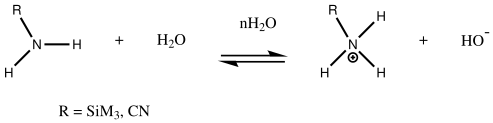
Previously, I looked at models of how ammonia could be protonated by water to form ammonium hydroxide. The energetic outcome of my model matched the known equilbrium in water as favouring the unprotonated form (pKb ~4.75). I add here two amines for which R=Me3Si and R=CN. The idea is that the first will assist nitrogen protonation by stabilising the positive centre and the second will act in the opposite sense; an exploration if you like of how one might go about computationally designing a non-steric superbasic amine that becomes predominantly protonated when exposed to water (pKb <1) and is thus more basic than hydroxide anion in this medium.

NH3-8

Before reporting any calculations, let us see what the CSD (Cambridge structure database) might contain. The search query is simple, a 3-coordinate amine forming a 4-coordinate quaternary nitrogen with one N-H and a positive (formal) charge on the N, and a 1-coordinate oxygen with one O-H and a negative charge on the O. With the constraints R < 10%, no disorder and no errors, one gets as many as 15 hits,[1] several of which also apparently contain separate water molecules in the crystal. A warning bell (perhaps several) sounds, since if R < 5%, the number of hits drops to just 2; these are clearly difficult structures to refine! So there is some tantalising evidence that in the solid state at least, the quaternary ammonium group (with at least one N-H), water and a hydroxide anion might be capable of co-existence. As noted below some fascinating 2-coordinate amines have also been reported as having superbasic properties.

NH3-8

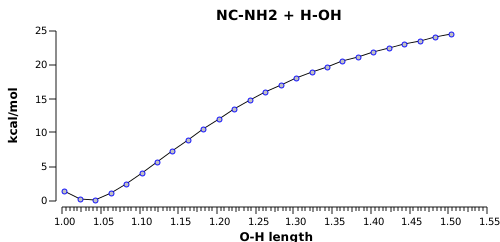
R=CN: the well known compound cyanamide is known to act only as an acid and its basic properties are never quoted. Shown below is the reaction path for transfer of a proton from water to the amine using an 8-water model (n=8) in which two bridges can serve to help stabilize any ionic form. The energy required to do so however is at least 24 kcal/mol (ωB97XD/Def2-TZVPPD/SCRF=water) which indicates that no protonated amine is formed. This can be attributed to the electron withdrawing cyano group strongly destablising any adjacent positive ammonium centre and thus effectively completely inhibiting its formation.

NH3-8

R=Me3Si: this too is already known[2],[3] but only in the presence of the non-coordinating counter-anion B(C6F5)4 crystallised from non-protic solution. An ionised form can now be located using the model above. This has the structure shown below; note the very short hydrogen bonds associated with the hydroxide anion and the possibility of forming only two water bridges across the ion-pair. The relative free energy of the ion-pair (table below) shows it to be if anything less basic than ammonia. 

NH3-8

n=8 R=H R=SiMe3 R=CN
ΔΔG298 7.0[4]

7.6[5],[6]

>24[7]

NBO (natural bond orbital) analysis might here  be a useful metric of basicity. Hence Me3SiNH2…H2O  suggests that donation from the N lone pair into an antiperiplanar Si-C bond is quite large (E(2) = 11.9 kcal/mol), although alternative donation by nitrogen into the H-O σ* bond  of the water is much higher (33.4 kcal/mol). 

Perhaps the basicity of simple amines is related to their ability to form stabilizing water bridges across the ion-pair? With trimethylsilyl substituents, this feature (and hence the basicity) is partially or even fully suppressed as in e.g. tris(trimethylsilyl)amine.The pKb of the latter appears to be unreported[8] but it does seem to be only weakly basic and "inert to H2O",[9] a property attributed instead to multiple character in the Si-N bonds. 

I will in a future post look at the alternative class of phosphazenium amines which do manage to achieve superbasicity.[10]


A phosphazenium 3-coordinate amine[11] was in 1991 claimed to be the strongest metal-free neutral base. This has now been superceded by combining this base motif with that of a sterically operating proton sponge.[12],[10] I will report the computational modelling of these systems in a later post.

One of the structures identified with R<10% is UBEJIU[13] and which is worth showing below. Note the apparent close contact of the type N-H…H-O (1.416-1.463Å) rather than the expected N-H…OH.  If correct (this feature is not mentioned in the article itself) it would be classified as a dihydrogen bond, a type normally only found in situations such as B-H…H-N. There are a number of other inconsistencies which must be resolved if this structure is to stand as correct.

NH3-8

References

  1. H. Rzepa, "Substituted ammonium hydroxides", 2016. https://doi.org/10.14469/hpc/361
  2. Y. Sarazin, J.A. Wright, and M. Bochmann, "Synthesis and crystal structure of [C6H5Hg(H2NSiMe3)][H2N{B(C6F5)3}2], a phenyl–mercury(II) cation stabilised by a non-coordinating counter-anion", Journal of Organometallic Chemistry, vol. 691, pp. 5680-5687, 2006. https://doi.org/10.1016/j.jorganchem.2006.09.021
  3. Sarazin, Y.., Wright, J.A.., and Bochmann, M.., "CCDC 608250: Experimental Crystal Structure Determination", 2007. https://doi.org/10.5517/ccndxzx
  4. H.S. Rzepa, and H.S. Rzepa, "H21NO9", 2016. https://doi.org/10.14469/ch/191946
  5. H.S. Rzepa, and H.S. Rzepa, "C 3 H 29 N 1 O 9 Si 1", 2016. https://doi.org/10.14469/ch/191987
  6. H.S. Rzepa, and H.S. Rzepa, "C 3 H 29 N 1 O 9 Si 1", 2016. https://doi.org/10.14469/ch/191982
  7. H.S. Rzepa, "CH20N2O9", 2016. https://doi.org/10.14469/ch/191983
  8. E.W. Abel, D.A. Armitage, and G.R. Willey, "Relative base strengths of some organosilicon amines", Transactions of the Faraday Society, vol. 60, pp. 1257, 1964. https://doi.org/10.1039/tf9646001257
  9. J. Goubeau, and J. Jimenéz‐Barberá, "Tris‐(trimethylsilyl)‐amin", Zeitschrift für anorganische und allgemeine Chemie, vol. 303, pp. 217-226, 1960. https://doi.org/10.1002/zaac.19603030502
  10. Kögel, Julius F.., Oelkers, Benjamin., Kovačević, Borislav., and Sundermeyer, Jörg., "CCDC 1002088: Experimental Crystal Structure Determination", 2014. https://doi.org/10.5517/cc12mrfw
  11. R. Schwesinger, and H. Schlemper, "Peralkylated Polyaminophosphazenes— Extremely Strong, Neutral Nitrogen Bases", Angewandte Chemie International Edition in English, vol. 26, pp. 1167-1169, 1987. https://doi.org/10.1002/anie.198711671
  12. J.F. Kögel, B. Oelkers, B. Kovačević, and J. Sundermeyer, "A New Synthetic Pathway to the Second and Third Generation of Superbasic Bisphosphazene Proton Sponges: The Run for the Best Chelating Ligand for a Proton", Journal of the American Chemical Society, vol. 135, pp. 17768-17774, 2013. https://doi.org/10.1021/ja409760z
  13. P. Vianello, A. Albinati, G.A. Pinna, A. Lavecchia, L. Marinelli, P.A. Borea, S. Gessi, P. Fadda, S. Tronci, and G. Cignarella, "Synthesis, Molecular Modeling, and Opioid Receptor Affinity of 9,10-Diazatricyclo[4.2.1.1<sup>2,5</sup>]decanes and 2,7-Diazatricyclo[4.4.0.0<sup>3,8</sup>]decanes Structurally Related to 3,8-Diazabicyclo[3.2.1]octanes", Journal of Medicinal Chemistry, vol. 43, pp. 2115-2123, 2000. https://doi.org/10.1021/jm991140q