Posts Tagged ‘relative free energy’

Ways to encourage water to protonate an amine: superbasing.

Friday, April 8th, 2016

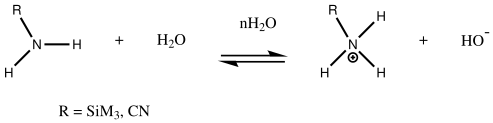
Previously, I looked at models of how ammonia could be protonated by water to form ammonium hydroxide. The energetic outcome of my model matched the known equilbrium in water as favouring the unprotonated form (pKb ~4.75). I add here two amines for which R=Me3Si and R=CN. The idea is that the first will assist nitrogen protonation by stabilising the positive centre and the second will act in the opposite sense; an exploration if you like of how one might go about computationally designing a non-steric superbasic amine that becomes predominantly protonated when exposed to water (pKb <1) and is thus more basic than hydroxide anion in this medium.
NH3-8

Before reporting any calculations, let us see what the CSD (Cambridge structure database) might contain. The search query is simple, a 3-coordinate amine forming a 4-coordinate quaternary nitrogen with one N-H and a positive (formal) charge on the N, and a 1-coordinate oxygen with one O-H and a negative charge on the O. With the constraints R < 10%, no disorder and no errors, one gets as many as 15 hits,[1] several of which also apparently contain separate water molecules in the crystal. A warning bell (perhaps several) sounds, since if R < 5%, the number of hits drops to just 2; these are clearly difficult structures to refine! So there is some tantalising evidence that in the solid state at least, the quaternary ammonium group (with at least one N-H), water and a hydroxide anion might be capable of co-existence. As noted below some fascinating 2-coordinate amines have also been reported as having superbasic properties.

NH3-8

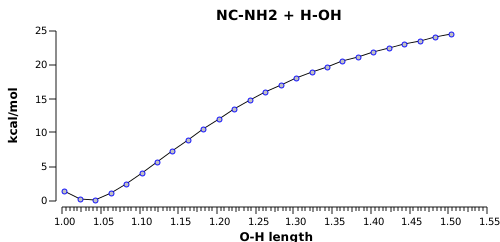
R=CN: the well known compound cyanamide is known to act only as an acid and its basic properties are never quoted. Shown below is the reaction path for transfer of a proton from water to the amine using an 8-water model (n=8) in which two bridges can serve to help stabilize any ionic form. The energy required to do so however is at least 24 kcal/mol (ωB97XD/Def2-TZVPPD/SCRF=water) which indicates that no protonated amine is formed. This can be attributed to the electron withdrawing cyano group strongly destablising any adjacent positive ammonium centre and thus effectively completely inhibiting its formation.
NH3-8

R=Me3Si: this too is already known[2],[3] but only in the presence of the non-coordinating counter-anion B(C6F5)4 crystallised from non-protic solution. An ionised form can now be located using the model above. This has the structure shown below; note the very short hydrogen bonds associated with the hydroxide anion and the possibility of forming only two water bridges across the ion-pair. The relative free energy of the ion-pair (table below) shows it to be if anything less basic than ammonia. 

NH3-8

n=8 R=H R=SiMe3 R=CN
ΔΔG298 7.0[4]

7.6[5],[6]

>24[7]

NBO (natural bond orbital) analysis might here  be a useful metric of basicity. Hence Me3SiNH2…H2O  suggests that donation from the N lone pair into an antiperiplanar Si-C bond is quite large (E(2) = 11.9 kcal/mol), although alternative donation by nitrogen into the H-O σ* bond  of the water is much higher (33.4 kcal/mol). 

Perhaps the basicity of simple amines is related to their ability to form stabilizing water bridges across the ion-pair? With trimethylsilyl substituents, this feature (and hence the basicity) is partially or even fully suppressed as in e.g. tris(trimethylsilyl)amine.The pKb of the latter appears to be unreported[8] but it does seem to be only weakly basic and "inert to H2O",[9] a property attributed instead to multiple character in the Si-N bonds. 

I will in a future post look at the alternative class of phosphazenium amines which do manage to achieve superbasicity.[10]


A phosphazenium 3-coordinate amine[11] was in 1991 claimed to be the strongest metal-free neutral base. This has now been superceded by combining this base motif with that of a sterically operating proton sponge.[12],[10] I will report the computational modelling of these systems in a later post.

One of the structures identified with R<10% is UBEJIU[13] and which is worth showing below. Note the apparent close contact of the type N-H…H-O (1.416-1.463Å) rather than the expected N-H…OH.  If correct (this feature is not mentioned in the article itself) it would be classified as a dihydrogen bond, a type normally only found in situations such as B-H…H-N. There are a number of other inconsistencies which must be resolved if this structure is to stand as correct.

NH3-8

References

  1. H. Rzepa, "Substituted ammonium hydroxides", 2016. https://doi.org/10.14469/hpc/361
  2. Y. Sarazin, J.A. Wright, and M. Bochmann, "Synthesis and crystal structure of [C6H5Hg(H2NSiMe3)][H2N{B(C6F5)3}2], a phenyl–mercury(II) cation stabilised by a non-coordinating counter-anion", Journal of Organometallic Chemistry, vol. 691, pp. 5680-5687, 2006. https://doi.org/10.1016/j.jorganchem.2006.09.021
  3. Sarazin, Y.., Wright, J.A.., and Bochmann, M.., "CCDC 608250: Experimental Crystal Structure Determination", 2007. https://doi.org/10.5517/ccndxzx
  4. H.S. Rzepa, and H.S. Rzepa, "H21NO9", 2016. https://doi.org/10.14469/ch/191946
  5. H.S. Rzepa, and H.S. Rzepa, "C 3 H 29 N 1 O 9 Si 1", 2016. https://doi.org/10.14469/ch/191987
  6. H.S. Rzepa, and H.S. Rzepa, "C 3 H 29 N 1 O 9 Si 1", 2016. https://doi.org/10.14469/ch/191982
  7. H.S. Rzepa, "CH20N2O9", 2016. https://doi.org/10.14469/ch/191983
  8. E.W. Abel, D.A. Armitage, and G.R. Willey, "Relative base strengths of some organosilicon amines", Transactions of the Faraday Society, vol. 60, pp. 1257, 1964. https://doi.org/10.1039/tf9646001257
  9. J. Goubeau, and J. Jimenéz‐Barberá, "Tris‐(trimethylsilyl)‐amin", Zeitschrift für anorganische und allgemeine Chemie, vol. 303, pp. 217-226, 1960. https://doi.org/10.1002/zaac.19603030502
  10. Kögel, Julius F.., Oelkers, Benjamin., Kovačević, Borislav., and Sundermeyer, Jörg., "CCDC 1002088: Experimental Crystal Structure Determination", 2014. https://doi.org/10.5517/cc12mrfw
  11. R. Schwesinger, and H. Schlemper, "Peralkylated Polyaminophosphazenes— Extremely Strong, Neutral Nitrogen Bases", Angewandte Chemie International Edition in English, vol. 26, pp. 1167-1169, 1987. https://doi.org/10.1002/anie.198711671
  12. J.F. Kögel, B. Oelkers, B. Kovačević, and J. Sundermeyer, "A New Synthetic Pathway to the Second and Third Generation of Superbasic Bisphosphazene Proton Sponges: The Run for the Best Chelating Ligand for a Proton", Journal of the American Chemical Society, vol. 135, pp. 17768-17774, 2013. https://doi.org/10.1021/ja409760z
  13. P. Vianello, A. Albinati, G.A. Pinna, A. Lavecchia, L. Marinelli, P.A. Borea, S. Gessi, P. Fadda, S. Tronci, and G. Cignarella, "Synthesis, Molecular Modeling, and Opioid Receptor Affinity of 9,10-Diazatricyclo[4.2.1.1<sup>2,5</sup>]decanes and 2,7-Diazatricyclo[4.4.0.0<sup>3,8</sup>]decanes Structurally Related to 3,8-Diazabicyclo[3.2.1]octanes", Journal of Medicinal Chemistry, vol. 43, pp. 2115-2123, 2000. https://doi.org/10.1021/jm991140q

Modelling the geometry of unbranched alkanes.

Saturday, March 29th, 2014

By about C17H36, the geometry of “cold-isolated” unbranched saturated alkenes is supposed not to contain any fully anti-periplanar conformations. [1] Indeed, a (co-crystal) of C16H34 shows it to have two-gauche bends.[2]. Surprisingly, the longest linear alkane I was able to find a crystal structure for, C28H58 appears to be fully extended[3],[4] (an early report of a low quality structure for C36H74[5] also appears to show it as linear). Here I explore how standard DFT theories cope with these structures.

I start with noting the use of a TZVP basis set. In a recent article[6] we noted that the basis-set-superposition-errors for this basis were about a quarter of that for the standard Pople-type 6-311G(d,p) basis that I tend to use for modelling in this blog. This matters, since the relative energy of a folded-conformation vs an extended linear one might depend on the quality of the basis set and its inherent BSSE. The DFT method is the classical B3LYP. I also modelled C58H118 as the hydrocarbon as being well beyond the region anticipated above for folding of the chain to have started (no, there is no crystal structure). The geometries of linear and bent forms are shown below.

003001

The relative free energy of the V-shaped bent form[7] emerges as 3.5 kcal/mol higher than the linear form[8]. Now, to add a Grimme-D3 dispersion correction to the energies. The V-shape of the bent form now adopts the hairpin mode,[9] and its energy is now 2.5 kcal/mol lower than the linear form.[10]

002

Note in the above the very slight strange oscillation (kink) that appears about 11 atoms away from the hairpin bend. I repeated this with the wB97XD DFT procedure (in which dispersion is implicit) and found the same result.

As triple-ζ basis quality modelling of molecules with >100 atoms becomes increasingly common, it is worth repeating yet again that the model should always contain dispersion (and solvent if appropriate) corrections as default. Indeed, it is probably also worth re-investigating much early modelling (by this I mean modelling done ten or more years ago) to see if such corrections significantly influence the conclusions.[6]


The searches cannot be carried out according to the formula CnH2n+2, but must be done individually for the value of n. I gave up at C50.

References

  1. N.O.B. Lüttschwager, T.N. Wassermann, R.A. Mata, and M.A. Suhm, "The Last Globally Stable Extended Alkane", Angewandte Chemie International Edition, vol. 52, pp. 463-466, 2012. https://doi.org/10.1002/anie.201202894
  2. N. Cocherel, C. Poriel, J. Rault‐Berthelot, F. Barrière, N. Audebrand, A. Slawin, and L. Vignau, "New 3π‐2Spiro Ladder‐Type Phenylene Materials: Synthesis, Physicochemical Properties and Applications in OLEDs", Chemistry – A European Journal, vol. 14, pp. 11328-11342, 2008. https://doi.org/10.1002/chem.200801428
  3. S.C. Nyburg, and A.R. Gerson, "Crystallography of the even <i>n</i>-alkanes: structure of C<sub>20</sub>H<sub>42</sub>", Acta Crystallographica Section B Structural Science, vol. 48, pp. 103-106, 1992. https://doi.org/10.1107/s0108768191011059
  4. R. Boistelle, B. Simon, and G. Pèpe, "Polytypic structures of n-C28H58 (octacosane) and n-C36H74 (hexatriacontane)", Acta Crystallographica Section B Structural Crystallography and Crystal Chemistry, vol. 32, pp. 1240-1243, 1976. https://doi.org/10.1107/s0567740876005025
  5. H.M.M. Shearer, and V. Vand, "The crystal structure of the monoclinic form of n-hexatriacontant", Acta Crystallographica, vol. 9, pp. 379-384, 1956. https://doi.org/10.1107/s0365110x5600111x
  6. A. Armstrong, R.A. Boto, P. Dingwall, J. Contreras-García, M.J. Harvey, N.J. Mason, and H.S. Rzepa, "The Houk–List transition states for organocatalytic mechanisms revisited", Chem. Sci., vol. 5, pp. 2057-2071, 2014. https://doi.org/10.1039/c3sc53416b
  7. H.S. Rzepa, "Gaussian Job Archive for C58H118", 2014. https://doi.org/10.6084/m9.figshare.978501
  8. H.S. Rzepa, "Gaussian Job Archive for C58H118", 2014. https://doi.org/10.6084/m9.figshare.978502
  9. H.S. Rzepa, "Gaussian Job Archive for C58H118", 2014. https://doi.org/10.6084/m9.figshare.978832
  10. H.S. Rzepa, "Gaussian Job Archive for C58H118", 2014. https://doi.org/10.6084/m9.figshare.978833

The Cyclol Hypothesis for protein structure: castles in the air.

Monday, April 4th, 2011

Most scientific theories emerge slowly, over decades, but others emerge fully formed virtually overnight as it were (think  Einstein in 1905). A third category is the supernova type, burning brightly for a short while, but then vanishing (almost) without trace shortly thereafter. The structure of DNA (of which I have blogged elsewhere) belongs to the second class, whilst one the brightest (and now entirely forgotten) examples of the supernova type concerns the structure of proteins. In 1936, it must have seemed a sure bet that the first person to come up with a successful theory of the origins of the (non-random) relatively rigid structure of proteins would inevitably win a Nobel prize (and of course this did happen for that other biologically important system, DNA, some 17 years later). Compelling structures for larger molecules providing reliable atom-atom distances based on crystallography were still in the future in 1936, and so structural theories contained a fair element of speculation and hopefully inspired guesswork (much as cosmological theories appear to have nowadays!).

Dorothy Wrinch was a mathematician who came up with just such a hypothesis for rigid protein structure, based in effect on elegance and symmetry, coupled with some knowledge of chemistry and crystallography[1]. She had noticed that the repeating polypeptide motif might be folded such that a cyclisation could occur to give what she termed a cyclol (an organic chemist would call this an aminol, and we would also now recognize it as a three-fold tetrahedral intermediate of the type involved in the hydrolysis of peptides). Wrinch proposed that this cyclisation could be repeated on a large scale to produce rigid scaffolds for proteins. The three-fold symmetric elegance of such motifs clearly appealed to this mathematician (the interesting symmetrical and conformational properties of the central cyclohexane-like ring were still to be fully recognised by anyone. Since Wrinch built many 3D models of her cyclols, one can but wonder how that central ring was represented, and whether its chair conformation was at all recognised. Another Nobel prize awaited the discoverer of this, Derek Barton).

The Cyclol structure. Click for 3D.

An immense controversy immediately broke out (not least because little direct spectroscopic evidence for the OH groups could be found). The story is rivetingly told by Patrick Coffey in his book Cathedrals of Science (ISBN 978-0-19-532134-0). Linus Pauling entered the fray in 1939[2], and one of the arguments he deployed was not so much symmetric elegance but thermodynamics (he also suggested hydrogen bonding and  S-S linkages for rigidifying proteins). The proposed cyclisation, he suggested, led to a very high energy species. Whilst Wrinch attempted to refute this[3], Pauling’s arguments won almost everyone over. Although Wrinch forlornly continued to promote her idea, last reviewing the topic as late as in 1963[4], crystallography was now producing cast iron data for protein structures. None have ever emerged with a cyclol motif, and this hypothesis is now firmly consigned to untaught history[5]. To this day, no examples of the tris(aminol) cyclol ring are to be found in the Cambridge small molecule crystal structure database either (although some related tetrahedral intermediates are known as crystalline species, see for example here, and they can be quite easily characterised in solution, see for example[6].

When  I read the story, it struck me that modern theory could easily verify how valid Pauling’s thermodynamic argument was. I have picked (ala)6 as my model, and have calculated the relative free energy (ΔG298) of the following three isomers.

  1. An acyclic zwitterionic form of this hexapeptide, calculated with a SCRF reaction field for water to allow for the ionic nature (ωB97XD/6-31G(d,p)), reveals a proton transfer to a neutral system, with an energy of +7.3 kcal/mol

    Acyclic (ala)6, in zwitterionic form

  2. A cyclic neutral peptide, which results from elimination of water from 1, again calculated with a water reaction field (DOI: 10042/to-8219), revealing a relative free energy of +0.0 kcal/mol

    Cyclic (ala)6

  3. The cyclic isomer 3 resulting from further cyclisation of 2 (DOI: 10042/to-8222) with a relative free energy of +69.0 kcal/mol

    Cyclol model for (ala)6.

From this, it appears that model 3 is ~69 kcal/mol less stable than the cyclic peptide 2, or 11.6 kcal/mol per amino acid residue. Pauling’s thermodynamic arguments suggested a value of ~28 kcal/mol (a value which Wrinch disputed as unreliable). So, in one sense, the above calculation is closer to Wrinch than to Pauling! In another, it still means Wrinch was wrong!! It is worth speculating why Pauling’s estimate is out. The cyclol 3 exhibits anomeric stabilizations, which of course were unknown in Pauling’s time. Both 2 and 3 exhibit attractive, but different, van der Waals attractions which contribute to their stabilities. And Pauling took no account of any entropy differences between 2 and 3. In retrospect,  3 was simply too rigid to allow most enzyme catalysis models to function, as we recognise them nowadays.

You might ask why I have revived a long forgotten theory as the topic of this post. Well, I think it is always worth revisiting the past, and re-examining old assumptions. When we do so, we find that Wrinch did not miss by as much as her detractors perhaps implied. With a little more luck, she might have gotten it right. Science is a bit like that, you need a dose of luck sometimes!

References

  1. "The cyclol hypothesis and the “globular” proteins", Proceedings of the Royal Society of London. Series A - Mathematical and Physical Sciences, vol. 161, pp. 505-524, 1937. https://doi.org/10.1098/rspa.1937.0159
  2. L. Pauling, and C. Niemann, "The Structure of Proteins", Journal of the American Chemical Society, vol. 61, pp. 1860-1867, 1939. https://doi.org/10.1021/ja01876a065
  3. D.M. Wrinch, "The Geometrical Attack on Protein Structure", Journal of the American Chemical Society, vol. 63, pp. 330-333, 1941. https://doi.org/10.1021/ja01847a004
  4. D. WRINCH, "Recent Advances in Cyclol Chemistry", Nature, vol. 199, pp. 564-566, 1963. https://doi.org/10.1038/199564a0
  5. C. Tanford, "How protein chemists learned about the hydrophobic factor", Protein Science, vol. 6, pp. 1358-1366, 1997. https://doi.org/10.1002/pro.5560060627
  6. H.S. Rzepa, A.M. Lobo, M.M. Marques, and S. Prabhakar, "Characterizing a tetrahedral intermediate in an acyl transfer reaction: An undergraduate 1H NMR demonstration", Journal of Chemical Education, vol. 64, pp. 725, 1987. https://doi.org/10.1021/ed064p725