Posts Tagged ‘Ammonia’

Ammonium tetraphenylborate and the mystery of its π-facial hydrogen bonding.

Friday, March 10th, 2017

A few years back, I did a post about the Pirkle reagent[1] and the unusual π-facial hydrogen bonding structure[2] it exhibits. For the Pirkle reagent, this bonding manifests as a close contact between the acidic OH hydrogen and the edge of a phenyl ring; the hydrogen bond is off-centre from the middle of the aryl ring. Here I update the topic, with a new search of the CSD (Cambridge structure database), but this time looking at the positional preference of that bond and whether it is on or off-centre. 

The search (February 2017 database, DOI:10.14469/hpc/2233) is shown above, QA = N, O, F, Cl and other constraints are R < 0.01, no errors, no disorder. Two distances are plotted, one (DIST1) is from the H to the ring centroid and the second (DIST2) from the H to an edge carbon atom. The colour code relates to ANG1, the angle subtended at the centroid. A value of 90° would indicate the H is orthogonal to the plane of the aromatic ring.

You can see from the above that the yellow dots correspond to ~90° and that by and large the H…centroid distances are shorter than the H…C distances. 

The above is another representation of this search, again showing that the preferred angle is 90°, although there is a fair bit of scatter. The extreme outliers may be crystallographic errors, but one point caught my eye and is circled in red above; ammonium tetrafluoroborate (3D model DOI: 10.5517/CC4V6TZ). This has a very short distance from the H to the centroid (2.07Å), shorter than the Pirkle reagent that we looked at all those years back. The authors[3] note that “The N-H…Ph distances, H…M 2.067Å … are exceptionally short (M = aromatic midpoint)” but also that “even at 20 K the ammonium ion performs large amplitude motions which allow the N-H vectors to sample the entire face of the aromatic system.” This implies that such bonds are largely agnostic about whether they bind to the centroid of the ring or to its edge and that the most probable position might arise simply because of crystal packing. An interesting variation on this molecule is a crystal that includes a further 5NH3 in addition to ammonium tetraphenylborate (3D model DOI: 10.5517/cc7bly2). Here an ammonia intervenes between the ammonium cation and a phenyl ring, resulting in a binding of the ammonia with two NHs closer to the edge of the ring and one NH interacting in parallel mode.

Time therefore for a calculation, using B3LYP+GD3BJ/Def2-TZVPP, the functional being chosen because the dispersion contribution is not built in, but uses what is currently thought to be the best representation of these attractions. The issue now is what molecular unit to use? This is an ionic structure and so a periodic boundary model is most appropriate, but given its size I reduced this to two models comprising smaller discrete fragments.

  1. A unit just comprising the simple ion pair. This leaves two of the four N-H bonds devoid of hydrogen bonding (DOI:10.14469/hpc/2234). The optimisation adopts a pose where two NH groups are directed towards a carbon atom rather than the ring centroid. How much of this is due to the smallness of this model?
  2. A unit comprising a double ion pair, which allows one ammonium group to participate with all four NH groups across four phenyl rings and exhibiting six NH interactions in total with six rings (DOI: 10.14469/hpc/2235). The NH hydrogen vectors all interact with ring carbons rather than the ring centroid.

This brief computational exploration has covered only one method (the B3LYP DFT procedure), albeit with what is thought to be a good dispersion attraction term added and a reasonable basis set. It does seem to show that hydrogen bonds interacting with the centroid of a phenyl ring are not the preferred mode, which is instead an interaction with the edge of the ring. The quote above, “even at 20 K the ammonium ion performs large amplitude motions which allow the N-H vectors to sample the entire face of the aromatic system” suggests that whilst the average position might be the centroid, a true hydrogen bond to the centroid might be rarer than thought. Although most of the crystallographic examples located in the searches above deem to show a preference for the ring centroid, this might be more apparent than real. 

References

  1. H.S. Rzepa, M.L. Webb, A.M.Z. Slawin, and D.J. Williams, "? Facial hydrogen bonding in the chiral resolving agent (S)-2,2,2-trifluoro-1-(9-anthryl)ethanol and its racemic modification", Journal of the Chemical Society, Chemical Communications, pp. 765, 1991. https://doi.org/10.1039/c39910000765
  2. H.S. Rzepa, M.H. Smith, and M.L. Webb, "A crystallographic AM1 and PM3 SCF-MO investigation of strong OH ⋯π-alkene and alkyne hydrogen bonding interactions", J. Chem. Soc., Perkin Trans. 2, pp. 703-707, 1994. https://doi.org/10.1039/p29940000703
  3. T. Steiner, and S.A. Mason, "Short N<sup>+</sup>—H...Ph hydrogen bonds in ammonium tetraphenylborate characterized by neutron diffraction", Acta Crystallographica Section B Structural Science, vol. 56, pp. 254-260, 2000. https://doi.org/10.1107/s0108768199012318

Oxane oxide: a tautomer of hydrogen peroxide.

Friday, April 15th, 2016

 If H3N+-O is viable compared with its tautomer H2N-OH when carrying water bridges, then why not try H2O+-O vs HO-OH?

There are no examples to be found in crystal structures! The solvated structure of H2O+-O is modified directly from that of H3N+-Oand the computed (ωB97XD/6-311++G(d,p)/SCRF=water) structure[1] is shown below. Noteworthy is that the hydrogen bonds at the O+ end are far stronger than those to at the O end.

NH3-8

The corresponding hydrated hydrogen peroxide is 16.3 kcal/mol lower in free energy; this compares favourably with the value for water itself and suggests that oxane oxide might also be capable of isolation inside a suitable hydrogen bond stabilising cavity.

References

  1. H.S. Rzepa, "H20O11", 2016. https://doi.org/10.14469/ch/192005

Azane oxide, a tautomer of hydroxylamine.

Friday, April 15th, 2016

In the previous post I described how hydronium hydroxide or H3O+…HO, an intermolecular tautomer of water, has recently been observed captured inside an organic cage[1] and how the free-standing species in water can be captured computationally with the help of solvating water bridges. Here I explore azane oxide or H3N+-O, a tautomer of the better known hydroxylamine (H2N-OH).

The usual search[2] of the Cambridge structure database reveals only two (related) entries[3],[4] the second reported in 2015.[5].

NH3-8
NH3-8

Now, location of hydrogen atoms is always a bit tricky, but here we see two species H3N+-OH…O-+NH3 connected by a strong hydrogen bond of 1.54Å (click on the above image to see this packing). However, it is noteworthy that the N-O bonds for each of these species are exactly the same length (1.412Å); one might have imagined that whether the oxygen carries a proton or not would affect its bond length to nitrogen. There is here a strong hint that energetically the azane oxide might be relatively low in energy relative to hydroxylamine and perhaps that the zwitterionic form might be favoured when captured with hydrogen bonds.

So certainly time for a computational exploration of this species. I am using the three water bridges as before, each comprised of three water molecules and the ωB97XD/6-311++G(d,p)/SCRF=water method. In fact the structure optimises[6] to a delightful propeller-like geometry in which bridges are formed from both two AND three waters across the ion-pair, with overall three-fold C3 symmetry (i.e. chiral! Indeed, this species has a predicted optical rotation of 40° at 589nm).

NH3-8

Hydroxylamine itself has a less symmetric arrangement of hydrogen bonds[7], with a free energy in fact very similar (within 1 kcal/mol) to the ion-pair isomer. Here, a stochastic (statistical) exploration of all the various arrangements of water would be needed to be confident that the lowest energy form had been located. I would note that the N-O bond lengths in the ion-pair and neutral forms are respectively 1.399 and 1.435Å.

NH3-8

Certainly, this very brief computational look at azane oxide suggests that concentrations of this species in aqueous solutions of hydroxylamine might be appreciable (detectable). Its "trapping" inside a suitably designed cavity must be a realistic possibility (the cavity used to trap hydronium hydroxide probably does not have the correct dimensions for this purpose), as indeed illustrated in the two crystal structures noted above.


I have represented this species in ionic form, but you may find text books showing it in dative form, or H3N→O. My personal inclination is to always prefer the ionic form, if only because it enables connections/analogies such as the one here to hydronium hydroxide to be more easily made.

References

  1. M. Stapf, W. Seichter, and M. Mazik, "Unique Hydrogen‐Bonded Complex of Hydronium and Hydroxide Ions", Chemistry – A European Journal, vol. 21, pp. 6350-6354, 2015. https://doi.org/10.1002/chem.201406383
  2. H. Rzepa, "Search for Azane oxide", 2016. https://doi.org/10.14469/hpc/380
  3. Fischer, Dennis., Klapotke, Thomas M.., and Stierstorfer, Jorg., "CCDC 1054611: Experimental Crystal Structure Determination", 2015. https://doi.org/10.5517/cc14ddqn
  4. Fischer, D.., Klapotke, T.M.., and Stierstorfer, J.., "CCDC 827687: Experimental Crystal Structure Determination", 2012. https://doi.org/10.5517/ccws8lh
  5. D. Fischer, T.M. Klapötke, and J. Stierstorfer, "1,5‐Di(nitramino)tetrazole: High Sensitivity and Superior Explosive Performance", Angewandte Chemie International Edition, vol. 54, pp. 10299-10302, 2015. https://doi.org/10.1002/anie.201502919
  6. H.S. Rzepa, "H 21 N 1 O 10", 2016. https://doi.org/10.14469/ch/192000
  7. H.S. Rzepa, "H 21 N 1 O 10", 2016. https://doi.org/10.14469/ch/192001

Ways to encourage water to protonate an amine: superbasing.

Friday, April 8th, 2016

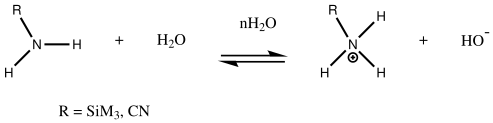
Previously, I looked at models of how ammonia could be protonated by water to form ammonium hydroxide. The energetic outcome of my model matched the known equilbrium in water as favouring the unprotonated form (pKb ~4.75). I add here two amines for which R=Me3Si and R=CN. The idea is that the first will assist nitrogen protonation by stabilising the positive centre and the second will act in the opposite sense; an exploration if you like of how one might go about computationally designing a non-steric superbasic amine that becomes predominantly protonated when exposed to water (pKb <1) and is thus more basic than hydroxide anion in this medium.

NH3-8

Before reporting any calculations, let us see what the CSD (Cambridge structure database) might contain. The search query is simple, a 3-coordinate amine forming a 4-coordinate quaternary nitrogen with one N-H and a positive (formal) charge on the N, and a 1-coordinate oxygen with one O-H and a negative charge on the O. With the constraints R < 10%, no disorder and no errors, one gets as many as 15 hits,[1] several of which also apparently contain separate water molecules in the crystal. A warning bell (perhaps several) sounds, since if R < 5%, the number of hits drops to just 2; these are clearly difficult structures to refine! So there is some tantalising evidence that in the solid state at least, the quaternary ammonium group (with at least one N-H), water and a hydroxide anion might be capable of co-existence. As noted below some fascinating 2-coordinate amines have also been reported as having superbasic properties.

NH3-8

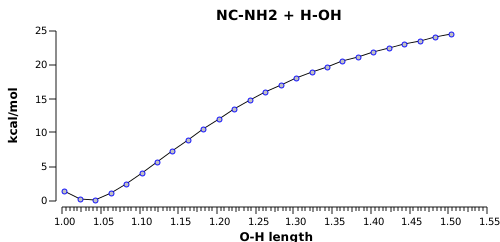
R=CN: the well known compound cyanamide is known to act only as an acid and its basic properties are never quoted. Shown below is the reaction path for transfer of a proton from water to the amine using an 8-water model (n=8) in which two bridges can serve to help stabilize any ionic form. The energy required to do so however is at least 24 kcal/mol (ωB97XD/Def2-TZVPPD/SCRF=water) which indicates that no protonated amine is formed. This can be attributed to the electron withdrawing cyano group strongly destablising any adjacent positive ammonium centre and thus effectively completely inhibiting its formation.

NH3-8

R=Me3Si: this too is already known[2],[3] but only in the presence of the non-coordinating counter-anion B(C6F5)4 crystallised from non-protic solution. An ionised form can now be located using the model above. This has the structure shown below; note the very short hydrogen bonds associated with the hydroxide anion and the possibility of forming only two water bridges across the ion-pair. The relative free energy of the ion-pair (table below) shows it to be if anything less basic than ammonia. 

NH3-8

n=8 R=H R=SiMe3 R=CN
ΔΔG298 7.0[4]

7.6[5],[6]

>24[7]

NBO (natural bond orbital) analysis might here  be a useful metric of basicity. Hence Me3SiNH2…H2O  suggests that donation from the N lone pair into an antiperiplanar Si-C bond is quite large (E(2) = 11.9 kcal/mol), although alternative donation by nitrogen into the H-O σ* bond  of the water is much higher (33.4 kcal/mol). 

Perhaps the basicity of simple amines is related to their ability to form stabilizing water bridges across the ion-pair? With trimethylsilyl substituents, this feature (and hence the basicity) is partially or even fully suppressed as in e.g. tris(trimethylsilyl)amine.The pKb of the latter appears to be unreported[8] but it does seem to be only weakly basic and "inert to H2O",[9] a property attributed instead to multiple character in the Si-N bonds. 

I will in a future post look at the alternative class of phosphazenium amines which do manage to achieve superbasicity.[10]


A phosphazenium 3-coordinate amine[11] was in 1991 claimed to be the strongest metal-free neutral base. This has now been superceded by combining this base motif with that of a sterically operating proton sponge.[12],[10] I will report the computational modelling of these systems in a later post.

One of the structures identified with R<10% is UBEJIU[13] and which is worth showing below. Note the apparent close contact of the type N-H…H-O (1.416-1.463Å) rather than the expected N-H…OH.  If correct (this feature is not mentioned in the article itself) it would be classified as a dihydrogen bond, a type normally only found in situations such as B-H…H-N. There are a number of other inconsistencies which must be resolved if this structure is to stand as correct.

NH3-8

References

  1. H. Rzepa, "Substituted ammonium hydroxides", 2016. https://doi.org/10.14469/hpc/361
  2. Y. Sarazin, J.A. Wright, and M. Bochmann, "Synthesis and crystal structure of [C6H5Hg(H2NSiMe3)][H2N{B(C6F5)3}2], a phenyl–mercury(II) cation stabilised by a non-coordinating counter-anion", Journal of Organometallic Chemistry, vol. 691, pp. 5680-5687, 2006. https://doi.org/10.1016/j.jorganchem.2006.09.021
  3. Sarazin, Y.., Wright, J.A.., and Bochmann, M.., "CCDC 608250: Experimental Crystal Structure Determination", 2007. https://doi.org/10.5517/ccndxzx
  4. H.S. Rzepa, and H.S. Rzepa, "H21NO9", 2016. https://doi.org/10.14469/ch/191946
  5. H.S. Rzepa, and H.S. Rzepa, "C 3 H 29 N 1 O 9 Si 1", 2016. https://doi.org/10.14469/ch/191987
  6. H.S. Rzepa, and H.S. Rzepa, "C 3 H 29 N 1 O 9 Si 1", 2016. https://doi.org/10.14469/ch/191982
  7. H.S. Rzepa, "CH20N2O9", 2016. https://doi.org/10.14469/ch/191983
  8. E.W. Abel, D.A. Armitage, and G.R. Willey, "Relative base strengths of some organosilicon amines", Transactions of the Faraday Society, vol. 60, pp. 1257, 1964. https://doi.org/10.1039/tf9646001257
  9. J. Goubeau, and J. Jimenéz‐Barberá, "Tris‐(trimethylsilyl)‐amin", Zeitschrift für anorganische und allgemeine Chemie, vol. 303, pp. 217-226, 1960. https://doi.org/10.1002/zaac.19603030502
  10. Kögel, Julius F.., Oelkers, Benjamin., Kovačević, Borislav., and Sundermeyer, Jörg., "CCDC 1002088: Experimental Crystal Structure Determination", 2014. https://doi.org/10.5517/cc12mrfw
  11. R. Schwesinger, and H. Schlemper, "Peralkylated Polyaminophosphazenes— Extremely Strong, Neutral Nitrogen Bases", Angewandte Chemie International Edition in English, vol. 26, pp. 1167-1169, 1987. https://doi.org/10.1002/anie.198711671
  12. J.F. Kögel, B. Oelkers, B. Kovačević, and J. Sundermeyer, "A New Synthetic Pathway to the Second and Third Generation of Superbasic Bisphosphazene Proton Sponges: The Run for the Best Chelating Ligand for a Proton", Journal of the American Chemical Society, vol. 135, pp. 17768-17774, 2013. https://doi.org/10.1021/ja409760z
  13. P. Vianello, A. Albinati, G.A. Pinna, A. Lavecchia, L. Marinelli, P.A. Borea, S. Gessi, P. Fadda, S. Tronci, and G. Cignarella, "Synthesis, Molecular Modeling, and Opioid Receptor Affinity of 9,10-Diazatricyclo[4.2.1.1<sup>2,5</sup>]decanes and 2,7-Diazatricyclo[4.4.0.0<sup>3,8</sup>]decanes Structurally Related to 3,8-Diazabicyclo[3.2.1]octanes", Journal of Medicinal Chemistry, vol. 43, pp. 2115-2123, 2000. https://doi.org/10.1021/jm991140q

How many water molecules does it take to form ammonium hydroxide from ammonia and water?

Sunday, March 20th, 2016

This is a corollary to the previous post exploring how many molecules are needed to ionise HCl. Here I am asking how many water molecules are required to form the ionic ammonium hydroxide from ammonia and water.

As Wikipedia will inform you, "it is actually impossible to isolate samples of NH4OH (more formally the ion-pair NH4+OH ) as these ions do not comprise a significant fraction of the total amount of ammonia except in extremely dilute solutions (my italics)". In fact, the ionization constant Kb = [NH4+][OH]/[NH3][H2O] is ~1.8 x 10⁻⁵ (pKb 4.75) equivalent to a free energy difference of  ~6.5 kcal/mol between the two forms. This is in stark contrast to solutions of e.g. HCl in water, where essentially all of the HCl is ionised to hydronium chloride or H3O+Clby addition of just ~4-5 water molecules. So what is the water model required to compute this known behaviour of ammonia? Here, this will be ωB97Xd/Def2-TZVPPD/SCRF=water, i.e. a continuum water model is already included and we add n further discrete water molecules to enhance it.

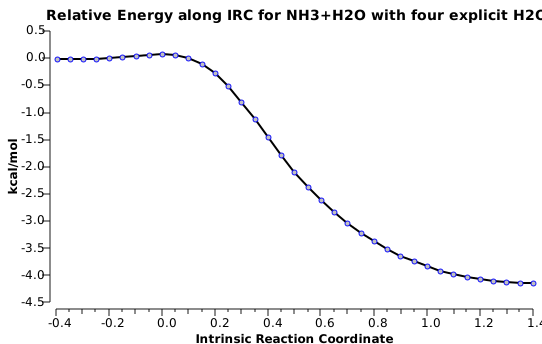
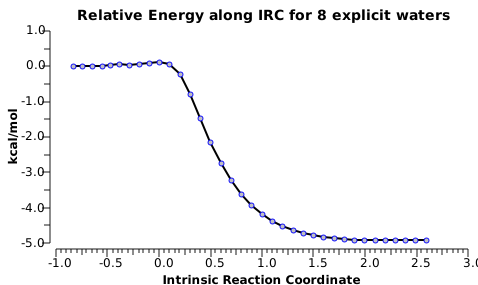
For n=0 or 2, the ion-pair is not an explicit minimum (although it appears to be a "hidden intermediate"[1]). Values of e.g. n=4,6,8 allow the formation of two or three "bridges" comprising two or three water molecules connecting the N and O atoms by hydrogen bonds and this additional solvation enables location of a transition state for proton transfer between O and N. This implies an equilibrium can be established as NH3 + H2O ⇌* NH4+.OH with the ion-pair now a genuine minimum stabilized by those ion-pair bridges. Note in particular how the hydrogen bond lengths involving the water salt-bridge in the ion-pair are shorter than for the neutral water-ammonia complex.

NH3-8

The contact ion-pair is nevertheless a very shallow minimum when surrounded by 4 or more explicit waters, the barrier from proton transfer from N being less than a vibrational quantum, and so the lifetime of the contact ion-pair is very much defined by the proton dynamics of the system..

4

8

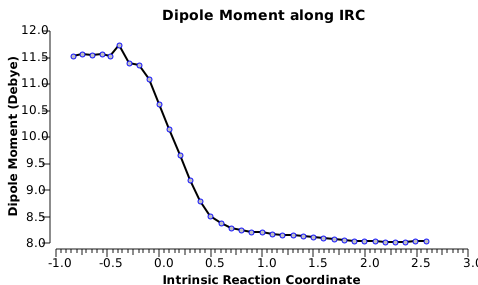
For n=8, the dipole moment changes along the IRC for proton transfer between N and O as might be expected for the collapse of a contact ion-pair.

8dm

The relative free energies of the ion-pair and the un-ionized pair are shown below, the former being the higher. The values correspond approximately to the known ionization constant. As more explicit water molecules are added, there is a hint that the proportion of ion-pairs might actually decrease relative to neutral ammonia. However, these calculations are for a contact ion-pair and not a solvent-separated ion pair, the latter form possibly being the more appropriate form for extremely dilute solutions (see above). Modelling the latter type of ion-pair is not as straightforward as the contact variety;  as the ion separation increases, so the propensity for barrierless proton transfers increases, ultimately leading back to the contact form. So to understand if it is correct that in extremely dilute solutions there is no remaining neutral ammonia, probably only a full molecular dynamics treatment of such a system is likely to give further insights.

n 4 6 8
 ΔΔG298 6.4[2] 5.9[3] 7.0[4]

To summarise, in order to compute the formation of the ammonium hydroxide ion pair from ammonia and water, one has to include an additional four or more explicit water molecules in the calculation. This model confirms that in the resulting equilibrium, only a tiny proportion of the ammonia becomes ionised. With such a base model in place, one can now proceed to investigate how addition of substituents on the nitrogen might impact upon such ionisation, i.e. to form a stronger or a weaker base.


A more complete analysis followed.[5] *If you are wondering how to produce a reversible arrow, see here. This is only approximate, since the concentration of water needs renormalising.


References

  1. https://doi.org/
  2. H.S. Rzepa, and H.S. Rzepa, "H13NO5", 2016. https://doi.org/10.14469/ch/191950
  3. https://doi.org/
  4. H.S. Rzepa, and H.S. Rzepa, "H21NO9", 2016. https://doi.org/10.14469/ch/191946
  5. A. Vargas‐Caamal, J.L. Cabellos, F. Ortiz‐Chi, H.S. Rzepa, A. Restrepo, and G. Merino, "How Many Water Molecules Does it Take to Dissociate HCl?", Chemistry – A European Journal, vol. 22, pp. 2812-2818, 2016. https://doi.org/10.1002/chem.201504016