Posts Tagged ‘free energy difference’

How many water molecules does it take to form ammonium hydroxide from ammonia and water?

Sunday, March 20th, 2016

This is a corollary to the previous post exploring how many molecules are needed to ionise HCl. Here I am asking how many water molecules are required to form the ionic ammonium hydroxide from ammonia and water.

As Wikipedia will inform you, "it is actually impossible to isolate samples of NH4OH (more formally the ion-pair NH4+OH ) as these ions do not comprise a significant fraction of the total amount of ammonia except in extremely dilute solutions (my italics)". In fact, the ionization constant Kb = [NH4+][OH]/[NH3][H2O] is ~1.8 x 10⁻⁵ (pKb 4.75) equivalent to a free energy difference of  ~6.5 kcal/mol between the two forms. This is in stark contrast to solutions of e.g. HCl in water, where essentially all of the HCl is ionised to hydronium chloride or H3O+Clby addition of just ~4-5 water molecules. So what is the water model required to compute this known behaviour of ammonia? Here, this will be ωB97Xd/Def2-TZVPPD/SCRF=water, i.e. a continuum water model is already included and we add n further discrete water molecules to enhance it.

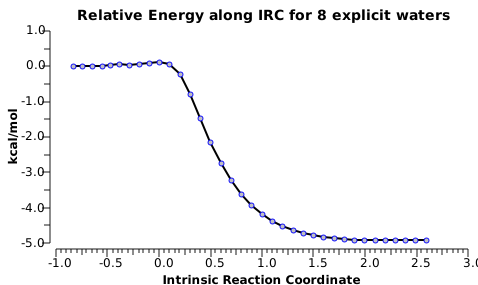
For n=0 or 2, the ion-pair is not an explicit minimum (although it appears to be a "hidden intermediate"[1]). Values of e.g. n=4,6,8 allow the formation of two or three "bridges" comprising two or three water molecules connecting the N and O atoms by hydrogen bonds and this additional solvation enables location of a transition state for proton transfer between O and N. This implies an equilibrium can be established as NH3 + H2O ⇌* NH4+.OH with the ion-pair now a genuine minimum stabilized by those ion-pair bridges. Note in particular how the hydrogen bond lengths involving the water salt-bridge in the ion-pair are shorter than for the neutral water-ammonia complex.

NH3-8

The contact ion-pair is nevertheless a very shallow minimum when surrounded by 4 or more explicit waters, the barrier from proton transfer from N being less than a vibrational quantum, and so the lifetime of the contact ion-pair is very much defined by the proton dynamics of the system..
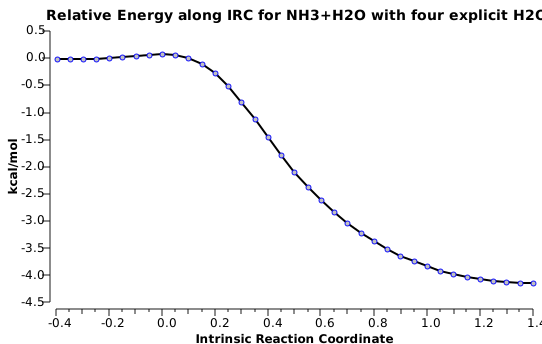
4

8

For n=8, the dipole moment changes along the IRC for proton transfer between N and O as might be expected for the collapse of a contact ion-pair.
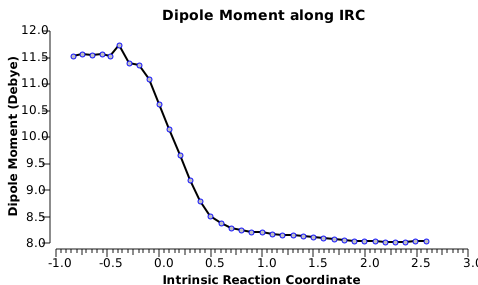
8dm

The relative free energies of the ion-pair and the un-ionized pair are shown below, the former being the higher. The values correspond approximately to the known ionization constant. As more explicit water molecules are added, there is a hint that the proportion of ion-pairs might actually decrease relative to neutral ammonia. However, these calculations are for a contact ion-pair and not a solvent-separated ion pair, the latter form possibly being the more appropriate form for extremely dilute solutions (see above). Modelling the latter type of ion-pair is not as straightforward as the contact variety;  as the ion separation increases, so the propensity for barrierless proton transfers increases, ultimately leading back to the contact form. So to understand if it is correct that in extremely dilute solutions there is no remaining neutral ammonia, probably only a full molecular dynamics treatment of such a system is likely to give further insights.

n 4 6 8
 ΔΔG298 6.4[2] 5.9[3] 7.0[4]

To summarise, in order to compute the formation of the ammonium hydroxide ion pair from ammonia and water, one has to include an additional four or more explicit water molecules in the calculation. This model confirms that in the resulting equilibrium, only a tiny proportion of the ammonia becomes ionised. With such a base model in place, one can now proceed to investigate how addition of substituents on the nitrogen might impact upon such ionisation, i.e. to form a stronger or a weaker base.


A more complete analysis followed.[5] *If you are wondering how to produce a reversible arrow, see here. This is only approximate, since the concentration of water needs renormalising.


References

  1. https://doi.org/
  2. H.S. Rzepa, and H.S. Rzepa, "H13NO5", 2016. https://doi.org/10.14469/ch/191950
  3. https://doi.org/
  4. H.S. Rzepa, and H.S. Rzepa, "H21NO9", 2016. https://doi.org/10.14469/ch/191946
  5. A. Vargas‐Caamal, J.L. Cabellos, F. Ortiz‐Chi, H.S. Rzepa, A. Restrepo, and G. Merino, "How Many Water Molecules Does it Take to Dissociate HCl?", Chemistry – A European Journal, vol. 22, pp. 2812-2818, 2016. https://doi.org/10.1002/chem.201504016

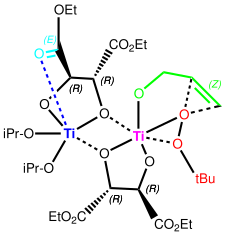
Why the Sharpless epoxidation is enantioselective!

Monday, December 17th, 2012

Part one on this topic showed how a quantum mechanical model employing just one titanium centre was not successful in predicting the stereochemical outcome of the Sharpless asymmetric epoxidation. Here in part 2, I investigate whether a binuclear model might have more success. The new model is constructed using two units of Ti(OiPr)4, which are likely to assemble into a dimer such as that shown below (in this crystal structure, some of the iPr groups are perfluorinated).

WAWBUR. Click for 3D

WAWBUR. Click for 3D

This allows one to construct a transition state model as follows.

sharpless-binuclear

  1. Two iPrOH molecules are displaced by diethyl tartrate for each half of the Ti2(OiPr)8, with the two metals then becoming bridged by one oxygen from each tartrate. 
  2. Two further iPrOH are then displaced from the second Ti by one of the substrate (allyl alcohol) and one of the oxidant (t-butyl peroxide).
  3. The oxygen transfer now proceeds via the second (hexacoordinate) Ti. The first Ti also achieves hexa-coordination via the carbonyl oxygen of one of the tartrate ester groups. It is the geometric properties of such a hexa-coordinated Ti that in part accounts for the subtle properties of this system. Put more simply, the extra crowding at the catalytic centre of the binuclear complex restricts the space available for the transition state, making it more selective for producing one enantiomer of the epoxide.

The (ωB97XD/6-311G(d,p)/SCRF=dichloromethane) optimised geometries are shown below. The reaction centre is shown in a magenta box for the disfavoured (R) epoxide and in green for the favoured (S) epoxide (the hydrogens are not shown for clarity; if you want to see them, click on the image to get the 3D model).

(R). Click for 3D.

(S). Click for 3D

(S). Click for 3D

You can see immediately that the biggest differences between the two occur in the bottom right corner. The t-butyl-O-O group folds in for (S) and this has a knock on effect on the two ester groups of the bottom right tartrate (the disposition of the tartrate on the top left is hardly changed). This folding is mediated by the hexa-coordination of the catalytic metal centre, together with dispersion interactions occurring to the t-butyl group, and this is helped by buttressing from the second Ti centre and its substituents.

The free energy difference ΔΔG298 favours the (S) for over the (R) by 3.0 kcal/mol. This free energy difference corresponds to an enantiomeric excess of >99%. In terms of attractive dispersion forces alone, (S) is favoured over (R) by -2.6 kcal/mol, and hence attractive dispersion seems to be the dominant term distinguishing between the two diastereomeric transition states. This aspect of non-covalent-interactions will be investigated in another post.

KOGYEK. Click for 3D.

KOGYEK, a Ti oligomer. Click for 3D.

One should however finally ask if this is the best model?

  1. Not all conformations have been explored in these models, although (S) was built from (R) as a template, so many features are the same. Nevertheless, further conformational exploration may be useful.
  2. Alkoxytitaniums are known to also form higher oligomers, such as the one shown above.[1]. If their concentration is significant, these too might be catalysing the reaction. Only computation would establish if they are capable of greater stereoselectivity/faster kinetics.

So we could end up with an answer that a number of oligomeric transition states are involved. But the one presented here, if not necessarily the most accurate or “best” model, seems good enough to form a template for further exploratory computation to see if the enantioselectivity of the reaction might be improved upon further.

References

  1. V.W. Day, T.A. Eberspacher, W.G. Klemperer, C.W. Park, and F.S. Rosenberg, "Solution structure elucidation of early transition metal polyoxoalkoxides using oxygen-17 NMR spectroscopy", Journal of the American Chemical Society, vol. 113, pp. 8190-8192, 1991. https://doi.org/10.1021/ja00021a068

Spotting the unexpected. The trifluoromeric effect in the hydration of the carbonyl group.

Friday, March 9th, 2012

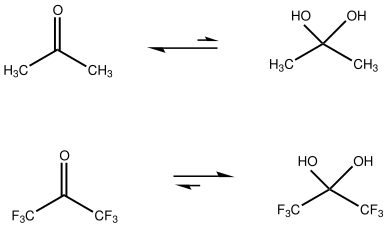
The equilibrium for the hydration of a ketone to form a gem-diol hydrate is known to be highly sensitive to substituents. Consider the two equilibria:

For propanone, it lies almost entirely on the left, whereas for the hexafluoro derivative it is almost entirely on the right. The standard answer to this is that electron-withdrawing substituents destabilize the carbonyl compound more than the hydrate. But could there be more to it than that? Might the converse also be true, that electron-withdrawing substituents stabilise the hydrate more than the carbonyl compound? To answer this last question, consider the anomeric interactions possible in the diol.

  1. There is the standard anomeric effect operating between the two hydroxy groups, whereby a lone pair donor on one oxygen interacts with the C-O acceptor bond of the other oxygen, and vice versa, a total of two stabilising interactions.
  2. But what if the C-CF3 group could also act as an acceptor instead of the C-O? That would give the trifluoromethyl system a total of four anomeric interactions, each of them stabilising, compared to only two for the methyl system.

Garnering evidence, firstly we compute (ωB97XD/6-311G(d,p) ) the free energy difference for the two equilibria above. These turn out to be +3.3 kcal/mol for the top equilibrium, and -9.0 kcal/mol for the bottom, which agrees with the assertions made earlier. The computed geometry looks as below.

Geometry of hydrate. Click for 3D.

We must now go hunting for anomeric interactions, and this is done using an NBO analysis. We look for large interactions between a donor (a lone pair on either oxygen) and an acceptor (which is conventionally the C-O anti-bonding NBO, but can now also be the C-CFanti-bonding NBO). Indeed exactly four large interactions are found, in pairs of E(2) = 17.5 and 9.8 kcal/mol. The former is common to both the systems above, but the latter is larger for the trifluoromethyl substituted equilibrium than the methyl system (for which E(2) is 6.2 kcal/mol), and therefore constitutes additional stabilisation by the electron-withdrawing groups of the diol.

Each oxygen has two lone pair NBO orbitals. The initial hypothesis is surely that it uses one of these to align with a C-O anti bonding acceptor, and the other to align with the C-CF3 anti bonding acceptor. The first of these is shown below.

The interaction between an O(Lp) and a O-C BD* orbital. Click for 3D.

  1. The colour code is that the two phases of the oxygen lone pair (Lp) are shown as purple/orange.
  2. These are superimposed upon the C-O anti bonding NBO (referred to as BD* in the output), which has the colours red and blue.
  3. I advise you now to click on the graphic above to load the 3D model and the orbital surfaces. You should spot the node along the C-O bond with a blue-red boundary.
  4. You will also spot that the orange phase of the Lp overlapping with the red phase of the C-O BD*. This is defined as a positive (stabilizing) overlap.
  5. Likewise the purple phase of the Lp overlaps with the blue phase of the C-O BD*. In other words orange=red, and purple=blue. I have made orange and red, and purple and blue deliberately different so that the origins of each NBO can be spotted.
  6. This combination therefore has good overlap, and this gives rise to the large E(2) interaction energy of 17.5 kcal/mol.
Now for the interaction with the C-CF3 BD*, the one with E(2) = 9.8 kcal/mol.

The interaction between an O(Lp) and a C-CF3 BD* orbital. Click for 3D.

  1. You can see the blue-red node along the C-CF3 bond quite clearly.
  2. But hang on, the O Lp orbital is the same as before! It is overlapping with BOTH the C-O and the C-CF3 BD* orbitals.

The other O Lp is shown below (viewed along the axis of the C-CF3 bond). Note how an equal proportion of the orange phase and the other purple phase of the O Lp overlap equally with the blue phase of the C-CF3 bond. In other words, one cancels the other.

The interaction between the other O(Lp) and a C-CF3 BD* orbital. Click for 3D.

So we have found that just one (of the two lone pairs) on each oxygen overlaps with both the C-O and the C-CF3 anti bonding NBOs, the latter giving a stabilisation not present when the group is instead C-CH3. We can attribute this to the far greater acceptor properties of the C-CF3 BD* because of the electronegative character of the fluorines.

This is an anomeric effect with a difference. The CF3 group is not normally associated with inducing such an effect (just as the CN group is not, see this post or this post where an alkene acts the donor instead of a lone pair). Also unusual (more accurately, I have not encountered it before) is the (apparent) use of the SAME donor lone pair to induce TWO quite different anomeric interactions. Before getting too excited by this unexpected effect, it it is worth taking a look at another technique for analysing lone pairs. The ELF (electron localisation function) can provide the centroid of what is referred to as a monosynaptic basin (a lone pair in other words).

EKF function, showing O Lone pairs (in yellow). Click for 3D.

You can see in yellow the oxygen lone pairs. Note how one of them aligns with the C-O bond, and the other with the C-CFbond. Unfortunately, the ELF method does not allow the strength of the interaction to be quantified, which is why the NBO analysis is preferred.

So we can conclude that not only might electron-withdrawing substituents destabilize the carbonyl compound more than the hydrate, but they certainly also stabilise the hydrate more than the carbonyl compound.

The mysteries of stereoinduction.

Thursday, July 1st, 2010

Stereo-induction is, lets face it, a subtle phenomenon. The ratio of two stereoisomers formed in a reaction can be detected very accurately by experiment, and when converted to a free energy difference using ΔG = -RT Ln K, this can amount to quite a small value (between 0.5 – 1.5 kcal/mol). Can modelling reproduce effects originating from such small energy differences? Well one system that has been argued about now for several decades is shown below as 1.

Norbornene systems

Way back in 1992, we thought that the explanation for attack by an electrophile on the alkene from the syn face was electrostatic (although it did depend on the nature of the electropile; thus we concluded that attack by Hg(OH)2 was electrostatic, but by BH3 was orbital controlled). Recently, a different explanation has emerged, relating to how the fundamental normal vibrational modes of the molecule interact with the transition normal mode for the reaction. A new example of this, relating to reaction of the isomeric 2 with a peracid has recently been discussed on Steve Bachrach’s blog. Here, the peroxide of the peracid is thought to act as an electrophile (although one must bear in mind that it does bear two electron lone pairs!). The conclusion was pretty clear cut; the experimental preference for syn (92%) over the anti isomer (8%, ΔΔG = 1.4 kcal/mol) was NOT due to electrostatic effects, but due to distorsional asymmetry in the vibrational mode that couples/forms the transition state mode.

I could not resist revisiting this system. As in 1992, a molecular electrostatic potential was calculated for 2. The method used was wB97XD/aug-cc-pvdz, and if you want the archive of this calculation to evaluate it yourself, see here).

MEP for 2. Click on diagram for 3D.

A very clear electrostatic bias for syn attack emerges (orange = attractive to a proton=electrophile). This electrostatic picture is not directly related to any distortional asymmetry, although of course both could arise from the same electronic factors. They may indeed be different manifestations of the same underlying nature of the wavefunction. But I would claim here that to make the clear statement that electrostatic effects are NOT responsible for the discrimination in this reaction is perhaps too simplistic (electrostatic potentials were not reported in the original article). The control experiment is 3, which is known to be far less selective. The calculated electrostatic potential likewise shows much less discrimination.

The norbornene with a four-membered ring

Is there another take on 2? Well, how about an NBO (natural bond order) analysis? The interaction energy between the filled C1-C2 orbital and the antibonding C15-C16 π* bond is 3.24. This could be regarded as pushing electrons into the anti-periplanar syn face of the alkene. The corresponding C2-C9/C15-C16 interaction resulting in an anti-preference is less at 2.55 kcal/mol. This effect arises because the C1-C2 bond (localised as an NBO) is a better donor (E=-17.8eV) than C2-C9 (E=-18.1eV). Because C2 is common to both, it must be the difference between C1 and C9 (i.e. the hybridization of each). Perhaps it’s an orbital effect after all?

Norbornene electrostatic potential

I would conclude by saying that it can be ferociously difficult to identify the fundamental origins of stereo-induction. But I leave the argument in the hands of the reader now. What do you think?