Posts Tagged ‘Hydroxides’

Azane oxide, a tautomer of hydroxylamine.

Friday, April 15th, 2016

In the previous post I described how hydronium hydroxide or H3O+…HO, an intermolecular tautomer of water, has recently been observed captured inside an organic cage[1] and how the free-standing species in water can be captured computationally with the help of solvating water bridges. Here I explore azane oxide or H3N+-O, a tautomer of the better known hydroxylamine (H2N-OH).

The usual search[2] of the Cambridge structure database reveals only two (related) entries[3],[4] the second reported in 2015.[5].

NH3-8
NH3-8

Now, location of hydrogen atoms is always a bit tricky, but here we see two species H3N+-OH…O-+NH3 connected by a strong hydrogen bond of 1.54Å (click on the above image to see this packing). However, it is noteworthy that the N-O bonds for each of these species are exactly the same length (1.412Å); one might have imagined that whether the oxygen carries a proton or not would affect its bond length to nitrogen. There is here a strong hint that energetically the azane oxide might be relatively low in energy relative to hydroxylamine and perhaps that the zwitterionic form might be favoured when captured with hydrogen bonds.

So certainly time for a computational exploration of this species. I am using the three water bridges as before, each comprised of three water molecules and the ωB97XD/6-311++G(d,p)/SCRF=water method. In fact the structure optimises[6] to a delightful propeller-like geometry in which bridges are formed from both two AND three waters across the ion-pair, with overall three-fold C3 symmetry (i.e. chiral! Indeed, this species has a predicted optical rotation of 40° at 589nm).

NH3-8

Hydroxylamine itself has a less symmetric arrangement of hydrogen bonds[7], with a free energy in fact very similar (within 1 kcal/mol) to the ion-pair isomer. Here, a stochastic (statistical) exploration of all the various arrangements of water would be needed to be confident that the lowest energy form had been located. I would note that the N-O bond lengths in the ion-pair and neutral forms are respectively 1.399 and 1.435Å.

NH3-8

Certainly, this very brief computational look at azane oxide suggests that concentrations of this species in aqueous solutions of hydroxylamine might be appreciable (detectable). Its "trapping" inside a suitably designed cavity must be a realistic possibility (the cavity used to trap hydronium hydroxide probably does not have the correct dimensions for this purpose), as indeed illustrated in the two crystal structures noted above.


I have represented this species in ionic form, but you may find text books showing it in dative form, or H3N→O. My personal inclination is to always prefer the ionic form, if only because it enables connections/analogies such as the one here to hydronium hydroxide to be more easily made.

References

  1. M. Stapf, W. Seichter, and M. Mazik, "Unique Hydrogen‐Bonded Complex of Hydronium and Hydroxide Ions", Chemistry – A European Journal, vol. 21, pp. 6350-6354, 2015. https://doi.org/10.1002/chem.201406383
  2. H. Rzepa, "Search for Azane oxide", 2016. https://doi.org/10.14469/hpc/380
  3. Fischer, Dennis., Klapotke, Thomas M.., and Stierstorfer, Jorg., "CCDC 1054611: Experimental Crystal Structure Determination", 2015. https://doi.org/10.5517/cc14ddqn
  4. Fischer, D.., Klapotke, T.M.., and Stierstorfer, J.., "CCDC 827687: Experimental Crystal Structure Determination", 2012. https://doi.org/10.5517/ccws8lh
  5. D. Fischer, T.M. Klapötke, and J. Stierstorfer, "1,5‐Di(nitramino)tetrazole: High Sensitivity and Superior Explosive Performance", Angewandte Chemie International Edition, vol. 54, pp. 10299-10302, 2015. https://doi.org/10.1002/anie.201502919
  6. H.S. Rzepa, "H 21 N 1 O 10", 2016. https://doi.org/10.14469/ch/192000
  7. H.S. Rzepa, "H 21 N 1 O 10", 2016. https://doi.org/10.14469/ch/192001

How many water molecules does it take to form ammonium hydroxide from ammonia and water?

Sunday, March 20th, 2016

This is a corollary to the previous post exploring how many molecules are needed to ionise HCl. Here I am asking how many water molecules are required to form the ionic ammonium hydroxide from ammonia and water.

As Wikipedia will inform you, "it is actually impossible to isolate samples of NH4OH (more formally the ion-pair NH4+OH ) as these ions do not comprise a significant fraction of the total amount of ammonia except in extremely dilute solutions (my italics)". In fact, the ionization constant Kb = [NH4+][OH]/[NH3][H2O] is ~1.8 x 10⁻⁵ (pKb 4.75) equivalent to a free energy difference of  ~6.5 kcal/mol between the two forms. This is in stark contrast to solutions of e.g. HCl in water, where essentially all of the HCl is ionised to hydronium chloride or H3O+Clby addition of just ~4-5 water molecules. So what is the water model required to compute this known behaviour of ammonia? Here, this will be ωB97Xd/Def2-TZVPPD/SCRF=water, i.e. a continuum water model is already included and we add n further discrete water molecules to enhance it.

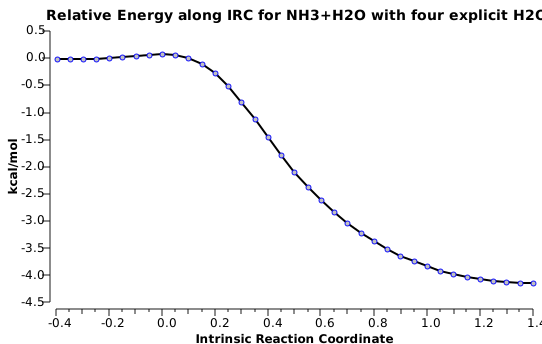
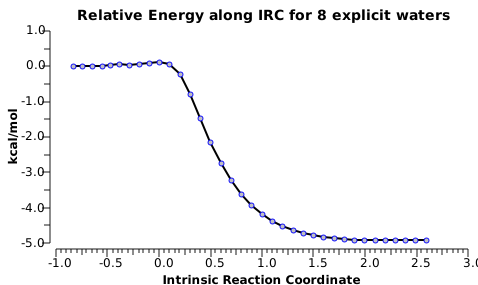
For n=0 or 2, the ion-pair is not an explicit minimum (although it appears to be a "hidden intermediate"[1]). Values of e.g. n=4,6,8 allow the formation of two or three "bridges" comprising two or three water molecules connecting the N and O atoms by hydrogen bonds and this additional solvation enables location of a transition state for proton transfer between O and N. This implies an equilibrium can be established as NH3 + H2O ⇌* NH4+.OH with the ion-pair now a genuine minimum stabilized by those ion-pair bridges. Note in particular how the hydrogen bond lengths involving the water salt-bridge in the ion-pair are shorter than for the neutral water-ammonia complex.

NH3-8

The contact ion-pair is nevertheless a very shallow minimum when surrounded by 4 or more explicit waters, the barrier from proton transfer from N being less than a vibrational quantum, and so the lifetime of the contact ion-pair is very much defined by the proton dynamics of the system..

4

8

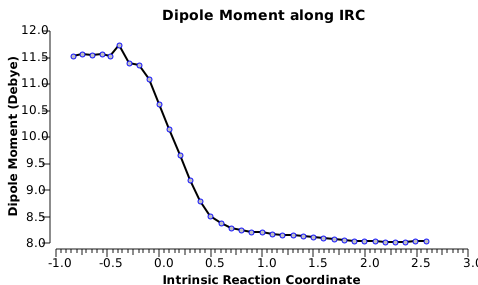
For n=8, the dipole moment changes along the IRC for proton transfer between N and O as might be expected for the collapse of a contact ion-pair.

8dm

The relative free energies of the ion-pair and the un-ionized pair are shown below, the former being the higher. The values correspond approximately to the known ionization constant. As more explicit water molecules are added, there is a hint that the proportion of ion-pairs might actually decrease relative to neutral ammonia. However, these calculations are for a contact ion-pair and not a solvent-separated ion pair, the latter form possibly being the more appropriate form for extremely dilute solutions (see above). Modelling the latter type of ion-pair is not as straightforward as the contact variety;  as the ion separation increases, so the propensity for barrierless proton transfers increases, ultimately leading back to the contact form. So to understand if it is correct that in extremely dilute solutions there is no remaining neutral ammonia, probably only a full molecular dynamics treatment of such a system is likely to give further insights.

n 4 6 8
 ΔΔG298 6.4[2] 5.9[3] 7.0[4]

To summarise, in order to compute the formation of the ammonium hydroxide ion pair from ammonia and water, one has to include an additional four or more explicit water molecules in the calculation. This model confirms that in the resulting equilibrium, only a tiny proportion of the ammonia becomes ionised. With such a base model in place, one can now proceed to investigate how addition of substituents on the nitrogen might impact upon such ionisation, i.e. to form a stronger or a weaker base.


A more complete analysis followed.[5] *If you are wondering how to produce a reversible arrow, see here. This is only approximate, since the concentration of water needs renormalising.


References

  1. https://doi.org/
  2. H.S. Rzepa, and H.S. Rzepa, "H13NO5", 2016. https://doi.org/10.14469/ch/191950
  3. https://doi.org/
  4. H.S. Rzepa, and H.S. Rzepa, "H21NO9", 2016. https://doi.org/10.14469/ch/191946
  5. A. Vargas‐Caamal, J.L. Cabellos, F. Ortiz‐Chi, H.S. Rzepa, A. Restrepo, and G. Merino, "How Many Water Molecules Does it Take to Dissociate HCl?", Chemistry – A European Journal, vol. 22, pp. 2812-2818, 2016. https://doi.org/10.1002/chem.201504016