Posts Tagged ‘Ion’

Cyclopropenium cyclopentadienide: a strangely neutral ion-pair?

Sunday, April 9th, 2017

Both the cyclopropenium cation and the cyclopentadienide anion are well-known 4n+2-type aromatic ions, but could the two together form an ion-pair?

A search of the Cambridge structure database reveals 52 instances of the cyclopropenium cation with a variety of counter-anions, 77 cyclopentadienide anions with a variety of counter-cations and one (SOWMOG, private communication to CSD) where the two sub-structures are common. The pyridinium-cyclopropenium fragment is actually a di-cation stabilized with dimethylamino substituents, with these charges balanced by two cyclopentadienide anions stabilized with ester substituents. The stacking distance between the ion-pairs is ~3.5-3.6Å, a bit larger than normal π-π stacking distances of 3.2-3.3Å

So could a “pure” cyclopropenium cyclopentadienide ion-pair exist, and if so what would its π-π stacking distance be? A ωB97XD/Def2-TZVPPD/SCRF=water calculation (DOI: 10.14469/hpc/2442) provides one answer to this question; 2.57Å! It is a true minimum in the potential energy surface (all +ve force constants) with a calculated dipole moment of only 7.57D. This species is “only” 27.1 kcal/mol higher in ΔG than the neutral hydrocarbon (DOI: 10.14469/hpc/2443), a difference which is as low as it is because of the gain in aromatic stabilization of two rings upon ion-pair formation.

A few posts back, I was considering candidates for the most polar neutral compound synthesized and I suggested a candidate with a dipole moment of ~22D, based as it happens on cyclopropenium and cyclopentadienide rings directly connected by a bond. So when this bond is removed and the two rings are allowed to stack one above the other, we now have an interesting inversion of the original challenge: what is the least-polar ionic organic compound (ionic in the sense of being an unconnected ion-pair)?

Here are some more properties of this intriguing “neutral” ion-pair.

  1. It has a number of low-frequency modes with correspond to the two rings moving with respect to each other (ν 216 cm-1)
  2. The molecular electrostatic potential illustrates the sense of polarization, with negative region (orange) residing on the 5-membered ring:
  3. The most stable π-type molecular orbital (below) reminds of the π-complex formed in the benzidine rearrangement and that in fact modelling this ion-pair may require a multi-reference (CASSCF) wavefunction, with the single-determinantal one used here only being a first approximation.
  4. A QTAIM analysis of the electron density topology shows only weak “bond” connectors between the two rings, with ρ(r) being typical of weak interactions such as hydrogen bonds.
  5. An ELF (electron localisation function) analysis also holds no surprises, with all the electron density basins (purple) confined to the two rings, just as expected of an ion-pair.
  6. I will leave one further question to a future discussion; what happens to the aromaticity and ring currents of the two individual rings as they combine to form this ion-pair? Might this property be connected to the very close separation between the two rings?

So we have a remarkably “neutral” ionic hydrocarbon to match the “ionic” neutral organic molecules previously discussed. This ion-pair may yet prove to have interesting properties, even if is unlikely to be synthesized without the addition of stabilising substituents.


For example, the stacking distance in graphite is 3.35Å.

More tetrahedral fun. Spherical aromaticity (and other oddities) in N4 and C4 systems?

Thursday, March 2nd, 2017

The thread thus far. The post about Na2He introduced the electride anionic counter-ion to Na+ as corresponding topologically to a rare feature known as a non-nuclear attractor. This prompted speculation about other systems with such a feature, and the focus shifted to a tetrahedral arrangement of four hydrogen atoms as a dication, sharing a total of two valence electrons. The story now continues here.

What emerged during comments about H42+ was that a density functional (DFT) derived wavefunction seemed to predict it to be a stable minimum, but that wavefunctions derived from coupled cluster or CASSCF methods predicted it to be a three-fold degenerate transition state instead. So I asked myself if perhaps other similar tetrahedral molecules less susceptible to such method ambiguity might be found. Here I record some of the species I investigated. 

  1. N4 in a tetrahedral allotropic arrangement of the element (ωB97XD/Def2-TZVPP DFT method: 10.14469/hpc/2217 and CCSD(T)/Def2-TZVPP 10.14469/hpc/2216). I found this intriguing, because each nitrogen has a lone pair of electrons and such an arrangement of eight electrons might be spherically aromatic according to the rule: 2(n+1)2, where n=1[1]. Nitself is indeed a true minimum (rN-N  1.460Å) with all positive force constants at both the DFT (767, 1005 and 1443) and CCSD(T) (726, 940 and 1304 cm-1) levels, but with a free energy ~185 kcal/mol higher than dinitrogen. The electronic topology is uneventfully classical, with six line (bond) critical points along each N-N axis (magenta), four ring critical points (green) and one cage point (inner blue sphere); there is no non-nuclear attractor present.The NICS value at the centre of the tetrahedron (coincident with the cage critical point) is -73 ppm, which does suggest aromaticity.
  2. C4 in a tetrahedral allotropic arrangement of this element is also a minimum as closed shell singlet (rC-C 1.646Å) again with positive force constants (ωB97XD/Def2-TZVPP DFT, 10.14469/hpc/2224, 434, 715, 1052 cm-1) and the same electronic topology as N4.
    The magnetic shielding at the ring centre is -1685 ppm, a value clearly perturbed by core ring currents or other factors; the molecule does not map to the 2(n+1)2 spherical aromaticity rule, which only allows values of 2,8,18, 32… electrons. I tried applying the ELF procedure using the computed WFN file (either direct or symmetrised, using both TopMod and MultiWFN) but the results did not have Td symmetry.
  3. C42+ with two fewer electrons is also a minimum as a closed shell singlet (rC-C 1.521Å) tetrahedral species (ωB97XD/Def2-TZVPP: 10.14469/hpc/2218, 1132, 1136, 1448 cm-1; CCSD(T)/Def2-TZVPP 10.14469/hpc/2225 showing rather different normal mode energies of ~330, 592, 1126 cm-1 ) which can be thought as mapping to the spherical aromaticity formula 2(n+1)2, where n=0. The electronic topology is slightly different from C4 itself, with four ring points (green) very close to the cage point in the centre.The ELF function now behaves itself in terms of symmetry, and produces a result in fact very similar to the H42+ molecule which started this topic rolling. There is an ELF basin with 0.14e located in the centroid and six equivalent basins (2.25e) spanning each pair of carbon atoms, although these C-C bonds are hugely banana shaped! That central electron basin closely resembles the one found in H42+ itself. The magnetic shielding at the centre of 3349 ppm is not meaningful in deciding if the molecule is indeed “aromatic”.
  4. C41-  is again a tetrahedral minimum, this time as a quartet 4A1 state (ωB97XD/Def2-TZVPP: 10.14469/hpc/2219, 918, 1024, 1377 cm-1; CCSD(T)/Def2-TZVPP 10.14469/hpc/2237, 824, 895, 1303 cm-1). The electronic topology is the same as before.Open shell spherical aromaticity[2] is given by the 2N2 + 2N + 1 (with S = N + ½) rule. A quartet state has S=3/2, hence N=1 and the formula stipulates 5 delocalizable electrons for aromaticity, which this species has! The isotropic magnetic shielding is 695 ppm, which again is not immediately helpful.The ELF analysis ((above) shows just two types of basin, with four “lone pairs” at each carbon vertex (1.24e) and eight associated with the C-C “bent” bonds (1.95e). 

What did I learn?

  • Firstly, that the (very unstable) tetrahedral allotrope of nitrogen might be a spherical aromatic.
  • Secondly, that tetrahedral closed-shell singlet C4 has a very odd wavefunction; this needs further work.
  • Thirdly that tetrahedral C42+  closely resembles H42+  in having a basin of electrons at the very centre, but that unlike H42+ it does appear to be a stable minimum.
  • Finally, that the radical anion C4 might be perhaps the smallest possible example of an open shell spherical aromatic.

And perhaps also in trying to answer some simple questions, I have also raised several more puzzles. Onwards and occasionally upwards.


This wavefunction is clearly odd, and needs further analysis.

References

  1. A. Hirsch, Z. Chen, and H. Jiao, "Spherical Aromaticity inIh Symmetrical Fullerenes: The 2(N+1)2 Rule", Angewandte Chemie, vol. 39, pp. 3915-3917, 2000. https://doi.org/10.1002/1521-3773(20001103)39:21<3915::aid-anie3915>3.0.co;2-o
  2. J. Poater, and M. Solà, "Open-shell spherical aromaticity: the 2N2 + 2N + 1 (with S = N + ½) rule", Chemical Communications, vol. 47, pp. 11647, 2011. https://doi.org/10.1039/c1cc14958j

How many water molecules does it take to form ammonium hydroxide from ammonia and water?

Sunday, March 20th, 2016

This is a corollary to the previous post exploring how many molecules are needed to ionise HCl. Here I am asking how many water molecules are required to form the ionic ammonium hydroxide from ammonia and water.

As Wikipedia will inform you, "it is actually impossible to isolate samples of NH4OH (more formally the ion-pair NH4+OH ) as these ions do not comprise a significant fraction of the total amount of ammonia except in extremely dilute solutions (my italics)". In fact, the ionization constant Kb = [NH4+][OH]/[NH3][H2O] is ~1.8 x 10⁻⁵ (pKb 4.75) equivalent to a free energy difference of  ~6.5 kcal/mol between the two forms. This is in stark contrast to solutions of e.g. HCl in water, where essentially all of the HCl is ionised to hydronium chloride or H3O+Clby addition of just ~4-5 water molecules. So what is the water model required to compute this known behaviour of ammonia? Here, this will be ωB97Xd/Def2-TZVPPD/SCRF=water, i.e. a continuum water model is already included and we add n further discrete water molecules to enhance it.

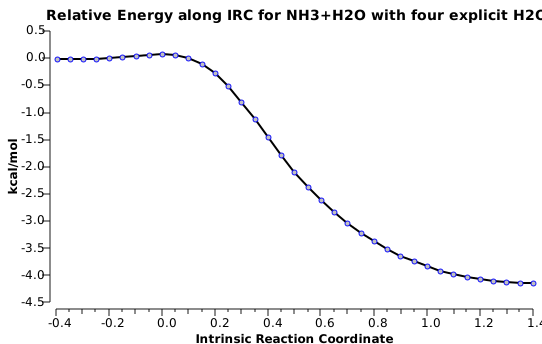
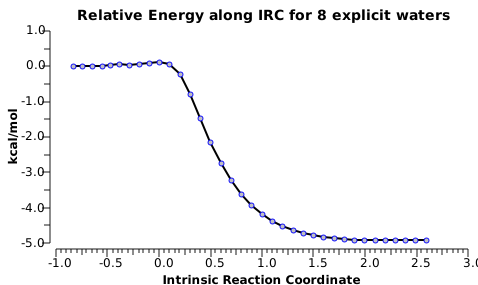
For n=0 or 2, the ion-pair is not an explicit minimum (although it appears to be a "hidden intermediate"[1]). Values of e.g. n=4,6,8 allow the formation of two or three "bridges" comprising two or three water molecules connecting the N and O atoms by hydrogen bonds and this additional solvation enables location of a transition state for proton transfer between O and N. This implies an equilibrium can be established as NH3 + H2O ⇌* NH4+.OH with the ion-pair now a genuine minimum stabilized by those ion-pair bridges. Note in particular how the hydrogen bond lengths involving the water salt-bridge in the ion-pair are shorter than for the neutral water-ammonia complex.

NH3-8

The contact ion-pair is nevertheless a very shallow minimum when surrounded by 4 or more explicit waters, the barrier from proton transfer from N being less than a vibrational quantum, and so the lifetime of the contact ion-pair is very much defined by the proton dynamics of the system..

4

8

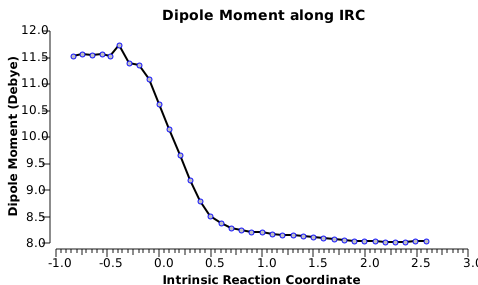
For n=8, the dipole moment changes along the IRC for proton transfer between N and O as might be expected for the collapse of a contact ion-pair.

8dm

The relative free energies of the ion-pair and the un-ionized pair are shown below, the former being the higher. The values correspond approximately to the known ionization constant. As more explicit water molecules are added, there is a hint that the proportion of ion-pairs might actually decrease relative to neutral ammonia. However, these calculations are for a contact ion-pair and not a solvent-separated ion pair, the latter form possibly being the more appropriate form for extremely dilute solutions (see above). Modelling the latter type of ion-pair is not as straightforward as the contact variety;  as the ion separation increases, so the propensity for barrierless proton transfers increases, ultimately leading back to the contact form. So to understand if it is correct that in extremely dilute solutions there is no remaining neutral ammonia, probably only a full molecular dynamics treatment of such a system is likely to give further insights.

n 4 6 8
 ΔΔG298 6.4[2] 5.9[3] 7.0[4]

To summarise, in order to compute the formation of the ammonium hydroxide ion pair from ammonia and water, one has to include an additional four or more explicit water molecules in the calculation. This model confirms that in the resulting equilibrium, only a tiny proportion of the ammonia becomes ionised. With such a base model in place, one can now proceed to investigate how addition of substituents on the nitrogen might impact upon such ionisation, i.e. to form a stronger or a weaker base.


A more complete analysis followed.[5] *If you are wondering how to produce a reversible arrow, see here. This is only approximate, since the concentration of water needs renormalising.


References

  1. https://doi.org/
  2. H.S. Rzepa, and H.S. Rzepa, "H13NO5", 2016. https://doi.org/10.14469/ch/191950
  3. https://doi.org/
  4. H.S. Rzepa, and H.S. Rzepa, "H21NO9", 2016. https://doi.org/10.14469/ch/191946
  5. A. Vargas‐Caamal, J.L. Cabellos, F. Ortiz‐Chi, H.S. Rzepa, A. Restrepo, and G. Merino, "How Many Water Molecules Does it Take to Dissociate HCl?", Chemistry – A European Journal, vol. 22, pp. 2812-2818, 2016. https://doi.org/10.1002/chem.201504016