Posts Tagged ‘Enantioselective’

Why the Sharpless epoxidation is enantioselective!

Monday, December 17th, 2012

Part one on this topic showed how a quantum mechanical model employing just one titanium centre was not successful in predicting the stereochemical outcome of the Sharpless asymmetric epoxidation. Here in part 2, I investigate whether a binuclear model might have more success. The new model is constructed using two units of Ti(OiPr)4, which are likely to assemble into a dimer such as that shown below (in this crystal structure, some of the iPr groups are perfluorinated).

WAWBUR. Click for 3D

WAWBUR. Click for 3D

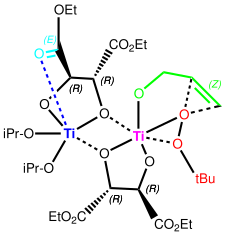
This allows one to construct a transition state model as follows.
sharpless-binuclear

  1. Two iPrOH molecules are displaced by diethyl tartrate for each half of the Ti2(OiPr)8, with the two metals then becoming bridged by one oxygen from each tartrate. 
  2. Two further iPrOH are then displaced from the second Ti by one of the substrate (allyl alcohol) and one of the oxidant (t-butyl peroxide).
  3. The oxygen transfer now proceeds via the second (hexacoordinate) Ti. The first Ti also achieves hexa-coordination via the carbonyl oxygen of one of the tartrate ester groups. It is the geometric properties of such a hexa-coordinated Ti that in part accounts for the subtle properties of this system. Put more simply, the extra crowding at the catalytic centre of the binuclear complex restricts the space available for the transition state, making it more selective for producing one enantiomer of the epoxide.

The (ωB97XD/6-311G(d,p)/SCRF=dichloromethane) optimised geometries are shown below. The reaction centre is shown in a magenta box for the disfavoured (R) epoxide and in green for the favoured (S) epoxide (the hydrogens are not shown for clarity; if you want to see them, click on the image to get the 3D model).

(R). Click for 3D.

(S). Click for 3D

(S). Click for 3D

You can see immediately that the biggest differences between the two occur in the bottom right corner. The t-butyl-O-O group folds in for (S) and this has a knock on effect on the two ester groups of the bottom right tartrate (the disposition of the tartrate on the top left is hardly changed). This folding is mediated by the hexa-coordination of the catalytic metal centre, together with dispersion interactions occurring to the t-butyl group, and this is helped by buttressing from the second Ti centre and its substituents.

The free energy difference ΔΔG298 favours the (S) for over the (R) by 3.0 kcal/mol. This free energy difference corresponds to an enantiomeric excess of >99%. In terms of attractive dispersion forces alone, (S) is favoured over (R) by -2.6 kcal/mol, and hence attractive dispersion seems to be the dominant term distinguishing between the two diastereomeric transition states. This aspect of non-covalent-interactions will be investigated in another post.

KOGYEK. Click for 3D.

KOGYEK, a Ti oligomer. Click for 3D.

One should however finally ask if this is the best model?

  1. Not all conformations have been explored in these models, although (S) was built from (R) as a template, so many features are the same. Nevertheless, further conformational exploration may be useful.
  2. Alkoxytitaniums are known to also form higher oligomers, such as the one shown above.[1]. If their concentration is significant, these too might be catalysing the reaction. Only computation would establish if they are capable of greater stereoselectivity/faster kinetics.

So we could end up with an answer that a number of oligomeric transition states are involved. But the one presented here, if not necessarily the most accurate or “best” model, seems good enough to form a template for further exploratory computation to see if the enantioselectivity of the reaction might be improved upon further.

References

  1. V.W. Day, T.A. Eberspacher, W.G. Klemperer, C.W. Park, and F.S. Rosenberg, "Solution structure elucidation of early transition metal polyoxoalkoxides using oxygen-17 NMR spectroscopy", Journal of the American Chemical Society, vol. 113, pp. 8190-8192, 1991. https://doi.org/10.1021/ja00021a068
Why is the Sharpless epoxidation enantioselective? Part 1: a simple model.

Sunday, December 9th, 2012

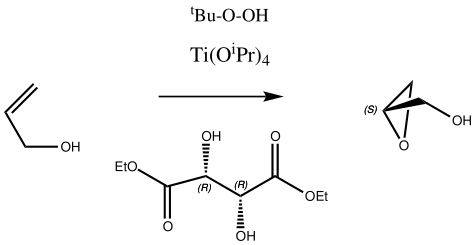
Sharpless epoxidation converts a prochiral allylic alcohol into the corresponding chiral epoxide with > 90% enantiomeric excess[1],[2]. Here is the first step in trying to explain how this magic is achieved.

The scheme above shows how (achiral) prop-2-enol is converted using the asymmetric catalyst (R,R)-diethyl tartrate  and t-butyl hydroperoxide as oxidant into the (S)-chiral epoxide. The first step is to try to construct a simple model for the reaction, and in this post I will start by using one titanium as the core of the stage on which these actors will perform. This is the mononuclear model. One can simply envisage that a molecule of tartrate displaces two iPrOH molecules from Ti(OiPr)4 in an ester exchange to form a Ti(OiPr)2(tartrate) complex. The remaining two iso-propanols are then replaced by one molecule each of prop-2-enol and tBu-OOH. Now we have the species Ti(OOtBu)(O-CH2CH=CH2)(tartrate) as the starting point from which a transition state for oxygen transfer to the alkene to form the (S) epoxide (for R,R tartrate) can be constructed (ωB97XD/6-311G(d,p)/SCRF=dichloromethane model).

Mononuclear TS for S-epoxide. Click for 3D.

Mononuclear TS for R-epoxide. Click for 3D.

IRC for mononuclear model showing oxygen atom transfer

The transition state leading to (S) epoxide emerges as 0.86 kcal/mol higher in ΔG than the (R), contrary to the experimental result where (S) is formed with high specificity[1]. Inspecting the model, it is clear that the allylic alcohol substrate sits in a very open pocket un-encumbered by any nearby groups (bottom right in the animation above) and so the lack of π-facial selectivity is perhaps not surprising.

To elaborate the model, I will turn to a crystal structure determined for a Ti complex bearing a t-butyl peroxy group[3], showing it to be a binuclear complex (magenta arrows indicate the peroxy groups) with bridging oxygen atoms.

ZUKJIY. Click for 3D

In the follow-up post,  we will see whether these binuclear models can do better at explaining the enantioselectivity of the Sharpless reaction.


See this post for an example of such “single-site” catalysis using Mg or this article for an example using silver[4].

A binuclear Zn catalyst with similar oxy-bridges is used to co-polymerise epoxides themselves with carbon dioxide[5]. Many such binuclear complexes are known.

The other element for which a number of examples of such t-butyl peroxy bonding are known is oddly enough, lithium.[6]

MUKVAQ. Click for 3D.


Postscript: Two lower energy conformations for the S and R transition states have been found, the latter being 1.6 kcal/mol lower in free energy. 

S R
S-new R-new

References

  1. J.M. Klunder, S.Y. Ko, and K.B. Sharpless, "Asymmetric epoxidation of allyl alcohol: efficient routes to homochiral .beta.-adrenergic blocking agents", The Journal of Organic Chemistry, vol. 51, pp. 3710-3712, 1986. https://doi.org/10.1021/jo00369a032
  2. R.M. Hanson, and K.B. Sharpless, "Procedure for the catalytic asymmetric epoxidation of allylic alcohols in the presence of molecular sieves", The Journal of Organic Chemistry, vol. 51, pp. 1922-1925, 1986. https://doi.org/10.1021/jo00360a058
  3. G. Boche, K. Möbus, K. Harms, and M. Marsch, "[((η<sup>2</sup>-<i>tert</i>-Butylperoxo)titanatrane)<sub>2</sub>· 3 Dichloromethane]:  X-ray Crystal Structure and Oxidation Reactions", Journal of the American Chemical Society, vol. 118, pp. 2770-2771, 1996. https://doi.org/10.1021/ja954308f
  4. J.L. Arbour, H.S. Rzepa, J. Contreras‐García, L.A. Adrio, E.M. Barreiro, and K.K.(. Hii, "Silver‐Catalysed Enantioselective Addition of OH and NH Bonds to Allenes: A New Model for Stereoselectivity Based on Noncovalent Interactions", Chemistry – A European Journal, vol. 18, pp. 11317-11324, 2012. https://doi.org/10.1002/chem.201200547
  5. A. Buchard, F. Jutz, M.R. Kember, A.J.P. White, H.S. Rzepa, and C.K. Williams, "Experimental and Computational Investigation of the Mechanism of Carbon Dioxide/Cyclohexene Oxide Copolymerization Using a Dizinc Catalyst", Macromolecules, vol. 45, pp. 6781-6795, 2012. https://doi.org/10.1021/ma300803b
  6. W. Uhl, M. Reza Halvagar, and M. Claesener, "Reducing GaH and GaC Bonds in Close Proximity to Oxidizing Peroxo Groups: Conflicting Properties in Single Molecules", Chemistry – A European Journal, vol. 15, pp. 11298-11306, 2009. https://doi.org/10.1002/chem.200900746