Posts Tagged ‘Cations’

Smoke and mirrors. All is not what it seems with this Sn2 reaction!

Thursday, April 4th, 2019

Previously, I explored the Graham reaction to form a diazirine. The second phase of the reaction involved an Sn2′ displacement of N-Cl forming C-Cl. Here I ask how facile the simpler displacement of C-Cl by another chlorine might be and whether the mechanism is Sn2 or the alternative Sn1. The reason for posing this question is that as an Sn1 reaction, simply ionizing off the chlorine to form a diazacyclopropenium cation might be a very easy process. Why? Because the resulting cation is analogous to the cyclopropenium cation, famously proposed by Breslow as the first example of a 4n+2 aromatic ring for which the value of n is zero and not 1 as for benzene.[1] Another example of a famous “Sn1” reaction is the solvolysis of t-butyl chloride to form the very stable tertiary carbocation and chloride anion (except in fact that it is not an Sn1 reaction but an Sn2 one!)
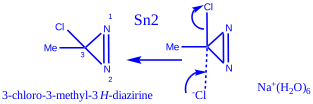
Here is the located transition state for the above, using Na+.6H2O as the counter-ion to the chloride. The calculated free energy of this transition state is 3.2 kcal/mol lower than the previous Sn2′ version (FAIR data collection, 10.14469/hpc/5045), with an overall barrier to reaction of 26.5 kcal/mol. This compares to ~24.5 kcal/mol obtained by Breslow for solvolysis of the cyclopropenyl tosylate. Given the relatively simple solvation model I used in the calculation (only six waters to solvate all the ions, and a continuum solvent field for water), the agreement is not too bad.

The animation above is of a normal vibrational mode known as the transition mode (click on the image above to get a 3D rotatable animated model). The calculated vectors for this mode (its energy being an eigenvalue of the force constant matrix) are regularly used to “characterise” a transition state. I will digress with a quick bit of history here, starting in 1972 when another famous article appeared.[2] The key aspect of this study was the derivation of the first derivatives of the energy of a molecule with respect to the (3N) geometrical coordinates of the atoms, using a relatively simply quantum mechanical method (MINDO/2) to obtain that energy. Analytical first derivatives of the MINDO/2 Hamiltonian were then used to both locate the transition state for a simple reaction and then to evaluate the second derivatives (the force constant matrix) using a finite difference method. That force constant matrix, when diagonalized, reveals one negative root (eigenvalue) which is characteristic of a transition state. The vectors reveal how the atoms displace along the vibration, and should of course approximate to the path to either reactant or product.

Since that time, it has been a more or less mandatory requirement for any study reporting transition state models to characterise them using the vectors of the negative eigenvalue. The eigenvalue invariably expressed as a wavenumber. Because this comes from the square root of the mass-weighted negative force constant, it is often called the imaginary mode. Thus in this example, 115i cm-1, the i indicating it is an imaginary number. The vectors are derived from quadratic force constants, which is a parabolic potential surface for the molecule. Since most potential surfaces are not quadratic, it is recognized as an approximation, but nonetheless good enough to serve to characterise the transition state as the one connecting the assumed reactant and product. Thousands of published studies in the literature have used this approach.

So now to the animation above. If you look closely you will see that it is a nitrogen and not a carbon that is oscillating between two chlorines (here it is the lighter atoms that move most). The vectors confirm that, with a large one at N and only a small one at C. So it is Sn2 displacement at nitrogen that we have located? 

Not so fast. This is a reminder that we have to explore a larger region of the potential energy surface, beyond the quadratic region of the transition state from which the vectors above are derived. This is done using an IRC (intrinsic reaction coordinate). Here it is, and you see something remarkable.

The Cl…N…Cl motions seen above in the transition state mode change very strongly in regions away from the transition state. On one side of the transition state, it forms a Cl…C bond, on the other side a Cl…N.
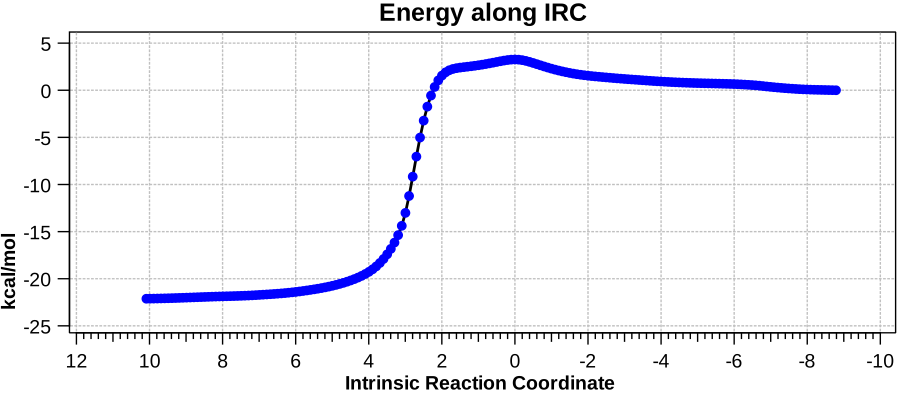
It is also reasonable to ask why the paths either side of the transition state are not the same? That may be because with only six explicit water molecules, three of which solvate the sodium ion, there are not enough to solvate equally the chloride anions either side of the transition state. As a result one chlorine does not behave in quite the same way as the other. The addition of an extra water molecule or two may well change the resulting reaction coordinate significantly.

The overall message is that there are two ways to characterise a computed reaction path. One involves looking at the motions of all the atoms just in the narrow region of the transition state. Most reported literature studies do only this. When the full path is explored with an IRC, a different picture can emerge, as here. The Cl…N…Cl Sn2 mode is replaced by a Cl…C/N…Cl mode. This example however is probably rare, with most reactions the transition state vibration and the IRC do actually agree!

References

  1. R. Breslow, "SYNTHESIS OF THE s-TRIPHENYLCYCLOPROPENYL CATION", Journal of the American Chemical Society, vol. 79, pp. 5318-5318, 1957. https://doi.org/10.1021/ja01576a067
  2. J.W. McIver, and A. Komornicki, "Structure of transition states in organic reactions. General theory and an application to the cyclobutene-butadiene isomerization using a semiempirical molecular orbital method", Journal of the American Chemical Society, vol. 94, pp. 2625-2633, 1972. https://doi.org/10.1021/ja00763a011
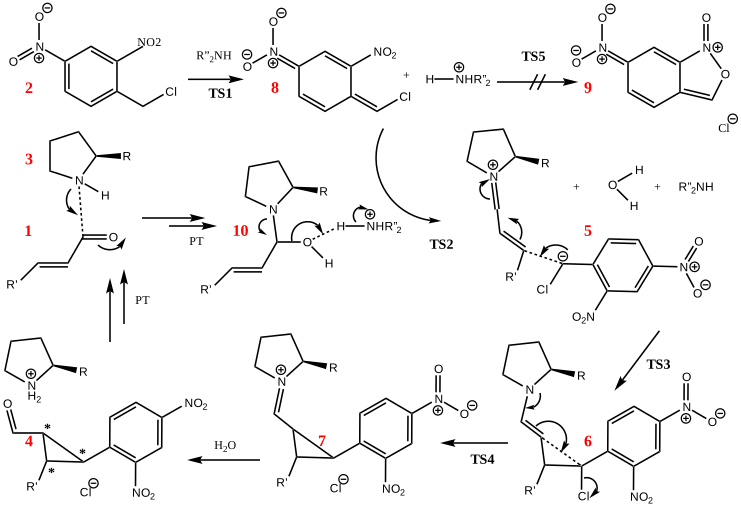
Organocatalytic cyclopropanation of an enal: (computational) mechanistic understanding.

Saturday, August 25th, 2018

Symbiosis between computation and experiment is increasingly evident in pedagogic journals such as J. Chemical Education. Thus an example of original laboratory experiments[1],[2] that later became twinned with a computational counterpart.[3] So when I spotted this recent lab experiment[4] I felt another twinning approaching.

The reaction under consideration is that between dec-2-enal and 2,4-dinitrobenzyl chloride as catalysed by an α,α-diphenylprolinol trimethylsilyl ester with addition of further base (di-isopropylamine?). The proposed mechanism can be seen in figure 7 of the journal article[4] and also scheme 2 of an earlier article.[5] The following is my interpretation of their published mechanism (the compound numbering is the same as in Figure 7).

  1. The initiating step is the condensation between the alkyl enal (1) and the prolinol derivative (3), with elimination of water and the formation of a positive iminium cation (5). One might wonder at this stage what the counter ion to this cation is.
  2. 5 then reacts with 2,4-dinitrobenzyl chloride (2) with apparent elimination of HCl to form 6. This corresponds to 1,4-Michael addition to 5 with the formation of the first new  C-C bond and the creation of two new stereogenic centres.
  3. 6 then cyclises to form a second new C-C bond and a third new stereogenic centre as in 7.
  4. 7 is then hydrolysed to give the final product 4.

A total of three (starred) stereogenic centres are therefore created in 4, implying 23 = 8 steroisomers, arranged as four diastereomers and their enantiomers. A computational mechanistic analysis might strive to cast light on the following questions.

  • Is the sequence shown in figure 7 reasonable? If not can a more reasonable cycle be constructed that has energetics corresponding to a facile reaction at 0°C?
  • What are the predicted relative yields of the four possible diastereomeric products and do they match those observed?
  • If  R=α,α-diphenylprolinol trimethylsilyl ester, then this fourth chiral centre increases the total number of stereoisomers to 16, arranged in eight pairs of diastereomers. Does this result in the diastereomers of 4 forming with an excess of one enantiomer over the other (an ee ≠ 0)?

This post addresses just the first question (R=R’=H, R”=isopropylamine) leaving the other two questions for later analysis.

My analysis (figure above) of the mechanism, as cast for computational analysis, differs in various details from Figure 7/Scheme 2 of the published articles.[4],[5]

  1. The issue of defining a counterion to 5 is solved by in fact starting the cycle with proton abstraction from 2 by di-isopropylamine to form a benzylic anion, as stabilized by the 2,4-dinitro groups and with the positive counter-ion being the protonated amine base.
  2. The next step is reaction between 1 and 3 to form an aminol 10, a tetrahedral intermediate.
  3. To remove water from this to form an iminium cation 5, one has to protonate the hydroxy group and this can now be done using the cationic ammonium species formed in step 5 above.
  4. The benzylic anion can now react with the iminium cation to form the first C-C bond and the first two stereocentres via 1,4-Michael addition to form 6
  5. The species 6 can now eliminate chloride anion to form the cyclopropyl iminium cation/anion pair 7, generating the 3rd stereogenic centre.
  6. Hydrolysis forms the product 4 and returns the system to the starting point in the catalytic cycle.
  7. Also included is whether an alternative mechanism is viable, involving elimination of Cl from 8 to form a “carbene”, which could then potentially add to the alkene in 1.

Species (transition state)

FAIR Data DOI
10.14469/hpc/4642

ΔG273.15, Hartree
(ΔΔG273.15, kcal/mol)

Structure
(click for 3D model)

Reactants -1837.174744 (0.0)
TS1 -1837.150502 (15.2)
TS2 -1837.154923 (12.4)
TS3 -1837.147927 (16.8)
TS4 -1837.175723 (-0.6)
TS5 -1837.101534 (45.9)

The (relative) free energies of the transition states at the B3LYP+GD3BJ/6-311G(d,p)/SCRF=chloroform level shown in the table above (click on the thumbnail images to show the 3D model of each transition state) reveal that the highest point corresponds to TS3, a C-C bond forming reaction. This is noteworthy because it constitutes the reaction between an ion-pair, albeit ions which are both heavily stabilized by delocalisation. Since the reaction is known to proceed over 3 hours at 0°C, the activation barrier of 16.8 kcal/mol is also entirely reasonable. TS5, the putative formation of a carbene from the benzyl chloride, has a very high barrier and in fact cyclises to form 9. This pathway can therefore be safely ignored.

The next stage would be to investigate the stereochemical implications of this mechanism (atoms in 4 marked with a *) using the actual substituents for R and R’. Because the mechanism includes ion-pairs throughout, this does actually present some tricky issues. Unlike molecules with covalent bonds, where the shapes are relatively easy to predict, ion-pairs are more flexible and can often adopt a variety of poses, the relative energy of which is frequently determined simply by the magnitudes of their dipole moments.[6] If I manage to sort this out, I will report back here.


I would love to show you figure 7 here, but the publisher asserts that I would need to pay them $87.75 to do so and so you will have to acquire the article yourself to see it.

Various guiding rules include constructing the entire catalytic cycle using exactly the same number of atoms so that the cycle can show only relative (free) energies and using neutral ion-pair models rather than just charged species alone.

Almost all the chemical diagrams on this blog for some ten years now have been in SVG (scalable vector graphics) format. Most modern web browsers for a number of years now have had excellent support for SVG. Until recently SVG could not be generated directly from a drawing program such as e.g. ChemDraw. Instead I saved as EPS (encapsulated postscript) and then used a program called Scribus to convert to SVG. In fact with Chemdraw V18.0, the direct conversion to SVG seems to be working very well, including honoring color maps. To scale up a diagram, click on it to open a new browser window containing only it and then use the browser zoom-in control to magnify it. Unlike e.g. a pixel image, SVG images magnify/scale correctly.

This relates to metadata as described in this post in performing a global search of any species matching this Gibbs Energy.

If the mechanism is set up without any base, then proton abstraction must occur directly from the benzyl chloride. Under these circumstances, the barrier for proton removal is 27.5 kcal/mol, whilst that for C-C bond formation is only 13.6.

References

  1. A. Burke, P. Dillon, K. Martin, and T.W. Hanks, "Catalytic Asymmetric Epoxidation Using a Fructose-Derived Catalyst", Journal of Chemical Education, vol. 77, pp. 271, 2000. https://doi.org/10.1021/ed077p271
  2. J. Hanson, "Synthesis and Use of Jacobsen's Catalyst: Enantioselective Epoxidation in the Introductory Organic Laboratory", Journal of Chemical Education, vol. 78, pp. 1266, 2001. https://doi.org/10.1021/ed078p1266
  3. K.K.(. Hii, H.S. Rzepa, and E.H. Smith, "Asymmetric Epoxidation: A Twinned Laboratory and Molecular Modeling Experiment for Upper-Level Organic Chemistry Students", Journal of Chemical Education, vol. 92, pp. 1385-1389, 2015. https://doi.org/10.1021/ed500398e
  4. M. Meazza, A. Kowalczuk, S. Watkins, S. Holland, T.A. Logothetis, and R. Rios, "Organocatalytic Cyclopropanation of (<i>E</i>)-Dec-2-enal: Synthesis, Spectral Analysis and Mechanistic Understanding", Journal of Chemical Education, vol. 95, pp. 1832-1839, 2018. https://doi.org/10.1021/acs.jchemed.7b00566
  5. M. Meazza, M. Ashe, H.Y. Shin, H.S. Yang, A. Mazzanti, J.W. Yang, and R. Rios, "Enantioselective Organocatalytic Cyclopropanation of Enals Using Benzyl Chlorides", The Journal of Organic Chemistry, vol. 81, pp. 3488-3500, 2016. https://doi.org/10.1021/acs.joc.5b02801
  6. J. Clarke, K.J. Bonney, M. Yaqoob, S. Solanki, H.S. Rzepa, A.J.P. White, D.S. Millan, and D.C. Braddock, "Epimeric Face-Selective Oxidations and Diastereodivergent Transannular Oxonium Ion Formation Fragmentations: Computational Modeling and Total Syntheses of 12-Epoxyobtusallene IV, 12-Epoxyobtusallene II, Obtusallene X, Marilzabicycloallene C, and Marilzabicycloallene D", The Journal of Organic Chemistry, vol. 81, pp. 9539-9552, 2016. https://doi.org/10.1021/acs.joc.6b02008

Ammonium tetraphenylborate and the mystery of its π-facial hydrogen bonding.

Friday, March 10th, 2017

A few years back, I did a post about the Pirkle reagent[1] and the unusual π-facial hydrogen bonding structure[2] it exhibits. For the Pirkle reagent, this bonding manifests as a close contact between the acidic OH hydrogen and the edge of a phenyl ring; the hydrogen bond is off-centre from the middle of the aryl ring. Here I update the topic, with a new search of the CSD (Cambridge structure database), but this time looking at the positional preference of that bond and whether it is on or off-centre. 

The search (February 2017 database, DOI:10.14469/hpc/2233) is shown above, QA = N, O, F, Cl and other constraints are R < 0.01, no errors, no disorder. Two distances are plotted, one (DIST1) is from the H to the ring centroid and the second (DIST2) from the H to an edge carbon atom. The colour code relates to ANG1, the angle subtended at the centroid. A value of 90° would indicate the H is orthogonal to the plane of the aromatic ring.

You can see from the above that the yellow dots correspond to ~90° and that by and large the H…centroid distances are shorter than the H…C distances. 

The above is another representation of this search, again showing that the preferred angle is 90°, although there is a fair bit of scatter. The extreme outliers may be crystallographic errors, but one point caught my eye and is circled in red above; ammonium tetrafluoroborate (3D model DOI: 10.5517/CC4V6TZ). This has a very short distance from the H to the centroid (2.07Å), shorter than the Pirkle reagent that we looked at all those years back. The authors[3] note that “The N-H…Ph distances, H…M 2.067Å … are exceptionally short (M = aromatic midpoint)” but also that “even at 20 K the ammonium ion performs large amplitude motions which allow the N-H vectors to sample the entire face of the aromatic system.” This implies that such bonds are largely agnostic about whether they bind to the centroid of the ring or to its edge and that the most probable position might arise simply because of crystal packing. An interesting variation on this molecule is a crystal that includes a further 5NH3 in addition to ammonium tetraphenylborate (3D model DOI: 10.5517/cc7bly2). Here an ammonia intervenes between the ammonium cation and a phenyl ring, resulting in a binding of the ammonia with two NHs closer to the edge of the ring and one NH interacting in parallel mode.

Time therefore for a calculation, using B3LYP+GD3BJ/Def2-TZVPP, the functional being chosen because the dispersion contribution is not built in, but uses what is currently thought to be the best representation of these attractions. The issue now is what molecular unit to use? This is an ionic structure and so a periodic boundary model is most appropriate, but given its size I reduced this to two models comprising smaller discrete fragments.

  1. A unit just comprising the simple ion pair. This leaves two of the four N-H bonds devoid of hydrogen bonding (DOI:10.14469/hpc/2234). The optimisation adopts a pose where two NH groups are directed towards a carbon atom rather than the ring centroid. How much of this is due to the smallness of this model?
  2. A unit comprising a double ion pair, which allows one ammonium group to participate with all four NH groups across four phenyl rings and exhibiting six NH interactions in total with six rings (DOI: 10.14469/hpc/2235). The NH hydrogen vectors all interact with ring carbons rather than the ring centroid.

This brief computational exploration has covered only one method (the B3LYP DFT procedure), albeit with what is thought to be a good dispersion attraction term added and a reasonable basis set. It does seem to show that hydrogen bonds interacting with the centroid of a phenyl ring are not the preferred mode, which is instead an interaction with the edge of the ring. The quote above, “even at 20 K the ammonium ion performs large amplitude motions which allow the N-H vectors to sample the entire face of the aromatic system” suggests that whilst the average position might be the centroid, a true hydrogen bond to the centroid might be rarer than thought. Although most of the crystallographic examples located in the searches above deem to show a preference for the ring centroid, this might be more apparent than real. 

References

  1. H.S. Rzepa, M.L. Webb, A.M.Z. Slawin, and D.J. Williams, "? Facial hydrogen bonding in the chiral resolving agent (S)-2,2,2-trifluoro-1-(9-anthryl)ethanol and its racemic modification", Journal of the Chemical Society, Chemical Communications, pp. 765, 1991. https://doi.org/10.1039/c39910000765
  2. H.S. Rzepa, M.H. Smith, and M.L. Webb, "A crystallographic AM1 and PM3 SCF-MO investigation of strong OH ⋯π-alkene and alkyne hydrogen bonding interactions", J. Chem. Soc., Perkin Trans. 2, pp. 703-707, 1994. https://doi.org/10.1039/p29940000703
  3. T. Steiner, and S.A. Mason, "Short N<sup>+</sup>—H...Ph hydrogen bonds in ammonium tetraphenylborate characterized by neutron diffraction", Acta Crystallographica Section B Structural Science, vol. 56, pp. 254-260, 2000. https://doi.org/10.1107/s0108768199012318

Hydronium hydroxide: the why of pH 7.

Thursday, April 14th, 2016

Ammonium hydroxide (NH4+…OH) can be characterised quantum mechanically when stabilised by water bridges connecting the ion-pairs. It is a small step from there to hydronium hydroxide, or H3O+…OH. The measured concentrations [H3O+] ≡ [OH] give rise of course to the well-known pH 7 of pure water, and converting this ionization constant to a free energy indicates that the solvated ion-pair must be some ~19.1 kcal/mol higher in free energy than water itself. So can a quantum calculation reproduce pH7 for water?

Let me start by saying that locating a stable minimum for H3O+…OH is non-trival. I have been trying to find a structure on and off for a little while now, but all my erstwhile attempts have resulted in barrierless proton transfers back to H2O…OH2. So I now decided on a more systematic approach by running a CSD (Cambridge structure database) search, defining the species H3O+ and specifying that the oxygen sustain one additional hydrogen bond, as per H3O+….H.[1] This produced 69 hits, with the distribution of O…H distances shown below indicating that a wide spectrum of hydrogen bond lengths to this oxygen appears possible.

NH3-8

Restricting the search to  H3O+….H-O  and specifying that the last O is bonded to just one atom reduces this to one hit.[2] If you click on the image below or visit here[3] you will see the hydrogen bonding pattern in this unique example is of the type (ROH…H)3O+…HO(…HOR)3 with overall three-fold symmetry. The "bridge" across the ion pair in this case is formed from hydrogen bonds to -CH2OH groups in 1,3,5-tris(hydroxymethyl)-2,4,6-triethylbenzene.

NH3-8

This structure immediately poses the question of whether water bridges could replace the organic bridge in the species above, to enable the elusive water-solvated hydronium hydroxide to finally be characterised as a bona-fide minimum in a quantum mechanical potential. By analogy one would need three bridges, each to be comprised of 3H2O. In other words a system containing  eleven water molecules.  An ωB97XD/6-311++G(d,p)/SCRF=water calculation indeed reveals this C3-symmetric arrangement is a minimum with a calculated[4] free energy (298K) 23.3 (23.5/Def2-TZVPPD) kcal/mol above that of the corresponding water cluster[5] in which a proton transfer has neutralised the ion pair. The error of +4.2 kcal/mol is probably due to a combination of incomplete basis set (calculations with better bases are under way), incomplete correction for solvation (continuum) as well as the limited size of the explicit water cluster (nine supporting water molecules) and other aspects such as the DFT method itself and the RRHO partition function approximations for thermal corrections. It would be a useful calibrant of all these aspects to explore whether these various corrections would converge to the known value or not.

The calculated geometry[4] reveals a H3O…HO hydrogen bond ~2.14Å, well within the range shown in the crystal structure distribution above.

NH3-8

With the basic model for hydronium hydroxide identified, one can now explore how to improve both the accuracy of the model in reproducing the "pH 7" observable and how indeed one might engineer a more superbasic variation.

Addendum 1: The NCI (non-covalent-interaction) analysis of the hydronium hydroxide water complex is shown below. The blue regions indicate strong hydrogen bonds, with cyan being weaker. In fact, the covalent/non-covalent threshold normally taken for an  NCI analysis  (0.05 au) had to be increased to 0.10 for this example (the default threshold was already treating the HO…H interactions as covalent rather than non-covalent).

NH3-8

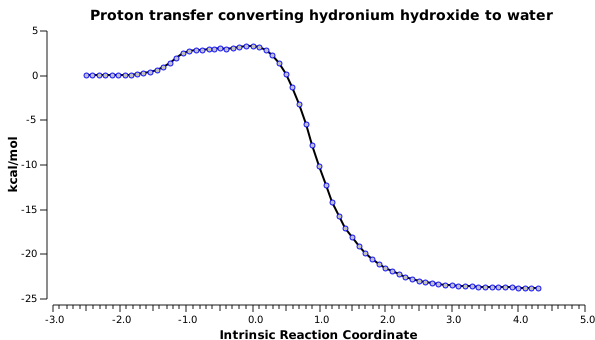
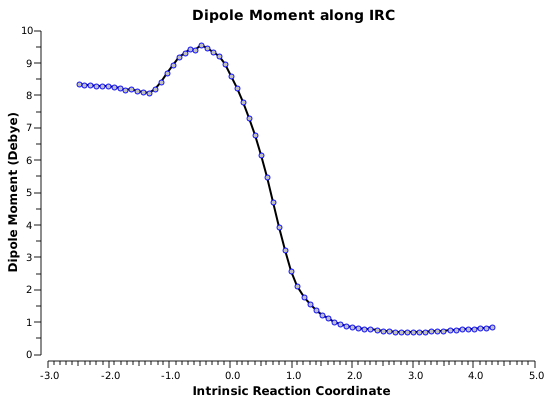
Addendum 2: Shown below is the intrinsic reaction cooordinate (IRC) calculated[6] for the proton transfer from the hydronium hydroxide ion-pair to form neutral water, revealing a barrier of ~3kcal/mol and exothermicity of 23 kcal/mol and how the dipole moment evolves.

NH3-8
NH3-8
NH3-8


Dissociation/equilibrium constants are rarely converted into free energies in text books and elsewhere. I would argue here that one gets a better intuitive feeling for such systems if expressed as energies. In this case, such a self-ionization energy for water might also be a useful way of calibrating how any given quantum mechanical procedure might perform in terms of the solvation model etc.

Recent calculations of like-charge pairs of either H3O+ or OH have been reported[7] but not as an ion-pair.

It is implicit when one talks about connecting bonds that the weaker hydrogen bonds do not qualify. Of course there is a whole spectrum of hydrogen bonding strengths; ones involved in ion-pairs for example can be up to 3 times stronger than those to neutral systems.

References

  1. H. Rzepa, "Crystal structures containing the hydronium cation", 2016. https://doi.org/10.14469/hpc/370
  2. M. Stapf, W. Seichter, and M. Mazik, "Unique Hydrogen‐Bonded Complex of Hydronium and Hydroxide Ions", Chemistry – A European Journal, vol. 21, pp. 6350-6354, 2015. https://doi.org/10.1002/chem.201406383
  3. Stapf, Manuel., Seichter, Wilhelm., and Mazik, Monika., "CCDC 1034049: Experimental Crystal Structure Determination", 2015. https://doi.org/10.5517/cc13q0f8
  4. H.S. Rzepa, "H22O11", 2016. https://doi.org/10.14469/ch/191994
  5. H.S. Rzepa, "H 22 O 11", 2016. https://doi.org/10.14469/ch/191995
  6. H.S. Rzepa, "H22O11", 2016. https://doi.org/10.14469/ch/192002
  7. M.K. Ghosh, T.H. Choi, and C.H. Choi, "Like-charge ion pairs of hydronium and hydroxide in aqueous solution?", Physical Chemistry Chemical Physics, vol. 17, pp. 16233-16237, 2015. https://doi.org/10.1039/c5cp02182k

Intermolecular atom-atom bonds in crystals? The O…O case.

Saturday, July 25th, 2015

I recently followed this bloggers trail; link1link2 to arrive at this delightful short commentary on atom-atom bonds in crystals[1] by Jack Dunitz. Here he discusses that age-old question (to chemists), what is a bond? Even almost 100 years after Gilbert Lewis’ famous analysis,[2] we continue to ponder this question. Indeed, quite a debate on this topic broke out in a recent post here. My eye was caught by one example in Jack’s article: “The close stacking of planar anions, as occurs in salts of croconic acid …far from producing a lowering of the crystal energy, this stacking interaction in itself leads to an increase by several thousand kJ mol−1 arising from Coulombic repulsion between the doubly negatively charged anions” I thought I might explore this point a bit further in this post.

A search query of the Cambridge structure database was defined as below. Two non-bonded oxygen atoms are each attached to one carbon, each oxygen was defined as having one bonded atom (to carbon) and each assigned one negative charge. Addition of the usual constraints of R < 0.05, no errors, no disorder and specifying an intermolecular search produced 103 hits with the distance distribution shown below.

OO-query


O-O

Firstly, you should be aware that the van der Waals radius for oxygen is ~1.5Å, and so any contacts less than 3.0Å become interesting. What becomes particularly exciting is the distinct cluster at ~2.5Å. Could these be ~30 examples of close encounters of the type noted by Dunitz? Well, a control search has to be done, this time for O-H-O motifs, with each OH distance plotted as below:

OHO

The hot-spot occurs when both OH distances are equal at ~1.22Å, or an O…O separation close to 2.45Å. Time to quote Dunitz again “This large destabilization is, of course, more than compensated in the overall energy balance by the large stabilization arising from Coulombic interactions of the croconate anions with the surrounding cations.” In this case of course, the cation is a proton, residing at the half way point between the two oxygens. So two oxygens can indeed approach ~0.5Å closer than the sum of the vdw radii if a proton sits in-between them.

What do we learn? Well, firstly that one should always have a reality check of the results of any crystal structure search. The search did specify that the oxygens be non-bonded but also that they should both carry a negative charge and that both should only have one bonded atom. That should in theory at least have excluded any C-O-H-O-C structures, so why were about 30 such examples found? I can only speculate here, but recollect that 50 years ago when the CSD was founded, hydrogen atoms were rarely identified from the electron density. They were instead placed or “idealised” to where they might be expected. Nowadays any contentious hydrogens are almost always located rather than idealised, but clearly their status as bona-fide atoms is not quite so strong as the rest of the periodic table. So in at least some of these 30 examples with short O…O contacts, we might expect there to lurk a (possibly unrecognised) proton. But one never knows, there may be some real examples of O…O contacts with no such proton intervening. Now these really would be interesting.


Postscript. F is isoelectronic with O(-); below is the same search as defined above, but for non-bonded CF…FC approaches. F---F

The vdw radius of F is 1.45Å hence any non-bonded contact <2.9Å is worth taking a look at. But notice the small cluster of about 10 compounds for which the value is ~2.15Å. The F-H-F plot shows a hot spot at ~2.3 for the F…F separation, but there are zero hits for CF-H-FC. So these ten hits are indeed tantalising.

References

  1. J.D. Dunitz, "Intermolecular atom–atom bonds in crystals?", IUCrJ, vol. 2, pp. 157-158, 2015. https://doi.org/10.1107/s2052252515002006
  2. G.N. Lewis, "THE ATOM AND THE MOLECULE.", Journal of the American Chemical Society, vol. 38, pp. 762-785, 1916. https://doi.org/10.1021/ja02261a002