Posts Tagged ‘Equilibrium chemistry’

Free energy relationships and their linearity: a test example.

Sunday, January 13th, 2019

Linear free energy relationships (LFER) are associated with the dawn of physical organic chemistry in the late 1930s and its objectives in understanding chemical reactivity as measured by reaction rates and equilibria.

The Hammett equation is the best known of the LFERs, albeit derived “intuitively”. It is normally applied to the kinetics of aromatic electrophilic substitution reactions and is expressed as;

log KR/K0 = σRρ (for equilibria) and extended to log kR/k0 = σRρ for rates.

The equilibrium constants are normally derived from the ionisation of substituted benzoic acids, with Kbeing that for benzoic acid itself and Kthat of a substituted benzoic acid, with σR being known as the substituent constant and ρ the reaction constant. The concept involved obtaining the substituent constants by measuring the ionisation equilibria. The value of σis then assumed to be transferable to the rates of reaction, where the values can be used to obtain reaction constants for a given reaction. The latter would then be assumed to give insight into the electronic nature of the transition state for that reaction.

The term log kR/k(the ratio of rates of reaction) can be related to ΔΔG = -RT ln kR/kand this latter quantity can be readily obtained from quantum calculations, where ΔΔG is the difference in computed reaction activation free energies for two substituents (of which one might be R=H). The most interesting such Hammett plots are the ones where a discontinuity becomes apparent. The plot comprises two separate linear relationships, but with different slopes. This is normally taken to indicate a change of mechanism, on the assumption that the two mechanisms will have different responses to substituents. 

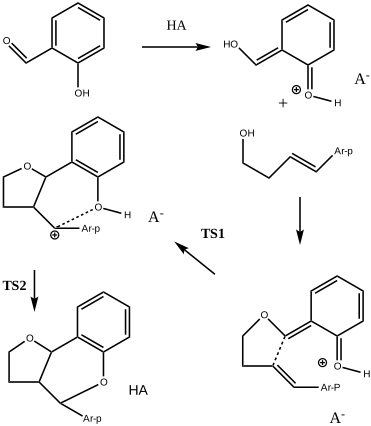
A test of this is available via the calculated activations energies for acid catalyzed cyclocondensation to give furanochromanes[1] which is a two-step reaction involving two transition states TS1 and TS2, either of which could be rate determining. A change from one to the other would constitute a change in mechanism. In this example, TS1 involves creation of a carbocationic centre which can be stabilized by the substituent on the Ar group; TS2 involves the quenching of the carbocation by a nucleophilic oxygen and hence might be expected to respond differently to the substituents on Ar. As it happens, the reaction coordinate for TS2 is not entirely trivial, since it also includes an accompanying proton transfer which might perturb the mechanism.
Fortunately for this reaction we have available full FAIR data (DOI: 10.14469/hpc/3943), which includes not only the computed free energies for both sets of transition states but also the entropy-free enthalpies for comparison. This allows the table below to be generated. For each substituent, the highest energy point is in bold, indicating the rate limiting step. The span of substituents corresponds to a range of rate constants of almost 1010, which in fact is rarely if ever achievable experimentally.

Highest free energy overall route for HCl catalysed mechanism,

trans stereochemistry

Sub ΔH/ΔG Reactant ΔH/ΔG, TS1 ΔH/ΔG, TS2 RDS
p-NH2 0.2/6.36 0.0/0.0 0.15/4.0 0.2/6.4 TS2/TS2
p-OMe 2.7/8.48 0.0/0.0 2.7/8.45 2.1/8.48 TS1/TS2
p-Me 5.5/10.00 0.0/0.0 5.5/9.9 3.9/10.00 TS1/TS2
p-Cl 7.7/12.28 0.0/0.0 7.7/12.28 5.9/11.84 TS1/TS1
p-H 7.6/13.01 0.0/0.0 7.6/13.01 5.5/11.51 TS1/TS1
p-CN 10.6/18.02 0.0/0.0 10.6 /17.61 10.5/18.02 TS1/TS2
p-NO2 12.4/19.85 0.0/0.0 12.4/18.24 12.0/19.85 TS1/TS2

For the free energies, you can see that TS2 is the rate limiting step for the first two electron donating substituents, and the last two electron withdrawing ones, whilst TS1 represents the rate limiting step for the middle substituents. This represents two changes of rate limiting step over the entire range of substituents. A different picture emerges if only the enthalpies are used. Now TS1 is rate limiting for essentially all the substituents. The difference of course arises because of significant changes to the entropy of the transition states. The Hammett equation, and its use of  σconstants to try to infer the electronic response of a reaction mechanism, does not really factor in entropic responses. Nor is it often if at all applied using a really wide range of substituents. So any linearity or indeed non-linearity in Hammett plots may correspond only very loosely to the underlying mechanisms involved.

Starting in the 1940s and lasting perhaps 40-50 years, thousands of different reaction mechanisms were subjected to the Hammett treatment during the golden era of physical organic chemistry, but very few have been followed up by exploring the computed free energies, as set out above. One wonders how many of the original interpretations will fully withstand such new scrutiny and in general how influential the role of entropy is.

References

  1. C.D. Nielsen, W.J. Mooij, D. Sale, H.S. Rzepa, J. Burés, and A.C. Spivey, "Reversibility and reactivity in an acid catalyzed cyclocondensation to give furanochromanes – a reaction at the ‘oxonium-Prins’ <i>vs.</i> ‘<i>ortho</i>-quinone methide cycloaddition’ mechanistic nexus", Chemical Science, vol. 10, pp. 406-412, 2019. https://doi.org/10.1039/c8sc04302g
Autoionization of hydrogen fluoride.

Sunday, April 24th, 2016

The autoionization of water involves two molecules transfering a proton to give hydronium hydroxide, a process for which the free energy of reaction is well known. Here I ask what might happen with the next element along in the periodic table, F.

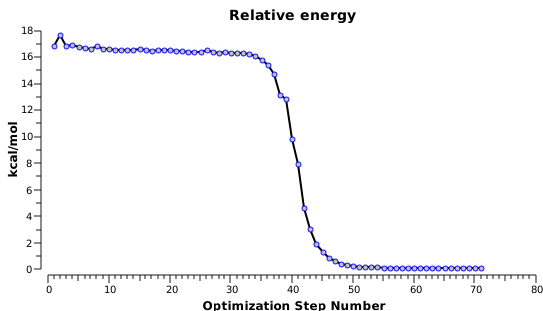
I have been unable to find much about the autoionization of HF in the literature; the pH of neat HF appears unreported (unlike that of H2O, which of course is 7). Even the dielectric constant of liquid HF[1],[2] seems to vary widely, the largest reported being ~84. It is suggested that liquid HF is much less ordered than e.g. water, and this suggests that a single static model is unlikely to be entirely realistic. Nonetheless, I thought it might be informative to take the model I previously constructed for water and try applying it to HF. Here is part of the geometry optimisation cycle[3] from the original edited water model. I used ωB97XD/Def2-TZVPPD/SCRF=water for the model. Why continuum water as the solvation treatment? Well, standard parameters for liquid HF are not available (perhaps given the variation in dielectric) and since the upper bound might be similar to water, I decided to use that to see what I got. Clearly however an approximation.

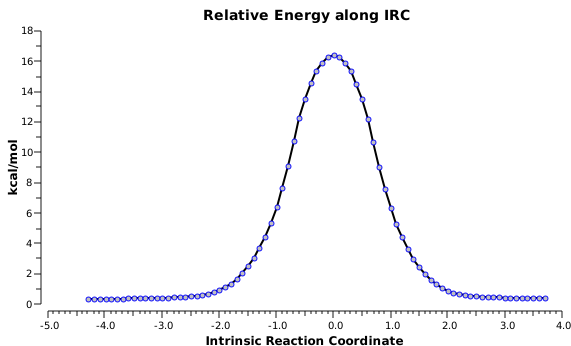
The low energy final geometry corresponds to 10 HF molecules and lies about 16 kcal/mol lower (in total energy) than the cyclic structure containing H2F+.F species connected by two (HF)3 bridges and two further non-bridge HF molecules hydrogen bonding to the H2Fand the F. In fact the ionic structure turns out to be a transition state for proton shifting along the chain to create (HF)10, with a free energy barrier of 9.2 kcal/mol above the neutral form.[4] This difference between ionic and non-ionic forms is considerably less than that for water as previously indicated. Note also how much shorter the hydrogen bonding H…F distances are in the HF cluster.

So unlike water, where the hydronium hydroxide is a clear minimum in the potential with a small but distinct barrier (~3.5 kcal/mol[5]) to proton transfer, with HF at the same level of theory the barrier is zero. Perhaps the difference might be because whereas hydronium hydroxide can support three stabilizing (H2O)3 bridges, only two (HF)3 bridges are possible with H2F+.F. It might also be higher levels of theory (or better/larger models of the HF cluster) could well give a barrier for the process, but this does tend to suggest that the dynamics of HF liquid may suggest quite different lifetimes for autoionized forms of HF compared to water. Liquid HF is clearly just as complicated a liquid as is H2O, certainly much less is known about it.

References

  1. R.H. Cole, "Dielectric constant and association in liquid HF", The Journal of Chemical Physics, vol. 59, pp. 1545-1546, 1973. https://doi.org/10.1063/1.1680219
  2. P.H. Fries, and J. Richardi, "The solution of the Wertheim association theory for molecular liquids: Application to hydrogen fluoride", The Journal of Chemical Physics, vol. 113, pp. 9169-9179, 2000. https://doi.org/10.1063/1.1319172
  3. H.S. Rzepa, "H 10 F 10", 2016. https://doi.org/10.14469/ch/192032
  4. H.S. Rzepa, "H 10 F 10", 2016. https://doi.org/10.14469/ch/192034
  5. H.S. Rzepa, "H22O11", 2016. https://doi.org/10.14469/ch/192022

Hydronium hydroxide: the why of pH 7.

Thursday, April 14th, 2016

Ammonium hydroxide (NH4+…OH) can be characterised quantum mechanically when stabilised by water bridges connecting the ion-pairs. It is a small step from there to hydronium hydroxide, or H3O+…OH. The measured concentrations [H3O+] ≡ [OH] give rise of course to the well-known pH 7 of pure water, and converting this ionization constant to a free energy indicates that the solvated ion-pair must be some ~19.1 kcal/mol higher in free energy than water itself. So can a quantum calculation reproduce pH7 for water?

Let me start by saying that locating a stable minimum for H3O+…OH is non-trival. I have been trying to find a structure on and off for a little while now, but all my erstwhile attempts have resulted in barrierless proton transfers back to H2O…OH2. So I now decided on a more systematic approach by running a CSD (Cambridge structure database) search, defining the species H3O+ and specifying that the oxygen sustain one additional hydrogen bond, as per H3O+….H.[1] This produced 69 hits, with the distribution of O…H distances shown below indicating that a wide spectrum of hydrogen bond lengths to this oxygen appears possible.

NH3-8

Restricting the search to  H3O+….H-O  and specifying that the last O is bonded to just one atom reduces this to one hit.[2] If you click on the image below or visit here[3] you will see the hydrogen bonding pattern in this unique example is of the type (ROH…H)3O+…HO(…HOR)3 with overall three-fold symmetry. The "bridge" across the ion pair in this case is formed from hydrogen bonds to -CH2OH groups in 1,3,5-tris(hydroxymethyl)-2,4,6-triethylbenzene.

NH3-8

This structure immediately poses the question of whether water bridges could replace the organic bridge in the species above, to enable the elusive water-solvated hydronium hydroxide to finally be characterised as a bona-fide minimum in a quantum mechanical potential. By analogy one would need three bridges, each to be comprised of 3H2O. In other words a system containing  eleven water molecules.  An ωB97XD/6-311++G(d,p)/SCRF=water calculation indeed reveals this C3-symmetric arrangement is a minimum with a calculated[4] free energy (298K) 23.3 (23.5/Def2-TZVPPD) kcal/mol above that of the corresponding water cluster[5] in which a proton transfer has neutralised the ion pair. The error of +4.2 kcal/mol is probably due to a combination of incomplete basis set (calculations with better bases are under way), incomplete correction for solvation (continuum) as well as the limited size of the explicit water cluster (nine supporting water molecules) and other aspects such as the DFT method itself and the RRHO partition function approximations for thermal corrections. It would be a useful calibrant of all these aspects to explore whether these various corrections would converge to the known value or not.

The calculated geometry[4] reveals a H3O…HO hydrogen bond ~2.14Å, well within the range shown in the crystal structure distribution above.

NH3-8

With the basic model for hydronium hydroxide identified, one can now explore how to improve both the accuracy of the model in reproducing the "pH 7" observable and how indeed one might engineer a more superbasic variation.

Addendum 1: The NCI (non-covalent-interaction) analysis of the hydronium hydroxide water complex is shown below. The blue regions indicate strong hydrogen bonds, with cyan being weaker. In fact, the covalent/non-covalent threshold normally taken for an  NCI analysis  (0.05 au) had to be increased to 0.10 for this example (the default threshold was already treating the HO…H interactions as covalent rather than non-covalent).

NH3-8

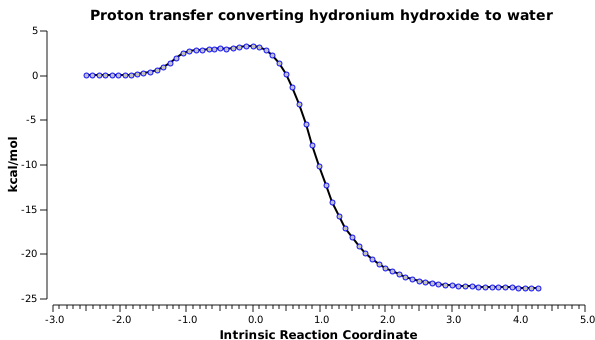
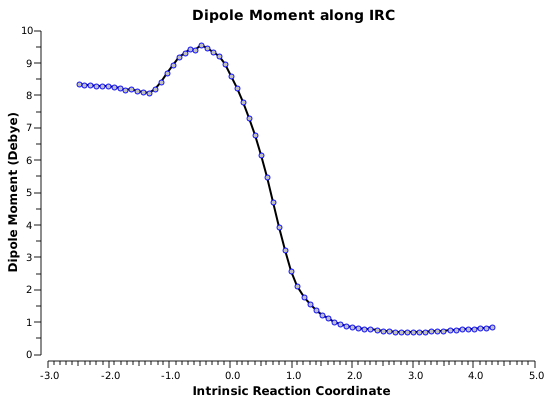
Addendum 2: Shown below is the intrinsic reaction cooordinate (IRC) calculated[6] for the proton transfer from the hydronium hydroxide ion-pair to form neutral water, revealing a barrier of ~3kcal/mol and exothermicity of 23 kcal/mol and how the dipole moment evolves.

NH3-8
NH3-8
NH3-8


Dissociation/equilibrium constants are rarely converted into free energies in text books and elsewhere. I would argue here that one gets a better intuitive feeling for such systems if expressed as energies. In this case, such a self-ionization energy for water might also be a useful way of calibrating how any given quantum mechanical procedure might perform in terms of the solvation model etc.

Recent calculations of like-charge pairs of either H3O+ or OH have been reported[7] but not as an ion-pair.

It is implicit when one talks about connecting bonds that the weaker hydrogen bonds do not qualify. Of course there is a whole spectrum of hydrogen bonding strengths; ones involved in ion-pairs for example can be up to 3 times stronger than those to neutral systems.

References

  1. H. Rzepa, "Crystal structures containing the hydronium cation", 2016. https://doi.org/10.14469/hpc/370
  2. M. Stapf, W. Seichter, and M. Mazik, "Unique Hydrogen‐Bonded Complex of Hydronium and Hydroxide Ions", Chemistry – A European Journal, vol. 21, pp. 6350-6354, 2015. https://doi.org/10.1002/chem.201406383
  3. Stapf, Manuel., Seichter, Wilhelm., and Mazik, Monika., "CCDC 1034049: Experimental Crystal Structure Determination", 2015. https://doi.org/10.5517/cc13q0f8
  4. H.S. Rzepa, "H22O11", 2016. https://doi.org/10.14469/ch/191994
  5. H.S. Rzepa, "H 22 O 11", 2016. https://doi.org/10.14469/ch/191995
  6. H.S. Rzepa, "H22O11", 2016. https://doi.org/10.14469/ch/192002
  7. M.K. Ghosh, T.H. Choi, and C.H. Choi, "Like-charge ion pairs of hydronium and hydroxide in aqueous solution?", Physical Chemistry Chemical Physics, vol. 17, pp. 16233-16237, 2015. https://doi.org/10.1039/c5cp02182k

I’ve started so I’ll finish. The ionisation mechanism and kinetic isotope effects for 1,3-dimethylindolin-2 one

Thursday, January 7th, 2016

This is the third and final study deriving from my Ph.D.[1]. The first two topics dealt with the mechanism of heteroaromatic electrophilic attack using either a diazonium cation or a proton as electrophile, followed by either proton abstraction or carbon dioxide loss from the resulting Wheland intermediate. This final study inverts this sequence by starting with the proton abstraction from an indolinone by a base to create/aromatize to a indole-2-enolate intermediate, which only then is followed by electrophilic attack (by iodine).  Here I explore what light quantum chemical modelling might cast on the mechanism.

Indole diazocoupling

The concentration of I3 is used to follow the reaction, given by the expression:  [I3] = k1[B][indolinone]t – k-1/k2*ln[I3] + const, where  k2* = k2/715[I] + k2' , the latter being the rate coefficient for the reaction between the enolate intermediate and I3. With appropriate least squares analysis of this rate equation, a value for k1 using either 1H or 2H (≡ D) isotopes can be extracted and this gives an isotope effect k1H/k1D of 6.3 ± 0.6. Note that this value does NOT depend on [B]. Here, I am going to try to see if I can construct a quantum mechanical model which reproduces this value.

Indole diazocoupling

  1. Model 1 uses just three water molecules as a proton relay (B3LYP+D3/Def2-TZVP/SCRF=water).
  2. Model 2 uses 2H2O.NaOH solvated by two extra passive water molecules. Since under these conditions, the NaOH is largely ionic, [B] ≡ [OH]
Model ΔG298 (ΔH298) kH/kD (298K) DataDOIs
1 28.0 (22.9) 10.3 [2],[3],[4]
2 2.5 (2.8) 4.4 [5],[6],[7]

The plot of rate vs [B] shows[1] that the uncatalysed (water) rate is very slow (intercept passes more or less through zero) and the calculated free energy barrier (28.0 kcal/mol) confirms a slow rate at ambient temperatures. Note in the final (aromatized) product, there is a noticeable hydrogen bond between the 3-carbon and a water molecule (2.14Å). The calculated kinetic isotope effect[8] is substantially larger than observed experimentally for the base catalysed contribution.

Indolineone ionization using 3 water molecules

In the presence of NaOH (standard state = 1 atm = 0.044M), the enthalpy barrier drops very substantially to 2.8 kcal/mol and the free energy to 2.5 kcal/mol. Similar behaviour was noted previously on this blog for the hydrolysis of thalidomide. Although the magnitude of the reduction in barrier in fact implies an extremely fast reaction, recollect that [B]=[OH] appears in the rate equation  and since its value is very much less than 0.044M, the observed rate is relatively slow.

Indolineone ionization using 3 water molecules + NaOH

The calculated KIE for the hydroxide catalysed mechanism is much smaller that for the water route, but also smaller than is observed. This is a value uncorrected for tunnelling, which given the small barrier might be significant. 

These calculations show how a model for ionization of indolinone can be constructed, and used to e.g. probe the sensitivity of KIE to perturbations induced by ring substituents, which may form the basis of a future post.


This is a non-linear equation with kinetics that straddle zero and first order behaviour. In 1972, it was not easily possible to graph such functions in a manner where the slope of a linear plot would yield the rate constant. It was only computers and languages such as Fortran which allowed such non-linear least squares analysis of the rate. In the event, it turned out that the presence of 50% methanol in the mixed aqueous solutions was the cause; in other solvents the kinetics approximated zero order behavour very well.

References

  1. B.C. Challis, and H.S. Rzepa, "Heteroaromatic hydrogen exchange reactions. Part VIII. The ionisation of 1,3-dimethylindolin-2-one", Journal of the Chemical Society, Perkin Transactions 2, pp. 1822, 1975. https://doi.org/10.1039/p29750001822
  2. H.S. Rzepa, "C 10 H 17 N 1 O 4", 2016. https://doi.org/10.14469/ch/191786
  3. H.S. Rzepa, "C 10 H 17 N 1 O 4", 2016. https://doi.org/10.14469/ch/191765
  4. H.S. Rzepa, "C10H17NO4", 2016. https://doi.org/10.14469/ch/191784
  5. H.S. Rzepa, "C 10 H 20 N 1 Na 1 O 6", 2016. https://doi.org/10.14469/ch/191787
  6. H.S. Rzepa, "C 10 H 20 N 1 Na 1 O 6", 2016. https://doi.org/10.14469/ch/191782
  7. H.S. Rzepa, "C10H20NNaO6", 2016. https://doi.org/10.14469/ch/191785
  8. H. Rzepa, "Mechanisms and kinetic isotope effects for the base catalysed ionisation of 1,3-dimethyl indolinone.", 2016. https://doi.org/10.14469/hpc/202