Posts Tagged ‘free energy barrier’
Wednesday, August 8th, 2018
White City is a small area in west london created as an exhibition site in 1908, morphing over the years into an Olympic games venue, a greyhound track, the home nearby of the BBC (British Broadcasting Corporation) and most recently the new western campus for Imperial College London.♣ The first Imperial department to move into the MSRH (Molecular Sciences Research Hub) building is chemistry. As a personal celebration of this occasion, I here dedicate three transition states located during my first week of occupancy there, naming them the White City trio following earlier inspiration by a string trio and their own instruments.
The chemistry revisits the mechanism of amide formation from an acid and an amine, which I first described on this blog about four years ago. I had constructed a model of one amine and one carboxylic acid, to which I added a further acid in recognition that proton transfers are a key aspect of the mechanism. When the model is quantified using quantum calculations (ωB97XD/6-311G(d,p)/SCRF=p-toluene) it resulted in a free energy barrier ΔG298‡ of about 22 kcal/mol. Re-reading what I wrote, I see I did rather gloss over this value, which implies a decently rapid reaction! In fact, the reaction occurs relatively slowly at the temperature of refluxing toluene. Perhaps some alarm bells should have been tinkling at this stage (although the sluggish reaction might for example instead be due to poor solubility) and so here I have a rethink of the model used to see if that modest barrier really is correct.
The new premise is to test if the required proton transfers can instead be mediated using a second molecule of amine instead of acid; thus two molecules of carboxylic acid are now accompanied by two of amine, one of which will be used to transfer protons. The second acid is retained to facilitate comparison. As before, the mechanism is characterised by three transition states and two tetrahedral intermediates. The new mechanism is summarised below, with TS1-3 being the White City Trio.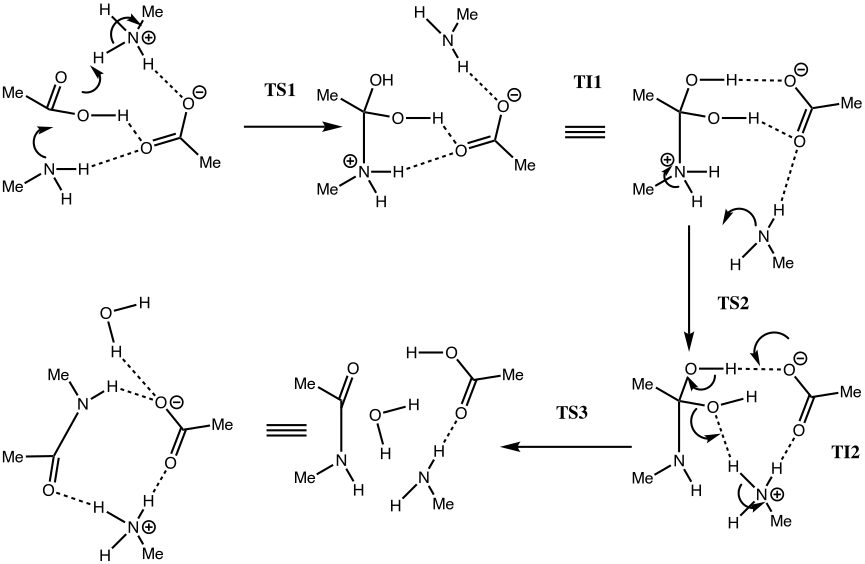
The free energies are summarised in the table below. TS3, the rate limiting step, is slightly lower in energy if the amine is used for the proton transfer than via carboxylic acid. This is the wrong direction; we really want the barrier to increase to explain the relative difficulty of the reaction as observed in refluxing toluene! Fear not however, the new barrier is indeed a much more sluggish 28.6 kcal/mol (30.5 using a larger basis set).
How did this happen? It’s the reactants! The original reactant model was based on the known structure of acetic acid dimer, with an amine weakly hydrogen bonded. Adding an extra amine now allows an entirely new motif to form, in which the amine disrupts the acetic dimer to form a cyclic system with a pair of very strong (-)O-H-N(+)-H-O(-) hydrogen bond units.† The original model did not have sufficient components to fully allow this to happen.
 So the White City Trio achieve a performance which helps explain why a reaction is sluggish rather than facile (normally one strives to show the opposite). Perhaps however it should be the White City quartet, in recognition that the reactant also had a role to play?
♣A photograph of the building under construction can be seen here. ‡Def2-TZVPPD basis set. †There does not appear to be a recorded structure for methylammonium acetate. We hope to obtain one to check what the extended structure actually is. ♥I will elaborate an interesting new use of this value in a separate post.
Tags:acetic acid, Acid, Amide, Amine, carboxylic acid, Chemistry, Company: BBC, Company: British Broadcasting Corporation, energy, Ester, exhibition site, free energy barrier, Functional groups, Hydrogen bond, Imperial College, Imperial College London, Ionic product, Newspaper & Magazine Printing Services, Non-ionic product, Olympic games, Organic chemistry, White City Trio
Posted in Interesting chemistry | 6 Comments »
Wednesday, August 8th, 2018
White City is a small area in west london created as an exhibition site in 1908, morphing over the years into an Olympic games venue, a greyhound track, the home nearby of the BBC (British Broadcasting Corporation) and most recently the new western campus for Imperial College London.♣ The first Imperial department to move into the MSRH (Molecular Sciences Research Hub) building is chemistry. As a personal celebration of this occasion, I here dedicate three transition states located during my first week of occupancy there, naming them the White City trio following earlier inspiration by a string trio and their own instruments.
The chemistry revisits the mechanism of amide formation from an acid and an amine, which I first described on this blog about four years ago. I had constructed a model of one amine and one carboxylic acid, to which I added a further acid in recognition that proton transfers are a key aspect of the mechanism. When the model is quantified using quantum calculations (ωB97XD/6-311G(d,p)/SCRF=p-toluene) it resulted in a free energy barrier ΔG298‡ of about 22 kcal/mol. Re-reading what I wrote, I see I did rather gloss over this value, which implies a decently rapid reaction! In fact, the reaction occurs relatively slowly at the temperature of refluxing toluene. Perhaps some alarm bells should have been tinkling at this stage (although the sluggish reaction might for example instead be due to poor solubility) and so here I have a rethink of the model used to see if that modest barrier really is correct.
The new premise is to test if the required proton transfers can instead be mediated using a second molecule of amine instead of acid; thus two molecules of carboxylic acid are now accompanied by two of amine, one of which will be used to transfer protons. The second acid is retained to facilitate comparison. As before, the mechanism is characterised by three transition states and two tetrahedral intermediates. The new mechanism is summarised below, with TS1-3 being the White City Trio.
The free energies are summarised in the table below. TS3, the rate limiting step, is slightly lower in energy if the amine is used for the proton transfer than via carboxylic acid. This is the wrong direction; we really want the barrier to increase to explain the relative difficulty of the reaction as observed in refluxing toluene! Fear not however, the new barrier is indeed a much more sluggish 28.6 kcal/mol (30.5 using a larger basis set).
How did this happen? It’s the reactants! The original reactant model was based on the known structure of acetic acid dimer, with an amine weakly hydrogen bonded. Adding an extra amine now allows an entirely new motif to form, in which the amine disrupts the acetic dimer to form a cyclic system with a pair of very strong (-)O-H-N(+)-H-O(-) hydrogen bond units.† The original model did not have sufficient components to fully allow this to happen.
 So the White City Trio achieve a performance which helps explain why a reaction is sluggish rather than facile (normally one strives to show the opposite). Perhaps however it should be the White City quartet, in recognition that the reactant also had a role to play?
♣A photograph of the building under construction can be seen here. ‡Def2-TZVPPD basis set. †There does not appear to be a recorded structure for methylammonium acetate. We hope to obtain one to check what the extended structure actually is. ♥I will elaborate an interesting new use of this value in a separate post.
Tags:acetic acid, Acid, Amide, Amine, carboxylic acid, Chemistry, Company: BBC, Company: British Broadcasting Corporation, energy, Ester, exhibition site, free energy barrier, Functional groups, Hydrogen bond, Imperial College, Imperial College London, Ionic product, Newspaper & Magazine Printing Services, Non-ionic product, Olympic games, Organic chemistry, White City Trio
Posted in Interesting chemistry | 6 Comments »
Thursday, September 21st, 2017
A recent article reports, amongst other topics, a computationally modelled reaction involving the capture of molecular hydrogen using a substituted borane (X=N, Y=C).[1] The mechanism involves an initial equilibrium between React and Int1, followed by capture of the hydrogen by Int1 to form a 5-coordinate borane intermediate (Int2 below, as per Figure 11).‡ This was followed by assistance from a proximate basic nitrogen to complete the hydrogen capture via a TS involving H-H cleavage. The forward free energy barrier to capture was ~11 kcal/mol and ~4 kcal/mol in the reverse direction (relative to the species labelled Int1), both suitably low for reversible hydrogen capture. Here I explore a simple variation to this fascinating reaction.∞

This variation involves transposing X and Y such that Y=N+ and X=C– to form a carbon ylide such that X=C becomes much more nucleophilic than the original nitrogen nucleophile. An animation of the full IRC† (intrinsic reaction coordinate computed at ωB97XD/cc-pvtz; FAIR data doi: 10.14469/hpc/2704) is shown below.

The profile shows that the reaction is concerted between the species labelled React and Prod; no sign of Int1 and Int2!
- The region IRC -12 to -5 involves B-C bond cleavage. Because the C is so very nucleophilic, the 4-ring species labelled React becomes very stable and opening it requires a high barrier.
- Between IRC -5 and 0, the BH2 group rotates, losing its original interaction with the C to slowly create an empty acceptor orbital on the boron which can then interact with the incoming hydrogen.
- At IRC= 0 (the transition state) the hydrogen has been captured by the boron to form a 5-coordinate species, in a manoeuvre that reminds one of the orbital capture of satellites by planets on their way to the outer reaches of the solar system. If the barrier to this capture is computed from IRC= -4 (the region of Int2) it is very much lower than the original system[1], again a reflection of the higher nucleophilicity of X=C–.
- The fly past continues until IRC= +7, at which point one end of the bound hydrogen has become suitably orientated to interact with the nucleophilic carbon via lone-pair donation into the acceptor H-H σ* orbital, thus helping to break it.
- By IRC= +9, the H-H cleavage is complete.
- By IRC= +13 the reaction has reached Prod, being overall ~ -12 kcal/mol exothermic.
- The overall thermochemistry is dominated by the potent carbon nucleophile in the reactant, which in turn makes this modification entirely useless for the purposes of a hydrogen-capture system!


The evolution of the dipole moment along the IRC shows very non-linear behaviour (such plots are rarely shown in most published IRC analyses; they should be!), ending of course with the ionic zwitterion that is the imminium borohydride Prod. Indeed the entire reaction coordinate is an unusually vivid example of a non-least motion path!

This simple atom transposition has given us a very instructive exercise in reaction paths, by-passing entirely both Int1 and Int2 (making them hidden intermediates), and converting React → Prod into a concerted reaction. It would be great to probe this convoluted journey using reaction dynamics!
∞Archived as DOI: 10.14469/hpc/3096
‡ Such a species can be seen as a hidden intermediate in the mechanism of reduction of a carboxylic acid by diborane.
†None were shown in the original study.[1]
References
- L. Li, M. Lei, Y. Xie, H.F. Schaefer, B. Chen, and R. Hoffmann, "Stabilizing a different cyclooctatetraene stereoisomer", Proceedings of the National Academy of Sciences, vol. 114, pp. 9803-9808, 2017. https://doi.org/10.1073/pnas.1709586114
Tags:Ammonia borane, animation, Boranes, Chemistry, Cleaning Services, Company: React Group, free energy barrier, Hydroboration, Hydrogen, Matter
Posted in reaction mechanism | 1 Comment »
Sunday, April 24th, 2016
The autoionization of water involves two molecules transfering a proton to give hydronium hydroxide, a process for which the free energy of reaction is well known. Here I ask what might happen with the next element along in the periodic table, F.
I have been unable to find much about the autoionization of HF in the literature; the pH of neat HF appears unreported (unlike that of H2O, which of course is 7). Even the dielectric constant of liquid HF[1],[2] seems to vary widely, the largest reported being ~84. It is suggested that liquid HF is much less ordered than e.g. water, and this suggests that a single static model is unlikely to be entirely realistic. Nonetheless, I thought it might be informative to take the model I previously constructed for water and try applying it to HF. Here is part of the geometry optimisation cycle[3] from the original edited water model. I used ωB97XD/Def2-TZVPPD/SCRF=water for the model. Why continuum water as the solvation treatment? Well, standard parameters for liquid HF are not available (perhaps given the variation in dielectric) and since the upper bound might be similar to water, I decided to use that to see what I got. Clearly however an approximation.
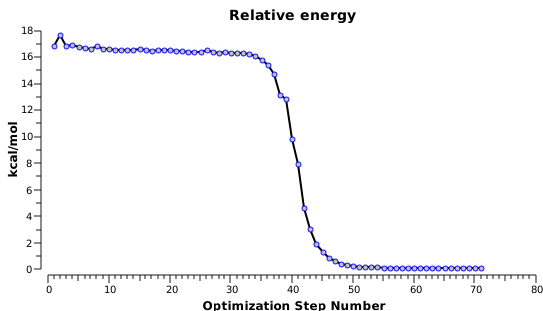
The low energy final geometry corresponds to 10 HF molecules and lies about 16 kcal/mol lower (in total energy) than the cyclic structure containing H2F+.F– species connected by two (HF)3 bridges and two further non-bridge HF molecules hydrogen bonding to the H2F+ and the F–. In fact the ionic structure turns out to be a transition state for proton shifting along the chain to create (HF)10, with a free energy barrier of 9.2 kcal/mol above the neutral form.[4] This difference between ionic and non-ionic forms is considerably less than that for water as previously indicated. Note also how much shorter the hydrogen bonding H…F distances are in the HF cluster.

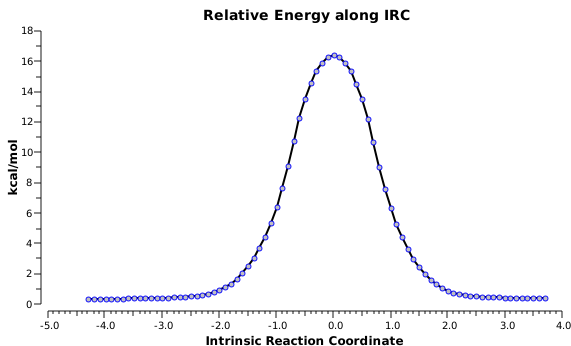
So unlike water, where the hydronium hydroxide is a clear minimum in the potential with a small but distinct barrier (~3.5 kcal/mol[5]) to proton transfer, with HF at the same level of theory the barrier is zero. Perhaps the difference might be because whereas hydronium hydroxide can support three stabilizing (H2O)3 bridges, only two (HF)3 bridges are possible with H2F+.F–. It might also be higher levels of theory (or better/larger models of the HF cluster) could well give a barrier for the process, but this does tend to suggest that the dynamics of HF liquid may suggest quite different lifetimes for autoionized forms of HF compared to water. Liquid HF is clearly just as complicated a liquid as is H2O, certainly much less is known about it.
References
- R.H. Cole, "Dielectric constant and association in liquid HF", The Journal of Chemical Physics, vol. 59, pp. 1545-1546, 1973. https://doi.org/10.1063/1.1680219
- P.H. Fries, and J. Richardi, "The solution of the Wertheim association theory for molecular liquids: Application to hydrogen fluoride", The Journal of Chemical Physics, vol. 113, pp. 9169-9179, 2000. https://doi.org/10.1063/1.1319172
- H.S. Rzepa, "H 10 F 10", 2016. https://doi.org/10.14469/ch/192032
- H.S. Rzepa, "H 10 F 10", 2016. https://doi.org/10.14469/ch/192034
- H.S. Rzepa, "H22O11", 2016. https://doi.org/10.14469/ch/192022
Tags:dielectric, energy, Equilibrium chemistry, Fluorides, free energy, free energy barrier, Hydrogen bond, Hydronium, Inorganic solvents, Lithium fluoride, low energy final geometry corresponds, Oxides, PH, Properties of water, Self-ionization of water, Water, Water model
Posted in Interesting chemistry | 10 Comments »
Wednesday, January 20th, 2016
The original strategic objective of my PhD researches in 1972-74 was to explore how primary kinetic hydrogen isotope effects might be influenced by the underlying structures of the transition states involved. Earlier posts dealt with how one can construct quantum-chemical models of these transition states that fit the known properties of the reactions. Now, one can reverse the strategy by computing the expected variation with structure to see if anything interesting might emerge, and then if it does, open up the prospect of further exploration by experiment. Here I will use the base-catalysed enolisation of 1,3-dimethylindolin-2-ones and the decarboxylation of 3-indole carboxylates to explore this aspect.
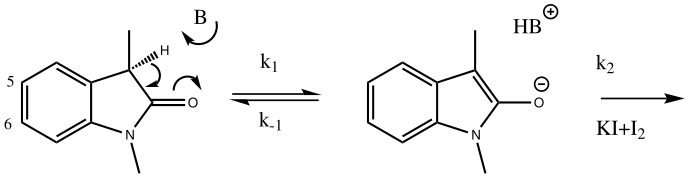
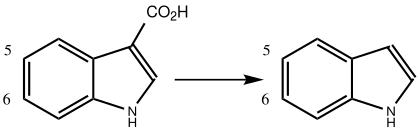
The systems and results are shown in the table below, summarised by the points:
1,3-dimethyl-indolinones:
-
The free energy barriers are very low, but show an overall increase when changing the substituent from nitro to amino, with the 6-position being more sensitive than the 5. However, the increase is not consistent.
-
The transition state mode changes regularly, the wavenumber more than doubling along the progression.
-
The basic structure of the proton transfer evolves smoothly, from being an early transition state with 6-nitro to being a late one with 6-amino.
-
The primary kinetic isotope effect shows less variation, but the trend is to increase as the transition state gets later, even beyond the point where the two bond lengths associated with the tranferring hydrogen are equal in length.
-
As Dan Singleton has pointed out on this blog, the observed KIE is a combination of effects based purely on the transition state structure and effects resulting from the sharpness of the barrier inducing proton tunneling and this is itself related to the magnitude of νi. The KIE ratios tabulated below derive purely from the former and do not take into account any such tunneling. We can see from the variation in νi that such tunnelling contributions are likely to vary substantially across this range of substituents. As a result, deconvoluting the KIE due to the symmetry of the proton transfer from the contribution due to tunnelling is going to be difficult.
-
There are other computational errors which might contribute, such as solvent reorganisations due to specific substituents, only partially taken into acount here. In effect the unsubstituted reaction geometry was used as the template for the others, followed of course by a re-optimisation which might not explore other more favourable orientations brought about by the substituents.
Indole-3-carboxylic acids:
-
The free energy barriers are now much higher than the indolinones, but show a consistent decrease along the series from 6-nitro to 6-amino. This matches with the idea that the indole is a base and the basicity is increased by electron donation and decreased by electron withdrawal.
-
The transition state mode again changes regularly, increasing as the barrier decreases.
-
For 5-H, the computed free energy barrier matches that measured remarkably well.
-
The calculated KIE increase regularly along the series 6-nitro to 6-amino.
-
The calculated KIE for 5-H matches that measured very well, but that for the 5-chloro does not. One might safely conclude that the outlier is probably the experimental value. The KIE are not obtained by direct measurement of the rate of reaction, but inferred from solving the relatively complex rate equation with inclusion of some approximations and assumptions. Perhaps one of these approximations is not valid for this substituent, or possibly an experimental error has encroached. Were this work to ever be repeated, this entry should be prioritised.
-
The overall variation in KIE is in fact quite small, but if the KIE can be measured very accurately, then they should be useful for comparison with such calculations.
-
We cannot really conclude whether the magnitude of the KIE closely reflects the symmetry of the transition state. For all the examples below, the C-H bond is always shorter than the H-O bond. More extreme and probably multiple substituents on the ring (5,6-dinitro? 5,6-diamino?) might have to be used to probe a wider variation in transition state symmetry. For example, the maximum value for proton transfer from a hydronium ion was stated a long time ago to be around 3.6, [1] and it would be of interest to see if that value is attained when the proton transfer becomes fully symmetry.
|
1,3-dimethylindolin-2-ones[2]
|
|
Model
|
ΔG‡298 (ΔH‡298)
|
kH/kD (298K)
|
rC-H, rH-O
|
νi
|
DataDOIs
|
|
6-nitro
|
1.94
|
3.22
|
1.256, 1.417
|
611
|
[3],[4]
|
|
5-nitro
|
1.82
|
3.65
|
1.289, 1.364
|
895
|
[5],[6]
|
|
H
|
2.48
|
4.40
|
1.326, 1.316
|
1130
|
[7],[8]
|
|
5-amino
|
6.73
|
3.86
|
1.337, 1.304
|
1182
|
[9],[10]
|
|
6-amino
|
3.19
|
4.43
|
1.349, 1.291
|
1226
|
[11],[12]
|
|
Indole-3-carboxylic acids[13]
|
|
6-nitro
|
25.1
|
2.72
|
1.279,1.391
|
706
|
[14],[15]
|
|
5-chloro
|
23.1
|
2.80 (2.23)
|
1.300,1.361
|
873
|
[16],[17]
|
|
5-H
|
22.1 (22.0)a[18]
|
2.87 (2.72)[18]
|
1.304,1.354
|
921
|
[19],[20]
|
|
6-amino
|
20.5
|
3.04
|
1.308,1.348
|
950
|
[21],[22]
|
aThe barrier is higher than previously reported because a significantly lower isomer of the ionised reactant was subsequently located.[21] Use of this new isomer also has a modest knock-on effect on the computed isotope effect for this system, bringing it into line with the other substituents and also with experiment.
Overall, this study of variation in kinetic isotope effects for proton transfer as induced by variation of ring substitution shows the viability of such computation. The total elapsed time since the start of this project is about three weeks, very much shorter than the original time taken to synthesize the molecules and measure their kinetics. Importantly, these were very much reactions occuring in aqueous solution, where solvation and general acid or general base catalysis occurred. Such reactions have long been thought to be very difficult to model in a non-dynamic discrete sense. The results obtained here tends towards optimism that such calculations may have a useful role to play in understanding such mechanisms.
I would like to express my enormous gratitude to my Ph.D. supervisor, Brian Challis, for starting me along this life-long exploration of reaction mechanisms. I hope the above gives him satisfaction that the endeavour back in 1972 has borne some more fruits.
References
- C.G. Swain, D.A. Kuhn, and R.L. Schowen, "Effect of Structural Changes in Reactants on the Position of Hydrogen-Bonding Hydrogens and Solvating Molecules in Transition States. The Mechanism of Tetrahydrofuran Formation from 4-Chlorobutanol<sup>1</sup>", Journal of the American Chemical Society, vol. 87, pp. 1553-1561, 1965. https://doi.org/10.1021/ja01085a025
- H. Rzepa, "Kinetic isotope effects for the ionisation of 5- and 6-substituted 1,3-dimethyl indolinones.", 2016. https://doi.org/10.14469/hpc/208
- H.S. Rzepa, "C 10 H 19 N 2 Na 1 O 8", 2016. https://doi.org/10.14469/ch/191802
- H.S. Rzepa, "C 10 H 19 N 2 Na 1 O 8", 2016. https://doi.org/10.14469/ch/191796
- H.S. Rzepa, "C 10 H 19 N 2 Na 1 O 8", 2016. https://doi.org/10.14469/ch/191800
- H.S. Rzepa, "C 10 H 19 N 2 Na 1 O 8", 2016. https://doi.org/10.14469/ch/191789
- H.S. Rzepa, "C 10 H 20 N 1 Na 1 O 6", 2016. https://doi.org/10.14469/ch/191787
- H.S. Rzepa, "C 10 H 20 N 1 Na 1 O 6", 2016. https://doi.org/10.14469/ch/191782
- H.S. Rzepa, "C 10 H 21 N 2 Na 1 O 6", 2016. https://doi.org/10.14469/ch/191803
- H.S. Rzepa, "C 10 H 21 N 2 Na 1 O 6", 2016. https://doi.org/10.14469/ch/191797
- H.S. Rzepa, "C 10 H 21 N 2 Na 1 O 6", 2016. https://doi.org/10.14469/ch/191804
- H.S. Rzepa, "C 10 H 21 N 2 Na 1 O 6", 2016. https://doi.org/10.14469/ch/191799
- H. Rzepa, "Decarboxylation of 5- and 6-substituted indole-3-carboxylic acids", 2016. https://doi.org/10.14469/hpc/220
- H.S. Rzepa, "C 9 H 15 Cl 1 N 2 O 8", 2016. https://doi.org/10.14469/ch/191807
- H.S. Rzepa, and H.S. Rzepa, "C 9 H 15 Cl 1 N 2 O 8", 2016. https://doi.org/10.14469/ch/191805
- H.S. Rzepa, "C 9 H 15 Cl 2 N 1 O 6", 2016. https://doi.org/10.14469/ch/191822
- H.S. Rzepa, "C 9 H 15 Cl 2 N 1 O 6", 2016. https://doi.org/10.14469/ch/191825
- B.C. Challis, and H.S. Rzepa, "Heteroaromatic hydrogen exchange reactions. Part 9. Acid catalysed decarboxylation of indole-3-carboxylic acids", Journal of the Chemical Society, Perkin Transactions 2, pp. 281, 1977. https://doi.org/10.1039/p29770000281
- H.S. Rzepa, "C 9 H 16 Cl 1 N 1 O 6", 2016. https://doi.org/10.14469/ch/191828
- H.S. Rzepa, "C 9 H 16 Cl 1 N 1 O 6", 2016. https://doi.org/10.14469/ch/191790
- H.S. Rzepa, "C 9 H 17 Cl 1 N 2 O 6", 2016. https://doi.org/10.14469/ch/191810
- H.S. Rzepa, "C 9 H 17 Cl 1 N 2 O 6", 2016. https://doi.org/10.14469/ch/191806
Tags:aqueous solution, Brian Challis, can construct quantum-chemical models, computed free energy barrier matches, Dan Singleton, free energy barrier, free energy barriers, Kinetic isotope effect, Organic chemistry, Physical organic chemistry, quantum-chemical models, supervisor
Posted in reaction mechanism | No Comments »
Sunday, April 26th, 2015
Allotropes are differing structural forms of the elements. The best known example is that of carbon, which comes as diamond and graphite, along with the relatively recently discovered fullerenes and now graphenes. Here I ponder whether any of the halogens can have allotropes.
Firstly, I am not aware of much discussion on the topic. But ClF3 is certainly well-known, and so it is trivial to suggest BrBr3, i.e. Br4 as an example of a halogen allotrope. Scifinder for example gives no literature hits on such a substance (either real or as a calculation; it is not always easy nowadays to tell which). So, is it stable? A B3LYP+D3/6-311++G(2d,2p) calculation reveals a free energy barrier of 17.2 kcal/mol preventing Br4 from dissociating to 2Br2.[1] The reaction however is rather exoenergic, and so to stand any chance of observing Br4, one would probably have to create it at a low temperature. But say -78° would probably be low enough to give it a long lifetime; perhaps even 0°.


So how to make it? This is pure speculation, but the red colour of bromine originates from (weak, symmetry forbidden) transitions, with energies calculated (for the 2Br2 complex) as 504, 492nm. Geometry optimisation of the first singlet excited state of 2Br2 produces the structure below, not that different from Br4.

At least from these relatively simple calculations, it does seem as if an allotrope of bromine might be detectable spectroscopically, if not actually isolated as a pure substance.
References
- H.S. Rzepa, "Br4", 2015. https://doi.org/10.14469/ch/191228
Tags:Allotropy, Bromine, Carbon, Chemical elements, Chemistry, free energy barrier, Fullerene, Halogen, Hypobromite, Matter, Nonmetals, Oxidizing agents, Oxygen, pence
Posted in reaction mechanism | 11 Comments »
Sunday, April 12th, 2015
Sodium borohydride is the tamer cousin of lithium aluminium hydride (LAH). It is used in aqueous solution to e.g. reduce aldehydes and ketones, but it leaves acids, amides and esters alone. Here I start an exploration of why it is such a different reducing agent.

Initially, I am using Li, not Na (X=Li), to enable a more or less equal comparison with LAH, with water molecules to solvate rather than ether (n=2,3,5) and R set to Me. First, n=2, for which the IRC is shown below. In this model, we will assume that the carbonyl has not first reacted with water to form a gem-diol. The free energy barrier is 9.6 kcal/mol (ωB97XD/6-311+G(d,p)/SCRF=water) which corresponds to a very fast reaction at room temperatures.

The immediate product is, if anything, more interesting than the transition state[1] with quite a stretched length for the newly formed C-H bond and predicted stretching wavenumber for this bond of 2137 cm-1. This effect is similar to that seen for the LAH reduction of cinnamaldehyde, and is due to stereoelectronic antiperiplanar alignment of the oxyanionic oxygen lone pair with the C-H bond. This species is also some 6.5 kcal/mol higher in energy than the reactant, and is clearly not the final product of the reaction (which must contain e.g. B-O bonds), the mechanism for which will not be investigated here immediately.

For n=3, we see new solvation patterns, including a dihydrogen bond formed between water and the borohydride at the transition state; ΔG† is 10.0 kcal.mol.

Click for 3D.
Finally, n=5, where the TS is showing a cage-like structure of complex weak interactions, ΔG† is 11.3 kcal.mol. We see a model where inclusion of explicit solvent molecules can have a significant influence on the size of the barrier obtained.

Click for 3D


NCI surface. Click for 3D. Blue=strong attractions, green=weak.
| n |
ΔG298‡ |
FAIR Data citation |
| 2 |
9.6 |
[2] |
| 3 |
10.0 |
[3] |
| 5 |
11.3 |
[4] |
With a mechanistic prototype now identified, it is time to start varying some of the parameters, such as X and R. This will enable us to assess the models built here to see if they reflect reality.
References
- H.S. Rzepa, and H.S. Rzepa, "C 2 H 12 B 1 Li 1 O 3", 2015. https://doi.org/10.14469/ch/191186
- H.S. Rzepa, and H.S. Rzepa, "C 2 H 12 B 1 Li 1 O 3", 2015. https://doi.org/10.14469/ch/191188
- H.S. Rzepa, and H.S. Rzepa, "C 2 H 14 B 1 Li 1 O 4", 2015. https://doi.org/10.14469/ch/191189
- H.S. Rzepa, and H.S. Rzepa, "C 2 H 18 B 1 Li 1 O 6", 2015. https://doi.org/10.14469/ch/191192
Tags:aqueous solution, Chemical bond, chemical bonding, Chemistry, Electronic effect, energy, final product, free energy barrier, Hydride, Hydrogen bond, immediate product, Lithium aluminium hydride, reduction
Posted in reaction mechanism | 2 Comments »
Wednesday, November 12th, 2014
In London, one has the pleasures of attending occasional one day meetings at the Burlington House, home of the Royal Society of Chemistry. On November 5th this year, there was an excellent meeting on the topic of Challenges in Catalysis, and you can see the speakers and (some of) their slides here. One talk on the topic of Direct amide formation – the issues, the art, the industrial application by Dave Jackson caught my interest. He asked whether an amide could be formed directly from a carboxylic acid and an amine without the intervention of an explicit catalyst. The answer involved noting that the carboxylic acid was itself a catalyst in the process, and a full mechanistic exploration of this aspect can be found in an article published in collaboration with Andy Whiting’s group at Durham.[1] My after-thoughts in the pub centered around the recollection that I had written some blog posts about the reaction between hydroxylamine and propanone. Might there be any similarity between the two mechanisms?
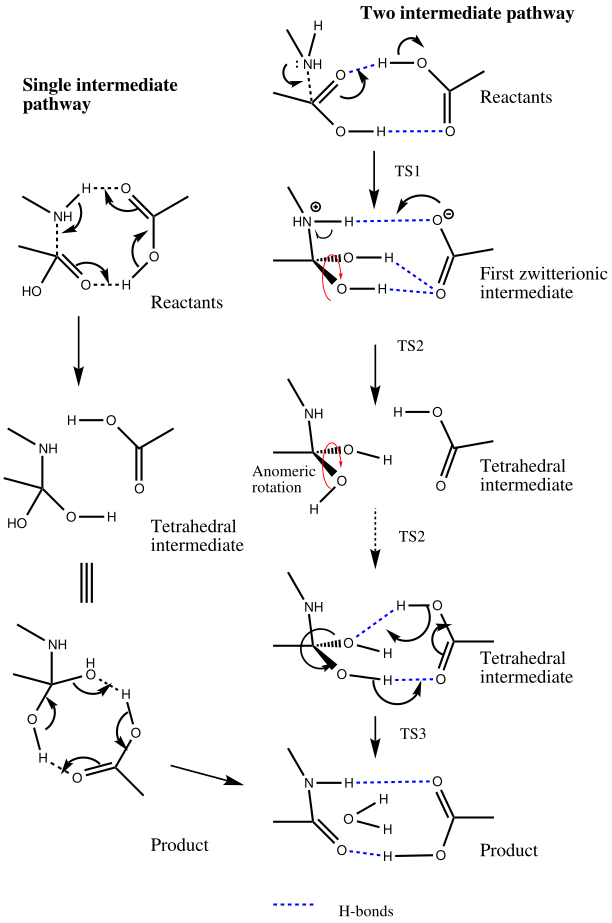
That mechanism can be represented as above, which (as per the hydroxylamine mechanism) comprises three transition states and two intermediates. The original study[1] reported just the one TS1. Editing out the starting coordinates from the PDF-based supporting information (the process is not always easy) enabled an IRC (intrinsic reaction coordinate) for TS1 to be easily computed.[2]

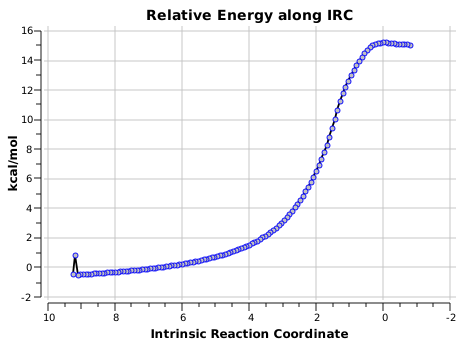
This reveals that TS1 is not the complete story, there is still much of the reaction left to complete. The energy profile is charted (using the ωB97XD/6-311G(d,p/SCRF=p-xylene method) according to the scheme above as reactants ⇒ TS1 ⇒ Intermediate 1 ⇒ TS2 ⇒ Tetrahedral intermediate ⇒ TS3 ⇒ products. Computed properties for this more detailed pathway are transcluded here from the digital repository[3] and appear at the end of this post.
- TS1 yields what might be called a zwitterionic intermediate. However, this has a relatively small dipole moment (5.7D). Thus, against accepted wisdom, such apparently ionic intermediates CAN be involved in reactions occurring in non-polar solvents!
- TS2 is rather unexpected, involving synchronous proton transfer coupled to anomerically related C-OH bond rotation. This rotation changes the anomeric interactions with the adjacent substituents; in my experience I have never before seen a reaction mode quite like this one!
- TS3 collapses the tetrahedral intermediate by synchronous proton transfer and C-O bond cleavage, and is (in this model) the rate determining step. The free energy barrier corresponds to a half-life at 298K of about half an hour.
- The product is calculated as exoenergic with respect to reactants,; the reaction does drive to form an amide (and any catalysis of course will not influence that final outcome, only its kinetics).
If you read the original article[1] you will realise the above only scratches the surface of the many fascinating properties of this apparently very simple reaction. Thus, not addressed above is why amides are only formed in certain solvents (xylene for example) but not others. The solvent may have a specific role to play which is not modelled simply by its continuum dielectric or its boiling point. There is much else that could be said.
References
- H. Charville, D.A. Jackson, G. Hodges, A. Whiting, and M.R. Wilson, "The Uncatalyzed Direct Amide Formation Reaction – Mechanism Studies and the Key Role of Carboxylic Acid H‐Bonding", European Journal of Organic Chemistry, vol. 2011, pp. 5981-5990, 2011. https://doi.org/10.1002/ejoc.201100714
- H.S. Rzepa, "C21H21NO4", 2014. https://doi.org/10.14469/ch/74636
- H.S. Rzepa, "A computed mechanistic pathway for the formation of an amide from an acid and an amine in non-polar solution.", 2014. https://doi.org/10.6084/m9.figshare.1235300
Tags:Andy Whiting, Dave Jackson, dielectric, Durham, energy profile, free energy barrier, London, non-polar solution, PDF, Royal Society of Chemistry
Posted in reaction mechanism | 6 Comments »
Sunday, May 18th, 2014
Continuing my european visits, here are two photos from Bonn. First, a word about how the representation of benzene evolved, attributed to Kekulé.

The sausage formula
Above is his first effort, made in 1865.

The bent bond formula
This one above is better, offered in 1866. But whilst what we now know as the double bond (C=C) is perhaps understandably kinked (and we now call these banana bonds, since nature tends to abhor kinks in electron density), so too are the single bonds!

The plinth
So when it came to erecting a statue in his honour around 1890, the kinks were straightened out! The figure on the right (female) represents science (and purity). The two chaps on the left are workers representing industry. Note that they have still not quite gotten the lengths of the putative single and double bonds in proportion. By 1872 of course, Kekulé had proposed[1],[2] his oscillating model, the one that is taught to this day.
I feel I should add one modern interpretation to this concept. An oscillation implies a frequency. Kekulé could only know that this oscillation was fast on what might be called the “laboratory scale” (in other words, no-one had been able to isolate the individual isomers of substituted benzenes, which implies that the rate constant inter-converting them was probably faster than k = 10-3 s-1 or a few minutes half-life).‡ We now know that this oscillation is ~1014 s-1, the timescale of a molecular vibration! By the way, transition state theory tells us that Ln(k/T) = 23.76 – ΔG‡/RT where k is the unimolecular rate constant, ΔG‡ the free energy barrier, T the temperature and R the gas constant. Setting ΔG‡ to zero gives us a rate constant of ~1014 s-1 (the barrier must be zero, or very close to it).

The Statue
Here is the statue atop the plinth above. Apparently it is honoured by the students with robes and other accoutrements on special occasions.
‡Another famous timescale inference was by Beckmann in 1889[3] when he deduced the existence of a transient unseen intermediate in the (what he thought was) racemisation of menthone. That intermediate of course was the enol.
References
- A. Kekulé, "Ueber einige Condensationsproducte des Aldehyds", Justus Liebigs Annalen der Chemie, vol. 162, pp. 77-124, 1872. https://doi.org/10.1002/jlac.18721620110
- A. Kekulé, "Ueber einige Condensationsproducte des Aldehyds", Justus Liebigs Annalen der Chemie, vol. 162, pp. 309-320, 1872. https://doi.org/10.1002/jlac.18721620211
- E. Beckmann, "Untersuchungen in der Campherreihe", Justus Liebigs Annalen der Chemie, vol. 250, pp. 322-375, 1889. https://doi.org/10.1002/jlac.18892500306
Tags:/RT, free energy barrier, gas constant
Posted in Historical | 3 Comments »
Saturday, November 23rd, 2013
Mercury (IV) tetrafluoride attracted much interest when it was reported in 2007[1] as the first instance of the metal being induced to act as a proper transition element (utilising d-electrons for bonding) rather than a post-transition main group metal (utilising just s-electrons) for which the HgF2 dihalide would be more normal (“Is mercury now a transition element?”[2]). Perhaps this is the modern equivalent of transmutation! Well, now we have new speculation about how to induce the same sort of behaviour for caesium; might it form CsF3 (at high pressures) rather than the CsF we would be more familiar with.[3] Here I report some further calculations inspired by this report.
The argument goes something like this. Xenon difluoride (XeF2) is a well-known stable compound of xenon. Caesium comes immediately after xenon in the periodic table (electron shell properties [Xe].6s1) and so Cs+ would be iso-electronic with Xe. If the latter can form a stable difluoride (and higher), why not Cs? A neutral compound following this line of argument would therefore be CsF3.
So here comes a calculation. I used a large basis set (Def2-QZVPPD basis for Cs), with a pseudopotential describing 46 core electrons (including the two d-shells) and a further 8 in the 5s/p shell to make up the [Xe] core + 1 extra in the 6s shell) using the ωB97XD functional to obtain the geometry, shown below.[4]

Click for 3D and normal modes
All 3N-6 normal vibrational modes are real, which indicates it is a proper minimum in the potential energy surface. A QTAIM analysis shows that ρ(r) at the bond critical points is pretty respectable for bonds (below). The QTAIM-derived average number of electrons on Cs is 7.4, which gives a charge of 1.6 on the Cs , thus involving the 5p shell as well as the 6s.

The most obvious question is what is the free energy change when the species dissociates to CsF and F2? This is exo-energic by 25.1 kcal/mol[5], not as large as you might have thought! Well, what about the barrier to such dissociation? The transition state for this process is shown below, delightfully asymmetric![6] and this gives a free energy barrier of 33.9 kcal/mol (the IRC smoothly defines this reaction[7],[8]).

Click for animation
We may conclude from this brief foray that in CsF3 caesium would indeed deserve to be called a p-block element, although this is not quite as good as it sounds. Take a look for example at the highest occupied molecular orbital. It certainly involves the p-block, but this orbital is in fact anti-bonding, and the Cs-F bonds derive their strength from the lower occupied orbitals.

HOMO. Click for 3D

HOMO-6. Click for 3D
And the final take-home message. The report of this molecule[3] suggests it could be stable under high pressure. Here, the free energy barrier to dissociation is calculated to be indeed high, which implies that if made it could be kinetically quite stable even under normal pressures (in an inert matrix where it would be prevented from reacting with itself).
POSTSCRIPT: The LUMO below is also antibonding, but is mostly 6s on Cs. If one force-populates this by a double excitation from the HOMO, the resulting state is higher in energy (the wavefunction is stable to both singlet and triplet excitations). Which shows that Cs utilises (antibonding) 5p rather than (antibonding) 6s in this species.

References
- X. Wang, L. Andrews, S. Riedel, and M. Kaupp, "Mercury Is a Transition Metal: The First Experimental Evidence for HgF<sub>4</sub>", Angewandte Chemie International Edition, vol. 46, pp. 8371-8375, 2007. https://doi.org/10.1002/anie.200703710
- M. Miao, "Caesium in high oxidation states and as a p-block element", Nature Chemistry, vol. 5, pp. 846-852, 2013. https://doi.org/10.1038/nchem.1754
- H.S. Rzepa, "Gaussian Job Archive for CsF3", 2013. https://doi.org/10.6084/m9.figshare.861029
- H.S. Rzepa, "Gaussian Job Archive for CsF3", 2013. https://doi.org/10.6084/m9.figshare.861030
- "Cs 1 F 3", 2013. http://hdl.handle.net/10042/26513
- H.S. Rzepa, "Gaussian Job Archive for CsF3", 2013. https://doi.org/10.6084/m9.figshare.861038
- H.S. Rzepa, "Gaussian Job Archive for CsF3", 2013. https://doi.org/10.6084/m9.figshare.861047
Tags:animation, energy, free energy barrier, free energy change, metal, pence, post-transition main group metal, potential energy surface
Posted in Hypervalency, Interesting chemistry | 5 Comments »


