Posts Tagged ‘aqueous solution’
Saturday, December 31st, 2016
My holiday reading has been Derek Lowe’s excellent Chemistry Book setting out 250 milestones in chemistry, organised by year. An entry for 1920 entitled hydrogen bonding seemed worth exploring in more detail here.
As with many historical concepts, it can often take a few years to coalesce into something we would readily recognise today, and hydrogen bonds are no exception. Wikipedia is another source of the history and it cites a 1912 article as the origin of the term in relation to the solvation of amines[1] but also notes that the better known setting of water occurs later in 1920.[2] Here I try to capture the essence of the concept with a few diagrams taken from these two articles.
Firstly “The state of amines in aqueous solution“[1] which is mostly concerned with the measurement of ionization constants of primary, secondary and tertiary amines. It boils down to the below:


and the connection to ionization is laid out as:


Since in 1912, Lewis’ electron pair theory of the covalent bond had not yet emerged, the authors use the terms “strong union” and “weak union”, and of course it is the “weak union” that we now know of as the hydrogen bond. Some other comments about this seminal diagram:
- The article contains the very explicit and modern term stereochemical, which is used in a manner that suggests it was already common.‡ But there is only a hint at most that the nitrogen atoms might be tetrahedral, or that the “weak union” between (what we now think of as the lone pair on) the nitrogen and the hydrogen of the water is directional.
- The second weak union between the tetramethyl ammonium (which we now describe as a cation) and the hydroxide (now described as an anion; both terms are however implied by the description strong electrolyte) is probably not what we would now call a hydrogen bond, more an intimate ion-pair.
The second article in 1920 on water itself[2] is post-Lewis, but perhaps applied in a manner which we would not entirely agree with nowadays. Thus dinitrogen, N≡N is shown as below with just a single connecting bond.

Then we get the interaction between ammonia and water,† analogous to the example shown above:

and for water itself:♠

which in each case shows the central hydrogen having what we now call a valence shell of four electrons,♣ and hence more equivalent to the “strong unions” above. This shows that in 1920 chemists were rapidly adopting Lewis’ representations, but not always entirely successfully.
On balance, I think the 1912 article sets out the modern concept of a hydrogen bond representing a weak union to a hydrogen rather better than the Latimer and Rodebush attempt (at least diagrammatically).
‡Stereochemical notation is discussed in this post, and it dates from the 1930s.
†The modern take is explored here, in which the equilibrium set up between a “weak union” between ammonia and water (the weak electrolyte) and an isomeric “strong union” which represents ionization into an ammonium hydroxide ion-pair (the strong electrolyte) is favoured for the former by ΔG ~6 kcal/mol.
♠The equilibrium between a “weak union” of two water molecules and the fully ionized strong union of hydronium hydroxide favours the former by ΔG ~23 kcal/mol.
♣ This 1920 representation does imply symmetry for the hydrogen, being ~equally disposed between the two oxygens. We now know that such symmetric hydrogen bonding is not unusual (see this post for how to fine-tune a hydrogen bond into this situation) but rather than requiring four electrons as implied in the diagram above, it is now better described as a three-centre-two-electron bond instead.
References
- T.S. Moore, and T.F. Winmill, "CLXXVII.—The state of amines in aqueous solution", J. Chem. Soc., Trans., vol. 101, pp. 1635-1676, 1912. https://doi.org/10.1039/ct9120101635
- W.M. Latimer, and W.H. Rodebush, "POLARITY AND IONIZATION FROM THE STANDPOINT OF THE LEWIS THEORY OF VALENCE.", Journal of the American Chemical Society, vol. 42, pp. 1419-1433, 1920. https://doi.org/10.1021/ja01452a015
Tags:10.1021, aqueous solution, Chemical bond, chemical bonding, Chemistry, Derek Lowe, Hydrogen, Hydrogen bond, Intermolecular forces, Lowe's, Nature, Supramolecular chemistry
Posted in Historical | 2 Comments »
Saturday, December 31st, 2016
My holiday reading has been Derek Lowe’s excellent Chemistry Book setting out 250 milestones in chemistry, organised by year. An entry for 1920 entitled hydrogen bonding seemed worth exploring in more detail here.
As with many historical concepts, it can often take a few years to coalesce into something we would readily recognise today, and hydrogen bonds are no exception. Wikipedia is another source of the history and it cites a 1912 article as the origin of the term in relation to the solvation of amines[1] but also notes that the better known setting of water occurs later in 1920.[2] Here I try to capture the essence of the concept with a few diagrams taken from these two articles.
Firstly “The state of amines in aqueous solution“[1] which is mostly concerned with the measurement of ionization constants of primary, secondary and tertiary amines. It boils down to the below:


and the connection to ionization is laid out as:


Since in 1912, Lewis’ electron pair theory of the covalent bond had not yet emerged, the authors use the terms “strong union” and “weak union”, and of course it is the “weak union” that we now know of as the hydrogen bond. Some other comments about this seminal diagram:
- The article contains the very explicit and modern term stereochemical, which is used in a manner that suggests it was already common.‡ But there is only a hint at most that the nitrogen atoms might be tetrahedral, or that the “weak union” between (what we now think of as the lone pair on) the nitrogen and the hydrogen of the water is directional.
- The second weak union between the tetramethyl ammonium (which we now describe as a cation) and the hydroxide (now described as an anion; both terms are however implied by the description strong electrolyte) is probably not what we would now call a hydrogen bond, more an intimate ion-pair.
The second article in 1920 on water itself[2] is post-Lewis, but perhaps applied in a manner which we would not entirely agree with nowadays. Thus dinitrogen, N≡N is shown as below with just a single connecting bond.

Then we get the interaction between ammonia and water,† analogous to the example shown above:

and for water itself:♠

which in each case shows the central hydrogen having what we now call a valence shell of four electrons,♣ and hence more equivalent to the “strong unions” above. This shows that in 1920 chemists were rapidly adopting Lewis’ representations, but not always entirely successfully.
On balance, I think the 1912 article sets out the modern concept of a hydrogen bond representing a weak union to a hydrogen rather better than the Latimer and Rodebush attempt (at least diagrammatically).
‡Stereochemical notation is discussed in this post, and it dates from the 1930s.
†The modern take is explored here, in which the equilibrium set up between a “weak union” between ammonia and water (the weak electrolyte) and an isomeric “strong union” which represents ionization into an ammonium hydroxide ion-pair (the strong electrolyte) is favoured for the former by ΔG ~6 kcal/mol.
♠The equilibrium between a “weak union” of two water molecules and the fully ionized strong union of hydronium hydroxide favours the former by ΔG ~23 kcal/mol.
♣ This 1920 representation does imply symmetry for the hydrogen, being ~equally disposed between the two oxygens. We now know that such symmetric hydrogen bonding is not unusual (see this post for how to fine-tune a hydrogen bond into this situation) but rather than requiring four electrons as implied in the diagram above, it is now better described as a three-centre-two-electron bond instead.
References
- T.S. Moore, and T.F. Winmill, "CLXXVII.—The state of amines in aqueous solution", J. Chem. Soc., Trans., vol. 101, pp. 1635-1676, 1912. https://doi.org/10.1039/ct9120101635
- W.M. Latimer, and W.H. Rodebush, "POLARITY AND IONIZATION FROM THE STANDPOINT OF THE LEWIS THEORY OF VALENCE.", Journal of the American Chemical Society, vol. 42, pp. 1419-1433, 1920. https://doi.org/10.1021/ja01452a015
Tags:10.1021, aqueous solution, Chemical bond, chemical bonding, Chemistry, Derek Lowe, Hydrogen, Hydrogen bond, Intermolecular forces, Lowe's, Nature, Supramolecular chemistry
Posted in Historical | 2 Comments »
Saturday, December 24th, 2016
The previous posts produced discussion about the dipole moments of highly polar molecules. Here to produce some reference points for further discussion I look at the dipole moment of glycine, the classic zwitterion (an internal ion-pair).
Dielectric relaxation studies of glycine–water mixtures yield values that range from 15.7D[1] to 11.9D[2] although these have to be derived using various approximations and assumptions for up to 4 independent Debye processes. Before proceeding to calculations, I looked at the properties of ionized amino acids in the solid state, using the following search query for the Cambridge structure database (CSD).

The distance measures hydrogen bonds to the carboxylate oxygens and the torsion their orientation. The O…H hydrogen bond distances vary between 1.7-1.85Å, which are short. The orientation of the hydrogen bond can be to the in-plane oxygen “σ-lone pair” (torsion 0 or 180°) and also an out-of-plane ~π form (torsion ~60-90°).

In aqueous solution, it is normally assumed that glycine sustains five such strong H-bonds (three to the H3N+ group and two[3] to the carboxylate anion), forming a polarised “salt bridge” across the ion-pair. Two model types were subjected to calculation using ωB97XD/Def2-TZVPP/SCRF=water. Aqueous glycine without any added explicit water molecules yields a dipole moment of 12.9D (DOI: 10.14469/hpc/2000), which is within the range noted above.‡

The solvated form is shown below, in one specific conformation of the three studied (ωB97XD/Def2-TZVPP/SCRF=water). The calculated O…H hydrogen bond lengths fall into the range revealed from crystal structures. The calculated dipole moments range from 12.6 (DOI: 10.14469/hpc/2007), 15.3 (DOI: 10.14469/hpc/2006) and 14.9D (DOI: 10.14469/hpc/2005), which is a modest increase over the model with no explicit water molecules. The actual dipole is of course a Boltzmann average over these and other as yet unexplored conformations, as well as other values for the number of water molecules.

Given the difficulties in interpreting the dipole moment of a complex Debye system such as hydrated glycine, the agreement between the limited range of solvated models and the measured values seems reasonable, and provides at least some measure of “calibration” for the polar molecules commented on previously.
‡Optimized with the solvent field on. If a vacuum model is used, the proton transfers from the N to the O.
References
- M.W. Aaron, and E.H. Grant, "Dielectric relaxation of glycine in water", Transactions of the Faraday Society, vol. 59, pp. 85, 1963. https://doi.org/10.1039/tf9635900085
- T. Sato, R. Buchner, Å. Fernandez, A. Chiba, and W. Kunz, "Dielectric relaxation spectroscopy of aqueous amino acid solutions: dynamics and interactions in aqueous glycine", Journal of Molecular Liquids, vol. 117, pp. 93-98, 2005. https://doi.org/10.1016/j.molliq.2004.08.001
- T. Shikata, "Dielectric Relaxation Behavior of Glycine Betaine in Aqueous Solution", The Journal of Physical Chemistry A, vol. 106, pp. 7664-7670, 2002. https://doi.org/10.1021/jp020957j
Tags:aqueous solution, Chemical polarity, Chemistry, dielectric, Dipole, Electric dipole moment, Electromagnetism, Magnetism, Moment, Nature, Physical quantities, Physics, Potential theory, zwitterion
Posted in crystal_structure_mining, Interesting chemistry | 1 Comment »
Wednesday, January 20th, 2016
The original strategic objective of my PhD researches in 1972-74 was to explore how primary kinetic hydrogen isotope effects might be influenced by the underlying structures of the transition states involved. Earlier posts dealt with how one can construct quantum-chemical models of these transition states that fit the known properties of the reactions. Now, one can reverse the strategy by computing the expected variation with structure to see if anything interesting might emerge, and then if it does, open up the prospect of further exploration by experiment. Here I will use the base-catalysed enolisation of 1,3-dimethylindolin-2-ones and the decarboxylation of 3-indole carboxylates to explore this aspect.
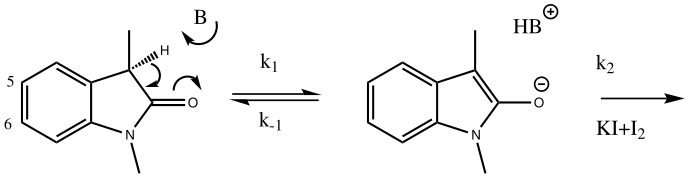
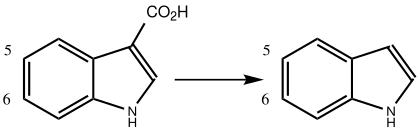
The systems and results are shown in the table below, summarised by the points:
1,3-dimethyl-indolinones:
-
The free energy barriers are very low, but show an overall increase when changing the substituent from nitro to amino, with the 6-position being more sensitive than the 5. However, the increase is not consistent.
-
The transition state mode changes regularly, the wavenumber more than doubling along the progression.
-
The basic structure of the proton transfer evolves smoothly, from being an early transition state with 6-nitro to being a late one with 6-amino.
-
The primary kinetic isotope effect shows less variation, but the trend is to increase as the transition state gets later, even beyond the point where the two bond lengths associated with the tranferring hydrogen are equal in length.
-
As Dan Singleton has pointed out on this blog, the observed KIE is a combination of effects based purely on the transition state structure and effects resulting from the sharpness of the barrier inducing proton tunneling and this is itself related to the magnitude of νi. The KIE ratios tabulated below derive purely from the former and do not take into account any such tunneling. We can see from the variation in νi that such tunnelling contributions are likely to vary substantially across this range of substituents. As a result, deconvoluting the KIE due to the symmetry of the proton transfer from the contribution due to tunnelling is going to be difficult.
-
There are other computational errors which might contribute, such as solvent reorganisations due to specific substituents, only partially taken into acount here. In effect the unsubstituted reaction geometry was used as the template for the others, followed of course by a re-optimisation which might not explore other more favourable orientations brought about by the substituents.
Indole-3-carboxylic acids:
-
The free energy barriers are now much higher than the indolinones, but show a consistent decrease along the series from 6-nitro to 6-amino. This matches with the idea that the indole is a base and the basicity is increased by electron donation and decreased by electron withdrawal.
-
The transition state mode again changes regularly, increasing as the barrier decreases.
-
For 5-H, the computed free energy barrier matches that measured remarkably well.
-
The calculated KIE increase regularly along the series 6-nitro to 6-amino.
-
The calculated KIE for 5-H matches that measured very well, but that for the 5-chloro does not. One might safely conclude that the outlier is probably the experimental value. The KIE are not obtained by direct measurement of the rate of reaction, but inferred from solving the relatively complex rate equation with inclusion of some approximations and assumptions. Perhaps one of these approximations is not valid for this substituent, or possibly an experimental error has encroached. Were this work to ever be repeated, this entry should be prioritised.
-
The overall variation in KIE is in fact quite small, but if the KIE can be measured very accurately, then they should be useful for comparison with such calculations.
-
We cannot really conclude whether the magnitude of the KIE closely reflects the symmetry of the transition state. For all the examples below, the C-H bond is always shorter than the H-O bond. More extreme and probably multiple substituents on the ring (5,6-dinitro? 5,6-diamino?) might have to be used to probe a wider variation in transition state symmetry. For example, the maximum value for proton transfer from a hydronium ion was stated a long time ago to be around 3.6, [1] and it would be of interest to see if that value is attained when the proton transfer becomes fully symmetry.
|
1,3-dimethylindolin-2-ones[2]
|
|
Model
|
ΔG‡298 (ΔH‡298)
|
kH/kD (298K)
|
rC-H, rH-O
|
νi
|
DataDOIs
|
|
6-nitro
|
1.94
|
3.22
|
1.256, 1.417
|
611
|
[3],[4]
|
|
5-nitro
|
1.82
|
3.65
|
1.289, 1.364
|
895
|
[5],[6]
|
|
H
|
2.48
|
4.40
|
1.326, 1.316
|
1130
|
[7],[8]
|
|
5-amino
|
6.73
|
3.86
|
1.337, 1.304
|
1182
|
[9],[10]
|
|
6-amino
|
3.19
|
4.43
|
1.349, 1.291
|
1226
|
[11],[12]
|
|
Indole-3-carboxylic acids[13]
|
|
6-nitro
|
25.1
|
2.72
|
1.279,1.391
|
706
|
[14],[15]
|
|
5-chloro
|
23.1
|
2.80 (2.23)
|
1.300,1.361
|
873
|
[16],[17]
|
|
5-H
|
22.1 (22.0)a[18]
|
2.87 (2.72)[18]
|
1.304,1.354
|
921
|
[19],[20]
|
|
6-amino
|
20.5
|
3.04
|
1.308,1.348
|
950
|
[21],[22]
|
aThe barrier is higher than previously reported because a significantly lower isomer of the ionised reactant was subsequently located.[21] Use of this new isomer also has a modest knock-on effect on the computed isotope effect for this system, bringing it into line with the other substituents and also with experiment.
Overall, this study of variation in kinetic isotope effects for proton transfer as induced by variation of ring substitution shows the viability of such computation. The total elapsed time since the start of this project is about three weeks, very much shorter than the original time taken to synthesize the molecules and measure their kinetics. Importantly, these were very much reactions occuring in aqueous solution, where solvation and general acid or general base catalysis occurred. Such reactions have long been thought to be very difficult to model in a non-dynamic discrete sense. The results obtained here tends towards optimism that such calculations may have a useful role to play in understanding such mechanisms.
I would like to express my enormous gratitude to my Ph.D. supervisor, Brian Challis, for starting me along this life-long exploration of reaction mechanisms. I hope the above gives him satisfaction that the endeavour back in 1972 has borne some more fruits.
References
- C.G. Swain, D.A. Kuhn, and R.L. Schowen, "Effect of Structural Changes in Reactants on the Position of Hydrogen-Bonding Hydrogens and Solvating Molecules in Transition States. The Mechanism of Tetrahydrofuran Formation from 4-Chlorobutanol<sup>1</sup>", Journal of the American Chemical Society, vol. 87, pp. 1553-1561, 1965. https://doi.org/10.1021/ja01085a025
- H. Rzepa, "Kinetic isotope effects for the ionisation of 5- and 6-substituted 1,3-dimethyl indolinones.", 2016. https://doi.org/10.14469/hpc/208
- H.S. Rzepa, "C 10 H 19 N 2 Na 1 O 8", 2016. https://doi.org/10.14469/ch/191802
- H.S. Rzepa, "C 10 H 19 N 2 Na 1 O 8", 2016. https://doi.org/10.14469/ch/191796
- H.S. Rzepa, "C 10 H 19 N 2 Na 1 O 8", 2016. https://doi.org/10.14469/ch/191800
- H.S. Rzepa, "C 10 H 19 N 2 Na 1 O 8", 2016. https://doi.org/10.14469/ch/191789
- H.S. Rzepa, "C 10 H 20 N 1 Na 1 O 6", 2016. https://doi.org/10.14469/ch/191787
- H.S. Rzepa, "C 10 H 20 N 1 Na 1 O 6", 2016. https://doi.org/10.14469/ch/191782
- H.S. Rzepa, "C 10 H 21 N 2 Na 1 O 6", 2016. https://doi.org/10.14469/ch/191803
- H.S. Rzepa, "C 10 H 21 N 2 Na 1 O 6", 2016. https://doi.org/10.14469/ch/191797
- H.S. Rzepa, "C 10 H 21 N 2 Na 1 O 6", 2016. https://doi.org/10.14469/ch/191804
- H.S. Rzepa, "C 10 H 21 N 2 Na 1 O 6", 2016. https://doi.org/10.14469/ch/191799
- H. Rzepa, "Decarboxylation of 5- and 6-substituted indole-3-carboxylic acids", 2016. https://doi.org/10.14469/hpc/220
- H.S. Rzepa, "C 9 H 15 Cl 1 N 2 O 8", 2016. https://doi.org/10.14469/ch/191807
- H.S. Rzepa, and H.S. Rzepa, "C 9 H 15 Cl 1 N 2 O 8", 2016. https://doi.org/10.14469/ch/191805
- H.S. Rzepa, "C 9 H 15 Cl 2 N 1 O 6", 2016. https://doi.org/10.14469/ch/191822
- H.S. Rzepa, "C 9 H 15 Cl 2 N 1 O 6", 2016. https://doi.org/10.14469/ch/191825
- B.C. Challis, and H.S. Rzepa, "Heteroaromatic hydrogen exchange reactions. Part 9. Acid catalysed decarboxylation of indole-3-carboxylic acids", Journal of the Chemical Society, Perkin Transactions 2, pp. 281, 1977. https://doi.org/10.1039/p29770000281
- H.S. Rzepa, "C 9 H 16 Cl 1 N 1 O 6", 2016. https://doi.org/10.14469/ch/191828
- H.S. Rzepa, "C 9 H 16 Cl 1 N 1 O 6", 2016. https://doi.org/10.14469/ch/191790
- H.S. Rzepa, "C 9 H 17 Cl 1 N 2 O 6", 2016. https://doi.org/10.14469/ch/191810
- H.S. Rzepa, "C 9 H 17 Cl 1 N 2 O 6", 2016. https://doi.org/10.14469/ch/191806
Tags:aqueous solution, Brian Challis, can construct quantum-chemical models, computed free energy barrier matches, Dan Singleton, free energy barrier, free energy barriers, Kinetic isotope effect, Organic chemistry, Physical organic chemistry, quantum-chemical models, supervisor
Posted in reaction mechanism | No Comments »
Sunday, April 12th, 2015
Sodium borohydride is the tamer cousin of lithium aluminium hydride (LAH). It is used in aqueous solution to e.g. reduce aldehydes and ketones, but it leaves acids, amides and esters alone. Here I start an exploration of why it is such a different reducing agent.

Initially, I am using Li, not Na (X=Li), to enable a more or less equal comparison with LAH, with water molecules to solvate rather than ether (n=2,3,5) and R set to Me. First, n=2, for which the IRC is shown below. In this model, we will assume that the carbonyl has not first reacted with water to form a gem-diol. The free energy barrier is 9.6 kcal/mol (ωB97XD/6-311+G(d,p)/SCRF=water) which corresponds to a very fast reaction at room temperatures.

The immediate product is, if anything, more interesting than the transition state[1] with quite a stretched length for the newly formed C-H bond and predicted stretching wavenumber for this bond of 2137 cm-1. This effect is similar to that seen for the LAH reduction of cinnamaldehyde, and is due to stereoelectronic antiperiplanar alignment of the oxyanionic oxygen lone pair with the C-H bond. This species is also some 6.5 kcal/mol higher in energy than the reactant, and is clearly not the final product of the reaction (which must contain e.g. B-O bonds), the mechanism for which will not be investigated here immediately.

For n=3, we see new solvation patterns, including a dihydrogen bond formed between water and the borohydride at the transition state; ΔG† is 10.0 kcal.mol.

Click for 3D.
Finally, n=5, where the TS is showing a cage-like structure of complex weak interactions, ΔG† is 11.3 kcal.mol. We see a model where inclusion of explicit solvent molecules can have a significant influence on the size of the barrier obtained.

Click for 3D


NCI surface. Click for 3D. Blue=strong attractions, green=weak.
| n |
ΔG298‡ |
FAIR Data citation |
| 2 |
9.6 |
[2] |
| 3 |
10.0 |
[3] |
| 5 |
11.3 |
[4] |
With a mechanistic prototype now identified, it is time to start varying some of the parameters, such as X and R. This will enable us to assess the models built here to see if they reflect reality.
References
- H.S. Rzepa, and H.S. Rzepa, "C 2 H 12 B 1 Li 1 O 3", 2015. https://doi.org/10.14469/ch/191186
- H.S. Rzepa, and H.S. Rzepa, "C 2 H 12 B 1 Li 1 O 3", 2015. https://doi.org/10.14469/ch/191188
- H.S. Rzepa, and H.S. Rzepa, "C 2 H 14 B 1 Li 1 O 4", 2015. https://doi.org/10.14469/ch/191189
- H.S. Rzepa, and H.S. Rzepa, "C 2 H 18 B 1 Li 1 O 6", 2015. https://doi.org/10.14469/ch/191192
Tags:aqueous solution, Chemical bond, chemical bonding, Chemistry, Electronic effect, energy, final product, free energy barrier, Hydride, Hydrogen bond, immediate product, Lithium aluminium hydride, reduction
Posted in reaction mechanism | 2 Comments »
Monday, September 7th, 2009
The science journal is generally acknowledged as first appearing around 1665 with the Philosophical Transactions of the Royal Society in London and (simultaneously) the French Academy of Sciences in Paris. By the turn of the millennium, around 10,000 science and medical journals were estimated to exist. By then, the Web had been around for a decade, and most journals had responded to this new medium by re-inventing themselves for it. For most part, they adopted a format which emulated paper (Acrobat), with a few embellishments (such as making the text fully searchable) and then used the Web to deliver this new reformulation of the journal. Otherwise, Robert Hooke would have easily recognized the medium he helped found in the 17th century.
In 1994, a small group of us thought that one could, and indeed should go further than emulated paper. We argued [1] that journals should be activated by delivering not merely the logic of a scientific argument, but also the data on which it might have been based. Of course, we encountered the usual problem; doing this might cost publishers more in production resources, and in the absence of a market prepared to pay the extra, the business model did not make sense (to the publishers). Well, 15 years later, and most publishers are indeed now thinking about how their journals can be enhanced. A number of interesting projects (the RSC’s Project Prospect is one which strives to bring science alive) have emerged. Another is the topic of this blog; the activation of the journal with molecular coordinates and data using the Jmol applet.
Initially (~2005), this project met with resistance from publishers, and the issue really amounted to what the definitive version of a scientific article should be. Should that definitive version be printable? That model, after all had served the community well for more than 300 years! And journals from the very beginning are still as readable now as when first published. In other words, print lasts! But print is pretty limiting after all. For a start, it is limited to 2D static representations. Molecules, by and large, do their magic in a dynamic three dimensions (4D in an Einsteinian sense). But print is also expensive; not merely to produce, but to transport paper around the world.
From the turn of the millennium, a number of publishers, amongst them the American Chemical Society, started to evolve the scientific article such that the pre-eminent version would now be considered to be the HTML form (perhaps as a prelude to phasing out print entirely? See an interesting commentary by a journal editor) and perhaps a digital Acrobat form which would be deemed to loose some of its functionality once printed (again see here for how Acrobat can be used to enhance things). Again however, a chicken-and-egg scenario resulted. To enhance the articles with extra functionality (such as data), they would need to find authors prepared to put the extra work into preparing the material. In fact, most authors already do that, but they call it supporting information. This is often highly data rich, covering materials such as spectra, coordinates and other information nowadays provided to researchers for analysis. Unfortunately, what has been missing is the education of authors to provide this information in a proper digital form which can be easily re-used by others, and on a Web page, converted automatically to nice interactive models. Most spectra which form part of the supporting information are in fact still scanned versions of printed spectra!
Enter computational chemists. Nowadays, they live in a world that truly does not need printing! Almost all of their data is already suitably digital. So perhaps it is no surprise to find that when enhanced journal articles started appearing around 2005, many were produced by this group of chemists. By now perhaps you are wondering what such an article might look like. Well, the remainder of this blog will be devoted to listing some examples. You will also notice that they come exclusively from our own publications. Perhaps someone will find the time to collect a far more representative set to better illustrate the diversity of this form, and how it is evolving. Meanwhile, you might wish to take a look at the following.
Part 1: The early days: 1994 onwards
These examples all relied on a browser plugin called Chime, which is no longer with us! Hence the pages designed to invoke it no longer display properly. But the data associated with the articles is still there!
- An early 1994 example of (hyper)activating a journal article can be seen here as the preliminary communication and
- in 1995 here as the final full article. I am told that this was the article that actually inspired the developers of Chime to enhance (Netscape) with a chemical plugin.
- This one from 1998 illustrates how articles can decay in functionality when Chime is no longer available.
- An ab initio and MNDO-d SCF-MO Computational Study of Stereoelectronic Control in Extrusion Reactions of R2I-F Iodine (III) Intermediates, M. A. Carroll, S. Martin-Santamaria, V. W. Pike, H. S. Rzepa and D. A. Widdowson, Perkin Trans. 2, 1999, 2707-2714 with the supporting information here.
- Huckel and Mobius Aromaticity and Trimerous transition state behaviour in the Pericyclic Reactions of [10], [14], [16] and [18] Annulenes. Sonsoles Martên-Santamarêa, Balasundaram Lavan and H. S. Rzepa, J. Chem. Soc., Perkin Trans 2, 2000, 1415. with the supporting information here.
- Peter Murray-Rust, H. S. Rzepa and Michael Wright, “Development of Chemical Markup Language (CML) as a System for Handling Complex Chemical Content”, New J. Chem., 2001, 618-634. DOI: 10.1039/b008780g. This article broke new ground in that the supporting information was something of a misnomer. It was expressed entirely in XML, including all the chemistry data, and used XSLT transforms on the fly to regenerate the article. In that sense, it was actually a superset of the published article. It would be fair to say that this article was rather ahead of its time (although it does seem appropriate to publish it in a new journal!).
- M. Jakt, L. Johannissen, H. S. Rzepa, D. A. Widdowson and R. Wilhelm, “A Computational Study of the Mechanism of Palladium Insertion into Alkynyl and Aryl Carbon-Fluorine bonds”, Perkin Trans. 2, 2002, 576-581 and supporting information.
- P. Murray-Rust and H. S. Rzepa, chapter in “Handbook of Chemoinformatics. Part 2. Advanced Topics.”, ed. J. Gasteiger and T. Engel, 2003, Vol 1, was not enhanced per se, but did lay out the principles of how it might/should be done.
- K. P. Tellmann, M. J. Humphries, H. S. Rzepa and V. C. Gibson, “An experimental and computational study of β-H transfer between organocobalt complexes and 1-alkenes”, Organometallics, 2004, 23, 5503-5513. DOI: 10.1021/om049581h and supporting information.
Part 2: 2005.
These four examples all now invoke Jmol, which downloads upon request and hence does not rely on the presence of any browser plugin. The four articles were submited with supporting information in the form of HTML. These were associated with the main article, but were not formal part of that article. In that sense, they represent an incarnation of the traditional model, with all the data firmly resident in the supporting information.
- Gibson, Vernon C.; Marshall, Edward L.; Rzepa, H. S. ” A computational study on the ring-opening polymerization of lactide initiated by β-diketiminate metal alkoxides: The origin of heterotactic stereocontrol”, J. Am. Chem. Soc., 2005, 127, 6048-6051. DOI: 10.1021/ja043819b and supporting information.
- H. S. Rzepa, Mobius aromaticity and delocalization”, Chem. Rev., 2005, 105, 3697 – 3715. DOI: 10.1021/cr030092l and supporting information.
- H. S. Rzepa, “Double-twist Mšbius Aromaticity in a 4n+2 Electron Electrocyclic Reaction”, 2005, Chem Comm, 5220-5222. DOI: 10.1039/b510508k The supporting information is also available directly.
- H. S. Rzepa, “A Double-twist Mobius-aromatic conformation of [14]annulene”, Org. Lett., 2005, 7, 637 – 4639. DOI: 10.1021/ol0518333 and supporting information.
Part 3: 2006 onwards
The supporting information has now been assimilated into the main body of the article proper, and within these confines contribute components such as enhanced figures or tables (i.e. enhanced with data)
- A. P. Dove, V. C. Gibson, E. L. Marshall, H. S. Rzepa, A. J. P. White and D. J. Williams, “Synthetic, Structural, Mechanistic and Computational Studies on Single-Site β-Diketiminate Tin(II) Initiators for the Polymerization of rac-Lactide”, J. Am. Chem. Soc., 2006,128, 9834-9843. DOI: 10.1021/ja061400a The enhancement can be seen in Figure 11.
- O. Casher and H. S. Rzepa, “SemanticEye: A Semantic Web Application to Rationalise and Enhance Chemical Electronic Publishing”, J. Chem. Inf. Mod., 2006, 46, 2396-2411. DOI: 10.1021/ci060139e
- H S. Rzepa and M. E. Cass, “A Computational Study of the Nondissociative Mechanisms that Interchange Apical and Equatorial Atoms in Square Pyramidal Molecules”, Inorg. Chem., 2006, 45, 3958–3963. DOI 10.1021/ic0519988. Interactive table at 10.1021/ic0519988/ic0519988.html
- M. E. Cass and H. S. Rzepa, “In Search of The Bailar Twist and Ray-Dutt mechanisms that racemize chiral tris-chelates: A computational study of Sc(III), V(III), Co(III), Zn(II) and Ga(III) complexes of a ligand analog of acetylacetonate”, Inorg. Chem., 2007, 49, 8024-8031. DOI: 10.1021/ic062473y The enhancement can be seen in Figure 2
- H. S. Rzepa, “Lemniscular Hexaphyrins as examples of aromatic and antiaromatic Double-Twist Möbius Molecules”, Org. Lett., 2008, 10, 949-952.DOI:10.1021/ol703129z The enhancement can be seen in Web Table 1.
- D. C. Braddock and H. S. Rzepa, “Structural Reassignment of Obtusallenes V, VI and VII by GIAO-based Density functional prediction”, J. Nat. Prod., 2008, DOI: 10.1021/np0705918 and WEO1.
- S. M. Rappaport and H S. Rzepa, “Intrinsically Chiral Aromaticity. Rules Incorporating Linking Number, Twist, and Writhe for Higher-Twist Möbius Annulenes”, J. Am. Chem. Soc., 2008, 130,, 7613-7619. DOI: 10.1021/ja710438j and WEO1 to 4
- C. S. M. Allan and H. S. Rzepa, “AIM and ELF Critical point and NICS Magnetic analyses of Möbius-type Aromaticity and Homoaromaticity in Lemniscular Annulenes and Hexaphyrins”, J. Org. Chem., 2008, 73, 6615-6622. DOI: 10.1021/jo801022b and WEO1
- C. S. M. Allan and H. S. Rzepa, “Chiral aromaticities. Möbius Homoaromaticity”, J. Chem. Theory. Comp., 2008, 4, 1841-1848. DOI: 10.1021/ct8001915 and WEO1
- C. S. M Allan and H. S. Rzepa, “The structure of Polythiocyanogen: A Computational investigation”, Dalton Trans., 2008, 6925 – 6932. DOI: 10.1039/b810147g and enhanced Table
- H. S. Rzepa, “Wormholes in Chemical Space connecting Torus Knot and Torus Link π-electron density topologies”, Phys. Chem. Chem. Phys., 2009, 1340-1345. DOI: 10.1039/b810301a and enhanced Table.
- H. S. Rzepa, “The Chiro-optical properties of a Lemniscular Octaphyrin”, Org. Lett., 2009, 11, 3088-3091. DOI: 10.1021/ol901172g
- C. S. Wannere, H. S. Rzepa, B. C. Rinderspacher, A. Paul, H. F. Schaefer III, P. v. R. Schleyer and C. S. M. Allan, “The geometry and electronic topology of higher-order Möbius charged Annulenes”, J. Phys. Chem., 2009, DOI: 10.1021/jp902176a and enhanced table
- H. S. Rzepa, “The distortivity of π-electrons in conjugated Boron rings.”, Phys. Chem. Chem. Phys., 2009, DOI: 10.1039/B911817A and enhanced table.
- H. S. Rzepa, “The importance of being bonded”, Nature Chem., 2009, DOI: 10.1038/nchem.373 and the exploratorium.
- King Kuok Hii, J.L.Arbour, H.S.Rzepa, A.J.P.White, “Unusual Regiodivergence in Metal-Catalysed Intramolecular Cyclisation of γ-Allenols”, Chem. Commun, 2009, DOI: 10.1039/b913295c and enhanced table.
- L. F. V. Pinto, P. M. C. Glória, M. J. S. Gomes, H. S. Rzepa, S. Prabhakar, A. M. Lobo. “A Dramatic Effect of Double Bond Configuration in N-Oxy-3-aza Cope Rearrangements – A simple synthesis of functionalised allenes”, Tet. Lett., 2009, 50, 3446-3449. DOI: 10.1016/j.tetlet.2009.02.228 and interactive table.
- H. S. Rzepa and C. S. M. Allan, “Racemization of isobornyl chloride via carbocations: a non-classical look at a classic mechanism”, J. Chem. Educ., 2010, DOI: 10.1021/ed800058c and interactive table.
- K. Abersfelder, A. J. P. White, H. S. Rzepa, and D. Scheschkewitz “A Tricyclic Aromatic Isomer of Hexasilabenzene”, Science, 2010, DOI: 10.1126/science.1181771 and interactive table.
- A. C. Spivey, L. Laraia, A. R. Bayly, H. S. Rzepa and A. J. P. White “Stereoselective Synthesis of cis- and trans-2,3-Disubstituted Tetrahydrofurans via Oxonium−Prins Cyclization: Access to the Cordigol Ring System”, Org. Lett., 2010, DOI 10.1021/ol9024259 and interactive table.
- J. Kong, P. v. R. Schleyer and H. S. Rzepa, “Successful Computational Modeling of Iso-bornyl Chloride Ion-Pair Mechanisms”, J. Org. Chem., 2010, DOI: 10.1021/jo100920e and interactive table.
- A. Smith, H. S. Rzepa, A. White, D. Billen, K. K. Hii, “Delineating Origins of Stereocontrol in Asymmetric Pd-Catalyzed α-Hydroxylation of 1,3-Ketoesters”, J. Org. Chem., 2010, 75, 3085-3096. DOI: 10.1021/jo1002906 and interactive table.
- H. S. Rzepa “The rational design of helium bonds”, Nature Chem., 2010, 2, 390-393. DOI: 10.1038/NCHEM.596 and web enhanced table.
- P. Rivera-Fuentes, J. Lorenzo Alonso-Gómez, A. G. Petrovic, P. Seiler, F. Santoro, N. Harada, N. Berova, H. S. Rzepa, and F. Diederich, “Enantiomerically Pure Alleno–Acetylenic Macrocycles: Synthesis, Solid-State Structures, Chiroptical Properties, and Electron Localization Function Analysis”, Chem. Eur. J., 2010, DOI: 10.1002/chem.201001087 and interactive figure
- H. S. Rzepa, “The Nature of the Carbon-Sulfur bond in the species H-CS-OH”, J. Chem. Theory. Comput., 2010, 49, DOI: 10.1021/ct100470g and interactive table.
- H. S. Rzepa, “Can 1,3-dimethylcyclobutadiene and carbon dioxide co-exist inside a supramolecular cavity?”, Chem. Commun., 2010, DOI: 10.1039/C0CC04023A and interactive table
- M. R. Crittall, H. S. Rzepa, and D. R. Carbery, “Design, Synthesis, and Evaluation of a Helicenoidal DMAP Lewis Base Catalyst”, Org. Lett., 2011, DOI: 10.1021/ol2001705 and interactive table
- H. S. Rzepa, “The past, present and future of Scientific discourse”, J. Cheminformatics, 2011, 3, 46. DOI: 10.1186/1758-2946-3-46 and interactive figure 3, figure 4 and figure 5.
- H. S. Rzepa, “A computational evaluation of the evidence for the synthesis of 1,3-dimethylcyclobutadiene in the solid state and aqueous solution”, Chem. Euro. J., 2012, in press.
- J. L. Arbour, H. S. Rzepa, L. A. Adrio, E. M. Barreiro, P. G. Pringle and K. K. (Mimi) Hii, “Silver-catalysed enantioselective additions of O-H and N-H to C=C bonds: Non-covalent interactions in stereoselective processes”, Chem. Euro. J., 2012, in press, Web table 1 and Web table 2.
- H. S. Rzepa, “Chemical datuments as scientific enablers”, J. Chemoinformatics, submitted.
- A. P. Buchard, F. Jutz, F. M. R. Kember, H. S. Rzepa, C. K. Williams, C.K., “Experimental and Computational Investigation of the Mechanism of Carbon Dioxide/Cyclohexene Oxide Copolymerization Using A Dizinc Catalyst”, in press. Interactivity box
- D. C. Braddock, D. Roy, D. Lenoir, E. Moore, H. S. Rzepa, J. I-Chia Wu and P. von R. Schleyer, “Verification of Stereospecific Dyotropic Racemisation of Enantiopure d and l-1,2-Dibromo-1,2-diphenylethane in Non-polar Media”, Chem. Comm., 2012, just published. DOI: 10.1039/C2CC33676F and interactivity box.
- K. Leszczyńska, K. Abersfelder, M. Majumdar, B. Neumann, H.-G. Stammler, H. S. Rzepa, P. Jutzi and D. Scheschkewitz, “The Cp*Si+ Cation as a Stoichiometric Source of Silicon, Chem. Comm., 2012, 48, 7820-7822. DOI: 10.1039/c2cc33911k. Cites links to 10042/to-13974, 10042/to-13982, 10042/to-13969, 10042/20028, 10042/to-13973, 10042/to-13985
- H. S. Rzepa, “A computational evaluation of the evidence for the synthesis of 1,3-dimethylcyclobutadiene in the solid state and aqueous solution”, Chem. Euro. J., 2013, 4932-4937. DOI: 10.1002/chem.201102942 and WebTable
- H. S. Rzepa, “Chemical datuments as scientific enablers”, J. Chemoinformatics, 2013, 4, DOI: 10.1186/1758-2946-5-6. The interactivity box is integrated into the body of the article.
- M. J. Cowley, V. Huch, H. S. Rzepa, D. Scheschkewitz, “A Silicon Version of the Vinylcarbene – Cyclopropene Equilibrium: Isolation of a Base-Stabilized Disilenyl Silylene”, 2013, Nature Chem., in press and Webtable.
- M. J. S. Gomes, L. F. V. Pinto, H. S. Rzepa, S. Prabhakar, A. M. Lobo, “N-Heteroatom Substitution Effects in 3-Aza-Cope Rearrangements”, Chemistry Central, 2013, 7:94. doi:10.1186/1752-153X-7-94 and Table.
- H. S. Rzepa and C. Wentrup, “Mechanistic Diversity in Thermal Fragmentation Reactions: a Computational Exploration of CO and CO2 Extrusions from Five-Membered Rings”, J. Org. Chem., DOI: 10.1021/jo401146k and Table.
- D. C. Braddock, J. Clarke and H. S. Rzepa “Epoxidation of Bromoallenes Connects Red Algae Metabolites by an Intersecting Bromoallene Oxide – Favorskii Manifold”, Chem. Comm., 2013, DOI: 10.1039/C3CC46720A and Table.
- M. J. Fuchter, Ya-Pei Lo and H. S. Rzepa, “Mechanistic and chiroptical studies on the desulfurization of epidithiodioxopiperazines reveal universal retention of configuration at the bridgehead carbon atoms”, J. Org. Chem., 2013, in press. doi: 10.1021/jo401316a and table.
References
- H.S. Rzepa, B.J. Whitaker, and M.J. Winter, "Chemical applications of the World-Wide-Web system", Journal of the Chemical Society, Chemical Communications, pp. 1907, 1994. https://doi.org/10.1039/c39940001907
Tags:A. I. Magee, A. Jana, A. P. Dove, Acrobat, American Chemical Society, aqueous solution, Balasundaram Lavan, C. S. M Allan, C. Wentrup, Chemical IT, chemical plugin, Chemoinformatics, Colorado, D. A. Widdowson, D. C. Braddock, D. J. Williams, D. R. Carbery, D. Scheschkewitz, Dalton Trans, digital Acrobat, E. H. Smith, E. M. Barreiro, E. W. Tate, Enhance Chemical Electronic Publishing, Extrusion Reactions, F. Diederich, F. Santoro, French Academy, G. Siligardi, G. Stammler, Ge, H. S. Rzepa, HTML, I. Omlor, I. Pavlakos, Interchange Apical, Interesting chemistry, Ion-Pair Mechanisms, J. Clarke, J. Jana, J. L. Arbour, J. Lorenzo Alonso-Gómez, J. P. White, J. R. Arendorf, journal editor, K. K. (Mimi) Hii, K. P. Tellmann, King, Kuok Hii, L. A. Adrio, L. Johannissen, Lewis Base Catalyst, M. E. Cass, M. Hii, M. J. Cowley, M. J. Fuchter, M. J. Harvey, M. J. Humphries, M. J. Porter, M. Jakt, M. R. Crittall, M. Ritzefeld, M. Weimar, Marshall, Michael Wright, N. Berova, N. Harada, N. J. Mason, N. Mason, N. Masumoto, O. Casher, opendata, P. G. Pringle, P. Jutzi, P. Lo, P. Seiler, Paris, Peter Murray-Rust, polymerization, Porter, printing, R. B. Moreno, R. M. Williams, R. Schleyer, R. Wilhelm, Rappaport, RDF, representative, Robert Hooke, Royal Society in London, S. Díez-González, S. Lai, S. M. Allan, S. Martin-Santamaria, Sonsoles Martên-Santamarêa, Square Pyramidal Molecules, T. Lanyon-Hogg, the Philosophical Transactions of the Royal Society, V, V. C. Gibson, V. Huch, V. W. Pike, V(III) Co, W. B. Motherwell, Web Application, Web Table, XML, XSLT, Ya-Pei Lo, β-diketiminate metal alkoxides
Posted in Chemical IT, Interesting chemistry | 6 Comments »

