Posts Tagged ‘Dan Singleton’
Wednesday, January 20th, 2016
The original strategic objective of my PhD researches in 1972-74 was to explore how primary kinetic hydrogen isotope effects might be influenced by the underlying structures of the transition states involved. Earlier posts dealt with how one can construct quantum-chemical models of these transition states that fit the known properties of the reactions. Now, one can reverse the strategy by computing the expected variation with structure to see if anything interesting might emerge, and then if it does, open up the prospect of further exploration by experiment. Here I will use the base-catalysed enolisation of 1,3-dimethylindolin-2-ones and the decarboxylation of 3-indole carboxylates to explore this aspect.
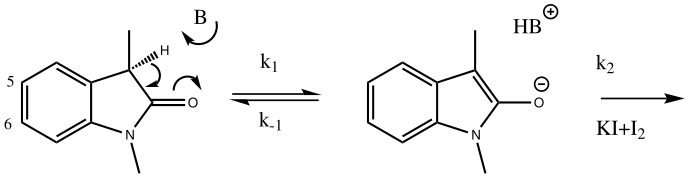
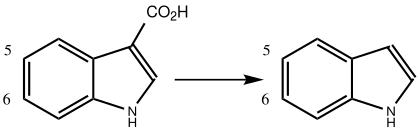
The systems and results are shown in the table below, summarised by the points:
1,3-dimethyl-indolinones:
-
The free energy barriers are very low, but show an overall increase when changing the substituent from nitro to amino, with the 6-position being more sensitive than the 5. However, the increase is not consistent.
-
The transition state mode changes regularly, the wavenumber more than doubling along the progression.
-
The basic structure of the proton transfer evolves smoothly, from being an early transition state with 6-nitro to being a late one with 6-amino.
-
The primary kinetic isotope effect shows less variation, but the trend is to increase as the transition state gets later, even beyond the point where the two bond lengths associated with the tranferring hydrogen are equal in length.
-
As Dan Singleton has pointed out on this blog, the observed KIE is a combination of effects based purely on the transition state structure and effects resulting from the sharpness of the barrier inducing proton tunneling and this is itself related to the magnitude of νi. The KIE ratios tabulated below derive purely from the former and do not take into account any such tunneling. We can see from the variation in νi that such tunnelling contributions are likely to vary substantially across this range of substituents. As a result, deconvoluting the KIE due to the symmetry of the proton transfer from the contribution due to tunnelling is going to be difficult.
-
There are other computational errors which might contribute, such as solvent reorganisations due to specific substituents, only partially taken into acount here. In effect the unsubstituted reaction geometry was used as the template for the others, followed of course by a re-optimisation which might not explore other more favourable orientations brought about by the substituents.
Indole-3-carboxylic acids:
-
The free energy barriers are now much higher than the indolinones, but show a consistent decrease along the series from 6-nitro to 6-amino. This matches with the idea that the indole is a base and the basicity is increased by electron donation and decreased by electron withdrawal.
-
The transition state mode again changes regularly, increasing as the barrier decreases.
-
For 5-H, the computed free energy barrier matches that measured remarkably well.
-
The calculated KIE increase regularly along the series 6-nitro to 6-amino.
-
The calculated KIE for 5-H matches that measured very well, but that for the 5-chloro does not. One might safely conclude that the outlier is probably the experimental value. The KIE are not obtained by direct measurement of the rate of reaction, but inferred from solving the relatively complex rate equation with inclusion of some approximations and assumptions. Perhaps one of these approximations is not valid for this substituent, or possibly an experimental error has encroached. Were this work to ever be repeated, this entry should be prioritised.
-
The overall variation in KIE is in fact quite small, but if the KIE can be measured very accurately, then they should be useful for comparison with such calculations.
-
We cannot really conclude whether the magnitude of the KIE closely reflects the symmetry of the transition state. For all the examples below, the C-H bond is always shorter than the H-O bond. More extreme and probably multiple substituents on the ring (5,6-dinitro? 5,6-diamino?) might have to be used to probe a wider variation in transition state symmetry. For example, the maximum value for proton transfer from a hydronium ion was stated a long time ago to be around 3.6, [1] and it would be of interest to see if that value is attained when the proton transfer becomes fully symmetry.
|
1,3-dimethylindolin-2-ones[2]
|
|
Model
|
ΔG‡298 (ΔH‡298)
|
kH/kD (298K)
|
rC-H, rH-O
|
νi
|
DataDOIs
|
|
6-nitro
|
1.94
|
3.22
|
1.256, 1.417
|
611
|
[3],[4]
|
|
5-nitro
|
1.82
|
3.65
|
1.289, 1.364
|
895
|
[5],[6]
|
|
H
|
2.48
|
4.40
|
1.326, 1.316
|
1130
|
[7],[8]
|
|
5-amino
|
6.73
|
3.86
|
1.337, 1.304
|
1182
|
[9],[10]
|
|
6-amino
|
3.19
|
4.43
|
1.349, 1.291
|
1226
|
[11],[12]
|
|
Indole-3-carboxylic acids[13]
|
|
6-nitro
|
25.1
|
2.72
|
1.279,1.391
|
706
|
[14],[15]
|
|
5-chloro
|
23.1
|
2.80 (2.23)
|
1.300,1.361
|
873
|
[16],[17]
|
|
5-H
|
22.1 (22.0)a[18]
|
2.87 (2.72)[18]
|
1.304,1.354
|
921
|
[19],[20]
|
|
6-amino
|
20.5
|
3.04
|
1.308,1.348
|
950
|
[21],[22]
|
aThe barrier is higher than previously reported because a significantly lower isomer of the ionised reactant was subsequently located.[21] Use of this new isomer also has a modest knock-on effect on the computed isotope effect for this system, bringing it into line with the other substituents and also with experiment.
Overall, this study of variation in kinetic isotope effects for proton transfer as induced by variation of ring substitution shows the viability of such computation. The total elapsed time since the start of this project is about three weeks, very much shorter than the original time taken to synthesize the molecules and measure their kinetics. Importantly, these were very much reactions occuring in aqueous solution, where solvation and general acid or general base catalysis occurred. Such reactions have long been thought to be very difficult to model in a non-dynamic discrete sense. The results obtained here tends towards optimism that such calculations may have a useful role to play in understanding such mechanisms.
I would like to express my enormous gratitude to my Ph.D. supervisor, Brian Challis, for starting me along this life-long exploration of reaction mechanisms. I hope the above gives him satisfaction that the endeavour back in 1972 has borne some more fruits.
References
- C.G. Swain, D.A. Kuhn, and R.L. Schowen, "Effect of Structural Changes in Reactants on the Position of Hydrogen-Bonding Hydrogens and Solvating Molecules in Transition States. The Mechanism of Tetrahydrofuran Formation from 4-Chlorobutanol<sup>1</sup>", Journal of the American Chemical Society, vol. 87, pp. 1553-1561, 1965. https://doi.org/10.1021/ja01085a025
- H. Rzepa, "Kinetic isotope effects for the ionisation of 5- and 6-substituted 1,3-dimethyl indolinones.", 2016. https://doi.org/10.14469/hpc/208
- H.S. Rzepa, "C 10 H 19 N 2 Na 1 O 8", 2016. https://doi.org/10.14469/ch/191802
- H.S. Rzepa, "C 10 H 19 N 2 Na 1 O 8", 2016. https://doi.org/10.14469/ch/191796
- H.S. Rzepa, "C 10 H 19 N 2 Na 1 O 8", 2016. https://doi.org/10.14469/ch/191800
- H.S. Rzepa, "C 10 H 19 N 2 Na 1 O 8", 2016. https://doi.org/10.14469/ch/191789
- H.S. Rzepa, "C 10 H 20 N 1 Na 1 O 6", 2016. https://doi.org/10.14469/ch/191787
- H.S. Rzepa, "C 10 H 20 N 1 Na 1 O 6", 2016. https://doi.org/10.14469/ch/191782
- H.S. Rzepa, "C 10 H 21 N 2 Na 1 O 6", 2016. https://doi.org/10.14469/ch/191803
- H.S. Rzepa, "C 10 H 21 N 2 Na 1 O 6", 2016. https://doi.org/10.14469/ch/191797
- H.S. Rzepa, "C 10 H 21 N 2 Na 1 O 6", 2016. https://doi.org/10.14469/ch/191804
- H.S. Rzepa, "C 10 H 21 N 2 Na 1 O 6", 2016. https://doi.org/10.14469/ch/191799
- H. Rzepa, "Decarboxylation of 5- and 6-substituted indole-3-carboxylic acids", 2016. https://doi.org/10.14469/hpc/220
- H.S. Rzepa, "C 9 H 15 Cl 1 N 2 O 8", 2016. https://doi.org/10.14469/ch/191807
- H.S. Rzepa, and H.S. Rzepa, "C 9 H 15 Cl 1 N 2 O 8", 2016. https://doi.org/10.14469/ch/191805
- H.S. Rzepa, "C 9 H 15 Cl 2 N 1 O 6", 2016. https://doi.org/10.14469/ch/191822
- H.S. Rzepa, "C 9 H 15 Cl 2 N 1 O 6", 2016. https://doi.org/10.14469/ch/191825
- B.C. Challis, and H.S. Rzepa, "Heteroaromatic hydrogen exchange reactions. Part 9. Acid catalysed decarboxylation of indole-3-carboxylic acids", Journal of the Chemical Society, Perkin Transactions 2, pp. 281, 1977. https://doi.org/10.1039/p29770000281
- H.S. Rzepa, "C 9 H 16 Cl 1 N 1 O 6", 2016. https://doi.org/10.14469/ch/191828
- H.S. Rzepa, "C 9 H 16 Cl 1 N 1 O 6", 2016. https://doi.org/10.14469/ch/191790
- H.S. Rzepa, "C 9 H 17 Cl 1 N 2 O 6", 2016. https://doi.org/10.14469/ch/191810
- H.S. Rzepa, "C 9 H 17 Cl 1 N 2 O 6", 2016. https://doi.org/10.14469/ch/191806
Tags:aqueous solution, Brian Challis, can construct quantum-chemical models, computed free energy barrier matches, Dan Singleton, free energy barrier, free energy barriers, Kinetic isotope effect, Organic chemistry, Physical organic chemistry, quantum-chemical models, supervisor
Posted in reaction mechanism | No Comments »
Saturday, July 11th, 2015
Previously on the kinetic isotope effects for the Baeyer-Villiger reaction, I was discussing whether a realistic computed model could be constructed for the mechanism. The measured KIE or kinetic isotope effects (along with the approximate rate of the reaction) were to be our reality check. I had used ΔΔG energy differences and then HRR (harmonic rate ratios) to compute[1] the KIE, and Dan Singleton asked if I had included heavy atom tunnelling corrections in the calculation, which I had not. His group has shown these are not negligible for low-barrier reactions such as ring opening of cyclopropyl carbinyl radical.[2] As a prelude to configuring his suggested programs for computing tunnelling (GAUSSRATE and POLYRATE), it was important I learnt how to reproduce his KIE values.[2] Hence the title of this post. Now, read on.

I felt I could contribute to the cause by extending the published results in two respects:
- The reported[2] calculations are for the model B3LYP/6-31G(d) but the article does not report the tolerance to e.g. basis set variation (6-31G(d), a modest basis set by 2015 standards),
- or to the quantum model used (B3LYP, a veritable DFT method).
These two model chemistries can both be tested by “increasing” their accuracy. The Def2-QZVPP basis set is nearing the CBS, or complete basis set limit. The coupled-cluster CCSD(T) method is regarded as the gold standard for single reference calculations. The CASSCF method tests the response to a multi-reference wave function. Each is applied separately to ensure only one variable is being changed at a time.
| Method |
Expt. KIE[2]‡ |
Pred. KIE (my result) |
Pred. ΔG298‡ |
Pred. KIE[2] |
KIE + Tunnelling correction[2] |
| B3LYP/6-31G(d)[3],[4] |
1.079295 |
1.0582 |
8.0 |
1.058 |
1.073 |
| 1.163173 |
1.1067 |
1.106 |
1.169 |
| B3LYP/Def2-QZVPP[5],[6] |
1.079295 |
1.0563 |
6.6 |
1.058 |
1.073 |
| 1.163173 |
1.1031 |
1.106 |
1.169 |
| CASSCF(5,5)/6-31G(d)[7],[8] |
1.079295 |
1.0572 |
8.2 |
1.058 |
1.073 |
| 1.163173 |
1.1050 |
1.106 |
1.169 |
| CASSCF(5,5)/Def2-TZVPP[9],[10] |
1.079295 |
1.0561 |
7.9 |
1.058 |
1.073 |
| 1.163173 |
1.1028 |
1.106 |
1.169 |
| CCSD(T)/6-31G(d)[11],[12] |
1.079295 |
1.0597† |
9.7 |
1.058 |
1.073 |
| 1.163173 |
1.1099 |
1.106 |
1.169 |
†Actually separate ratios of 13C/12C(C-4)/13C/12C(C-3) since C-3 and C-4 are not equivalent in the reactant species because of the methylene group pyramidalisation. The KIE calculation input and outputs are archived.[13]
The first two rows of table are my attempt at an exact replication of the literature. The start point of such a project would be the supporting information or SI[2] which contains coordinates for the program GAUSSRATE and defines key structures in the form of a double-column, page thrown (broken might be a better word) PDF file. It was going to be a bit of a struggle to reconstitute this format into the structure required for a Gaussian calculation, so I simply constructed the models from scratch and optimised to the ring-opening transition state[4] and reactant.[3] I used a more recent version of the Gaussian program (G09/D.01 rather than G03/D.02) to do this, and tightened up some of the criteria to modern cutoff standards. A continuum solvent model could have been specified (the solvent used in the experiments was 1,2-dichlorobenzene) but since no mention was made of solvent, I assumed a gas phase calculation had originally been done. The starting geometry of the reactant deliberately had no symmetry, but during optimisation it converged to having a plane of symmetry using the B3LYP/6-31G(d) level of theory (the SI does not note this symmetry, it is implicit). I then used my code[1] to compute the isotope effects. The KIE program used in the original literature calculation was not directly mentioned in the supporting information but is presumed to be Quiver. Dan Singleton has recently sent me these codes, but they still need to be compiled and tested at my end. I ended up with splendid agreement for the KIE as you can see above (top two lines). Its reproducible! Hence the various assumptions I made in achieving this appear justified.
Returning to the geometry of the cyclopropyl carbinyl radical as having a plane of symmetry, two of the other methods, CCSD(T)/6-31G(d) and CASSCF(5,5)/6-31G(d), as well as CASSCF(5,5) at the better Def2-TZVPP basis all predicted that the methylene radical is twisted by about 20° with respect to the Cs plane of the ring.

It is useful to check whether this twisting has any impact on the predicted KIE. The answer is clear (Table). ALL the methods predict similar KIE to ± 0.003,† which is as about as accurate as can be measured experimentally at the 1σ level of confidence. This is a remarkable result; few other computed molecular properties turn out to be so insensitive to the quantum procedure used. The next stage will be to check if the tunnelling corrections required to bring the calculation into congruence with the measured values are similarly insensitive.
‡ The “barrier height” is quoted as 7 kcal/mol[2]. This is probably NOT the activation free energy.
References
- H.S. Rzepa, "KINISOT. A basic program to calculate kinetic isotope effects using normal coordinate analysis of transition state and reactants.", 2015. https://doi.org/10.5281/zenodo.19272
- O.M. Gonzalez-James, X. Zhang, A. Datta, D.A. Hrovat, W.T. Borden, and D.A. Singleton, "Experimental Evidence for Heavy-Atom Tunneling in the Ring-Opening of Cyclopropylcarbinyl Radical from Intramolecular <sup>12</sup>C/<sup>13</sup>C Kinetic Isotope Effects", Journal of the American Chemical Society, vol. 132, pp. 12548-12549, 2010. https://doi.org/10.1021/ja1055593
- H.S. Rzepa, "C4H7(2)", 2015. https://doi.org/10.14469/ch/191357
- H.S. Rzepa, "C4H7(2)", 2015. https://doi.org/10.14469/ch/191358
- H.S. Rzepa, "C 4 H 7", 2015. https://doi.org/10.14469/ch/191353
- H.S. Rzepa, "C 4 H 7", 2015. https://doi.org/10.14469/ch/191352
- H.S. Rzepa, "C 4 H 7", 2015. https://doi.org/10.14469/ch/191361
- H.S. Rzepa, "C 4 H 7", 2015. https://doi.org/10.14469/ch/191364
- H.S. Rzepa, "C 4 H 7", 2015. https://doi.org/10.14469/ch/191363
- H.S. Rzepa, "C 4 H 7", 2015. https://doi.org/10.14469/ch/191362
- H.S. Rzepa, "C 4 H 7", 2015. https://doi.org/10.14469/ch/191367
- H.S. Rzepa, "C 4 H 7", 2015. https://doi.org/10.14469/ch/191356
- H.S. Rzepa, "Reproducibility In Science: Calculated Kinetic Isotope Effects For Cyclopropyl Carbonyl Radical.", 2015. https://doi.org/10.5281/zenodo.19949
Tags:activation free energy, Basis set, Dan Singleton, energy differences, gas phase calculation, Kinetic isotope effect, PDF, Physical organic chemistry
Posted in reaction mechanism | 2 Comments »
Wednesday, July 1st, 2015
Recollect this earlier post on the topic of the Baeyer-Villiger reaction. In 1999 natural abundance kinetic isotope effects were reported[1] and I set out to calculate the values predicted for a particular model constructed using Quantum mechanics. This comparison of measurement and calculation is nowadays a standard verification of both experiment and theory. When the two disagree either the computational model is wrong or incomplete, or the remoter possibility that there is something not understood about the experiment.

In this case, as you can see above, the measured 13C KIE at the carbonyl carbon was in the range 1.045-1.051, whereas the theory (ωB97XD/Def2-TZVP/SCRF=DCM) predicted a significantly smaller value of 1.023 for the first kinetic step, the formation of the tetrahedral intermediate. This was the step suggested by Singleton as rate limiting in the forward direction (there was also a larger disagreement on the 2H KIE at C3/C5, measured as 0.97 and calculated as 0.997 but this might simply be a typographical error).
Now we have to find an explanation, and it was contingent upon myself to show that the theory was properly executed. At this stage, Dan Singleton offered some suggestions on this blog. This one related to how I had calculated the KIE, with Dan suggesting that the method I had used might be too inaccurate to draw any conclusions from. It was up to me to reproduce my results using the method suggested by Dan as the more accurate. And this is where this story really starts.
I had used the Free energy method, which involves calculating the free energies of reactant and product using the built-in thermochemical component of the Gaussian code. Dan’s concern was that such free energies are only reported to an accuracy of 0.000001 Hartree. Since the isotope effect is calculated from differences in these free energies, was this degree of precision high enough to ensure reliable calculated KIE? Better to solve the equations directly and these involve the so-called Bigeleisen-Mayer terms derived from the classical partition functions. I recollected we had used this method back in 1975[2], but I assumed the computer code used was long since lost by myself. Instead Quiver was suggested (first written around 1988 by Keith Laidig at Yale) and I added the comment that the modern version of Quiver is called THERMISTP[3]. All that needed to be done was to acquire a copy of an appropriate code and re-run the KIE calculation using it.
And now comes the true purpose of this post, which is reproducing a calculation that might have been done ~20 years ago using computer code. Issues such as:
- Does the code still exist in either Source form or Executable form?
- If it does, will it still run correctly on a modern computer?
- Is it documented sufficiently to allow someone not immersed in the code to run it. After ~20 years, it might not be possible to talk to the original coders for explanations.
So this is what happened when I investigated.
- Requests for the THERMISTP code of its authors, by email, have not yet brought a response. They may still, but one has to recognise that they may not. For example (unless I missed it), the article in which THERMISTP is cited[3] does not document how the code described in that article might be obtained (but the authors’ emails are provided).
- I then followed up Dan’s suggestion to use Quiver. A copy was tracked down at http://www.chem.ucla.edu/~mccarren/houkGroup.html and a tar archive was available. The program comes as Quiver itself and a pre-program called qcrunch is used to prepare the data for Quiver.
- It comes with pretty good (and brief!) documentation.
- Fortran source code for Quiver (quiver.f) is available which is good, since one can compile it for one’s favourite machine (in my case a Mac running OS X). One can also read the comments to discover information beyond that provided by the documentation.
- qcrunch however is only provided as an executable, and that means running it on Linux. One cannot read the comments!
- When I ran qcrunch, it complained that an auxiliary program was not available to it. It wanted to run something associated with Gaussian 94, sadly long since gone from our systems. With no source code available I would have to fool qcrunch into thinking that Gaussian09 was really Gaussian94. It involves symbolic links and such and needs a little Unix expertise.
- That done, I gave it its first input data, which is the normal mode analysis of the reactant involved in the reaction above, in the form of a formatted checkpoint file (a .fchk file). It seemed happy, and so I proceeded to the next step
- which was to run quiver. This needed compilation. Here we encounter interesting issues. Most Fortran code can have “dependencies” which relate to the compiler used by its developer. The compiler however is rarely stated in the documentation, and I decided to use GFortran, which I obtained from http://hpc.sourceforge.net and installed on my Mac. And using this compiler, the compilation failed with about 3 syntax errors. You have to know enough Fortran to correct them all and obtain your executable.
- Now I could run quiver to get the Bigeleisen-Mayer functions. It appeared to happily run, but produced rubbish (the anticipated frequencies had silly values of -10,000 cm-1 etc).
- Now you go back to the code, and discover that the dimension statement (yes, Fortran required you to specify the size of your arrays in the code) is limited to 40 atoms! The Baeyer-Villiger system has 48. Easily fixed. Still rubbish out!
- So now you go back to the start and create data for a tiny molecule, water in this case, and again qcrunch and quiver are run. Now sensible results, in the shape of normal mode frequencies of the anticipated values.
- Conclusion: That qcrunch is probably also dimensioned to 40 atoms, but I now have no way of correcting this because I do not (yet?) have the source code for it. It might indeed be lost. If it is, it will have to be re-written from scratch.
- Time elapsed thus far: ~2 weeks of intermittent work on the problem.
- It was at this point I had one of those happy moments of accidental discovery. I updated the OS on my Mac to 10.10.4 (this was released yesterday). One of the new features was TRIM support for solid state third party disks (SSDs). I installed it and decided to test an external SSD connected to my machine. It happened to have lots of old stuff on it. In an idle moment, I decided to search its file base for the program we had written back in 1975 and which I had convinced myself was long-lost. Hey presto, there it was (KINISOT.f). I even found example input and output files. These take the form of frequencies for reactant (normal isotopes), reactant (new isotope), transition state (normal isotope) and transition state (new isotope). Not as elegant as quiver, but entirely fit for my purpose here.
- The results:
- 13C KIE for the carbonyl carbon using the free energy method: 1.023 (see diagram above)
- 13C KIE using the Bigeleisen-Mayer partition function ratios: 1.0226
- 2H KIE for the axial α protons using the free energy method: 0.928
- 2H KIE for the axial α protons using the Bigeleisen-Mayer partition function ratios: 0.92831
- The agreement enables me to conclude that the free energy method does not in fact suffer from significant round-off errors and other inaccuracies induced by the subtraction of two very similar energies.
What I have I learnt from this experience?
- That reproducing a calculation using old computer codes (in this case ~18 years) can be a difficult and complex procedure, relying on being able to contact people and ask for copies of the code, coping with possibly non-existent documentation, and with no access to the original coder who may be the only person able to explain it.
- That 20 years of continuous improvement in the computer industry means that a problem that would require impossibly enormous amounts of computer time then might be easily feasible now. The limit of 40 atoms in 1997 for quiver and qcrunch must have seemed future proof then, but alas it did not prove so.
- That if the source code for a program dimensioned too small is lost, one may have no option but to re-write it from scratch. It would indeed be a good test of reproducibility if the answers are unchanged!
- Keep good archives of your old work. You never know when they might come in useful!
Lessons for the future?
- Document your code! Put yourself in the position of someone in 20 years time trying to make sense of it! And record the compiler used (along with flags), and also the OS.
- Archive it in Zenodo or Github, and include that documentation.[4] You might not be contactable by email in 20 years time!
- include test inputs and outputs (OK, that is mostly done nowadays).
- I intend to do the above for my program. But I will use the immediate excuse often used by others for not archiving their codes: it is not yet documented sufficiently! But surely this would only take an hour or so? Watch this space. And please forgive the coding, it was done in 1975, when I was very inexperienced (another oft-used excuse!).
What about the Baeyer-Villiger isotope effects? Well, the above merely establishes that the free energy method (which requires no extra codes) has sufficient accuracy for computing KIEs. An explanation for the difference between the reported 13C KIE at the carbonyl carbon and its calculation still needs identifying. I state at the outset that (heavy atom) tunnelling corrections are NOT yet applied, and I might try the small-curvature tunneling model suggested by Dan, since he and Borden[5] have shown it can indeed be important. It would be exciting if the hydrogen isotope effects can be reproduced without tunnelling but that the carbon KIEs do require it.
I have received much help in the above saga from Jordi Bures Amat here, Erik Plata in Donna Blackmond’s group and information about another useful system for calculating KIE, the ISOEFF program.[6]
References
- D.A. Singleton, and M.J. Szymanski, "Simultaneous Determination of Intermolecular and Intramolecular <sup>13</sup>C and <sup>2</sup>H Kinetic Isotope Effects at Natural Abundance", Journal of the American Chemical Society, vol. 121, pp. 9455-9456, 1999. https://doi.org/10.1021/ja992016z
- M.J.S. Dewar, S. Olivella, and H.S. Rzepa, "Ground states of molecules. 49. MINDO/3 study of the retro-Diels-Alder reaction of cyclohexene", Journal of the American Chemical Society, vol. 100, pp. 5650-5659, 1978. https://doi.org/10.1021/ja00486a013
- M. Saunders, M. Wolfsberg, F.A.L. Anet, and O. Kronja, "A Steric Deuterium Isotope Effect in 1,1,3,3-Tetramethylcyclohexane", Journal of the American Chemical Society, vol. 129, pp. 10276-10281, 2007. https://doi.org/10.1021/ja072375r
- H.S. Rzepa, "KINISOT. A basic program to calculate kinetic isotope effects using normal coordinate analysis of transition state and reactants.", 2015. https://doi.org/10.5281/zenodo.19272
- O.M. Gonzalez-James, X. Zhang, A. Datta, D.A. Hrovat, W.T. Borden, and D.A. Singleton, "Experimental Evidence for Heavy-Atom Tunneling in the Ring-Opening of Cyclopropylcarbinyl Radical from Intramolecular <sup>12</sup>C/<sup>13</sup>C Kinetic Isotope Effects", Journal of the American Chemical Society, vol. 132, pp. 12548-12549, 2010. https://doi.org/10.1021/ja1055593
- V. Anisimov, and P. Paneth, "ISOEFF98. A program for studies of isotope effects using Hessian modifications", Journal of Mathematical Chemistry, vol. 26, pp. 75-86, 1999. https://doi.org/10.1023/a:1019173509273
Tags:Dan Singleton, Donna Blackmond, energy method, Erik Plata, free energy method, Jordi Bures Amat, Keith Laidig, Kinetic isotope effect, Physical organic chemistry, Yale
Posted in reaction mechanism | 4 Comments »
Friday, June 12th, 2015
In the preceding post, I discussed the reaction between mCPBA (meta-chloroperbenzoic acid) and cyclohexanone, resulting in Baeyer-Villiger oxidation via a tetrahedral intermediate (TI). Dan Singleton, in whose group the original KIE (kinetic isotope measurements) were made, has kindly pointed out on this blog that his was a mixed-phase reaction, and that mechanistic comparison with homogenous solutions may not be justified. An intriguing aspect of the (solution) mechanism would be whether the TI forms quickly and/or reversibly and what the position of any equilibrium between it and the starting ketone is. This reminded me of work we did some years ago,[1] and here I discuss that.
It involved the addition of phenyl hydroxylamine, PhNHOH to acetyl cyanide at 215K. Because the CN group is poor at leaving, the tetrahedral intermediates do not collapse and instead accumulate in seconds to the point of becoming detectable by NMR (both N-C and O-C isomers). The position of the equilibrium clearly favours the TI rather than the starting materials. In another context, both the rate of reaction and the equilibrium can be driven towards the TI by the application of pressure.[2] Hydroxylamines are known to be super nucleophiles, enhanced by the so-called α-effect from buttressing of adjacent lone pairs on the N and O. This reminds that a peracid also should exhibit a related α-effect; it should be a better nucleophile than a normal carboxylic acid. So I decided to take the TI formed from cyclohexanone and mcPBA and look at the NBO orbitals, which should tell us about the anomeric effects present in this TI, and in particular if they might be larger than normal (which could be equated with greater stability for the TI). Here are the relevant NBO energies.[3]

- The conventional anomeric effect in O-C-O manifests as a E(2) perturbation energy of ~16-18 kcal/mol between one oxygen lone pair and the antibonding C-O orbital. There are two combinations, and these are normally similar in energy.
- For the system above, the O1-C2-O6 interaction is 25.6 kcal/mol, much larger than normal, but partially counterbalanced by:
- O6-C1-O2 =13.0 kcal/mol which is a little lower than normal. This is overall an unusually strong anomeric effect for the O-C-O motif!
- The energetic asymmetry is matched by the two computed bond lengths, 1.381Å for the larger interaction and 1.455Å for the smaller. The pseudo-α-effect has desymmetrized the anomeric effect, but nevertheless strengthened it overall.

NBO 103 for O1(Lp)

NBO 97 for O6(Lp)

NBO 123 for C2-O6 antibonding σ*orbital
One concludes that the asymmetric anomeric effect makes the TI resemble the reactants. The transition state leading to the TI must be even earlier. In this context, I note that the (mixed phase) 13C effect reported for the carbonyl by Singleton and Szymanski[4] was quite a large one for carbon (1.045-1.051), a magnitude which argues against a very early transition state under these conditions. But the calculated value for a homogenous solution state model of ~1.023 is certainly more in accord with an early transition state.
Finally, a search of the CSD reveals 12 molecules containing either a O-O-C-O-O or a O-C-O-O sub unit This one[5] shows a bis HO-C-O-O-C-OH structure at room temperature; these species need not be unstable! There are none however with Ac-O-O-C-O. And of course the potent antimalarial artemisinin contains a O-O-C-O-C-O-Ac unit, for which stereoelectronic effects may also be important.
References
- A.M. Lobo, M.M. Marques, S. Prabhakar, and H.S. Rzepa, "Tetrahedral intermediates formed by nitrogen and oxygen attack of aromatic hydroxylamines on acetyl cyanide", The Journal of Organic Chemistry, vol. 52, pp. 2925-2927, 1987. https://doi.org/10.1021/jo00389a050
- N.S. Isaacs, H.S. Rzepa, R.N. Sheppard, A.M. Lobo, S. Prabhakar, and A.E. Merbach, "Volumes of reaction for the formation of some analogues of tetrahedral intermediates", Journal of the Chemical Society, Perkin Transactions 2, pp. 1477, 1987. https://doi.org/10.1039/p29870001477
- H.S. Rzepa, "C 20 H 20 Cl 2 O 6", 2015. https://doi.org/10.14469/ch/191327
- D.A. Singleton, and M.J. Szymanski, "Simultaneous Determination of Intermolecular and Intramolecular <sup>13</sup>C and <sup>2</sup>H Kinetic Isotope Effects at Natural Abundance", Journal of the American Chemical Society, vol. 121, pp. 9455-9456, 1999. https://doi.org/10.1021/ja992016z
- A. Kobayashi, Y. Ikeda, K. Kubota, and Y. Ohashi, "Syntheses and crystalline structures of several aldehyde peroxides as new flavor compounds", Journal of Agricultural and Food Chemistry, vol. 41, pp. 1297-1299, 1993. https://doi.org/10.1021/jf00032a025
Tags:Anomer, Anomeric effect, Carbohydrate chemistry, Carbohydrates, Chemistry, Dan Singleton, homogenous solutions, Ketone, Meta-Chloroperoxybenzoic acid, Organic chemistry, Tetrahedral carbonyl addition compound
Posted in reaction mechanism | 2 Comments »
Wednesday, June 3rd, 2015
My PhD thesis involved determining kinetic isotope effects (KIE) for aromatic electrophilic substitution reactions in an effort to learn more about the nature of the transition states involved.[1] I learnt relatively little, mostly because a transition state geometry is defined by 3N-6 variables (N = number of atoms) and its force constants by even more and you get only one or two measured KIE per reaction; a rather under-defined problem in terms of data! So I decided to spend a PostDoc learning how to invert the problem by computing the anticipated isotope effects using quantum mechanics and then comparing the predictions with measured KIE.[2] Although such computation allows access to ALL possible isotope effects, the problem is still under-defined because of the lack of measured KIE to compare the predictions with. In 1995 Dan Singleton and Allen Thomas reported an elegant strategy to this very problem by proposing a remarkably simple method for obtaining KIE using natural isotopic abundances.[3] It allows isotope effects to be measured for all the positions in one of the reactant molecules by running the reaction close to completion and then recovering unreacted reactant and measuring the changes in its isotope abundances using NMR. The method has since been widely applied[4],[5] and improved.[6] Here I explore how measured and calculated KIE can be reconciled.
The original example uses the Diels-Alder cycloaddition as an example, with the 2-methylbutadiene component being subjected to the isotopic abundance. Although comparison with calculation on related systems was done at the time[7] the computational methods in use then did not allow effects such as solvation to be included. I thought it might be worth re-investigating this specific reaction using more modern methodology (ωB97XD/Def2-TZVPP/SCRF=xylenes), giving an opportunity for testing one key assumption made by Singleton and Allen, viz the use of an internal isotope reference for a site where the KIE is assumed to be exactly 1.000 (the 2-methyl group in this instance). This assumption made me recollect my post on how methyl groups might not be entirely passive by rotating (methyl “flags”) in the Diels-Alder reaction between cis-butene and 1,4-dimethylbutadiene. I had concluded that post by remarking that Rotating methyl groups should be looked at more often as harbingers of interesting effects, which in this context may mean that such rotations may not be entirely isotope agnostic.

To start, I note that the endo (closed shell, i.e. non-biradical; the wavefunction is STABLE to open shell solutions) transition state obtained for this reaction[8],[9] has a computed dipole moment of 6.1D, just verging into the region where solvation starts to make an impact. Perhaps the most important conclusion drawn from Singleton and Allen’s original article[2] was that the presence of an apparently innocuous 2-methyl substituent is sufficient to render the reaction asynchronous, which means that one C-C bond forms faster than the other. They drew this conclusion from observing that the inverse deuterium isotope effect was larger at C1 than C4, the difference being well outside of their estimated errors. The calculations indicate that the two bonds have predicted lengths of 2.197 (to C1) and 2.294Å (to C4) at the transition state. This means that an asynchronicity as small as Δ0.1Å can be picked up in measured isotope effects!
The calculated activation free energy is 19.2 kcal/mol (0.044M), which is entirely reasonable for a reaction occurring slowly at room temperature. The barrier for the exo isomer is 21.0 kcal/mol, 1.8 kcal/mol higher in free energy.† The measured isotope effects are shown below with the predicted values in brackets. The colour code is green=within the estimated experimental error, red=outside the error.

The following observations can be made:
- The internal isotope reference assumed as 1.000 is reasonable for carbon, but the “rotating methyl groups” resulting from hyper conjugation between the C-H groups and the π system do have a small effect resulting in a predicted KIE of 0.996 rather than the assumed 1.000. This will impact upon all the other measured values to some extent.
- All the predicted‡ 13C isotope effects agree with experiment within the error estimated for the latter. The calculation also has its errors, of which the most obvious is that harmonic frequencies are used rather than the more correct anharmonic values.
- The 2H isotope effects show more deviation. This might be a combination of the assumption that the internal Me reference has no isotope effect coupled with the use of harmonic frequencies for the calculation.
- Although the 2H values differ somewhat beyond the experimental error, the E/Z effects are well reproduced by calculation. The inverse isotope effect for the (Z) configuration is significantly larger in magnitude than for the (E) form, as was indeed noted by Singleton and Thomas.
- So too is the asymmetry induced by the methyl group. The inverse isotope effects are greater for the more completely formed bond (to C1) than for the lagging bond (to C4). They are indeed a very sensitive measure of reaction synchronicity.
The pretty good agreement between calculation and experiment provides considerable reassurance that the calculated properties of transition states can indeed be subjected to reality checks using experiment. Indeed, it takes little more than a day to compute a complete set of KIEs, far less than it takes to measure them. One could easily argue that such a computation should accompany measured KIE whenever possible.
‡This gives me an opportunity to extol the virtues of effective RDM (research data management). The two DOIs for the data include files containing the full coordinates and force constant matrices for both reactant and TS. Using these, one can obtain frequencies for any isotopic substitution you might wish to make in <1 second each, and hence isotope effects not computed here. One option might be to e.g. invert the reactant from the 2-methylbutadiene to the maleic anhydride and hence compute the isotope effects expected on this species (not reported in the original article) or to monitor instead the product.[10]
†The KIE have only subtle small differences to the endo isomer; too small to assign the stereochemistry with certainty.
References
- B.C. Challis, and H.S. Rzepa, "The mechanism of diazo-coupling to indoles and the effect of steric hindrance on the rate-limiting step", Journal of the Chemical Society, Perkin Transactions 2, pp. 1209, 1975. https://doi.org/10.1039/p29750001209
- M.J.S. Dewar, S. Olivella, and H.S. Rzepa, "Ground states of molecules. 49. MINDO/3 study of the retro-Diels-Alder reaction of cyclohexene", Journal of the American Chemical Society, vol. 100, pp. 5650-5659, 1978. https://doi.org/10.1021/ja00486a013
- D.A. Singleton, and A.A. Thomas, "High-Precision Simultaneous Determination of Multiple Small Kinetic Isotope Effects at Natural Abundance", Journal of the American Chemical Society, vol. 117, pp. 9357-9358, 1995. https://doi.org/10.1021/ja00141a030
- https://doi.org/
- Y. Wu, R.P. Singh, and L. Deng, "Asymmetric Olefin Isomerization of Butenolides via Proton Transfer Catalysis by an Organic Molecule", Journal of the American Chemical Society, vol. 133, pp. 12458-12461, 2011. https://doi.org/10.1021/ja205674x
- J. Chan, A.R. Lewis, M. Gilbert, M. Karwaski, and A.J. Bennet, "A direct NMR method for the measurement of competitive kinetic isotope effects", Nature Chemical Biology, vol. 6, pp. 405-407, 2010. https://doi.org/10.1038/nchembio.352
- J.W. Storer, L. Raimondi, and K.N. Houk, "Theoretical Secondary Kinetic Isotope Effects and the Interpretation of Transition State Geometries. 2. The Diels-Alder Reaction Transition State Geometry", Journal of the American Chemical Society, vol. 116, pp. 9675-9683, 1994. https://doi.org/10.1021/ja00100a037
- H.S. Rzepa, "C 9 H 10 O 3", 2015. https://doi.org/10.14469/ch/191299
- H.S. Rzepa, "C 9 H 10 O 3", 2015. https://doi.org/10.14469/ch/191301
- D.E. Frantz, D.A. Singleton, and J.P. Snyder, "<sup>13</sup>C Kinetic Isotope Effects for the Addition of Lithium Dibutylcuprate to Cyclohexenone. Reductive Elimination Is Rate-Determining", Journal of the American Chemical Society, vol. 119, pp. 3383-3384, 1997. https://doi.org/10.1021/ja9636348
Tags:Allen Thomas, calculated activation free energy, Chemistry, Dan Singleton, Deuterium, Diels–Alder reaction, Isotope, Isotopes, Kinetic isotope effect, Nuclear physics, Physical organic chemistry, shell solutions
Posted in reaction mechanism | 6 Comments »

