Posts Tagged ‘Deuterium’

Epoxidation of ethene: a new substituent twist.

Friday, December 21st, 2018

Five years back, I speculated about the mechanism of the epoxidation of ethene by a peracid, concluding that kinetic isotope effects provided interesting evidence that this mechanism is highly asynchronous and involves a so-called “hidden intermediate”. Here I revisit this reaction in which a small change is applied to the atoms involved.

Below are two representations of the mechanism. The synchronous mechanism involves five “curly arrows”, two of which are involved in forming a bond between oxygen and carbon, and three of which transfer a proton to the group X (X=O). The second variation asynchronously stops at the half way stage to form a pseudo ion-pair (the “hidden intermediate”) and the proton transfer only occurs in the second stage. If the ethene is substituted with deuterium, experimentally an inverse kinetic isotope effect is observed, which provides strong evidence that at the transition state, no proton transfer is occurring
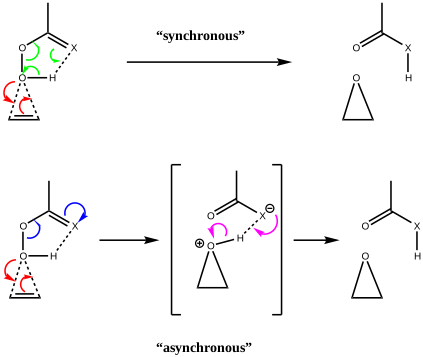
Before I go on, I should say that you will not find the mechanism as shown in either variation above in very many text books, which tend to practice “curly arrow economy” by employing only four arrows. I will not pursue this aspect here, except to note that as drawn above, the synchronous mechanism resembles that of a pericyclic reaction in a variation known as coarctate, as I noted in the original post (DOI: 10.14469/hpc/4807).

Now I introduce a veritable variation into this reaction, known as Payne epoxidation[1], which replaces the peracid with a reagent generated by adding hydrogen peroxide to a nitrile to generate a transient species which can be represented by X=NH above. How does this change things? The model below also uses propene rather than ethene (M062X/Def2-TZVPPD/SCRF=dichloromethane). This transition state (ΔG298 31.3 kcal/mol) shows two C-O bond formations, and as before the proton is clearly not yet transferred to the nitrogen (X=NH). Because of this asynchrony, the reaction could also be called a coarctate pseudo-pericyclic reaction.

Asynchronous concerted mechanism. Click for 3D

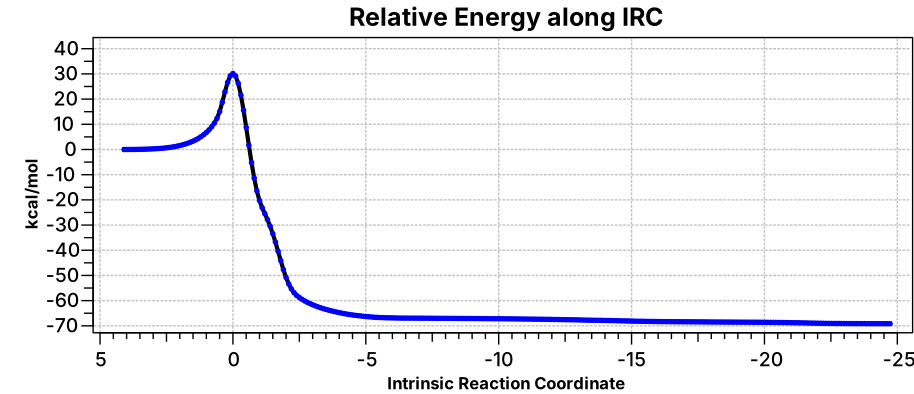
However, the proton transfer is nonetheless part of a concerted mechanism, as shown by the IRC profile.

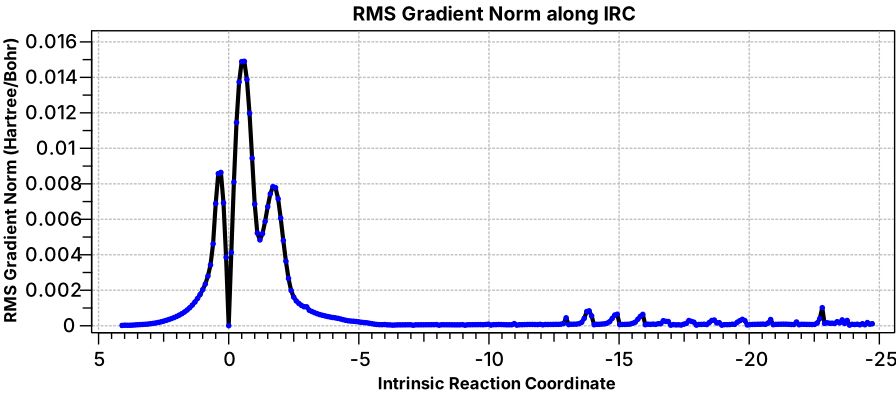
The gradient norm most clearly shows the “hidden ion-pair intermediate” at IRC = -1, and the proton transfer only occurs after this point is passed.
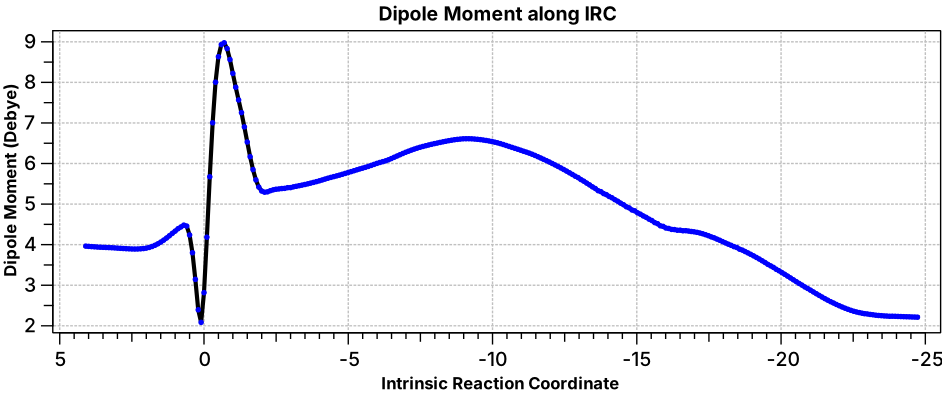
This is even more spectacularly illustrated with a plot of dipole moment along the IRC;
In truth, no real differences are yet revealed between the Payne reagent and the peracid. In fact, this is a real surprise, since the NH of the Payne reagent should be very much more basic than the carbonyl oxygen of the peracid. But more exploration of the potential energy surface reveals another transition state!

Stepwise mechanism. Click for 3D

This is seen forming the two C-O bonds AFTER the proton transfer from oxygen to nitrogen. It is 4.2 kcal/mol lower than the first transition state, which corresponds to the scheme below.
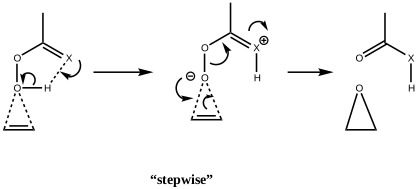
The new ion-pair shown above is 7.1 kcal/mol higher than the previous reactant, but is so much more basic than before that the overall activation energy is indeed lowered. Two distinctly separate IRCs can be constructed for this alternative, the first a pure proton transfer (not shown) and the second a pure C-O bond forming process (below). This second step is both concerted and almost purely synchronous.
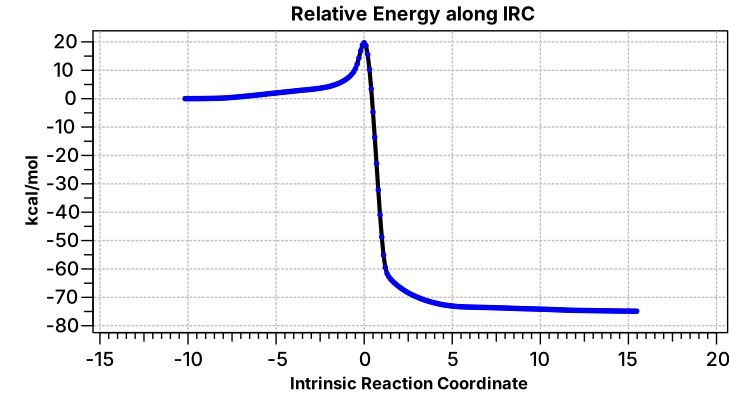
So now we see how a small change to the reactant molecules (X=O to X=NH) can induce a reaction for which two quite different mechanisms can operate, an asynchronous one albeit with a hidden intermediate and a fully stepwise one in which a quite different, but this time real, intermediate is involved. Nevertheless for both the peracid mechanism and the peroxyimine variation shown here, the proton transfer is NOT involved in the rate limiting step. So for this variation too, inverse kinetic isotope effects would be expected.


FAIR data for the calculations at DOI: 10.14469/hpc/4909 Thanks Ed for pointing this out.

References

  1. G.B. PAYNE, P.H. DEMING, and P.H. WILLIAMS, "Reactions of Hydrogen Peroxide. VII. Alkali-Catalyzed Epoxidation and Oxidation Using a Nitrile as Co-reactant", The Journal of Organic Chemistry, vol. 26, pp. 659-663, 1961. https://doi.org/10.1021/jo01062a004

Natural abundance kinetic isotope effects: expt. vs theory.

Wednesday, June 3rd, 2015

My PhD thesis involved determining kinetic isotope effects (KIE) for aromatic electrophilic substitution reactions in an effort to learn more about the nature of the transition states involved.[1] I learnt relatively little, mostly because a transition state geometry is defined by 3N-6 variables (N = number of atoms) and its force constants by even more and you get only one or two measured KIE per reaction; a rather under-defined problem in terms of data! So I decided to spend a PostDoc learning how to invert the problem by computing the anticipated isotope effects using quantum mechanics and then comparing the predictions with measured KIE.[2] Although such computation allows access to ALL possible isotope effects, the problem is still under-defined because of the lack of measured KIE to compare the predictions with. In 1995 Dan Singleton and Allen Thomas reported an elegant strategy to this very problem by proposing a remarkably simple method for obtaining KIE using natural isotopic abundances.[3] It allows isotope effects to be measured for all the positions in one of the reactant molecules by running the reaction close to completion and then recovering unreacted reactant and measuring the changes in its isotope abundances using NMR. The method has since been widely applied[4],[5] and improved.[6] Here I explore how measured and calculated KIE can be reconciled.

The original example uses the Diels-Alder cycloaddition as an example, with the 2-methylbutadiene component being subjected to the isotopic abundance. Although comparison with calculation on related systems was done at the time[7] the computational methods in use then did not allow effects such as solvation to be included. I thought it might be worth re-investigating this specific reaction using more modern methodology (ωB97XD/Def2-TZVPP/SCRF=xylenes), giving an opportunity for testing one key assumption made by Singleton and Allen, viz the use of an internal isotope reference for a site where the KIE is assumed to be exactly 1.000 (the 2-methyl group in this instance). This assumption made me recollect my post on how methyl groups might not be entirely passive by rotating (methyl “flags”) in the Diels-Alder reaction between cis-butene and 1,4-dimethylbutadiene. I had concluded that post by remarking that Rotating methyl groups should be looked at more often as harbingers of interesting effects, which in this context may mean that such rotations may not be entirely isotope agnostic.

DA

To start, I note that the endo (closed shell, i.e. non-biradical; the wavefunction is STABLE to open shell solutions) transition state obtained for this reaction[8],[9] has a computed dipole moment of 6.1D, just verging into the region where solvation starts to make an impact. Perhaps the most important conclusion drawn from Singleton and Allen’s original article[2] was that the presence of an apparently innocuous 2-methyl substituent is sufficient to render the reaction asynchronous, which means that one C-C bond forms faster than the other. They drew this conclusion from observing that the inverse deuterium isotope effect was larger at C1 than C4, the difference being well outside of their estimated errors. The calculations indicate that the two bonds have predicted lengths of 2.197 (to C1) and 2.294Å (to C4) at the transition state. This means that an asynchronicity as small as Δ0.1Å can be picked up in measured isotope effects!

The calculated activation free energy is 19.2 kcal/mol (0.044M), which is entirely reasonable for a reaction occurring slowly at room temperature. The barrier for the exo isomer is 21.0 kcal/mol, 1.8 kcal/mol higher in free energy. The measured isotope effects are shown below with the predicted values in brackets. The colour code is green=within the estimated experimental error, red=outside the error.

DA1

The following observations can be made:

  1. The internal isotope reference assumed as 1.000 is reasonable for carbon, but the “rotating methyl groups” resulting from hyper conjugation between the C-H groups and the π system do have a small effect resulting in a predicted KIE of 0.996 rather than the assumed 1.000. This will impact upon all the other measured values to some extent.
  2. All the predicted 13C isotope effects agree with experiment within the error estimated for the latter. The calculation also has its errors, of which the most obvious is that harmonic frequencies are used rather than the more correct anharmonic values.
  3. The 2H isotope effects show more deviation. This might be a combination of the assumption that the internal Me reference has no isotope effect coupled with the use of harmonic frequencies for the calculation.
  4. Although the 2H values differ somewhat beyond the experimental error, the E/Z effects are well reproduced by calculation. The inverse isotope effect for the (Z) configuration is significantly larger in magnitude than for the (E) form, as was indeed noted by Singleton and Thomas.
  5. So too is the asymmetry induced by the methyl group. The inverse isotope effects are greater for the more completely formed bond (to C1) than for the lagging bond (to C4). They are indeed a very sensitive measure of reaction synchronicity.

The pretty good agreement between calculation and experiment provides considerable reassurance that the calculated properties of transition states can indeed be subjected to reality checks using experiment. Indeed, it takes little more than a day to compute a complete set of KIEs, far less than it takes to measure them. One could easily argue that such a computation should accompany measured KIE whenever possible.


This gives me an opportunity to extol the virtues of effective RDM (research data management). The two DOIs for the data include files containing the full coordinates and force constant matrices for both reactant and TS. Using these, one can obtain frequencies for any isotopic substitution you might wish to make in <1 second each, and hence isotope effects not computed here. One option might be to e.g. invert the reactant from the 2-methylbutadiene to the maleic anhydride and hence compute the isotope effects expected on this species (not reported in the original article) or to monitor instead the product.[10]


The KIE have only subtle small differences to the endo isomer; too small to assign the stereochemistry with certainty.


References

  1. B.C. Challis, and H.S. Rzepa, "The mechanism of diazo-coupling to indoles and the effect of steric hindrance on the rate-limiting step", Journal of the Chemical Society, Perkin Transactions 2, pp. 1209, 1975. https://doi.org/10.1039/p29750001209
  2. M.J.S. Dewar, S. Olivella, and H.S. Rzepa, "Ground states of molecules. 49. MINDO/3 study of the retro-Diels-Alder reaction of cyclohexene", Journal of the American Chemical Society, vol. 100, pp. 5650-5659, 1978. https://doi.org/10.1021/ja00486a013
  3. D.A. Singleton, and A.A. Thomas, "High-Precision Simultaneous Determination of Multiple Small Kinetic Isotope Effects at Natural Abundance", Journal of the American Chemical Society, vol. 117, pp. 9357-9358, 1995. https://doi.org/10.1021/ja00141a030
  4. https://doi.org/
  5. Y. Wu, R.P. Singh, and L. Deng, "Asymmetric Olefin Isomerization of Butenolides via Proton Transfer Catalysis by an Organic Molecule", Journal of the American Chemical Society, vol. 133, pp. 12458-12461, 2011. https://doi.org/10.1021/ja205674x
  6. J. Chan, A.R. Lewis, M. Gilbert, M. Karwaski, and A.J. Bennet, "A direct NMR method for the measurement of competitive kinetic isotope effects", Nature Chemical Biology, vol. 6, pp. 405-407, 2010. https://doi.org/10.1038/nchembio.352
  7. J.W. Storer, L. Raimondi, and K.N. Houk, "Theoretical Secondary Kinetic Isotope Effects and the Interpretation of Transition State Geometries. 2. The Diels-Alder Reaction Transition State Geometry", Journal of the American Chemical Society, vol. 116, pp. 9675-9683, 1994. https://doi.org/10.1021/ja00100a037
  8. H.S. Rzepa, "C 9 H 10 O 3", 2015. https://doi.org/10.14469/ch/191299
  9. H.S. Rzepa, "C 9 H 10 O 3", 2015. https://doi.org/10.14469/ch/191301
  10. D.E. Frantz, D.A. Singleton, and J.P. Snyder, "<sup>13</sup>C Kinetic Isotope Effects for the Addition of Lithium Dibutylcuprate to Cyclohexenone. Reductive Elimination Is Rate-Determining", Journal of the American Chemical Society, vol. 119, pp. 3383-3384, 1997. https://doi.org/10.1021/ja9636348