Posts Tagged ‘pericyclic reaction’

Epoxidation of ethene: a new substituent twist.

Friday, December 21st, 2018

Five years back, I speculated about the mechanism of the epoxidation of ethene by a peracid, concluding that kinetic isotope effects provided interesting evidence that this mechanism is highly asynchronous and involves a so-called “hidden intermediate”. Here I revisit this reaction in which a small change is applied to the atoms involved.

Below are two representations of the mechanism. The synchronous mechanism involves five “curly arrows”, two of which are involved in forming a bond between oxygen and carbon, and three of which transfer a proton to the group X (X=O). The second variation asynchronously stops at the half way stage to form a pseudo ion-pair (the “hidden intermediate”) and the proton transfer only occurs in the second stage. If the ethene is substituted with deuterium, experimentally an inverse kinetic isotope effect is observed, which provides strong evidence that at the transition state, no proton transfer is occurring
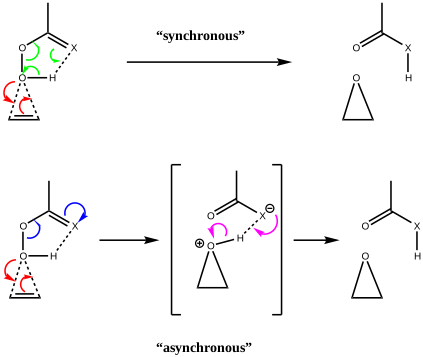
Before I go on, I should say that you will not find the mechanism as shown in either variation above in very many text books, which tend to practice “curly arrow economy” by employing only four arrows. I will not pursue this aspect here, except to note that as drawn above, the synchronous mechanism resembles that of a pericyclic reaction in a variation known as coarctate, as I noted in the original post (DOI: 10.14469/hpc/4807).

Now I introduce a veritable variation into this reaction, known as Payne epoxidation[1], which replaces the peracid with a reagent generated by adding hydrogen peroxide to a nitrile to generate a transient species which can be represented by X=NH above. How does this change things? The model below also uses propene rather than ethene (M062X/Def2-TZVPPD/SCRF=dichloromethane). This transition state (ΔG298 31.3 kcal/mol) shows two C-O bond formations, and as before the proton is clearly not yet transferred to the nitrogen (X=NH). Because of this asynchrony, the reaction could also be called a coarctate pseudo-pericyclic reaction.

Asynchronous concerted mechanism. Click for 3D

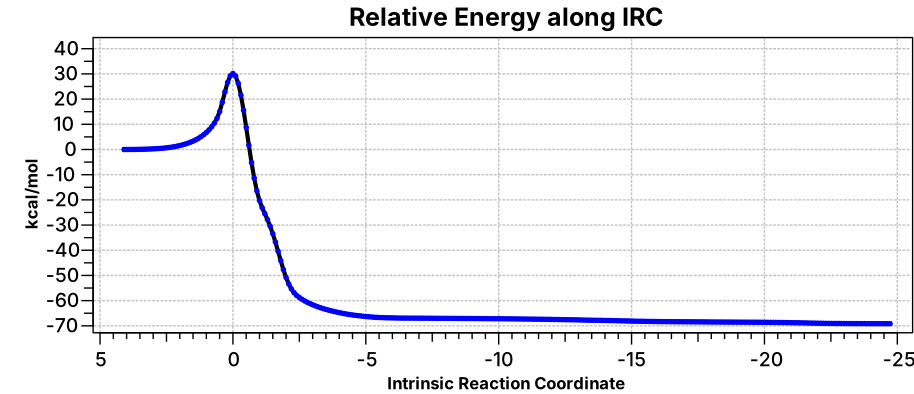
However, the proton transfer is nonetheless part of a concerted mechanism, as shown by the IRC profile.

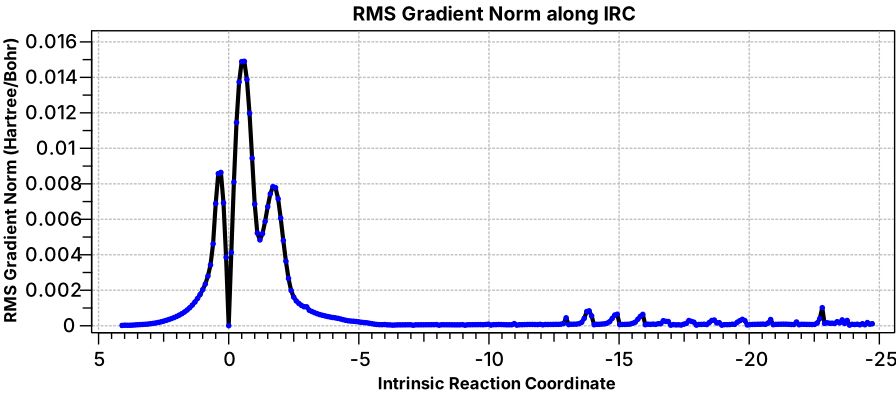
The gradient norm most clearly shows the “hidden ion-pair intermediate” at IRC = -1, and the proton transfer only occurs after this point is passed.
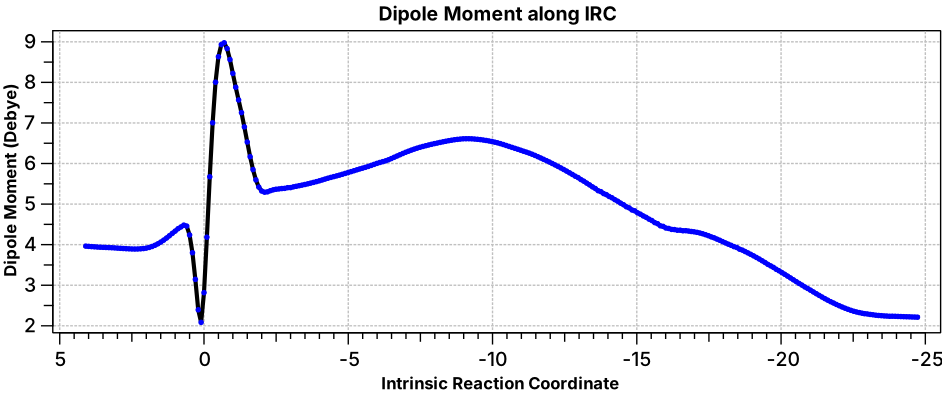
This is even more spectacularly illustrated with a plot of dipole moment along the IRC;
In truth, no real differences are yet revealed between the Payne reagent and the peracid. In fact, this is a real surprise, since the NH of the Payne reagent should be very much more basic than the carbonyl oxygen of the peracid. But more exploration of the potential energy surface reveals another transition state!

Stepwise mechanism. Click for 3D

This is seen forming the two C-O bonds AFTER the proton transfer from oxygen to nitrogen. It is 4.2 kcal/mol lower than the first transition state, which corresponds to the scheme below.
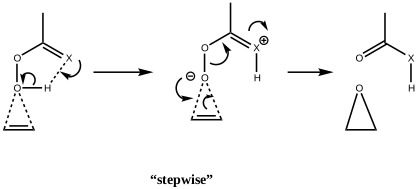
The new ion-pair shown above is 7.1 kcal/mol higher than the previous reactant, but is so much more basic than before that the overall activation energy is indeed lowered. Two distinctly separate IRCs can be constructed for this alternative, the first a pure proton transfer (not shown) and the second a pure C-O bond forming process (below). This second step is both concerted and almost purely synchronous.
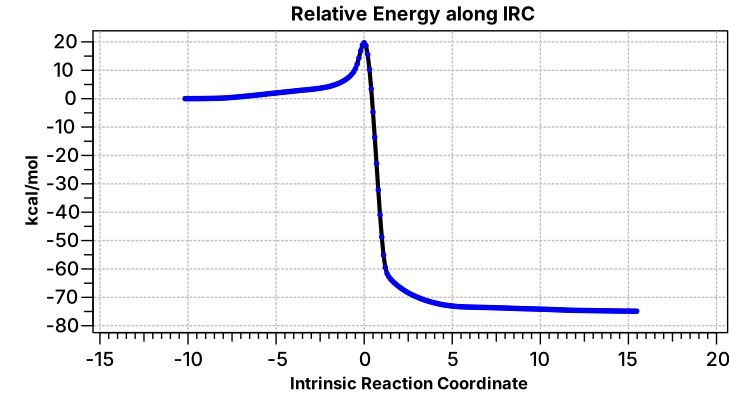
So now we see how a small change to the reactant molecules (X=O to X=NH) can induce a reaction for which two quite different mechanisms can operate, an asynchronous one albeit with a hidden intermediate and a fully stepwise one in which a quite different, but this time real, intermediate is involved. Nevertheless for both the peracid mechanism and the peroxyimine variation shown here, the proton transfer is NOT involved in the rate limiting step. So for this variation too, inverse kinetic isotope effects would be expected.


FAIR data for the calculations at DOI: 10.14469/hpc/4909 Thanks Ed for pointing this out.

References

  1. G.B. PAYNE, P.H. DEMING, and P.H. WILLIAMS, "Reactions of Hydrogen Peroxide. VII. Alkali-Catalyzed Epoxidation and Oxidation Using a Nitrile as Co-reactant", The Journal of Organic Chemistry, vol. 26, pp. 659-663, 1961. https://doi.org/10.1021/jo01062a004

Combichem: an introductory example of the complexity of chemistry

Sunday, December 19th, 2010

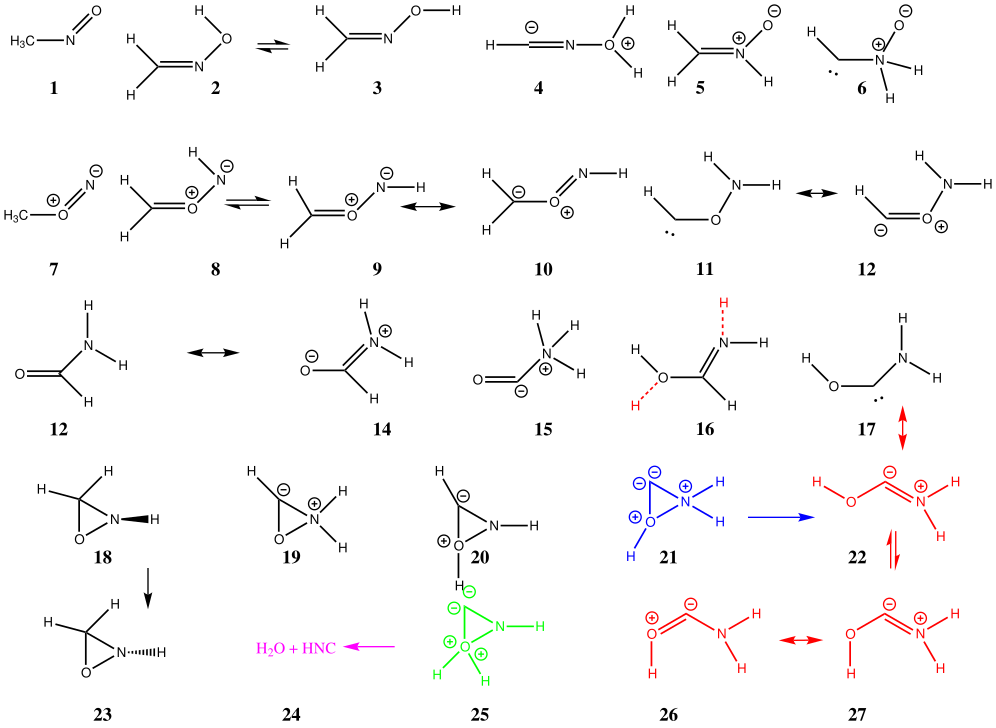
Chemistry gets complex very rapidly. Consider the formula CH3NO as the topic for a tutorial in introductory chemistry. I challenge my group (of about 8 students) to draw as many different molecules as they can using exactly those atoms. I imply that perhaps each of them might find a different structure; this normally brings disbelieving expressions to their faces.

Click on image to see molecules constructed from these atoms. The list is not comprehensive!

Amongst the useful concepts that can be introduced are:

  1. How to determine how many double bond equivalents (or degrees of unsaturation) are implied by the formula.
    1. Students spot one dbe in the above formula, but can take a little longer to notice that it can reside in a ring.
    2. Few (and I count tutors in this) will add sub-valent atoms (here, the possibility of a carbene or a nitrene) to the list.
  2. What is meant by “different”? This can be reduced to the equations: Ln k/T = 23.76 – ΔG/RT; t1/2 = (Ln 2)/k, where t1/2 is the half life (in seconds) of any species constrained by a free energy barrier of ΔG. A nice illustration of this equation is to be found on Jan Jensen’s blog (and an worthwhile calculation would be to find the barrier required to achieve a half life based on the age of the universe). This can be boiled down to three ranges.
    1. Half lives of ~10-15 s, or vibrations (and this includes transition states themselves). Arguably, resonance isomers, which involve the (nominal) motions of electrons and not nuclei, fall into this class as well.
    2. Half lives of < 101 s, which would include most conformational isomers (excepting atropisomers) and highly unstable isomers, and which cannot be bottled and labelled as such.
    3. Compounds with half lives > 102 s, up to of course the age of the universe. This would include configurational isomers (and if the students are up to it, you can ask them to identify any compounds constructed above which can exhibit optical isomerism).
  3. One might be inclined to (approximately) use arrows to indicate the timescales above. Thus electronic resonance is represented by double-headed arrow, conformational and E/Z isomers by an equilibrium arrow, and a single headed arrow indicating a reaction (which may in fact have a very low barrier) connecting two isomers.
  4. Its normally now time to count the electrons. This includes the “invisible ones”, the lone pairs, and also the occasion to introduce the valence shell octet.
  5. Putting the appropriate charges onto any atoms which require them is always fun (the dative bond is avoided). The blue structure revealed in the click above is an extreme interpretation of this! Gernot Frenking has pioneered the class of compound he calls carbones. For his latest article on the theme, see DOI: 10.1002/anie.201002773. The green compound would belong to this class, if it did not fall apart (probably with no barrier) to something which is not actually one molecule, but two (separable) molecules (purple). This brings us into what a molecule actually is. Could it be two molecules unconected by any bonds, but nevertheless also inseparable (such as catenanes, rotaxanes, and many other entwined systems)? Two molecules can also interact weakly, which is not normally referred to as bonds. In this case, the two molecules would be bound by a hydrogen bond.
  6. Quite a number of the isomers can be also called tautomers. This involve the movement of one type of atom in particular, the hydrogen (or proton). In terms of lifetime, they would fall into class 2 above (although if one takes extreme care to remove all traces of acids or bases, particularly from the surface of any glass container, one can extend the lifetimes quite considerably).
  7. The peptide bond is included in the isomers, and its ionic resonance formulation, which can lead the discussion to the molecular basis of life and how finely-tuned this bond in fact is.
  8. One might speculate about what the most stable of all the isomers might be, and how many are indeed bottleable. One might introduce quantum mechanics as nowadays a very reliable way of estimating this (and whilst you are at it, introduce free energies, entropies etc). For example, which of the two red geometrical isomers is the more stable, and why? What is the best resonance representation (i.e. where does one put the charges? On this specific point, a CCSD/6-311G(d,p) ELF calculation does come up with a very definitive answer of on the nitrogen rather than the oxygen).
  9. This might be followed up by introducing arrow pushing as a means of interconverting two isomers, and with one of the pair of isomers, one can introduce pericyclic selection rules, transition state aromaticity and other advanced stereochemical concepts.
  10. Now we are well into to stereoelectronics. One can introduce anomeric effects via the NBO technique. Thus in the red compounds, there is an interesting interaction between the lone pair on carbon and the anti N-H bond (but, spectacularly, not the syn N-H bond). There is another particularly strong one between the oxygen lone pair and the C-N bond.

I dare say I have only picked at the surface, but covering the above should be enough for one tutorial I should imagine 🙂


PS For the (calculated) relative energies of some of these isomers, see DOI: 10.1021/jo010671v