Posts Tagged ‘activation free energy’

The Graham reaction: Deciding upon a reasonable mechanism and curly arrow representation.

Monday, February 18th, 2019

Students learning organic chemistry are often asked in examinations and tutorials to devise the mechanisms (as represented by curly arrows) for the core corpus of important reactions, with the purpose of learning skills that allow them to go on to improvise mechanisms for new reactions. A common question asked by students is how should such mechanisms be presented in an exam in order to gain full credit? Alternatively, is there a single correct mechanism for any given reaction? To which the lecturer or tutor will often respond that any reasonable mechanism will receive such credit. The implication is that a mechanism is “reasonable” if it “follows the rules”. The rules are rarely declared fully, but seem to be part of the absorbed but often mysterious skill acquired in learning the subject. These rules also include those governing how the curly arrows should be drawn. Here I explore this topic using the Graham reaction.[1]

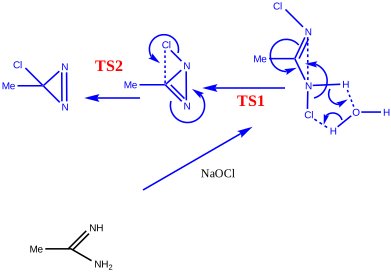
I start by noting the year in which the Graham procedure was published, 1965. Although the routine representation of mechanism using curly arrows had been established for about 5-10 years by then, the quality of such representations in many articles was patchy. Thus, this one (the publisher will need payment for me to reproduce the diagram here, so I leave you to get it yourself) needs some modern tidying up. In the scheme below, I have also made a small change, using water itself as a base to remove a NH proton, rather than hydroxide anion as used in the article (I will return to the anion later). The immediate reason is that water is a much simpler molecule to use at the start of our investigation than solvated sodium hydroxide. You might want to start with comparing the mechanism above with the literature version[1] to discover any differences. 
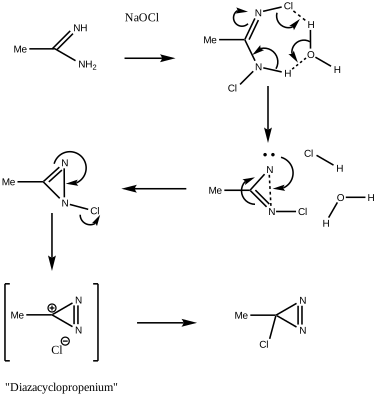
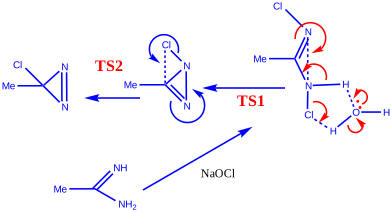
The next stage is to compute all of this using quantum mechanics, which will tell us about the energy of the system as it evolves and also identify the free energy of the transition states for the reaction. I am not going to go into any detail of how these energies are obtained, suffice to say that all the calculations can be found at the following DOI: 10.14469/hpc/5045 The results of this exercise are represented by the following alternative mechanism.

How was this new scheme obtained? The key step is locating a transition state in the energy surface, a point where the first derivatives of the energy with respect to all the 3N-6 coordinates defining the geometry (the derivative vector) are zero and where the second derivative matrix has just one negative eigenvalue (check up on your Maths for what these terms mean). Each located transition state (which is an energy maximum in just one of the 3N-6 coordinates) can be followed downhill in energy to two energy minima, one of which is declared the reactant of the reaction and the other the product, using a process known as an IRC (intrinsic reaction coordinate). The coordinates of these minima are then inspected so they can be mapped to the conventional representations shown above. New bonds in the formalism above are shown with dashed lines and have an arrow-head ending at their mid-point; breaking bonds (more generally, bonds reducing their bond order) have an arrow starting from their mid-point. The change in geometry along the IRC for TS1 can then be shown as an animation of the reaction coordinate, which you can see below.

Don’t worry too much about when bonds appear to connect or disconnect, the animation program simply uses a simple bond length rule to do this. The major difference with the original mechanism is that it is the chlorine on the nitrogen also bearing a proton that gets removed. Also, the N-N bond is formed as part of the same concerted process, rather than as a separate step.
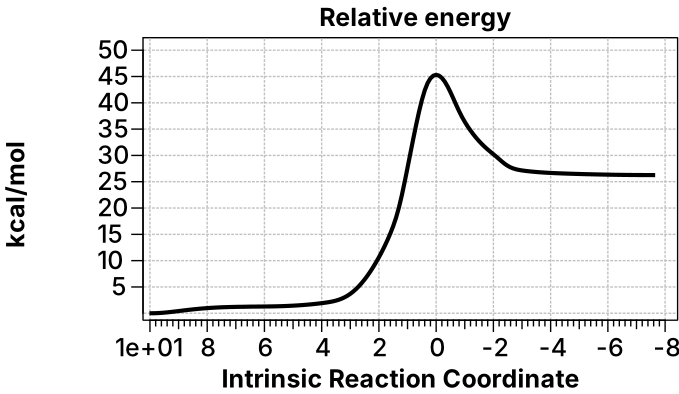
Shown above is the computed energy along the reaction path. Here a “reality check” can be carried out. The activation free energy (the difference between the transition state and the reactant) emerges as a rather unsavoury ΔG=40.8 kcal/mol. Why is this unsavoury? Well, according to transition state theory, the rate of a (unimolecular) reaction is given by the expression: Ln(k/T) = 23.76 – ΔG/RT where T is temperature (~323K in this example), R = is the gas constant and k is the unimolecular rate constant. When you solve it for ΔG=40.8, it turns out to be a very slow reaction indeed. More typically, a reaction that occurs in a few minutes at this sort of temperature has ΔG= ~15 kcal/mol. So this turns out to be an “unreasonable” mechanism, but based on the quantum mechanically predicted rate and not on the nature of the “curly arrows”. And no, one cannot do this sort of thing in an examination (not even on a mobile phone; there is no app for it, yet!) I must also mention that the “curly arrows” used in the above representation are, like the bonds, based on simple rules of connecting a breaking with a forming bond with such an arrow. There IS a method of computing both their number and their coordinates “realistically”, but I will defer this to a future post. So be patient!

The next thing to note is that the energy plot shows this stage of the reaction as being endothermic. Time to locate TS2, which it turns out corresponds to the N to C migration of the chlorine to complete the Graham reaction. As it happens, TS2 is computed to be 10.6 kcal/mol lower than TS1 in free energy, so it is not “rate limiting”.

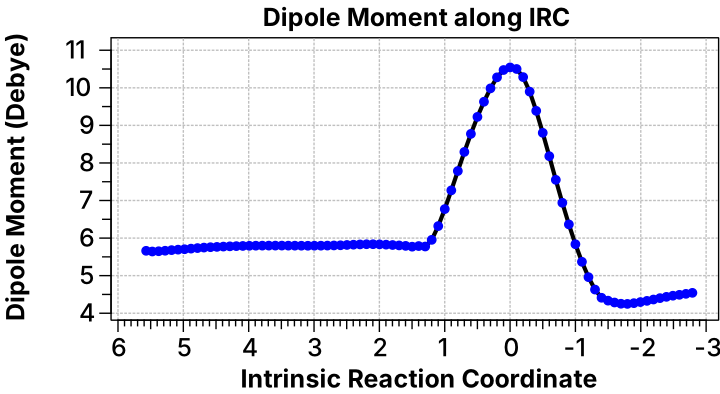
To provide insight into the properties of this reaction path, a plot of the calculated dipole moment along the reaction path is shown. At the transition state (IRC value = 0), the dipole moment is a maximum, which suggests it is trying to form an ion-pair, part of which is the diazacylopropenium cation shown in the first scheme above. The ion-pair is however not fully formed, probably because it is not solvated properly.
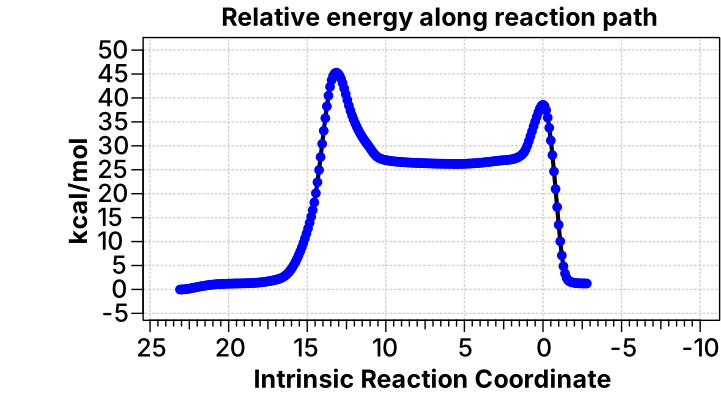
We can add the two reaction paths together to get the overall reaction energy, which is no longer endothermic but approximately thermoneutral. Things are still not quite “reasonable” because the actual reaction is exothermic.
Time then to move on to hydroxide anion as the catalytic base, in the form of sodium hydroxide. To do this, we need to include lots of water molecules (here six), primarily to solvate the Na+ (shown in purple below) but also any liberated Cl. You can see the water molecules moving around a lot as the reaction proceeds, via again TS1 to end at a similar point as before.

The energy plot is now rather different. The activation energy is now lower than the 15 kcal/mol requirement for a fast reaction; in fact ΔG= 9.5 kcal/mol and overall it is already showing exothermicity. What a difference replacing a proton (from water) by a sodium cation makes!
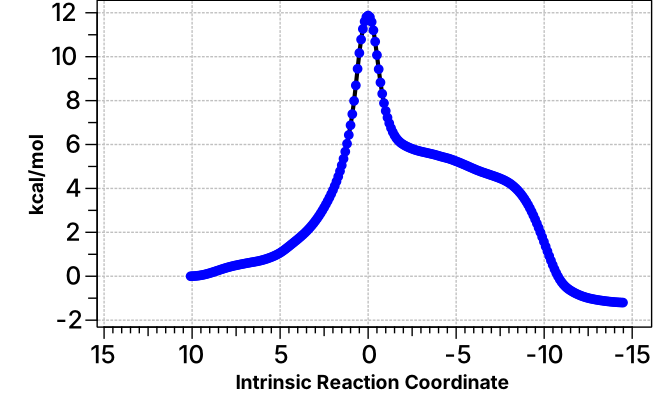
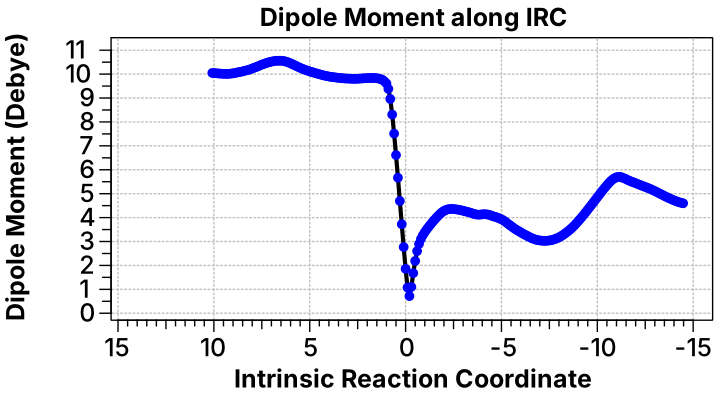
Take a look also at this dipole moment plot as the reaction proceeds! TS1 is almost entirely non-ionic!
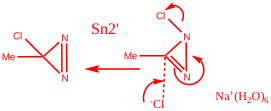
To complete the reaction, the chlorines have to rearrange. This time a rather different mode is adopted, as shown below, termed an Sn2′ reaction. The energy of TS2′ is again lower than TS1, by 9.2 kcal/mol. Again no explicit diazacylopropenium cation-anion pair (an aromatic 4n+2, n=0 Hückel system) is formed.


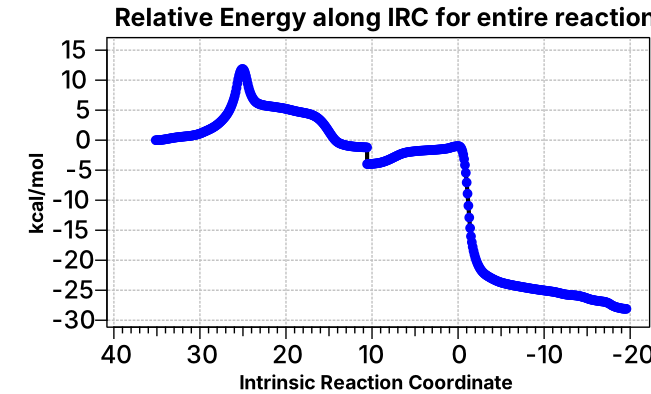
Combing both stages of the reaction as before. The discontinuity in the centre is due to further solvent reorganisation not picked up at the ends of the two individual IRCs which were joined to make this plot. Note also that the reaction is now appropriately exothermic overall.
So what have we learnt?

  1. That a “reasonable” mechanism as shown in a journal article, and perhaps reproduced in a text-book, lecture or tutorial notes or even an examination, can be subjected in a non-arbitrary manner to a reality check using modern quantum mechanical calculations.
  2. For the Graham reaction, this results in a somewhat different pathway for the reaction compared to the original suggestion.
    1. In particular, the removal of chlorine occurs from the same nitrogen as the initial deprotonation
    2. This process does not result in an intermediate nitrene being formed, rather the chlorine removal is concerted with N-N bond formation.
    3. The resulting 1-chloro-1H-diazirine does not directly ionize to form a diazacyclopropenium cation-chloride anion ion pair, but instead can undertake an Sn2′ reaction to form the final 3-chloro-3-methyl-3H-diazirine.
  3. A simple change in the conditions, such as replacing water as a catalytic agent with Na+OH(5H2O) can have a large impact on the energetics and indeed pathways involved. In this case, the reaction is conducted in NaOCl or NaOBr solutions, for which the pH is ~13.5, indicating [OH] is ~0.3M.
  4. The curly arrows here are “reasonable” for the computed pathway, but are determined by some simple formalisms which I have adopted (such as terminating an arrow-head at the mid-point of a newly forming bond). As I hinted above, these curly arrows can also be subjected to quantum mechanical scrutiny and I hope to illustrate this process in a future post.

But do not think I am suggesting here that this is the “correct” mechanism, it is merely one mechanism for which the relative energies of the various postulated species involved have been calculated relatively accurately. It does not preclude that other, perhaps different, routes could be identified in the future where the energetics of the process are even lower. 


This blog is inspired by the two students who recently asked such questions. In fact, you also have to acquire this completely unrelated article[2] for reasons I leave you to discover yourself. You might want to consider the merits or demerits of an alternative way of showing the curly arrows. Is this representation “more reasonable”? I thank Ed Smith for measuring this value for NaOBr and for suggesting the Graham reaction in the first place as an interesting one to model.
References

  1. W.H. Graham, "The Halogenation of Amidines. I. Synthesis of 3-Halo- and Other Negatively Substituted Diazirines<sup>1</sup>", Journal of the American Chemical Society, vol. 87, pp. 4396-4397, 1965. https://doi.org/10.1021/ja00947a040
  2. E.W. Abel, B.C. Crosse, and D.B. Brady, "Trimeric Alkylthiotricarbonyls of Manganese and Rhenium", Journal of the American Chemical Society, vol. 87, pp. 4397-4398, 1965. https://doi.org/10.1021/ja00947a041

Reproducibility in science: calculated kinetic isotope effects for cyclopropyl carbinyl radical.

Saturday, July 11th, 2015

Previously on the kinetic isotope effects for the Baeyer-Villiger reaction, I was discussing whether a realistic computed model could be constructed for the mechanism. The measured KIE or kinetic isotope effects (along with the approximate rate of the reaction) were to be our reality check. I had used ΔΔG energy differences and then HRR (harmonic rate ratios) to compute[1] the KIE, and Dan Singleton asked if I had included heavy atom tunnelling corrections in the calculation, which I had not. His group has shown these are not negligible for low-barrier reactions such as ring opening of cyclopropyl carbinyl radical.[2] As a prelude to configuring his suggested programs for computing tunnelling (GAUSSRATE and POLYRATE), it was important I learnt how to reproduce his KIE values.[2] Hence the title of this post. Now, read on.

cp

I felt I could contribute to the cause by extending the published results in two respects:

  1. The reported[2] calculations are for the model B3LYP/6-31G(d) but the article does not report the tolerance to e.g. basis set variation (6-31G(d), a modest basis set by 2015 standards),
  2. or to the quantum model used (B3LYP, a veritable DFT method).

These two model chemistries can both be tested by “increasing” their accuracy. The Def2-QZVPP basis set is nearing the CBS, or complete basis set limit. The coupled-cluster CCSD(T) method is regarded as the gold standard for single reference calculations. The CASSCF method tests the response to a multi-reference wave function. Each is applied separately to ensure only one variable is being changed at a time.

Method Expt. KIE[2] Pred. KIE (my result) Pred. ΔG298 Pred. KIE[2] KIE + Tunnelling correction[2]
B3LYP/6-31G(d)[3],[4] 1.079295 1.0582 8.0 1.058 1.073
1.163173 1.1067 1.106 1.169
B3LYP/Def2-QZVPP[5],[6] 1.079295 1.0563 6.6 1.058 1.073
1.163173 1.1031 1.106 1.169
CASSCF(5,5)/6-31G(d)[7],[8] 1.079295 1.0572 8.2 1.058 1.073
1.163173 1.1050 1.106 1.169
CASSCF(5,5)/Def2-TZVPP[9],[10] 1.079295 1.0561 7.9 1.058 1.073
1.163173 1.1028 1.106 1.169
CCSD(T)/6-31G(d)[11],[12] 1.079295 1.0597 9.7 1.058 1.073
1.163173 1.1099 1.106 1.169

Actually separate ratios of 13C/12C(C-4)/13C/12C(C-3) since C-3 and C-4 are not equivalent in the reactant species because of the methylene group pyramidalisation. The KIE calculation input and outputs are archived.[13]

The first two rows of table are my attempt at an exact replication of the literature. The start point of such a project would be the supporting information or SI[2] which contains coordinates for the program GAUSSRATE and defines key structures in the form of a double-column, page thrown (broken might be a better word) PDF file. It was going to be a bit of a struggle to reconstitute this format into the structure required for a Gaussian calculation, so I simply constructed the models from scratch and optimised to the ring-opening transition state[4] and reactant.[3] I used a more recent version of the Gaussian program (G09/D.01 rather than G03/D.02) to do this, and tightened up some of the criteria to modern cutoff standards. A continuum solvent model could have been specified  (the solvent used in the experiments was 1,2-dichlorobenzene) but since no mention was made of solvent, I assumed a gas phase calculation had originally been done.  The starting geometry of the reactant deliberately had no symmetry, but during optimisation it converged to having a plane of symmetry using the B3LYP/6-31G(d) level of theory (the SI does not note this symmetry, it is implicit). I then used my code[1] to compute the isotope effects. The KIE program used in the original literature calculation was not directly mentioned in the supporting information but is presumed to be Quiver. Dan Singleton has recently sent me these codes, but they still need to be compiled and tested at my end. I ended up with splendid agreement for the KIE as you can see above (top two lines). Its reproducible! Hence the various assumptions I made in achieving this appear justified.

Returning to the geometry of the cyclopropyl carbinyl radical as having a plane of symmetry, two of the other methods, CCSD(T)/6-31G(d) and CASSCF(5,5)/6-31G(d), as well as CASSCF(5,5) at the better Def2-TZVPP basis all predicted that the methylene radical is twisted by about 20° with respect to the Cs plane of the ring.

cp-asymm

It is useful to check whether this twisting has any impact on the predicted KIE. The answer is clear (Table). ALL the methods predict similar KIE to ± 0.003, which is as about as accurate as can be measured experimentally at the 1σ level of confidence. This is a remarkable result; few other computed molecular properties turn out to be so insensitive to the quantum procedure used. The next stage will be to check if the tunnelling corrections required to bring the calculation into congruence with the measured values are similarly insensitive.


The “barrier height” is quoted as 7 kcal/mol[2]. This is probably NOT the activation free energy.

References

  1. H.S. Rzepa, "KINISOT. A basic program to calculate kinetic isotope effects using normal coordinate analysis of transition state and reactants.", 2015. https://doi.org/10.5281/zenodo.19272
  2. O.M. Gonzalez-James, X. Zhang, A. Datta, D.A. Hrovat, W.T. Borden, and D.A. Singleton, "Experimental Evidence for Heavy-Atom Tunneling in the Ring-Opening of Cyclopropylcarbinyl Radical from Intramolecular <sup>12</sup>C/<sup>13</sup>C Kinetic Isotope Effects", Journal of the American Chemical Society, vol. 132, pp. 12548-12549, 2010. https://doi.org/10.1021/ja1055593
  3. H.S. Rzepa, "C4H7(2)", 2015. https://doi.org/10.14469/ch/191357
  4. H.S. Rzepa, "C4H7(2)", 2015. https://doi.org/10.14469/ch/191358
  5. H.S. Rzepa, "C 4 H 7", 2015. https://doi.org/10.14469/ch/191353
  6. H.S. Rzepa, "C 4 H 7", 2015. https://doi.org/10.14469/ch/191352
  7. H.S. Rzepa, "C 4 H 7", 2015. https://doi.org/10.14469/ch/191361
  8. H.S. Rzepa, "C 4 H 7", 2015. https://doi.org/10.14469/ch/191364
  9. H.S. Rzepa, "C 4 H 7", 2015. https://doi.org/10.14469/ch/191363
  10. H.S. Rzepa, "C 4 H 7", 2015. https://doi.org/10.14469/ch/191362
  11. H.S. Rzepa, "C 4 H 7", 2015. https://doi.org/10.14469/ch/191367
  12. H.S. Rzepa, "C 4 H 7", 2015. https://doi.org/10.14469/ch/191356
  13. H.S. Rzepa, "Reproducibility In Science: Calculated Kinetic Isotope Effects For Cyclopropyl Carbonyl Radical.", 2015. https://doi.org/10.5281/zenodo.19949

Experimental evidence for “hidden intermediates”? Epoxidation of ethene by peracid.

Sunday, August 25th, 2013

The concept of a “hidden intermediate” in a reaction pathway has been promoted by Dieter Cremer[1] and much invoked on this blog. When I used this term in a recent article of ours[2], a referee tried to object, saying it was not in common use in chemistry. The term clearly has an image problem. A colleague recently sent me an article to read (thanks Chris!) about isotope effects in the epoxidation of ethene[3] and there I discovered a nice example of hidden intermediates which I share with you now.

peracid

The reaction above is considered as a transfer of an oxygen atom to an alkene with concomitant concerted proton transfer (for the analogous reaction of an alkyne see here). The mechanism is normally illustrated with five arrows accomplishing both operations (see below). But a simple experiment shows this cannot be accurate[3]. When d4-ethene is used (with mCPBA as the peracid) in dichloromethane solution, an inverse kinetic isotope effect of 0.83 is observed (in other words the d4– species reacts faster than the 1H). If the peracid is instead deuterated (as OD) the reaction slows down by a factor of 1.05 (a normal isotope effect). This data provides a good test of whether any transition state model constructed for the reaction is a good one. So how about a ωB97XD/6-311G(d,p)/SCRF=dichloromethane[4],[5] model, using per-ethanoic acid? The isotope effect can be obtained by calculating the activation free energy with the appropriate isotope specified.

Activation barriers for isotopic substitutions
Value Normal isotopes d4-ethene OD acid One 13C-ethene One 18O
ΔG298 26.6844375 26.5589375 26.7245975 26.6907125 26.7296175
KIE  – 0.808 1.070 1.011 1.080

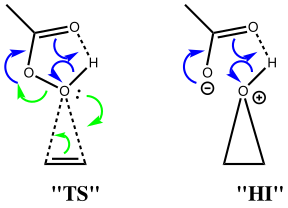
The deuterium isotope effects, on both carbon and oxygen compare very well indeed with those measured (the 13C and 18O have never been measured, they are predictions), which greatly assures that the model is a good one. So the predicted transition state geometry as shown below has had a good reality check. It reveals that two O-C bonds are forming, and the O-O bond is breaking, but that proton transfer has hardly started. This corresponds to the three green arrows shown at the top. The three blue arrows are not yet in action. I have colour-coded them to illustrate this temporal aspect. 

peracid+alkene1

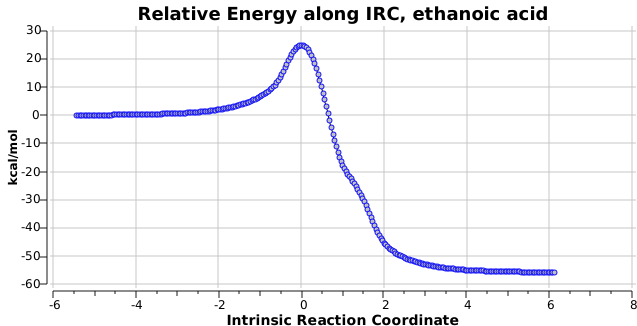
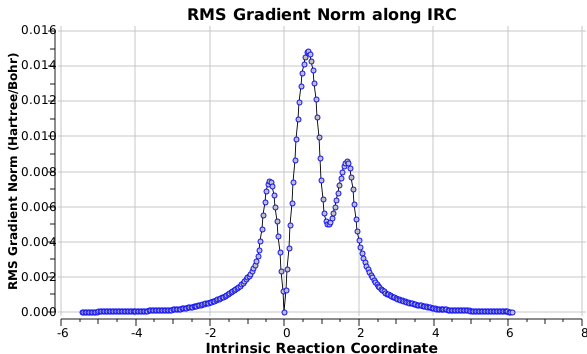
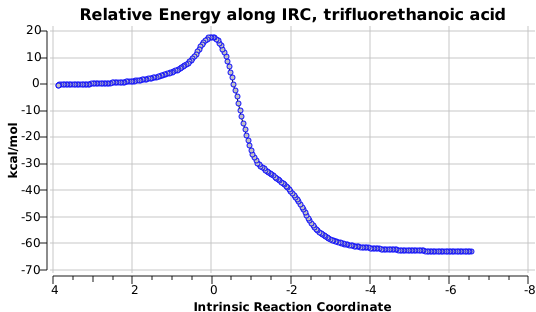
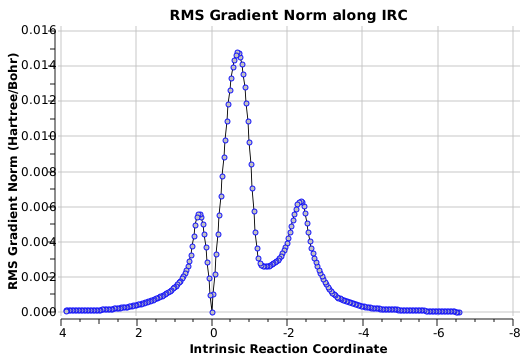
An intrinsic reaction coordinate[6] shows that the reaction is concerted, albeit asynchronous; the transition state (TS, @IRC=0.0) really only involves the green arrows; the blue arrows kick in only AFTER the ion-pair-like hidden intermediate is formed, labelled HI above (and seen @IRC =+1.2). Stabilising the ion-pair using trifluorethanoic acid[7] (a stronger acid) renders the HI more prominent.

peracid
peracidG
peracidF
peracidFG

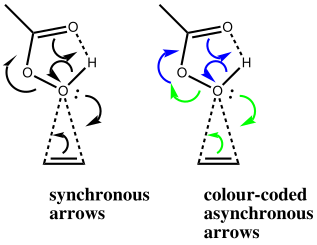
As quantum calculations apparently give us trustworthy indications of the order in which events happen during this reaction mechanism, perhaps it is time to start representing this information in our simple schematics. (Some) text-books currently show the left hand diagram below, involving five arrows but with no indication of their relative timing. The right hand side now colours the arrows to indicate that the green precede the blue. An extra arrow is added to indicate that one electron pair is involved in forming a “hidden intermediate”, the green arrow aspiring to end at a lone pair, but the blue arrow then continuing its progress to the final epoxide. The end-point of one arrow representing the start point of another could thus be taken as implying a hidden intermediate.

peracid1

As I have noted elsewhere, the curly-arrow representation of reaction mechanism has hardly evolved over the last sixty years. Some might argue that such stability is appropriate for a very simple heuristic used to teach introductory chemistry to students, and that this very simplicity should not be gratuitously discarded. But perhaps, in the light of what we now know about many mechanisms, it has become over-simple? Could judiciously deployed colour-coding of the arrows be a useful, albeit perhaps only a small step, to upgrading arrow pushing into the 21st century? 


I appreciate that some people are red-green/blue-yellow colour-blind, and that a full ROYGBIV spectrum of colours may carry too much information!

References

  1. E. Kraka, and D. Cremer, "Computational Analysis of the Mechanism of Chemical Reactions in Terms of Reaction Phases: Hidden Intermediates and Hidden Transition States", Accounts of Chemical Research, vol. 43, pp. 591-601, 2010. https://doi.org/10.1021/ar900013p
  2. H.S. Rzepa, and C. Wentrup, "Mechanistic Diversity in Thermal Fragmentation Reactions: A Computational Exploration of CO and CO<sub>2</sub> Extrusions from Five-Membered Rings", The Journal of Organic Chemistry, vol. 78, pp. 7565-7574, 2013. https://doi.org/10.1021/jo401146k
  3. T. Koerner, H. Slebocka-Tilk, and R.S. Brown, "Experimental Investigation of the Primary and Secondary Deuterium Kinetic Isotope Effects for Epoxidation of Alkenes and Ethylene with <i>m</i>-Chloroperoxybenzoic Acid", The Journal of Organic Chemistry, vol. 64, pp. 196-201, 1998. https://doi.org/10.1021/jo981652x
  4. H.S. Rzepa, "Gaussian Job Archive for C4H8O3", 2013. https://doi.org/10.6084/m9.figshare.781238
  5. H.S. Rzepa, "Gaussian Job Archive for C4H8O3", 2013. https://doi.org/10.6084/m9.figshare.781284
  6. H.S. Rzepa, "Gaussian Job Archive for C4H5F3O3", 2013. https://doi.org/10.6084/m9.figshare.781283

Experimental evidence for "hidden intermediates"? Epoxidation of ethene by peracid.

Sunday, August 25th, 2013

The concept of a “hidden intermediate” in a reaction pathway has been promoted by Dieter Cremer[1] and much invoked on this blog. When I used this term in a recent article of ours[2], a referee tried to object, saying it was not in common use in chemistry. The term clearly has an image problem. A colleague recently sent me an article to read (thanks Chris!) about isotope effects in the epoxidation of ethene[3] and there I discovered a nice example of hidden intermediates which I share with you now.

peracid

The reaction above is considered as a transfer of an oxygen atom to an alkene with concomitant concerted proton transfer (for the analogous reaction of an alkyne see here). The mechanism is normally illustrated with five arrows accomplishing both operations (see below). But a simple experiment shows this cannot be accurate[3]. When d4-ethene is used (with mCPBA as the peracid) in dichloromethane solution, an inverse kinetic isotope effect of 0.83 is observed (in other words the d4– species reacts faster than the 1H). If the peracid is instead deuterated (as OD) the reaction slows down by a factor of 1.05 (a normal isotope effect). This data provides a good test of whether any transition state model constructed for the reaction is a good one. So how about a ωB97XD/6-311G(d,p)/SCRF=dichloromethane[4],[5] model, using per-ethanoic acid? The isotope effect can be obtained by calculating the activation free energy with the appropriate isotope specified.

Activation barriers for isotopic substitutions
Value Normal isotopes d4-ethene OD acid One 13C-ethene One 18O
ΔG298 26.6844375 26.5589375 26.7245975 26.6907125 26.7296175
KIE  – 0.808 1.070 1.011 1.080

The deuterium isotope effects, on both carbon and oxygen compare very well indeed with those measured (the 13C and 18O have never been measured, they are predictions), which greatly assures that the model is a good one. So the predicted transition state geometry as shown below has had a good reality check. It reveals that two O-C bonds are forming, and the O-O bond is breaking, but that proton transfer has hardly started. This corresponds to the three green arrows shown at the top. The three blue arrows are not yet in action. I have colour-coded them to illustrate this temporal aspect. 

peracid+alkene1

An intrinsic reaction coordinate[6] shows that the reaction is concerted, albeit asynchronous; the transition state (TS, @IRC=0.0) really only involves the green arrows; the blue arrows kick in only AFTER the ion-pair-like hidden intermediate is formed, labelled HI above (and seen @IRC =+1.2). Stabilising the ion-pair using trifluorethanoic acid[7] (a stronger acid) renders the HI more prominent.

peracid
peracidG
peracidF
peracidFG

As quantum calculations apparently give us trustworthy indications of the order in which events happen during this reaction mechanism, perhaps it is time to start representing this information in our simple schematics. (Some) text-books currently show the left hand diagram below, involving five arrows but with no indication of their relative timing. The right hand side now colours the arrows to indicate that the green precede the blue. An extra arrow is added to indicate that one electron pair is involved in forming a “hidden intermediate”, the green arrow aspiring to end at a lone pair, but the blue arrow then continuing its progress to the final epoxide. The end-point of one arrow representing the start point of another could thus be taken as implying a hidden intermediate.

peracid1

As I have noted elsewhere, the curly-arrow representation of reaction mechanism has hardly evolved over the last sixty years. Some might argue that such stability is appropriate for a very simple heuristic used to teach introductory chemistry to students, and that this very simplicity should not be gratuitously discarded. But perhaps, in the light of what we now know about many mechanisms, it has become over-simple? Could judiciously deployed colour-coding of the arrows be a useful, albeit perhaps only a small step, to upgrading arrow pushing into the 21st century? 


I appreciate that some people are red-green/blue-yellow colour-blind, and that a full ROYGBIV spectrum of colours may carry too much information!

References

  1. E. Kraka, and D. Cremer, "Computational Analysis of the Mechanism of Chemical Reactions in Terms of Reaction Phases: Hidden Intermediates and Hidden Transition States", Accounts of Chemical Research, vol. 43, pp. 591-601, 2010. https://doi.org/10.1021/ar900013p
  2. H.S. Rzepa, and C. Wentrup, "Mechanistic Diversity in Thermal Fragmentation Reactions: A Computational Exploration of CO and CO<sub>2</sub> Extrusions from Five-Membered Rings", The Journal of Organic Chemistry, vol. 78, pp. 7565-7574, 2013. https://doi.org/10.1021/jo401146k
  3. T. Koerner, H. Slebocka-Tilk, and R.S. Brown, "Experimental Investigation of the Primary and Secondary Deuterium Kinetic Isotope Effects for Epoxidation of Alkenes and Ethylene with <i>m</i>-Chloroperoxybenzoic Acid", The Journal of Organic Chemistry, vol. 64, pp. 196-201, 1998. https://doi.org/10.1021/jo981652x
  4. H.S. Rzepa, "Gaussian Job Archive for C4H8O3", 2013. https://doi.org/10.6084/m9.figshare.781238
  5. H.S. Rzepa, "Gaussian Job Archive for C4H8O3", 2013. https://doi.org/10.6084/m9.figshare.781284
  6. H.S. Rzepa, "Gaussian Job Archive for C4H5F3O3", 2013. https://doi.org/10.6084/m9.figshare.781283

The formation of cyanohydrins: re-writing the text books. ! or ?

Friday, March 4th, 2011

Nucleophilic addition of cyanide to a ketone or aldehyde is a standard reaction for introductory organic chemistry. But is all as it seems? The reaction is often represented as below, and this seems simple enough.

Cyanohydrin formation.

But attention to detail suggests that, HCN being a weak acid, there will be only a very small concentration of cyanide anion in the presence of HCl. There are other aspects which (if fussy) one might quibble with. The arrow pushing originates at the negative sign of the cyanide group. It is slightly more accurate to suggest that any arrow shown originates at an electron pair rather than necessarily a charge (think borohydride anion).

Possible sources of electron pairs in "HCN"

In cyanide anion, the relevant electron pair is shown above in red (a). But if most of this anion is really protonated in HCl, then the electron pair resides in a H-C bond (b). Or, if we put the proton on the nitrogen, then again it becomes a lone pair (c). So, can we formulate a mechanism for cyanohydrin formation for acidic solutions, which avoids the need to use (a)?

7-ring mechanism for cyanohydrin formation.

We need to borrow a water molecule, and then isomerise the HCN to HNC, before subjecting the combination to a cyclic reaction. Is this viable? To answer that, we will do a ωB97XD/6-311G(d,p)/SCRF=water calculation. Solvating this reaction with both (at least) one explicit water, and a continuum field model is crucial. The calculated free energy of activation for this process with respect to HCN+H2O+carbonyl is 30.0 kcal/mol. This is a bit high for a reaction that occurs readily at room temperatures, but perhaps with a better model which includes more explicit water molecules, it might be regarded as a reasonable alternative to the cyanide anion mechanism.

Transition state for cyanohydrin formation. Click for 3D

Are there any other possibilities? Well, one might be to protonate the carbonyl group first using that HCl. This might activate the carbonyl group towards nucleophilic attack (the Prins reaction), and hence make it more reactive. This counteracts the intrinsic low nucleophilicity of a H-C bond  (compared to e.g. a lone pair).

Alternative mechanism for cyanohydrin formation

This results in a 6-ring transition state with an activation free energy of 33.4 kcal/mol with respect to  HCN+H2O+protonated carbonyl. This transition state has a very unusual feature, namely water acting as a base removing the proton from HCN, and the same carbon that is losing this proton is also forming a new C-C bond to make the cyanohydrin. Such a bimolecular displacement at an sp-hybridized carbon centre is quite unusual (and it also happens with retention of “configuration” at the carbon, an SNi reaction). Notice also that the proton removal occurs as a linear geometry, and the carbon attacks the (protonated) carbonyl at 111°.

6-ring transition state. Click for 3D

What have we learnt? Well, that quite subtle alternatives to the text-book arrow pushing for the formation of a cyanohydrin are possible. There may be more which have not yet been located! These cyclic (or almost cyclic) mechanisms solve the problem of using cyanide anion in HCl solutions, and their predicted activation energies are not entirely unreasonable. Whilst the above do not represent a definitive answer to this mechanism, it does suggest that many a text-book diagram used by students may deserve a re-think, or at least a calculation!


Janus mechanisms (the past and the future): Reactions of the diazonium cation.

Saturday, December 11th, 2010

Janus was the mythological Roman god depicted as having two heads facing opposite directions, looking simultaneously into the past and the future. Some of the most ancient (i.e. 19th century) known reactions can be considered part of a chemical mythology; perhaps it is time for a Janus-like look into their future.

Reaction of the diazonium cation with cyanide.

The phenyl diazonium ion is often introduced early in most chemistry teaching; it is used to produce spectacularly coloured solutions from colourless starting materials and makes an immediate impression.1 The reaction of this species with cyanide salts often appears in introductory courses of aromatic chemistry as a means of producing aryl cyanides. It entered the text books around a century ago as the Sandmeyer reaction (using copper(I)cyanide, but it is also reported as occurring using more ionic cyanide salts as well).2 The mechanism of the ionic reaction however has been given little attention recently. One common representation is as a unimolecular reaction to lose nitrogen gas forming an arene cation, which is mechanistically then followed by fast quenching with cyanide anion to replace the diazo group with the cyano group.

Computational modelling of such ion-pair reactions has now become possible,3 and is going to be used here to peek into the future. A B3LYP/6-311G(d,p)/SCRF calculation shows a transition state involving C-N cleavage, with an adjacent cyanide ion doing rather more than merely spectating. The dipole moment of the transition state is 11D (in acetonitrile as solvent). The structure shows the ion-pair endeavouring to minimise the charge separation, with the cyanide approaching at a rather different angle from the departing diazo group. This sort of SN2 displacement at an sp2 (as opposed to sp3) carbon centre is mechanistically quite unusual.4 The free energy of activation for this mechanism is calculated as 24.9 kcal/mol, which is slightly worryingly high for what is considered a room-temperature reaction (the same method gave quite reasonable barriers for another ion-pair mechanism3).

Phenyldiazonium cation + cyanide anion; substitution mechanism. Click for 3D

So time to see if all is what it might seem. There are many other mechanisms that might be explored; below is what seems quite a reasonable one, the elimination of the diazo-group with accompanying proton abstraction to form a benzyne. This transition state has an activation free energy of 17.8 kcal/mol, a much more reasonable value for a room temperature reaction. The dipole moment is 17.1D (the reactant ion-pair is 19.7D).

Benzyne mechanism, in acetonitrile solvent. Click for 3D

So could it be that this veritable reaction actually proceeds via a different mechanism from that in the text books? Benzyne would be formed as a very reactive intermediate, and presumably in the presence of cyanide anions, it would react by nucleophilic addition to form benzonitrile, the same product as before. How could this be verified? Well, if the carbon atom carrying the diazonium group were to be labelled as say 14C, the original mechanism would carry all that label at one carbon in the benzonitrile product. But the benzyne mechanism would scramble the label between two carbons. Janus therefore sees the future in the shape of a useful experiment which could be done to distinguish the two alternative mechanisms.

It is also noteworthy that the two alternative transition states have different dipole moments, and so are affected differently by solvent polarity. Thus in water, the activation free energies are respectively (substitution/elimination) 25.1 and 17.9, whilst in benzene as solvent they are much higher: 48.7 and 39.0 kcal/mol. The effect of the solvent upon the structure of the transition state is also considerable. Below is shown the benzyne elimination mechanism as calculated in the non polar benzene as solvent. Note how the proton transfer is much more advanced, and the C…N cleavage is less advanced than in acetonitrile as solvent.

Benzyne transition state, in benzene solvent. Click for 3D

We are seeing something of a revolution here. Gradually, the mechanisms of the reaction library built up over the last 100 years or so are increasingly being explored using quantitative calculations. It seems entirely likely that more surprises will crop up.


  1. At the age of ~12 I was introduced to chemistry via this reaction, an exposure at least in part why almost 50 years later I am still doing chemistry and why I write this blog.
  2. Kazitsyna, L. A.; Gruzdneva, V. N. Vestnik Moskovskogo Universiteta, Seriya 2: Khimiya, 1975, 16, 331-7.
  3. The ion-pair mechanism of the racemisation of iso-bornyl chloride, another ancient and almost mythological reaction, has recently been studied in this manner; J. Kong, P. v. R. Schleyer and H. S. Rzepa, “Successful Computational Modeling of Iso-bornyl Chloride Ion-Pair Mechanisms”, J. Org. Chem., 2010, DOI: 10.1021/jo100920e
  4. Z. Wu and R. Glaser, “Ab Initio Study of the SN1Ar and SN2Ar Reactions of Benzenediazonium Ion with Water. On the Conception of “Unimolecular Dediazoniation” in Solvolysis Reactions”,  J. Am. Chem. Soc., 2004, DOI: 10.1021/ja047620a


Archived as Henry Rzepa, Janus mechanisms (the past and the future): Reactions of the diazonium cation, URL:http://www.ch.ic.ac.uk/rzepa/blog/?p=3003. Accessed: 2010-12-12. (Archived by WebCite® at http://www.webcitation.org/5uv90cJnU)