Posts Tagged ‘model’

Experimental evidence for “hidden intermediates”? Epoxidation of ethene by peracid.

Sunday, August 25th, 2013

The concept of a “hidden intermediate” in a reaction pathway has been promoted by Dieter Cremer[1] and much invoked on this blog. When I used this term in a recent article of ours[2], a referee tried to object, saying it was not in common use in chemistry. The term clearly has an image problem. A colleague recently sent me an article to read (thanks Chris!) about isotope effects in the epoxidation of ethene[3] and there I discovered a nice example of hidden intermediates which I share with you now.
peracid

The reaction above is considered as a transfer of an oxygen atom to an alkene with concomitant concerted proton transfer (for the analogous reaction of an alkyne see here). The mechanism is normally illustrated with five arrows accomplishing both operations (see below). But a simple experiment shows this cannot be accurate[3]. When d4-ethene is used (with mCPBA as the peracid) in dichloromethane solution, an inverse kinetic isotope effect of 0.83 is observed (in other words the d4– species reacts faster than the 1H). If the peracid is instead deuterated (as OD) the reaction slows down by a factor of 1.05 (a normal isotope effect). This data provides a good test of whether any transition state model constructed for the reaction is a good one. So how about a ωB97XD/6-311G(d,p)/SCRF=dichloromethane[4],[5] model, using per-ethanoic acid? The isotope effect can be obtained by calculating the activation free energy with the appropriate isotope specified.

Activation barriers for isotopic substitutions
Value Normal isotopes d4-ethene OD acid One 13C-ethene One 18O
ΔG298 26.6844375 26.5589375 26.7245975 26.6907125 26.7296175
KIE  – 0.808 1.070 1.011 1.080

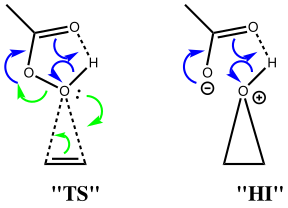
The deuterium isotope effects, on both carbon and oxygen compare very well indeed with those measured (the 13C and 18O have never been measured, they are predictions), which greatly assures that the model is a good one. So the predicted transition state geometry as shown below has had a good reality check. It reveals that two O-C bonds are forming, and the O-O bond is breaking, but that proton transfer has hardly started. This corresponds to the three green arrows shown at the top. The three blue arrows are not yet in action. I have colour-coded them to illustrate this temporal aspect. 

peracid+alkene1

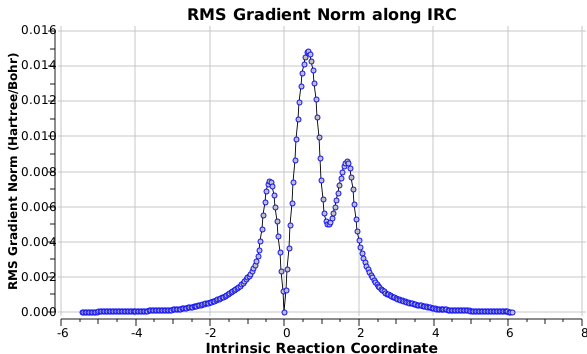
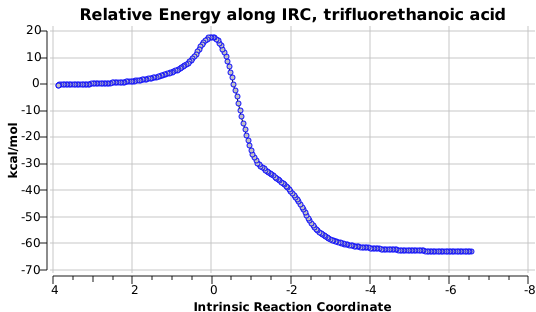
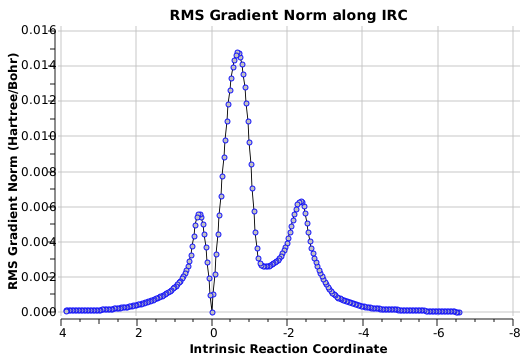
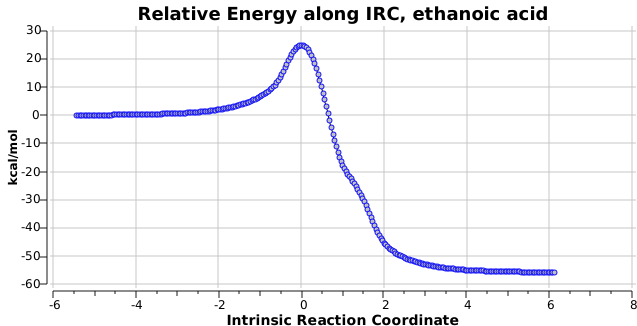
An intrinsic reaction coordinate[6] shows that the reaction is concerted, albeit asynchronous; the transition state (TS, @IRC=0.0) really only involves the green arrows; the blue arrows kick in only AFTER the ion-pair-like hidden intermediate is formed, labelled HI above (and seen @IRC =+1.2). Stabilising the ion-pair using trifluorethanoic acid[7] (a stronger acid) renders the HI more prominent.
peracid
peracidG
peracidF
peracidFG

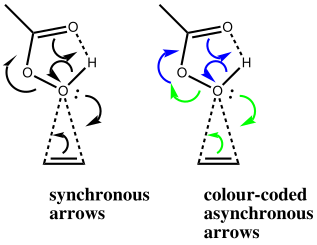
As quantum calculations apparently give us trustworthy indications of the order in which events happen during this reaction mechanism, perhaps it is time to start representing this information in our simple schematics. (Some) text-books currently show the left hand diagram below, involving five arrows but with no indication of their relative timing. The right hand side now colours the arrows to indicate that the green precede the blue. An extra arrow is added to indicate that one electron pair is involved in forming a “hidden intermediate”, the green arrow aspiring to end at a lone pair, but the blue arrow then continuing its progress to the final epoxide. The end-point of one arrow representing the start point of another could thus be taken as implying a hidden intermediate.
peracid1

As I have noted elsewhere, the curly-arrow representation of reaction mechanism has hardly evolved over the last sixty years. Some might argue that such stability is appropriate for a very simple heuristic used to teach introductory chemistry to students, and that this very simplicity should not be gratuitously discarded. But perhaps, in the light of what we now know about many mechanisms, it has become over-simple? Could judiciously deployed colour-coding of the arrows be a useful, albeit perhaps only a small step, to upgrading arrow pushing into the 21st century? 


I appreciate that some people are red-green/blue-yellow colour-blind, and that a full ROYGBIV spectrum of colours may carry too much information!

References

  1. E. Kraka, and D. Cremer, "Computational Analysis of the Mechanism of Chemical Reactions in Terms of Reaction Phases: Hidden Intermediates and Hidden Transition States", Accounts of Chemical Research, vol. 43, pp. 591-601, 2010. https://doi.org/10.1021/ar900013p
  2. H.S. Rzepa, and C. Wentrup, "Mechanistic Diversity in Thermal Fragmentation Reactions: A Computational Exploration of CO and CO<sub>2</sub> Extrusions from Five-Membered Rings", The Journal of Organic Chemistry, vol. 78, pp. 7565-7574, 2013. https://doi.org/10.1021/jo401146k
  3. T. Koerner, H. Slebocka-Tilk, and R.S. Brown, "Experimental Investigation of the Primary and Secondary Deuterium Kinetic Isotope Effects for Epoxidation of Alkenes and Ethylene with <i>m</i>-Chloroperoxybenzoic Acid", The Journal of Organic Chemistry, vol. 64, pp. 196-201, 1998. https://doi.org/10.1021/jo981652x
  4. H.S. Rzepa, "Gaussian Job Archive for C4H8O3", 2013. https://doi.org/10.6084/m9.figshare.781238
  5. H.S. Rzepa, "Gaussian Job Archive for C4H8O3", 2013. https://doi.org/10.6084/m9.figshare.781284
  6. H.S. Rzepa, "Gaussian Job Archive for C4H5F3O3", 2013. https://doi.org/10.6084/m9.figshare.781283

Experimental evidence for "hidden intermediates"? Epoxidation of ethene by peracid.

Sunday, August 25th, 2013

The concept of a “hidden intermediate” in a reaction pathway has been promoted by Dieter Cremer[1] and much invoked on this blog. When I used this term in a recent article of ours[2], a referee tried to object, saying it was not in common use in chemistry. The term clearly has an image problem. A colleague recently sent me an article to read (thanks Chris!) about isotope effects in the epoxidation of ethene[3] and there I discovered a nice example of hidden intermediates which I share with you now.

peracid

The reaction above is considered as a transfer of an oxygen atom to an alkene with concomitant concerted proton transfer (for the analogous reaction of an alkyne see here). The mechanism is normally illustrated with five arrows accomplishing both operations (see below). But a simple experiment shows this cannot be accurate[3]. When d4-ethene is used (with mCPBA as the peracid) in dichloromethane solution, an inverse kinetic isotope effect of 0.83 is observed (in other words the d4– species reacts faster than the 1H). If the peracid is instead deuterated (as OD) the reaction slows down by a factor of 1.05 (a normal isotope effect). This data provides a good test of whether any transition state model constructed for the reaction is a good one. So how about a ωB97XD/6-311G(d,p)/SCRF=dichloromethane[4],[5] model, using per-ethanoic acid? The isotope effect can be obtained by calculating the activation free energy with the appropriate isotope specified.

Activation barriers for isotopic substitutions
Value Normal isotopes d4-ethene OD acid One 13C-ethene One 18O
ΔG298 26.6844375 26.5589375 26.7245975 26.6907125 26.7296175
KIE  – 0.808 1.070 1.011 1.080

The deuterium isotope effects, on both carbon and oxygen compare very well indeed with those measured (the 13C and 18O have never been measured, they are predictions), which greatly assures that the model is a good one. So the predicted transition state geometry as shown below has had a good reality check. It reveals that two O-C bonds are forming, and the O-O bond is breaking, but that proton transfer has hardly started. This corresponds to the three green arrows shown at the top. The three blue arrows are not yet in action. I have colour-coded them to illustrate this temporal aspect. 

peracid+alkene1

An intrinsic reaction coordinate[6] shows that the reaction is concerted, albeit asynchronous; the transition state (TS, @IRC=0.0) really only involves the green arrows; the blue arrows kick in only AFTER the ion-pair-like hidden intermediate is formed, labelled HI above (and seen @IRC =+1.2). Stabilising the ion-pair using trifluorethanoic acid[7] (a stronger acid) renders the HI more prominent.

peracid
peracidG
peracidF
peracidFG

As quantum calculations apparently give us trustworthy indications of the order in which events happen during this reaction mechanism, perhaps it is time to start representing this information in our simple schematics. (Some) text-books currently show the left hand diagram below, involving five arrows but with no indication of their relative timing. The right hand side now colours the arrows to indicate that the green precede the blue. An extra arrow is added to indicate that one electron pair is involved in forming a “hidden intermediate”, the green arrow aspiring to end at a lone pair, but the blue arrow then continuing its progress to the final epoxide. The end-point of one arrow representing the start point of another could thus be taken as implying a hidden intermediate.

peracid1

As I have noted elsewhere, the curly-arrow representation of reaction mechanism has hardly evolved over the last sixty years. Some might argue that such stability is appropriate for a very simple heuristic used to teach introductory chemistry to students, and that this very simplicity should not be gratuitously discarded. But perhaps, in the light of what we now know about many mechanisms, it has become over-simple? Could judiciously deployed colour-coding of the arrows be a useful, albeit perhaps only a small step, to upgrading arrow pushing into the 21st century? 


I appreciate that some people are red-green/blue-yellow colour-blind, and that a full ROYGBIV spectrum of colours may carry too much information!

References

  1. E. Kraka, and D. Cremer, "Computational Analysis of the Mechanism of Chemical Reactions in Terms of Reaction Phases: Hidden Intermediates and Hidden Transition States", Accounts of Chemical Research, vol. 43, pp. 591-601, 2010. https://doi.org/10.1021/ar900013p
  2. H.S. Rzepa, and C. Wentrup, "Mechanistic Diversity in Thermal Fragmentation Reactions: A Computational Exploration of CO and CO<sub>2</sub> Extrusions from Five-Membered Rings", The Journal of Organic Chemistry, vol. 78, pp. 7565-7574, 2013. https://doi.org/10.1021/jo401146k
  3. T. Koerner, H. Slebocka-Tilk, and R.S. Brown, "Experimental Investigation of the Primary and Secondary Deuterium Kinetic Isotope Effects for Epoxidation of Alkenes and Ethylene with <i>m</i>-Chloroperoxybenzoic Acid", The Journal of Organic Chemistry, vol. 64, pp. 196-201, 1998. https://doi.org/10.1021/jo981652x
  4. H.S. Rzepa, "Gaussian Job Archive for C4H8O3", 2013. https://doi.org/10.6084/m9.figshare.781238
  5. H.S. Rzepa, "Gaussian Job Archive for C4H8O3", 2013. https://doi.org/10.6084/m9.figshare.781284
  6. H.S. Rzepa, "Gaussian Job Archive for C4H5F3O3", 2013. https://doi.org/10.6084/m9.figshare.781283

The importance of being complete.

Monday, September 26th, 2011

To (mis)quote Oscar Wilde again, ““To lose one methyl group may be regarded as a misfortune; to lose both looks like carelessness.” Here, I refer to the (past) tendency of molecular modellers to simplify molecular structures. Thus in 1977, quantum molecular modelling, even at the semi-empirical level, was beset by lost groups. One of my early efforts (DOI: 10.1021/ja00465a005) was selected for study because it had nothing left to lose; the mass spectrometric fragmentation of the radical cations of methane and ethane. Methyl, phenyl and other “large” groups were routinely replaced by hydrogen in order to enable the study. Cations indeed were always of interest to modellers; the relative lack of electrons almost always meant unusual or interesting structures and reactions (including this controversial species, DOI: 10.1021/ja00444a012). Inured to such functional loss, we modellers forgot that (unless in a mass spectrometer), cations have to have a counter anion. Here I explore one example of the model being complete(d).

The ion-pair complex of cyclobutadiene.

In the earlier post on this topic I had explored the possibility of a new isomer of cyclobutadiene, induced by the presence nearby of a strong acid, in the form of guanidinium cation. You might note there was no mention of any counterion! Well, here I add it in to complete the model, using perchlorate. I was following in a sense my own advice on Steve Bachrach’s blog, where the NMR spectrum of the adamantly cation was discussed. I had argued there that the anion (I chose SnCl5) might actually have an effect on the NMR. For the cyclobutadiene complex above without a counter-ion, this non-planar form of the cyclobutadiene was calculated earlier to be ~8.5 kcal/mol in free energy higher than the rectangular conventional geometry. Add the perchlorate as above, and this energy difference drops to 4.1 kcal/mol (modelled in water as a solvent). So the counter-ion CAN make a difference!

What are the implications to a modeller of adding counter ions? Well, when you start doing such calculations, you find that the practical matter of optimising the geometry is not quite as straightforward as it is found to be for what I would call covalently bonded systems. These latter have pretty predictable geometries, and these geometries are pretty rigid. Ion-pairs on the other hand are less predictable. Note for example in the above diagram that the perchlorate counterion sits to one side of the molecule, and is not symmetrical. The potential energy surface can be very flat indeed, which means that locating the optimal geometry can be quite a struggle. And unlike a covalent structure, where once the location of the covalent bonds is decided, there is little further ambiguity, ion-pairs may have many different possible relative orientations. Thus the above one may not be unique!

But the last word to this post should be: do not forget counter ions if you a looking at ionic species, and always strive to be complete!

A short history of molecular modelling: 1860-1890.

Saturday, February 5th, 2011

In 1953, the model of the DNA molecule led to what has become regarded as the most famous scientific diagram of the 20th century. It had all started 93 years earlier in 1860, at a time when the tetravalency of carbon was only just established (by William Odling) and the concept of atoms as real entities was to remain controversial for another 45 years (for example Faraday, perhaps the most famous scientist alive in 1860 did not believe atoms were real). So the idea of constructing a molecular model from atoms as the basis for understanding chemical behaviour was perhaps bolder than we might think. It is shown below, part of a set built for August Wilhelm von Hofmann as part of the lectures he delivered at the Royal College of Chemistry in London (now Imperial College).

The original August Wilhelm von Hofmann molecular model

This grand-daddy of all molecular models does have some interesting features. The most obvious is that the carbon atom at the centre is square planar (tetrahedral carbon was still 14 years in the future). What HAS survived to the present day is the colour scheme used (black=carbon, white=hydrogen, and not shown here, red=oxygen, blue=nitrogen, green=chlorine).  But another noteworthy aspect is the relative size of the white hydrogen, which is larger than the black carbon. This deficiency was however very soon rectified in 1861 by Josef Loschmidt, who published  a famous pamphlet in which he set out his ideas for the structures of more than  270 molecules (many of which by the way were cyclic, and this some four years before Kekule’s dream!). An example (#239) is shown below, which gets the relative sizes of the atoms more or less correct (OK, chlorine is shown with rather an odd shape). To get an idea of how good Loschmidt’s model actually was, click on the diagram to load a modern model, and compare the two! Even more impressive, these diagrams pre-date van der Waals work on the finite sizes of atoms, first presented in 1873.

Loschmidt’s molecular models. Click for 3D

To conclude, I cannot resist showing one more model. Hermann Sachse believed cyclohexane could not be planar. To try to convince people, in 1890 he included a  “flat-packed” model in the pages of a journal article,  evidently believing that people would cut it out, and assemble it into a 3D shape.

Flat-packed molecular model of cyclohexane

You might have noticed a theme in the present blog of presenting 3D models for many of the molecules I discuss (include the Loschmidt one above). For the historians amongst you, I note our 1995 article in which we updated[1] Sachse’s origami with an article featuring how to incorporate interactive models into journals (still sadly only too rare). Perhaps a history of the molecular model, and how it has been presented over 150 years might be an interesting one to trace!

References

  1. O. Casher, G.K. Chandramohan, M.J. Hargreaves, C. Leach, P. Murray-Rust, H.S. Rzepa, R. Sayle, and B.J. Whitaker, "Hyperactive molecules and the World-Wide-Web information system", Journal of the Chemical Society, Perkin Transactions 2, pp. 7, 1995. https://doi.org/10.1039/p29950000007