Posts Tagged ‘tutor’

The Graham reaction: Deciding upon a reasonable mechanism and curly arrow representation.

Monday, February 18th, 2019

Students learning organic chemistry are often asked in examinations and tutorials to devise the mechanisms (as represented by curly arrows) for the core corpus of important reactions, with the purpose of learning skills that allow them to go on to improvise mechanisms for new reactions. A common question asked by students is how should such mechanisms be presented in an exam in order to gain full credit? Alternatively, is there a single correct mechanism for any given reaction? To which the lecturer or tutor will often respond that any reasonable mechanism will receive such credit. The implication is that a mechanism is “reasonable” if it “follows the rules”. The rules are rarely declared fully, but seem to be part of the absorbed but often mysterious skill acquired in learning the subject. These rules also include those governing how the curly arrows should be drawn. Here I explore this topic using the Graham reaction.[1]

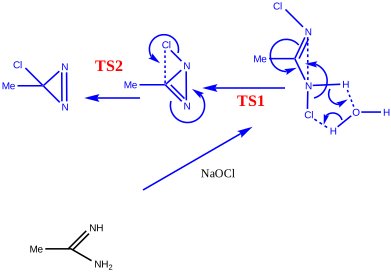
I start by noting the year in which the Graham procedure was published, 1965. Although the routine representation of mechanism using curly arrows had been established for about 5-10 years by then, the quality of such representations in many articles was patchy. Thus, this one (the publisher will need payment for me to reproduce the diagram here, so I leave you to get it yourself) needs some modern tidying up. In the scheme below, I have also made a small change, using water itself as a base to remove a NH proton, rather than hydroxide anion as used in the article (I will return to the anion later). The immediate reason is that water is a much simpler molecule to use at the start of our investigation than solvated sodium hydroxide. You might want to start with comparing the mechanism above with the literature version[1] to discover any differences. 
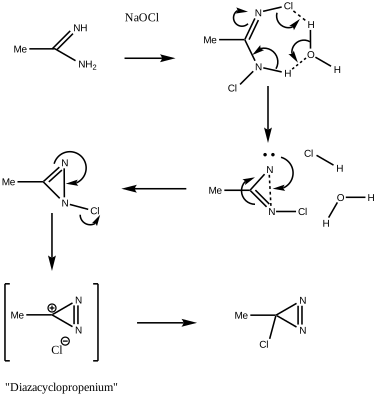
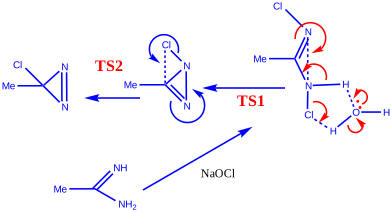
The next stage is to compute all of this using quantum mechanics, which will tell us about the energy of the system as it evolves and also identify the free energy of the transition states for the reaction. I am not going to go into any detail of how these energies are obtained, suffice to say that all the calculations can be found at the following DOI: 10.14469/hpc/5045 The results of this exercise are represented by the following alternative mechanism.

How was this new scheme obtained? The key step is locating a transition state in the energy surface, a point where the first derivatives of the energy with respect to all the 3N-6 coordinates defining the geometry (the derivative vector) are zero and where the second derivative matrix has just one negative eigenvalue (check up on your Maths for what these terms mean). Each located transition state (which is an energy maximum in just one of the 3N-6 coordinates) can be followed downhill in energy to two energy minima, one of which is declared the reactant of the reaction and the other the product, using a process known as an IRC (intrinsic reaction coordinate). The coordinates of these minima are then inspected so they can be mapped to the conventional representations shown above. New bonds in the formalism above are shown with dashed lines and have an arrow-head ending at their mid-point; breaking bonds (more generally, bonds reducing their bond order) have an arrow starting from their mid-point. The change in geometry along the IRC for TS1 can then be shown as an animation of the reaction coordinate, which you can see below.

Don’t worry too much about when bonds appear to connect or disconnect, the animation program simply uses a simple bond length rule to do this. The major difference with the original mechanism is that it is the chlorine on the nitrogen also bearing a proton that gets removed. Also, the N-N bond is formed as part of the same concerted process, rather than as a separate step.
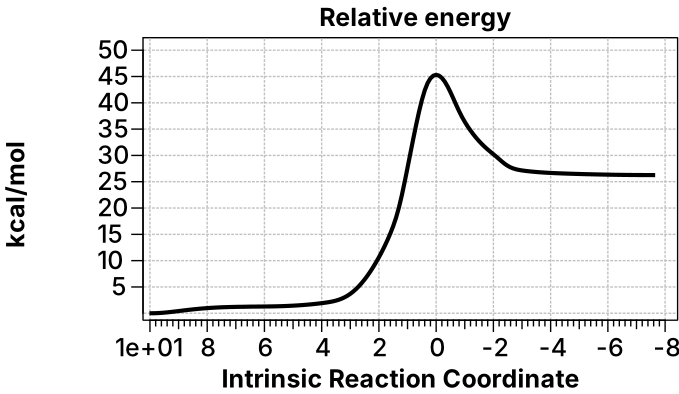
Shown above is the computed energy along the reaction path. Here a “reality check” can be carried out. The activation free energy (the difference between the transition state and the reactant) emerges as a rather unsavoury ΔG=40.8 kcal/mol. Why is this unsavoury? Well, according to transition state theory, the rate of a (unimolecular) reaction is given by the expression: Ln(k/T) = 23.76 – ΔG/RT where T is temperature (~323K in this example), R = is the gas constant and k is the unimolecular rate constant. When you solve it for ΔG=40.8, it turns out to be a very slow reaction indeed. More typically, a reaction that occurs in a few minutes at this sort of temperature has ΔG= ~15 kcal/mol. So this turns out to be an “unreasonable” mechanism, but based on the quantum mechanically predicted rate and not on the nature of the “curly arrows”. And no, one cannot do this sort of thing in an examination (not even on a mobile phone; there is no app for it, yet!) I must also mention that the “curly arrows” used in the above representation are, like the bonds, based on simple rules of connecting a breaking with a forming bond with such an arrow. There IS a method of computing both their number and their coordinates “realistically”, but I will defer this to a future post. So be patient!

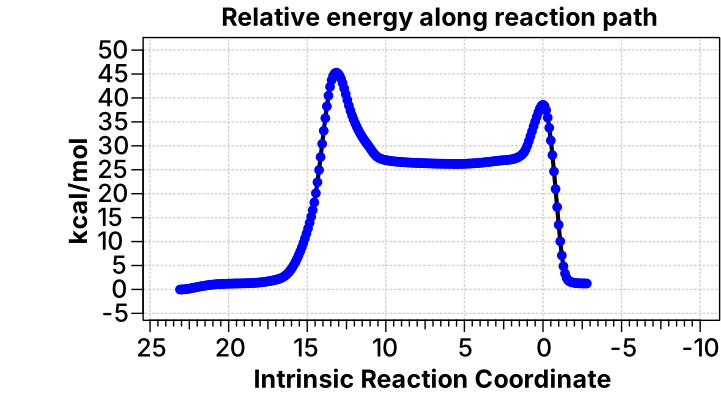
The next thing to note is that the energy plot shows this stage of the reaction as being endothermic. Time to locate TS2, which it turns out corresponds to the N to C migration of the chlorine to complete the Graham reaction. As it happens, TS2 is computed to be 10.6 kcal/mol lower than TS1 in free energy, so it is not “rate limiting”.

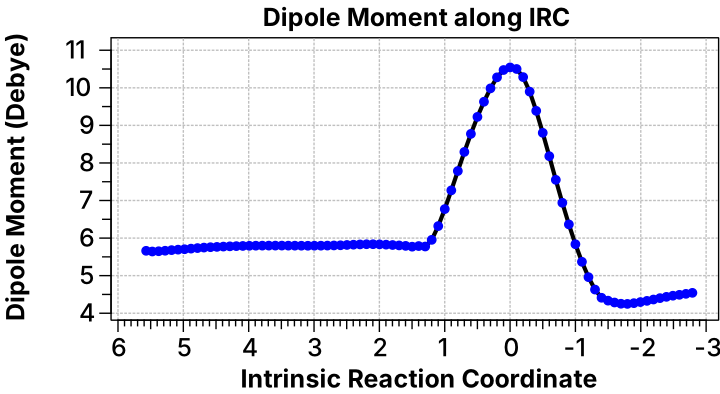
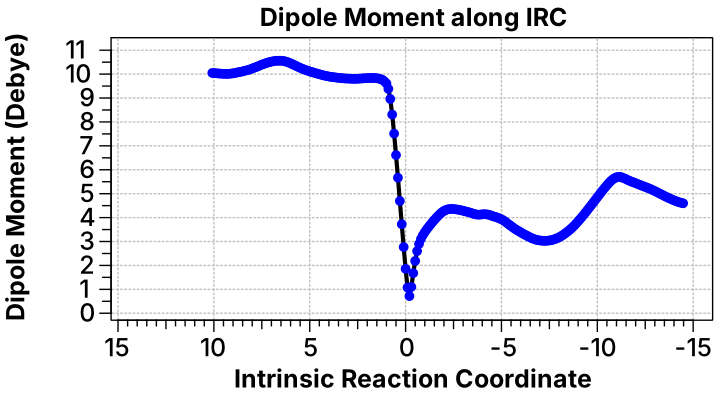
To provide insight into the properties of this reaction path, a plot of the calculated dipole moment along the reaction path is shown. At the transition state (IRC value = 0), the dipole moment is a maximum, which suggests it is trying to form an ion-pair, part of which is the diazacylopropenium cation shown in the first scheme above. The ion-pair is however not fully formed, probably because it is not solvated properly.
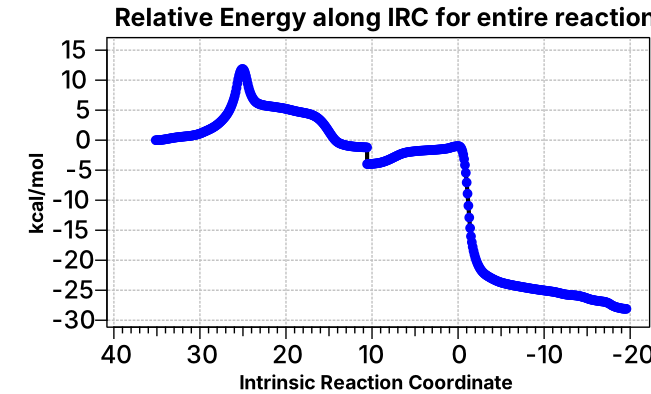
We can add the two reaction paths together to get the overall reaction energy, which is no longer endothermic but approximately thermoneutral. Things are still not quite “reasonable” because the actual reaction is exothermic.
Time then to move on to hydroxide anion as the catalytic base, in the form of sodium hydroxide. To do this, we need to include lots of water molecules (here six), primarily to solvate the Na+ (shown in purple below) but also any liberated Cl. You can see the water molecules moving around a lot as the reaction proceeds, via again TS1 to end at a similar point as before.

The energy plot is now rather different. The activation energy is now lower than the 15 kcal/mol requirement for a fast reaction; in fact ΔG= 9.5 kcal/mol and overall it is already showing exothermicity. What a difference replacing a proton (from water) by a sodium cation makes!
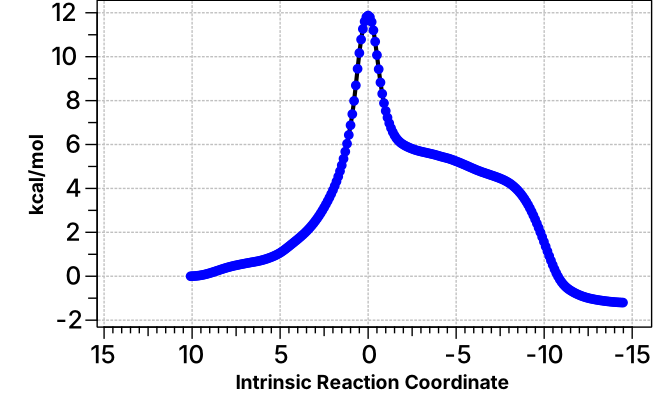
Take a look also at this dipole moment plot as the reaction proceeds! TS1 is almost entirely non-ionic!
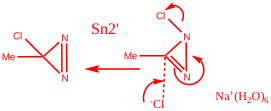
To complete the reaction, the chlorines have to rearrange. This time a rather different mode is adopted, as shown below, termed an Sn2′ reaction. The energy of TS2′ is again lower than TS1, by 9.2 kcal/mol. Again no explicit diazacylopropenium cation-anion pair (an aromatic 4n+2, n=0 Hückel system) is formed.


Combing both stages of the reaction as before. The discontinuity in the centre is due to further solvent reorganisation not picked up at the ends of the two individual IRCs which were joined to make this plot. Note also that the reaction is now appropriately exothermic overall.
So what have we learnt?

  1. That a “reasonable” mechanism as shown in a journal article, and perhaps reproduced in a text-book, lecture or tutorial notes or even an examination, can be subjected in a non-arbitrary manner to a reality check using modern quantum mechanical calculations.
  2. For the Graham reaction, this results in a somewhat different pathway for the reaction compared to the original suggestion.
    1. In particular, the removal of chlorine occurs from the same nitrogen as the initial deprotonation
    2. This process does not result in an intermediate nitrene being formed, rather the chlorine removal is concerted with N-N bond formation.
    3. The resulting 1-chloro-1H-diazirine does not directly ionize to form a diazacyclopropenium cation-chloride anion ion pair, but instead can undertake an Sn2′ reaction to form the final 3-chloro-3-methyl-3H-diazirine.
  3. A simple change in the conditions, such as replacing water as a catalytic agent with Na+OH(5H2O) can have a large impact on the energetics and indeed pathways involved. In this case, the reaction is conducted in NaOCl or NaOBr solutions, for which the pH is ~13.5, indicating [OH] is ~0.3M.
  4. The curly arrows here are “reasonable” for the computed pathway, but are determined by some simple formalisms which I have adopted (such as terminating an arrow-head at the mid-point of a newly forming bond). As I hinted above, these curly arrows can also be subjected to quantum mechanical scrutiny and I hope to illustrate this process in a future post.

But do not think I am suggesting here that this is the “correct” mechanism, it is merely one mechanism for which the relative energies of the various postulated species involved have been calculated relatively accurately. It does not preclude that other, perhaps different, routes could be identified in the future where the energetics of the process are even lower. 


This blog is inspired by the two students who recently asked such questions. In fact, you also have to acquire this completely unrelated article[2] for reasons I leave you to discover yourself. You might want to consider the merits or demerits of an alternative way of showing the curly arrows. Is this representation “more reasonable”? I thank Ed Smith for measuring this value for NaOBr and for suggesting the Graham reaction in the first place as an interesting one to model.
References

  1. W.H. Graham, "The Halogenation of Amidines. I. Synthesis of 3-Halo- and Other Negatively Substituted Diazirines<sup>1</sup>", Journal of the American Chemical Society, vol. 87, pp. 4396-4397, 1965. https://doi.org/10.1021/ja00947a040
  2. E.W. Abel, B.C. Crosse, and D.B. Brady, "Trimeric Alkylthiotricarbonyls of Manganese and Rhenium", Journal of the American Chemical Society, vol. 87, pp. 4397-4398, 1965. https://doi.org/10.1021/ja00947a041
Secrets of a university tutor: unravelling a mechanism using spectroscopy.

Thursday, January 31st, 2013

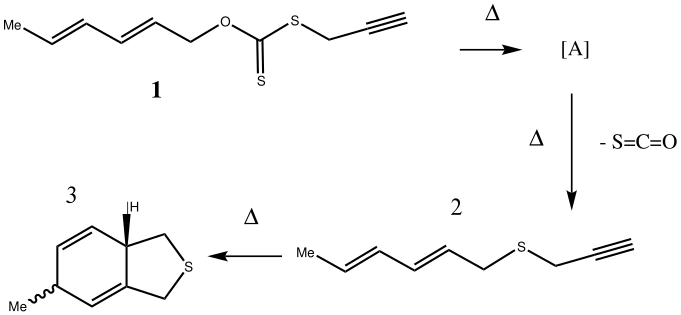
It is always rewarding when one comes across a problem in chemistry that can be solved using a continuous stream of rules and logical inferences from them. The example below[1] is one I have been using as a tutor in organic chemistry for a few years now, and I share it here. It takes around 50 minutes to unravel with students.

14

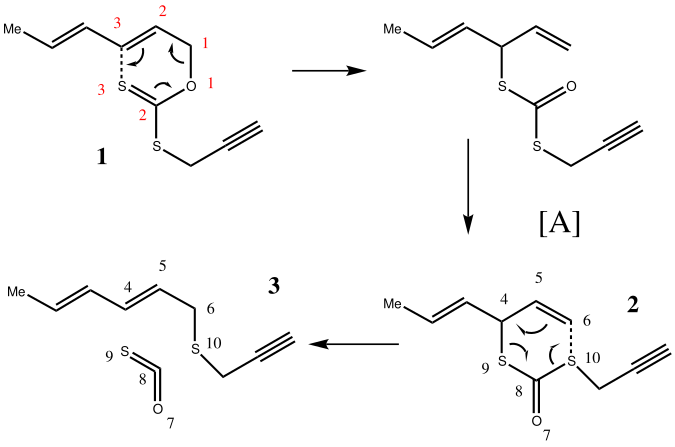
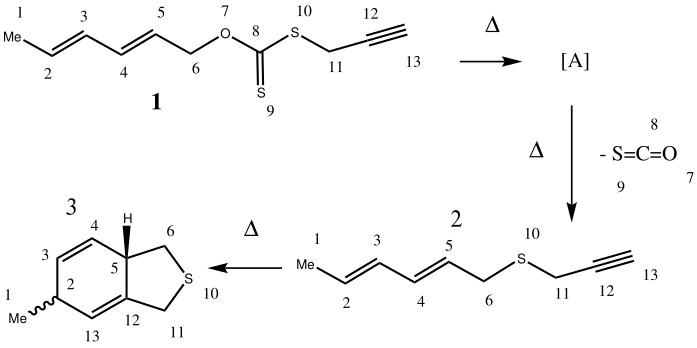
The narrative is that attempted preparation of 1 resulted instead in a mysterious compound [A], which when heated extruded S=C=O to give 2, and upon further heating gave 3. The challenge is to identify [A] with the help of the spectroscopic information provided, to infer the mechanism of its formation and further to suggest what the stereochemistry of the methyl group in 3 might be.

The 1H NMR of [A] is set out below for future reference: δ 1.70 (3H,d,6Hz), 2.23 (1H, t, 3Hz), 3.73 (2H, d, 3Hz), 4.84 (1H, dd, 7,8Hz), 5.15 (1H, d, 10Hz), 5.27 (1H, d, 17Hz), 5.51 (1H, dd, 8,16.5 Hz), 5.77 (1H, dq, 6,16.5 Hz), 5.88 (1H, ddd, 7,10,17Hz). 

As usual, one has to start somewhere, and here the task is to number the atoms, and then try to “reaction map” them to the products.

14a

  1. The first real decision is how to map S9 or S10. Occam’s razor suggests that the sulfur in the SCO comes from S9 (this would allow C10-C11 to be left alone), but if that hypothesis is wrong, we can always return and try the alternative. Let us go with the simpler option first.
  2. Another relatively simple decision is to map C12-C13 as shown in 3, since this only changes its bond order by one (few mechanisms require a change in bond order of > 1 in any single mechanistic step). 

Analysis of the 1H NMR starts with the most obvious (marker) group, the methyl:

  1. The methyl is J-coupled to C2-H (6Hz), and hence this is assigned to 5.77 ppm.
  2. C2-H is J-coupled to C3-H (16.5 Hz) and hence this is assigned to 5.51 ppm
  3. C3-H is J-coupled to C4-H (8 Hz) and hence this is assigned to 4.84 ppm. 
  4. We now encounter a problem. C4-H has a chemical shift which suggests it is not attached to an sp2-C, but has become sp3-hybridized. But the relatively high chemical shift suggests that this carbon may be attached to electronegative substituents. C4 is flagged for attention below.
  5. C4-H is J-coupled via J 7 Hz to the peak at 5.88 ppm. The chemical shift is typical of sp2-C, and is assigned as C5-H.
  6. C5-H is J-coupled via two couplings of 10 and 17 Hz to peaks at 5.15 and 5.27 ppm. Both these are also sp2-C, which may be assigned as C6-H. As such it can only carry three attached atoms (two Hs and a C-C) and so the C6-O7 bond cannot be retained. C6 is flagged for attention below.
  7. The remaining peaks can be assigned as C11-H and C13-H from their mutual 4J coupling of 3Hz.

Armed with these inferences, a list of to-dos can now be assembled.

  1.  For the transform 1 → [A], break C6-O7
  2. Form a bond to C4 using if possible an electronegative atom.

This pattern of break one σ-bond/form one σ-bond, reminds of a sigmatropic pericyclic reaction. A typical example is the Cope rearrangement, in which a bond forms between the termini of two double bonds separated by three σ-bonds. The penny drops when one re-draws the original compound by rotating about a single bond (a perfectly allowed operation):

14b

A [3,3] Cope is now exposed. The (re)-numbering in red shows the pattern described above, and completes the assignment of the bond forming above to C4 as C4-S9. The next step is to find out how to extrude S=C=O. 

  1. To get to 2, one needs to create the C6-S10 bond (it is  sp2-C in [A]). 
  2. The O8-S10 bond needs to break.
  3. The recently formed C4-S9 bond needs to break again, with the result of extruding the required S=C=O.

This pattern of forming and breaking bonds, but in unequal number reminds of the so-called ene class of pericyclic reaction. Both the Cope and now the ene are six-electron thermal pericyclic processes.

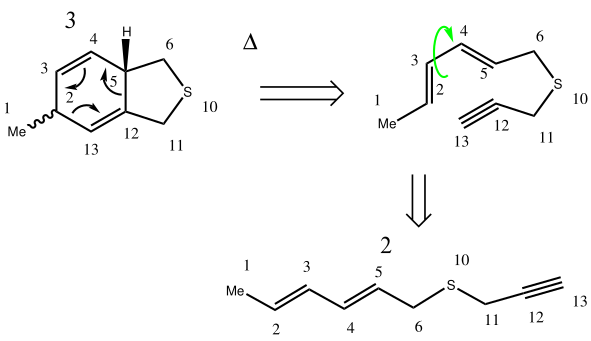
We can now turn our attention to the last reaction shown above. Since we have both structures now, we can do a retrosynthetic analysis, which reveals that in the final step, C2-C13 and C5-C12 have both got to form. Such a pattern is another six-electron pericyclic reaction, the Diels-Alder π2s + π4s cycloaddition. Again, we have to rotate about the C3-C4 single bond (green arrow) to get the diene of the reactant into a conformation capable of undertaking this reaction. We are helped in this by ensuring that the trans hydrogens at both C2-C3 and C4-C5 (which we inferred from the values of the J-couplings above) are not transformed during our redrawing of this conformation.

14c

The conclusion to this tutorial comes in assigning the stereochemistry of that methyl group. The π4s component of the cycloaddition mandates that the two bonds forming to C5 and to C2 must both form suprafacially across this four-carbon unit. We know that the bond to C5 must form on the bottom face, so as to rotate the C5-H up. Therefore it must form on the bottom face also of C2, likewise rotating the attached hydrogen up. Therefore the methyl must point  down in the final product.

QED.

But not quite, since nowadays, one can take the NMR analysis one step further. In another post, I will perform a full quantum mechanical prediction of the above NMR spectrum to see how well it matches what is reported above.

References

  1. K. Harano, M. Eto, K. Ono, K. Misaka, and T. Hisano, "Sequential pericyclic reactions of unsaturated xanthates. One-pot synthesis of hydrobenzo[c]thiophenes", Journal of the Chemical Society, Perkin Transactions 1, pp. 299, 1993. https://doi.org/10.1039/p19930000299

Do marauding electrons go in packs?

Monday, December 27th, 2010

Is there a preferred pack size for electrons on the move? Or put less flamboyantly, is there an optimum, and a maximum number of arrows (electron pairs) that one might push in revealing the mechanism of a concerted reaction? A sort of village-instinct for electrons. Consider the following (known, DOI: 10.1016/S0040-4039(00)98289-3) reaction

A double 3,3 sigmatropic reaction

It is a double [3,3] sigmatropic rearrangement, each component involving two packs of three arrows (six electrons) each. Do these packs move together, or do they prefer to move one at a time? If the former, then we come up against another interesting question. How many of say the six bonding electrons in a triple bond can simultaneously participate in a reaction? Many a tutor of the arrow pushing exercise might say the limit is always two (I have even seen this written into a set of rules for arrow pushing). But could it be four, as shown in the above example? Or perchance even six as discussed in this post? OK, the question is rather loaded for this example, since being a pericyclic reaction it has a built in (thermal) preference for packs of 4n+2 electrons, which enable the transition state for the process to be considered as aromatic. So in a sense it boils down to whether two aromatic packs would have any advantage in both marauding concurrently.

A connection can also be made to recent work by Rainer Herges (DOI: 10.1021/jo801390x) in which he suggests that pericyclic reactions involving four electrons at an alkyne can indeed be concerted, giving them the specific name of coarctate reactions (ones which exhibit one or more coarctate atoms at each of which two bonds are made and two bonds are broken). And one further connection is to Clar islands, in which the tendency of electrons in polycyclic aromatic hydrocarbons (PAH) to form packs of six is discussed (these of course are not marauding).

So onwards to a computational exploration (B3LYP/6-311G(d,p), 10042/to-6354). Two geometries can be located, with respectively C2 and Ci symmetries. They differ in the orientation of the two chair-like rings, and the former (shown below) is the more (cis) stable. Two negative force constants are calculated (shown below) which indicate that the two [3,3] sigmatropic rearrangements like to go consecutively and not concurrently.

Geometry of the asynchronous pathway. Click for 3D

Geometry of the synchronous pathway. Click for 3D

The ΔG† is calculated as high as 58.3 kcal/mol, which given that the reaction does proceed experimentally at ~410°C suggests this cannot be the true mechanism (discussion of which I leave to a future post). The electrons therefore move in smaller packs, but certainly not 12!

Hunting in packs of six, not twelve.

In conclusion, one might make the analogy of electrons as medieval travellers, preferring to travel in small groups, and probably invariably stopping off a in a coaching inn for a rest whenever they see one close to their route (or perhaps even sometimes well off the route). I suspect (but cannot prove) that there are few types of bond forming or bond breaking reactions which involve more than five arrows (ten electrons) participating in a single concerted step. More, and I think the travelling electrons are likely to find a resting place  on the journey (which, if not a closed shell species, may well be a biradical, or in suitable solvent, zwitterion).

So that is the challenge posed here; to find an example of a reaction involving six or more arrows which theory appears to show is concerted and where new bonds are formed, or old ones broken (this last clause excludes artificial reactions such as bond shifting in higher annulenes).

Following one’s nose: a quadruple bond to carbon. Surely I must be joking!

Thursday, December 16th, 2010

Do you fancy a story going from simplicity to complexity, if not absurdity, in three easy steps? Read on! The following problem appears in one of our (past) examination questions in introductory organic chemistry. From relatively mundane beginnings, one can rapidly find oneself in very unexpected territory.

How would one make 3-nitrobenzonitrile?

One teaches how to disconnect each group, identifying that both are meta-directing towards electrophiles, and hence asking what an appropriate electrophile might be? The “correct” answer is a nitronium cation (nitric + sulfuric acids) acting upon m-directing benzonitrile. But (sacrilege), why not a “cyonium” cation (CN+) on m-directing nitrobenzene? Well, as a tutor one would normally swat it away on the grounds it has never been previously observed (or that cyanide is always seen as an anion, not a cation). But then one (or a student) asks, why not? How about generating it from e.g. TfOCN. TfO is a jolly good leaving group, one of the best. Well, this precursor truly appears never to have been made (or even calculated!). By now (if encountered in a tutorial), most chemistry students would be rather bemused. So the process of following one’s nose (more accurately, my nose) continues in the peace and quiet of a blog, where a rather different readership might be bemused (or inflamed).

A Quadruple CN bond?

One might start the same place a student would. How would one represent this diatomic with bonds? How about the above? It has the merit that both atoms are associated with a (shared) octet of electrons, in the form of a quadruple bond. I did show this (briefly) to a colleague, but they recoiled in horror, although it has to be said they were slightly at a loss to actually explain their horror.

Well, time for calculations. How about CCSD/aug-cc-pVTZ (DOI: 10042/to-6261) or B3LYP/aug-cc-pVTZ (DOI: 10042/to-6255). The latter allows a so-called Wiberg bond index to be computed (a reasonably accepted index). This comes out at 3.55, well on the way to being quadruple. An NBO analysis (NBO 5.9) identifies FOUR NBO orbitals with an occupancy of ~2.0, all designated BD (rather than e.g. Lp). What are these NBOs like? (as it turns out, they are almost identical to the MOs for this molecule).

Orbital 7. Click for 3D

Orbital 6 (π)

Orbital 5 (π)

Orbital 4. Click for 3D

Orbital 3. Click for 3D

Orbitals 5 & 6 are standard π orbitals with no mystery (and 8 & 9, not shown, are the matching π* pair). Orbital 3 results from the overlap of two 2s AOs (but note the curious little toroid at the carbon end). Orbitals 4 and 7 (the LUMO) are the interesting ones. Nominally, the result of overlapping two 2px AOs to give what should be a bonding and antibonding pair, they both appear to be bonding in the C-N region! Perhaps the quadruple bond is not looking quite so unlikely after all (comprising ~double occupancy of orbitals  3-6)!

What about those stalwarts I often use in these blogs, QTAIM and ELF? The former  (using the CCSD natural orbitals) has a ρ(r) of 0.346 and a ∇2ρ(r) of +2.01 at the bond-critical point (BCP). The former is certainly a high value, although no calibration exists to compare it to a quadruple bond. The Laplacian has a positive value at this point, possibly an indication of a charge-shift bond (see this and this blog, although more likely due to the adjacency of the bond critical point to the core shell of the carbon atom). ELF (also using natural orbitals) declares the presence of TWO disynaptic basins, with integrations of 5.39e and 2.44 (totalling 7.83e). The basins will each take the form of a torus (see DOI: 10.1021/ct100470g). Hm, perhaps, on reflection, this paragraph might not be entirely suitable for an introductory tutorial to organic chemistry. The density of mumbo-jumbo is rather high!

So starting from a simple retrosynthetic analysis of a simple aromatic molecule, in which the less obvious route is at least considered, one derives a “new” reagent, the cyonium cation CN+. In a effort to analyse its bonding, one concludes that a quadruple bond needs to be taken at least seriously. I would note as a warning that these diatomic species can be really tricky to pin down, and the iso-electronc C2 is a good example of that. But C2 has all sorts of issues, some of which are avoided with CN+. So the last word is hardly written, but not a bad outcome, I venture to suggest, of following one’s nose in a tutorial.


I have appended to this post a 3D exploration of the ELF function, showing the two torus basins referred to above.


ELF function for CN+. Click for 3D


Henry Rzepa, URL:http://www.ch.imperial.ac.uk/rzepa/blog/?p=3065. Accessed: 2011-06-04. (Archived by WebCite® at http://www.webcitation.org/5zBSjBjhM)

Following one's nose: a quadruple bond to carbon. Surely I must be joking!

Thursday, December 16th, 2010

Do you fancy a story going from simplicity to complexity, if not absurdity, in three easy steps? Read on! The following problem appears in one of our (past) examination questions in introductory organic chemistry. From relatively mundane beginnings, one can rapidly find oneself in very unexpected territory.

How would one make 3-nitrobenzonitrile?

One teaches how to disconnect each group, identifying that both are meta-directing towards electrophiles, and hence asking what an appropriate electrophile might be? The “correct” answer is a nitronium cation (nitric + sulfuric acids) acting upon m-directing benzonitrile. But (sacrilege), why not a “cyonium” cation (CN+) on m-directing nitrobenzene? Well, as a tutor one would normally swat it away on the grounds it has never been previously observed (or that cyanide is always seen as an anion, not a cation). But then one (or a student) asks, why not? How about generating it from e.g. TfOCN. TfO is a jolly good leaving group, one of the best. Well, this precursor truly appears never to have been made (or even calculated!). By now (if encountered in a tutorial), most chemistry students would be rather bemused. So the process of following one’s nose (more accurately, my nose) continues in the peace and quiet of a blog, where a rather different readership might be bemused (or inflamed).

A Quadruple CN bond?

One might start the same place a student would. How would one represent this diatomic with bonds? How about the above? It has the merit that both atoms are associated with a (shared) octet of electrons, in the form of a quadruple bond. I did show this (briefly) to a colleague, but they recoiled in horror, although it has to be said they were slightly at a loss to actually explain their horror.

Well, time for calculations. How about CCSD/aug-cc-pVTZ (DOI: 10042/to-6261) or B3LYP/aug-cc-pVTZ (DOI: 10042/to-6255). The latter allows a so-called Wiberg bond index to be computed (a reasonably accepted index). This comes out at 3.55, well on the way to being quadruple. An NBO analysis (NBO 5.9) identifies FOUR NBO orbitals with an occupancy of ~2.0, all designated BD (rather than e.g. Lp). What are these NBOs like? (as it turns out, they are almost identical to the MOs for this molecule).

Orbital 7. Click for 3D

Orbital 6 (π)

Orbital 5 (π)

Orbital 4. Click for 3D

Orbital 3. Click for 3D

Orbitals 5 & 6 are standard π orbitals with no mystery (and 8 & 9, not shown, are the matching π* pair). Orbital 3 results from the overlap of two 2s AOs (but note the curious little toroid at the carbon end). Orbitals 4 and 7 (the LUMO) are the interesting ones. Nominally, the result of overlapping two 2px AOs to give what should be a bonding and antibonding pair, they both appear to be bonding in the C-N region! Perhaps the quadruple bond is not looking quite so unlikely after all (comprising ~double occupancy of orbitals  3-6)!

What about those stalwarts I often use in these blogs, QTAIM and ELF? The former  (using the CCSD natural orbitals) has a ρ(r) of 0.346 and a ∇2ρ(r) of +2.01 at the bond-critical point (BCP). The former is certainly a high value, although no calibration exists to compare it to a quadruple bond. The Laplacian has a positive value at this point, possibly an indication of a charge-shift bond (see this and this blog, although more likely due to the adjacency of the bond critical point to the core shell of the carbon atom). ELF (also using natural orbitals) declares the presence of TWO disynaptic basins, with integrations of 5.39e and 2.44 (totalling 7.83e). The basins will each take the form of a torus (see DOI: 10.1021/ct100470g). Hm, perhaps, on reflection, this paragraph might not be entirely suitable for an introductory tutorial to organic chemistry. The density of mumbo-jumbo is rather high!

So starting from a simple retrosynthetic analysis of a simple aromatic molecule, in which the less obvious route is at least considered, one derives a “new” reagent, the cyonium cation CN+. In a effort to analyse its bonding, one concludes that a quadruple bond needs to be taken at least seriously. I would note as a warning that these diatomic species can be really tricky to pin down, and the iso-electronc C2 is a good example of that. But C2 has all sorts of issues, some of which are avoided with CN+. So the last word is hardly written, but not a bad outcome, I venture to suggest, of following one’s nose in a tutorial.


I have appended to this post a 3D exploration of the ELF function, showing the two torus basins referred to above.


ELF function for CN+. Click for 3D


Henry Rzepa, URL:http://www.ch.imperial.ac.uk/rzepa/blog/?p=3065. Accessed: 2011-06-04. (Archived by WebCite® at http://www.webcitation.org/5zBSjBjhM)

Anatomy of an arrow-pushing tutorial: reducing a carboxylic acid.

Wednesday, December 1st, 2010

Arrow pushing (why never pulling?) is a technique learnt by all students of organic chemistry (inorganic chemistry seems exempt!). The rules are easily learnt (supposedly) and it can be used across a broad spectrum of mechanism. But, as one both becomes more experienced, and in time teaches the techniques oneself as a tutor, its subtle and nuanced character starts to dawn. An example of such a mechanism is illustrated below, and in this post I attempt to tease out some of these nuances.

The example chosen is the reduction of a carboxylic acid to an alcohol by borane (diborane). Lecture notes present this reaction as being specific to carboxylic acids, even in the presence of carboxylic esters. The tutor is then faced with how to explain this selectivity to students in a tutorial, using arrow pushing.

Scheme for reduction of a carboxylic acid by borane.

I start with grouping the arrow pushing into three sets:

  1. The essential arrows (red). These will attempt to describe the key mechanistic step for which an answer is sought, in this example why the reaction is so selective for the carboxylic acid. A cruder, but perhaps pragmatic description is that these are the arrows needed to pass examinations in the subject (music to students’ ears).
  2. The lazy arrows (blue). In this case, these arrows are essential to “prep the patient”, but they will not of themselves carry much insight into the operation of the mechanism.
  3. The workup arrows (green). To continue the medical analogy, this is a post operative “closing the patient up” stage.

This tutorial actually starts with non-arrows. Process 1 involves converting the actual real structure of diborane (a bridged dimer) into its monomer, which is thought to be the active ingredient of this reagent. Because the bridging hydrogens are bound by three-centre-two-electron bonds, it is actually difficult to represent this process with conventional (two-centre-two-electron) arrows. So we do not even try!

Process 3 is the one which involves the essential (red) arrow pushing. It encapsulates the reason why only a carboxylic acid reacts in this process, and these arrows can be formalised by computing the transition state quantum mechanically (below). In fact there are two ways of illustrating this essential process. Process 2 involves first forming a O-B bond before the essential arrows. Process 4 involves another B-O bond AFTER the key transition state; the outcome of either process is identical. This illustrates another subtle behaviour in arrow pushing; the detailed timing or choreography of the arrows. In this example, the animated form of the reaction coordinate indicates relatively little B-O bond formation, so we will go with 2 and then 5 as the more realistic representation. In fact, the QM transition state is fascinating in its own right; note for example how one of the two extruding hydrogen atoms is moving far less (the hydridic one) than the other (the proton-like one; full details available at 10042/to-5725).

Key transition state? Click for 3D.

Process 6 is a lazy category. The preceding steps are simply repeated twice more to form a triacyloxyborane. There are many other forms of lazy arrow. Proton transfers are often thought of in this category, and double headed arrows involved in addition/elimination to e.g. carbonyl groups.

Process 7 and 8 are in an awkward category. Of themselves, they do not explain the selectivity of borane for this functional group, but they do represent another essential operation; namely the actual reduction of the carbonyl group. They are also somewhat speculative, and it is quite possible other routes could be devised.

Finally, with 9, we arrive at a resting phase which now requires workup (green). Thus 10 and 11 represent hydrolysis of the borate esters to the reduced alcohol and something starting to resemble boric acid. Clearly, more arrows are needed after 11, but few tutors (or examination graders) would begrudge a student if these were to be omitted. Step 11 also contains some lazy arrows, since a proton is transferred between oxygen atoms, but no arrows are shown for this process.

Clearly, there are plenty of nuances here, and it is perfectly possible that other arrow-pushers may even disagree with some of the ones I have shown above. But perhaps the above analysis might give you some ideas of your own on how to communicate the essential of reaction mechanisms to others.