Posts Tagged ‘Royal Society of Chemistry’
Sunday, November 4th, 2018
For perhaps ten years now, the future of scientific publishing has been hotly debated. The traditional models are often thought to be badly broken, although convergence to a consensus of what a better model should be is not apparently close. But to my mind, much of this debate seems to miss one important point, how to publish data.
Thus, at one extreme is COAlition S, a model which promotes the key principle that “after 1 January 2020 scientific publications on the results from research funded by public grants provided by national and European research councils and funding bodies, must be published in compliant Open Access Journals or on compliant Open Access Platforms.” This includes ten principles, one of which “The ‘hybrid’ model of publishing is not compliant with the above principles” has revealed some strong dissent, as seen at forbetterscience.com/2018/09/11/response-to-plan-s-from-academic-researchers-unethical-too-risky I should explain that hybrid journals are those where the business model includes both institutional closed-access to the journal via a subscription charge paid by the library, coupled with the option for individual authors to purchase an Open Access release of an article so that it sits outside the subscription. The dissenters argue that non-OA and hybrid journals include many traditional ones, which especially in chemistry are regarded as those with the best impact factors and very much as the journals to publish in to maximise both the readership, hence the impact of the research and thus researcher’s career prospects. Thus many (not all) of the American Chemical Society (ACS) and Royal Society of Chemistry (RSC) journals currently fall into this category, as well as commercial publishers of journals such as Nature, Nature Chemistry,Science, Angew. Chemie, etc.
So the debate is whether funded top ranking research in chemistry should in future always appear in non-hybrid OA journals (where the cost of publication is borne by article processing charges, or APCs) or in traditional subscription journals where the costs are borne by those institutions that can afford the subscription charges, but of course also limit the access. A measure of how important and topical the debate is that there is even now a movie devoted to the topic which makes the point of how profitable commercial scientific publishing now is and hence how much resource is being diverted into these profit margins at the expense of funding basic science.
None of these debates however really takes a close look at the nature of the modern research paper. In chemistry at least, the evolution of such articles in the last 20 years (~ corresponding to the online era) has meant that whilst the size of the average article has remained static at around 10 “pages” (in quotes because of course the “page” is one of those legacy concepts related to print), another much newer component known as “Supporting information” or SI♥ has ballooned to absurd sizes. It can reach 1000 pages[1] and there are rumours of even larger SIs. The content of SI is of course mostly data. The size is often because the data is present in visual form (think spectra). As visual information, it is not easily “inter-operable” or “accessible”. Nor is it “findable” until commercial abstracting agencies chose to index it. Searches of such indexed data are most certainly “closed” (again depending on institutional purchases of access) and not “open access”. You may recognise these attributes as those of FAIR (Findable, accessible, inter-operable and re-usable). So even if an article in chemistry is published in pure OA form, in order to get FAIR access to the data associated with the article, you will probably have to go to a non-OA resource run by a commercial organisation for profit. Thus a 10 page article might itself be OA, but the full potential of its 1000+ page data (an elephant if ever there was one) ends up being very much not OA.
You might argue that the 1000+ pages of data does not require the services of an abstracting agency to be useful. Surely a human can get all the information they want from inspecting a visual spectrum? Here I raise the future prospects of AI (artificial intelligence). The ~1000 page SI I noted above[1] includes e.g NMR spectra for around 70 compounds (I tried to count them all visually, but could not be certain I found them all). A machine, trained to identify spectra from associated metadata (a feature of FAIR), could extract vastly more information than a human could from FAIR raw data‡ (a spectrum is already processed data, with implied information/data loss) in a given time. And for many articles, not just one. Thus FAIR data is very much targeted not only at humans but at the AI-trained machines of the future.
So I again repeat my assertion that focussing on whether an article is OA or not and whether publishing in hybrid journals is to be allowed or not by funders is missing that 100-fold bigger elephant in the room. For me, a publishing model that is fit for the future should include as a top priority a declaration of whether the data associated with it is FAIR. Thus in the Plan-S ten principles, FAIR is not mentioned at all. Only when FAIR-enabled data becomes part of the debates can we truly say that the article and its data are on its way to being properly open access.
‡The FAIR concept did not originally differentiate between processed data (i.e. spectra) and the underlying primary or raw data on which the processed data is based. Our own implementation of FAIR data includes both types of data; raw for machine reprocessing if required, and processed data for human interpretation. Along with a rich set of metadata, itself often created using carefully designed workflows conducted by machines.
♥The proportion of articles relating to chemistry which do not include some form of SI is probably low. These would include articles which simply provide a new model or interpretation of previously published data, reporting no new data of their own. A famous historical example is Michael Dewar’s re-interpretation of the structure of stipitatic acid[2] which founded the new area of non-benzenoid aromaticity.
References
- J.M. Lopchuk, K. Fjelbye, Y. Kawamata, L.R. Malins, C. Pan, R. Gianatassio, J. Wang, L. Prieto, J. Bradow, T.A. Brandt, M.R. Collins, J. Elleraas, J. Ewanicki, W. Farrell, O.O. Fadeyi, G.M. Gallego, J.J. Mousseau, R. Oliver, N.W. Sach, J.K. Smith, J.E. Spangler, H. Zhu, J. Zhu, and P.S. Baran, "Strain-Release Heteroatom Functionalization: Development, Scope, and Stereospecificity", Journal of the American Chemical Society, vol. 139, pp. 3209-3226, 2017. https://doi.org/10.1021/jacs.6b13229
- M.J.S. DEWAR, "Structure of Stipitatic Acid", Nature, vol. 155, pp. 50-51, 1945. https://doi.org/10.1038/155050b0
Tags:Academia, Academic publishing, American Chemical Society, Angewandte Chemie, article processing charge, article processing charges, artificial intelligence, Cognition, Company: RSC, Electronic publishing, G factor, Hybrid open access journal, Knowledge, Michael Dewar, Nature, online era, Open access, Predatory publishing, Publishing, researcher, Royal Society of Chemistry, Scholarly communication, Science, Technology/Internet
Posted in Chemical IT | 2 Comments »
Thursday, October 18th, 2018
The Royal Society of Chemistry historical group (of which I am a member) organises two or three one day meetings a year. Yesterday the October meeting covered (amongst other themes) the fascinating history of madder and its approximately synthetic equivalent alizarin. Here I add a little to the talk given by Alan Dronsfield on the synthesis of alizarin and the impact this had on the entire industry.
Although William Perkin famously (and accidentally) produced the first synthetic chemical dye in 1856 (Mauveine), the industry at that time was both large and dominated by dyes from natural products. Mauve was something of a niche colour; far more important was alizarin, both as a red dye (for cotton) and a red pigment (in painting) and up to 1869 it was sourced from the roots of the madder plant (which was difficult to farm) and from insects (which could be farmed). It was nonetheless expensive to produce it from either and so a race started to create it synthetically. Famously, two groups submitted patents for such a synthesis in 1869, William Perkin himself and two scientists working in BASF, Carl Graebe and Carl Liebermann.[1],[2] The latter were the winners (by one day) and they are now famed for their work‡ (what a difference one day can make; Perkin is known for his other work, but not as much for the synthesis of alizarin). As with mauveine, the structures of these dyes were not known with certainty (or for mauveine even approximately) at the time, but Graebe and Liebermann had managed to prove that alizarin was derived from anthracene by reducing the former to the latter using zinc dust. Trouble was, the structure of anthracene itself was not certain in 1869! There were two probable candidates, (a) and (b) below.
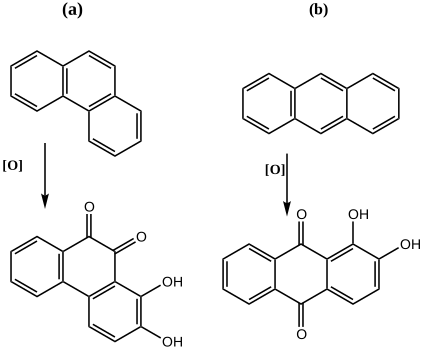
Alan told us how Graebe and Liebermann favoured structure (a), now known as phenanthrene, rather than (b), which we recognize as anthracene. A full story is told in this PhD thesis, written in 1919 and published in 1921[3] and I can only tell a tiny bit of it here. Essentially (a) was preferred over (b) because the former could sustain three aromatic (benzene-like) rings, whereas the latter only two (p 3 of the thesis above). Years later in 1972, this concept emerged as the Clar π-sextet rule, but the idea was already more than 100 years old by then! And indeed thermodynamically, phenanthrene is more stable than anthracene. By 1872, circumstantial evidence was accumulating that in fact alizarin was derived from (b), largely via attempts to synthesize the molecule by various reactions. These often were performed at high temperatures (red-hot tubes), and we now know that many complex rearrangements can occur at such temperatures. In 1889[4], Armstrong was quoting the structure of anthracene with no doubts about its structure. However, it took another 30 years or so for an entirely unambiguous total synthesis of anthracene to be devised.[3] Also around that time the first structures based on crystallography were emerging (by William Bragg) that supported this hypothesis. Even so, the first modern crystal structure had to wait until 1950.[5]
We learn from this story that many chemical structures established during the 19th century were largely based on (admittedly a large) body of circumstantial evidence. A wonderful example of how a systematic rather than a circumstantial proof of the structure of naphthalene was established using chemical synthesis and degradations alone can be found here in the work by Armstrong. Evidence obtained from instruments was largely restricted to techniques such as thermochemistry and polarimetry in the 19th century and for the first twenty years of the 20th to e.g. infra-red spectroscopy.[6] It is remarkable then that actually, most 19th century structures have stood the test of time. Moreover, not knowing the precise structure did not prevent the processes for making them to be patented. Nowadays of course, a simple crystal structure can often be solved in a few minutes and NMR spectroscopy takes a similar amount of time. We are no longer used to waiting for years or indeed decades for structural proof!
‡This synthesis proved to be very expensive (requiring a step using bromine and then a second step to remove it). But shortly after, a much more efficient synthesis which dispensed with the bromine brought the cost of the dye down dramatically. The madder industry never really recovered from this blow.
References
- C. Graebe, and C. Liebermann, "Ueber künstliche Bildung von Alizarin", Berichte der deutschen chemischen Gesellschaft, vol. 2, pp. 14-14, 1869. https://doi.org/10.1002/cber.18690020106
- C. Graebe, and C. Liebermann, "Ueber künstliches Alizarin", Berichte der deutschen chemischen Gesellschaft, vol. 2, pp. 332-334, 1869. https://doi.org/10.1002/cber.186900201141
- C.W. Colver, and W.A. Noyes, "SYNTHESIS OF ANTHRACENE<sup>1</sup> FROM NAPHTHALENE.", Journal of the American Chemical Society, vol. 43, pp. 898-905, 1921. https://doi.org/10.1021/ja01437a023
- "Proceedings of the Chemical Society, Vol. 6, No. 85", Proceedings of the Chemical Society (London), vol. 6, pp. 95, 1890. https://doi.org/10.1039/pl8900600095
- A. McL Mathieson, J.M. Robertson, and V.C. Sinclair, "The crystal and molecular structure of anthracene. I. X-ray measurements", Acta Crystallographica, vol. 3, pp. 245-250, 1950. https://doi.org/10.1107/s0365110x50000641
- W.W. Coblentz, "Infra-red Absorption Spectra: I. Gases", Physical Review (Series I), vol. 20, pp. 273-291, 1905. https://doi.org/10.1103/physrevseriesi.20.273
Tags:Alan Dronsfield, Alizarin, Anthraquinone dyes, Art materials, BASF, Carl Gräbe, Carl Graebe, Carl Liebermann, Carl Theodore Liebermann, Catechols, Colors, cryoEM MicroEM, Dihydroxyanthraquinones, Dye, Mauve, Mauveine, Rapid structure determination of microcrystalline molecular compounds, Royal Society of Chemistry, Shades of violet, William Bragg, William Perkin
Posted in Historical | 1 Comment »
Wednesday, April 13th, 2016
Publishing embargoes seem a relatively new phenomenon, probably starting in areas of science when the data produced for a scientific article was considered more valuable than the narrative of that article. However, the concept of the embargo seems to be spreading to cover other aspects of publishing, and I came across one recently which appears to take such embargoes into new and uncharted territory.
One example (there are many others) of embargoes continuing to operate in the era of open science and open data relates to crystallographically derived coordinates for macromolecules. Biomolecular structures are allowed to be embargoed for a maximum of one year before becoming openly available or “released” (considered a friendlier term than embargo). A more recent phenomenon is of embargoes on press releases which may be prepared by authors and or publishers to accompany the appearance of any article considered especially newsworthy. The publisher will then request that the press release is only released to coincide with the actual publication time and date of the article itself. Both of these types of embargo are more or less accepted by both parties. But in the last five years or so, new types of embargo have been introduced and it is these I want to discuss here.
- The self-archive or “green open access” version of an article, in the form of the last author version of an accepted manuscript prior to copy-editing and other operations by a publisher. Such Green OA versions are now a mandatory requirement from funders (in the UK), arising from the need to conduct a “REF” or research excellence framework assessment of all (UK) universities every seven years or so. In order to allow assessors and funding councils unencumbered access to these research outputs, the authors must self-archive their publications in a suitable institutional repository. In general therefore, there should always exist two versions of any scientific paper authored within these guidelines, the AV (author version) and VoR (Version of Record, held by the publisher, and carrying the guarantee of peer review). Publishers now embargo author versions until the VoR version has been published, and sometimes even up to 18 months beyond this period.
- The “supporting information” or SI embargo. This is closely related to the crystallographic data embargo noted above, but it applies in general to most other data and information associated with an article. Until very recently, most SI was in fact handled by the publisher themselves, and so it was released at the same time as the article. Since it is becoming more common to deposit data and SI in a separate repository, some publishers mandate that the release dates of this material must not precede the article itself. Deposition of such data has also become a mandatory requirement from (UK) funders since May 2015, and I have blogged about such “research data management” often here. In effect, both the scientific article and the data supporting it achieve their own DOIs or persistent digital identifiers, allowing easy and independent access to either the article OR its data. In fact, assigning such a DOI has a more subtle effect; creating a DOI means that metadata describing the object is also created and then aggregated by the agency issuing the DOI such as CrossRef and DataCite. Importantly, one should note that SI which is handled purely by the publisher will not have its own separate DOI and it will not have its own metadata. The data metadata for example can include the DOI for the article, and vice versa. I have shown examples of the utility of such metadata for data in an earlier post.
- So now we come to the most recent embargo, which has surfaced since around May 2015, as increasingly data has become a first class object in its own right with its own DOI and importantly its own metadata. There is now evidence that some publishers are requesting that this very metadata about data is also subjected to an embargo, not to be released before the article which makes use of that data is itself released. So data can be deposited in “dark form” prior to a publication, but the metadata (which carries the date stamp and provenance for the deposition) may have to be “dark” or embargoed. Actually, this is not yet very common; for example I asked the Royal Society of Chemistry what their policy was, with the reply “the Royal Society of Chemistry wouldn’t require metadata about the data files to be embargoed”.
We live in an era where the very careers of reseachers can be determined by their claim to priority about scientific discoveries. The date stamps for priority continue to be largely controlled and issued by publishers and some may decide that it will be in their business interests to extend their control to data. Perhaps they may even wish to control all aspects of publication including the data and its metadata, acting as self-proclaimed research facilitators.
At this moment, this has not happened; both data and its metadata can remain open and FAIR. Which is where I think we should go in the future in the interests of open science itself.
Tags:Academic publishing, Embargo, Open access, Publishing, Royal Society of Chemistry, Technology/Internet, Uncharted, Uncharted Territory
Posted in Chemical IT | No Comments »
Thursday, February 12th, 2015
The title of this post refers to the site http://howopenisit.org/ which is in effect a license scraper for journal articles. In the past 2-3 years in the UK, we have been able to make use of grants to our university to pay publishers to convert our publications into Open Access (also called GOLD). I thought I might check out a few of my recent publications to see what http://howopenisit.org/ makes of them.
This was catalysed by an article which revealed that UK universities spent £9M in 2014 on the purchase of such openness. One of the “challenges” identified is the difficulty in converting such payment into an article that actually is open. Apparently, publishers make not a few mistakes in their quality controls in ensuring it is so, relying on irate authors informing them of such mistakes. This can be quite tedious to do, and so a tool that largely automates this checking is most useful. So here we go.
- doi: 10.1039/C3SC53416B[1] This is a good start. The output looks like thus. Green is GOLD so to speak. Well done the Royal Society of Chemistry.

- doi: 10.1021/ci500302p[2] from the ACS this time. Pink, but at least free to read. Quite what that means is less certain. There is an adage, “the right to read means the right to mine” presumably means this article is OK to mine, but then why does it not say so?

- doi: 10.1002/anie.201405238[3]. Pink again, but the colour now simply means no information about the license could be obtained from the publisher (Wiley).

I ran a few more and sadly the third of the above, “no information” was the most common response. And the legal response is invariably that if no information can be obtained, the answer is NO, it is not free to read. In other words, not providing a license is just as bad as saying it’s not free to read.
Article aggregators such as Symplectic do not yet perform the service above (which to be fair is still in beta), and so I cannot yet check how many GOLD articles there are to my name. I think it should be about 8, and I might add that the time I have to spend in arranging for this to happen is not negligible. Hell, I could probably have found a few more reactions mechanism in the time I have spent on achieving GOLD. This is one of those topics which would be interesting to revisit say in five years time to see how the world has changed. So I leave this little time capsule and will update it then!
References
- A. Armstrong, R.A. Boto, P. Dingwall, J. Contreras-García, M.J. Harvey, N.J. Mason, and H.S. Rzepa, "The Houk–List transition states for organocatalytic mechanisms revisited", Chem. Sci., vol. 5, pp. 2057-2071, 2014. https://doi.org/10.1039/c3sc53416b
- M.J. Harvey, N.J. Mason, and H.S. Rzepa, "Digital Data Repositories in Chemistry and Their Integration with Journals and Electronic Notebooks", Journal of Chemical Information and Modeling, vol. 54, pp. 2627-2635, 2014. https://doi.org/10.1021/ci500302p
- A. Jana, I. Omlor, V. Huch, H.S. Rzepa, and D. Scheschkewitz, "N‐Heterocyclic Carbene Coordinated Neutral and Cationic Heavier Cyclopropylidenes", Angewandte Chemie International Edition, vol. 53, pp. 9953-9956, 2014. https://doi.org/10.1002/anie.201405238
Tags:ACS, GBP, Royal Society of Chemistry, United Kingdom
Posted in Chemical IT, General | No Comments »
Wednesday, November 12th, 2014
In London, one has the pleasures of attending occasional one day meetings at the Burlington House, home of the Royal Society of Chemistry. On November 5th this year, there was an excellent meeting on the topic of Challenges in Catalysis, and you can see the speakers and (some of) their slides here. One talk on the topic of Direct amide formation – the issues, the art, the industrial application by Dave Jackson caught my interest. He asked whether an amide could be formed directly from a carboxylic acid and an amine without the intervention of an explicit catalyst. The answer involved noting that the carboxylic acid was itself a catalyst in the process, and a full mechanistic exploration of this aspect can be found in an article published in collaboration with Andy Whiting’s group at Durham.[1] My after-thoughts in the pub centered around the recollection that I had written some blog posts about the reaction between hydroxylamine and propanone. Might there be any similarity between the two mechanisms?
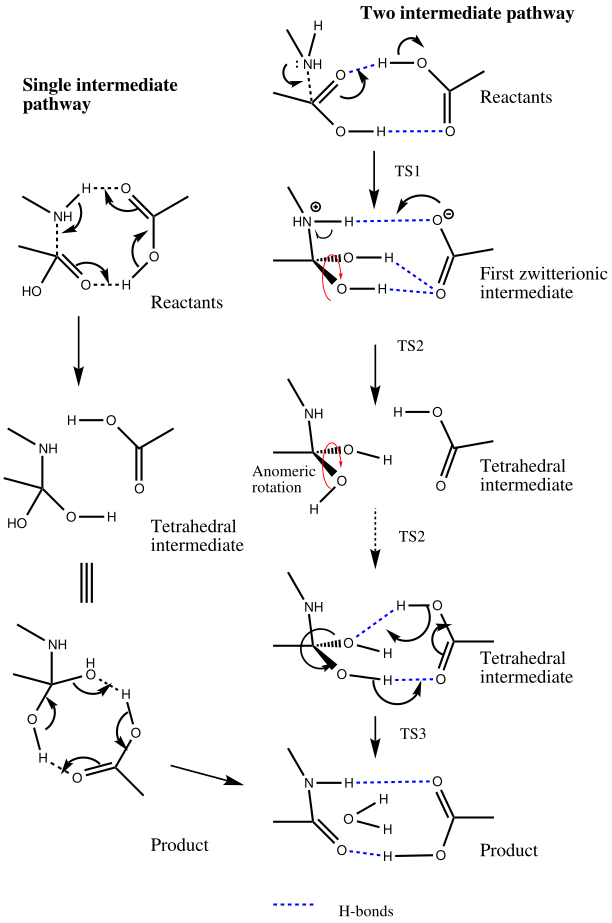
That mechanism can be represented as above, which (as per the hydroxylamine mechanism) comprises three transition states and two intermediates. The original study[1] reported just the one TS1. Editing out the starting coordinates from the PDF-based supporting information (the process is not always easy) enabled an IRC (intrinsic reaction coordinate) for TS1 to be easily computed.[2]

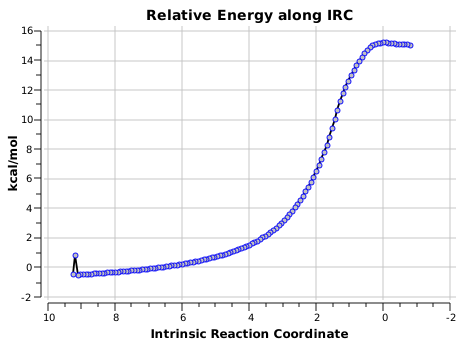
This reveals that TS1 is not the complete story, there is still much of the reaction left to complete. The energy profile is charted (using the ωB97XD/6-311G(d,p/SCRF=p-xylene method) according to the scheme above as reactants ⇒ TS1 ⇒ Intermediate 1 ⇒ TS2 ⇒ Tetrahedral intermediate ⇒ TS3 ⇒ products. Computed properties for this more detailed pathway are transcluded here from the digital repository[3] and appear at the end of this post.
- TS1 yields what might be called a zwitterionic intermediate. However, this has a relatively small dipole moment (5.7D). Thus, against accepted wisdom, such apparently ionic intermediates CAN be involved in reactions occurring in non-polar solvents!
- TS2 is rather unexpected, involving synchronous proton transfer coupled to anomerically related C-OH bond rotation. This rotation changes the anomeric interactions with the adjacent substituents; in my experience I have never before seen a reaction mode quite like this one!
- TS3 collapses the tetrahedral intermediate by synchronous proton transfer and C-O bond cleavage, and is (in this model) the rate determining step. The free energy barrier corresponds to a half-life at 298K of about half an hour.
- The product is calculated as exoenergic with respect to reactants,; the reaction does drive to form an amide (and any catalysis of course will not influence that final outcome, only its kinetics).
If you read the original article[1] you will realise the above only scratches the surface of the many fascinating properties of this apparently very simple reaction. Thus, not addressed above is why amides are only formed in certain solvents (xylene for example) but not others. The solvent may have a specific role to play which is not modelled simply by its continuum dielectric or its boiling point. There is much else that could be said.
References
- H. Charville, D.A. Jackson, G. Hodges, A. Whiting, and M.R. Wilson, "The Uncatalyzed Direct Amide Formation Reaction – Mechanism Studies and the Key Role of Carboxylic Acid H‐Bonding", European Journal of Organic Chemistry, vol. 2011, pp. 5981-5990, 2011. https://doi.org/10.1002/ejoc.201100714
- H.S. Rzepa, "C21H21NO4", 2014. https://doi.org/10.14469/ch/74636
- H.S. Rzepa, "A computed mechanistic pathway for the formation of an amide from an acid and an amine in non-polar solution.", 2014. https://doi.org/10.6084/m9.figshare.1235300
Tags:Andy Whiting, Dave Jackson, dielectric, Durham, energy profile, free energy barrier, London, non-polar solution, PDF, Royal Society of Chemistry
Posted in reaction mechanism | 6 Comments »
Friday, July 8th, 2011
As a personal retrospective of my use of computers (in chemistry), the Macintosh plays a subtle role.
- 1985: In the previous part, I noted how the Corvus Concept computer introduced a network hard drive (these still being too expensive for any one individual to afford one); the same principle applied to the 1985 Macintosh but now relating to the remarkable introduction of the laser printer. Until then, us chemists had used french curves (see previous post for an explanation), stencils or transfer lettering. It could be really tedious preparing a complex manuscript. Indeed, in some published articles of the time, one often saw hand-drawn chemical diagrams! So when the Macs arrived in 1985 (and it has to be said the associated rise of ChemDraw at that time), it became imperative to network them so that everyone could have access to that precious laser printer (I still remember its network name, selected using the aptly named Chooser utility). Fortunately, the Mac came with a network port (unless I am mistaken, this was not an invariable feature of the IBM PC of the period). The network was created using a router (the first time I had come across one of these) from the Webster corporation in Australia, and our local electrician and his colleagues suddenly found themselves putting in Appletalk cables everywhere. The poor chemists in the department not only had to get used to the mouse pointing device and unfloppy floppy disks, but to the idea of selecting network devices.
- 1987:We also acquired a Microvax with an Evans and Sutherland PS390 stereographics device at this time (more of which later in another post), and this came with an interesting bonus. Haggling had managed to leave about £25K left over, which I decided to spend on a “grown up proper network”. This took the form of a thickwire ethernet of about 400m length. This stretched from the Microvax to the main college hub and thence the outside world (the “Internet”) and also to the close-by new network distribution cabinet where one end of the Fibre optic cable was terminated (a bonus of all this was a Pirelli calendar, yet another story that must wait to be told). The fibre was strung to a catenary connecting to our other building (the idea being that it should be immune to lightening strikes. I had earlier explored the idea of a copper cable routed through tunnels connecting the two chemistry buildings, and spent a most interesting day down in those tunnels exploring. Therein lies yet another story for another day). Anyway, we now had a 10 megabit network (1000 times faster than the old PADs, which were still around) and this was connected to the Webster multigate routers (there were two of them now, one for each building). Our Macs all had the Internet!
Apple, bless their hearts, distributed a control panel called MacTCP, and after I figured out what it all meant (network masks, Class C subnets and the like) I let everyone know that another network device had been added to join the laserprinter. Few IBM PC owners could boast this. At this stage, in truth, there was not that much people could connect to. Using MacTelnet, we could indeed access CAS Online, and print the search to a laserprinter. Using MacFTP, we could get files remotely from other FTP servers, and we started to acquire coordinate files for our molecular modelling. This in turn brought the realisation that the existing formats (Brookhaven protein databank files were the most common at the time) were not ideally suited for the purpose, and this could be seen as another spark for the CML (XML) work that started about nine years later. I also remember discovering that Apple computer ran their own FTP server, where I could download the latest operating system disk images (Systems 5-7 as I recollect were obtained from this site ). Things were free (but not always that easy) in those days. Our Macs ended up have the latest OS on them (in other words, they tended to crash a little less) almost as soon as it was released (and the Mac app store™, with its impending 4.6 Gbyte of OS X Lion about to be downloaded is merely the latest example of this).
- 1987: Armed with all this experience, I was also asked to serve a two year stint on the editorial advisory board of the Royal Society of Chemistry. At the time, what is now called supporting information was just starting, and of course it was going to be in print only. I suggested that perhaps the RSC should plan for the day when it could be online instead (the term online was not, I think, in that common use then, and electronic journals were also not yet common). I was still not happy that the only way to access that information would have to be FTP file transfers, but then little did I realise then that Tim Berners-Lee at CERN already had a glimmer in his eye.
- 1988: The network on the Macs became a little more useful in this year, when a Macintosh email client called Eudora was released (in truth, I had already sent my first email in 1976, from CMU in Pittsburgh whilst on a visit there, to the person standing next to me!). The Microvax alluded to above provided the mail relay, and a few brave individuals started sending email (not that many people had email addresses in those days mind you). The RSC was still grappling with this. I remember putting my email address at the top of an article submitted to them, and the copy-editor deleted it from the proofs as “unrecognised address form“. I re-instated it, they deleted it again. After some telephone negotiation, it remained (although the RSC assured me it would confuse the journal readers mightily). For the record, if you do manage to find it, it no longer works (being something like rzepa@vaxa.ch.ic.ac.uk. We were still learning how to do things properly then).
- 1989: I managed to convince the department that it would be useful to use computers for undergraduate teaching, and we opened a computer room with 12 Macs. I maintained them using a wonderful network utility called RevRDist for Mac, which cloned a master Mac onto the 12 clients, and made the task of adding new software very easy. There was always lots of good software for Macs in those early days. But to introduce students to how to use them, I did feel impelled to produce a 4 page printed handout explaining it all. And I only did this once a year. Clearly again, the need to manage this better must have been in my mind.
This post focuses on a very short period, because I wanted to get across how (in my mind at least) chemistry became globally networked for the (chemical) masses (or at least those with Apple Macintosh computers!), and the role the laserprinter Pippa played in this development.
Tags:Apple computer, Appletalk, Australia, chemical, copy-editor, ethernet, Eudora, Fibre optic, GBP, hand-drawn chemical diagrams, Historical, IBM, laser printer, Mac OS X, Macintosh, megabit network, mouse pointing device, multigate routers, operating system, Pirelli, Pittsburgh, proper network, Royal Society of Chemistry, stereographics device, telephone negotiation, Tim Berners-Lee, Webster multigate routers, XML
Posted in Chemical IT | 3 Comments »


