Posts Tagged ‘Michael Dewar’

Open Access journal publishing debates – the elephant in the room?

Sunday, November 4th, 2018

For perhaps ten years now, the future of scientific publishing has been hotly debated. The traditional models are often thought to be badly broken, although convergence to a consensus of what a better model should be is not apparently close. But to my mind, much of this debate seems to miss one important point, how to publish data.

Thus, at one extreme is COAlition S, a model which promotes the key principle that “after 1 January 2020 scientific publications on the results from research funded by public grants provided by national and European research councils and funding bodies, must be published in compliant Open Access Journals or on compliant Open Access Platforms.” This includes ten principles, one of which “The ‘hybrid’ model of publishing is not compliant with the above principles” has revealed some strong dissent, as seen at forbetterscience.com/2018/09/11/response-to-plan-s-from-academic-researchers-unethical-too-risky I should explain that hybrid journals are those where the business model includes both institutional closed-access to the journal via a subscription charge paid by the library, coupled with the option for individual authors to purchase an Open Access release of an article so that it sits outside the subscription. The dissenters argue that non-OA and hybrid journals include many traditional ones, which especially in chemistry are regarded as those with the best impact factors and very much as the journals to publish in to maximise both the readership, hence the impact of the research and thus researcher’s career prospects. Thus many (not all) of the American Chemical Society (ACS) and Royal Society of Chemistry (RSC) journals currently fall into this category, as well as commercial publishers of journals such as Nature, Nature Chemistry,Science, Angew. Chemie, etc. 

So the debate is whether funded top ranking research in chemistry should in future always appear in non-hybrid OA journals (where the cost of publication is borne by article processing charges, or APCs) or in traditional subscription journals where the costs are borne by those institutions that can afford the subscription charges, but of course also limit the access.  A measure of how important and topical the debate is that there is even now a movie devoted to the topic which makes the point of how profitable commercial scientific publishing now is and hence how much resource is being diverted into these profit margins at the expense of funding basic science.

None of these debates however really takes a close look at the nature of the modern research paper. In chemistry at least, the evolution of such articles in the last 20 years (~ corresponding to the online era) has meant that whilst the size of the average article has remained static at around 10 “pages” (in quotes because of course the “page” is one of those legacy concepts related to print), another much newer component known as “Supporting information” or SI has ballooned to absurd sizes. It can reach 1000 pages[1] and there are rumours of even larger SIs. The content of SI is of course mostly data. The size is often because the data is present in visual form (think spectra). As visual information, it is not easily “inter-operable” or “accessible”. Nor is it “findable” until commercial abstracting agencies chose to index it. Searches of such indexed data are most certainly “closed” (again depending on institutional purchases of access) and not “open access”. You may recognise these attributes as those of FAIR (Findable, accessible, inter-operable and re-usable). So even if an article in chemistry is published in pure OA form, in order to get FAIR access to the data associated with the article, you will probably have to go to a non-OA resource run by a commercial organisation for profit. Thus a 10 page article might itself be OA, but the full potential of its 1000+ page data (an elephant if ever there was one) ends up being very much not OA.

You might argue that the 1000+ pages of data does not require the services of an abstracting agency to be useful. Surely a human can get all the information they want from inspecting a visual spectrum? Here I raise the future prospects of AI (artificial intelligence). The ~1000 page SI I noted above[1] includes e.g NMR spectra for around 70 compounds (I tried to count them all visually, but could not be certain I found them all). A machine, trained to identify spectra from associated metadata (a feature of FAIR), could extract vastly more information than a human could from FAIR raw data (a spectrum is already processed data, with implied information/data loss) in a given time. And for many articles, not just one. Thus FAIR data is very much targeted not only at humans but at the AI-trained machines of the future.

So I again repeat my assertion that focussing on whether an article is OA or not and whether publishing in hybrid journals is to be allowed or not by funders is missing that 100-fold bigger elephant in the room. For me, a publishing model that is fit for the future should include as a top priority a declaration of whether the data associated with it is FAIR. Thus in the Plan-S ten principles, FAIR is not mentioned at all. Only when FAIR-enabled data becomes part of the debates can we truly say that the article and its data are on its way to being properly open access.


The FAIR concept did not originally differentiate between processed data (i.e. spectra) and the underlying primary or raw data on which the processed data is based. Our own implementation of FAIR data includes both types of data; raw for machine reprocessing if required, and processed data for human interpretation. Along with a rich set of metadata, itself often created using carefully designed workflows conducted by machines.

The proportion of articles relating to chemistry which do not include some form of SI is probably low. These would include articles which simply provide a new model or interpretation of previously published data, reporting no new data of their own. A famous historical example is Michael Dewar’s re-interpretation of the structure of stipitatic acid[2] which founded the new area of non-benzenoid aromaticity.

References

  1. J.M. Lopchuk, K. Fjelbye, Y. Kawamata, L.R. Malins, C. Pan, R. Gianatassio, J. Wang, L. Prieto, J. Bradow, T.A. Brandt, M.R. Collins, J. Elleraas, J. Ewanicki, W. Farrell, O.O. Fadeyi, G.M. Gallego, J.J. Mousseau, R. Oliver, N.W. Sach, J.K. Smith, J.E. Spangler, H. Zhu, J. Zhu, and P.S. Baran, "Strain-Release Heteroatom Functionalization: Development, Scope, and Stereospecificity", Journal of the American Chemical Society, vol. 139, pp. 3209-3226, 2017. https://doi.org/10.1021/jacs.6b13229
  2. M.J.S. DEWAR, "Structure of Stipitatic Acid", Nature, vol. 155, pp. 50-51, 1945. https://doi.org/10.1038/155050b0

George Olah and the norbornyl cation.

Friday, March 10th, 2017

George Olah passed away on March 8th. He was part of the generation of scientists in the post-war 1950s who had access to chemical instrumentation that truly revolutionised chemistry. In particular he showed how the then newly available NMR spectroscopy illuminated structures of cations in solvents such “Magic acid“. The obituaries will probably mention his famous “feud” with H. C. Brown over the structure of the norbornyl cation (X=CH2+), implicated in the mechanism of many a solvolysis reaction that characterised the golden period of physical organic chemistry just before and after WWII. 

The dispute between Olah and Brown was not played on a pitch using quite the same goal posts. Olah did much of his work in magic acid and Brown did his in aqueous solutions. I was involved in a tiny way when the discussion about the precise character of the norbornyl cation was reaching its peak in the mid 1970s. At the time, I was working with Michael Dewar, who was himself not shy in joining in the fun and sometimes very acrimonious disputes at conferences. We contributed by calculating the so-called core-electron carbon ESCA spectrum.[1] History records that we came down on the wrong side, by suggesting that this form of spectroscopy supported Brown rather than Winstein/Olah on the basis of a 6:1 spectral deconvolution (classical) rather than 5:2 (non-classical). More recently of course the crystal structure of the parent cation itself has been shown to be non-classical[2] (there are other crystal structures which differ in respect to having one or more additional methyl groups[3]). For a 3D model of norbornyl cation, see DOI: 10.5517/CCZ21LN. This still leaves the issue (very slightly) open for the structure of the solvated cation when formed in water! 

When I started to teach a course in molecular modelling, I touched briefly on how modelling could contribute and whilst updating the notes in the 1990s, wondered why the boron analogue had never been so studied (X=BH2). Unlike the crystallographically difficult norbornyl ion-pair, the iso-electronic boron species would be neutral and not need a counter-ion. Perhaps it might be a more manageable molecule? Checking the Cambridge structural database, such a species has never been reported! So here as my homage to Olah, I report its calculated structure (b2plypd3/Def2-TZVPP, DOI: 10.14469/hpc/2236).

The norbornyl cation has symmetrical C-C bridging distances of ~1.80±0.02Å and a basal C-C distance of ~1.39±0.02Å. The calculated values for the boron equivalent are 2.16Å and 1.36Å respectively, with all positive force constants. B-C bonds are normally 1.66-1.72Å, significantly longer than C-C bonds, which makes the longer B-C lengths in this example unsurprising. More interestingly, the species has one vibrational normal mode (ν 203 cm-1) which corresponds to the [1,2] shift of the BHgroup across the basal C-C. For a classical species, this vibrational motion would correspond to a transition state (an imaginary vibration) but for a non-classical species it is of course real. In this sense it is analogous to the so-called real Kekulé mode in non-classical benzene, which “equilibrates” the two classical Kekulé structures. The corresponding calculated vibration for the norbornyl cation itself is ν 194 cm-1 (DOI: 10.14469/hpc/2238).

Of course, the entire controversy over the structure of this species is littered with comparisons between not quite similar systems, differing in a methyl group more or less. So morphing a C+ to a B might be seen as quite a large change. But perhaps if it had been crystallised in say the 1960s, would the subsequent debates have taken a different turn?


We were also wrong about the symmetry of the Diels-Alder cyclisation, which is nowadays accepted to be synchronous rather than asynchronous for simple  Diels-Alder reactions. But that is another story.

GAXLIA is perhaps the closest analogue.[4],

References

  1. M.J.S. Dewar, R.C. Haddon, A. Komornicki, and H. Rzepa, "Ground states of molecules. 34. MINDO/3 calculations for nonclassical ions", Journal of the American Chemical Society, vol. 99, pp. 377-385, 1977. https://doi.org/10.1021/ja00444a012
  2. F. Scholz, D. Himmel, F.W. Heinemann, P.V.R. Schleyer, K. Meyer, and I. Krossing, "Crystal Structure Determination of the Nonclassical 2-Norbornyl Cation", Science, vol. 341, pp. 62-64, 2013. http://dx.doi.org/10.1126/science.1238849
  3. T. Laube, "Redetermination of the Crystal Structure of the 1,2,4,7‐<i>anti</i>‐tetramethylbicyclo[2.2.1]heptan‐2‐yl cation at 110 K", Helvetica Chimica Acta, vol. 77, pp. 943-956, 1994. https://doi.org/10.1002/hlca.19940770407
  4. P.J. Fagan, E.G. Burns, and J.C. Calabrese, "Synthesis of boroles and their use in low-temperature Diels-Alder reactions with unactivated alkenes", Journal of the American Chemical Society, vol. 110, pp. 2979-2981, 1988. https://doi.org/10.1021/ja00217a053

Why diphenyl peroxide does not exist.

Monday, April 29th, 2013

A few posts back, I explored the “benzidine rearrangement” of diphenyl hydrazine. This reaction requires diprotonation to proceed readily, but we then discovered that replacing one NH by an O as in N,O-diphenyl hydroxylamine required only monoprotonation to undergo an equivalent facile rearrangement. So replacing both NHs by O to form diphenyl peroxide (Ph-O-O-Ph) completes this homologous series. I had speculated that PhNHOPh might exist if all traces of catalytic acid were removed, but could the same be done to PhOOPh? Not if it continues the trend and requires no prior protonation at all!

PhOOPh

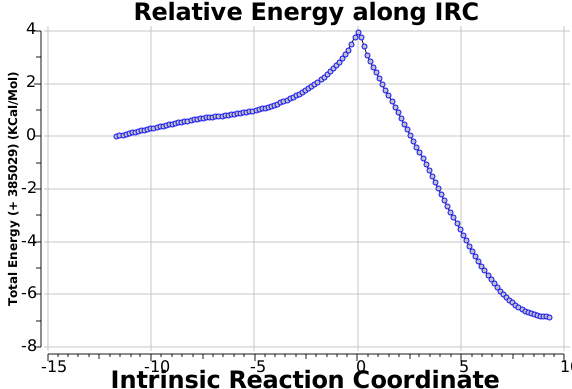
Here is the results of a ωB97XD/6-311G(d,p)/SCRF=water calculation. Now I should explain that the conventional explanation for the non-existence of PhOOPh is that the O-O bond homolyses very readily to form phenoxy radicals[1]. But of course other peroxides such as t-Bu-O-O-t-Bu do exist (although they are rather fragile) and so the phenyl analogue is clearly special.

PhOOPh  PhOOPha1 
 PhOOPh2 PhOOPha1 

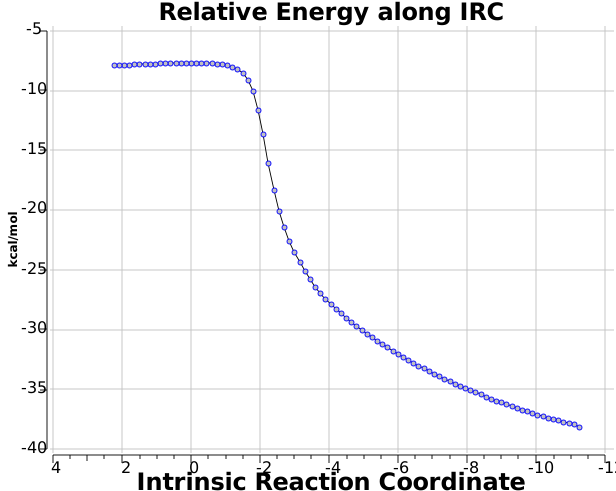
You will notice from the IRC profiles shown above that even without any prior protonation, the barrier to O-O cleavage is really very small (~ 4 kcal/mol). But the method I have used to calculate this is a closed shell DFT procedure. This does not allow the formation of the (open shell) biradical that two phenoxy radicals would represent. The barrier is low even without the formation of phenoxy radicals! Of course, as with the two previous examples, the actual initial product formed is the π-complex as first suggested by Michael Dewar. The wavefunction of such a species requires special treatment, since it is best described as a linear combination of two closed-shell configurations, what is called a multi-configuration or multi-reference wavefunction. So the single-configuration closed shell calculation that the above IRC represents must be an upper bound to a proper description of the energy transition state. In other words, if the description is improved, the barrier can only get even lower! 

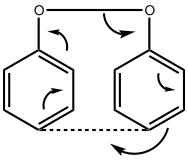
Notice in the above that the π-complex formed in the first stage (of two) is actually lower in energy than the diphenyl peroxide itself, and that the barrier for this π-complex to then collapse to form the C-C bond between the two 4-positions is also tiny. This π-complex in other words is very transient indeed, probably not surviving for even one molecular vibration. To all intents and purposes, this really is a concerted [5,5] sigmatropic shift, as shown in the schematic at the top of this post. But the bottom line is that the homolysis argument need not be the only one (although it  is not necessarily incorrect). One can just as readily explain why PhOOPh does not exist by invoking facile formation of Dewar-like π-complex instead.


Another deceptively simple little molecule that requires such a treatment is C2, the topic of much recent debate![2], [3]

References

  1. R. Benassi, U. Folli, S. Sbardellati, and F. Taddei, "Conformational properties and homolytic bond cleavage of organic peroxides. I. An empirical approach based upon molecular mechanics and <i>ab initio</i> calculations", Journal of Computational Chemistry, vol. 14, pp. 379-391, 1993. https://doi.org/10.1002/jcc.540140402
  2. S. Shaik, H.S. Rzepa, and R. Hoffmann, "One Molecule, Two Atoms, Three Views, Four Bonds?", Angewandte Chemie International Edition, vol. 52, pp. 3020-3033, 2013. https://doi.org/10.1002/anie.201208206
  3. J.M. Matxain, F. Ruipérez, I. Infante, X. Lopez, J.M. Ugalde, G. Merino, and M. Piris, "Communication: Chemical bonding in carbon dimer isovalent series from the natural orbital functional theory perspective", The Journal of Chemical Physics, vol. 138, 2013. https://doi.org/10.1063/1.4802585

Aromaticity in the benzidine-like π-complex formed from PhNHOPh.

Saturday, January 19th, 2013

The transient π-complex formed during the “[5,5]” sigmatropic rearrangement of protonated N,O-diphenyl hydroxylamine can be (formally) represented as below, namely the interaction of a six-π-electron aromatic ring (the phenoxide anion 2) with a four-π-electron phenyl dication-anion pair 1. Can one analyse this interaction in terms of aromaticity?

pi-complex1

I showed previously that the interaction between these two components involves the stabilising overlap (donation) of a filled orbital on 2 with an empty (acceptor) orbital on the dication-anion pair 1. So what does the interaction of a six-electron (and hence 4n+2 Hückel aromatic) donor ring with a four-electron (and hence formally a Hückel anti-aromatic) acceptor ring lead to? To find out, I carried out a QTAIM analysis of the ring- and bond-critical points in the topology of the computed electron density of complex, and then evaluated the NICS (nucleus-independent-chemical shift) NMR probe at these points. First, the QTAIM analysis. Green=bond critical points, red=ring and blue=cage.

pi-QTAIM

The NMR analysis (ωB97XD/6-311G(d,p)/SCRF=water) is shown below. This is for a closed shell wavefunction, which does not include contributions from any open shell biradical singlet.

Click for  3D.

Click for 3D.

  1. This is the ring centroid of the phenoxide anion 2, and would normally be expected to show a highly diatropic NICS value indicative of ring aromaticity. The value computed for the complex is -0.9 ppm, which is not aromatic!
  2. This is the ring centroid of the (nominally) antiaromatic 1, and has a value of -5.9 (mildly aromatic; benzene itself on this scale is about -10 ppm). Neither ring is behaving as might be indicated they should prior to their forming the π-complex.
  3. The remaining points all lie in plane between the two rings; they are unique to the π-complex itself. Point # 3 has a NICS of -14.0 ppm; it is ~located at the centroid of the C=O and C=N bonds.
  4. This point has NICS -17.1 ppm, being the most highly diatropic of the seven computed.
  5. This, -12.1, and
  6. the next -13.2 are ring points lying between the 3,3′ carbons of either ring.
  7. This point is the (defining) centroid of the whole complex and has NICS -15.7 ppm.

This reveals that neither individual ring of the complex sustains a a diatropic ring current, but that the region between the two rings, one that defines the π-complex itself, is very highly diatropic. The most simple way of looking at it is that the two rings coming together has created an aromatic complex (I remind again that this is in the closed-shell picture of this system, allowing partial biradical character may influence this). To illustrate this holistic aspect, I show below the most stable of the π-MOs (this MO in fact resembles to remarkable degree the lowest π-MO of ferrocene  which can be used to illustrate the 18-electron filled shells of the iron at the centre).  in fact this is one of seven π-MOs that can be identified, making the system a 14 (certainly 10)-π-electron aromatic (the extra electrons come from the oxygen of 2 and the C=N region of 1).

Click for  3D.

Click for 3D.

It is most amusing (which is how Michael Dewar might have stated it) that such an unpretentious molecule as PhNHOPh could reveal such surprises. It is also noteworthy that Dewar championed the concept of using aromaticity to determine selection rules for pericyclic reactions, and so he would perhaps have appreciated that the π-complex he suggested for the benzidine pericyclic rearrangement might have its own unique aromatic character.

The π-complex in the benzidine rearrangement: a molecular orbital analysis.

Friday, January 18th, 2013

Michael Dewar[1] famously implicated a so-called π-complex in the benzidine rearrangement, back in the days when quantum mechanical calculations could not yet provide a quantitatively accurate reality check. Because this π-complex actually remains a relatively unusual species to encounter in day-to-day chemistry, I thought I would try to show in a simple way how it forms.

pi-complex

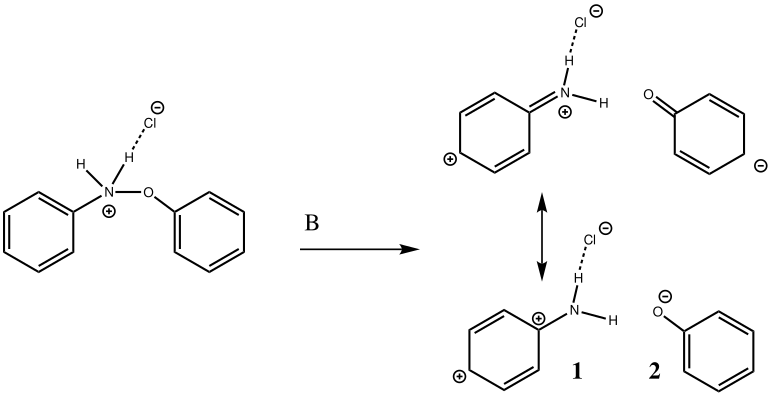
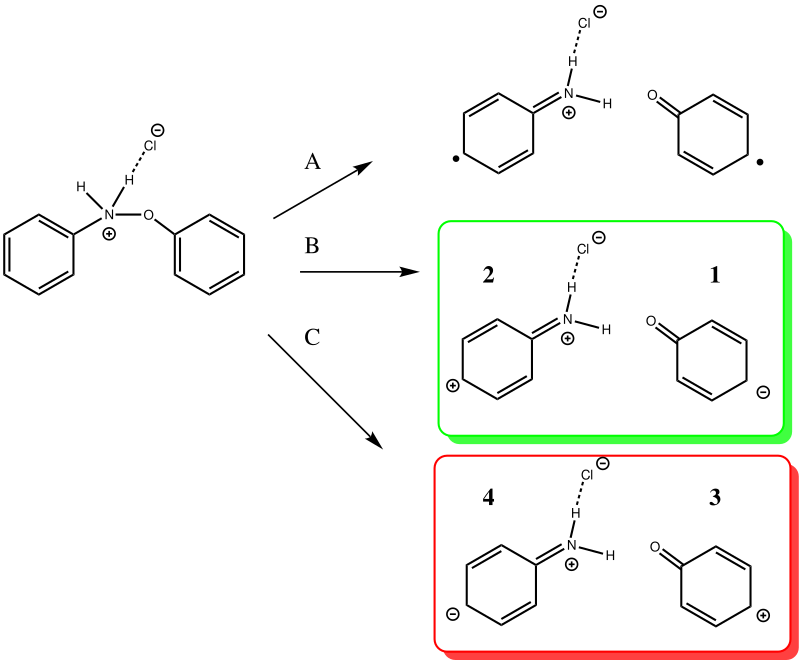
I am actually illustrating it with the benzidine rearrangement of monoprotonated PhNHOPh, which I dealt with in the previous post, if only because the energy of this π-complex relative to monoprotonated PhNHOPh is amazingly low (in other words, it is not one of these high energy molecules which only exist in the virtual world of computational modelling). The mechanism can be conceptually broken down to considering how the N-O bond can be cleaved in one of three ways. Route A is the homolytic route to give a 4-biradical (in one of the possible resonance forms), which of course can couple to form a 4,4′-biphenyl. Route B is a heterolytic route in which the two electrons from the N-O σ-bond are retained by 1, whilst for route C this electron pair is retained by 4.

These two fragments can then interact in several ways to form the π-complex.  Here I will illustrate just the two closed shell options (B/C), whilst recognising that there may also be contribution from the open shell biradical (in water as solvent, the two ionic configurations are clearly going to be stabilised by solvation and so may contribute relatively more than the non-polar radical-pair ).

  1. Route B (green), overlapping the HOMO of 1 with the LUMO of 2 to create a new π-MO to be occupied by the two electrons extracted from the N-O σ-bond (a similar promotion of a σ- to a π-pair was noted in this post).
  2. Route C (red), overlapping the HOMO of 4 with the LUMO of 3 to achieve the same result.
Route B
HOMO for 5,5 benzidine rearrangement. Click for 3D.

LUMO of 2. Click for 3D.

HOMO for 5,5 benzidine rearrangement. Click for 3D.

HOMO for π-complex. Click for 3D.

HOMO for π-complex. Click for 3D.

HOMO of 1. Click for 3D.

Route C
HOMO for 5,5 benzidine rearrangement. Click for 3D.

LUMO of 3. Click for 3D.

HOMO for 5,5 benzidine rearrangement. Click for 3D.

HOMO for π-complex. Click for 3D.

HOMO for π-complex. Click for 3D.

HOMO of 4. Click for 3D.

The relative weight of these two combinations is largely determined by the difference in energies between the two HOMO/LUMO pairs and their overlap. ΔE is different for the two combinations, being 0.021 Hartree (route B) and 0.091 (route C), with lower being better.

The overlap of the HOMO/LUMO (in either orbital combination) is almost perfect for the face-to-face π-stacking of the complex. Note that this π-π-stacked arrangement in effect returns some electrons to the N-O region, in what is now called σ-π conjugation, and which used to be called hyperconjugation (it also resembles the conjugation of a Si-C bond with a phenyl ring in the Wheland intermediate).

References

  1. M. Dewar, and H. McNicoll, "Mechanism of the benzidine rearrangement", Tetrahedron Letters, vol. 1, pp. 22-23, 1959. https://doi.org/10.1016/s0040-4039(01)82765-9

The Benzidine rearrangement. Computed kinetic isotope effects.

Friday, January 11th, 2013

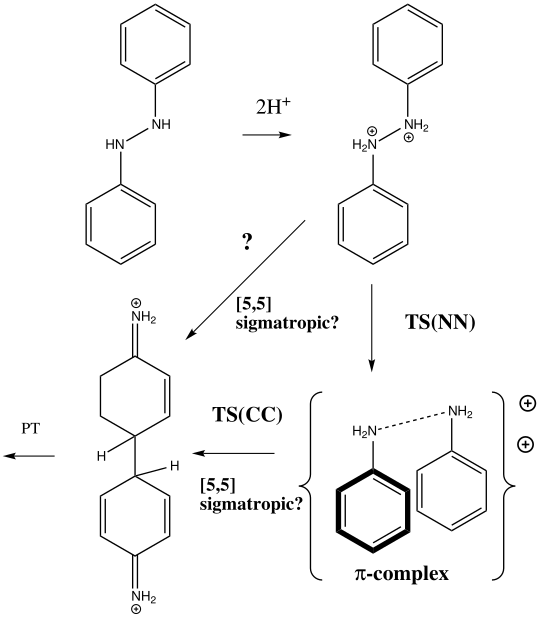
Kinetic isotope effects have become something of a lost art when it comes to exploring reaction mechanisms. But in their heyday they were absolutely critical for establishing the mechanism of the benzidine rearrangement[1]. This classic mechanism proceeds via bisprotonation of diphenyl hydrazine, but what happens next was the crux. Does this species rearrange directly to the C-C coupled intermediate (a concerted [5,5] sigmatropic reaction) or does it instead form a π-complex, as famously first suggested by Michael Dewar[2] [via TS(NN] and only then in a second step [via TS(CC)] form the C-C bond? Here I explore the isotope effects measured and calculated for this exact system.

benzidine-KIE

It boils down to the following. It was supposed that if the mechanism was a concerted [5,5] sigmatropic shift, then both the N-N and the C-C bonds would be breaking/forming at the transition state and both N and C isotope effects would be expected. However, if a π-complex were formed, then either TS(NN) OR TS(CC) would be the rate determining step, and so either a NN OR a CC isotope effect should manifest, but not BOTH. The experiment carried out by Henry Shine and colleagues was thus expected to be the definitive one.[3] The results (in aqueous ethanol, at 273K) revealed the following: k(2H/1H) = 0.962, k(14C/12C) = 1.013, k(13C/13C) = 1.013, k(15N/14N) = 1.041. This might have appeared to prove conclusively that the reaction was concerted, involving both the C-C and N-N bonds; in other words a [5,5] sigmatropic rearrangement.

The quantum mechanical (closed shell) surface reveals only two separate transition states, TS(NN) and TS(CC), and so at first sight seems to contradict the experimental isotope inference. But the experimental values are very unlikely to be wrong. So how can one reconcile these two methods? Well, the answer is not to give up, but to calculate the isotope effects for BOTH transition states, and see if either of them matches the experimental result. Here are these calculations:

TS k(2H/1H) k(14C/12C) k(13C/13C) k(15N/14N)
CC  0.946  1.050  1.050  1.032
NN  1.002  1.008  1.007  1.075
Expt  0.962  1.013  1.013  1.041

The match between experiment and theory for TS(CC) is reasonable (given the approximations in both the theory and the difficulty of the experiments and ensuring isotopic purities) but not so for TS(NN). But TS(CC) is a “stepwise-concerted” reaction as a closed shell singlet; as shown in the  IRC computed from TS(CC). 

Yamabe and co[4] have come to similar conclusions (their model used a dication rather than an ion-pair). In the latest twist, Ghigo et al[5] used the same model as here (HCl to provide protonation as an ion-pair) but identified biradical (radical-cation) character at the transition state. The latter group also calculated kinetic isotope effects[6] for the open shell biradical TS, finding an even better match with experiment than above.

So this see-saw mechanism has oscillated between a stepwise π-complex, then a direct [5,5] rearrangement and in more recent times using computational modelling, a concerted [5,5] sigmatropic proceeding via an initially formed π-complex, and (finally) via a multi-step mechanism proceeding through a biradical π-complex and involving radical coupling, which nevertheless appears to behave in some aspects as a concerted [5,5] rearrangement. It is fascinating that a simple diprotonation of a hydrazine could so readily induce biradical character, and that such an apparently simple reaction could have so many twists and turns!


For one 14C-12C pair.

References

  1. H.J. Shine, H. Zmuda, K.H. Park, H. Kwart, A.G. Horgan, and M. Brechbiel, "Benzidine rearrangements. 16. The use of heavy-atom kinetic isotope effects in solving the mechanism of the acid-catalyzed rearrangement of hydrazobenzene. The concerted pathway to benzidine and the nonconcerted pathway to diphenyline", Journal of the American Chemical Society, vol. 104, pp. 2501-2509, 1982. https://doi.org/10.1021/ja00373a028
  2. M. Dewar, and H. McNicoll, "Mechanism of the benzidine rearrangement", Tetrahedron Letters, vol. 1, pp. 22-23, 1959. https://doi.org/10.1016/s0040-4039(01)82765-9
  3. W. Subotkowski, L. Kupczyk-Subotkowska, and H.J. Shine, "The benzidine and diphenyline rearrangements revisited. 1-14C and 1,1'-13C2 kinetic isotope effects, transition state differences, and coupled motion in a 10-atom sigmatropic rearrangement", Journal of the American Chemical Society, vol. 115, pp. 5073-5076, 1993. https://doi.org/10.1021/ja00065a018
  4. S. Yamabe, H. Nakata, and S. Yamazaki, "π Complexes in benzidine rearrangement", Organic & Biomolecular Chemistry, vol. 7, pp. 4631, 2009. https://doi.org/10.1039/b909313c
  5. G. Ghigo, A. Maranzana, and G. Tonachini, "A change from stepwise to concerted mechanism in the acid-catalysed benzidine rearrangement: a theoretical study", Tetrahedron, vol. 68, pp. 2161-2165, 2012. https://doi.org/10.1016/j.tet.2012.01.014
  6. G. Ghigo, S. Osella, A. Maranzana, and G. Tonachini, "The Mechanism of the Acid‐Catalyzed Benzidine Rearrangement of Hydrazobenzene: A Theoretical Study", European Journal of Organic Chemistry, vol. 2011, pp. 2326-2333, 2011. https://doi.org/10.1002/ejoc.201001636

Computers 1967-2011: a personal perspective. Part 1. 1967-1985.

Thursday, July 7th, 2011

Computers and I go back a while (44 years to be precise), and it struck me (with some horror) that I have been around them for ~62% of the modern computing era (Babbage notwithstanding, ~1940 is normally taken as the start of the modern computing era). So indulge me whilst I record this perspective from the viewpoint of the computers I have used over this 62% of the computing era.

  1. 1967: I encountered (but that term has to be qualified) my first computer, suggested to me as an alternative to running quarter marathons on Wimbledon common at school by an obviously enlightened teacher! I wrote a program (in Algol) on paper tape, put the tape in an envelope, and sent it off to Imperial College (by van) to run, on an IBM 7094. A week later, printed output showed you had made a mistake on line 1 of the program. As I recollect, after about eight weeks of this, I got the program to run (and calculated π to 5 decimal places).
  2. 1970: By now I was a student (again at Imperial College), and was introduced to Fortran, then a radical new innovation to a chemistry degree. The delightfully named pufft compiler combined with the 7094 again, but this time with punched Holerith cards as input and line printer output. I cannot remember what we were asked to program. I do remember that the punched cards were produced by a pool of punch card operators, working from code pages written by the programmer. Some students (not me!) thought it great fun to give their Fortran variables naughty names (which the punch card operators then refused to punch, thus causing the student to fail the course!).
  3. 1971: I really liked this programming lark, so when instant-turnaround was introduced that year, I decided to do a proper program. It was called NLADAD (yes, I was no good at names, even then), which stood for non-linear-analysis of donor-acceptor complexes. The idea was to take recorded NMR chemical shifts, and fit them to an equilibrium A+B ⇔ AB+B ⇔ AB2 using non-linear regression analysis. It must have been all of 200 lines of code (OK, I did not write the matrix inversion routine myself)! Instant turnaround was also great, you got to punch your own cards this time, and had the great excitement of feeding them into a card reader yourself. You then walked about 5 yards to the line printer and waited agog. No waiting one week, this was less than a minute. Or it would have been if the line printer did not paper-wreck every two minutes! (I might add that I have a dim recollection of a member of the computer centre staff standing by to recover these paper wrecks. He, by the way, is now the director of the ICT division here!).
  4. 1972: I am now doing a PhD (yes, boringly, yet again at Imperial College). I had found the one and only teletypewriter in the chemistry department. The crystallographers had secreted it away in their empire, but were very dismayed to find me occupying it constantly. Instant was now even more instant. I was now connecting to a time-sharing CDC 6400 computer, at the dazzling speed of 110 baud (or bytes per second). These were small bytes by the way, since the CDC used 6 bits per byte. The result was that one did everything in UPPER CASE, since a 6-bit byte only allows 64 characters! My (still Fortran) programs reached probably 1000 lines of code now, and I was engrossed in deriving non-linear analyses of steady state chemical kinetics (about four different kinds of rate equation as I recollect). Ah, the joys of covariance analysis, and propagation of errors (I was in a kinetics lab, and all the other students plotted graphs on graph paper, and if pressed, plotted gradients of graphs, the so-called Guggenheim plots. I thought this the dark ages, but no-one volunteered to join me in this single teletypewriter room. Not even the attractive girls in the group. I was the geek of my time, no doubt about that. My kinetic analysis did however have one upside. Its how I meet my wife to be a few years later!).
  5. 1974: PhD completed, I was now ready to go to Texas, where everything is bigger (and in terms of computers, slightly better, a CDC 6600 now and a 300 baud teletypewriter!). I had been computing now for seven years, and finally I actually got to SEE the device for the very first time. My mentor, Michael Dewar, had a sort of special relationship with the university. His students (and possibly only his students) were allowed to go into the depths of the machine room, where behind plate glass you could see the CDC 6600. I soon learnt how to get even closer. It was not particularly exciting however. I was more entranced with the CALCOMP flatbed plotter, which was located next to the 6600. Pictures at last (you probably do not want to know that to convert my kinetics in 4 above to pictures, I got quite expert in using a french curve. Look it up before you jump to conclusions). Part of the pact I negotiated was that I was only allowed into the inner sanctum at 03:00 in the morning (sic!). Still a geek then! Oddly, I was one of the few students in Dewar’s group using the CALCOMP, but at least we now had pictures of the molecules I was now calculating (using MINDO/3). To put the computing power into context, in 1975, Paul Weiner, another group member, announced that he had completed a full geometry optimisation of LSD, this having taken about 4 days to do on that over-worked 6600. The entire group went out to celebrate. Many pitchers of beer were drunk that nite.

    Computer graphics from 1976.

  6. 1977: Back to Imperial, where we might have also now had a CDC 6600. And a Tektronix terminal running at the dizzying (hardwired end-to-end) speed of 9600 baud. I learnt to Word process on this device (using a word processor, written in Fortran, although not by me) and I wrote three review articles by this means, using a fancy phototypesetter as the printer. My next program, STEK, probably ran to about 5000 lines of code, and it persuaded the Tektronix to plot all sorts of things, ball&stick diagrams, isometric potential surfaces, molecular orbitals, and the like (and jumping ahead, my experience with this program eventually led to CML, and Peter Murray-Rust, but that is indeed jumping ahead). I think I also managed to gain access to the Imperial machine room, that inner sanctum, yet again. But for reasons I will not go into, it was not as interesting as the Texan machine room.

    Chemistry Computer graphics, circa 1977-85.

  7. 1979: I encountered a Cray 1 computer, and probably also 8-bit bytes (and yes, lower case printer outputs) for the first time at the University of London Computing Centre.
  8. 1980: Remember that teletypewriter, encountered earlier. Well these were now running at 2400 baud and I started to organise the deployment of a chemistry department computer network to sprinkle several such terminals around the department. The controller was a PAD, and in that year, we introduced STN ONLINE using this network. It was the first time we could search CAS online ourselves (previously, it was a service offered by the library). Literature searching has not been the same since.
  9. 1980: I finally again encountered a real computer, which one could happily listen to without creeping into machine rooms in the middle of the night. It was the data system on a Bruker Spectrospin 250 MHz superconducting NMR spectrometer. I had many adventures on this system. It was installed, by the way, on more or less the same day as the birth of my first daughter Joana. It had a hard drive (5 Mbytes as I recollect, and cost an absolute fortune, around £10,000 if I remember correctly).

    Combining Quantum mechanics and NMR.

    Computer graphics 1982, from NMR spectrometer.

  10. 1982: More networks, this time a curious computer known as the Corvus Concept, using a networked hard drive (possibly as big as 20 Mbytes by now), and a large screen.
  11. 1985: Enter the Mac (OK, the IBM PC came a little earlier, but it was not entrancing). Now one really had a tactile computer that made noises (not always nice), produced smoke signals occasionally, and ejected its floppy disk incessantly. Yet another revolution to cope with. As I type this, I look down on that Mac, which is still underneath my desk. Wonder if its worth anything on ebay?

Well, a second consecutive blog, with (almost) no pictures or molecules. And I have only gotten to the half way stage of my story. Better break off then.